Reading the Quran without wudu is one of the most asked fiqh questions among Muslims — from students memorizing daily to new converts building their practice. The short answer depends on how you’re engaging with the Quran and which state of impurity applies. Most articles give you one line and stop. This one covers every real scenario with the scholarly evidence behind each ruling.

What You’ll Learn in This Article
- Whether wudu is obligatory, recommended, or simply not required — depending on the scenario.
- The exact Quranic verse and Prophetic narrations scholars cite for the touching ruling — and what they actually say.
- How the four major madhabs differ on reciting vs. touching.
- The specific rulings for janabah, menstruation, and reading from a phone.
- A three-question decision framework so you always know where you stand.
Table of Contents
Can You Read the Quran Without Wudu?
Reading the Quran without wudu is not categorically forbidden. The ruling divides into two distinct categories in Islamic law: reciting the Quran (from memory or a screen) and physically touching a printed Mushaf. These carry different rulings, and conflating the two is the most common misunderstanding on this topic.
The scholarly consensus is that wudu is not obligatory for recitation alone — but it is strongly recommended as an act of respect. Touching the physical Mushaf, however, is governed by a direct Quranic statement and carries a stricter ruling.
The foundation of all purity rulings in Islamic law traces to a clear Quranic declaration about what Allah loves in His servants:
“إِنَّ اللَّهَ يُحِبُّ التَّوَّابِينَ وَيُحِبُّ الْمُتَطَهِّرِينَ”
“Indeed, Allah loves those who are constantly repentant and loves those who purify themselves.”— (Surah Al-Baqarah, 2:222)
The verb يُحِبُّ (yuhibbu — “loves”) is significant here. Purity is not presented merely as a legal precondition for ritual acts — it is presented as a quality Allah actively loves in His servants. Scholars of tafsir, including al-Tabari and Ibn Kathir, note that this verse encompasses both physical ritual purification and internal moral purification (tazkiyah).
This is precisely why all four madhabs recommend wudu before Quran recitation even where they do not require it: the ruling answers what is obligatory; this verse answers what Allah loves.
1. Reciting from Memory or a Screen Without Wudu
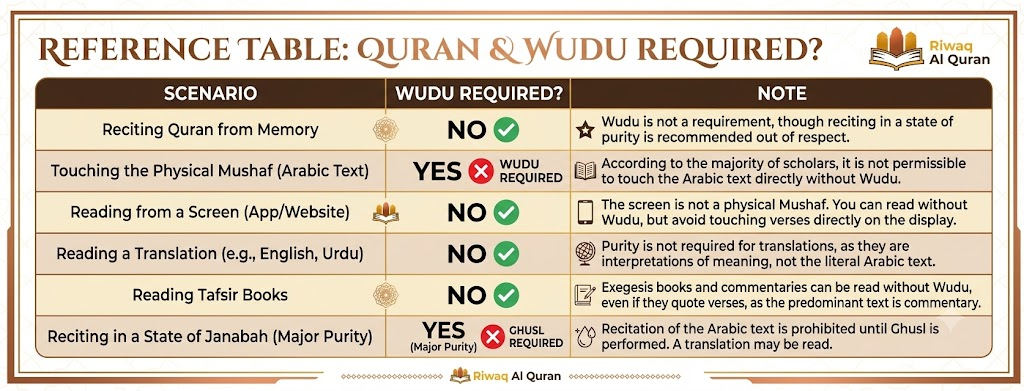
Reciting the Quran from memory without wudu is permissible according to all four major madhabs, provided you are not in a state of major ritual impurity (janabah). The madhabs’ positions differ in degree:
- Hanafi and Maliki schools: consider recitation without wudu makruh (disliked) — discouraged, not prohibited.
- Shafi’i and Hanbali schools: hold it permissible but suboptimal.
No authentic narration specifically prohibits recitation in a state of minor hadath (minor impurity). The Prophet ﷺ engaged in dhikr and verbal remembrance of Allah in various states throughout his life, and recitation in a state of minor impurity was not singled out for prohibition.
Interested in building a consistent daily recitation practice? Riwaq Al Quran’s Online Quran Recitation Course is taught by certified instructors and designed to strengthen your Tajweed from any level.
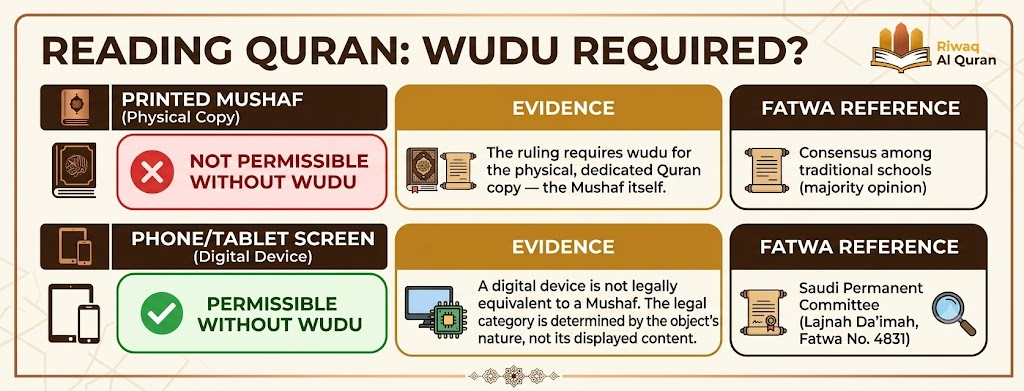
2. Reading from a Phone or Tablet Without Wudu
Reading the Quran on a phone or tablet screen without wudu is permissible. The Saudi Permanent Committee for Islamic Research and Fatwa (Lajnah Da’imah, Fatwa No. 4831) has ruled that a digital device is not legally equivalent to a Mushaf — it is not a book prepared specifically as a Quran copy — so the purity requirement for touching the Mushaf does not extend to it.
A common practitioner error:
Muslims often assume that because a phone displays Quranic text, it carries the same ruling as a printed Mushaf. In Islamic fiqh, legal categories are determined by the nature of the object, not the content it happens to display. The ruling requires wudu for the physical, dedicated Quran copy — not for every surface on which Quranic text appears.
Can You Touch the Quran Without Wudu?
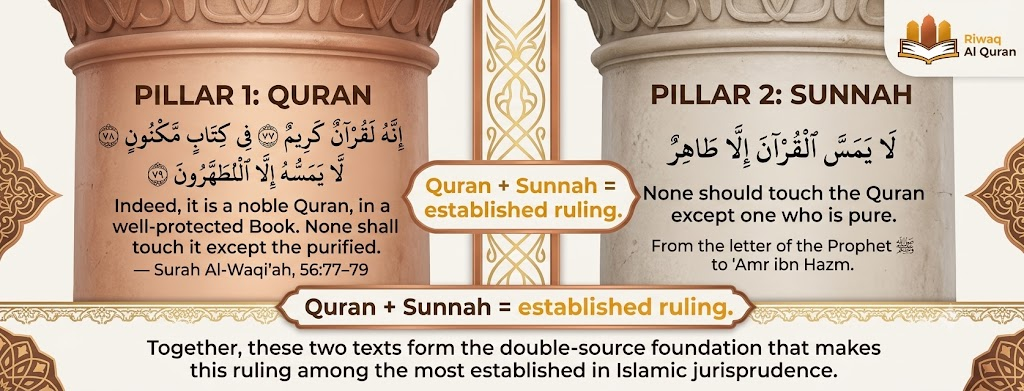
Touching the physical Mushaf without wudu is not permissible according to the majority of scholars across all four madhabs. The evidence rests on two sources: a direct Quranic statement and a Prophetic letter that has served as a cornerstone of Islamic legal discourse since the first century of Islam.
Allah says in Surah Al-Waqi’ah:
إِنَّهُ لَقُرْآنٌ كَرِيمٌ ﴿٧٧﴾ فِي كِتَابٍ مَّكْنُونٍ ﴿٧٨﴾ لَّا يَمَسُّهُ إِلَّا الْمُطَهَّرُونَ ﴿٧٩﴾
“Indeed, it is a noble Quran, in a well-protected Book. None shall touch it except the purified.”— Surah Al-Waqi’ah, 56:77–79
The word الْمُطَهَّرُونَ (al-mutahharoon — “the purified”) is the crux of the scholarly debate. The majority of jurists — Hanafi, Maliki, Shafi’i, and Hanbali — interpret this as referring to humans in a state of ritual purity, meaning those who have performed wudu. A minority opinion, adopted by Ibn Hazm, argues that the verse refers exclusively to the angels who carry the Preserved Tablet.
The majority rejects this reading because the verse contextually addresses the earthly Quran as interacted with by human beings, not an angelic realm inaccessible to them.
This verse is reinforced by a direct Prophetic ruling from a letter the Prophet ﷺ sent to the people of Yemen:
“لَا يَمَسَّ الْقُرْآنَ إِلَّا طَاهِرٌ”
“None should touch the Quran except one who is pure.”— From the letter of the Prophet ﷺ to ‘Amr ibn Hazm, recorded in Muwatta Imam Malik and authenticated by al-Hakim in Al-Mustadrak; also cited by Ibn Hajar al-‘Asqalani in Bulugh al-Maram.
The legal term طَاهِرٌ (tahir — “pure”) is interpreted by the majority to mean one holding ritual purity through wudu — not simply one who is physically clean. Al-Nawawi in Al-Majmu’ and Ibn Qudamah in Al-Mughni both rely on this narration alongside the Waqi’ah verse to establish the prohibition as binding.
Together, these two texts — one Quranic, one Prophetic — form the double-source foundation that makes this ruling among the most established in the chapter of purification.
Does This Ruling Extend to the Cover and Margins?
The madhabs differ here in a way that matters practically. The two most referenced positions are:
- Shafi’i school (strictest): touching the cover, binding, or margins of a Mushaf also requires wudu, as long as the volume is composed primarily of Quranic text.
- Hanafi school (more lenient): you may pick up a Mushaf by its cover or binding without wudu, but not the pages themselves.
Knowing which position applies in your madhab prevents both unintended violations and unnecessary hardship.
Can You Read the Quran in a State of Janabah?
No. Reciting the Quran in any form — from memory, from a Mushaf, or from a screen — is not permissible while in a state of janabah. This ruling is agreed upon by all four madhabs without exception.
What Janabah Is and How It Is Removed
Janabah is a state of major ritual impurity that occurs after sexual intercourse or ejaculation. It is removed only through ghusl (the complete ritual bath) — wudu alone is not sufficient. Until ghusl is performed, a person in this state may not:
- Pray
- Touch the physical Mushaf.
- Recite the Quran in any form — from memory, screen, or printed copy.
The primary evidence is reported by ‘Ali ibn Abi Talib (may Allah be pleased with him):
“كَانَ رَسُولُ اللَّهِ ﷺ يُقْرِئُنَا الْقُرْآنَ مَا لَمْ يَكُنْ جُنُبًا”
“The Messenger of Allah ﷺ used to teach us the Quran at all times, except when he was in a state of janabah.”— Bulugh al-Maram, Hadith 116 (Ibn Hajar al-‘Asqalani)
A parallel narration from the same companion clarifies the scope:
“The Messenger of Allah ﷺ used to come out of the toilet and recite the Quran with us, eat meat with us, and nothing prevented him from reciting the Quran — except janabah.”— Sunan Abi Dawud 229, graded sahih by al-Albani
Read together, these two narrations carry exceptional legal precision. The second hadith establishes what the Prophet ﷺ did not stop reciting for: using the restroom, eating, all ordinary daily activities. He suspended Quran recitation for one state only — janabah.
This is the basis on which scholars distinguish: minor impurity (minor hadath) does not prohibit recitation; major impurity (janabah) does. The restriction is narrow, specific, and deliberately bounded by these two narrations.
Building a consistent daily Quran practice — one that is not disrupted by gaps in purity — starts with memorization. Riwaq Al Quran’s Quran Memorization with Tajweed program pairs certified instructors with a structured hifz method that fits around any schedule.
Can a Woman Read the Quran During Menstruation?
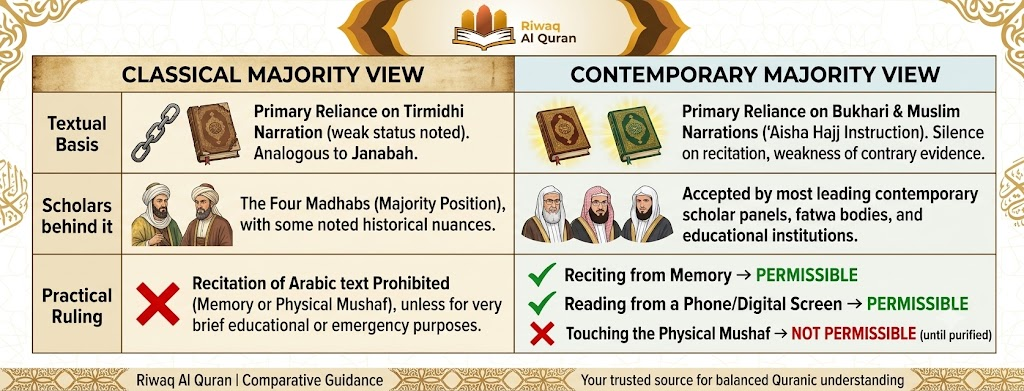
This is one of the most genuinely disputed questions in contemporary fiqh, and the answer differs meaningfully from the janabah ruling. The classical majority held that menstruation and nifas (postpartum bleeding) carry the same prohibition on recitation as janabah.
However, Sheikh al-Islam Ibn Taymiyyah and Ibn Hazm drew a critical distinction: janabah is a voluntary state removable at any time through ghusl; menstruation is involuntary and may last 5–10 days, making a blanket prohibition a hardship not clearly supported by specific authentic textual evidence.
1. The Prohibitive Hadith — Chain and Authenticity
The classical prohibition on recitation during menstruation rests on a narration from Ibn ‘Umar:
“Neither the menstruating woman nor the one in a state of janabah should recite anything from the Quran.”— Sunan al-Tirmidhi 131; Sunan Ibn Majah 595
Authenticity assessments from major hadith scholars:
- Al-Tirmidhi himself classified it as gharib (odd/isolated chain).
- Imam al-Bukhari considered the chain unreliable.
- Al-Albani graded it da’if (weak).
This weakness in the primary prohibitive text is the structural reason the dispute has persisted: had this narration been soundly authenticated, the disagreement would not carry the weight it does today.
2. The Authentic Narration Supporting Permissibility
When ‘Aisha (may Allah be pleased with her) began her menses during Hajj, the Prophet ﷺ instructed her:
“Do everything that a pilgrim does, except do not perform tawaf around the Ka’bah until you become pure.”— Sahih Bukhari 1650; Sahih Muslim 1211
This authentic narration is the textual cornerstone of the contemporary permissive view. The Prophet ﷺ listed tawaf — and only tawaf — as what a menstruating woman must avoid during Hajj. He did not mention Quran recitation. Hajj involves extensive recitation and supplication; if recitation were equally prohibited, he would have stated it explicitly.
The fact that he did not, combined with the weakness of the Tirmidhi narration, leads the contemporary majority to permit recitation from memory or a digital screen during menstruation.
The practical position accepted by most contemporary scholars:
- Reciting from memory → permissible.
- Reading from a phone or digital screen → permissible.
- Touching the physical Mushaf → not permissible until purified.
If you want to maintain a consistent daily practice through every part of your month — without depending on having a Mushaf in hand — memorization is the most reliable foundation.
Explore the full range of online Quran classes for adults and beginners at Riwaq Al Quran, or go straight to the structured memorization program guided by certified instructors.
Do You Need Wudu to Read a Quran Translation?
No. Reading a Quran translation without wudu is permissible. A translation is not the Quran in the legal sense — it is a scholarly rendering of the meanings of the Quran into another language. The purity requirement applies to the Arabic text of the Quran itself, not to its translations or tafsir books that quote from it.
This applies across the board:
- Any language translation (English, Urdu, French, etc.) can be read freely without wudu.
- Quran study books and exegesis volumes — even those that reproduce Quranic verses alongside commentary — carry no purity requirement.
- The same applies in states of janabah: a translation may be read where recitation of the Arabic text is prohibited.
Want to go deeper into the meanings of what you’re reading? Riwaq Al Quran’s Online Tafseer Course gives you structured access to Quranic meanings with certified guidance — no advanced Arabic required to start. For further reading, see: What does the Quran say about reading the Quran?
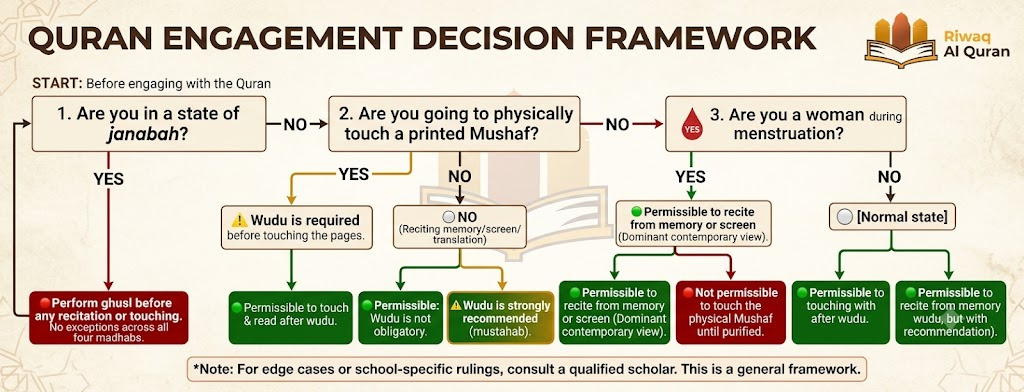
When Is Wudu Required? A Three-Question Decision Framework
Rather than tracking multiple rules separately, the three questions below resolve the vast majority of everyday situations Muslims face. Work through them in order before engaging with the Quran.
Question 1 — Are you in a state of janabah?
- Yes → Perform ghusl before any recitation or touching. No exceptions across all four madhabs.
- No → Proceed to Question 2.
Question 2 — Are you going to physically touch a printed Mushaf?
- Yes → Wudu is required before touching the pages.
- No (reciting from memory, reading from a screen, or reading a translation) → Wudu is not obligatory, though strongly recommended.
Question 3 — Are you a woman during menstruation?
- Reciting from memory or screen → Permissible per the dominant contemporary view.
- Touching the physical Mushaf → Not permissible until purified.
For edge cases or school-specific rulings, consult a qualified scholar.
Start Your Quran Journey with Certified Teachers — Book a Free Trial
Knowing the rulings is the first step. Building an actual practice — one that improves your recitation, deepens your understanding, and makes the Quran a daily anchor — takes consistent, expert-guided instruction.
Riwaq Al Quran is a comprehensive online platform offering personalized Quran, Arabic, and Islamic Studies classes for individuals of all ages and backgrounds. Experienced instructors use a structured curriculum covering Tajweed, Tafsir, and Memorization through advanced live sessions that allow seamless interaction between students and teachers — from anywhere in the world.
Watch how Riwaq Al Quran instructors approach Quranic recitation in live sessions:
Explore courses by your goal:
| Your Goal | Recommended Course |
|---|---|
| Master proper recitation | Online Quran Recitation Course |
| Memorize the Quran | Quran Memorization with Tajweed |
| Learn Tajweed rules | Online Tajweed Classes |
| Explore Qiraat styles | Online Qirat Course |
| Understand Quranic meaning | Online Tafseer Course |
| Start from the basics | Noorani Qaida Online |
| Kids — Quran foundation | Online Quran Classes for Kids |
| Learn Arabic | Online Arabic Courses |
| Obtain Ijazah | Online Ijazah Courses |
Every student begins with a free trial class — no commitment required.
See how students perform after training with Riwaq Al Quran’s certified instructors:
Conclusion
Reading the Quran without wudu follows a clear and consistent logic once you understand the categories:
- Recitation without touching the Mushaf requires no wudu — though it is recommended by all four madhabs.
- Touching the physical Mushaf requires wudu, established by Surah Al-Waqi’ah and the Prophetic letter to ‘Amr ibn Hazm.
- Janabah suspends all Quran engagement until ghusl is performed, confirmed by two authentic narrations from ‘Ali ibn Abi Talib.
- Reading a translation or tafsir carries no purity requirement at all.
- Menstruating women may recite from memory or a screen per the dominant contemporary view — the authentic Hajj narration and the weakness of the opposing hadith both support this position.
The underlying principle is consistent across all these rulings: the Quran deserves the highest degree of respect a Muslim can bring to it. Allah described Himself as loving those who purify themselves (Al-Baqarah 2:222). Performing wudu before any engagement with the Quran — even where it is not strictly obligatory — remains the practice scholars universally recommend, because it signals intentionality and honors the sanctity of the words of Allah.
Frequently Asked Questions
The questions below address the most common real-world scenarios Muslims face — including phone use, menstruation, and the difference between wudu and ghusl. Each answer reflects the dominant scholarly position alongside its textual basis.
Can you recite Quran without wudu?
Yes. You can recite the Quran from memory or from a screen without wudu. Wudu is not obligatory for recitation in a state of minor impurity, though all four madhabs consider it strongly recommended. The mandatory purity requirement applies to touching the physical Mushaf, and all recitation — in any form — is suspended during janabah until ghusl is performed.
Does breaking wudu mean you must stop reading the Quran?
If you are not holding a physical Mushaf, breaking wudu during recitation does not obligate you to stop. You may continue reciting from memory or from a screen. If you are holding a Mushaf, the majority position is to set it down and renew your wudu before continuing.
Can you read the Quran on your phone without wudu?
Yes. A phone or tablet is not legally classified as a Mushaf in Islamic fiqh, so the purity requirement for touching a printed Quran does not apply to digital devices. The Lajnah Da’imah (Saudi Permanent Committee, Fatwa No. 4831) has confirmed this position. Wudu remains recommended but is not obligatory. See also: Can I Listen to the Quran without Wudu?
Can a woman read the Quran on her period?
A menstruating woman may recite the Quran from memory or from a digital screen according to the view of Ibn Taymiyyah, adopted by the majority of contemporary scholars. The key evidence is the authentic Hajj narration (Sahih Bukhari 1650) in which the Prophet ﷺ prohibited only tawaf — not Quran recitation — during menstruation. She may not touch the physical Mushaf until she is purified.
Is wudu required to read a Quran translation or tafsir?
No. Wudu is not required to read a Quran translation, tafsir, or any commentary book — even those that reproduce Quranic verses in Arabic. The purity requirement applies to books prepared specifically as a Mushaf, not to scholarly works that quote from it.
What is the difference between wudu and ghusl for Quran reading?
Wudu (minor ritual purification — face, arms, head, and feet) removes minor impurity and is required before touching the physical Mushaf; it is also recommended before all recitation. Ghusl (the complete ritual bath) removes major impurity (janabah) and is a prerequisite for any form of Quran engagement — recitation, touching, or otherwise — before it can resume.
Sources
- Surah Al-Baqarah, 2:222 — Quranic basis for the love of purification.
- Surah Al-Waqi’ah, 56:77–79 — Primary Quranic text on touching the Quran.
- Muwatta Imam Malik — Letter of the Prophet ﷺ to ‘Amr ibn Hazm; authenticated by al-Hakim in Al-Mustadrak.
- Bulugh al-Maram, Hadith 116 — ‘Ali ibn Abi Talib on janabah and Quran teaching.
- Sunan Abi Dawud 229 — Nothing prevented the Prophet from reciting except janabah (graded sahih by al-Albani).
- Sunan al-Tirmidhi 131 — Ibn ‘Umar hadith on menstruation (classified da’if).
- Sunan Ibn Majah 595 — Parallel chain (graded da’if).
- Sahih Bukhari 1650 — The Prophet ﷺ instructs Aisha during Hajj.
- Sahih Muslim 1211 — Parallel narration of the Hajj ruling.
- Lajnah Da’imah Fatwa No. 4831 — Digital devices and the Mushaf ruling.
- Ibn Taymiyyah, Majmu’ al-Fatawa, Vol. 26 — Menstruation and Quran recitation.