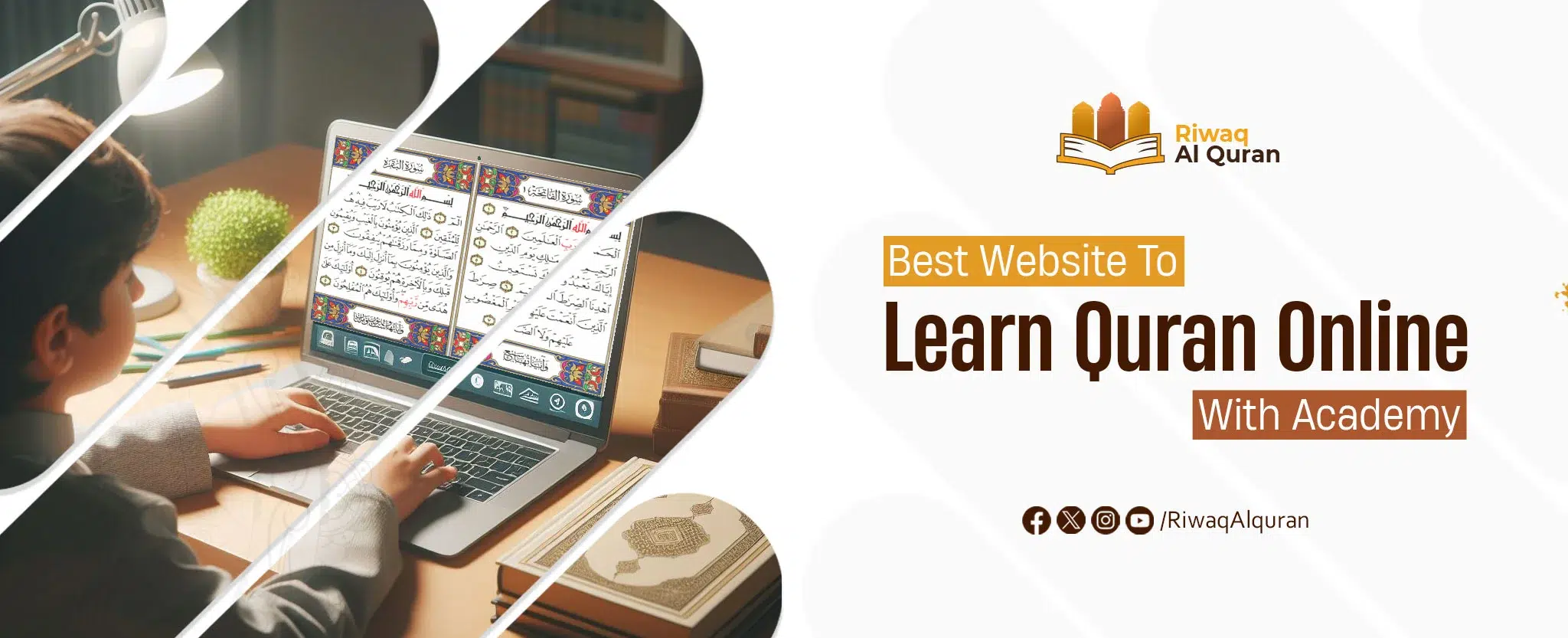
Choosing where to learn Quran online is not a small decision — it shapes how well you recite, how much you retain, and whether you stay consistent long enough to see real progress. Allah describes His Book with a promise that makes this search worthwhile:
“وَلَقَدْ يَسَّرْنَا الْقُرْآنَ لِلذِّكْرِ فَهَلْ مِن مُّدَّكِرٍ”
“And We have certainly made the Qur’an easy to remember — so is there anyone who will take heed?”(Surah Al-Qamar, 54:17)
This exact promise repeats four times across Surah Al-Qamar. That repetition is deliberate — the barrier to learning the Quran was never the text itself, but the method and teacher behind it.
Before comparing platforms, it’s worth understanding why this specific pursuit is treated differently in Islamic tradition — it explains why teacher quality matters so much more here than in an ordinary online course.
“حَدَّثَنَا عَنِ النَّبِيِّ صلى الله عليه وسلم أَنَّهُ قَالَ: “خَيْرُكُمْ مَنْ تَعَلَّمَ الْقُرْآنَ وَعَلَّمَهُ”
“The Prophet ﷺ said: “The best among you are those who learn the Qur’an and teach it.” (Sahih al-Bukhari 5027)
This hadith is narrated by Uthman ibn Affan and is agreed upon as authentic (sahih). It’s the reason Ijazah-certified teaching is treated as a distinct qualification in Quran academies rather than a marketing label — the act of teaching itself carries specific, named merit, which is also why verifying a teacher’s chain of certification is worth the extra step before enrolling.
What You’ll Learn in This Article
- What to check before enrolling in any online Quran academy, including red flags to avoid.
- A side-by-side comparison of the 10 leading platforms, including pricing.
- What authentic hadith say about the reward of learning, teaching, and reciting the Quran — even imperfectly.
- What proper Tajweed actually requires, with its Quranic basis.
- A full look at Riwaq Al-Quran’s own course catalog, for readers who want to go straight to enrolling.
- A simple checklist you can use to make your final decision.
Table of Contents
10 Best Websites to Learn Quran Online (Side-by-Side Comparison)
Each of the following platforms offers live, teacher-led Quran instruction. The differences that actually matter once you start comparing them show up in three places: how the curriculum is structured, what you can verify about the teachers, and how much the platform tells you upfront versus what you have to ask about directly.
1. Riwaq Al-Quran
Riwaq Al-Quran runs certified male and female teachers through a structured curriculum covering Tajweed, Hifz, Tafsir, and Qira’at, with a dedicated Quran LMS and mobile app for tracking progress.
Courses include Noorani Qaida, Quran recitation, memorization with Tajweed, Tafsir, the Ten Qira’at, Arabic for kids, and Islamic studies. Pricing starts at $32 per month for two 30-minute classes weekly, with a free trial lesson before enrollment.
Best for families who want progress tracking they can see themselves, rather than relying on a child’s account of the lesson. The free trial removes the biggest risk in this list — paying before you know if the teaching style fits.
Start with Riwaq Al-Quran’s free trial lesson — no payment required before you’ve seen the teaching style, met the instructor, and decided it’s the right fit for your child.
2. Quran Oasis
Quran Oasis focuses on Quranic Arabic, Tajweed, and Ijaza-track recitation, with tutors who adjust pacing for different age groups. Courses include recitation, Tajweed, the 10 Qiraat, memorization, Ijaza, Islamic studies, and Arabic language basics. Plans start at $38 per month for two 30-minute classes weekly.
Suitable for students specifically targeting an Ijaza (formal certification of their own recitation), since it’s listed as a distinct track rather than an add-on. If Ijaza is your goal, ask directly what the certifying chain looks like and how long the track typically takes before you enroll.
3. Quran Ayat
Quran Ayat structures its early lessons around interactive drills, which tends to suit younger or more easily distracted students better than lecture-style teaching. Courses include Quran reading, Noorani Qaida, recitation, Tajweed, memorization, and Ijazah. Pricing starts at $38 per month.
At a glance: best for younger kids who lose focus in a straight recitation-and-repeat format. Worth asking how the “interactive” element actually works on a video call — whether that means gamified exercises or simply shorter segments with more frequent teacher check-ins.
4. Firdaws Academy
Firdaws Academy lets students choose fully individual class scheduling rather than fixed weekly slots, which suits learners with irregular routines. Courses include a foundation course, recitation, memorization, Islamic studies, and Arabic language. Pricing starts at $38 per month.
Good for shift workers, students with exam schedules, or families across time zones who can’t commit to the same two slots every week. The tradeoff with fully flexible booking is usually teacher consistency — confirm whether you’ll keep the same instructor each session or rotate between available tutors.
5. Mishkah Academy
Mishkah Academy pairs Quran instruction with a dedicated Arabic-conversation track, making it a stronger fit for students who want spoken Arabic fluency alongside recitation. Courses include Quran classes for kids, Seerah, Fiqh, recitation, Arabic conversation, Arabic grammar, Modern Standard Arabic, and a course built specifically for new Muslim converts. Pricing starts at $35 per month.
New Muslims and Arabic learners who want religious and language study combined rather than as two separate subscriptions elsewhere. The dedicated new-convert course is unusual on this list and worth asking about if that applies to you.
If you want Islamic Studies and structured Quran learning in one place — without paying for two separate platforms — Riwaq Al-Quran covers both in a single, affordable plan. At $32/month, you get certified instructors, a dedicated LMS for tracking your child’s progress, and a free lesson before any commitment.

6. Itqan ElQuran Academy
Itqan ElQuran Academy places heavier emphasis on pronunciation correction within one-on-one sessions, which benefits students who have struggled with Tajweed elsewhere. Courses include Noorani Qaida, recitation, Quran for kids, the 10 Qira’at, memorization, Ijazah, Tafsir, Arabic language, and Islamic studies. Pricing starts at $40 per month.
This site is best students restarting after a bad experience with rushed or uncorrected recitation somewhere else. If that’s your situation, ask how the first session is structured — a good sign is a diagnostic assessment of your current pronunciation before jumping into new material.
7. BeIN Quran Academy
BeIN Quran Academy runs a more rigid, structured curriculum with less flexibility in pacing, which works well for students who want an academy to set the schedule for them. Courses include Tajweed-based recitation, Quran reading, memorization, kids’ classes, and a business Arabic course. Pricing starts at $40 per month.
Suitable for students who do better with an externally imposed structure than a self-paced one. The business Arabic course is a notable outlier on this list, aimed more at professional use than religious study.
8. Quran Spirit
Quran Spirit puts more emphasis on building a personal connection to the Quran before moving into technical recitation drills, which can help students who feel intimidated by formal instruction. Courses include Quran reading, memorization, Tafsir, Tajweed, and a dedicated kids’ track. Pricing starts at $40 per month.
Adult beginners who feel self-conscious about starting from zero will prefer it. The tradeoff to check for: confirm when Tajweed correction actually begins, since a slower on-ramp should not mean pronunciation errors go uncorrected for weeks.
9. Studio Arabiya Academy
Studio Arabiya Academy is built primarily around Arabic-language instruction, with Quran study offered as a companion track rather than the core focus. Courses include Arabic for kids, Classical Arabic, Madinah Arabic, Arabic reading for kids, and Quran for adults and kids. Pricing starts at $40 per month.
Good for students whose main goal is Arabic fluency, with Quran recitation as a secondary benefit. If Quran memorization is actually your priority rather than Arabic, confirm how much of the weekly class time is allocated to it versus language instruction before enrolling.
10. TarteeleQuran
TarteeleQuran centers its early curriculum on correct articulation before introducing memorization, which suits students who want a slower, accuracy-first start. Courses include Quran foundation (Qaida), Tajweed-based reading, memorization, and Islamic studies for kids. Pricing starts at $39 per month.
Best for students who would rather spend extra weeks on Qaida than move to memorization with shaky pronunciation. This is a deliberate tradeoff, not a slower academy — ask how the transition point from Qaida to memorization is decided so you know what “ready” looks like on this platform.
One Practical Note Before You Compare Prices Alone
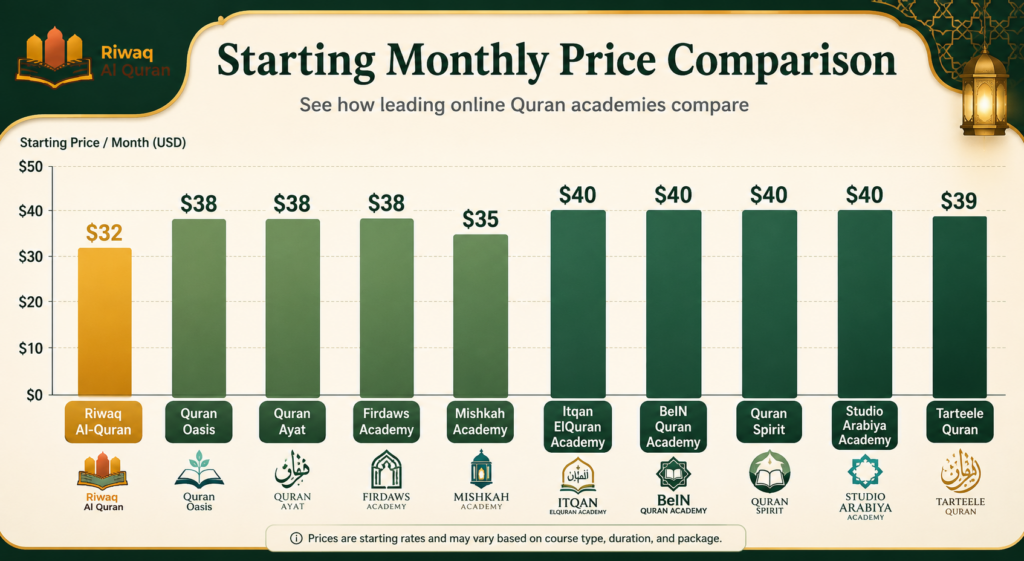
All ten platforms cluster within $8 of each other per month, so price is rarely the deciding factor once you look closely — the deciding factor is usually whether the platform’s structure matches how you or your child actually learn.
A rigid, teacher-led schedule (BeIN Quran Academy) suits a different learner than a flexible, self-paced one (Firdaws Academy), even at a nearly identical monthly cost.
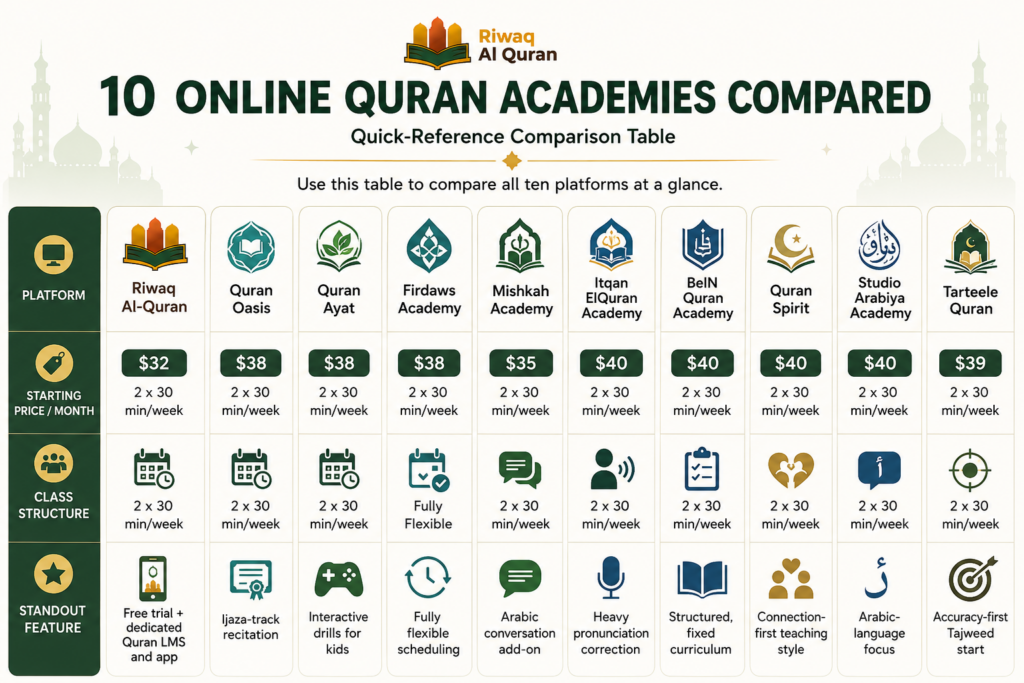
Quick-Reference Comparison Table
Use the table below to compare all ten platforms at a glance without re-reading the full breakdown above.
| Platform | Starting Price/Month | Class Structure | Standout Feature |
|---|---|---|---|
| Riwaq Al-Quran | $32 | 2 x 30 min/week | Free trial + dedicated Quran LMS and app |
| Quran Oasis | $38 | 2 x 30 min/week | Ijaza-track recitation |
| Quran Ayat | $38 | 2 x 30 min/week | Interactive drills for kids |
| Firdaws Academy | $38 | 2 x 30 min/week | Fully flexible scheduling |
| Mishkah Academy | $35 | 2 x 30 min/week | Arabic conversation add-on |
| Itqan ElQuran Academy | $40 | 2 x 30 min/week | Heavy pronunciation correction |
| BeIN Quran Academy | $40 | 2 x 30 min/week | Structured, fixed curriculum |
| Quran Spirit | $40 | 2 x 30 min/week | Connection-first teaching style |
| Studio Arabiya Academy | $40 | 2 x 30 min/week | Arabic-language focus |
| TarteeleQuran | $39 | 2 x 30 min/week | Accuracy-first Tajweed start |
Why Riwaq Al-Quran Stands Out Among Online Quran Academies
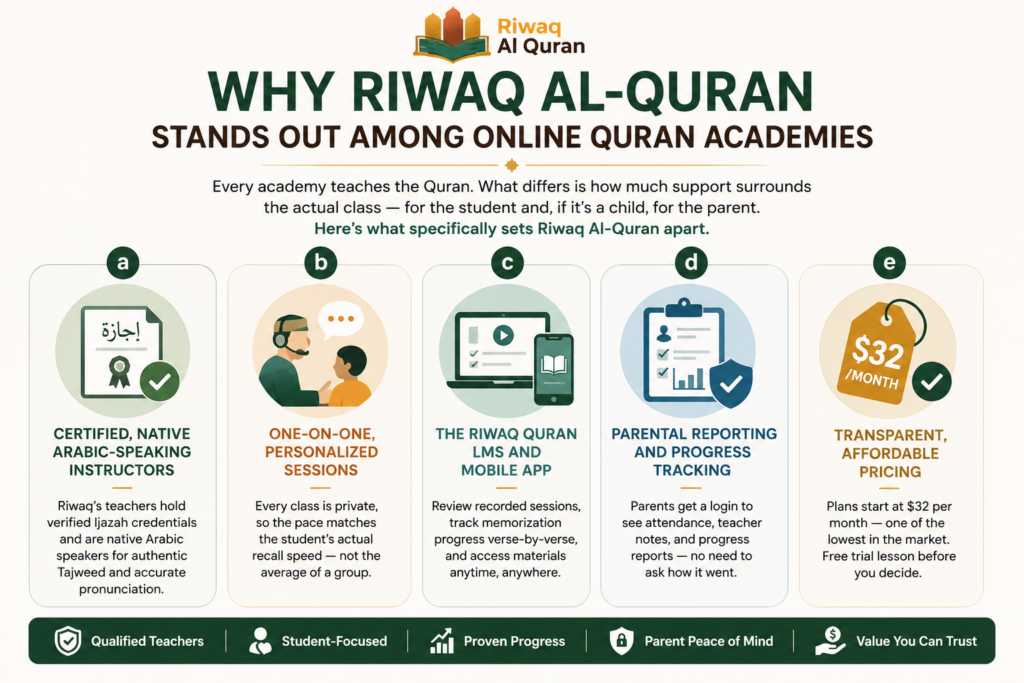
Every academy above teaches the Quran. What differs is how much support surrounds the actual class — for the student and, if it’s a child, for the parent watching from outside the lesson. The five points below (a through e) cover what specifically sets Riwaq Al-Quran apart.
Here’s a short look at what a live Tilawa session with Riwaq Al-Quran actually looks like:
a. Certified, Native Arabic-Speaking Instructors
Riwaq Al-Quran’s teachers hold verified Ijazah credentials and are native Arabic speakers, which matters directly for Tajweed — pronunciation is easier to correct when the teacher’s own articulation is the reference point, not an approximation.
b. One-on-One, Personalized Sessions
Every class is private, not group-based. That means the pace follows the student’s actual recall speed for memorization rather than an average across a class of five or six learners.
c. The Riwaq Quran LMS and Mobile App
Students and parents can review recorded sessions, see verse-by-verse memorization progress, and access lesson materials from the app between classes — useful for the daily practice that recitation skill actually depends on.
d. Parental Reporting and Progress Tracking
Parents get a login to see attendance, teacher notes, and progress reports directly, without needing to ask the child how the lesson went.
e. Transparent, Affordable Pricing
Plans start at $32 per month, at the lower end of the range covered in the comparison table above, with a free trial lesson before any payment is required.
If you want to see whether this fits your schedule and your child’s pace before committing to a monthly plan, a free trial class is the fastest way to find out.
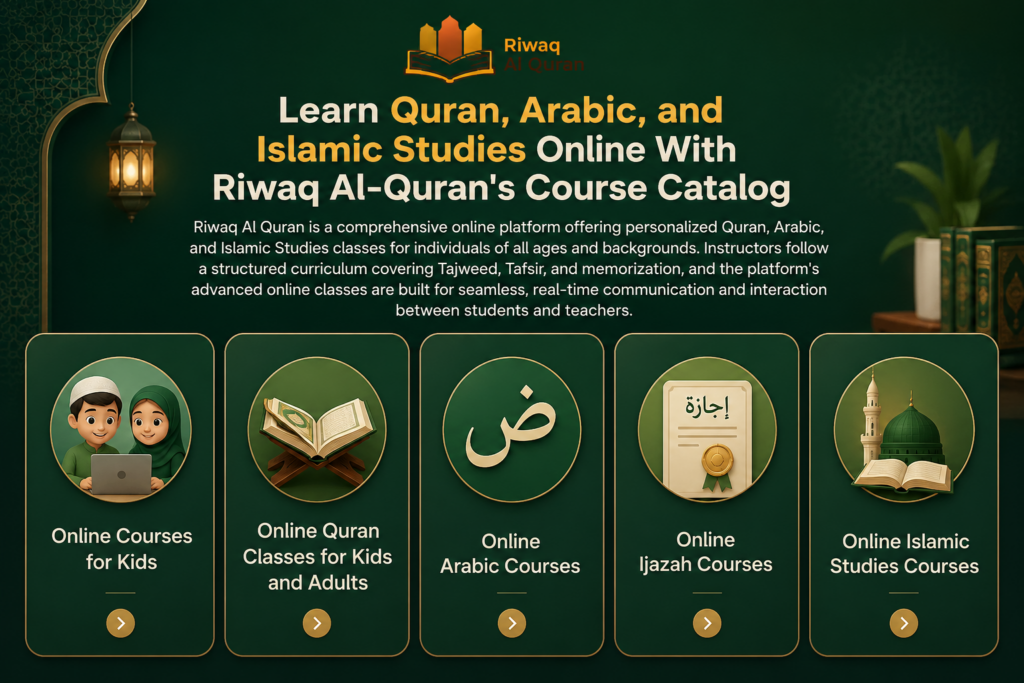
Learn Quran, Arabic, and Islamic Studies Online With Riwaq Al-Quran’s Course Catalog
Riwaq Al Quran is a comprehensive online platform offering personalized Quran, Arabic, and Islamic Studies classes for individuals of all ages and backgrounds. Instructors follow a structured curriculum covering Tajweed, Tafsir, and memorization, and the platform’s advanced online classes are built for seamless, real-time communication and interaction between students and teachers.
Below is Riwaq Al-Quran’s full course catalog, starting with the five main categories.
Course Categories at a Glance
- Online courses for kids
- Online Quran classes for kids and adults
- Online Arabic courses
- Online Ijazah courses
- Online Islamic Studies courses
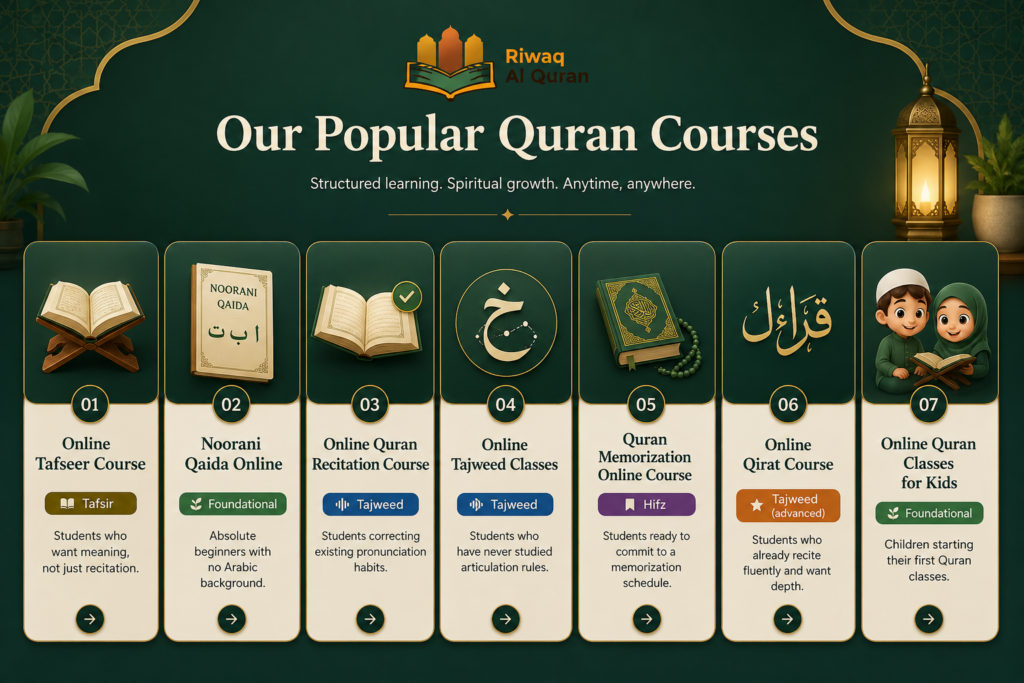
Here is a closer look at seven of the individual Quran courses within that catalog:
- Online Tafseer Course: Delve into Quranic meanings with Riwaq’s insightful online Tafseer course, designed to build real understanding of the text alongside correct recitation.
- Noorani Qaida Online: Learn Quranic basics efficiently through the Noorani Qaida online program — the recommended starting point for anyone with no prior Arabic reading experience.
- Online Quran Recitation Course: Enhance your recitation skills through the expert-led online recitation course, built around one-on-one correction rather than group instruction.
- Online Tajweed Classes: Master the rules of correct pronunciation in the online Tajweed classes, aimed at producing accurate, well-articulated recitation.
- Quran Memorization Online Course: Memorize the Quran with structure and accountability through the specialized online memorization course, which integrates Tajweed correction into the memorization process itself.
- Online Qirat Course: Explore the different recitation styles through the comprehensive online Qirat course, for students who want to go beyond a single reading tradition.
- Online Quran Classes for Kids: Nurture a love for the Quran early through interactive online classes for kids, designed around shorter attention spans and age-appropriate pacing.
Course Quick-Reference Table
For a faster overview, here is how these seven courses map to the three main learning tracks covered earlier in this article (Tajweed, Hifz, and Tafsir).
| Course | Primary Track | Best For |
|---|---|---|
| Online Tafseer Course | Tafsir | Students who want meaning, not just recitation. |
| Noorani Qaida Online | Foundational | Absolute beginners with no Arabic background. |
| Online Quran Recitation Course | Tajweed | Students correcting existing pronunciation habits. |
| Online Tajweed Classes | Tajweed | Students who have never studied articulation rules. |
| Quran Memorization Online Course | Hifz | Students ready to commit to a memorization schedule. |
| Online Qirat Course | Tajweed (advanced) | Students who already recite fluently and want depth. |
| Online Quran Classes for Kids | Foundational | Children starting their first Quran classes. |
How to Learn the Quran Online Effectively
Picking the right academy solves half the problem. The other half is how you use the classes you’re paying for. The five steps below are ordered — each builds on the one before it.
1. Start With the Fundamentals (Noorani Qaida)
Noorani Qaida teaches the shapes of Arabic letters, their sounds in isolation and in combination, and basic Tajweed rules before a student ever opens a full mus’haf. Skipping this step to “get to the Quran faster” is the single most common reason students plateau — they end up guessing at pronunciation instead of reading it correctly.
2. Recite With Tajweed, Not Just Speed
Tajweed is not decoration on top of recitation — it is the standard the Quran itself sets for how it should be read:
“وَرَتِّلِ الْقُرْآنَ تَرْتِيلًا”
“…and recite the Qur’an in a measured, well-articulated way.”(Surah Al-Muzzammil, 73:4)
This instruction was given directly to the Prophet ﷺ in one of the earliest revelations, before any formal Tajweed science existed — the command for careful, unhurried recitation predates the rules that were later codified to protect it.
“الَّذِينَ آتَيْنَاهُمُ الْكِتَابَ يَتْلُونَهُ حَقَّ تِلَاوَتِهِ”
“Those to whom We have given the Book recite it as it truly should be recited.” (Surah Al-Baqarah, 2:121) Translation:
Classical commentators read “haqqa tilawatih” (its due recitation) as covering both correct pronunciation and acting on its meaning — a reminder that Tajweed and understanding are meant to develop together, not as separate, optional tracks.
A teacher who lets a student rush through verses without correcting makharij and madd (elongation) rules is optimizing for the wrong thing. Speed without accuracy has to be unlearned later, which takes longer than learning it correctly the first time.
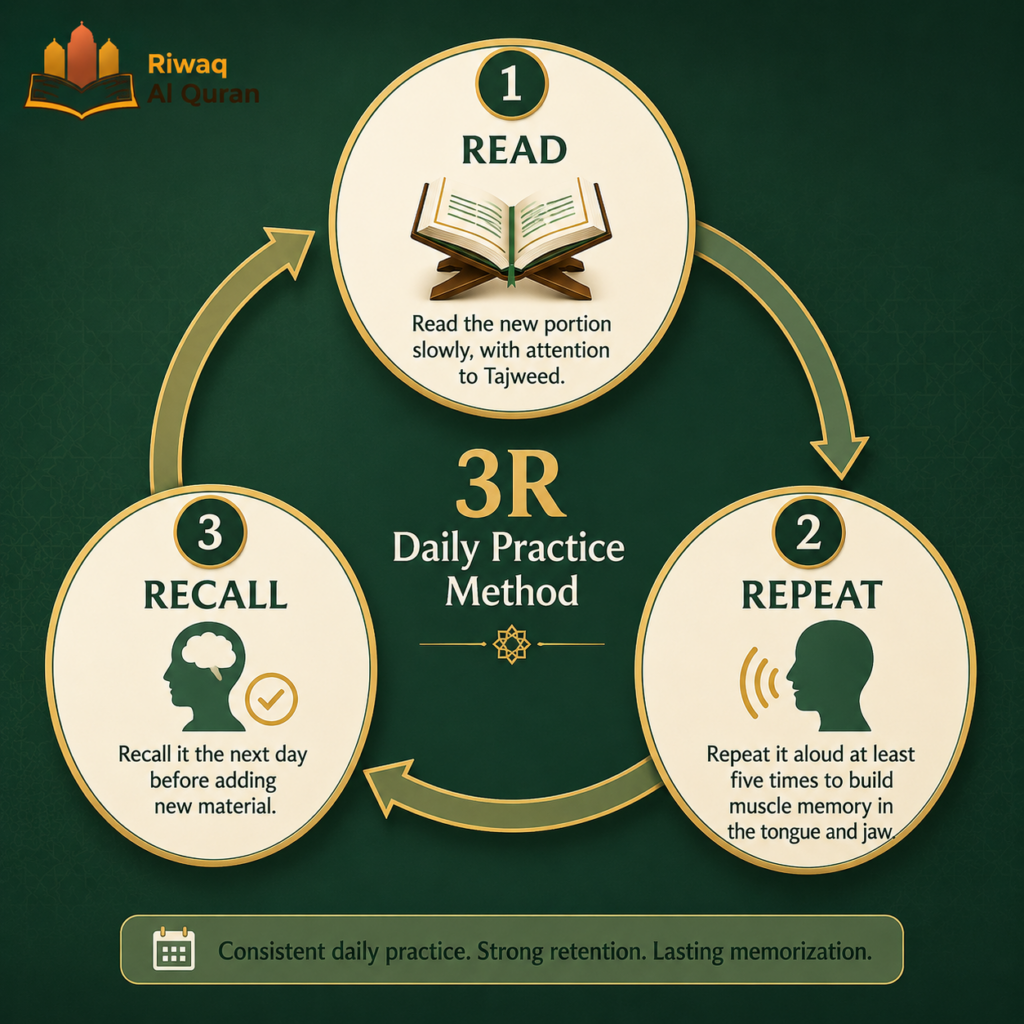
3. Practice Daily Using the 3R Method
A simple structure that keeps daily practice from becoming aimless:
- Read the new portion slowly, with attention to Tajweed.
- Repeat it aloud at least five times to build muscle memory in the tongue and jaw.
- Recall it the next day before adding new material.
Students who skip the recall step tend to memorize forward but lose the earlier portions within weeks.
4. Common Mistakes Beginners Make
Three mistakes show up repeatedly:
- Choosing an academy based on price alone without checking whether the teacher holds an Ijazah
- Skipping the free trial class and discovering a scheduling or teaching-style mismatch after paying for a month
- Not confirming the makeup-class policy before a first absence
A fourth, quieter mistake is giving up after a few sessions of feeling like reading is too slow or too difficult. Authentic hadith address this directly:
“عَنْ عَائِشَةَ رضي الله عنها قَالَتْ: قَالَ رَسُولُ اللَّهِ صلى الله عليه وسلم: “الْمَاهِرُ بِالْقُرْآنِ مَعَ السَّفَرَةِ الْكِرَامِ الْبَرَرَةِ، وَالَّذِي يَقْرَأُ الْقُرْآنَ وَيَتَتَعْتَعُ فِيهِ وَهُوَ عَلَيْهِ شَاقٌّ لَهُ أَجْرَانِ”
“Prophet ﷺ said: “The one who is skilled in the Qur’an is with the noble, righteous scribes (angels), and the one who reads the Qur’an and stumbles over it, finding it difficult, will have two rewards.” (Sahih Muslim 798a)
The Narrated by A’isha and recorded in Sahih Muslim, this hadith is specifically about beginners and non-native readers who struggle with pronunciation. It reframes early difficulty as something rewarded rather than something to be embarrassed by — which matters because giving up from discouragement, not lack of ability, is what actually ends most people’s Quran learning attempts.
5. Realistic Timelines for Memorization (Hifz)
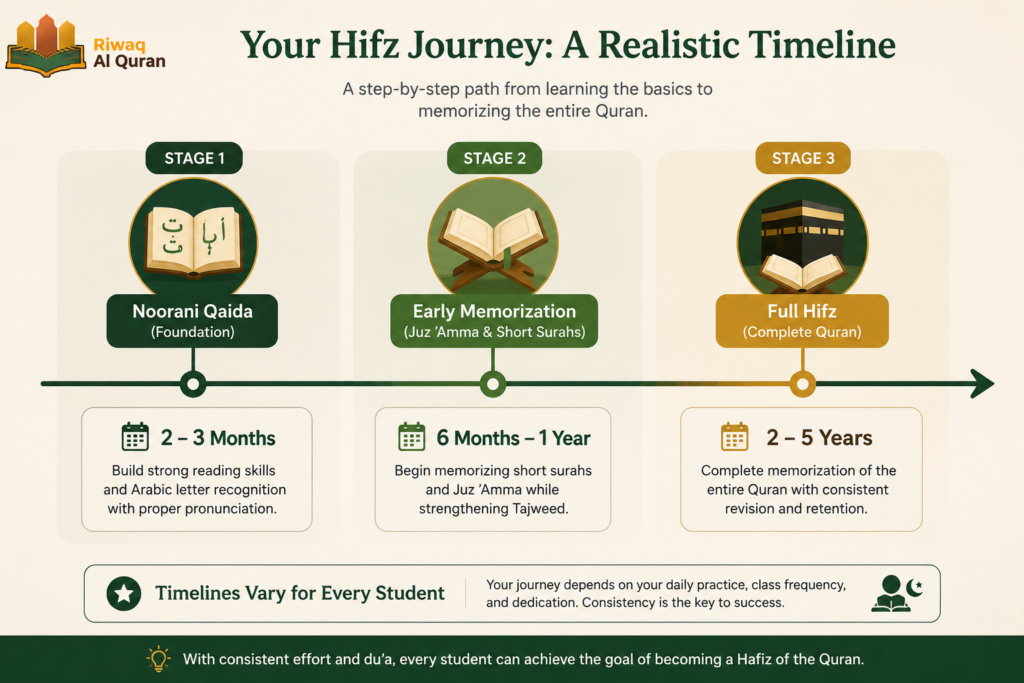
Most students complete Noorani Qaida within two to three months of consistent practice. Full Quran memorization timelines vary widely depending on daily class frequency and independent revision time, and typically range from two to five years for students attending two to three classes per week alongside daily personal review.
What to Look for Before You Choose a Website to Learn Quran Online
An online Quran academy is a service that pairs students with a certified teacher for live, one-on-one lessons delivered over video call, following a structured curriculum for recitation, memorization, and Islamic studies. The quality of that pairing — not the website’s design — is what determines your results. The six criteria below (a through f) cover everything worth checking before you commit.
a. Instructor Qualifications and Ijazah
Look for teachers who hold an Ijazah, a formal certification confirming their recitation has been verified, chain by chain, back to an authorized teacher.
A platform that lists this openly is signaling real quality control; one that only says “certified teachers” without specifying in what is worth a direct question before you sign up.
b. Curriculum Covering Tajweed Hifz and Tafsir
A serious academy separates its curriculum into distinct tracks:
- Tajweed — correct pronunciation and articulation.
- Hifz — memorization.
- Tafsir — interpretation and meaning.
If a platform offers only generic “Quran classes” with no defined track, the lesson plan is usually improvised per teacher rather than standardized.
c. The Learning Management System (LMS) and Technology
A Quran-specific LMS should let you replay recordings of your own sessions, track memorization progress verse by verse, and give parents a login to monitor a child’s attendance and performance.
Generic video-call platforms with no tracking layer make it hard to measure whether a student is actually improving.
d. Pricing Models You Should Expect
Most reputable academies price around $32 to $40 per month for two 30-minute classes per week. That structure is an industry baseline, not a coincidence — two short sessions a week is frequent enough to build retention without demanding a schedule most working adults or school-age children can’t sustain.
Riwaq Al-Quran prices in that same range, starting at $32 per month, while including a free trial lesson and access to its Quran LMS and mobile app before you commit.
e. Signs You’ve Chosen a Weak Online Quran Teacher
Three warning signs show up consistently:
- The teacher never corrects your makharij (articulation points) even when you mispronounce a letter.
- Sessions run as one-directional reading with no feedback in either direction.
- There’s no written or app-based record of what was covered last week.
Any one of these on its own is a reason to ask questions; two together are a reason to switch.
f. How to Evaluate Your Free Trial Class Before Committing
Use the trial to test three things specifically:
- Whether the teacher stops you to correct pronunciation in real time.
- Whether they can explain in plain language what track (Tajweed, Hifz, or Tafsir) your first month will follow.
- Whether you receive any written feedback afterward.
A trial that feels like a sales pitch rather than an actual lesson is a preview of what the paid classes will feel like.
Book Your Free Trial Class With Riwaq Al-Quran Today
You’ve seen what separates a strong academy from an average one — certified teachers, a real curriculum, and a system that tracks actual progress instead of just attendance. Riwaq Al-Quran offers all three, starting at $32 per month, with a free trial class before you commit to anything.
Don’t just take our word for it — hear directly from one of our students:
Conclusion
The 10 platforms compared here all teach the Quran online, but they differ in exactly the places that matter most: whether teachers hold a verified Ijazah, whether the curriculum separates Tajweed, Hifz, and Tafsir into distinct tracks, and whether there’s a real system for tracking a student’s progress between classes rather than just scheduling them.
Riwaq Al-Quran sits at the lower end of the pricing range covered above, starting at $32 per month, while including the free trial, native-speaking certified instructors, a full course catalog spanning Quran, Arabic, and Islamic Studies, and a dedicated LMS that the majority of the other nine platforms don’t offer as standard.
Whichever academy you choose, the standard to hold it to is the one both the Quran and the Prophet ﷺ set for it:
“إِنَّ الَّذِينَ يَتْلُونَ كِتَابَ اللَّهِ وَأَقَامُوا الصَّلَاةَ وَأَنفَقُوا مِمَّا رَزَقْنَاهُمْ سِرًّا وَعَلَانِيَةً يَرْجُونَ تِجَارَةً لَّن تَبُورَ”
“Those who recite the Book of Allah, establish prayer, and spend from what We have provided them, secretly and openly, hope for a transaction that will never perish.”(Surah Fatir, 35:29)
“اقْرَءُوا الْقُرْآنَ فَإِنَّهُ يَأْتِي يَوْمَ الْقِيَامَةِ شَفِيعًا لِأَصْحَابِهِ”
“The Prophet ﷺ said: “Recite the Qur’an, for on the Day of Resurrection it will come as an intercessor for those who recite it.” (Sahih Muslim 804a)
Narrated by Abu Umama and recorded in Sahih Muslim, this hadith frames consistent recitation — not just eventual memorization — as the thing being rewarded. That’s worth remembering on the days progress feels slow.
Learning to read it correctly, consistently, and with real understanding is worth choosing the right teacher for.
FAQs
The questions below are the ones readers ask most often when comparing online Quran academies — answered directly, with no need to re-read the full article.
What is the best way to learn Quran online?
The best way combines a certified teacher, a structured curriculum that separates Tajweed from memorization, and daily personal practice between live sessions. No platform replaces consistent daily review on the student’s side.
How much does it cost to learn Quran online?
Most reputable academies charge between $32 and $40 per month for two 30-minute classes weekly. Riwaq Al-Quran starts at $32 per month and includes a free trial lesson.
Can beginners with no Arabic background learn Quran online?
Yes. Programs like Noorani Qaida are built specifically for students starting from zero, teaching Arabic letter shapes and sounds before introducing full Quranic text.
Is there religious merit in learning the Quran even if I read slowly or make mistakes?
Yes. Sahih Muslim 798a states that a reader who struggles with the Qur’an and finds it difficult receives two rewards, while a fluent reader is described as being with the noble recording angels. Difficulty in the early stages is explicitly not a reason to stop.
How long does it take to memorize the Quran through online classes?
Timelines vary, but most students attending two to three classes weekly with daily personal revision complete full memorization within two to five years.
What qualifications should an online Quran teacher have?
Look for a verified Ijazah, which confirms the teacher’s own recitation has been certified through an authorized chain of teachers, plus experience teaching the specific track you need — Tajweed, Hifz, or Tafsir.