
You sit down to study, open your textbook, and press play on a Quran recitation. It feels right — grounded and productive at once. But a question surfaces: is this actually permissible, and are you genuinely benefiting from it?
Can you listen to the Quran while reading a book or studying, or does multitasking reduce what the Quran deserves from you? The short answer is yes — it is permissible. But there is a deeper answer most articles skip entirely: Islamic jurisprudence draws a clear line between hearing the Quran passively and listening to it with attention, and that distinction shapes exactly when, how, and why combining Quran recitation with study is valid — and when it works against you.
This article gives you the full picture: the scholarly basis rooted in Quran and Sunnah, a practical framework for when background recitation helps your study versus hurts it, and the correct etiquette most guides never explain.
What You’ll Learn in This Article
- Whether Islamic scholars permit listening to the Quran while reading or studying.
- The fiqh difference between hearing (sama’) and attentive listening (istima’) — and why it matters.
- A practical framework for when background Quran recitation supports your concentration vs. competes with it.
- The correct adab (etiquette) for having Quran playing in your environment.
- Why reciting the Quran yourself carries more reward than listening alone — with the Prophetic evidence.
Table of Contents
Can I Listen to the Quran While Reading a Book or Studying?
The consensus among Islamic scholars is that listening to the Quran while reading a book or studying is permissible — but that permissibility rests on a condition most articles never spell out clearly.
1. The Fiqh Distinction Between Hearing Sama’ and Attentive Listening Istima’
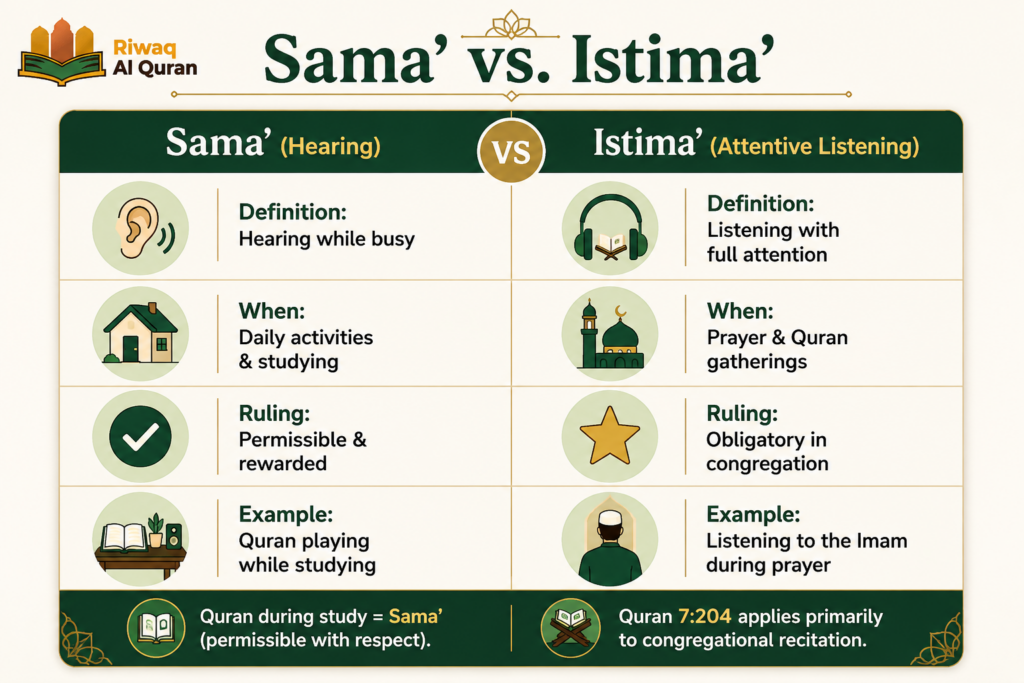
Islamic jurisprudence recognizes two distinct modes of engagement with Quran recitation. Sama’ (سَمَاع) is hearing — the Quran reaches your ears while your attention is directed elsewhere.
Istima’ (إِنْصَات) is attentive listening — actively directing your focus to the recitation. Scholars across the four Sunni madhabs agree that istima’ is obligatory when the Quran is recited in a congregational setting. Sama’, however, is permissible and carries reward even when you are simultaneously engaged in another lawful activity.
This distinction is the scholarly foundation for why playing Quran while you study is allowed. You are in sama’ mode — receiving the recitation as part of your environment. Allah says:
“وَإِذَا قُرِئَ الْقُرْآنُ فَاسْتَمِعُوا لَهُ وَأَنصِتُوا لَعَلَّكُمْ تُرْحَمُونَ”
“When the Quran is recited, listen to it attentively and be silent, that you may receive mercy.” (Al-A’raf 7:204)
The two commands in this verse — istami’u (listen actively) and anshitu (be silent and still) — form the Quranic basis for what scholars call wujub al-istima’, the obligation of attentive listening. Ibn Kathir states in his Tafsir that the majority of scholars apply this verse primarily to prayer and formal congregational recitation, where following the Imam’s recitation is obligatory.
Al-Qurtubi extends it to gatherings specifically assembled for Quran recitation. Both scholars agree that outside these two contexts — in a household, a study room, or a daily routine — what is required is not enforced silence but basic adab (reverence). Playing Quran during study, then, is not a violation of this verse; it is an application of sama’ with intention, which is itself a praised act in the Sunnah.
2. What “Maintaining Reverence” Actually Means in Practice
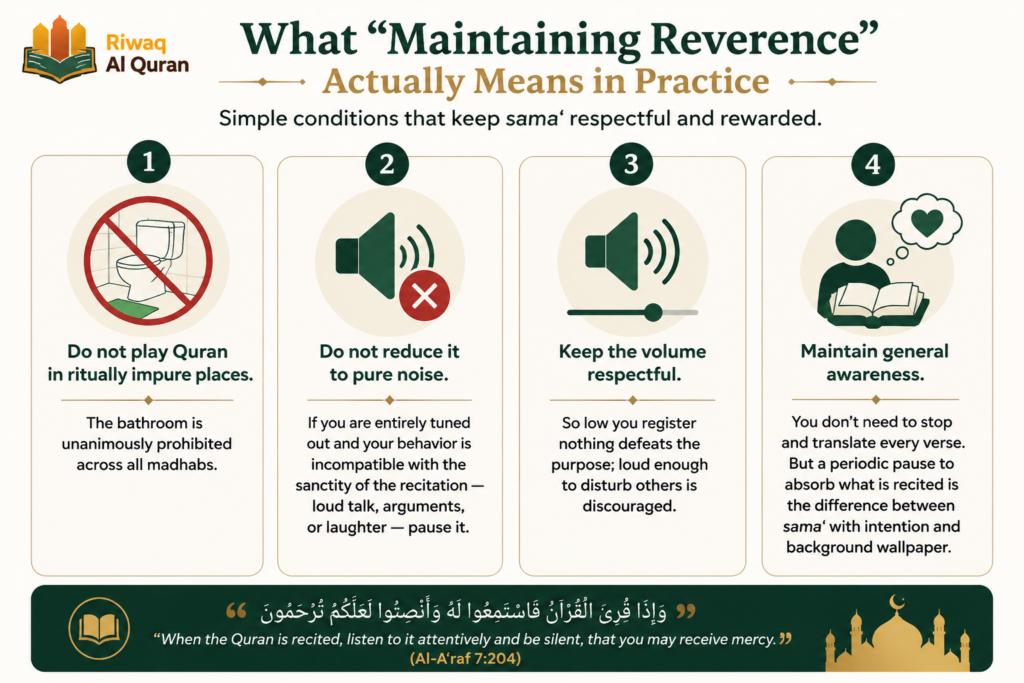
Many articles say “show proper reverence” without defining it. Scholars specify several concrete conditions that make sama’ respectful rather than negligent:
- Do not play Quran in ritually impure places. The bathroom is unanimously prohibited across all madhabs.
- Do not reduce it to pure noise. If you are entirely tuned out and your behavior is incompatible with the sanctity of the recitation — loud irrelevant talk, argumentation, or laughter — scholars recommend pausing it.
- Keep the volume respectful. So low you register nothing defeats the purpose; loud enough to disturb others is discouraged.
- Maintain general awareness. You do not need to stop and translate every verse. But a periodic pause to absorb what is recited is the difference between sama’ with intention and background wallpaper.
These are the practical conditions — not a vague spiritual feeling, but behavioral norms you can actually apply at your desk.
When Does Listening to the Quran While Studying Help or Hurt?
Permissibility answers the religious question. But there is a separate practical question: does background Quran recitation actually support your study? The answer depends on the type of task in front of you.
1. When Background Quran Recitation Supports Your Concentration
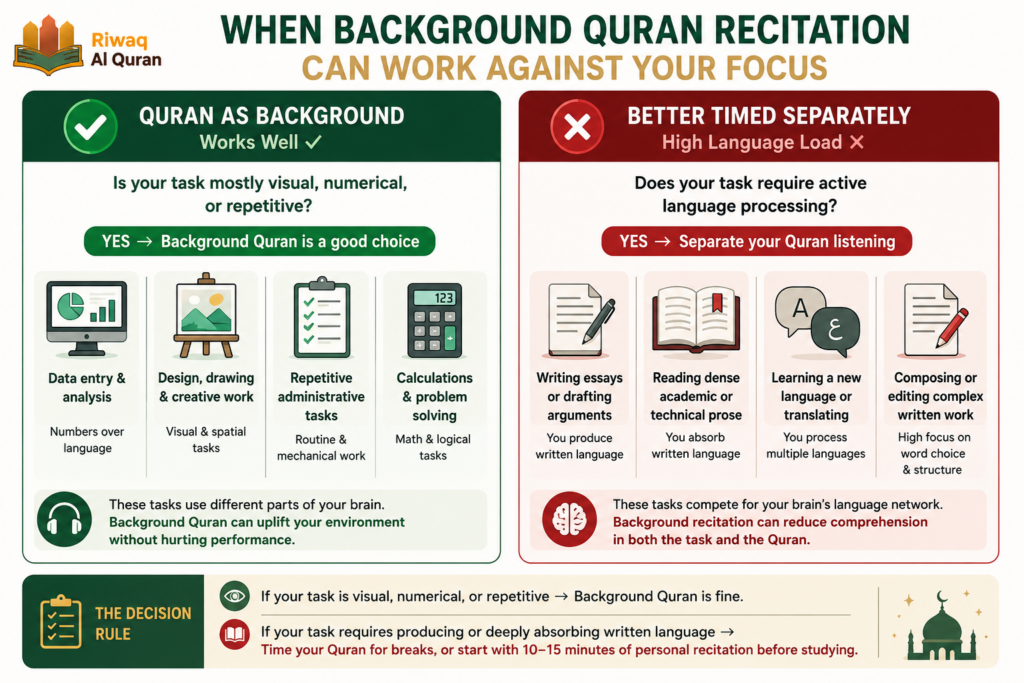
Quran recitation works well as background audio during tasks that are repetitive, visual, or procedural. Suitable study activities include:
- Reviewing flashcards
- Organizing and summarizing notes
- Reading for broad comprehension
- Solving math problems
- Highlighting or annotating texts
These activities draw primarily on motor or visual processing rather than language generation. The rhythmic cadence of Tajweed recitation in this context creates a calm, focused environment without competing for the cognitive resources you are actually using. The Quran’s positive effects on concentration and spiritual well-being during these moments are well-documented in both religious tradition and educational practice.
Allah says:
“وَلَقَدْ يَسَّرْنَا الْقُرْآنَ لِلذِّكْرِ فَهَلْ مِن مُّدَّكِرٍ”
“And We have certainly made the Quran easy for remembrance — so is there anyone who will remember?”(Al-Qamr 54:17)
This verse — repeated four times in Surah Al-Qamr (verses 17, 22, 32, and 40) — is a divine invitation, not merely a statement of fact. The Arabic word yassarna (made easy) encompasses both ease of memorization and ease of integration into daily life.
Ibn Kathir explains that this ease is one of the Quran’s miracles: no other revealed scripture has been so thoroughly memorized by so many across so many centuries. Applied to the study context, this verse supports the understanding that the Quran is not reserved only for formal halaqas (circles of learning) — its accessibility is itself a mercy, allowing its recitation to be a natural companion across lawful daily activities.


2. When Background Quran Recitation Can Work Against Your Focus
Quran recitation becomes cognitively competing during tasks that require active language processing. Activities where separation is advisable include:
- Writing essays or drafting arguments.
- Reading dense academic or technical prose.
- Learning a new language or translating.
- Composing or editing complex written work.
Your brain’s language network processes both the written content in front of you and the Arabic recitation simultaneously, reducing comprehension in both.
The decision rule: If your task requires you to produce or deeply absorb written language, time your Quran listening for breaks — or open your session with 10–15 minutes of personal recitation before switching to study. If the task is visual, numerical, or repetitive, background Quran recitation is a sound choice that won’t cost you performance.
If you want to move beyond passive listening and build a real daily recitation habit, Riwaq Al Quran’s online courses teach Tajweed from the foundations up — so every moment you engage with the Quran is intentional rather than incidental. The Quran’s own guidance on education and the pursuit of knowledge makes clear that structured, intentional learning is the highest form of engagement.
Can I Do Dhikr While Listening to the Quran?
Combining dhikr with Quran listening is permissible — but with a specific etiquette that most discussions skip.
How to Combine Dhikr and Quran Listening Correctly
Dhikr — verbal remembrance of Allah through phrases such as SubhanAllah, Alhamdulillah, and Allahu Akbar — may be performed while Quran recitation plays, provided your dhikr does not override or interrupt the recitation to the point where you lose awareness of what is being recited. Silent or whispered dhikr alongside audible recitation is the most widely accepted form.
The weight of dhikr in Islam is not incidental. The Prophet ﷺ said:
“أَلَا أُخْبِرُكُمْ بِخَيْرِ أَعْمَالِكُمْ وَأَزْكَاهَا عِنْدَ مَلِيكِكُمْ وَأَرْفَعِهَا فِي دَرَجَاتِكُمْ وَخَيْرٌ لَكُمْ مِنْ إِنْفَاقِ الذَّهَبِ وَالْوَرِقِ وَخَيْرٌ لَكُمْ مِنْ أَنْ تَلْقَوْا عَدُوَّكُمْ فَتَضْرِبُوا أَعْنَاقَهُمْ وَيَضْرِبُوا أَعْنَاقَكُمْ؟” قَالُوا: بَلَى. قَالَ: “ذِكْرُ اللَّهِ تَعَالَى”
“Shall I not tell you about the best of your deeds, the most pleasing to your Lord, the highest in raising your ranks, better for you than spending gold and silver in charity, and better than meeting your enemy — striking their necks and they striking yours?” They said: “Yes, O Messenger of Allah.” He said: “The remembrance of Allah.”(Narrated by Abu al-Darda’ (رضي الله عنه). Sunan al-Tirmidhi 3377, declared Hasan by al-Tirmidhi and Sahih by al-Albani.)
This hadith establishes dhikr not as a supplementary act of worship but as the highest category of deed — outranking even financial charity and physical sacrifice in its reward. When understood this way, combining dhikr with Quran listening is not multitasking in any diminishing sense; it is layering two of the most valued forms of worship.
The key, as scholars note, is that neither act should be allowed to fully eclipse the other: whispered dhikr during recitation keeps both acts conscious and intentional.
A common mistake is sustained loud dhikr while Quran plays, creating a situation where neither act receives proper attention. The stronger etiquette position — held by scholars including Ibn Rajab al-Hanbali in his commentary on the merits of dhikr — is to give each its own moment: dhikr in the pauses between recitations, or in a dedicated session after listening. This is not a prohibition; it is an etiquette recommendation for making both acts more complete rather than diluting both.
For a deeper understanding of the benefits of reading and engaging with the Quran both alongside dhikr and as a standalone practice, the connection between the two becomes even more apparent.
Why Reciting the Quran Yourself Is More Rewarding Than Listening
The reward of listening to the Quran is genuine and established in the Sunnah. But reciting it yourself — even imperfectly — carries more, for reasons that are precise and Prophetically grounded. Understanding what the Quran teaches in its fullness becomes possible only when you move from hearing it to actively engaging with it through recitation.
1. The Active Engagement Difference
When you recite, you are producing the words of Allah rather than receiving them. This requires simultaneous engagement of memory, articulation, breath control, and intention — all of which deepen your connection to the text. The Prophet Muhammad ﷺ said:
“الْمَاهِرُ بِالْقُرْآنِ مَعَ السَّفَرَةِ الْكِرَامِ الْبَرَرَةِ، وَالَّذِي يَقْرَأُ الْقُرْآنَ وَيَتَتَعْتَعُ فِيهِ وَهُوَ عَلَيْهِ شَاقٌّ لَهُ أَجْرَانِ”
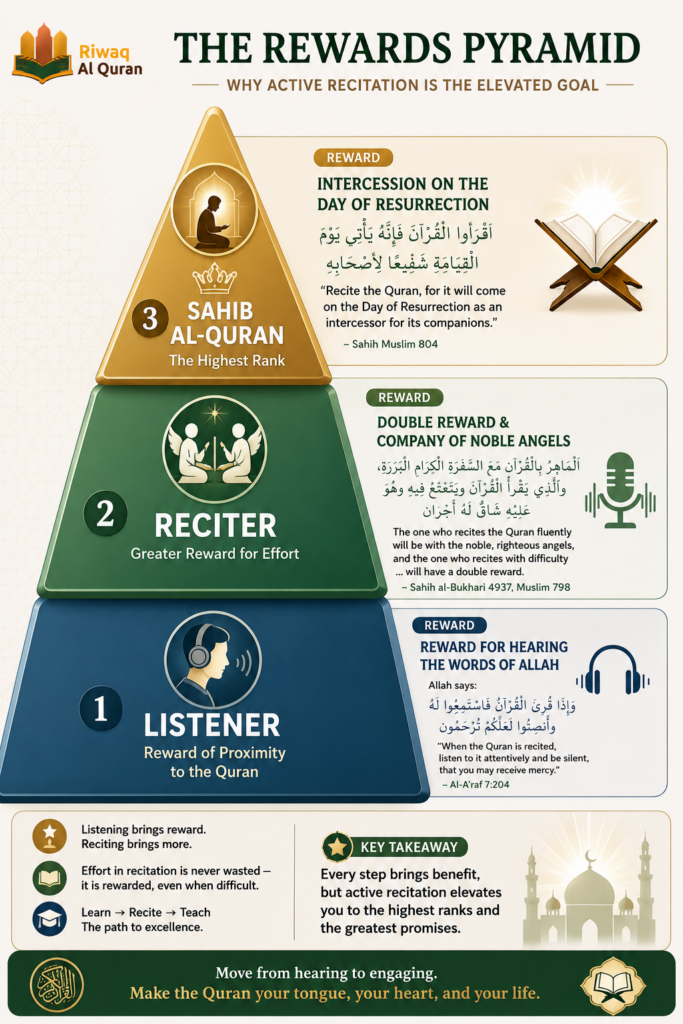
“The one who recites the Quran fluently will be with the noble, righteous recording angels, and the one who recites the Quran with difficulty, faltering through it while it is hard for them, will have a double reward.”(Narrated by Aisha (رضي الله عنها). Sahih al-Bukhari 4937, Sahih Muslim 798.)
This hadith accomplishes two things simultaneously: it elevates the proficient reciter by placing them in the company of the highest angels, and it removes all discouragement from the struggling beginner by doubling their reward. The struggling reciter is not penalized for difficulty; they are rewarded twice — once for the recitation and once for the effort itself. This is the Prophetic framework for Quran learning: there is no losing position.
The one who finds Arabic pronunciation difficult, who trips over makhraj distinctions, who is memorizing after age 40 — they are not behind. They are, in this hadith, in a category of double blessing. Listening alone, while rewarding, receives no equivalent promise in the texts.
2.The Quran as Your Intercessor Through a Promise Tied to Recitation
Listening builds familiarity. Recitation builds a relationship. The Prophet ﷺ said:
“اقْرَءُوا الْقُرْآنَ فَإِنَّهُ يَأْتِي يَوْمَ الْقِيَامَةِ شَفِيعًا لِأَصْحَابِهِ”
“Recite the Quran, for it will come on the Day of Resurrection as an intercessor for its companions.”(Narrated by Abu Umamah al-Bahili (رضي الله عنه). Sahih Muslim 804.)
The word ashab (companions/people of the Quran) in this hadith is used specifically in the context of those who recite and engage with it, not merely those who hear it. Al-Nawawi explains in his commentary on Sahih Muslim that the intercession here belongs to those who made the Quran a consistent recitation practice — the ones who returned to it daily with their tongues, not only their ears.
This does not exclude listeners from the Quran’s blessings; but it defines a specific, elevated category — sahib al-Quran — whose relationship with the text is built through active, regular recitation.
3. The Highest Rank Belongs to Those Who Learn and Teach
The Prophet ﷺ also said:
“خَيْرُكُمْ مَنْ تَعَلَّمَ الْقُرْآنَ وَعَلَّمَهُ”
“The best of you are those who learn the Quran and teach it.”(Narrated by Uthman ibn Affan (رضي الله عنه). Sahih al-Bukhari 5027.)
This hadith defines excellence in the Muslim community not by wealth, lineage, or scholarship in other domains — but by engagement with the Quran. Specifically: learning it and teaching it. Both verbs require active recitation. You cannot teach correct Tajweed by playing an audio file; you cannot transmit the authorized chain of Quran transmission (ijazah) by passive listening.
The scholars who carried the Quran through generations — from the Companions to the Tabi’in and beyond — did so through mouth-to-mouth transmission, teacher to student, in structured recitation sessions. Passive listening plays a supporting role; active recitation with a qualified teacher is the core of the tradition.
4. What Passive Listening Cannot Build in Tajweed and Memorization
You cannot memorize the Quran through listening alone. Retention requires active retrieval — vocalizing the verse, testing yourself against what you have heard, correcting errors. The same applies to Tajweed: the rules of makharij al-huruf (points of articulation), madd (vowel elongation), and ghunnah (nasalization) are learned and corrected through supervised recitation, not through hearing.
Allah commands precisely this careful, deliberate approach to recitation:
“وَرَتِّلِ الْقُرْآنَ تَرْتِيلًا”
“And recite the Quran with measured, careful recitation.”(Al-Muzzammil 73:4)
The word tartil (measured recitation) is not poetic license — it is a technical command. Ibn Kathir defines it as reciting each letter from its correct point of articulation, with proper elongation, without rushing and without artificial slowing. Al-Qurtubi adds that tartil requires the reader to understand what they are saying — which is impossible in pure passive listening.
This verse is the Quranic origin of the entire science of Tajweed: every rule about idgham, ikhfa’, qalqalah, and the fourteen types of madd exists in service of this single divine command. A student who only listens is moved by tartil; a student who learns it is transformed by it.
A common pattern among adult learners: years of listening to beautiful recitation, followed by the realization that they cannot replicate even basic pronunciation correctly. The gap is not effort — it is method. Supervised recitation with a qualified teacher closes it faster than any other approach.
Tajweed matters more than most learners realize. This short from Riwaq Al Quran explains why:
Understanding the importance of Tajweed rules and how they directly affect the validity and beauty of recitation makes the case for structured learning even stronger. Riwaq Al Quran’s Quran Recitation with Tajweed course pairs you one-on-one with a certified teacher who corrects your pronunciation in real time — something no audio track can do. For those actively building their hifz, proven strategies for retaining and revising memorized Quran complement the active recitation practice built in class.
When Should You Listen to the Quran with Full Attention?
Not all Quran listening moments are equal. Some contexts require istima’ — full, directed attention — rather than the sama’ that is sufficient during study.
1. During Prayer and Congregational Recitation
When the Quran is recited in prayer — whether you are praying alone or following an Imam — attentive listening is obligatory. This is the primary application of the command in Al-A’raf 7:204. Allowing your attention to drift during the Imam’s recitation in Jumu’ah or Tarawih prayer directly contradicts the commanded istima’ in that setting.
Crucially, this also means Quran playing externally in the room should be paused before prayer begins so it does not compete with the prayer’s own recitation.
2. During Personal Recitation Sessions and Moments of Solitude
When you sit down specifically to recite or study the Quran — not as background, but as your primary activity — that session calls for the same full attention. Scholars recommend a defined structure for these dedicated sessions:
- Choose a clean, quiet space.
- Face the Qiblah if possibleز
- Begin with ta’awwudh and basmala
- Set a specific recitation goal — a page, a rub’, a surah — rather than playing indefinitely.
This structured approach transforms passive listening into active engagement with the words of Allah. Establishing the best time to memorize and recite the Quran as a fixed daily slot applies this same principle: intention and structure produce results that unscheduled listening does not.
Start Learning Quran Recitation with Tajweed at Riwaq Al Quran
Listening to the Quran is where most people begin. Reciting it correctly — with proper Tajweed, under qualified guidance — is where real growth happens.
Riwaq Al Quran is a fully online Quran and Islamic Studies academy offering personalized instruction for individuals of all ages and backgrounds. Its certified instructors deliver live, one-on-one sessions through a structured curriculum covering Tajweed, Tafsir, Memorization, Arabic language, and Islamic Studies. The platform’s advanced online classes allow seamless communication and interaction between students and teachers. Every teacher holds ijazah — a certified chain-of-transmission authorization in Quran recitation traceable back to the Prophet ﷺ
himself. No rigid classroom hours, no commute — consistent, corrected recitation at your own schedule.
Core programs available:
- Quran recitation and memorization — Tajweed, Hifz, Qirat, and Tafseer for all levels
- Quran for kids and adults — interactive live sessions structured around each learner’s pace
- Arabic language — from foundational reading to advanced comprehension
- Ijazah certification — authorized chain-of-transmission for qualified students
- Islamic Studies — structured coverage of fiqh, aqeedah, and Seerah
Explore individual courses:
| Course | What You’ll Learn |
|---|---|
| Quran Recitation with Tajweed | Tajweed rules with real-time correction from certified instructors |
| Online Quran Recitation Course | Expert-led recitation training built for all levels |
| Quran Memorization Online Course | Structured hifz with Tajweed, revision strategies, and progress checkpoints |
| Online Tafseer Course | Quranic meanings, scholarly interpretation, and contextual understanding |
| Noorani Qaida Online | Quranic basics for absolute beginners — letters, harakat, and joining rules |
| Online Qirat Course | The ten authentic recitation styles of the Quran |
| Online Quran Classes for Kids | Age-appropriate, interactive Quran learning with child-focused instructors |
See what a live Riwaq Al Quran recitation session looks like:
Conclusion
Listening to the Quran while reading a book or studying is permissible in Islam. The scholarly basis is the recognized distinction between passive hearing (sama’) — valid during lawful activities — and obligatory attentive listening (istima’), required in prayer and congregational settings, as established by Al-A’raf 7:204 and the consensus of classical scholars.
Practically, background recitation supports study best during visual, repetitive, or procedural tasks. During deep language-processing work — writing, dense reading, drafting — it is better timed separately. Dhikr can be combined with Quran listening when kept soft and non-competing, as the Prophet ﷺ confirmed dhikr to be the highest category of deed.
And while listening carries genuine reward, active recitation with correct Tajweed builds the memorization, pronunciation, and spiritual connection that passive listening cannot — a promise the Prophet ﷺ attached specifically to the act of recitation itself, with double reward even for those who struggle, and intercession reserved for those who make the Quran their daily companion through voice, not only through ears.
The most important shift is moving from hearing the Quran as background to engaging with it as a daily practice. Even 15–20 minutes of structured, corrected recitation each day produces results that years of passive listening will not.
Frequently Asked Questions
Below are direct answers to the most common questions on this topic — covering Islamic ruling, scholarly distinctions, and practical guidance for daily Quran engagement.
Is it disrespectful to play the Quran in the background while studying or doing chores?
It is not disrespectful, provided basic adab is observed — the Quran should not be played in ritually impure spaces such as the bathroom, and you should not be engaged in behavior directly incompatible with its sanctity. Playing Quran during lawful household and study activities is a recognized and historically practiced form of filling your environment with the remembrance of Allah, consistent with the broader Sunnah encouragement of dhikr in all states.
What is the difference between hearing and listening to the Quran in Islamic jurisprudence?
Hearing (sama’) is passive — the recitation reaches you while your attention is elsewhere. Listening (istima’) is active — you direct full attention to the recitation. Scholars across all four Sunni madhabs agree that istima’ is obligatory during prayer and congregational recitation based on Al-A’raf 7:204; sama’ during other lawful activities carries reward but not the same obligation.
Can I listen to the Quran while sleeping?
Letting Quran recitation play as you fall asleep is permissible, but scholars recommend turning it off before sleep rather than leaving it running all night. The sleeping state is one of reduced awareness in which the commanded istima’ is not possible, and allowing it to play indefinitely into the night is considered by many scholars to be less than the full respect the Quran deserves.
Can I pray while Quran is playing in the background?
No — the Quran playing externally should be paused before prayer begins. During prayer, the worshipper must maintain khushu’ (full concentration and humility), which an external recitation directly competes with. This applies whether you are praying alone or following an Imam, and is grounded in the same verse commanding istima’ during formal recitation (Al-A’raf 7:204).
Is listening to Quran while studying actually supported by Islamic scholarship?
Yes. The permissibility of sama’ — hearing the Quran during lawful activity — is established across all four major Sunni madhabs and is not a modern opinion. What scholars consistently specify are the conditions of basic reverence: appropriate environment, appropriate behavior, and the absence of deliberate disregard for what is being recited. The scholarly basis predates the modern study environment by centuries.
How much daily Quran recitation should I aim for alongside my listening habit?
Islamic scholars and teachers generally recommend a minimum daily recitation of one hizb (half a juz’), which takes approximately 15–25 minutes depending on pace — a useful reference for planning your goals is understanding how the Quran is structured across its pages, verses, and surahs. The Prophet ﷺ established that even the one who recites with difficulty receives double reward (Sahih al-Bukhari 4937) — meaning the measure is consistency and sincerity, not fluency. A single page recited correctly each day with proper Tajweed produces more measurable progress than extended passive listening. Consistency over volume is the consistent principle across scholarly guidance on this question.