Most articles about Islamic stories for children tell you what happened. This guide tells you what to do with it — the Quranic verse the story comes from, the authentic hadith that reinforces its lesson, the specific character trait it builds, and the age at which it lands best.
Quran stories for kids are narrative accounts drawn directly from the Quran that illustrate Islamic values through the lives of prophets, righteous people, and real historical events. They are not myths or folklore — the Quran itself describes them as purposeful revelation:
“نَحْنُ نَقُصُّ عَلَيْكَ أَحْسَنَ الْقَصَصِ بِمَا أَوْحَيْنَا إِلَيْكَ هَٰذَا الْقُرْآنَ“
“We tell you the best of stories through what We have revealed to you in this Quran.”Surah Yusuf, 12:3
Allah, exalted is He, did not describe the Quranic stories as merely “good stories” or “beneficial stories” — He said “the best of stories,” an absolute superlative. This is direct guidance for parents: when you’re searching for an educational tool to shape your children’s character, the answer lies in the Quran
That word — qasas (قَصَص), stories — appears across the Quran to describe accounts that are purposeful, not decorative. Each one was revealed to answer a real need: to comfort the Prophet ﷺ, to guide his companions, and by extension, to guide every generation of children who hears them.
The Prophet ﷺ himself pointed to the Quran as the highest educational inheritance a parent can pass on:
“خَيْرُكُمْ مَنْ تَعَلَّمَ الْقُرْآنَ وَعَلَّمَهُ“
“The best of you are those who learn the Quran and teach it.”— sunnah.com/bukhari:5027
This hadith combines learning and teaching into a single statement. The father who sits with his son, telling the story of Yusuf or Ibrahim and explaining its verses, is at once both a learner and a teacher — and both roles fall within this merit that the Prophet ﷺ described as “the best among you.
This guide covers the top 10 Quran stories for kids — each with its source verse in Arabic with full tashkeel, its Surah reference linked directly to quran.com, the single core lesson it teaches, the age group it suits best, an authentic hadith from the Sunnah that deepens the lesson, and a practical tip for the parent telling it. For a broader perspective on what the Quran says about education and its role in raising children, that article provides essential context before you begin.
What You’ll Learn in This Article
- The specific Quranic verse each story comes from, with Arabic text, Surah reference, and quran.com link.
- An authentic hadith from the Sunnah paired with each story — sourced, translated, and commented on.
- The one core lesson each story is best at teaching — and the age it works best.
- A 5-step storytelling method so children remember and act on these stories.
- Three common mistakes parents make that reduce a story’s impact.
- How to match each story to a specific challenge your child is facing right now.
The stories below are organized to move from the simplest moral structures (best for young children) toward the more complex themes of identity and social pressure (best for older children and teenagers).
Table of Contents
1. The Story of Adam (AS) — Obedience, Mistakes, and Mercy
- Best age: 4–8
- Core lesson: Every mistake can be forgiven when you turn back to Allah
Allah created Adam (AS) from clay, breathed life into him, and placed him in Jannah with his wife Hawwa. He gave them one instruction: do not eat from one specific tree. Shaitan deceived them both, and they disobeyed. The moment they recognized their mistake, they turned to Allah with genuine remorse — and He forgave them.
“فَتَلَقَّىٰ آدَمُ مِن رَّبِّهِ كَلِمَاتٍ فَتَابَ عَلَيْهِ ۚ إِنَّهُ هُوَ التَّوَّابُ الرَّحِيمُ“
“Then Adam received words from his Lord, and He accepted his repentance. Indeed, it is He who is the Accepting of repentance, the Merciful.“Surah Al-Baqarah, 2:37
Notice that the verse did not simply say “Allah forgave him” — it concluded with “At-Tawwab Ar-Raheem” together. At-Tawwab: the One who repeatedly accepts repentance; Ar-Raheem: the One vast in mercy. This pairing is deliberate: it teaches the child that the door of repentance never closes, and that Allah turns to you with mercy the very moment you turn to Him with remorse.
Hadith Supporting This Lesson
This is the hadith that ties the whole lesson together — read it first, then see how it connects to Adam’s story below.
“كُلُّ ابْنِ آدَمَ خَطَّاءٌ، وَخَيْرُ الْخَطَّائِينَ التَّوَّابُونَ“
“Every son of Adam sins, and the best of those who sin are those who repent.”(Jami’ at-Tirmidhi, Hadith 2499; Sunan Ibn Majah, Hadith 4251)
This hadith cements what the story of Adam already taught: making mistakes is not an exception — it is part of human nature. But the Prophet ﷺ did not stop at simply stating the reality — he turned it into an opportunity: “The best of those who err are the ones who constantly repent.” When you tell your child this hadith after the story, teach them that Allah does not expect perfection from them — He expects their return to Him.
This is the ideal first story for young children precisely because it normalizes mistakes while teaching the response to them. Teaching a child to say Astaghfirullah after this story gives them a concrete practice to carry out of the narrative.
Parenting note: Resist the urge to use this story as a discipline tool — “even Adam got punished.” That flips the lesson from mercy to fear. The emphasis belongs on the verse above: Allah accepted his repentance.
2. The Story of Nuh (AS) — 950 Years of Patience
- Best age: 5–9
- Core lesson: Do what is right even when no one listens
Prophet Nuh (AS) called his people to worship Allah alone for 950 years. He faced mockery, rejection, and the loss of his own son. When the flood came, Allah commanded him to build an Ark — an instruction that must have seemed absurd to everyone watching.
“وَاصْنَعِ الْفُلْكَ بِأَعْيُنِنَا وَوَحْيِنَا وَلَا تُخَاطِبْنِي فِي الَّذِينَ ظَلَمُوا ۚ إِنَّهُم مُّغْرَقُونَ“
“And construct the ship under Our observation and Our inspiration, and do not address Me concerning those who have wronged; indeed, they are to be drowned.”Surah Hud, 11:37
“بِأَعْيُنِنَا” — “before Our eyes” — using the plural of majesty. Allah did not say “I will watch you” — He told him that this work was being carried out under His direct care and supervision. The ark was not merely a vessel of rescue; it was a work witnessed by Allah Himself. Teach your child: every deed you do in obedience to Allah, Allah is its witness and its caretaker.
Hadith Supporting This Lesson
Read this hadith first — it’s the key that unlocks why Nuh’s 950 years of patience matter so much:
“وَمَنْ يَصْبِرْ يُصَبِّرْهُ اللَّهُ، وَمَا أُعْطِيَ أَحَدٌ عَطَاءً خَيْرًا وَأَوْسَعَ مِنَ الصَّبْرِ“
“Whoever is patient, Allah will grant him patience — and no one has been given a gift better or more abundant than patience.”(Sahih al-Bukhari, Hadith 1469; Sahih Muslim, Hadith 1053)
950 years of patience in the story of Nuh might seem like an abstract number to a child. This hadith gives it its true value: patience is not weakness or surrender — it is the most precious gift Allah gives His servant. And the Prophet ﷺ did not simply say “patience is beneficial”; he said “no one has ever been given a gift better or more expansive than it.” This hadith transforms patience from an abstract virtue into a prize that any wise person would long to receive.
Children naturally fear being different from their peers. The Story of Nuh teaches that persistence matters more than popularity — and that when even family members resist the truth, your relationship with Allah is what holds.
Parenting note: The number 950 years is worth pausing on with children aged 7+. Ask: “What would you do if you tried to help someone for your whole life and they still didn’t listen?” The answer opens the door to a real conversation about effort versus outcome.
3. The Story of Ibrahim (AS) — Faith That Survives Fire
- Best age: 6–10
- Core lesson: Trust Allah completely, even when the situation looks impossible
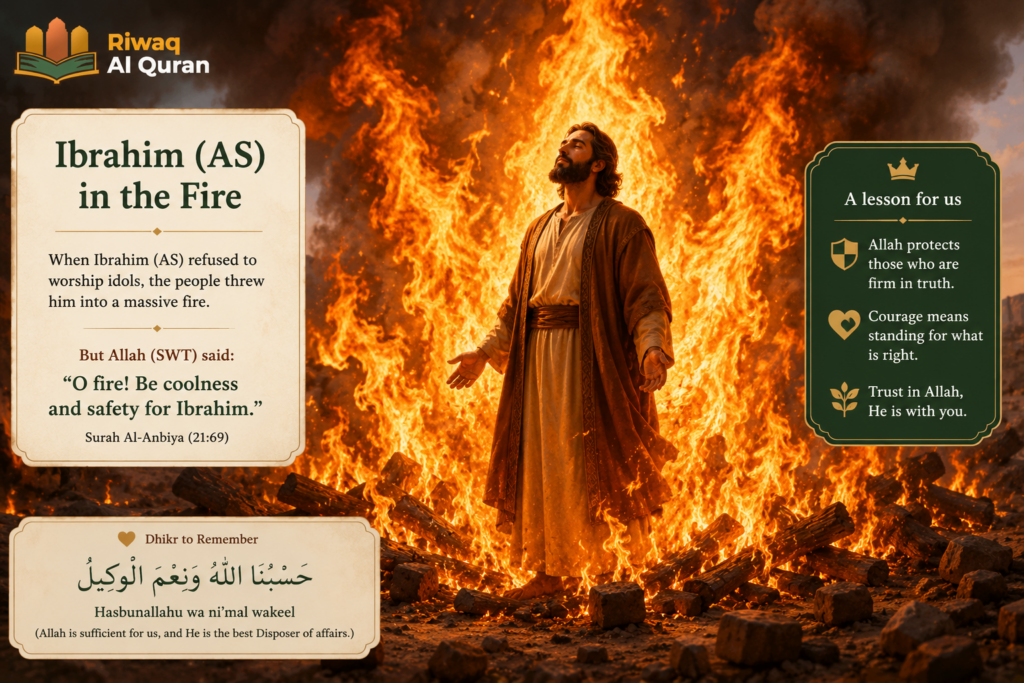
Ibrahim (AS) grew up surrounded by idol worshippers and questioned from a young age why people bowed to stone and wood that could neither hear nor help them. After destroying the idols, he was thrown into a blazing fire as punishment. Allah’s command made the fire powerless.
“قُلْنَا يَا نَارُ كُونِي بَرْدًا وَسَلَامًا عَلَىٰ إِبْرَاهِيمَ“
“We said, ‘O fire, be coolness and safety upon Ibrahim.'”Surah Al-Anbiya, 21:69
Allah did not extinguish the fire — He kept it burning and commanded it to become “cool and safe.” Scholars have noted the precision here: “cool” alone might have harmed him through extreme cold, so “and safe” came to complete the protection. When Allah protects, He protects completely. Teach your child: when you place your trust in Allah, don’t expect the problem to disappear — expect to become safe within it.
Hadith Supporting This Lesson
One phrase, said by two prophets in two different fires — this hadith shows why it still matters today:
“حَسْبُنَا اللَّهُ وَنِعْمَ الْوَكِيلُ. قَالَهَا إِبْرَاهِيمُ ﷺ حِينَ أُلْقِيَ فِي النَّارِ، وَقَالَهَا مُحَمَّدٌ ﷺ حِينَ قَالُوا: إِنَّ النَّاسَ قَدْ جَمَعُوا لَكُمْ فَاخْشَوْهُمْ، فَزَادَهُمْ إِيمَانًا وَقَالُوا: حَسْبُنَا اللَّهُ وَنِعْمَ الْوَكِيلُ“
“‘Allah is sufficient for us, and He is the best Disposer of affairs.’ Ibrahim (AS) said it when thrown into the fire; Muhammad ﷺ said it when they were told ‘the people have gathered against you, so fear them’ — and it only increased their faith.”(Narrated by Abu Dharr. Al-Hakim; authenticated by Al-Albani in Sahih al-Jami’ (6470). Also recorded in Mishkat al-Masabih, Hadith 2175.)
This hadith teaches the child two lessons for the price of one. First, that this phrase “Hasbunallahu wa ni’mal Wakeel” (“Allah is sufficient for us, and He is the best Disposer of affairs”) is not just a supplication — it is the chosen prophetic response in the most intense moments of fear. Second, that two of the greatest prophets said it in two different situations, which means it is fit for any moment a person feels they are facing something bigger than themselves. Teach your child to say it in times of hardship.
This story is most powerful for children who are beginning to reason about faith. Ibrahim (AS) did not simply believe — he observed the stars, the moon, and the sun, and reached conviction through honest questioning (Surah Al-An’am, 6:76–79). His story teaches children that sincere inquiry is not the opposite of faith — it can be the path to it.
4. The Story of Yusuf (AS) — From the Well to the Throne
- Best age: 8–12
- Core lesson: Patience through injustice, and forgiveness as a form of strength
The story of Yusuf (AS) is the most complete narrative in the Quran — an entire Surah spanning 111 verses dedicated to one life. His brothers threw him in a well out of jealousy. He was sold into slavery, falsely accused, and imprisoned. At every turn, he stayed patient and kept his connection with Allah. Years later, standing as the most powerful man in Egypt, he faced the brothers who had tried to destroy him.
“قَالَ لَا تَثْرِيبَ عَلَيْكُمُ الْيَوْمَ ۖ يَغْفِرُ اللَّهُ لَكُمْ ۖ وَهُوَ أَرْحَمُ الرَّاحِمِينَ“
“He said, ‘No blame will there be upon you today. Allah will forgive you, and He is the most merciful of the merciful.'”Surah Yusuf, 12:92
“لا تَثْرِيبَ” — no reproach, no rebuke, no reminder of what you did. Yusuf (peace be upon him) did not merely forgive — he closed the chapter as though it had never happened. And notice he did not say “I forgive you”; he said “Allah will forgive you” — he handed the entire matter over to Allah. This is profound spiritual maturity: true forgiveness does not seek praise for itself — it hands the matter to Allah and lets it end there.
Hadith Supporting This Lesson
Four generations of nobility in one line — this is how the Prophet ﷺ himself summed up Yusuf’s character:
“الكَرِيمُ ابْنُ الكَرِيمِ ابْنِ الكَرِيمِ ابْنِ الكَرِيمِ، يُوسُفُ بْنُ يَعْقُوبَ بْنِ إِسْحَاقَ بْنِ إِبْرَاهِيمَ“
“The noble, son of the noble, son of the noble, son of the noble — Yusuf, son of Yaqub, son of Ishaq, son of Ibrahim.”(Sahih al-Bukhari, Hadith 3383)
The Prophet ﷺ did not describe Yusuf as “the patient one” or “the forgiving one” — he called him “al-Karim” (the noble/generous one). In Arabic, “karam” carries the meaning of both noble lineage and elevated character together. This hadith offers a comprehensive description of Yusuf (peace be upon him): his character is the result of generations of prophethood and good character accumulating together. The lesson for the child: character is both inherited and built, and what Yusuf did on the day of forgiveness was not an exception — it was the natural extension of someone raised on this very character.
For children dealing with friendship betrayal, sibling rivalry, or social exclusion, this story is directly applicable. A child who memorizes this verse has a response model ready for the worst moments of their social life.
Parenting note: Parents often end this story at “he became powerful.” The real lesson is what Yusuf (AS) did with that power — he fed his enemies, forgave his betrayers, and reunited his family. Always end there, not at the throne.
5. The Story of Musa (AS) — A Baby, a River, and a Pharaoh
- Best age: 6–10
- Core lesson: Courage against injustice, and trusting Allah’s timing
Musa (AS) was born under a death sentence — Pharaoh was killing newborn Israelite boys. His mother, guided by Allah, placed him in a basket on the Nile. He was found by Pharaoh’s own household, raised in the palace of his enemy, and then chosen by Allah to confront that same Pharaoh and free his people.
“وَأَوْحَيْنَا إِلَىٰ أُمِّ مُوسَىٰ أَنْ أَرْضِعِيهِ ۖ فَإِذَا خِفْتِ عَلَيْهِ فَأَلْقِيهِ فِي الْيَمِّ وَلَا تَخَافِي وَلَا تَحْزَنِي ۖ إِنَّا رَادُّوهُ إِلَيْكِ وَجَاعِلُوهُ مِنَ الْمُرْسَلِينَ“
“And We inspired to the mother of Moses: ‘Nurse him; but when you fear for him, cast him into the river and do not fear and do not grieve. Indeed, We will return him to you and will make him one of the messengers.'”Surah Al-Qasas, 28:7
In a single verse: two seemingly contradictory commands (“suckle him” then “cast him into the river”) and two divine promises (“We will return him to you” and “We will make him one of the messengers”). This is the essence of the lesson: when Allah commands you to do something that feels frightening, fear is natural — but tawakkul means you move forward despite the fear. Musa’s mother did not cast him into the river because she felt no fear; she cast him because her belief in the promise was greater than her fear.
Hadith Supporting This Lesson
Three levels of standing against wrong — this hadith maps almost exactly onto Musa’s own story:
“مَنْ رَأَى مِنْكُمْ مُنْكَرًا فَلْيُغَيِّرْهُ بِيَدِهِ، فَإِنْ لَمْ يَسْتَطِعْ فَبِلِسَانِهِ، فَإِنْ لَمْ يَسْتَطِعْ فَبِقَلْبِهِ، وَذَلِكَ أَضْعَفُ الإِيمَانِ“
“Whoever among you sees evil, let him change it with his hand; if he cannot, then with his tongue; if he cannot, then with his heart — and that is the weakest of faith.”(Sahih Muslim, Hadith 49)
The entire journey of Musa (peace be upon him) is a practical application of this hadith: he confronted injustice with his hand when he was able to (the day he struck the man), with his tongue when he confronted Pharaoh, and with his heart when the means were constrained. For children who feel wronged at school or in their surroundings, this hadith gives them a practical map: you don’t have to fix every problem with your own hand — start from where you are able, and never let your heart accept silence in the face of wrong.
Children often feel powerless. The Story of Musa begins not with a prophet but with a frightened mother making an impossible decision — an entry point accessible to any child. The parting of the Red Sea (Surah Ash-Shu’ara, 26:63) is the dramatic climax, but the deeper lesson arrives earlier: Allah’s plan was already in motion the moment Musa was placed in the water.
6. The Story of Dawud (AS) and Goliath — Victory Without Superior Strength
- Best age: 5–9
- Core lesson: Allah’s permission makes the impossible outcome real
Dawud (AS) was a young shepherd when the armies of the Israelites stood paralyzed before the giant warrior Goliath. Every trained soldier was afraid. Dawud (AS) stepped forward with a slingshot and certainty in Allah — and won.
“زفَهَزَمُوهُم بِإِذْنِ اللَّهِ وَقَتَلَ دَاوُودُ جَالُوتَ وَآتَاهُ اللَّهُ الْمُلْكَ وَالْحِكْمَةَ وَعَلَّمَهُ مِمَّا يَشَاءُ“
“So they defeated them by permission of Allah, and David killed Goliath, and Allah gave him the kingship and wisdom and taught him from that which He willed.”Surah Al-Baqarah, 2:251
“بِإِذْنِ اللَّهِ” — “by Allah’s permission” — this phrase in the middle of the verse is not a literary addition. The Quran corrects the equation of victory: they did not win because Dawud was brave, nor because their strategy was better — but “by Allah’s permission.” And that divine permission came as a result of Dawud’s inner orientation of the heart, not his physical strength. Victory does not belong to the strongest — it belongs to the one most sincere in faith at that moment.
Hadith Supporting This Lesson
One moment of courage with a sling made Dawud famous — this hadith shows what made him great:
أَحَبُّ الصَّلَاةِ إِلَى اللَّهِ صَلَاةُ دَاوُدَ، وَأَحَبُّ الصِّيَامِ إِلَى اللَّهِ صِيَامُ دَاوُدَ: كَانَ يَنَامُ نِصْفَ اللَّيْلِ وَيَقُومُ ثُلُثَهُ وَيَنَامُ سُدُسَهُ، وَكَانَ يُفْطِرُ يَوْمًا وَيَصُومُ يَوْمًا“
“The most beloved prayer to Allah is the prayer of Dawud — he would sleep half the night, stand a third of it, and sleep a sixth of it. And the most beloved fast to Allah is the fast of Dawud — he would fast one day and break his fast the next.”(Sahih al-Bukhari, Hadith 1131)
Dawud, who killed Jalut (Goliath) with a sling, was not merely a passing moment of bravery — he was a person who built his relationship with Allah through regularity and consistency. This hadith completes the picture: courage in the great moment comes as the fruit of steadfastness in the small moments. For the child: heroism is not built on the battlefield — it is built in daily prayer, fasting, and remembrance. What people saw of Dawud’s courage was the result of what they never saw of his worship.
7. The Story of Sulaiman (AS) and the Ants — Power Used with Compassion
- Best age: 6–10
- Core lesson: True strength is shown in kindness to the small and weak
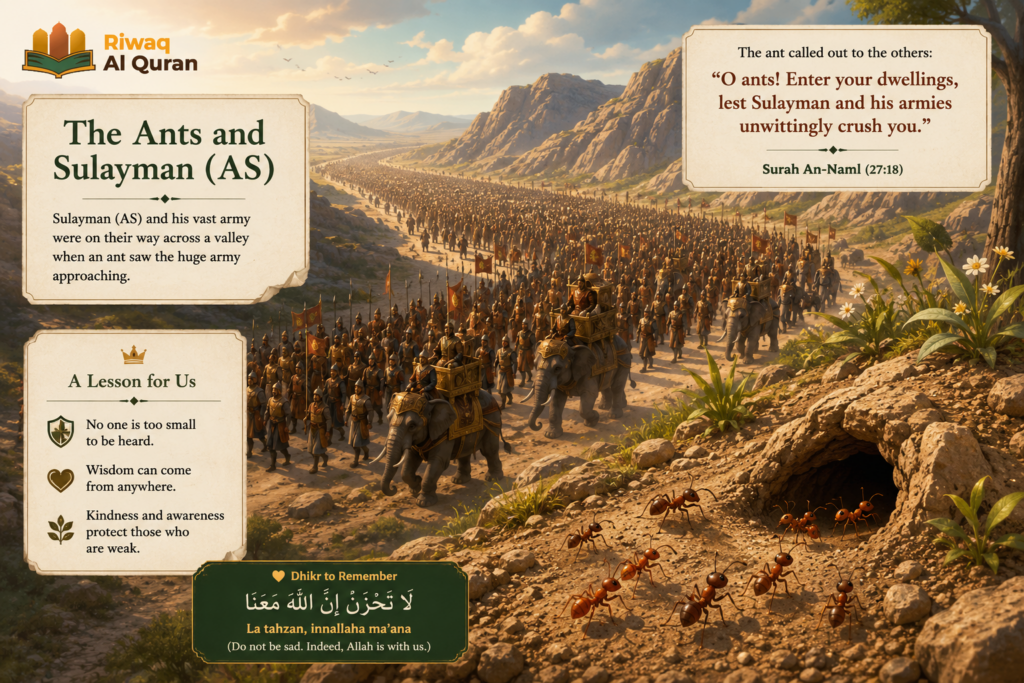
Sulaiman (AS) was given dominion over wind, animals, and jinn — the most powerful king of his time. As his army marched through a valley, a single ant warned its colony to take shelter before they were unknowingly crushed. Sulaiman (AS) heard her, stopped his entire army, and made du’a in gratitude.
“حَتَّىٰ إِذَا أَتَوْا عَلَىٰ وَادِ النَّمْلِ قَالَتْ نَمْلَةٌ يَا أَيُّهَا النَّمْلُ ادْخُلُوا مَسَاكِنَكُمْ لَا يَحْطِمَنَّكُمْ سُلَيْمَانُ وَجُنُودُهُ وَهُمْ لَا يَشْعُرُونَ ﴿١٨﴾ فَتَبَسَّمَ ضَاحِكًا مِّن قَوْلِهَا وَقَالَ رَبِّ أَوْزِعْنِي أَنْ أَشْكُرَ نِعْمَتَكَ الَّتِي أَنْعَمْتَ عَلَيَّ وَعَلَىٰ وَالِدَيَّ“
“Until, when they came upon the valley of the ants, an ant said, ‘O ants, enter your dwellings that you not be crushed by Solomon and his soldiers while they perceive not.’ So he smiled, amused at her speech, and said, ‘My Lord, enable me to be grateful for Your favor which You have bestowed upon me and upon my parents.'”Surah An-Naml, 27:18–19
The shift in the verse is remarkable: from the voice of a tiny ant → to the smile of the most powerful king on earth → to a prayer of gratitude. Three consecutive moments that teach the child that true power does not blind you — it sharpens your awareness. Sulaiman did not halt his army out of fear of being called harsh — he did it because his attentiveness to Allah made him attentive to even His smallest creature.
Hadith Supporting This Lesson
The lesson of compassion in Prophet Sulayman’s story is reinforced by a hadith that makes Ihsan a universal obligation in every action, no matter how great or small.
“إِنَّ اللَّهَ كَتَبَ الإِحْسَانَ عَلَى كُلِّ شَيْءٍ، فَإِذَا قَتَلْتُمْ فَأَحْسِنُوا الْقِتْلَةَ، وَإِذَا ذَبَحْتُمْ فَأَحْسِنُوا الذَّبْحَ“
“Indeed Allah has prescribed excellence (ihsan) in all things. So when you kill, kill well; and when you slaughter, slaughter well.”(Sahih Muslim, Hadith 1955)
Allah has decreed excellence (Ihsan) in all things” — Ihsan is not a moral option; it is a divine obligation prescribed toward everything. Sulaiman (peace be upon him) halted an entire army for the sake of a single ant — this is Ihsan in its clearest form. For the child: when you deal with your younger sibling, with your pet, with any creature weaker than you — Allah has decreed Ihsan upon you. It is not a choice, but a responsibility.
Use this story when a child is unkind to younger siblings, pets, or anyone they see as less significant. The contrast is memorable: the most powerful man on earth stopped for an insect.
8. The Story of Maryam (AS) and Isa (AS) — Faith When You Stand Alone
- Best age: 9–14
- Core lesson: Devotion to Allah is its own defense
Maryam (AS) was the most devoted woman in Islamic tradition recognized in the Quran — known for her constant worship and her withdrawal from society to focus on Allah. When she gave birth to Isa (AS) without a father, she faced the full weight of her community’s judgment alone. Allah told her not to speak. When she returned to her people, she pointed to the infant. Isa (AS) spoke from the cradle.
“قَالَ إِنِّي عَبْدُ اللَّهِ آتَانِيَ الْكِتَابَ وَجَعَلَنِي نَبِيًّا“
“He [Isa] said, ‘Indeed, I am the servant of Allah. He has given me the Scripture and made me a prophet.'”Surah Maryam, 19:30
The very first thing Isa (peace be upon him) said as an infant was: “Indeed, I am the servant of Allah.” Not “I am a miracle,” not “I am a stranger to you” — he began by defining his identity before Allah. This opening teaches children that the noblest statement a person can make when their existence or standing is questioned is: I am a servant of Allah. This identity needs no one’s defense.
Hadith Supporting This Lesson
The example of Maryam (peace be upon her) is reinforced by a hadith in which the Prophet ﷺ highlights the women whose faith, patience, and devotion set the highest standard for believers throughout history.
“حَسْبُكَ مِنْ نِسَاءِ الْعَالَمِينَ مَرْيَمُ ابْنَةُ عِمْرَانَ، وَخَدِيجَةُ بِنْتُ خُوَيْلِدٍ، وَفَاطِمَةُ بِنْتُ مُحَمَّدٍ، وَآسِيَةُ امْرَأَةُ فِرْعَوْنَ“
“Sufficient for you among the women of the world are Maryam daughter of ‘Imran, Khadijah daughter of Khuwaylid, Fatimah daughter of Muhammad, and Asiyah wife of Pharaoh.”(Jami’ at-Tirmidhi, Hadith 3878 (Sahih; authenticated by Imam al-Tirmidhi and Al-Albani))
The Prophet ﷺ chose four women out of all of history, and placed Maryam at the forefront of them. But what unites them? All of them faced tremendous solitude in the face of falsehood: Maryam standing before her own community, Khadijah at the very beginning of the message, Fatimah in the pain of losing her father, Asiyah inside Pharaoh’s own house. This hadith is for teenage girls who feel alone in their faith: standing alone in a position of truth is precisely the shared trait of the four greatest women history has known.
Surah Maryam is the only Surah in the Quran named after a woman — a distinction that carries its own teaching for children about the status of pious women in Islam. This story is best suited to older children and adolescents navigating social pressure around Islamic identity.
9. The Story of the People of the Cave — 300 Years of Divine Protection
- Best age: 10–14
- Core lesson: When society pressures you to abandon your faith, Allah protects those who hold firm
A group of righteous youths — described by the Quran specifically as fityah (فِتْيَة), youth — refused to participate in idol worship in their community and fled to a cave. Allah caused them to sleep for 300 years. When they woke, the society that had persecuted them was gone.
“إِنَّهُمْ فِتْيَةٌ آمَنُوا بِرَبِّهِمْ وَزِدْنَاهُمْ هُدًى ﴿١٣﴾ وَرَبَطْنَا عَلَىٰ قُلُوبِهِمْ إِذْ قَامُوا فَقَالُوا رَبُّنَا رَبُّ السَّمَاوَاتِ وَالْأَرْضِ لَن نَّدْعُوَ مِن دُونِهِ إِلَٰهًا“
Indeed, they were youths who believed in their Lord, and We increased them in guidance. And We bound their hearts together when they stood up and said, ‘Our Lord is the Lord of the heavens and the earth. Never will we invoke besides Him any deity.'”Surah Al-Kahf, 18:13–14
“وَرَبَطْنَا عَلَىٰ قُلُوبِهِمْ” — “And We strengthened/bound their hearts.” This binding of the heart is a form of divine steadfastness: Allah did not leave them to decide alone — He entered directly into the equation of their steadfastness. And just before it, “وَزِدْنَاهُمْ هُدًى” — “And We increased them in guidance.”
Guidance accumulates and increases the more a person remains firm upon it. The lesson: standing firm in faith does not weaken you over time — rather, Allah increases you in guidance the more the pressure increases.
Two Hadiths Supporting This Lesson
The lessons of Surah Al-Kahf are reinforced by authentic hadiths that connect its message to both real-life examples and regular acts of worship. Together, these narrations show that the story of the People of the Cave is not only meant to be remembered, but also to shape a believer’s actions and faith.
a. The Parallel Cave Story:
“قصة الثلاثة الذين آواهم المبيت إلى غار فانطبق عليهم، فقال بعضهم لبعض: انظروا أعمالاً عملتموها صالحة لله فادعوا الله بها لعله يُفرجها عنكم…”
“Three men were caught in a cave blocked by a boulder. Each made du’a to Allah through their best righteous deed. With each du’a, the rock moved, until they were freed.”(Sahih al-Bukhari, Hadith 2272; Sahih Muslim, Hadith 2244)
This noble hadith has a striking structural parallel with the story of the People of the Cave: people trapped in a cave, who turn to Allah through their righteous deeds, and Allah rescues them.
Bring the two stories together for older children: the Quranic story of the People of the Cave speaks of spiritual steadfastness, while the hadith teaches action and supplication through good deeds. The cave in both is not a prison — it is a refuge of salvation for those who turn to Allah.
The Prophet ﷺ also connected Surah Al-Kahf to a recurring weekly practice, ensuring that its lessons remain alive in the hearts of believers.
b. The Sunnah of Reading Surah Al-Kahf on Friday:
“مَنْ قَرَأَ سُورَةَ الْكَهْفِ يَوْمَ الْجُمُعَةِ أَضَاءَ لَهُ مِنَ النُّورِ مَا بَيْنَهُ وَبَيْنَ الْجُمُعَتَيْنِ“
“Whoever reads Surah Al-Kahf on Friday, a light will shine for him between the two Fridays.”(Narrated by Ahmad; authenticated by Al-Albani in Sahih al-Jami’ (Hadith 1424). Also cited in Mishkat al-Masabih, Hadith 2175.)
This hadith turns the story of the People of the Cave from a historical tale into a weekly practice. A child who knows the story of the youths recites the surah on Friday while remembering their steadfastness and what Allah prepared for them. Weekly repetition is exactly what fixes the lesson in long-term memory.
The Sunnah of reading Surah Al-Kahf every Friday means Muslim children encounter this story as a weekly ritual, not just a one-time tale. The number 300 years (Surah Al-Kahf, 18:25) is worth pausing on with older children: time means nothing to Allah. What matters is the state of faith, not the duration of the trial.
10. The Story of the Spider and the Bird — When the Smallest Help Comes from Allah
- Best age: 6–12
- Core lesson: Allah’s protection can arrive through the most unexpected means
During the Prophet Muhammad’s ﷺ migration (Hijra) to Madinah, he and Abu Bakr (RA) sheltered in the Cave of Thawr while enemies searched for them. A spider spun a web across the cave entrance; a dove nested nearby. The searchers passed the entrance assuming no one had recently entered.
“إِذْ يَقُولُ لِصَاحِبِهِ لَا تَحْزَنْ إِنَّ اللَّهَ مَعَنَا“
“When he said to his companion, ‘Do not grieve; indeed Allah is with us.'”Surah At-Tawbah, 9:40
“Do not grieve” — not “do not be afraid,” but “do not grieve.” Fear of the unknown is different from grief born of feeling lost. Abu Bakr (may Allah be pleased with him), in that moment, was not afraid for himself — he was afraid for the Prophet ﷺ. And the Prophet ﷺ did not reassure him with an escape plan, but with a truth: “Indeed, Allah is with us.” The presence of Allah with His servant is the ultimate security that needs no further explanation.
Hadith Supporting This Lesson
The events of the Hijrah demonstrate that sincere reliance on Allah is always accompanied by action. The Prophet ﷺ further explained this principle in the following hadith, using the daily journey of a bird to illustrate the true meaning of tawakkul.
“لَوْ أَنَّكُمْ كُنْتُمْ تَتَوَكَّلُونَ عَلَى اللَّهِ حَقَّ تَوَكُّلِهِ لَرَزَقَكُمْ كَمَا يَرْزُقُ الطَّيْرَ، تَغْدُو خِمَاصًا وَتَرُوحُ بِطَانًا“
“If you relied upon Allah with true reliance, He would provide for you as He provides for birds — they leave hungry in the morning and return full in the evening.“(Jami’ at-Tirmidhi, Hadith 2344 (Hasan Sahih)
The hadith specifically chose the bird as an example of tawakkul (reliance on Allah). And in the story of the Hijrah, the bird (the dove) and the spider were both instruments of divine protection. This connection between the hadith and the story teaches the child that tawakkul is not passivity — the bird goes out, strives, and moves, yet returns full because Allah is the Provider.
The Prophet ﷺ and Abu Bakr took action (the Hijrah), followed the means available to them (the cave, the guide, the alternate route), and Allah sent the spider and the dove. Tawakkul + action = complete divine protection.
A note worth teaching older children: The spider and bird detail comes from seerah narrations rather than direct Quranic text, while the cave event itself is referenced in the verse above. Making this distinction with children aged 10+ is a genuine Islamic literacy skill — knowing the difference between Quran, hadith, and seerah is foundational knowledge that most children’s content never teaches.
Why These Stories Work Differently from Other Children’s Stories
The Quran’s stories are built around one clear moral axis per narrative. Surah Yusuf is entirely about patience and forgiveness — every scene circles back to that theme. The Story of Ibrahim (AS) is entirely about trusting Allah when logic says otherwise. This makes them unusually easy for children to absorb:
- One hero, one test, one outcome tied directly to the hero’s response to Allah.
- The moral is the architecture of the narrative itself, not an afterthought.
- Children can replay the story mentally and reach the same conclusion each time.
Most children’s books treat morals as incidental. In Quran stories, the moral is the foundation the entire narrative is built on.
The Right Age to Start — A Practical Guide by Story
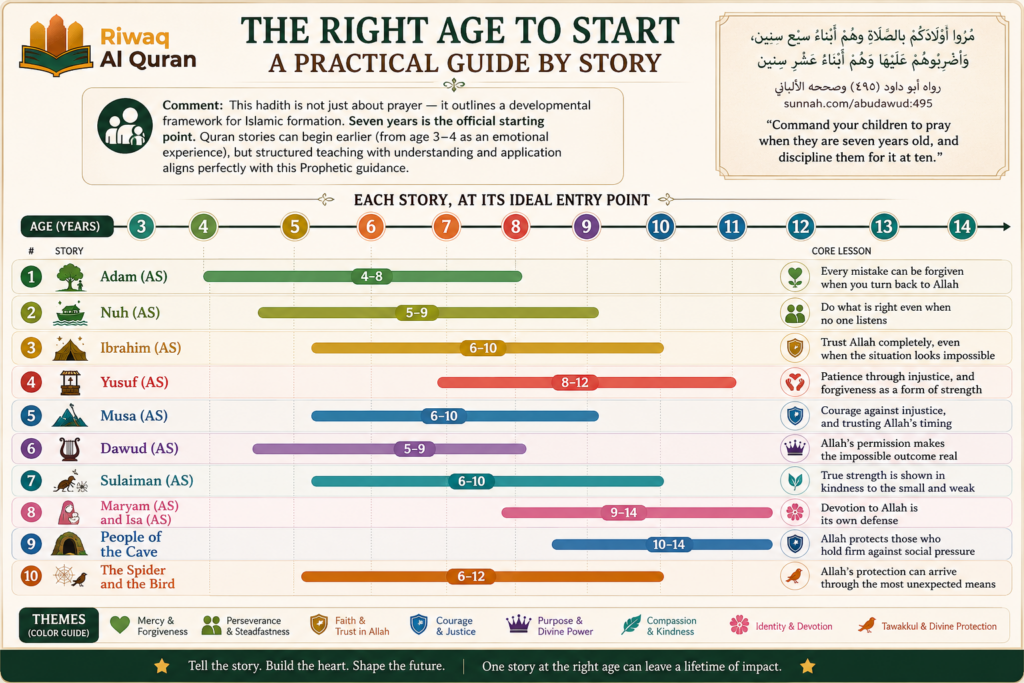
There is no minimum age for Quran stories, but delivery must match developmental stage. The Prophet ﷺ himself set a clear developmental marker for Islamic formation:
“مُرُوا أَوْلَادَكُمْ بِالصَّلَاةِ وَهُمْ أَبْنَاءُ سَبْعِ سِنِينَ، وَاضْرِبُوهُمْ عَلَيْهَا وَهُمْ أَبْنَاءُ عَشْرِ سِنِينَ“
“Command your children to pray when they are seven years old, and discipline them for it at ten.”(Sunan Abi Dawud, Hadith 495)
This hadith is not only about prayer — it lays out a staged educational framework: the age of seven marks the official starting point of formal Islamic formation. Quranic stories begin earlier than that (from around ages 3–4, as an emotional/experiential introduction), but structured teaching tied to understanding and application aligns precisely with this prophetic framework.
The table below maps each story to the age range where it is most naturally received, based on the moral complexity of each narrative and the cognitive stage required to fully absorb its lesson.
| # | Story | Best Age | Core Lesson |
|---|---|---|---|
| 1 | Adam (AS) | 4–8 | Every mistake can be forgiven when you turn back to Allah |
| 2 | Nuh (AS) | 5–9 | Do what is right even when no one listens |
| 3 | Ibrahim (AS) | 6–10 | Trust Allah completely, even when the situation looks impossible |
| 4 | Yusuf (AS) | 8–12 | Patience through injustice, and forgiveness as a form of strength |
| 5 | Musa (AS) | 6–10 | Courage against injustice, and trusting Allah’s timing |
| 6 | Dawud (AS) | 5–9 | Allah’s permission makes the impossible outcome real |
| 7 | Sulaiman (AS) | 6–10 | True strength is shown in kindness to the small and weak |
| 8 | Maryam (AS) and Isa (AS) | 9–14 | Devotion to Allah is its own defense |
| 9 | People of the Cave | 10–14 | Allah protects those who hold firm against social pressure |
| 10 | The Spider and the Bird | 6–12 | Allah’s protection can arrive through the most unexpected means |
Below age 6, a child processes a story as an emotional event — they feel the fear of the flood and the relief of Ibrahim safe from the fire. Abstract concepts like divine justice or monotheism land better after age 8, when a child can hold cause-and-effect reasoning across multiple steps. Each story below includes the recommended age window not as a strict rule, but as practical guidance for when each theme is most naturally received.
How to Tell These Stories So Children Remember Them — The 5-Step Method
Knowing the stories is step one. Telling them so a child retains, internalizes, and applies the lesson is a different skill entirely. The Prophet ﷺ taught with wisdom and ease:
“يَسِّرُوا وَلَا تُعَسِّرُوا، وَبَشِّرُوا وَلَا تُنَفِّرُوا“
“Make things easy and do not make them difficult. Give glad tidings and do not drive people away.” (Sahih al-Bukhari, Hadith 69)
This hadith is the educational constitution that comes before any method. Before you even think about the five steps, ask yourself: does my storytelling approach make things easy or difficult? Does it give glad tidings or does it repel?
A child who leaves the story session loving Allah and eager for more has learned more than a child who heard precise details and that was the end of it.
The following five steps work across all ages and all ten stories above.
1. Open with a Question, Not the Story
- “Have you ever made a mistake and felt really bad about it?” → before Adam (AS).
- “Have you ever been afraid of something much bigger than you?” → before Ibrahim (AS) or Dawud (AS).
- “Have you ever felt like no one was listening, no matter how hard you tried?” → before Nuh (AS).
Before you say “there was a prophet,” ask a question that activates the child’s own experience first:
This creates a personal entry point before the narrative begins.
2. Tell the Story Without Softening the Difficulty
Do not sanitize the hard parts:
- Yusuf (AS) was thrown into a well by his own brothers.
- Maryam (AS) stood alone against her entire community’s judgment.
- Nuh (AS) lost his own son to the flood.
Children recognize softened stories and stop taking them seriously. The difficulty is what makes the resolution meaningful — removing it removes the lesson.
3. Pause at the Turning Point and Ask: “What Would You Do?”
Before revealing what the prophet did, stop. “Yusuf was falsely accused and thrown in prison. What would you do?” Whatever the child says, follow with what Yusuf (AS) actually did — and ask why they think he chose that. This is where critical thinking and Islamic values meet directly.
4. Read or Recite the Arabic Verse
Even if a young child does not understand Arabic, hearing the actual words of the Quran at the story’s peak moment creates a different kind of impression than paraphrase:
- The verse becomes associated with the story’s emotional high point.
- Over time, when that child hears the same verse in salah, the story comes back with it.
- The Quran moves from being a recitation exercise to a living book.
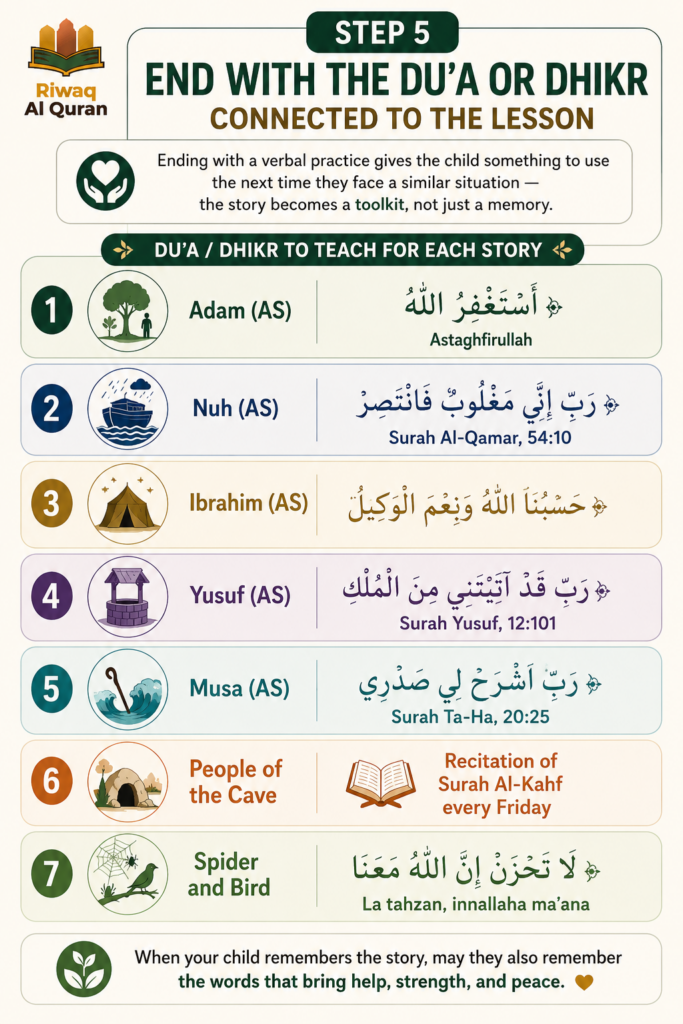
5. End with the Du’a or Dhikr Connected to the Lesson
Ending with a verbal practice gives the child something to use the next time they face a similar situation — the story becomes a toolkit, not just a memory. Below is the pairing for each story.
| Story | Du’a / Dhikr to Teach |
|---|---|
| Adam (AS) | أستغفر الله — Astaghfirullah |
| Nuh (AS) | رَبِّ إِنِّي مَغْلُوبٌ فَانتَصِرْ — Surah Al-Qamar, 54:10 |
| Ibrahim (AS) | حَسْبُنَا اللَّهُ وَنِعْمَ الْوَكِيلُ |
| Yusuf (AS) | رَبِّ قَدْ آتَيْتَنِي مِنَ الْمُلْكِ — Surah Yusuf, 12:101 |
| Musa (AS) | رَبِّ اشْرَحْ لِي صَدْرِي — Surah Ta-Ha, 20:25 |
| People of the Cave | Recitation of Surah Al-Kahf every Friday |
| Spider and Bird | لَا تَحْزَنْ إِنَّ اللَّهَ مَعَنَا |
Common Mistakes Parents Make When Telling Quran Stories
Good delivery makes these stories memorable. The three mistakes below consistently reduce their impact — and each one is easy to avoid once you recognize it.
1 . Using the Story as a Discipline Tool
The moment you say “and that’s why you should listen to me,” the child’s trust in the story shifts. The story stops being about Allah and starts being about your parenting agenda. The lesson from Adam’s story is mercy and repentance — not obedience to parents. Let the story teach on its own terms.
2 . Skipping the Quranic Verse
Parents often tell the full narrative but never open the Quran. A child who hears the Arabic verse once — even without understanding it — begins to associate the Quran itself with living stories rather than just recitation practice. That association is the beginning of a genuine relationship with the book.
3. Reserving Stories Only for Bedtime
The most effective moment to tell the story of Dawud and Goliath is right after a child has faced something scary. Stories that arrive when the relevant emotion is fresh become memory anchors — recalled precisely when the lesson is needed. Keep the stories in your daily repertoire, not just your bedtime routine.
If you want your child learning these stories with a qualified teacher who can bring them to life, answer real questions, and connect them to proper Quranic recitation — Riwaq Al-Quran’s online Islamic studies for kids provides exactly that, on a schedule that works for your family.
Why Quran Stories Build Islamic Character More Effectively Than Any Other Method
The Quran describes its own stories as ahsanal qasas — the best of stories (Surah Yusuf, 12:3). That is not a casual description. Each narrative was revealed at a specific moment in response to a specific need faced by the early Muslim community.
The same mechanism operates in a child: the right story at the right moment of a child’s experience creates understanding that instruction alone cannot.
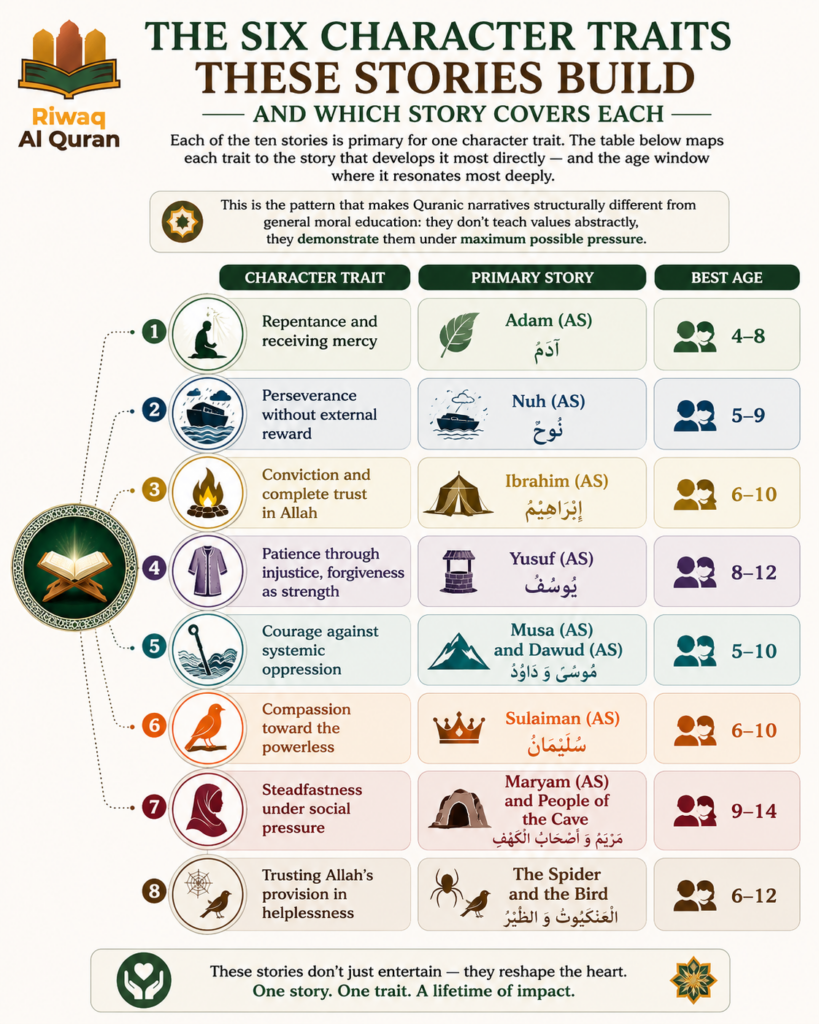
The Six Character Traits These Stories Build — and Which Story Covers Each
Each of the ten stories is primary for one character trait. The table below maps each trait to the story that develops it most directly — and the age window where it resonates most deeply. This is the pattern that makes Quranic narratives structurally different from general moral education: they don’t teach values abstractly, they demonstrate them under maximum possible pressure.
| Character Trait | Primary Story | Best Age |
|---|---|---|
| Repentance and receiving mercy | Adam (AS) | 4–8 |
| Perseverance without external reward | Nuh (AS) | 5–9 |
| Conviction and complete trust in Allah | Ibrahim (AS) | 6–10 |
| Patience through injustice, forgiveness as strength | Yusuf (AS) | 8–12 |
| Courage against systemic oppression | Musa (AS) and Dawud (AS) | 5–10 |
| Compassion toward the powerless | Sulaiman (AS) | 6–10 |
| Steadfastness under social pressure | Maryam (AS) and People of the Cave | 9–14 |
| Trusting Allah’s provision in helplessness | The Spider and the Bird | 6–12 |
When a child faces a specific challenge — betrayal by a friend, shame over a mistake, fear of standing out as Muslim — you can go directly to the story that matches their situation.
Start Your Child’s Quran Journey with Riwaq Al-Quran
Your child deserves to learn these stories from a teacher who knows how to bring the Quran to life — one who speaks Arabic natively, understands how children at each age process Islamic content, and can answer the real questions children ask when they hear these narratives.
Riwaq Al-Quran is a comprehensive online platform offering personalized Quran, Arabic, and Islamic Studies classes for individuals of all ages and backgrounds. Experienced instructors follow a structured curriculum covering Tajweed, Tafsir, and Memorization — through advanced online classes designed for seamless interaction between students and teachers.
Hear directly from our students about how Riwaq Al Quran Academy has transformed their connection with the Book of Allah:
The platform serves learners across five learning tracks:
- Online Quran classes for kids and adults
- Online courses for kids
- Online Arabic courses
- Online Ijazah courses
- Online Islamic Studies courses

For families getting started, two foundational courses build the skills every student needs before advancing:
| Course | What It Covers |
|---|---|
| Noorani Qaida Online | Letter recognition, sounds, and early Quranic reading |
| Online Quran Recitation Course | Fluency and accuracy in reading the Quran aloud |
For children specifically, the platform offers two dedicated programs built around the stories and values in this guide:
- Online Quran Classes for Kids — Interactive one-on-one sessions designed around children’s learning pace and attention span
- Online Islamic Studies for Kids — Structured Islamic education covering Quranic stories, the pillars of Islam, and core values
For students ready to go deeper, Riwaq Al-Quran offers advanced tracks: master recitation rules with Online Tajweed Classes, build a lasting relationship with the text through the Quran Memorization Online Course, understand meanings through the Online Tafseer Course, or explore all recitation traditions with the Online Qirat Course. Browse the full online Quran courses catalog or register directly to get started. The first session is free.

Conclusion
Quran stories for kids are not supplementary to Islamic education — they are its foundation. The ten stories covered here — Adam, Nuh, Ibrahim, Yusuf, Musa, Dawud, Sulaiman, Maryam, the People of the Cave, and the Spider and the Bird — together address the full range of tests a person faces:
- Mistakes and the path back through repentance.
- Persecution, loneliness, and the pressure to abandon faith.
- Injustice, betrayal, and the choice between bitterness and forgiveness.
- Fear in the face of something far larger than yourself.
Each story in this guide is grounded in a specific Quranic verse linked directly to quran.com, so children hear the actual words of Allah connected to the moment that matters. Each is reinforced by an authentic hadith from the Sunnah, sourced and linked to sunnah.com, because the Quran and the Sunnah are inseparable teachers. Each one maps to a specific character trait and a natural age window where it resonates most deeply.
The 5-Step Method gives you a repeatable structure for telling these stories so they create lasting memory — not just a bedtime tale forgotten by morning.
The next step is simple: choose one story, use one verse, read the hadith, ask your child one question before you begin, and see what happens.
For further reading on keeping Arabic and Islamic learning connected at home, see 13 Arabic Games for Kids — practical activities that reinforce the language behind these stories.
Frequently Asked Questions
The questions below address the most common concerns parents and educators raise when introducing Quran stories to children — from the right starting age to how to handle more complex narrative elements.
1. What is the best age to start telling children Quran stories?
You can begin as early as age 3 with simple narratives like Adam (AS) and Nuh (AS), using emotion and retelling. More complex themes work best at later stages:
Social pressure and identity — Maryam (AS) or the People of the Cave: best from age 9
Sustained adversity and forgiveness — Yusuf (AS): best from age 8
Courage and systemic injustice — Musa (AS) and Dawud (AS): accessible from age 6
Abstract concepts like divine justice or monotheism land better after age 8, when a child can reason through cause-and-effect moral logic across a full narrative arc.
2. Which Quran story is the most complete in the Quran?
The story of Yusuf (AS) is the most complete in the Quran, occupying an entire Surah — Surah Yusuf, chapter 12, spanning 111 verses. It covers his childhood, trials, imprisonment, rise to power, and family reunion, making it the only story in the Quran told as a continuous narrative from beginning to end. The Quran itself calls it ahsanal qasas — the best of stories.
3. What is the most frequently mentioned prophet in the Quran?
Musa (AS) is the most frequently referenced prophet in the Quran, mentioned in over 30 Surahs. No other prophet’s story appears as often. This repetition is itself a teaching: Musa’s life covers fear, courage, mistakes, and complete reliance on Allah, making it applicable across a wider range of human experiences than any other single narrative.
4. How do I make Quran stories engaging for older children and teenagers?
For children aged 10 and above, move beyond the narrative and engage the reasoning:
Ask: “Why do you think Ibrahim (AS) used logical argument with his people before the miracle came?”
Connect to current situations: “What does it look like to face pressure to do something wrong today?”
Focus on stories with real social cost — Maryam (AS) and the People of the Cave both involve direct pressure to abandon Islamic identity, and both show Allah’s protection arriving without requiring the believer to compromise
Teenagers respond to stories where the hero faces genuine doubt, real fear, and clear social consequences — not sanitized versions where the difficulty is removed.
5. Do children need to understand Arabic to benefit from the Quranic verses?
No. Hearing the Arabic verse at the emotional peak of a story creates a meaningful association even without comprehension. Over time, as children learn:
To recite through Quran classes for kids
To read with proper pronunciation through Tajweed practice
To understand meaning through Tafseer study
…they recognize those verses and the stories come back with them. The association is built first through experience, then deepened through understanding.
6. Are all ten of these stories drawn directly from the Quran?
Nine of the ten stories are sourced directly from Quranic accounts. The spider and bird detail during the Prophet’s ﷺ migration to Madinah comes from seerah narrations, though the Cave of Thawr event itself is referenced in Surah At-Tawbah, 9:40. Teaching older children this distinction is a genuine Islamic literacy skill — knowing the difference between Quran, hadith, and seerah is foundational knowledge that most children’s resources skip entirely.
Sources
The Quranic verses in this article are linked to quran.com, the standard reference for Arabic Quranic text with English translations.
All hadiths are sourced from sunnah.com, the standard scholarly reference for the six major hadith collections. Hadiths from Bukhari and Muslim are graded sahih by scholarly consensus. Hadiths from Tirmidhi, Abu Dawud, and Ibn Majah cited here are authenticated (sahih) by Sheikh Nasiruddin Al-Albani.
- Bukhari 5027 — خَيْرُكُمْ مَنْ تَعَلَّمَ الْقُرْآنَ وَعَلَّمَهُ
- Abu Dawud 495 — مُرُوا أَوْلَادَكُمْ بِالصَّلَاةِ
- Tirmidhi 2499 — كُلُّ ابْنِ آدَمَ خَطَّاءٌ
- Bukhari 1469 — وَمَا أُعْطِيَ أَحَدٌ عَطَاءً خَيْرًا مِنَ الصَّبْرِ
- Bukhari 4563 — حَسْبُنَا اللَّهُ وَنِعْمَ الْوَكِيلُ
- Bukhari 3383 — الكَرِيمُ ابْنُ الكَرِيمِ يُوسُفُ
- Muslim 49 — مَنْ رَأَى مِنْكُمْ مُنْكَرًا فَلْيُغَيِّرْهُ
- Bukhari 1131 — أَحَبُّ الصَّلَاةِ إِلَى اللَّهِ صَلَاةُ دَاوُدَ
- Muslim 1955 — إِنَّ اللَّهَ كَتَبَ الإِحْسَانَ عَلَى كُلِّ شَيْءٍ
- Tirmidhi 3878 — مَرْيَمُ ابْنَةُ عِمْرَانَ مِنْ خَيْرِ نِسَاءِ الْعَالَمِينَ
- Bukhari 2272 — الثلاثة الذين آواهم الغار
- Mishkat 2175 — مَنْ قَرَأَ سُورَةَ الْكَهْفِ يَوْمَ الْجُمُعَةِ
- Tirmidhi 2344 — تَوَكَّلُوا عَلَى اللَّهِ كَمَا يَرْزُقُ الطَّيْرَ
- Bukhari 69 — يَسِّرُوا وَلَا تُعَسِّرُوا