Reading the Quran benefits Muslims on three connected levels: it deepens faith and inner peace, supports mental and emotional well-being, and carries a reward system the Quran and Hadith describe in specific, concrete terms — not vague spiritual benefit alone. Allah describes the effect of remembering Him directly:
(أَلَا بِذِكْرِ اللَّهِ تَطْمَئِنُّ الْقُلُوبُ)
“Verily, in the remembrance of Allah do hearts find rest.”(Surah Ar-Ra’d, 13:28)
Most articles on this topic list benefits without explaining the mechanism behind each one, or without saying clearly which claims are settled and which are a matter of belief.
Reading the Quran benefits Muslims spiritually, mentally, and emotionally — it strengthens faith, reduces stress, improves focus, and earns reward in this life and the Hereafter, according to the Quran and authentic Hadith. Each category below works through a different mechanism, which is why they’re covered separately rather than as one long list.
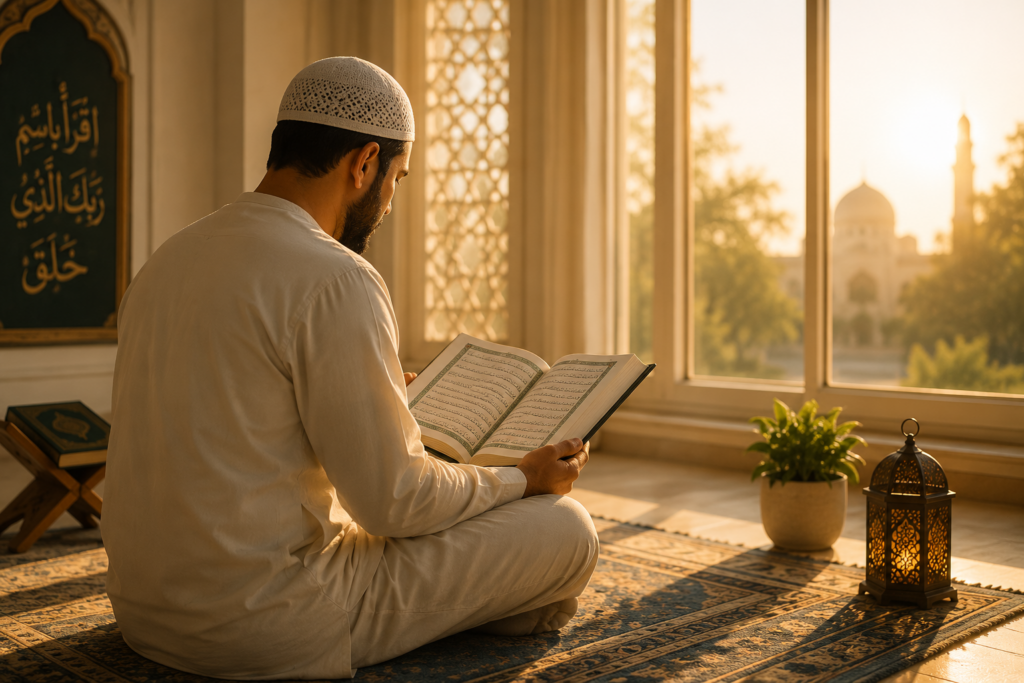
Ask ten Muslims what reading the Quran does for them, and most will start with the same word: peace. That’s not a coincidence — the Quran names this effect directly rather than leaving it to the reader’s interpretation.
The Quran holds great spiritual significance for Muslims all over the world, and that explains why The Quran is important To Muslims.. Reading the Quran not only strengthens one’s connection with their faith but also brings about numerous spiritual benefits.
Table of Contents
1. Reading the Quran Brings Tranquility and Inner Peace
The calm many readers describe isn’t just a subjective impression — it’s the stated purpose of Surah Ar-Ra’d, 13:28, quoted above.
What distinguishes this from general relaxation is the source: the peace is tied to remembering Allah specifically, not to the act of reading in the abstract, which is why many readers report the same calm even during difficult verses that aren’t comforting in content on the surface — a fear-focused verse can produce the same settling effect as a mercy-focused one, since the mechanism is remembrance itself, not the emotional tone of the words.
2. Reading the Quran Strengthens Faith and Trust in Allah
Allah describes exactly this effect in believers directly:
(إِنَّمَا الْمُؤْمِنُونَ الَّذِينَ إِذَا ذُكِرَ اللَّهُ وَجِلَتْ قُلُوبُهُمْ وَإِذَا تُلِيَتْ عَلَيْهِمْ آيَاتُهُ زَادَتْهُمْ إِيمَانًا)
“The believers are only those whose hearts tremble with awe when Allah is mentioned, and whose faith increases when His verses are recited to them.” (Surah Al-Anfal, 8:2)
This verse is worth reading closely: faith is described here as something that measurably increases through exposure to specific verses, not something fixed at the point of belief.
Faith built through occasional exposure tends to weaken under pressure; faith built through this kind of regular engagement holds up differently — reading consistently gives a believer a reservoir of familiar verses to draw from during hardship, rather than a text encountered for the first time in a moment of crisis.
3. Reading the Quran Purifies the Soul Through Reflection
Allah states the underlying principle behind this benefit directly:
(قَدْ أَفْلَحَ مَن زَكَّاهَا وَقَدْ خَابَ مَن دَسَّاهَا)
“He has certainly succeeded who purifies his soul, and he has failed who instills it with corruption.” (Surah Ash-Shams, 91:9-10)
Reflection prompted by Quranic reading works less like a moral checklist and more like ongoing self-accountability — the text repeatedly returns to the same themes of accountability and mercy, which pushes a regular reader toward re-examining their own conduct rather than reading once and moving on.
This verse frames purification as something a person actively does to their own soul, not something that happens passively by proximity to scripture — which is why reflection, not just exposure, is the mechanism scholars point to here.
4.Reading the Quran Reduces Stress and Supports Emotional Well-Being
The calming effect linked to reciting and reflecting on Quranic verses is commonly attributed by researchers to the rhythmic, measured pace of recitation combined with sustained, focused attention — the same combination behind the documented calming effect of other rhythmic, meditative practices, applied here to Arabic recitation specifically.
This is distinct from benefit 1 above: tranquility there comes from the meaning of remembrance itself, while this effect is tied more to the physical rhythm and pacing of recitation, which is why even listening to unfamiliar Arabic recitation can produce a calming effect before comprehension fully develops.
The Quran contains information about scientific concepts that were not known at the time of its revelation, such as the Theory of Relativity, the Big Bang Theory, genetics, black holes, and more. This demonstrates the compatibility between the Quran and science.
5. Reading the Quran Sharpens Focus and Strengthens Memory
Recitation demands the reader hold attention on sound, meaning, and pronunciation simultaneously, and that kind of layered repetition is a well-established memory-reinforcement mechanism — comparable to spaced repetition used in language learning, except practiced daily as an act of worship rather than a study technique.
This is worth naming as a genuinely transferable skill: the same repeated, attentive engagement that builds Quranic memory also strengthens general working memory and sustained attention, which is part of why lifelong reciters often describe an easier time memorizing other material later in life.
6. Reading the Quran Earns a Reward Multiplied Ten Times for Every Letter
The Prophet ﷺ said:
(مَنْ قَرَأَ حَرْفًا مِنْ كِتَابِ اللَّهِ فَلَهُ بِهِ حَسَنَةٌ، وَالْحَسَنَةُ بِعَشْرِ أَمْثَالِهَا، لَا أَقُولُ الم حَرْفٌ، وَلَكِنْ أَلِفٌ حَرْفٌ، وَلَامٌ حَرْفٌ، وَمِيمٌ حَرْفٌ)
“Whoever reads a letter from the Book of Allah will have a reward, and that reward is multiplied by ten. I am not saying that Alif-Lam-Meem is one letter — rather, Alif is a letter, Lam is a letter, and Meem is a letter.” (Jami’ at-Tirmidhi 2910, graded Sahih by Al-Albani)
The specificity here matters, and it’s a detail most articles skip past: the Prophet ﷺ deliberately corrected a possible misunderstanding, insisting that a three-letter combination be counted as three separate letters, not one.
This means the reward scales with the actual number of letters read, which is why even a short verse recited in a spare minute between tasks generates measurable reward under this hadith — length isn’t a precondition, and there’s no minimum amount of Quran you need to read in one sitting to benefit from it.
If sorting sound Tafsir from unsupported claims about the Quran interests you, Riwaq Al Quran‘s Tafseer course is built around exactly this kind of careful, source-grounded interpretation — not popular claims repeated without checking.
7. Reading the Quran Brings Intercession on the Day of Judgment
The Prophet ﷺ described the Quran directly as an intercessor for those who engage with it:
(اقْرَءُوا الْقُرْآنَ فَإِنَّهُ يَأْتِي يَوْمَ الْقِيَامَةِ شَفِيعًا لِأَصْحَابِهِ)
“Read the Quran, for it will come on the Day of Judgment as an intercessor for those who read it.” (Sahih Muslim 804)
The condition attached in the fuller hadith — “for those who read it” and act on it — distinguishes this from reading alone; the intercession is tied to genuine, ongoing engagement, not recitation performed once and forgotten.
This is why scholars generally treat intercession as something built over a relationship with the text, not earned through a single reading session.
8. Reading the Quran Counts Among the Good Deeds That Offset Wrongdoing
Allah states the broader principle underlying this benefit:
(وَأَقِمِ الصَّلَاةَ طَرَفَيِ النَّهَارِ وَزُلَفًا مِّنَ اللَّيْلِ ۚ إِنَّ الْحَسَنَاتِ يُذْهِبْنَ السَّيِّئَاتِ)
“And establish prayer at the two ends of the day and at the approach of the night. Indeed, good deeds do away with misdeeds.” (Surah Hud, 11:114)
Reciting the Quran falls under this general principle of good deeds offsetting wrongdoing, rather than functioning as some separate, standalone mechanism specific to reading alone.
This distinction matters practically: it means Quran reading works alongside other good deeds as part of a cumulative effect, not as a shortcut that operates independently of a person’s other conduct.
9. Memorizing the Quran While Reading It Raises Your Rank in the Hereafter
Memorization carries a reward structure the other reading methods don’t. The Prophet ﷺ said:
يُقَالُ لِصَاحِبِ الْقُرْآنِ اقْرَأْ وَارْتَقِ وَرَتِّلْ كَمَا كُنْتَ تُرَتِّلُ فِي الدُّنْيَا فَإِنَّ مَنْزِلَتَكَ عِنْدَ آخِرِ آيَةٍ تَقْرَؤُهَا
“It will be said to the companion of the Quran: ‘Recite and ascend, and recite as you used to recite in the world, for your rank will be at the last verse you recite.'” (Sunan Abi Dawud 1464; Jami’ at-Tirmidhi 2914, graded Hasan)
That means the depth of someone’s memorization directly maps to their described rank — a mechanism unique to Hifz among the different reading methods, and one scholars specifically tie to memorizing with genuine understanding and application, not recitation alone.
A related hadith reinforces the practical side of this: the one who recites with difficulty still earns double reward for the effort, meaning this benefit is available to a beginner as much as to a fluent Hafiz, just calibrated to where each person actually is.
How Your Reading Method Changes the Benefit?
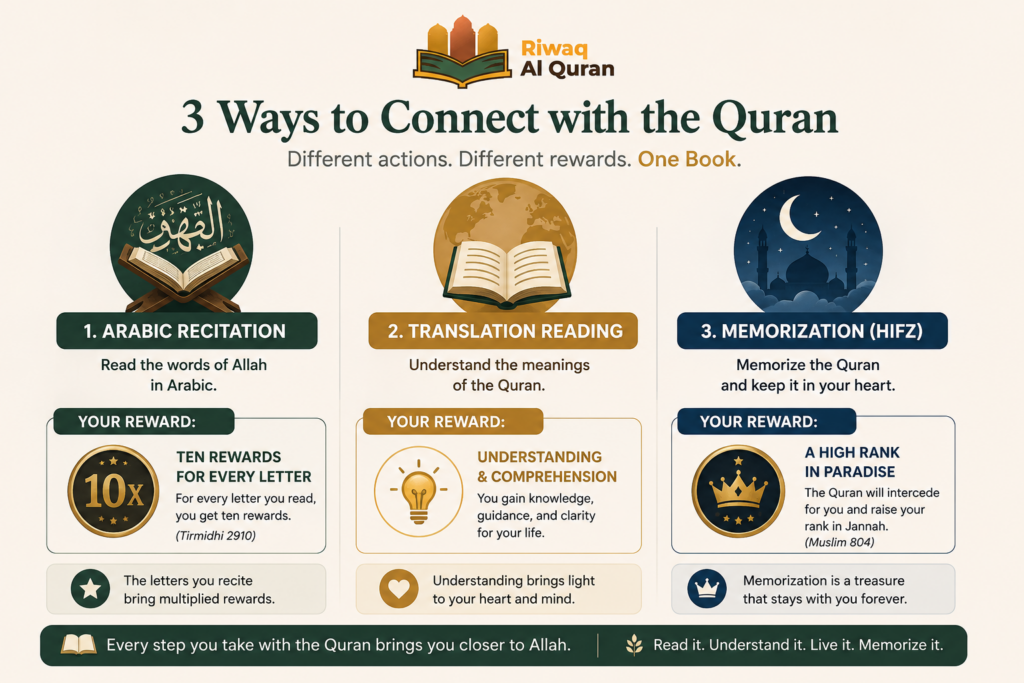
Reciting Arabic, reading a translation, and memorizing the text aren’t interchangeable paths to the same outcome — each one unlocks something the others don’t, and knowing the difference changes where you should actually invest your time.
1. Reading With Tajweed
Tajweed governs correct pronunciation and articulation of Quranic Arabic, and it does more than make recitation sound better.
A hadith attributed to Aisha describes the fluent reciter as being in the company of:
(الْمَاهِرُ بِالْقُرْآنِ مَعَ السَّفَرَةِ الْكِرَامِ الْبَرَرَةِ، وَالَّذِي يَقْرَأُ الْقُرْآنَ وَيَتَتَعْتَعُ فِيهِ وَهُوَ عَلَيْهِ شَاقٌّ لَهُ أَجْرَانِ )
“the noble and obedient angels” — but the same hadith adds that someone who struggles through the recitation still earns a doubled reward for the extra effort (Sahih al-Bukhari 4937; Sahih Muslim 798).
In practice, that means beginners shouldn’t wait until their Tajweed is polished to start reciting regularly — the struggling reciter isn’t penalized, they’re rewarded twice.
Start your journey towards a deeper spiritual connection with Riwaq Al-Quran’s online Tajweed classes. Join us today to perfect your recitation and understand the Quran like never before!
Here’s a short breakdown of why Tajweed matters in the first place, even while you’re still building it up.
2. Reading With Translation
A translation opens the meaning to anyone who doesn’t read Arabic, and it’s genuinely valuable for reflection and applying guidance to daily decisions.
Where scholars draw a clear line is on reward mechanics: translation is tafsir — explanation of meaning — not the Quran’s own wording, so it doesn’t carry the specific letter-based reward tied to reciting the Arabic text itself, even though reading it still counts as knowledge-seeking in its own right.
3. Memorizing the Quran (Hifz)
Memorization carries a reward structure the other two methods don’t: a hadith states that the person who memorized the Quran will be told, on entering Paradise, to keep reciting and rising a level for every verse recited, until they reach the last verse they memorized (Sunan Ibn Majah 3779).
That means the depth of someone’s memorization directly maps to their described rank — a mechanism unique to Hifz among the three reading methods.
Here’s what that kind of structured memorization can lead to — one of our students placing first in Juz’ memorization.
Structured guidance changes how fast this actually happens — Riwaq Al Quran‘s Quran Memorization course pairs you with an instructor who tracks retention session by session, rather than leaving you to catch memorization slips on your own.
Why the Timing and Consistency of When You Read Matters?
Most guides stop at “read daily.” The more useful question is when in the day, and why the length of each session matters less than most people assume.
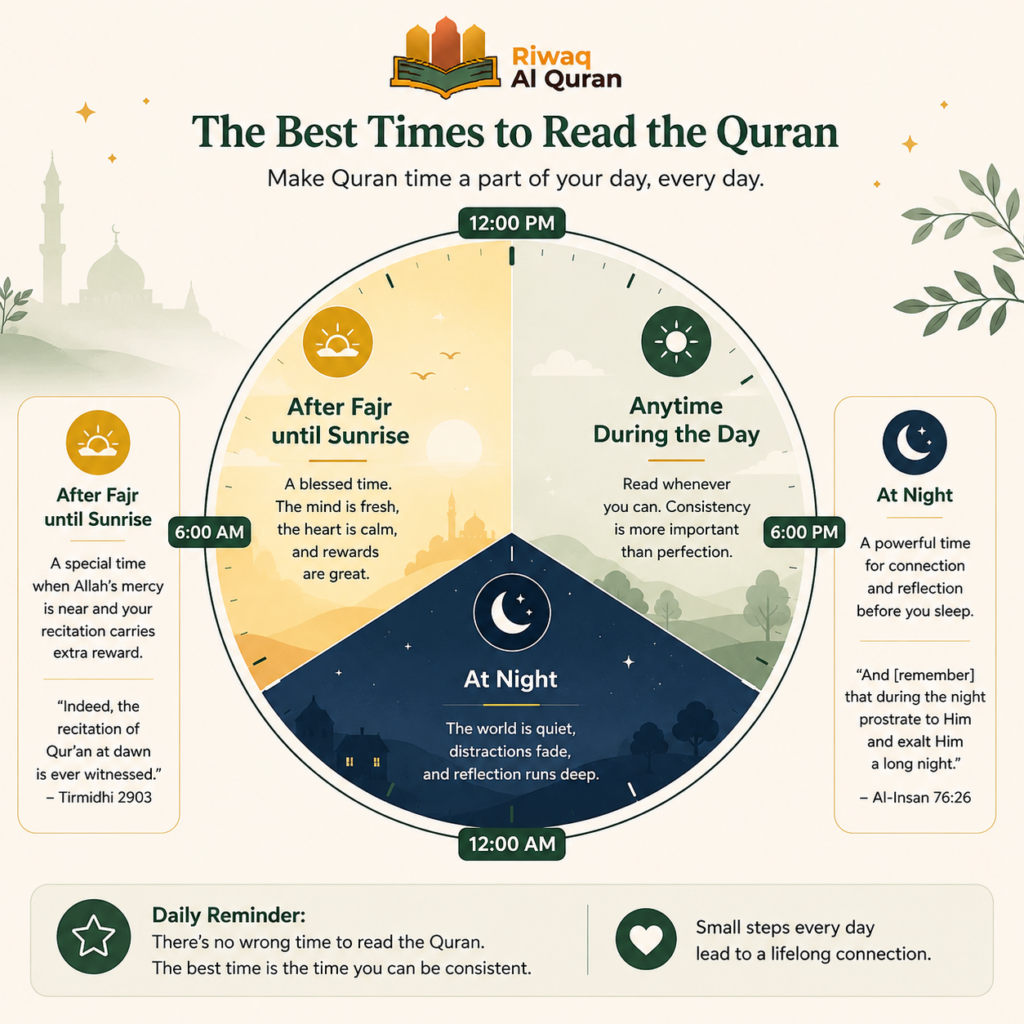
a. Reading After Fajr
A mind that hasn’t yet absorbed the day’s demands holds focus differently than one already juggling messages and tasks — which is why many practitioners find recitation right after Fajr easier to concentrate on and easier to retain than the same reading attempted later.
This isn’t just a modern productivity observation; the Quran singles out Fajr recitation specifically:
(وَقُرْآنَ الْفَجْرِ ۖ إِنَّ قُرْآنَ الْفَجْرِ كَانَ مَشْهُودًا)
“…and the recitation of dawn. Indeed, the recitation of dawn is ever witnessed.” (Surah Al-Isra, 17:78)
Scholars read “ever witnessed” as referring to the angels of the night and day shift changing over specifically at Fajr, meaning this particular reading window carries a documented significance beyond just being a quiet time of day — it’s a moment the Quran itself marks as distinct.
b. Reading at Night
Information encountered close to sleep tends to consolidate into memory more effectively — a general memory mechanism, not unique to Quranic text, but one that transfers well to it. The Quran makes a related observation about the quality of nighttime worship specifically:
(إِنَّ نَاشِئَةَ اللَّيْلِ هِيَ أَشَدُّ وَطْئًا وَأَقْوَمُ قِيلًا)
“Indeed, the hours of the night are more effective for concentration and better for expression.” (Surah Al-Muzzammil, 73:6)
This verse describes nighttime worship as having a different quality of focus than daytime activity — quieter surroundings and fewer competing demands allow words to settle more deliberately, which lines up with the same memory-consolidation window sleep researchers describe.
Reading a few verses before bed, rather than only during the day, gives that consolidation window a chance to work.
c. Consistency Matters More Than Session Length
Here’s the mistake worth naming directly: treating Quran reading as something to binge on free days and skip during busy weeks. The Prophet ﷺ addressed this exact pattern directly, when Aisha asked him which deeds Allah loves most:
(سَدِّدُوا وَقَارِبُوا، وَاعْلَمُوا أَنْ لَنْ يُدْخِلَ أَحَدَكُمْ عَمَلُهُ الْجَنَّةَ، وَأَنَّ أَحَبَّ الْأَعْمَالِ أَدْوَمُهَا إِلَى اللَّهِ وَإِنْ قَلَّ)
“Do good deeds properly, sincerely, and moderately, and know that the most beloved deed to Allah is the one done most consistently, even if it is small.” (Sahih al-Bukhari 6464)
This is precisely the trade-off most beginners get wrong: a small, consistent habit is explicitly described here as more valuable than an intense but irregular one, not just more practical. A single page read daily builds far more retention over a year than long sessions squeezed in irregularly, because each gap resets momentum the way skipped days reset any habit.
Ten minutes a day, done daily, is closer to what this hadith actually describes as beloved to Allah than an hour once a week ever will be — this isn’t just a memory-science tip, it’s the standard the Prophet ﷺ set directly.
Rewards for Reading the Quran
Beyond the personal and cognitive benefits above, the Quran and Hadith attach a specific, quantifiable reward structure to the act of reading itself — not a vague promise, but a stated mechanism.
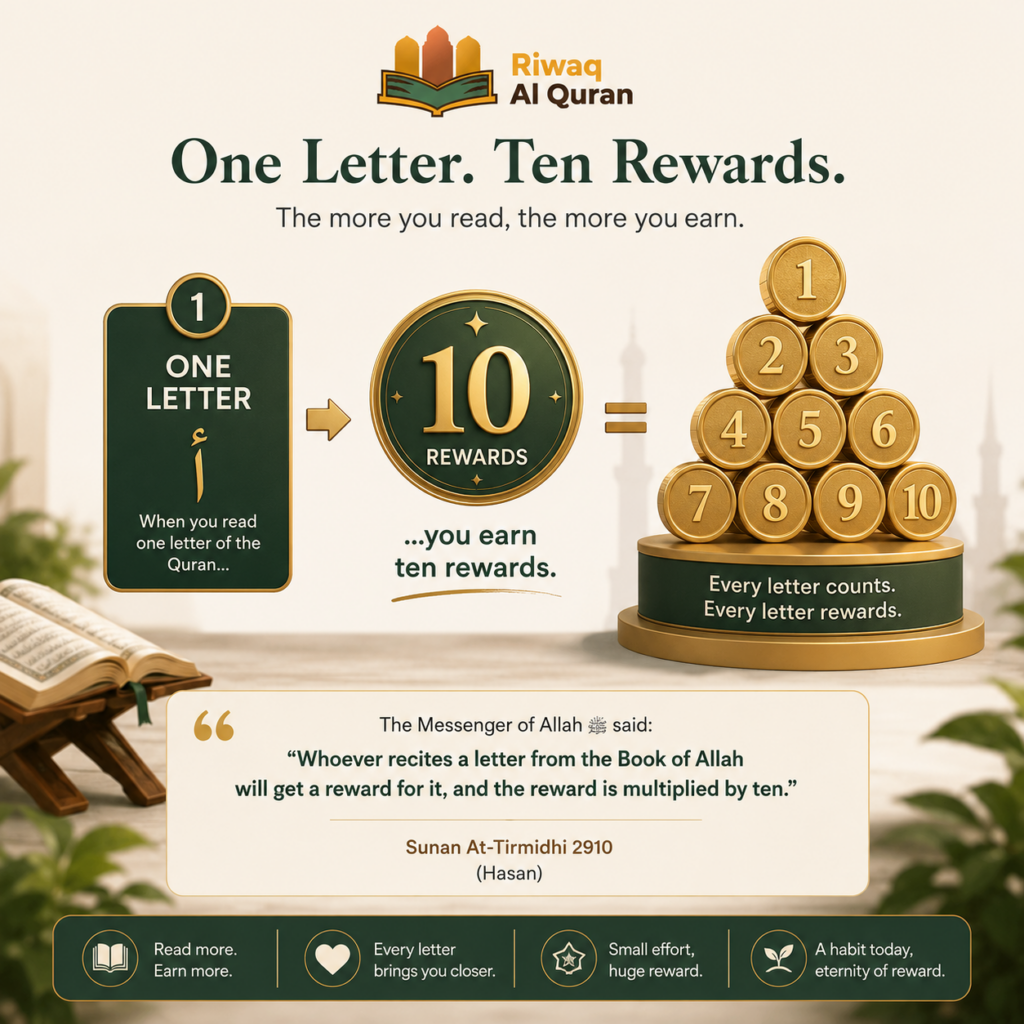
1. Multiplied Reward for Every Letter
The Prophet ﷺ said: “Whoever reads a letter from the Book of Allah will have a reward, and that reward is multiplied by ten. I am not saying that Alif-Lam-Meem is one letter — rather, Alif is a letter, Lam is a letter, and Meem is a letter” (Jami’ at-Tirmidhi, Hadith 2910, graded Sahih by al-Albani).
The specificity here matters: the reward is counted per letter, which means even a short verse recited in a spare minute between tasks generates measurable reward under this hadith — length isn’t a precondition.
2. Intercession on the Day of Judgment
The Prophet ﷺ described the Quran coming as an intercessor for those who read and acted on it, pleading on their behalf on the Day of Judgment (narrated in Sahih Muslim, Book of Prayer, Hadith 804).
The condition attached — “read and acted upon it” — distinguishes this from reading alone; the intercession is tied to application, not recitation in isolation.
3. Recitation as a Path to Erasing Wrongdoing
Allah states the broader principle underlying this: وَأَقِمِ الصَّلَاةَ طَرَفَيِ النَّهَارِ وَزُلَفًا مِّنَ اللَّيْلِ ۚ إِنَّ الْحَسَنَاتِ يُذْهِبْنَ السَّيِّئَاتِ (Surah Hud, 11:114) — “And establish prayer at the two ends of the day and at the approach of the night.
Indeed, good deeds do away with misdeeds.” Recitation falls under this general principle of good deeds offsetting wrongdoing, rather than functioning as some separate, standalone mechanism specific to reading alone.
Benefits of Reading the Quran after Fajr
Engaging with the Quran after the Fajr prayer holds great significance for Muslims. Here are some significant benefits:
1. Sense of Achievement:
Starting the day with the recitation of the Quran after Fajr prayer establishes a productive and rewarding routine, leading to a sense of accomplishment and motivation throughout the day.
2. Increased Focus and Concentration:
Reading the Quran after Fajr prayer, when the mind is fresh and undistracted, allows for enhanced focus, attentiveness, and absorption of its teachings.
3. Barakah (Blessings) in the Day
It is believed that reciting the Quran after Fajr brings an abundance of blessings (barakah) into one’s day, setting a positive tone and fostering a pious mindset to tackle challenges and make the most of the day.
Refine your Quranic recitation skills with Riwaq Al-Quran’s Online Qirat Course. Learn from expert instructors and unlock your full potential in the beautiful art of Quranic recitation.
Memorize the Quran With Confidence
Knowing these benefits is one step; building a habit that actually sustains them long enough to matter takes structure most people don’t build on their own.
Riwaq Al Quran offers a comprehensive online Quran memorization course designed to help you memorize the Quran with confidence. Our expert instructors provide personalized support and guidance, ensuring you develop a strong foundation in the memorization process, with techniques and strategies that build real retention rather than short-term repetition.
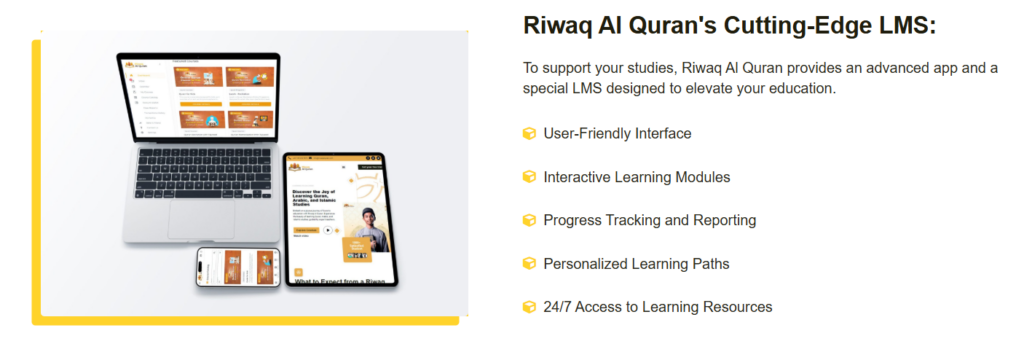
Here are a sample of our set of Quran Courses that will be helpful for you:
- Online Tafseer Course: Delve into Quranic meanings with our insightful online Tafseer course.
- Noorani Qaida Online: Learn Quranic basics efficiently through our Noorani Qaida online program.
- Online Quran Recitation Course: Enhance Quranic recitation skills through our expert-led online course.
- Online Tajweed Classes: Master Tajweed rules for beautiful Quranic recitation in online classes.
- Quran Memorization Online Course: Memorize the Quran effectively with our specialized online memorization course.
- Online Qirat Course: Explore diverse Qirat styles with our comprehensive online Qirat course.
- Online Quran Classes for Kids: Nurture a love for the Quran in kids through interactive online classes.

Conclusion
Reading the Quran benefits Muslims across three connected dimensions: the spiritual peace and faith it builds, the cognitive and emotional effects tied to focused, rhythmic engagement, and a reward system that’s genuinely specific — ten rewards per letter, not a vague promise of blessing.
How you read shapes which benefits you access:
- Tajweed improves pronunciation and earns rewards even when mistakes are made with sincere effort.
- Translation helps learners understand the meanings of the Quran, though it does not carry the letter-by-letter reward of recitation.
- Hifz focuses on memorization, with each verse learned bringing the student closer to higher ranks in the Hereafter.
And the habit that sustains all of it isn’t built by long, occasional sessions — it’s built by a short one, repeated daily, without the gaps that reset momentum.
Reading the Quran offers many benefits even for kids that go beyond spiritual enrichment. It provides scientific knowledge, promotes overall health and well-being, and improves our understanding of Islamic teachings.
FAQs
The questions below cover specifics this article’s sections touch on in passing but that deserve a direct, standalone answer.
Does reading the Quran remove sins?
Reading the Quran counts as a good deed, and Allah states in Surah Hud (11:114) that good deeds do away with misdeeds — recitation falls under this general principle rather than functioning as its own separate mechanism for erasing sin.
How many rewards do you get for reading the Quran?
Each letter recited from the Quran earns ten rewards, based on the Prophet’s ﷺ statement in Jami’ at-Tirmidhi (Hadith 2910), which specifies that individual letters like Alif, Lam, and Meem are each counted separately rather than as one combined letter.
Is reading the Quran in translation as rewarding as reading it in Arabic?
Not in the same specific sense: the letter-based, tenfold reward in Hadith 2910 applies to reciting the Quran’s actual Arabic wording, while a translation earns reward as knowledge-seeking and reflection, since scholars classify translation as tafsir rather than the Quran’s own text.
What is the best time to read the Quran?
There’s no single mandated time, but reading after Fajr takes advantage of a rested, undistracted mind, while reading at night is linked to stronger memory consolidation — both supported by general practice and memory research rather than either being prescribed as superior in the Quran or Hadith itself.
Do you need Tajweed to benefit from reading the Quran?
No — a hadith confirms that someone who struggles through recitation without polished Tajweed still receives reward, in fact doubled for the added effort, though fluent recitation with correct Tajweed carries its own additional described virtue (Sahih al-Bukhari 4937; Sahih Muslim 798).