What would it feel like to carry the entire Book of Allah in your heart — reciting it in prayer, in grief, in silence, without a page in front of you?
The importance of memorizing Quran has been recognized since the time of the Prophet ﷺ not as a ceremonial achievement but as a living transformation. Hifz reshapes your relationship with Allah, trains your mind in ways that transfer to every area of life, and places you inside an unbroken chain of preservation stretching back to the first revelation. Today, millions of Huffaz — children and adults, Arabic speakers and non-Arabic speakers — continue that chain.
This article explains what Quran memorization actually does: spiritually, cognitively, and practically — and what holds most people back from completing it.
What You’ll Learn in This Article:
- The spiritual standing that memorization builds — and why every verse counts.
- How Hifz measurably improves memory, focus, and language acquisition.
- The single most common mistake that causes memorizers to lose previously learned sections.
- Why adults can complete Hifz — and what method works for them.
- What children gain when they begin memorization early.
Table of Contents
Why the Importance of Memorizing Quran Extends Beyond Earning Rewards
The importance of memorizing Quran begins with what it does to your relationship with Allah. Unlike reading from a Mushaf, memorization places the divine words inside you — accessible during prayer, on a commute, at 3 a.m. when you can’t sleep and can’t reach a book.
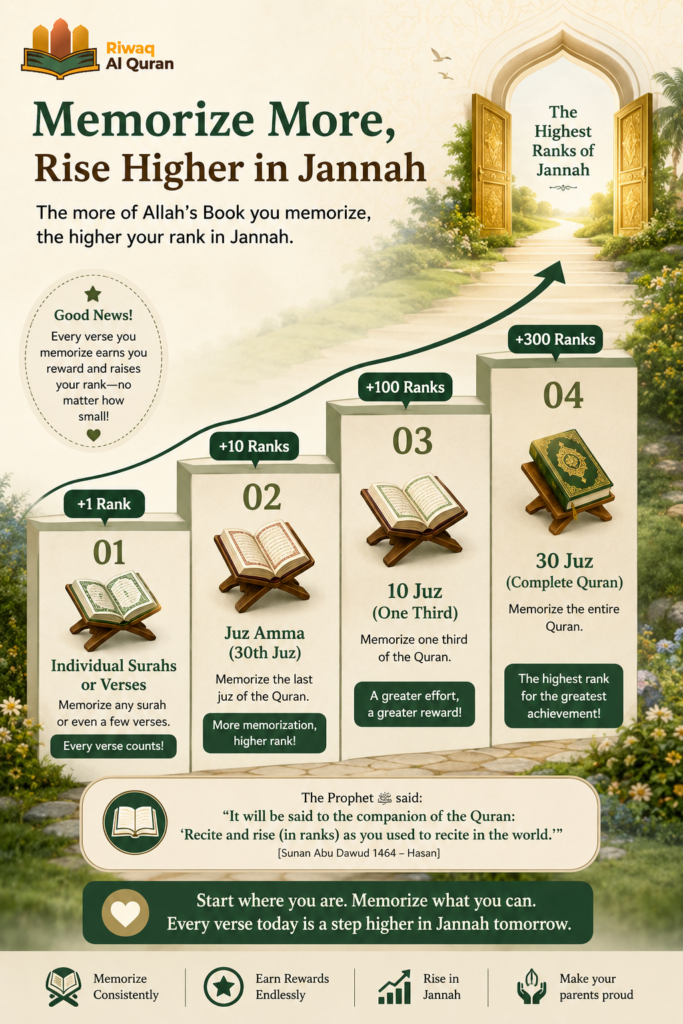
1. Your Rank in Paradise Is Tied to How Much You Memorize
The Prophet Muhammad ﷺ said:
«اقْرَأْ وَارْقَ وَرَتِّلْ كَمَا كُنْتَ تُرَتِّلُ فِي الدُّنْيَا، فَإِنَّ مَنْزِلَكَ عِنْدَ آخِرِ آيَةٍ تَقْرَؤُهَا»
“Recite and rise in status, recite as you used to recite in the world, for your station will be at the last verse you recite.”— Sunan Abi Dawud 1464 / Jami’ at-Tirmidhi 2914 — Rated Sahih
This hadith dismantles the all-or-nothing thinking that discourages many from starting:
- You do not need to complete all 30 Juz to benefit.
- Your rank in Jannah rises with every verse you memorize and maintain.
- Someone who memorized 15 Juz occupies a higher station than someone who memorized 10 — and both stand higher than someone who memorized none.
- The first surah you commit to memory is already a permanent spiritual investment with no expiry date.
Your parents also receive their own elevation. The Prophet ﷺ said:
«مَنْ قَرَأَ الْقُرْآنَ وَتَعَلَّمَهُ وَعَمِلَ بِهِ أُلْبِسَ وَالِدَاهُ يَوْمَ الْقِيَامَةِ تَاجًا مِنْ نُورٍ ضَوْؤُهُ مِثْلُ ضَوْءِ الشَّمْسِ»
“Whoever reads the Quran, learns it, and acts by it, his parents will be given a crown of light on the Day of Resurrection whose radiance is like that of the sun.”( Sunan Abi Dawud 1453)
The phrase “and acts by it” is significant: the reward is tied not to memorization as a performance but to the integration of its guidance into daily conduct — exactly what sustained Hifz practice cultivates. Memorization without action earns recitation reward; memorization that reshapes behavior earns the crown.
2. The Quran Will Intercede for You on the Day of Judgment
Beyond your personal rank, the Quran itself becomes an active advocate for you before Allah. The Prophet ﷺ said:
«اقْرَءُوا الْقُرْآنَ فَإِنَّهُ يَجِيءُ يَوْمَ الْقِيَامَةِ شَفِيعًا لِأَصْحَابِهِ»
“Recite the Quran, for it will come as an intercessor on the Day of Resurrection for its companions.”( Sahih Muslim 804)
The word sahib (companion) in Arabic describes a committed, ongoing relationship — not an occasional encounter. Huffaz embody this companionship most fully: their daily recitation during Hifz, and their ongoing muraja’ah after completion, establish exactly the bond this hadith is describing.
The Quran does not intercede for someone who read it once; it intercedes for the one who made it a constant companion.
3. Memorization Keeps the Heart Attached to Divine Remembrance
Consistent Hifz protects the heart from spiritual heedlessness in a way that occasional reading cannot match. Allah says:
“إِنَّمَا الْمُؤْمِنُونَ الَّذِينَ إِذَا ذُكِرَ اللَّهُ وَجِلَتْ قُلُوبُهُمْ”
“The believers are only those who, when Allah is mentioned, their hearts become fearful.”(Al-Anfal 8:2)
Experienced Hifz teachers consistently observe that memorized verses activate involuntarily during moments of temptation or difficulty — a memorized ayah on patience surfaces during hardship in a way a read ayah rarely does. This is not metaphorical: repetition-based memorization conditions automatic recall, so Quranic guidance becomes accessible precisely when you most need it.
The heart carrying verses on patience (Al-Baqarah 2:155–157), reliance on Allah (At-Talaq 65:3), and gratitude (Ibrahim 14:7) is better equipped than the heart that knows those verses exist somewhere but cannot summon them under pressure.
This healing dimension of internalized Quran is addressed directly:
“وَنُنَزِّلُ مِنَ الْقُرْآنِ مَا هُوَ شِفَاءٌ وَرَحْمَةٌ لِّلْمُؤْمِنِينَ”
“And We send down of the Quran that which is healing and mercy for the believers.”(Al-Isra 17:82)
Scholars of tafsir note that the healing here is not restricted to recitation from a Mushaf. It extends to the state of the one who carries the Quran in their chest — for whom the healing is present and active at every moment, requiring no book, no device, no conditions.
How Quran Memorization Builds the Brain
Hifz is one of the most cognitively demanding tasks a person can undertake — memorizing a 604-page text in a foreign phonetic system, with precision down to every vowel marking. The cognitive load this demands produces real, transferable benefits.
1. Hifz Trains Working Memory and Sustained Attention
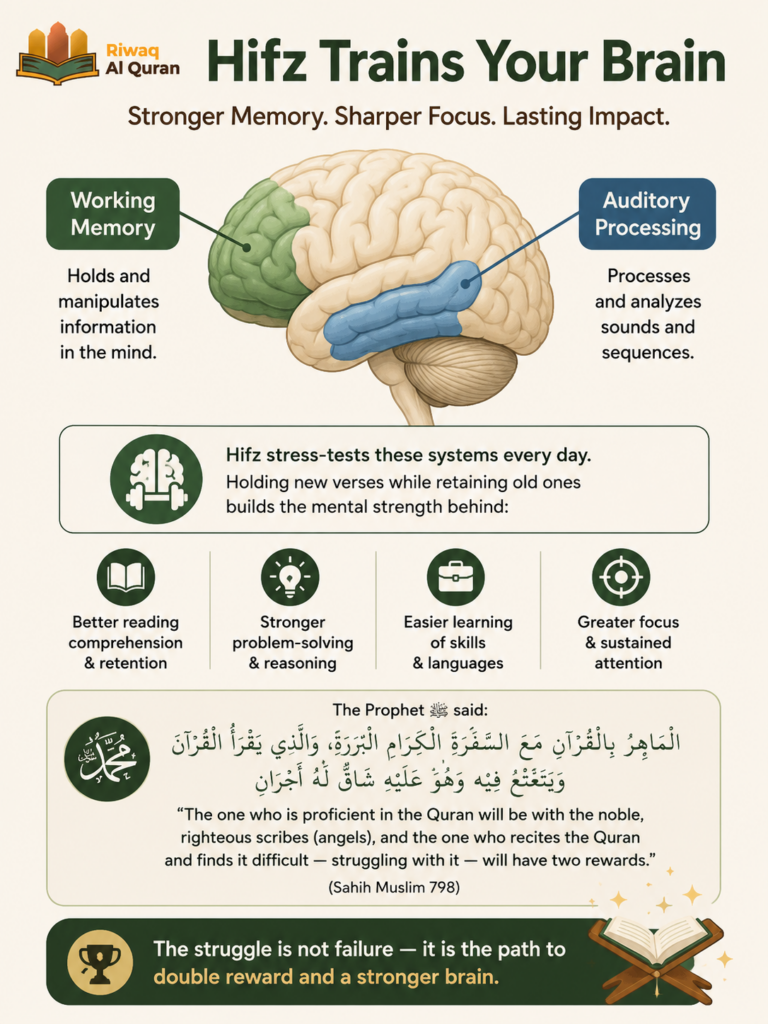
The mechanism is specific: when you memorize a new page while simultaneously maintaining previously memorized pages in active recall, you are repeatedly stress-testing your working memory. Unlike passive studying, Hifz requires holding a precise phonetic sequence under scrutiny — your teacher will catch a single misplaced sukun. This kind of high-stakes recall under pressure builds the same mental circuitry that underlies:
- Reading comprehension and information retention.
- Problem-solving and analytical reasoning.
- Learning new professional skills and languages.
The Prophet ﷺ acknowledged both levels of difficulty in this process:
«الْمَاهِرُ بِالْقُرْآنِ مَعَ السَّفَرَةِ الْكِرَامِ الْبَرَرَةِ، وَالَّذِي يَقْرَأُ الْقُرْآنَ وَيَتَتَعْتَعُ فِيهِ وَهُوَ عَلَيْهِ شَاقٌّ لَهُ أَجْرَانِ»
“The one who is proficient in the Quran will be with the noble, righteous scribes (angels), and the one who recites the Quran and finds it difficult — struggling with it — will have two rewards.”(Sahih Muslim 798)
This hadith carries a direct message for every adult or late-starting student who feels embarrassed by slow progress: the difficulty itself is rewarded — and the cognitive effort of pushing through unfamiliar phonetics and challenging passages is precisely what produces the neurological benefits of Hifz. The struggle is not a sign of failure; it is the mechanism of the double reward.
2. Proper Tajweed Amplifies the Cognitive Benefit
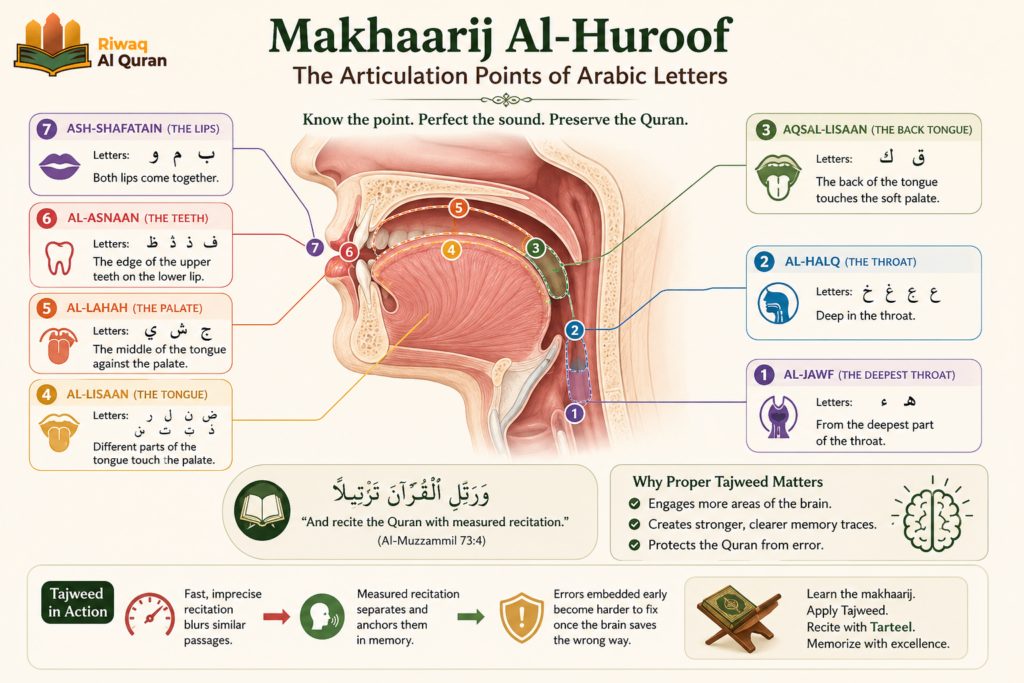
For non-Arabic speakers, Quran memorization provides a unique form of linguistic exposure. Arabic’s consonant-heavy phonetic system and its precise vowel distinctions — marked through tashkeel and governed by Tajweed rules — engage auditory and motor brain regions that native-language learning doesn’t activate. Correct articulation of each letter from its makhraj adds a physical dimension to memorization that deepens retention.
Allah commands measured recitation directly:
“وَرَتِّلِ الْقُرْآنَ تَرْتِيلًا”
“And recite the Quran with measured recitation.”(Al-Muzzammil 73:4)
The word tarteel describes deliberate, unhurried articulation — the direct opposite of speed recitation. Tajweed teachers explain that tarteel forces the memorizer to engage consciously with each word, creating more distinct memory traces:
- Fast, imprecise recitation blurs phonetically similar passages together.
- Measured recitation separates and anchors them in memory.
- Errors embedded early become increasingly difficult to correct once the brain has consolidated the wrong pronunciation alongside the text.
This is why Tajweed instruction cannot be separated from Hifz. Riwaq Al Quran’s certified Azhari tutors integrate Tajweed correction into every Hifz session from day one — so pronunciation and memorization reinforce each other rather than working against each other. To build this foundation before starting Hifz, explore our dedicated Online Tajweed Classes.
This is what completing the Hifz journey looks like — a Riwaq Al Quran student receiving his Hafiz certification:
The Single Biggest Mistake in Quran Memorization — and How to Fix It
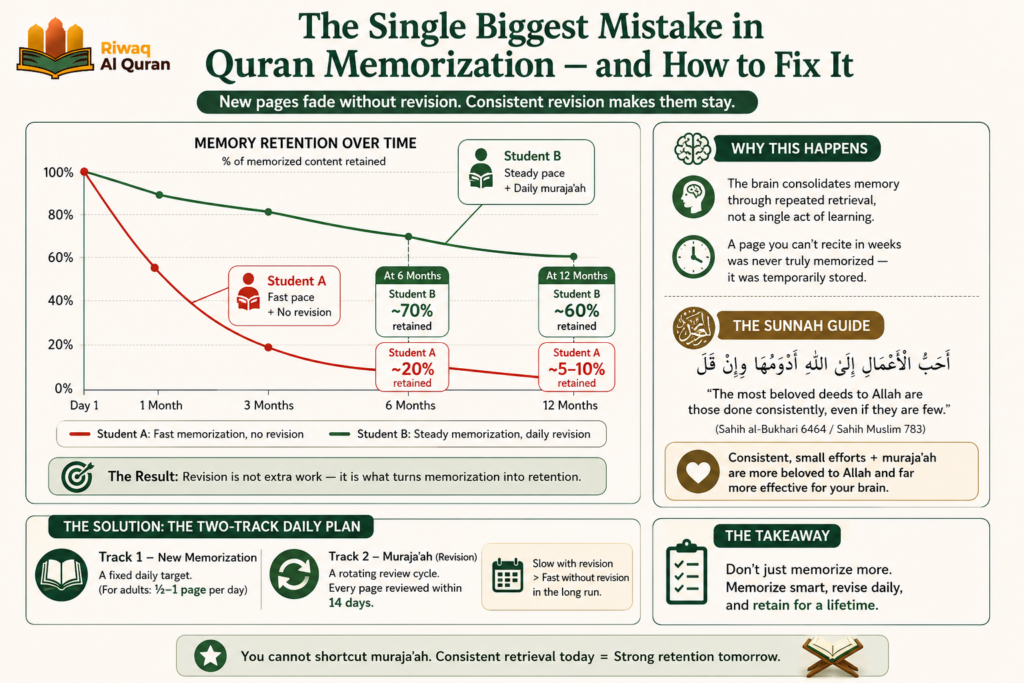
Most students who struggle with Hifz make the same structural error: they prioritize new memorization over revision (muraja’ah). They memorize Juz 1, move to Juz 2, then Juz 3 — and by the time they reach Juz 5, Juz 1 has faded to partial recall. New memorization feels productive. Revision feels slow. So they keep pushing forward — and they keep losing ground.
This happens because the brain consolidates memory through repeated retrieval, not through a single act of learning. A page you can recite perfectly today but cannot recite in three weeks was never truly memorized — it was temporarily stored.
The Sunnah itself points directly to the principle underlying this failure:
«أَحَبُّ الْأَعْمَالِ إِلَى اللَّهِ أَدْوَمُهَا وَإِنْ قَلَّ»
“The most beloved deeds to Allah are those done consistently, even if they are few.”(Sahih al-Bukhari 6464 / Sahih Muslim 783)
Applied directly to Hifz, this hadith is an instruction on method: a small daily target maintained consistently — with structured muraja’ah — is more beloved to Allah, and more effective cognitively, than intense memorization that is abandoned or unrevised. Distributed, consistent retrieval practice produces retention that massed learning cannot match. You cannot shortcut muraja’ah.
The approach used in structured Hifz programs is a two-track daily schedule:
- Track 1 — New memorization: a defined daily target, typically half a page to one page per day for adult learners.
- Track 2 — Muraja’ah (revision): a rotating review cycle that brings every memorized page back into active recitation within a 14-day window.
Students who follow this structure at a slower pace consistently retain more after one year than students who memorize twice as fast without structured revision. If you are currently memorizing without a revision schedule, this single adjustment is the most impactful change you can make.
Maintaining this structure on your own is difficult without accountability. Riwaq Al Quran’s one-on-one Quran Memorization Course includes built-in revision tracking — your tutor monitors both new pages and prior retention, so you never memorize faster than you can retain.
→ Read also: How to Revise Your Quran Hifz Effectively
Can Adults Memorize the Quran? What Actually Works
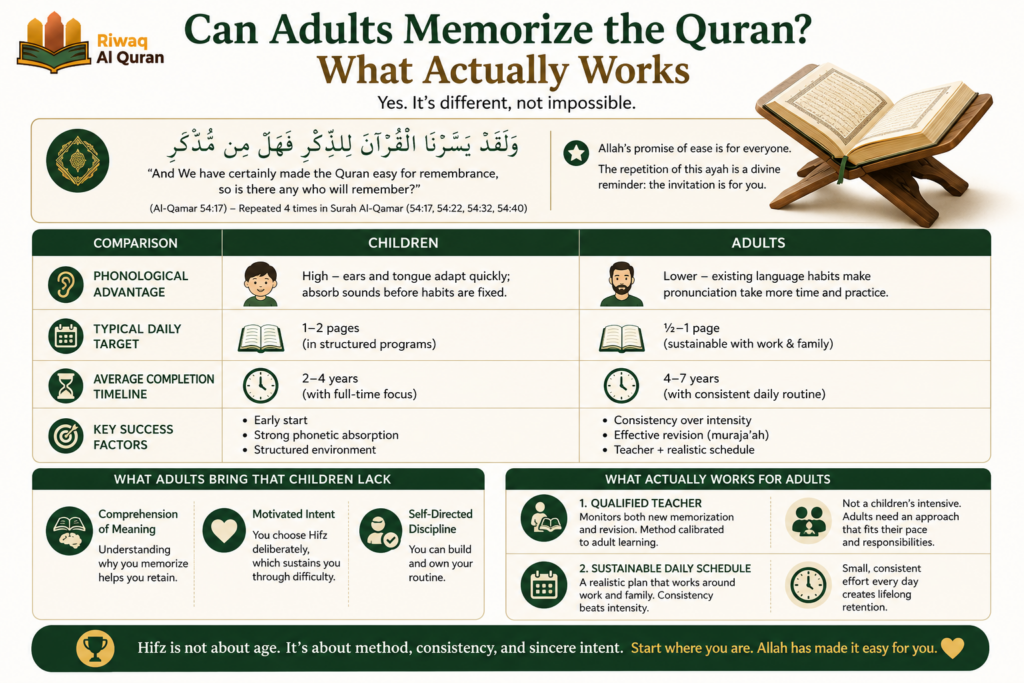
The most persistent misconception in Quran education is that Hifz is only realistic for children. Children do have a genuine phonological advantage — their ears and tongues adapt to Arabic sounds more quickly, and they absorb new phonetic patterns before native-language habits are fully fixed. These differences are real. They do not make adult Hifz impossible. They make it different.
Allah says — and He repeats it four times within a single surah, which is itself a Quranic signal of extraordinary emphasis:
“وَلَقَدْ يَسَّرْنَا الْقُرْآنَ لِلذِّكْرِ فَهَلْ مِن مُّدَّكِرٍ”
“And We have certainly made the Quran easy for remembrance, so is there any who will remember?”(Al-Qamar 54:17, repeated in 54:22, 54:32, and 54:40)
Scholars of tafsir note that Allah did not say “We made the Quran easy for children” or “for Arabs” or “for those with strong memory.” The divine guarantee of ease is unconditional — and the rhetorical question “Is there any who will remember?” is an open invitation addressed to every person, in every generation, in every condition of life.
The repetition of this ayah four times is a Quranic technique for removing every barrier of hesitation between a person and their commitment to memorize.
Adults who complete the Quran consistently identify two factors that determined their success:
- A qualified teacher who monitors both new memorization and revision — not a children’s intensive program, but a method calibrated to adult learning patterns.
- A sustainable daily schedule that fits around work and family without requiring six hours of study.
What adults bring that children lack:
- Comprehension of meaning — understanding why you are memorizing a verse aids long-term retention significantly.
- Motivated intent — adults choose Hifz deliberately, which sustains commitment through difficulty.
- Self-directed discipline — adults can structure their own routines once the method is established.
→ How to Memorize Quran Fast and Easily · When Is the Best Time to Memorize the Quran?
Quran Memorization and Its Role in Islamic Scholarship
Hifz has functioned as a prerequisite for Islamic scholarly formation across centuries — not as a ceremonial credential but as a functional one. When a scholar has the entire Quran in memory, they can recognize cross-references between verses, identify contextual evidence without searching, and trace whether a ruling has been abrogated. Classical scholarship assumed this foundation.
1. Why Memorization Precedes Advanced Islamic Study
The Prophet ﷺ said:
«خَيْرُكُمْ مَنْ تَعَلَّمَ الْقُرْآنَ وَعَلَّمَهُ»
“The best of you are those who learn the Quran and teach it.”(Sahih al-Bukhari 5027)
The coupling of learning and teaching in this hadith is deliberate. Memorization that stays private fulfills one dimension; teaching it to others fulfills the second. Scholars note that teaching Quran reinforces the teacher’s own retention in measurable ways:
- Explaining a ruling of Tajweed deepens the teacher’s own mastery of it.
- Correcting a student’s recitation sharpens the teacher’s own ear.
- Guiding someone through a difficult passage reinforces the teacher’s own retention of that passage.
This is why the Hifz tradition is self-sustaining: each generation of Huffaz becomes the teachers of the next, and excellence compounds across generations.
Imam Ash-Shafi’i memorized the Quran at age seven and the Muwatta of Imam Malik by age ten. His later jurisprudential brilliance — his ability to build legal arguments from direct Quranic evidence — depended entirely on this textual recall.
Modern Islamic universities, including Al-Azhar — the world’s oldest continuously operating university — still require Hifz as a prerequisite for advanced degree programs in Fiqh, Tafsir, and Hadith sciences.
2. How Huffaz Protect the Quran Across Generations
Allah gave an absolute guarantee:
“إِنَّا نَحْنُ نَزَّلْنَا الذِّكْرَ وَإِنَّا لَهُ لَحَافِظُونَ”
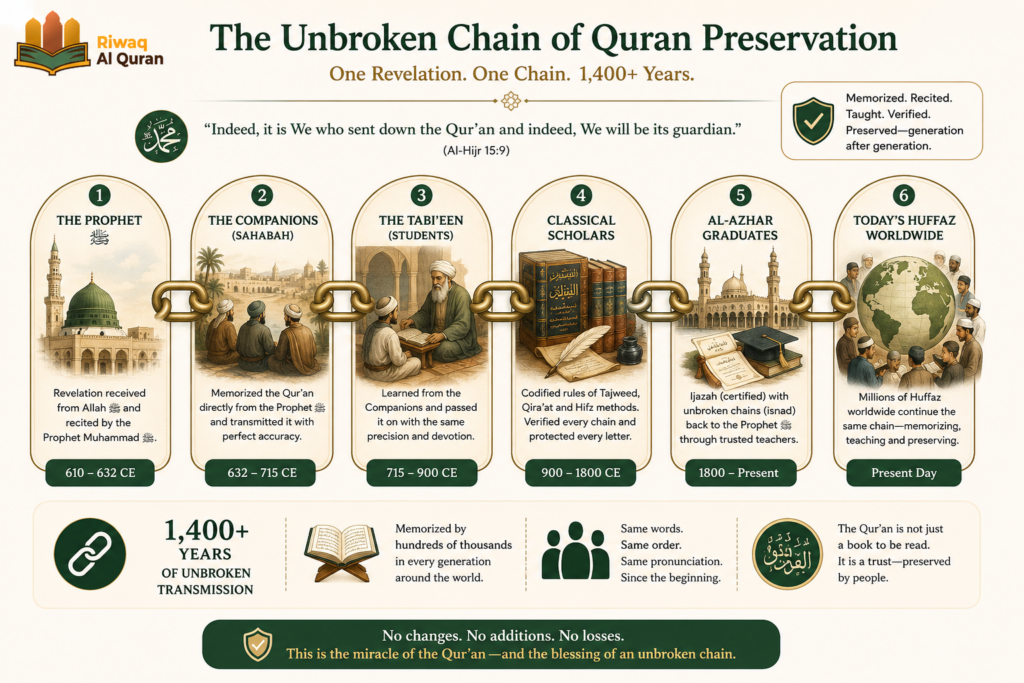
“Indeed, it is We who sent down the Reminder, and indeed, We will be its guardian.”(Al-Hijr 15:9)
The mechanism Allah chose for this preservation is human memorization. There are currently millions of Huffaz worldwide — in every country, in every language community. Their collective memory means:
- Any attempt to alter a single word in the Quran would be immediately detected by children who memorized it in Malaysia, scholars in Egypt, and converts in the United States simultaneously.
- No other scripture in human history has been preserved this way.
- The preservation is not dependent on any physical medium — it cannot be deleted, confiscated, or lost.
Scholars of Ulum al-Quran further note that each Hafiz who received their memorization from a qualified teacher carries an unbroken chain of transmission (isnad) connecting their recitation back to the Companions and to the Prophet ﷺ himself. When you memorize through a certified Qira’at teacher, you enter this chain.
Riwaq Al Quran’s Azhari tutors carry their own verified isnad chains — making this transmission accessible to students worldwide. Those seeking formal certification can explore our Ijazah Program, which grants an official chain of transmission in recitation.
Why Children Who Start Hifz Early Carry a Lifelong Advantage
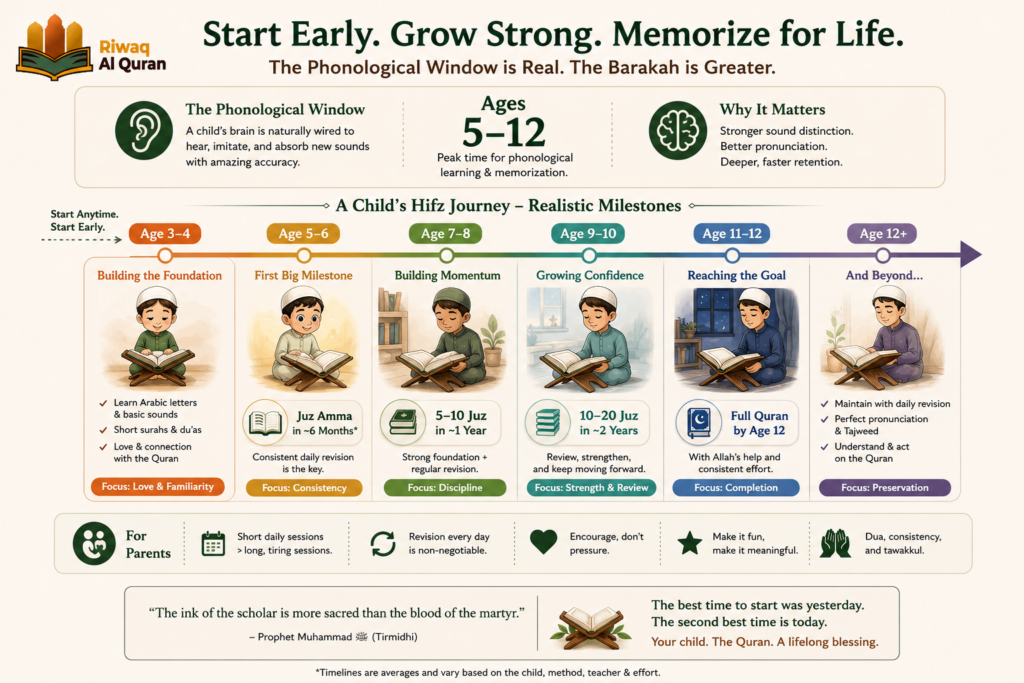
Children’s brains form new neural connections faster than adults’, and their phonological sensitivity to new sounds peaks between ages 5 and 12. This makes early childhood the most efficient window for memorizing the Quran’s Arabic phonetic system — children at this stage absorb pronunciation patterns that adult learners spend years working to correct.
Islamic scholars historically began Hifz instruction at ages 5–7 for precisely this reason. The character benefits compound over time:
- Sustained focus: Daily memorization sessions build attention spans that transfer directly to academic performance.
- Self-discipline: Maintaining a revision schedule teaches children to manage their own learning — a habit that outlasts Hifz itself.
- Moral foundation: Children who spend formative years in structured memorization internalize Islamic values before external pressures take hold.
- Resilience: The Quran they carry in childhood surfaces in moments of adult difficulty as a companion rather than a reference.
“وَمَن يُعَظِّمْ شَعَائِرَ اللَّهِ فَإِنَّهَا مِن تَقْوَى الْقُلُوبِ”
“And whoever honors the symbols of Allah — indeed, it is from the piety of hearts.”(Al-Hajj 22:32)
Tarbiyah scholars note that this verse defines honoring the symbols of Allah — and Hifz is among the highest of those symbols — as an expression of taqwa al-qulub: piety originating from the heart, not from external pressure or social expectation. Children raised to approach Hifz as an honor rather than an obligation internalize this heart-level taqwa during the years when character is most malleable.
For parents, the timing decision is both spiritual and practical. A child who starts at 7 and maintains a page per day with proper revision will likely complete the Quran before reaching their teens. And the reward extends to the parents themselves:
“Whoever reads the Quran, learns it, and acts by it, his parents will be given a crown of light on the Day of Resurrection whose radiance is like that of the sun — and they will say, ‘Why have we been given this?’ It will be said: ‘Because your child learned the Quran.'”
— Sunan Abi Dawud 1453
Riwaq Al Quran’s Online Quran Classes for Kids are led by certified Azhari tutors trained in child-centered instruction — one-on-one, online, at your child’s pace.
→ Do You Have to Memorize the Quran? Is It Compulsory? · Why Do Muslims Memorize the Quran? · Easy Quran Surahs to Start With
Start Memorizing with the Right Teacher Behind You
The difference between a student who completes Hifz and one who cycles through the same pages for years usually comes down to one thing: structured accountability with a qualified teacher who monitors both new memorization and revision — and who corrects Tajweed before errors become habits.
Riwaq Al Quran has served students in over 50 countries since 2017, providing online Quran memorization with certified graduates of Al-Azhar University. Sessions are one-on-one, available 24/7 to fit your timezone, and start from $32/month with no long-term commitment required.
Not sure what to expect? Hear directly from one of our students about learning with Riwaq Al Quran:
Every enrollment includes:
- Certified Azhari tutors with 9+ years of teaching experience.
- Integrated Tajweed instruction from the first session.
- Structured revision tracking to protect previously memorized pages.
- Full money-back guarantee if you’re not satisfied.
Choose your learning path:
| Course | Focus | Best For |
|---|---|---|
| Quran Memorization with Tajweed | Full Hifz + integrated Tajweed correction | Adults and teens starting or resuming Hifz |
| Online Tajweed Classes | Tajweed rules, pronunciation, measured recitation | Learners perfecting recitation before or alongside Hifz |
| Quran Classes for Kids | Age-appropriate Hifz and Quran reading | Children ages 5–15 |
| Ijazah Program | Certified chain of transmission in recitation | Advanced students seeking formal certification |
| Arabic Language Classes | Quranic and Modern Standard Arabic | Anyone wanting to understand the Quran directly |
| Islamic Studies Courses | Tafsir, Aqeedah, Fiqh, and Islamic foundations | Students deepening their understanding alongside Hifz |
Also available: Online Tafseer Course · Noorani Qaida Online · Online Qirat Course · Online Quran Recitation Course
Conclusion
The importance of memorizing Quran runs from the highest spiritual stakes — your standing before Allah on the Day of Judgment, the intercession of the Quran on your behalf, the crown placed on your parents — to the practical structure of daily life, the quality of your attention, and the character you build in your children.
These are not separate benefits. They are an interlocking system: spiritual depth reinforces discipline, discipline enables retention, and retention makes the Quran a constant companion rather than a text you return to only when you open a book.
The insight most articles miss is this: Hifz does not reward speed — it rewards structure. A student who memorizes half a page daily with consistent revision will retain more after one year than a student who memorizes two pages daily with irregular review. Getting the structure right — ideally with a qualified teacher from the first session — is what separates Huffaz who complete from those who stay perpetually in progress.
Whether you are an adult who has thought about starting for years, a parent deciding when to enroll your child, or someone who memorized some surahs and wants to continue — the path is the same: a daily commitment, a revision schedule, and a teacher who will hold you to both.
Frequently Asked Questions
The questions below address the most common points of hesitation and confusion that come up before — and during — the Hifz journey. Each answer draws directly on the principles covered in this article.
1. How long does it take to memorize the entire Quran?
The time required varies by age, daily schedule, and method:
Children in full-time structured programs: typically 2–4 years
Adults memorizing 30–45 minutes per day: generally 4–7 years
The most important variable is not memorization speed — it is whether daily revision (muraja’ah) is consistently built into the schedule alongside new pages. A slow, structured student will consistently outperform a fast, unstructured one over time.
2. Is it possible to memorize the Quran as an adult?
Yes — adults can and do complete the Quran. Allah’s guarantee in Al-Qamar 54:17 — “We have certainly made the Quran easy for remembrance” — is unconditional. The process for adults requires:
A sustainable daily target (not a children’s intensive program)
A teacher who monitors both new memorization and revision
A revision cycle that prevents previously learned pages from fading
Adults also benefit from understanding the meaning of verses they memorize, which meaningfully aids long-term retention.
3. What is muraja’ah and why does it matter for Hifz?
Muraja’ah is the Arabic term for revision — regularly reciting previously memorized sections to keep them in active recall. Without structured muraja’ah, memorized pages fade within weeks. The principle is grounded in the Prophetic hadith that the most beloved deeds to Allah are the most consistent (Bukhari 6464). Most structured programs recommend:
A rotating revision cycle that brings every memorized page back into active recitation within a 14-day window
A separate daily target for new memorization, running in parallel
4. What is the best age to start Quran memorization?
The most efficient window is ages 5–12, when phonological sensitivity to new sounds peaks and Arabic pronunciation patterns are absorbed more naturally. That said, Hifz is achievable at any age. The scholarly consensus is that earlier is cognitively easier, but later is not impossible. Adults who begin with a structured approach and a qualified teacher regularly complete significant portions of the Quran.
5. Do I need to know Arabic to memorize the Quran?
No. Many Huffaz worldwide are non-Arabic speakers who learned to recite with correct Tajweed before understanding the full linguistic meaning. Key points:
Learning Tajweed alongside Hifz is essential regardless of your language background.
Studying basic Quranic Arabic in parallel deepens comprehension and strengthens long-term retention.
Arabic knowledge is not a prerequisite for beginning.
The Quran was made easy for remembrance — that promise applies regardless of your native language.
6. Does Quran memorization help children in school?
Teachers who work with Hifz students consistently report improvements in:
Attention span and sustained focus
Working memory capacity
Performance across academic subjects — including mathematics and language arts
The mechanism is direct: memorizing a 604-page Arabic text with precision — under regular recitation checks with a teacher who corrects every error — builds the sustained focus and recall capacity that underpin learning in every subject. These gains are the predictable outcome of demanding, consistent cognitive work. They are not incidental.