Of all the surahs in the Quran, few carry the weight Surah Yaseen carries in the daily lives of Muslims worldwide. It is recited at births, at deaths, in hospitals, and at the Fajr prayer.
Yet most people who recite it have never been told precisely what Islam says about why — what the Quran and authentic hadith actually attribute to this surah, what the evidence looks like, and where documented scholarship ends and cultural tradition begins.
This article answers all of that. Every benefit here comes with its source — in Arabic, with translation, with a direct link to the verified reference — and with commentary that explains what it means for you as a reciter. If you are looking for a broader understanding of the rewards of engaging with the Quran, the benefits of reading the Quran extend well beyond any single surah and are worth exploring alongside this guide.
Allah describes the purpose of every Quran surah:
“وَنُنَزِّلُ مِنَ ٱلْقُرْءَانِ مَا هُوَ شِفَآءٌ وَرَحْمَةٌ لِّلْمُؤْمِنِينَ ۙ وَلَا يَزِيدُ ٱلظَّـٰلِمِينَ إِلَّا خَسَارًا“
“We send down of the Quran that which is a healing and a mercy to the believers, and it does not increase the wrongdoers except in loss.” [Surah Al-Isra, 17:82]
Surah Yaseen delivers that healing with particular concentration. Here is what the scholarship says — and what you gain from engaging with it attentively.
What You’ll Learn in This Article
- The 7 core spiritual benefits of Surah Yaseen, grounded in Quran and hadith — with Arabic sources, translations, and verified links.
- What the Prophet (ﷺ) specifically said about this surah — and how scholars assess the hadith.
- The surah’s most overlooked story — and the character it builds in the reciter.
- The best times to recite Surah Yaseen and the Quranic evidence for each.
- A tested memorization framework with practical timelines and the sahih hadith behind it.
Table of Contents
What Are the Benefits of Surah Yaseen?
Surah Yaseen is the 36th surah of the Quran, revealed in Makkah, comprising 83 verses. It opens with an oath by the Quran itself — a structural device that appears in only a handful of surahs and signals elevated status from the very first word:
“يسۤ وَٱلْقُرْءَانِ ٱلْحَكِيمِ إِنَّكَ لَمِنَ ٱلْمُرْسَلِينَ“
“Yaa-Seen. By the Quran, full of wisdom. Indeed you, [O Muhammad], are among the messengers.” [Surah Yaseen, 36:1–3]
The benefits of this surah draw from two sources: explicit narrations about reciting it, and the content the surah itself delivers to the person who engages with it attentively. Both are real, both are documented, and the difference between them matters for your intention.
1. Surah Yaseen — The Heart of the Quran
The Prophet Muhammad (ﷺ) said:
«لِكُلِّ شَيْءٍ قَلْبٌ، وَقَلْبُ الْقُرْآنِ يس، وَمَنْ قَرَأَ يس كَتَبَ اللَّهُ لَهُ بِقِرَاءَتِهَا قِرَاءَةَ الْقُرْآنِ عَشْرَ مَرَّاتٍ»
“Everything has a heart, and the heart of the Quran is Yaseen. Whoever reads Yaseen, Allah will record for his reading the reward of reading the Quran ten times.” [Tirmidhi, 2887] | [al-Darimi, 3418]
This hadith is recorded by Imam al-Tirmidhi and al-Darimi. Key points on its scholarly status:
- Shaykh al-Albani classified it as da’if (weak) in his review of al-Tirmidhi’s collection.
- A number of classical scholars cite it in tafsir literature and accept it under the traditional leniency applied to fada’il al-a’mal (hadiths about the merits of deeds), where a weak hadith may be acted upon if there is no contradicting evidence.
- The safest position is to avoid treating the “ten times” reward as a guaranteed promise, while accepting “heart of the Quran” as an accurate description of the surah’s content.
The “heart” metaphor is theologically precise, not decorative. The qalb in Islamic thought is the seat of consciousness, intention, and spiritual receptivity. To say Surah Yaseen is the heart of the Quran means it circulates the Quran’s essential spiritual foundations — tawheed, prophethood, resurrection, and accountability — through a single, concentrated reading.
A person who reads Surah Yaseen with understanding has encountered every major pillar of Islamic creed in one sitting. This is why scholars of the salaf specifically recommended this surah for those seeking a summary of Quranic doctrine, and why it remains the surah most commonly taught to new Muslims.
2. Surah Yaseen — Easing the Soul at the Time of Death
The Prophet (ﷺ) said:
«اقْرَؤُوا يس عَلَى مَوْتَاكُمْ»
“Recite Yaseen over your dying.” [Abu Dawud, 3121] | [Ibn Majah, 1448]
On authenticity:
- The chain of this narration has been scrutinized by hadith scholars; Shaykh al-Albani graded it da’if.
- Ibn Hajar al-Asqalani and numerous classical scholars have nonetheless accepted it for practice.
- It is acted upon across all four madhabs (schools of jurisprudence).
- Scholars hold that in matters of recommended acts with no doctrinal consequence, a weak hadith with no contradicting evidence may be followed — this practice carries that consensus.
The theological logic behind reciting Surah Yaseen at the time of death is not dependent on the hadith alone. The surah’s content speaks directly to the dying person — and everyone present:
“إِنَّا نَحْنُ نُحْيِ ٱلْمَوْتَىٰ وَنَكْتُبُ مَا قَدَّمُوا۟ وَءَاثَـٰرَهُمْ ۚ وَكُلَّ شَىْءٍ أَحْصَيْنَـٰهُ فِىٓ إِمَامٍ مُّبِينٍ“
“Indeed, it is We who bring the dead to life and record what they have put forth and what they left behind. And all things We have enumerated in a clear register.” [Surah Yaseen, 36:12]
To hear this verse at the moment of departure is to hear Allah’s own assurance of continuity — that what the soul did in life is recorded and held, and that what follows is entirely in the hands of the All-Knowing. This is why the practice persists universally in Muslim communities regardless of the hadith’s technical grading: the surah speaks directly to the moment.

3. Surah Yaseen — Building Certainty in Allah’s Absolute Power
One of the Quran’s most concentrated statements of divine authority appears inside Surah Yaseen:
“إِنَّمَآ أَمْرُهُۥٓ إِذَآ أَرَادَ شَيْـًٔا أَن يَقُولَ لَهُۥ كُن فَيَكُونُ”
“His command is only when He intends a thing that He says to it, ‘Be,’ and it is.” [Surah Yaseen, 36:82]
The linguistic structure of kun fa-yakūnu in Arabic is significant — the command and its fulfillment are simultaneous. There is no gap between Allah’s will and its execution, no condition, no intermediary, no waiting period. For a believer in difficulty, this is not comfort in a vague sense — it is a direct theological claim: the thing you need, if Allah wills it, requires nothing more than His word.
The surah does not state this truth once. It returns to it through different evidence across its 83 verses:
- The movement of the sun runs by His command.
- The phases of the moon follow His determination.
- The revival of dead earth happens at His word.
- The creation of the human being originates from Him alone.
This is the Quran’s teaching method: repetition with variation, so the concept builds from information into conviction. Regular recitation of Surah Yaseen, for this reason alone, recalibrates the soul’s relationship with hope and dependence over time.
4. Surah Yaseen — Confronting Human Accountability
Surah Yaseen does not place the Day of Judgment in the background. It makes it immediate and personal:
“ٱلْيَوْمَ نَخْتِمُ عَلَىٰٓ أَفْوَٰهِهِمْ وَتُكَلِّمُنَآ أَيْدِيهِمْ وَتَشْهَدُ أَرْجُلُهُم بِمَا كَانُوا۟ يَكْسِبُونَ“
“That Day, We will seal over their mouths, and their hands will speak to Us, and their feet will testify about what they used to earn.” [Surah Yaseen, 36:65]
The Quran uses this image — the body testifying against its own owner — as a reminder that actions are not merely recorded externally in some ledger.
They are inscribed in the very limbs that performed them. Your own hand will speak what your mouth would prefer to deny. Scholars who recommend Surah Yaseen for spiritual stagnation cite this passage specifically, and for clear reasons:
- The urgency it creates is real and immediate, not abstract.
- It is balanced directly by the surah’s closing vision of Paradise for the believer.
- The two — accountability and mercy — sit side by side in the text deliberately, so one leads the reader naturally to the other.
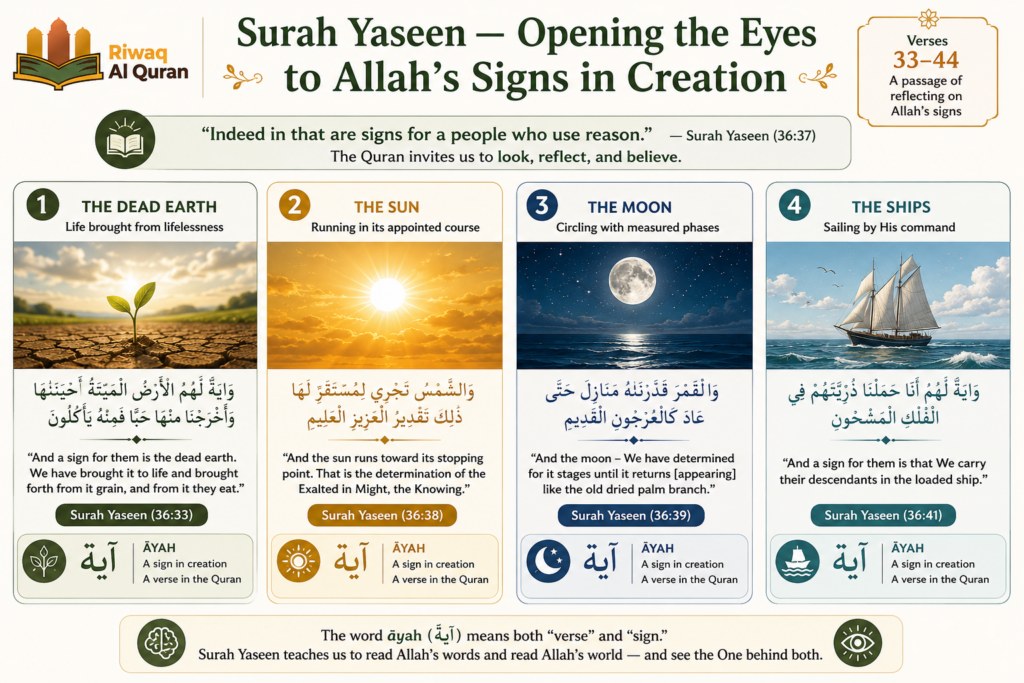
5. Surah Yaseen — Opening the Eyes to Allah’s Signs in Creation
Surah Yaseen dedicates an extended passage — verses 33 through 44 — to the observable natural world as direct evidence of Allah’s existence and ongoing authority:
“وَءَايَةٌ لَّهُمُ ٱلْأَرْضُ ٱلْمَيْتَةُ أَحْيَيْنَـٰهَا وَأَخْرَجْنَا مِنْهَا حَبًّا فَمِنْهُ يَأْكُلُونَ”
“And a sign for them is the dead earth. We have brought it to life and brought forth from it grain, and from it they eat.” [Surah Yaseen, 36:33]
The passage then makes a remark that has drawn scholars and scientists alike for centuries:
“وَٱلشَّمْسُ تَجْرِى لِمُسْتَقَرٍّ لَّهَا ۚ ذَٰلِكَ تَقْدِيرُ ٱلْعَزِيزِ ٱلْعَلِيمِ”
“And the sun runs toward its stopping point. That is the determination of the Exalted in Might, the Knowing.” [Surah Yaseen, 36:38]
The phrase mustaqarr lahā — “its appointed stopping point” — is interpreted in classical tafsir as the sun’s ordained end in its cosmic course. Modern astrophysics confirms that the sun is indeed in motion, orbiting the galactic center at approximately 220 km/s, and has an eventual terminus in its stellar lifecycle.
The Quran does not claim to be a science textbook, and this should not be forced into a simplistic proof argument — but the observation stands: this verse, revealed in the 7th century, uses language that aligns with what science later confirmed.
More broadly, the word āyah (آية) in Arabic means both “verse of the Quran” and “sign in creation.” This double meaning is deliberate: the Quran draws a direct correspondence between reading Allah’s words and reading Allah’s world. Surah Yaseen — by enumerating these natural signs — trains the habit of tafakkur (contemplation), which the Quran consistently links to the deepest levels of faith.
6. Surah Yaseen — The Promise of Mercy for the Sincere Believer
Surah Yaseen moves, in its final verses, from the fate of those who reject to the reward of those who believe — with striking directness:
“إِنَّ أَصْحَـٰبَ ٱلْجَنَّةِ ٱلْيَوْمَ فِى شُغُلٍ فَـٰكِهُونَ هُمْ وَأَزْوَٰجُهُمْ فِى ظِلَـٰلٍ عَلَى ٱلْأَرَآئِكِ مُتَّكِـُٔونَ“
Indeed, the companions of Paradise, that Day, will be amused in joyful occupation. They and their spouses — in shade, reclining on adorned couches.” [Surah Yaseen, 36:55–56]
Then the simplest, most moving statement in the surah:
“سَلَـٰمٌ قَوْلًا مِّن رَّبٍّ رَّحِيمٍ“
“‘Peace’ — a word from a Merciful Lord.” [Surah Yaseen, 36:58]
Three Arabic words carry what theological volumes struggle to express: salāmun qawlan min rabbin rahīm. The first word Allah speaks to the believer in Paradise is not a command, not a judgment, not an instruction — it is salaam, peace, spoken directly by the Merciful.
Scholars of Quranic rhetoric observe that this ayah is striking precisely for its brevity: the most desired experience in all of existence is described in the fewest possible words. Regular recitation of Surah Yaseen keeps this destination present in the reciter’s awareness — not as wishful thinking, but as the orienting goal of a Muslim life.
7. Surah Yaseen — The Character of a Believer Through One Man’s Story
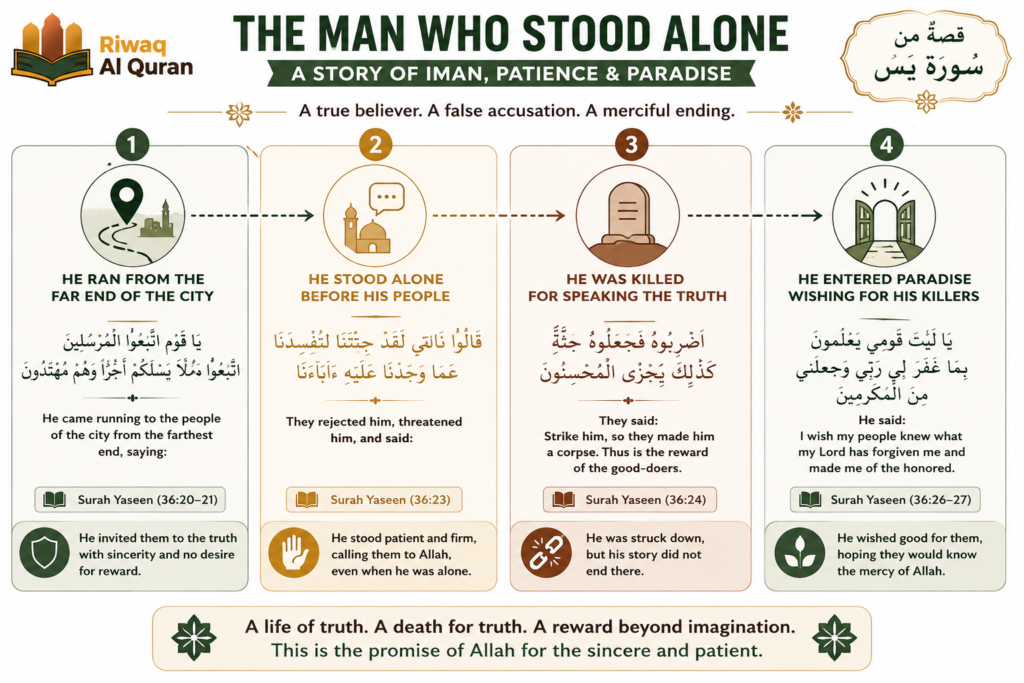
The surah’s opening pages narrate the story of a man — unnamed in the Quran, identified in tafsir tradition as Habib al-Najjar — who lived in a city that rejected three messengers. He was not a prophet. He was not a scholar. He was an ordinary believer who understood the truth, stood alone in his community, and paid for it with his life.
“وَجَآءَ مِنْ أَقْصَا ٱلْمَدِينَةِ رَجُلٌ يَسْعَىٰ قَالَ يَـٰقَوْمِ ٱتَّبِعُوا۟ ٱلْمُرْسَلِينَ”
“And there came from the farthest end of the city a man, running. He said, ‘O my people, follow the messengers.'” [Surah Yaseen, 36:20]
He ran. He did not wait to gauge the community’s direction. He ran toward the messengers, publicly, knowing the risk. He was killed for it. Then:
“قِيلَ ٱدْخُلِ ٱلْجَنَّةَ ۖ قَالَ يَـٰلَيْتَ قَوْمِى يَعْلَمُونَ بِمَا غَفَرَ لِى رَبِّى وَجَعَلَنِى مِنَ ٱلْمُكْرَمِينَ”
“He was told, ‘Enter Paradise.’ He said, ‘I wish my people could know — of how my Lord has forgiven me and placed me among the honored.'” [Surah Yaseen, 36:26–27]
At the moment of entering Paradise, his first and only recorded words are for the people who killed him — not reproach, not vindication, but a wish for their guidance. This is the most psychologically profound passage in Surah Yaseen, and the one most rarely discussed in popular writing about its benefits. Scholars of Islamic character formation (tarbiyah) consistently cite this story for two reasons:
- The character of a true believer is defined not by what happens to them, but by what they wish for others even after being wronged.
- Surah Yaseen does not simply describe the righteous — it shows you what one looks like in an impossible moment and asks, implicitly, whether you would run.
The Surah’s Own Instruction for Engaging with It
Surah Yaseen poses a pointed challenge directly to its reader — not once, but several times across its verses:
“أَفَلَا يَعْقِلُونَ”
“Then will they not reason?” [Surah Yaseen, 36:68]
This repetition is deliberate. The surah demands ‘aql — reason, reflection, active engagement — not passive pronunciation. It does not ask you to recite its words as a formula. It asks you to think about what they mean. Memorizing without understanding, or reciting as a ritual detached from comprehension, is the opposite of what the surah itself invites.
A Scholar’s Honest Note on Popular Claims About Surah Yaseen
Several widely-circulated practices attach guaranteed outcomes to reciting Surah Yaseen a specific number of times — 7, 40, or 41 — for marriage, pregnancy, provision, or specific personal needs. Islamic scholars who deeply value this surah consistently advise that these specific formulas are not established in authenticated Quranic text or hadith. Key points:
- Specific recitation counts (7, 40, 41 times) for guaranteed outcomes have no basis in authenticated Quran or Sunnah.
- The authenticated Prophetic model for seeking needs is: sincere recitation → sincere dua → sincere tawakkul on Allah.
- Framing Quranic recitation as a formula with a contractual output treats it as a mechanism, which the Quran does not sanction.
- This is not a reason to recite less — it is a reason to recite with the correct orientation and intention.
For reliable scholarly analysis grounded in primary Islamic sources on this topic, IslamQA.info is a dependable reference.
When Should You Recite Surah Yaseen?
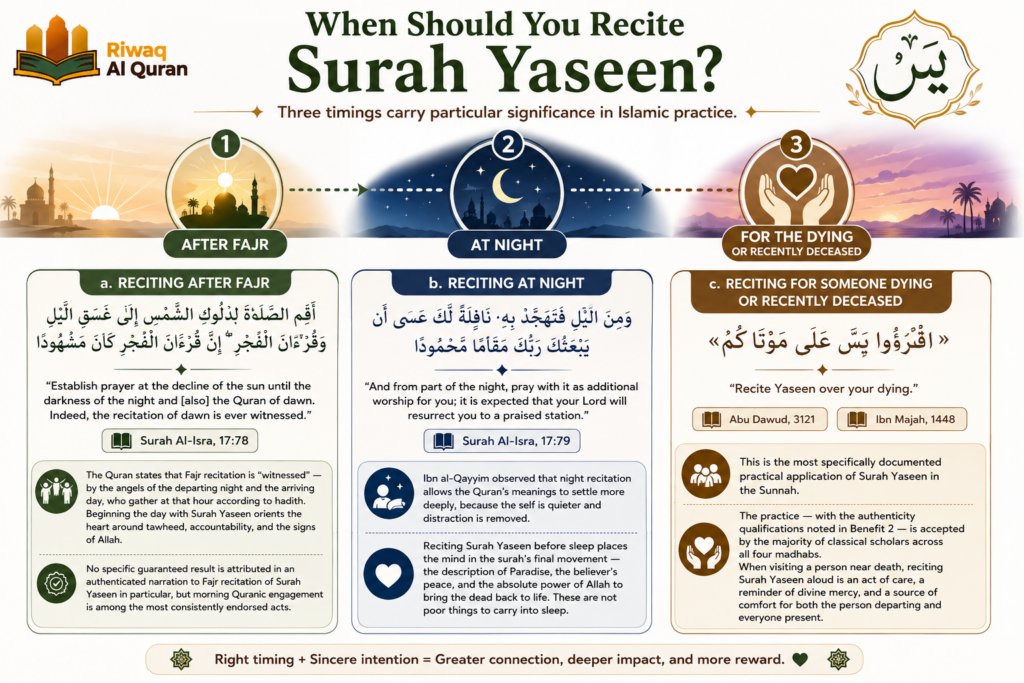
Three timings carry particular significance in Islamic practice, each for its own evidential reason. The timing shapes the intention — and intention, in Islamic practice, shapes the reward. Understanding why each timing matters gives the recitation its proper frame.
a. Reciting After Fajr
Reciting the Quran in the morning carries direct Quranic endorsement:
“أَقِمِ ٱلصَّلَوٰةَ لِدُلُوكِ ٱلشَّمْسِ إِلَىٰ غَسَقِ ٱلَّيْلِ وَقُرْءَانَ ٱلْفَجْرِ ۖ إِنَّ قُرْءَانَ ٱلْفَجْرِ كَانَ مَشْهُودًا”
“Establish prayer at the decline of the sun until the darkness of the night and [also] the Quran of dawn. Indeed, the recitation of dawn is ever witnessed.” [Surah Al-Isra, 17:78]
The Quran states that Fajr recitation is “witnessed” — by the angels of the departing night and the arriving day, who gather at that hour according to hadith. Beginning the day with Surah Yaseen — with its focus on tawheed, accountability, and signs of creation — orients the entire day’s consciousness around what matters.
No specific guaranteed result is attributed in an authenticated narration to Fajr recitation of Surah Yaseen in particular, but morning Quranic engagement is among the most consistently endorsed acts in both the Quran and Sunnah.
b. Reciting at Night
The Quran honors night recitation with a specific promise:
“وَمِنَ ٱلَّيْلِ فَتَهَجَّدْ بِهِۦ نَافِلَةً لَّكَ عَسَىٰٓ أَن يَبْعَثَكَ رَبُّكَ مَقَامًا مَّحْمُودًا”
“And from part of the night, pray with it as additional worship for you; it is expected that your Lord will resurrect you to a praised station.” [Surah Al-Isra, 17:79]
Ibn al-Qayyim observed that night recitation allows the Quran’s meanings to settle more deeply, because the self is quieter and distraction is removed.
Reciting Surah Yaseen before sleep places the mind in the surah’s final movement — the description of Paradise, the believer’s peace, and the absolute power of Allah to bring the dead back to life. These are not poor things to carry into sleep.
c. Reciting for Someone Dying or Recently Deceased
The Prophet (ﷺ) said:
«اقْرَؤُوا يس عَلَى مَوْتَاكُمْ»
Recite Yaseen over your dying.” [Abu Dawud, 3121] | [Ibn Majah, 1448]
This is the most specifically documented practical application of Surah Yaseen in the Sunnah. The practice — with the authenticity qualifications noted in Benefit 2 — is accepted by the majority of classical scholars across all four madhabs.
When visiting a person near death, reciting Surah Yaseen aloud is a documented act of care, a reminder of divine mercy, and a source of comfort both for the person departing and for everyone present.
How to Learn the Meaning of Surah Yaseen
Reciting Surah Yaseen in Arabic carries its own documented reward. Understanding what you recite multiplies that benefit — and this is what the surah itself demands, asking repeatedly: “Then will they not reason?” The following three steps apply at any level, regardless of your Arabic background.
a. Begin with a Reliable Tafsir
Two tafsir works are specifically recommended for Surah Yaseen, each suited to a different reader:
- Tafsir Ibn Kathir — classical depth; available at Quran.com’s Tafseer section. Best for readers who want the full scholarly context and chains of narration.
- Tafsir al-Sa’di (Taysir al-Karim al-Rahman) — clearer and more practical for modern readers; available in Arabic and translated editions. Best for those who want direct, applicable explanation without technical complexity.
Begin by reading the tafsir of one thematic block before reciting it, so the meaning is active in your mind during the recitation — not something you look up afterward as a separate exercise.
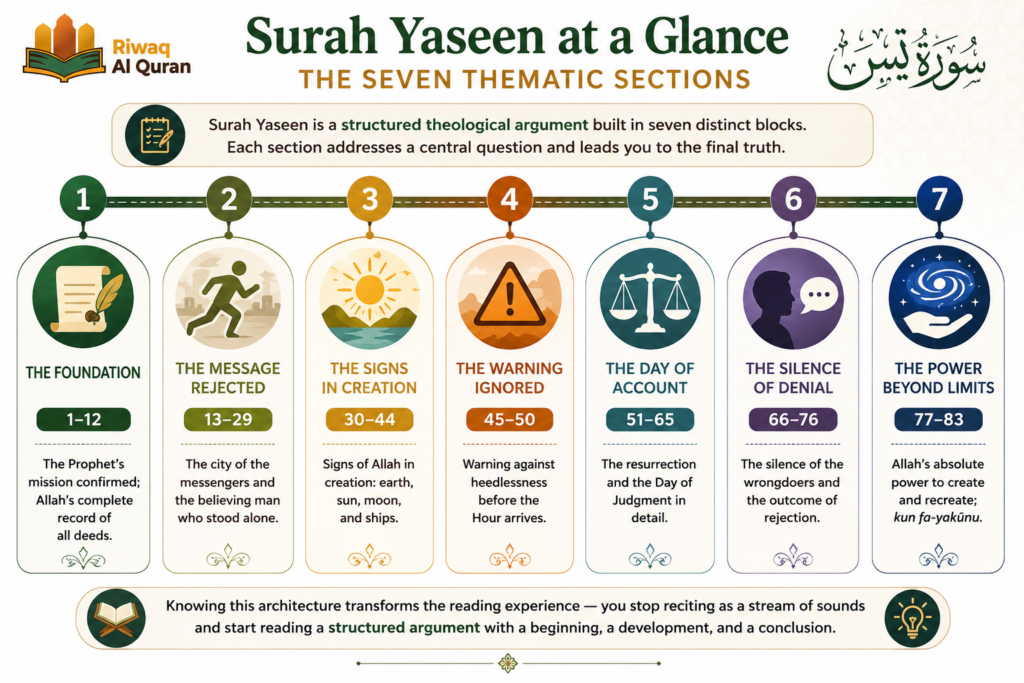
b. Map the Surah’s Seven Thematic Sections
Before studying verse by verse, it helps to see the surah as a whole structured argument. Surah Yaseen is not a random sequence of 83 verses — it is a theological case built in seven distinct blocks, each addressing a central question. The table below shows how those blocks are organized and what each one covers.
| Section | Verses | Central Theme |
|---|---|---|
| 1 | 1–12 | The Prophet’s mission confirmed; Allah’s complete record of all deeds |
| 2 | 13–29 | The city of the messengers and the believing man who stood alone |
| 3 | 30–44 | Signs of Allah in creation: earth, sun, moon, and ships |
| 4 | 45–50 | Warning against heedlessness before the Hour arrives |
| 5 | 51–65 | The resurrection and the Day of Judgment in detail |
| 6 | 66–76 | The silence of the wrongdoers and the outcome of rejection |
| 7 | 77–83 | Allah’s absolute power to create and recreate; kun fa-yakūnu |
Knowing this architecture transforms the reading experience — you stop reciting as a stream of sounds and start reading a structured argument with a beginning, a development, and a conclusion.
c. Build Core Vocabulary First if Arabic Is Not Your Language
If Arabic is not your first language, invest two to three weeks on the surah’s most-repeated core vocabulary before attempting full sentence-level translation. Recognizing key words when they appear transforms the recitation experience immediately, even before grammatical understanding is complete. Start with these:
- آية (āyah) — sign / verse
- بَعْث (ba’th) — resurrection
- قَوْم (qawm) — people / community
- مُسْتَقَرّ (mustaqarr) — resting place / stopping point
- حَسْرَة (hasra) — regret
- أَمْر (amr) — command
If you want to study Surah Yaseen under qualified guidance — with vocabulary, tafsir, and recitation feedback in one structured program — the Online Tafseer Course at Riwaq Al Quran offers one-on-one instruction with certified scholars in Arabic and English, at a schedule built around your timezone.
How to Memorize Surah Yaseen Effectively
The Quran gives its own assurance on the memorization process:
“وَلَقَدْ يَسَّرْنَا ٱلْقُرْءَانَ لِلذِّكْرِ فَهَلْ مِن مُّدَّكِر”
“And We have certainly made the Quran easy for remembrance, so is there any who will remember?” [Surah Al-Qamar, 54:17]
This verse appears four times in Surah Al-Qamar. Its repetition is its own teaching: the ease is real — but it requires a willing and consistent effort in return. Surah Yaseen at 83 verses is long enough to be a meaningful challenge, short enough to complete within weeks. What separates those who finish from those who don’t is almost never talent — it is system.
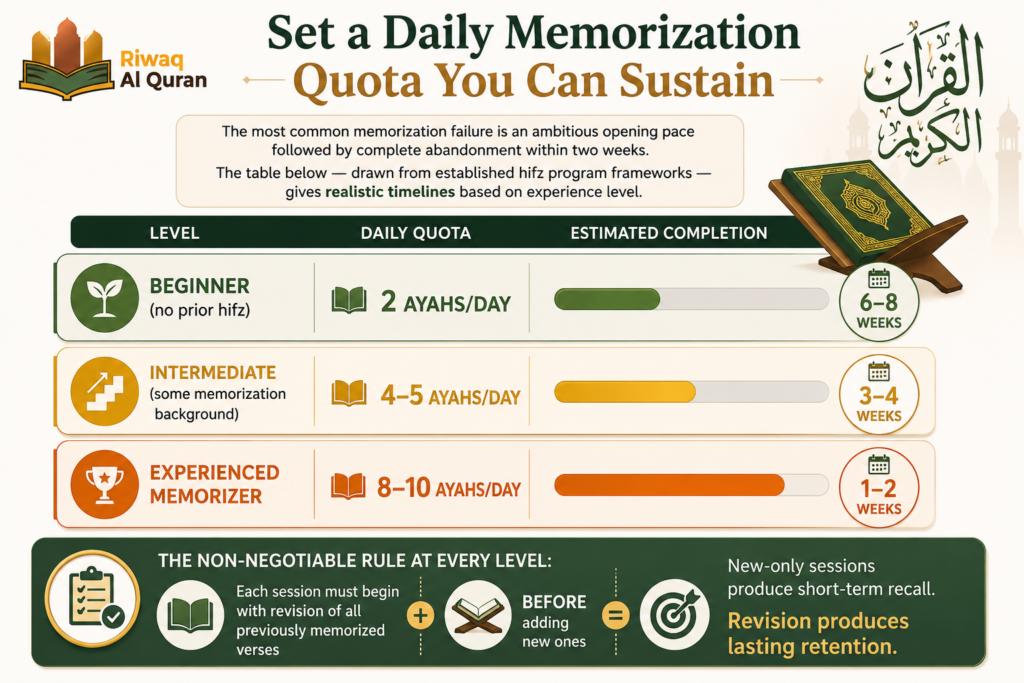
a. Set a Daily Memorization Quota You Can Sustain
The most common memorization failure is an ambitious opening pace followed by complete abandonment within two weeks. The table below — drawn from established hifz program frameworks — gives realistic timelines based on experience level.
| Level | Daily Quota | Estimated Completion |
|---|---|---|
| Beginner (no prior hifz) | 2 ayahs/day | 6–8 weeks |
| Intermediate (some memorization background) | 4–5 ayahs/day | 3–4 weeks |
| Experienced memorizer | 8–10 ayahs/day | 1–2 weeks |
The non-negotiable rule at every level: each session must begin with revision of all previously memorized verses before adding new ones. New-only sessions produce short-term recall. Revision produces lasting retention.
b. Listen to a Skilled Reciter Before Each Section
Hearing each section three to five times before memorizing it prevents errors in pronunciation and rhythm from the very first attempt, rather than embedding mistakes that take weeks to unlearn. Two reciters are specifically recommended for their clarity and measured pace:
- Sheikh Mishary Alafasy — widely available recordings in multiple tempos; excellent for learners at all levels.
- Sheikh Mahmoud Khalil Al-Hussary — particularly valued for measured, tajweed-precise pacing designed for memorization.
If you want to work on Tajweed rules alongside your memorization, Riwaq Al Quran’s Online Tajweed Classes cover the rules for beautiful Quranic recitation under expert guidance — an ideal complement to daily self-directed memorization sessions.
c. Use Your Salah as the Primary Revision Tool
Incorporating newly memorized ayahs into your daily prayers is the most effective reinforcement method used in formal hifz programs globally. It has an unambiguous sahih basis:
«الْمَاهِرُ بِالْقُرْآنِ مَعَ السَّفَرَةِ الْكِرَامِ الْبَرَرَةِ، وَالَّذِي يَقْرَأُ الْقُرْآنَ وَيَتَتَعْتَعُ فِيهِ، وَهُوَ عَلَيْهِ شَاقٌّ، لَهُ أَجْرَانِ»
“The one who is skilled in the Quran will be with the noble, righteous scribes (angels). And the one who recites the Quran and finds it difficult — and it is hard on him — will have two rewards.” [Sahih al-Bukhari, 4937] | [Sahih Muslim, 798]
This hadith — graded sahih in both Bukhari and Muslim — removes the psychological barrier of imperfection completely:
- The person who recites skillfully will be with the noble scribes on the Day of Judgment.
- The person who struggles and stumbles receives two rewards — one for the recitation and one for persevering through difficulty.
- Difficulty in memorization is not a sign of failure — it is a documented source of additional reward in Allah’s scale.
The intention to recite in salah creates urgency in each memorization session. The act of standing before Allah and reciting what you have memorized seals the verses into long-term memory in a way that desk repetition alone cannot replicate.
d. A Practitioner Note Most Memorization Guides Miss
The most common undetected error in Surah Yaseen memorization is the blending of similar structural phrases that appear across different sections — particularly the repeated rhetorical questions and the sequential descriptions of disbelievers in adjacent passages. Reciters who memorize section by section often conflate these without realizing it.
The correction is simple: always begin each new memorization session by reciting your last three ayahs from the previous session aloud, before opening to new material. This forces the brain to hold the section boundary clearly and eliminates the most frequent category of Surah Yaseen memorization error — the kind that goes undetected for weeks until a teacher catches it.
Begin Your Surah Yaseen Journey with a Certified Instructor
Memorizing and understanding Surah Yaseen on your own is possible. Doing it with a qualified teacher is faster, more accurate, and more lasting. The most common setback in self-directed Quran study is an error that goes unnoticed for weeks — then takes a month to correct. A skilled instructor catches it in the first session.
The Prophet (ﷺ) said:
«خَيْرُكُمْ مَنْ تَعَلَّمَ الْقُرْآنَ وَعَلَّمَهُ»
“The best among you are those who learn the Quran and teach it.” [Sahih al-Bukhari, 5027]
Riwaq Al Quran is a comprehensive online platform offering personalized Quran, Arabic, and Islamic Studies classes for all ages and backgrounds. Certified instructors use a structured curriculum designed for flexible, effective learning.
Watch real moments from our live sessions at Riwaq Al Quran and see how we bring learning to life:
whether you are memorizing Surah Yaseen, studying its Tafseer, or building your Tajweed foundation. Choose the program that fits your goal:
- Online Tafseer Course — Study Surah Yaseen’s meanings, verse by verse, with a certified scholar
- Quran Memorization with Tajweed — Memorize Surah Yaseen correctly and retain it for life
- Online Tajweed Classes — Master the rules of recitation for beautiful, accurate Quranic reading
- Quran for Kids — Nurture a love for the Quran in children through interactive online classes
Every student begins with a free trial class — no commitment required — so you can assess the teaching quality and instructor fit before deciding.
Start your Surah Yaseen journey today. Book your free trial now.
[CTA button placeholder: Book Your Free Trial →]
Conclusion
The benefits of Surah Yaseen are real, documented, and meaningful — but they are not mechanical. The surah eases the soul at death, per the narration of Abu Dawud and Ibn Majah. It strengthens tawheed through 83 verses of varied, repeated exposition of Allah’s authority. It confronts accountability with vivid specificity that recalibrates daily behavior. It opens the eyes to Allah’s signs in the observable world — in the reviving earth, the moving sun, and the turning moon. And through the story of an ordinary man who died wishing guidance for his killers, it builds a character in the reader — not merely a practice.
Where scholarly debate exists about specific hadith chains, this article has been transparent: the two hadiths most commonly cited for Surah Yaseen specifically (Tirmidhi 2887 and Abu Dawud 3121) have debated authenticity, while the sahih hadiths on Quran recitation generally (Bukhari 4937, Muslim 798, Bukhari 5027) are unambiguous in their grading and in what they promise.
Engaging with the Quran through learning, recitation, and memorization has clear, authenticated reward — and Surah Yaseen, as the heart of that Book, is as worthy a starting point as any in the Quran.
Recite Surah Yaseen with intention, learn its meaning through its seven thematic sections, and memorize it with the support of a qualified instructor. The Quran was made easy to remember. Surah Yaseen is the evidence.
Frequently Asked Questions
The questions below address the most common points of confusion about Surah Yaseen’s benefits, hadith authenticity, and practice — compiled from what readers most frequently search and ask on this topic.
What is the most evidentially supported benefit of Surah Yaseen?
The most consistently supported practice is reciting Surah Yaseen over a dying person, documented in Abu Dawud (3121) and Ibn Majah (1448) and accepted across all four major madhabs. Its designation as “the heart of the Quran” (Tirmidhi 2887) is also widely cited, though hadith scholars have noted weakness in its chain — which this article addresses openly in Benefit 1.
Are the specific Surah Yaseen hadiths graded sahih?
No. The two hadiths most specific to Surah Yaseen — “heart of the Quran” (Tirmidhi 2887) and “recite over the dying” (Abu Dawud 3121; Ibn Majah 1448) — have weaknesses in their chains noted by Shaykh al-Albani and others. Scholars who act upon them do so under the traditional leniency for fada’il al-a’mal narrations. The sahih hadiths cited in this article — Bukhari 4937 and Muslim 798 on recitation reward, and Bukhari 5027 on learning and teaching — carry no such qualification.
Can Surah Yaseen be read for a sick person?
Yes. Reading the Quran for someone who is ill is established in Islamic practice as an act of care, spiritual support, and dua. No text restricts this to particular surahs — general Quran recitation with the intention of mercy for the sick person is documented and encouraged across the schools of jurisprudence.
How long does it take to memorize Surah Yaseen?
At 2 ayahs per day with consistent daily revision, beginners complete memorization in 6–8 weeks. Those with prior hifz experience may finish in 2–4 weeks at a higher daily pace. The key variable is not speed — it is daily revision of previously memorized verses alongside new memorization. Without revision, recall does not hold beyond a few days. For guided memorization with Tajweed correction built in, consider exploring the Quran Memorization Online Course at Riwaq Al Quran.
Is reciting Surah Yaseen a fixed number of times authenticated in Islam?
No. There is no hadith graded as sahih or hasan that specifies a recitation count — 7, 40, or 41 times — with a guaranteed result for Surah Yaseen specifically. Scholars advise: recite sincerely, make dua directly to Allah, and practice tawakkul. That sequence is what the Quran and Sunnah support consistently.
What is the most important verse in Surah Yaseen to understand?
Scholars of aqeedah consistently point to verse 82 — kun fa-yakūnu — as the surah’s theological peak: Allah’s command and its fulfillment are simultaneous, with no gap between will and execution. Verses 26–27, the believing man entering Paradise and wishing guidance for those who killed him, are equally cited as the surah’s defining lesson in character formation and the believer’s true priorities.
Sources
The table below links every hadith and key Quranic reference cited in this article to its verified primary source on Sunnah.com and Quran.com.
| Source | Reference | Verified Link |
|---|---|---|
| “Heart of the Quran” | Tirmidhi, 2887 | sunnah.com/tirmidhi:2887 |
| “Heart of the Quran” (second chain) | al-Darimi, 3418 | sunnah.com/darimi:3418 |
| “Recite Yaseen over the dying” | Abu Dawud, 3121 | sunnah.com/abudawud:3121 |
| “Recite Yaseen over the dying” (second chain) | Ibn Majah, 1448 | sunnah.com/ibnmajah:1448 |
| Skilled reciter with angels / two rewards (Sahih) | Bukhari, 4937 | sunnah.com/bukhari:4937 |
| Skilled reciter with angels / two rewards (Sahih) | Muslim, 798 | sunnah.com/muslim:798 |
| “Best of you learns and teaches the Quran” (Sahih) | Bukhari, 5027 | sunnah.com/bukhari:5027 |
| “Whoever reads a letter — ten rewards” | Tirmidhi, 2910 | sunnah.com/tirmidhi:2910 |
| Surah Yaseen — full text, tafsir, recitations | Quran.com | quran.com/36 |
| Scholarly rulings on Surah Yaseen practices | IslamQA | islamqa.info |