
| Key Takeaways |
| Most dedicated learners reach functional Quranic Arabic reading comprehension within 6 to 12 months of consistent daily study. |
| Quranic Arabic has a far smaller vocabulary than Modern Standard Arabic — roughly 70% of the Quran uses only around 300 root words. |
| A structured schedule of 30 minutes daily produces significantly better results than longer, infrequent sessions spread across the week. |
| The biggest barrier for non-Arabic speakers is not grammar complexity but inconsistent practice and the absence of a qualified teacher. |
Many non-Arabic speaking Muslims recite the Quran daily without understanding a word — and that gap quietly weighs on them. Learning Quranic Arabic is not the years-long undertaking most people assume it is.
With the right structure, a beginner can understand significant portions of the Quran in under a year.
Table of Contents
How Long Does It Take to Learn Quranic Arabic at a Beginner Level?
Most beginners with no Arabic background can reach a functional reading and comprehension level in Quranic Arabic within 6 to 12 months, provided they study consistently for 20 to 30 minutes daily.
This means understanding the core vocabulary and basic sentence structures found throughout the Quran — not translation-level fluency in all 6,236 verses.
This timeline assumes structured learning, not passive exposure. Students who work through a systematic curriculum — covering Arabic script, root-word patterns, common vocabulary, and basic grammar — progress far faster than those studying randomly from YouTube videos or isolated apps.
At Riwaq Al Quran, students enrolled in our Quranic Arabic Course work one-on-one with Azhari-certified instructors, which consistently compresses this timeline compared to self-study. Personalized correction removes the compounding errors that slow down solo learners for months.
Book Your FREE Trial in Riwaq’s Quranic Arabic Classes

What Is a Realistic Schedule to Learn Quranic Arabic?
A practical Quranic Arabic schedule depends on your available daily time and your specific goal — basic comprehension, deeper Tafsir engagement, or full translational fluency. Below is a structured breakdown based on realistic student outcomes.
1. Quranic Arabic Learning Timeline by Study Commitment
| Timeframe | Daily Study Time | Realistic Milestone |
| 1 Month | 20–30 min/day | Master Arabic script and recognize isolated letters and vowel marks with all variations |
| 3 Months | 20–30 min/day | Read Quranic words fluently and recognize 50–80 common Quranic vocabulary items |
| 6 Months | 30 min/day | Understand short Surahs, identify root words, follow basic sentence structure |
| 1 Year | 30–45 min/day | Comprehend 60–70% of frequently recurring Quranic vocabulary in context |
| 2 Years | 45–60 min/day | Functional Quranic comprehension with access to Tafsir texts independently |
This table reflects consistent, structured study. Sporadic effort will not produce these results regardless of total hours. Daily regularity matters more than session length.
One-Month Plan: Building the Foundation
In the first month, focus entirely on the Arabic script. This means recognizing all 28 letters in their isolated, initial, medial, and final forms — and reading short-vowel marked (harakat) words fluently.
Many students underestimate this phase and rush past it. At Riwaq Al Quran, our tutors observe that students who spend adequate time on foundational script reading in month one progress nearly twice as fast in the grammar phase that follows.
Three-Month Plan: Entering the Vocabulary Core
By month three, a student should be working through the most frequent Quranic roots systematically. Start with the 100 most-repeated words — many appear hundreds of times across the Quran. Understanding these alone unlocks meaningful engagement with Salah recitation.
Pair vocabulary with Tajweed rules during this phase. Pronunciation accuracy and comprehension reinforce each other — mispronounced letters often carry different meanings entirely in Arabic, making Tajweed study inseparable from language learning.


Six-Month Plan: Reaching Comprehension of Short Surahs
At the six-month mark, a dedicated student should understand the literal meaning of Surah Al-Fatiha, Juz’ ‘Amma (the final section), and dozens of the most-recited shorter Surahs without translation aid.
This is a meaningful, spiritually significant milestone — Salah becomes a different experience entirely.
Grammar study deepens here. Focus on the three grammatical states (raf’, nasb, jarr), basic verb forms (fi’l madi, mudari’), and the patterns of broken and sound plurals that appear frequently throughout the text.
One-Year Plan: Functional Quranic Comprehension
One year of consistent study produces a learner who can read a Quranic verse, identify its root words, understand the grammatical structure, and approximate the meaning — then verify against a Tafsir to confirm. This is not memorization of translations. It is reading the Quran as a text.
For students pursuing deeper study, our Online Quran Tafseer Course builds directly on this foundation — connecting linguistic comprehension to classical exegetical tradition under Azhari-certified guidance.
Enroll Now in Riwaq’s Tafseer Course with a FREE trial

How To Put A Schedule To Learn Quranic Arabic In 6 Months?
Here is a suggested weekly schedule to learn Quranic Arabic in 6 months.
| For 4 days a week | 5th day of the week | 6th day of the week | 7th day of the week | |
| For 4 hours, learn 10 new Arabic words (meaning/writing/usage) | For 2 hours, Learn 2 new Arabic grammar rule (usage/examples) | This day will be for revising the new words/grammar rules you learned in the previous 4 days. | For 2 hours, Learn 2 new Arabic grammar rules (usage/examples) | OFF for refreshments |
How To Put A Schedule To Learn Quranic Arabic In 1 Year?
| For 4 days a week | 5th day of the week | 6th day of the week | 7th day of the week | |
| For 2 hours, learn 5 new Arabic words (meaning/writing/usage) | For 1 hour, Learn 1 new Arabic grammar rule (usage/examples) | This day will be for revising the new words/grammar rules you learned in the previous 4 days. | This day will be the “Practice Day” – practice what you have learned: Speaking with other Arabic native persons listening to Arabic (Quran recitations for example)Writing the new words you have learned in Arabic text (books, articles, etc.) | OFF for refreshments |
Experience Riwaq Al Quran Classes
Watch real moments from our live sessions at Riwaq Al Quran and see how we bring learning to life. These clips highlight our interactive, student-focused approach designed to keep learners engaged, motivated, and actively involved in every step of their educational journey.
What Makes Quranic Arabic Easier to Learn Than Most People Expect?
Quranic Arabic is a focused classical register, not a full spoken language — and that distinction dramatically reduces the learning load. The vocabulary is finite. Research in Arabic linguistics indicates that roughly 300 root words account for approximately 70% of the Quran’s total word occurrences. A learner who masters these roots unlocks the majority of the text.
Modern Standard Arabic has thousands of active vocabulary items. Quranic Arabic does not require that breadth.
What it requires is depth — understanding how the trilateral root system generates word families, and how basic grammatical case markers (i’rab) signal meaning within Quranic sentences.
Most Common Quranic Arabic Words by Category
| Category | Examples | Approximate Frequency |
| Divine names & pronouns | Allah, Huwa, Rabbuka | Hundreds of occurrences |
| Connectives & particles | Wa (and), Fa (then), Inna (indeed) | Thousands of occurrences |
| Verbs of command | Qul (say), Aqimu (establish), Ittaqū (fear) | Hundreds of occurrences |
| Nouns of worship | Salah, Zakat, Iman, Taqwa | Hundreds of occurrences |
| Time and place words | Yawm (day), Ard (earth), Sama’ (sky) | Hundreds of occurrences |
This is why students who approach Quranic Arabic with the wrong expectation — treating it like learning conversational French — often feel overwhelmed.
Reframe the goal: you are learning to read and understand a specific text, not to hold a conversation in a living language. That shift in expectation alone changes a student’s relationship with the subject.
What Are the Real Benefits of Learning Quranic Arabic?
Learning Quranic Arabic is not merely an academic achievement — it fundamentally changes a Muslim’s relationship with the Quran itself. Allah ﷻ describes the Quran in Surah Yusuf:
إِنَّآ أَنزَلْنَـٰهُ قُرْءَٰنًا عَرَبِيًّا لَّعَلَّكُمْ تَعْقِلُونَ
Innā anzalnāhu Qur’ānan ‘arabiyyan la’allakum ta’qilūn
“Indeed, We have sent it down as an Arabic Qur’an that you might understand.” (Yusuf 12:2)
The word ta’qilūn — from the root meaning to reason, comprehend, and reflect — implies that understanding the language is part of the intended engagement with the text. Four specific benefits emerge consistently from this study.
Benefit 1: Salah Transforms from Routine to Worship
When a Muslim understands what they recite in prayer, concentration (khushu’) increases measurably. Students who reach basic Quranic Arabic comprehension frequently describe Salah shifting from a memorized recitation into a live conversation with their Creator. That shift has a profound effect on their consistency and quality of worship.
Benefit 2: Quran Memorization Becomes Faster and More Durable
This is among the most practically significant benefits for Hifz students. In our experience at Riwaq Al Quran, students who understand the meaning of what they memorize retain verses far longer and make far fewer positional errors — confusing similar verses within the same Surah.
Meaning creates structural memory that phonetic repetition alone cannot replicate. Explore our Quran memorization techniques for additional strategies that benefit from Arabic comprehension.
Benefit 3: Independent Access to Tafsir
Classical Tafsir works — including Ibn Kathir and Al-Qurtubi — are written in Arabic. A student with functional Quranic Arabic can access the scholarly tradition directly, without depending entirely on translated summaries.
Understanding the Tafsir meaning in its original language adds a dimension of depth that translation cannot fully replicate.
Benefit 4: Deeper Engagement with Islamic Studies
Arabic is the foundational language of Fiqh, Hadith, and Aqeedah scholarship. A student who builds Quranic Arabic competency simultaneously builds the linguistic foundation for broader Islamic Studies engagement.
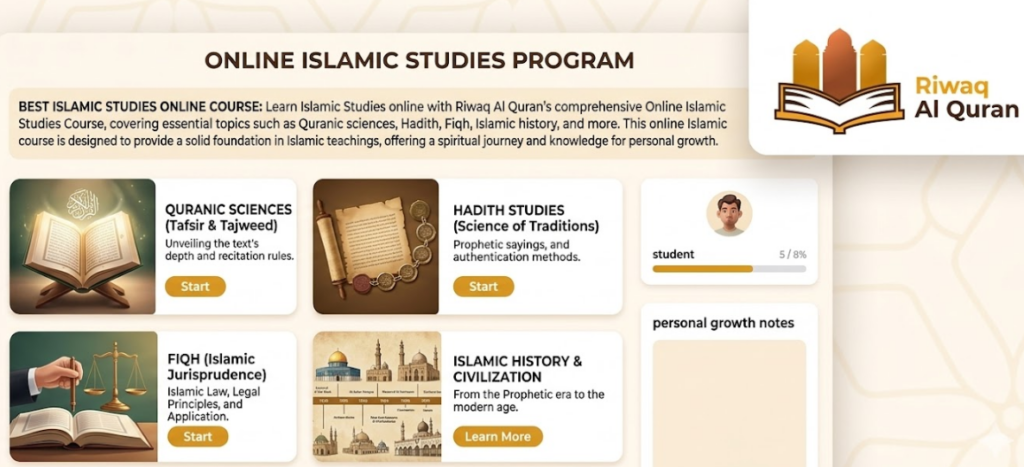
Our Best Islamic Studies Online Course integrates Arabic literacy with Islamic knowledge in a structured sequence designed for Western Muslim learners.
Begin your Islamic Studies with a FREE trial lesson
How Can You Overcome the Top Challenges When Learning Quranic Arabic?
Most learners do not fail at Quranic Arabic because of the language’s difficulty. They stall because of three specific, solvable problems. Identifying them early prevents the plateau that ends most self-study attempts.
Challenge 1: Inconsistency and Loss of Momentum
The most common obstacle — by a significant margin — is not difficulty but irregular study. Classical Arabic grammar patterns require spaced repetition to internalize.
A student who studies for two hours on weekends but skips weekdays does not accumulate the same retention as one who studies 25 minutes every day.
Solution: Build a non-negotiable 20-minute daily slot tied to an existing habit — immediately after Fajr, or before sleeping. Consistency matters more than duration.
Challenge 2: Studying Grammar Rules Without Quranic Application
Many learners work through grammar textbooks without connecting each rule to actual Quranic verses.
This produces students who can identify grammatical cases in isolated exercises but cannot read the Mushaf with comprehension. It also makes the study feel abstract and draining.
Solution: Every grammar concept must be immediately anchored to a Quranic verse. Learn the genitive construction (idafa) — then find and read ten examples in the Quran directly. Grammar embedded in revelation is grammar that sticks.
Challenge 3: Absence of Qualified, Live Correction
Self-study produces silent errors. A student mispronouncing a root, misreading a case marker, or misunderstanding a grammatical pattern will reinforce that error thousands of times before discovering it — if they ever do.
This is why online course completion rates for self-directed Arabic learning are so low.
Solution: Work with a qualified teacher who can identify errors as they form, not months later. The Azhari-certified instructors at Riwaq Al Quran specialize in teaching non-Arabic speakers and use systematic correction methods that prevent these compounding mistakes. Our Best Islamic Studies Online Course includes language foundation components specifically designed for Western learners starting from zero.
Why Students Love Learning with Riwaq Al Quran
Hear directly from our students about how Riwaq Al Quran Academy has transformed their connection with the Book of Allah. Their experiences reflect the dedication, care, and quality that guide every step of our teaching.
Start Learning Quranic Arabic with Riwaq Al Quran
A structured path, the right teacher, and daily consistency are all you need. The language of the Quran is within reach — and closer than most students believe.
Riwaq Al Quran offers:
- Azhari-certified tutors — Al-Azhar University graduates with Ijazah credentials
- One-on-one personalized sessions — no classroom, no one left behind
- 24/7 scheduling — built around your timezone and routine
- 2 Free Trial Classes — no commitment required
- 100% Money-Back Guarantee
We offer courses in Online Quran & Tajweed Classes, Arabic Language, and Islamic Studies.
- Online Quran Memorization Course
- Tafseer Course
- Tajweed Classes
- Online Quran Classes for Kids.
- Ijazah Program.
- Qirat Course.
- Arabic Language Classes.
- Islamic Studies Courses.
Enroll now for 2 Free Trial Classes
Conclusion
Learning Quranic Arabic is one of the most rewarding investments a Muslim can make — not because it is easy, but because what it opens is worth every hour of effort.
A realistic timeline, a structured daily schedule, and a qualified teacher are the three variables that determine how quickly you get there.
Most dedicated learners reach meaningful comprehension within 6 to 12 months. The language has always been accessible — the question is whether you begin. May Allah ﷻ grant you tawfiq on this path. Ameen.
Read Also: How to Complete the Quran in 10 Days?
Frequently Asked Questions About Learning Quranic Arabic
Can I learn Quranic Arabic without knowing Modern Standard Arabic first?
Yes — and in many ways, starting directly with Quranic Arabic is more efficient for Muslims. Quranic Arabic is a classical register with a finite, structured vocabulary. Modern Standard Arabic adds thousands of words and contemporary grammatical constructions that are irrelevant to Quranic comprehension. Focused Quranic Arabic study produces faster results for the specific goal of understanding the Quran.
Is Quranic Arabic the same as the Arabic spoken in Arab countries today?
No. Quranic Arabic is classical Arabic, distinct from spoken dialects (Egyptian, Levantine, Gulf Arabic) and different in some respects from Modern Standard Arabic. Spoken dialects have evolved significantly over fourteen centuries. A student learning Quranic Arabic will not be able to hold a street conversation in Cairo — but that is not the goal.
How long does it take to understand the Quran without a translation?
For a learner studying 30 minutes daily with structured instruction, understanding the most frequently recurring vocabulary — enough to follow the meaning of prayers and shorter Surahs — takes approximately 6 months. Reaching the level where you can read most of the Quran without a translation takes 1.5 to 2 years of consistent effort. See our Quran memorization schedule guide for a parallel planning framework.
Do I need to learn the Arabic script before starting Quranic Arabic grammar?
Yes — script fluency is foundational and cannot be bypassed. Attempting to study grammar through transliteration is a significant pedagogical mistake. The Arabic root system is inseparable from written form: recognizing roots visually in the Quran is how the vocabulary actually becomes usable. Dedicate the first 4–6 weeks exclusively to script mastery before moving to grammar.
What age is best to begin learning Quranic Arabic?
There is no age that is too late. Adults often progress faster than children in the grammar phase because of their stronger analytical thinking. Children, when taught through age-appropriate methods, develop more natural phonetic instincts. Riwaq Al Quran’s Online Quran Classes for Kids and adult programs are structured separately to meet each group’s learning style.