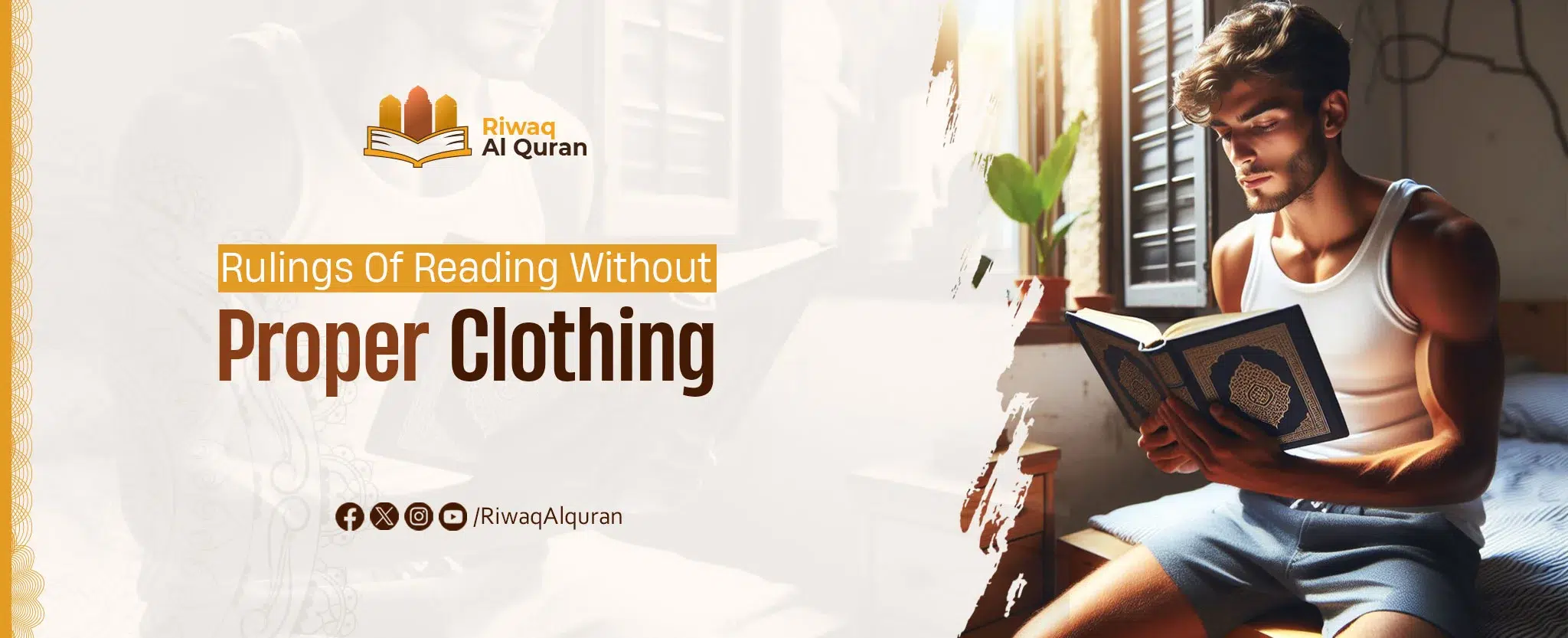
Yes, you can read the Quran in shorts, short sleeves, or even without a shirt — covering the body isn’t a requirement for reading the Quran outside of prayer. What matters is a separate question people often confuse with this one: the specific dress requirements for Salah (prayer) don’t automatically apply to simply reading or reciting the Quran on your own.
This guide separates those two rulings clearly, explains what’s actually recommended versus required, and covers the specific edge cases — short sleeves, no shirt, impure clothing, and being fully undressed — that most articles on this topic answer six different times instead of once.
What You’ll Learn in This Article
- Why the “prayer awrah” standard doesn’t automatically apply to reading the Quran.
- What Islamic teaching actually requires versus what it recommends.
- The specific ruling on shorts, short sleeves, and reading without a shirt.
- Whether reciting in impure clothing is permissible.
- What’s genuinely different for women, and where the Qibla and hijab actually fit in.
Table of Contents
Body Covering and the “Navel-to-Knee” Rule in Quran Recitation
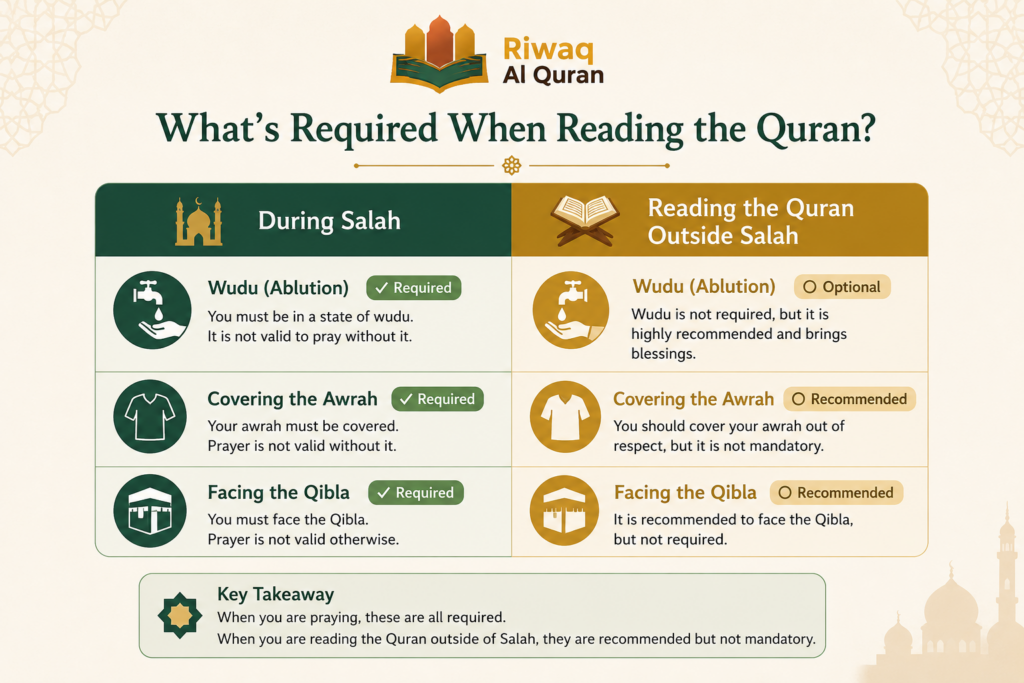
No — covering the body, including the area scholars define as awrah, is not a condition for reading the Quran outside of Salah. A scholar at Al-Azhar University’s Faculty of Usul Ad-Din addressed this directly: “It’s not a condition to cover the awrah while reading the Qur’an, but it’s far better and recommended to read the Qur’an while one is in the best form of dignity and modesty.”
This is worth being precise about, because it’s easy to confuse with a different ruling entirely — the one that governs prayer specifically:
- The rule that a man’s awrah is the area between the navel and the knees is the majority scholarly position specifically for Salah — one of the conditions that makes prayer valid, based on scholarly consensus (Al-Mughni, 3/7).
- Reading the Quran on its own is a different act of worship from Salah: it doesn’t require wudu the same way touching a physical Mushaf does.
- It doesn’t require facing the Qibla the way prayer does.
- It isn’t governed by the same conditions that make prayer valid or invalid.
This distinction is the actual reason shorts, short sleeves, or reading without a shirt are permissible outside of prayer, even though the same clothing would invalidate Salah if the navel-to-knee area were left uncovered during it.
This flexibility is part of a broader point — the Quran is meant to be engaged with wherever you are, not only under strict conditions.
Can I Read Quran in Shorts, Short Sleeves, or Without a Shirt?
Yes to all three — a scholarly fatwa addressing this directly states: “It is permissible to read the Qur’an with sleeping clothes even if they do not cover the awrah… however, it is better for a person to beautify himself when reading the Qur’an, as he is addressing his Lord” (islamweb.net, Fatwa 91561).
The Quran itself gives the basis for the “beautify yourself” recommendation, in a verse commonly cited in this context:
(يَا بَنِي آدَمَ خُذُوا زِينَتَكُمْ عِندَ كُلِّ مَسْجِدٍ)
“O children of Adam, take your adornment at every place of worship.” (Surah Al-A’raf, 7:31)
This verse establishes dressing with dignity as a recommended practice tied to acts of worship generally — it’s the basis for the etiquette (adab) scholars encourage, not a strict legal requirement with its own separate ruling for every type of clothing question. That’s exactly why the shorts, short-sleeve, and no-shirt questions all get the same answer: they’re really one question, not three.
If you want to understand how a verse like this connects to broader Islamic etiquette rather than reading it as an isolated ruling, Riwaq Al Quran’s online Tafseer course walks through this kind of thematic context directly with a qualified instructor.
Can You Recite the Quran in Ritually Impure Clothing?
Yes, reciting the Quran while wearing clothing considered ritually impure is permissible, though it goes against the recommended etiquette of engaging with the Quran.
- Being in a state of purity — both personally and in your surroundings, including your clothing — is encouraged for a stronger sense of reverence.
- Performing wudu beforehand is recommended, though not mandatory, for reading alone.
This is a genuinely separate question from the clothing-coverage questions above — it’s about cleanliness rather than modesty, and it’s worth answering on its own rather than folding into the same “yes, permissible, but better to…” pattern.
Does This Ruling Differ for Women?
The core principle is the same — hijab and full-body covering are not conditions for reading the Quran outside of Salah, the same way the navel-to-knee rule for men isn’t.
Scholars across the major schools, including Imam Abu Hanifa, Imam Malik, and Imam Ahmad, held that the requirement to cover applies specifically to prayer and to being in the presence of non-mahram men — not to the act of reading the Quran privately on its own.
Where scholars do add a recommendation specific to women is modesty as an act of reverence, even in private, alongside a broader recommendation — for anyone, not only women — to face the Qiblah and be in wudu as acts of adab (etiquette) rather than binding conditions. Allah frames this kind of voluntary reverence directly:
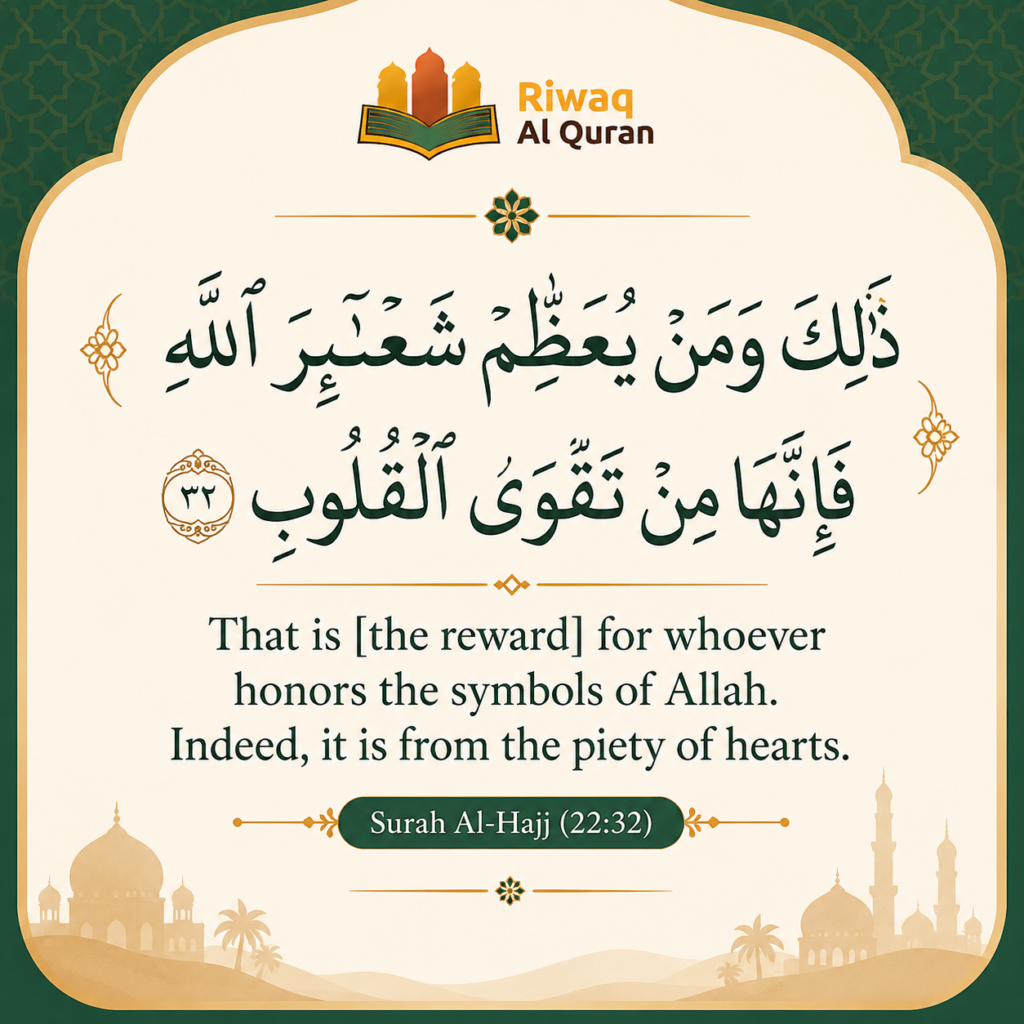
(وَمَن يُعَظِّمْ شَعَائِرَ اللَّهِ فَإِنَّهَا مِن تَقْوَى الْقُلُوبِ)
“And whoever honors the symbols of Allah — indeed, it is from the piety of hearts.” (Surah Al-Hajj, 22:32)
This verse is the basis scholars point to for why these recommendations matter, even though none of them affect whether your recitation counts or is rewarded.
Understanding which parts of a ruling are obligatory versus recommended is exactly the kind of nuance Riwaq Al Quran’s Islamic Studies course is built to walk through properly, rather than treating every recommendation as a strict requirement.
Read the Quran With Confidence, Not Just Correct Dress
Getting the ruling on Proper Clothing right is one part of engaging with the Quran properly — reciting it accurately, with correct Tajweed, is the part that actually shapes your recitation itself.
Riwaq Al Quran is a comprehensive online platform that offers personalized Quran, Arabic, and Islamic Studies online classes for individuals of all ages and backgrounds. Our experienced instructors use a structured curriculum to cover Tajweed, Tafsir, and Memorization, providing easy and effective access to learning the Quran, with advanced online classes that allow for seamless communication and interaction between students and teachers. Join Riwaq Al Quran for a deeper connection with the Quran.
Once the question of what to wear is settled, this is the part that actually shapes your recitation.
We offer several courses, including:
- Online courses for kids
- Online Quran classes for kids and adults
- Online Arabic courses
- Online Ijazah courses
Here’s a sample of our Quran courses that will be helpful for you:
- Online Tafseer Course: Delve into Quranic meanings with our insightful online Tafseer course.
- Noorani Qaida Online: Learn Quranic basics efficiently through our Noorani Qaida online program.
- Online Quran Recitation Course: Enhance Quranic recitation skills through our expert-led online course.
- Online Tajweed Classes: Master Tajweed rules for beautiful Quranic recitation in online classes.
- Quran Memorization Online Course: Memorize the Quran effectively with our specialized online memorization course.
- Online Qirat Course: Explore diverse Qirat styles with our comprehensive online course.
- Online Quran Classes for Kids: Nurture a love for the Quran in kids through interactive online classes.

Conclusion
Two acts of worship, two different standards — and confusing them is where almost every question about clothing and reading the Quran actually starts.
- Salah has real conditions. Covering the navel-to-knee area, facing the Qibla, being in wudu — these aren’t etiquette, they’re what makes the prayer valid at all.
- Reading the Quran doesn’t carry those same conditions. Shorts, short sleeves, no shirt, even imperfectly clean clothing — none of it invalidates your recitation, because this isn’t Salah.
- What’s left is recommendation, not requirement. Dressing with dignity, approaching the Quran in a state of cleanliness, facing the Qiblah out of reverence — Allah frames this kind of voluntary care directly:
(وَمَن يُعَظِّمْ شَعَائِرَ اللَّهِ فَإِنَّهَا مِن تَقْوَى الْقُلُوبِ)
“And whoever honors the symbols of Allah — indeed, it is from the piety of hearts.” (Surah Al-Hajj, 22:32)
That line is the whole article in one sentence: none of these recommendations affect whether your recitation counts. They affect the quality of your presence while you’re doing it. Know which is which, and you can stop treating a recommendation like a rule — and stop treating a rule like it’s optional.
FAQs
Here are quick, direct answers to the specific edge cases people ask about most once the general ruling is clear.
Do you have to cover your knees to read the Quran?
No, covering the knees or any specific body part is not required to read the Quran outside of prayer — the navel-to-knee awrah rule is specifically a condition for Salah, not for reading the Quran on its own.
Can a man read the Quran without a shirt?
Yes, it’s permissible for a man to read the Quran without a shirt, though dressing with more dignity is recommended as a matter of respect when engaging with the text.
Do you need wudu to read the Quran?
Wudu is recommended but not mandatory to recite the Quran from memory or a digital device; the majority of scholars hold that wudu is required specifically to touch a physical Mushaf, based on the verse describing it as touched only by the purified.
Does a woman need to wear hijab to read the Quran at home?
No, according to the majority of scholars across the major schools, hijab is a condition of Salah and of being in the presence of non-mahram men — not a condition for reading the Quran privately at home.
Can you recite the Quran in unclean clothing?
Yes, reciting the Quran while wearing ritually impure clothing is permissible, though maintaining personal and clothing cleanliness is recommended as part of approaching the Quran with proper respect.