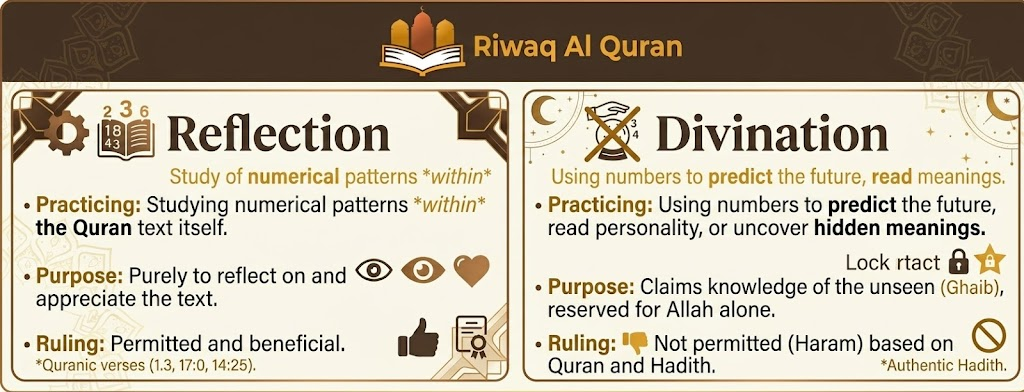
Numerology in Islam — using numbers to predict the future, read personality, or uncover hidden meanings — is not permitted, because it claims knowledge that Islam reserves for Allah alone. At the same time, some scholars study numerical patterns within the Quran itself, purely as a way to reflect on the text, and this is a different practice with a different ruling.
This distinction matters, because the two get confused constantly online, and conflating them leads people either to wrongly avoid legitimate reflection on the Quran, or to wrongly justify divination by calling it “Quranic numerology.” This guide draws that line clearly, using the Quran and authentic Hadith rather than general assumption.
What You’ll Learn in This Article
- The exact Islamic ruling on numerology, and the specific belief it conflicts with.
- The difference between forbidden numerology and permissible study of Quranic numerical patterns.
- Which numerical claims about the Quran are well-documented, and which are disputed?
- What the Abjad system actually is, and why it isn’t a numerology tool despite common confusion?
- A practical way to tell whether you’re reflecting on the Quran or drifting into divination.
Table of Contents
What Is Numerology in Islam?
Quranic numerology refers to the study and interpretation of numerical patterns, codes, and symbolism found within the Quran. It involves analyzing the frequency of certain words, letters, and numbers in the Quranic text to predict things or uncover hidden meanings and signs that point to the Quran’s miraculous nature.
Numerology as a practice covers two very different things that are frequently grouped together:
| Numerology (Forbidden) | Quranic Numerical Patterns (Permissible) | |
|---|---|---|
| What it is | Using numbers to predict the future, determine personality traits, or uncover hidden meanings in a text or name | Academic study of numerical patterns within the Quran’s text |
| The claim | Access to knowledge of the unseen (ghayb) | Appreciation of the Quran’s precision |
| The purpose | Prediction or extraction of secret messages | Observation only — no predictions made |
| Islamic ruling | Not permitted — ghayb belongs to Allah alone (Quran) | Permissible when kept within its proper scope |
The distinction comes down to intention and the claim being made — not the numbers themselves.
Recommended for you: What Is Qirat in Islam?


What Does Islam Say about Numerology and Astrology?
Islam provides clear guidance on practices like numerology and astrology, generally discouraging or outright prohibiting their use. Here’s an overview of what Islam says about these practices, supported by scholarly interpretations and religious texts.
1. Numerology in Islam
The mainstream Islamic view is that seeking hidden knowledge or predicting the future through numbers falls under the category of haram activities. This is because such practices can lead to Shirk, which is considered a grave sin in Islam.
Prophet Muhammad said,
(مَنْ أَتَى كَاهِنًا فَصَدَّقَهُ بِمَا يَقُولُ، فَقَدْ كَفَرَ بِمَا أُنْزِلَ عَلَى مُحَمَّدٍ ﷺ)
“Whoever approaches a fortune teller and believes in what he says, has disbelieved in what was revealed to Muhammad” (Ahmad, 10170).
Many scholars agree that using numerology to seek future knowledge or control events is not permissible as it contradicts the fundamental Islamic belief in Tawheed (the oneness of God) and divine decree.
Accepted Practices:
In some historical contexts, scholars have used the Abjad system to find deeper spiritual meanings in Quranic verses. However, this is generally seen as an academic exercise rather than a predictive or divinatory practice.
2. Astrology in Islam
Astrology involves studying the movements and relative positions of celestial bodies to divine information about human affairs and natural phenomena. Similar to numerology, astrology is generally condemned as it involves divination and predicting the future.
The Quran explicitly warns against seeking knowledge of the unseen:
(لَّا يَعْلَمُ مَن فِي السَّمَاوَاتِ وَالْأَرْضِ الْغَيْبَ إِلَّا اللَّهُ)
“Say: None in the heavens and the earth knows the Unseen except Allah…” ( Surah An-Naml 27:65).
Accepted Practices:
Islam distinguishes between astronomy and astrology. Astronomy is considered a legitimate science and is encouraged for its contributions to knowledge and understanding of the universe. Historically, Muslims have used astronomical knowledge for practical purposes like determining prayer times, navigating, and creating calendars.
Why Numerology Is Not Permitted in Islam
The ruling against numerology rests on a small number of clear principles, not a single isolated objection. Understanding all three together explains why the prohibition is firm rather than a matter of preference:
1. Tawhid and Knowledge of the Unseen
Islam’s core belief in Tawhid holds that Allah alone possesses knowledge of the unseen and the future. The Quran states this directly:
(قُل لَّا يَعْلَمُ مَن فِي السَّمَاوَاتِ وَالْأَرْضِ الْغَيْبَ إِلَّا اللَّهُ)
“Say: None in the heavens and the earth knows the unseen except Allah.” (Surah An-Naml, 27:65)
Any practice, including numerology, that implies numbers can reveal a person’s future or hidden truths contradicts this principle directly.
2. The Prohibition of Divination
The Prophet ﷺ addressed those who consult diviners and fortune-tellers directly:
(مَنْ أَتَى كَاهِنًا أَوْ عَرَّافًا فَصَدَّقَهُ بِمَا يَقُولُ، فَقَدْ كَفَرَ بِمَا أُنْزِلَ عَلَى مُحَمَّدٍ ﷺ)
“Whoever goes to a fortune-teller or soothsayer and believes what he says has disbelieved in what was revealed to Muhammad” (narrated by Musnad Ahmad: ; 10170).
A related hadith adds that even approaching one out of curiosity, without belief, still carries a penalty —
(مَنْ أَتَى عَرَّافًا فَسَأَلَهُ عَنْ شَيْءٍ، لَمْ تُقْبَلْ لَهُ صَلَاةٌ أَرْبَعِينَ لَيْلَةً)
“his prayer will not be accepted for forty nights” (Sahih Muslim 2230). Numerology used to predict events or personality falls under this same category of divination.
If distinguishing sound Islamic rulings from popular but unverified claims circulating online is something you’d like structured guidance on, Riwaq Al Quran is a comprehensive online platform offering personalized Quran, Arabic, and Islamic Studies classes, and its Online Islamic Studies courses cover exactly this kind of practical fiqh with a qualified instructor to ask directly, rather than piecing it together from articles.


3. Astrology and the Difference From Astronomy
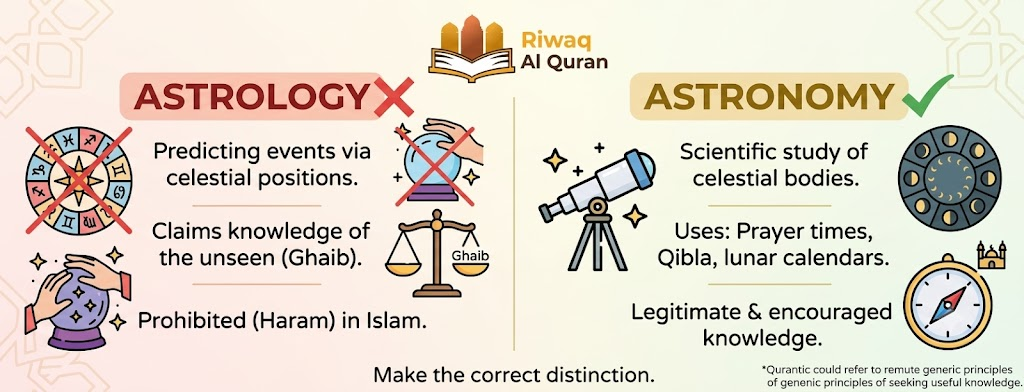
Astrology — predicting events or personality from celestial positions — is prohibited for the same reason as numerology: it claims knowledge of the unseen through created objects rather than through Allah.
Astronomy, by contrast, is the scientific study of celestial bodies for practical purposes like determining prayer times, lunar calendars, and the direction of Qibla, and has long been considered a legitimate and encouraged field of knowledge in Islamic scholarship.
Numerical Patterns in the Quran What Is Established and What Is Contested
Beyond the ruling on numerology itself, many people ask about specific numerical claims made about the Quran’s text. Some of these are well-documented; others are popular but don’t hold up once checked carefully — and treating both categories the same way undermines the credibility of the ones that are genuinely solid.
1. The Word “Month” and the 12 Lunar Months
Allah states directly in the Quran:
(إِنَّ عِدَّةَ الشُّهُورِ عِندَ اللَّهِ اثْنَا عَشَرَ شَهْرًا فِي كِتَابِ اللَّهِ يَوْمَ خَلَقَ السَّمَاوَاتِ وَالْأَرْضَ)
“Indeed, the number of months with Allah is twelve months in the register of Allah, from the day He created the heavens and the earth.” (Surah At-Tawbah, 9:36) —
Consistent with this, the singular word “Shahr” (month) appears exactly 12 times across the Quran — a count many scholars note as a fitting linguistic match to the verse’s own statement, rather than a hidden code requiring interpretation.
2. Word-Count Claims That Don’t Hold Up Consistently
Several popular claims — such as specific words for “day” or “sea” appearing an exact number of times said to match scientific or calendar figures — circulate widely online but don’t survive a careful, form-by-form recount once every grammatical variation of the word is included.
Treating an unverified viral claim as equivalent to a well-documented one like the “month” count above weakens trust in the genuinely solid observations; the honest position is that some patterns are well-established and others need to be checked before being repeated.
3. The Abjad System as a Historical Tool and Not a Predictive One
The Abjad system (حساب الجُمَّل) assigns each of the 28 Arabic letters a fixed numerical value and has been used historically by some scholars to log dates or find deeper linguistic patterns in classical texts, largely as an academic exercise.
It becomes impermissible the moment it’s used to predict events, determine a person’s fate, or assign mystical meaning to a name or verse — the tool itself is neutral; the purpose it’s put to is what the ruling actually addresses.
If you’d rather build a real, source-grounded understanding of Quranic language and structure than rely on unverified viral claims, Riwaq Al Quran‘s Online Tafseer Course teaches the Quran’s meanings through recognized scholarly method, not speculation.
Common Misconceptions About Quranic Numerology
A number of misconceptions repeat across numerology content online, and naming them directly is more useful than listing them without explanation.
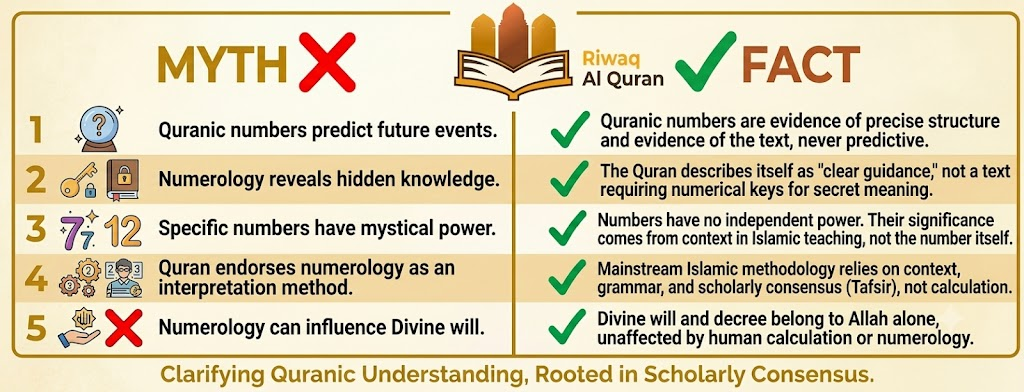
- “Quranic numbers predict future events” — the Quran’s numerical patterns are cited by scholars as evidence of its precision, never as a predictive system for personal or future events.
- “Numerology reveals hidden knowledge in the Quran” — the Quran describes itself as clear guidance (Surah Al-Baqarah, 2:2), not a text requiring a numerical key to unlock secret meaning.
- “Specific numbers have mystical power” — no number in Islamic teaching carries independent power; significance comes from what Allah has stated about it, not from the number itself.
- “The Quran endorses numerology as a method of interpretation” — mainstream Tafsir relies on established scholarly method (context, grammar, hadith, and consensus), not numerical calculation.
- “Numerology can influence or reveal divine will” — divine will and decree belong to Allah alone, unaffected by any human calculation, numerological or otherwise.
How to Tell Reflection From Divination
A practical way to check yourself: if you’re using a numerical observation to appreciate the Quran’s precision or consistency, that’s reflection. If you’re using it to predict an outcome, assign meaning to a person’s name, or decide a course of action, that’s crossed into divination — regardless of whether the number in question comes from the Quran itself.
The source of the number doesn’t change the ruling; the use it’s put to does.
Deepen Your Understanding of the Quran With Riwaq Al Quran
Distinguishing sound Quranic study from viral claims takes more than reading articles — it takes structured learning with someone who can walk you through the text properly.
Riwaq Al Quran is a comprehensive online platform that offers personalized Quran, Arabic, and Islamic Studies online classes for individuals of all ages and backgrounds. Their experienced instructors use a structured curriculum to cover Tajweed, Tafsir, and Memorization, providing easy and effective access to learning the Quran.
The advanced online classes allow for seamless communication and interaction between students and teachers. Join Riwaq Al Quran for a deeper connection with the Quran.
We offer several courses such as:
- Online courses for kids.
- Online Quran classes for kids and adults.
- Online Arabic courses.
- Online Ijazah courses.
- Online Islamic Studies courses.

Here are a sample of our set of Quran Courses that will be helpful for you:
- Online Tafseer Course: Delve into Quranic meanings with our insightful online Tafseer course.
- Noorani Qaida Online: Learn Quranic basics efficiently through our Noorani Qaida online program.
- Online Quran Recitation Course: Enhance Quranic recitation skills through our expert-led online course.
- Online Tajweed Classes: Master Tajweed rules for beautiful Quranic recitation in online classes.
- Quran Memorization Online Course: Memorize the Quran effectively with our specialized online memorization course.
- Online Qirat Course: Explore diverse Qirat styles with our comprehensive online Qirat course.
- Online Quran Classes for Kids: Nurture a love for the Quran in kids through interactive online classes.
Conclusion
Numerology in Islam — the practice of predicting the future or reading hidden meaning through numbers — is not permitted, because it claims a form of knowledge of the unseen that belongs to Allah alone.
Studying genuine numerical patterns in the Quran, like the 12 occurrences of “month” matching the Quran’s own statement about the lunar year, is a different and permissible practice, as long as it’s approached as reflection rather than prediction.
The line between the two isn’t about which numbers you’re looking at — it’s about whether you’re appreciating the Quran’s precision or attempting to extract a hidden code from it.
FAQs
The questions below cover specific numerical claims about the Quran that come up often but deserve a direct, verified answer rather than a repeated assumption.
Is numerology haram in Islam?
Yes, numerology used to predict the future, read personality, or uncover hidden meanings is considered impermissible, because it claims knowledge of the unseen that Islamic belief reserves for Allah alone.
What is the most frequently mentioned number in the Quran?
The number one is generally cited as the most frequently referenced concept in the Quran, though the exact count depends on whether you’re counting a specific Arabic word for “one” or the broader concept of divine oneness expressed across many verses.
How many times is the word “month” mentioned in the Quran?
The singular word “Shahr” (month) appears exactly 12 times in the Quran, a count that aligns with the Quran’s own statement in Surah At-Tawbah (9:36) that Allah has decreed twelve months in a year.
What is the Abjad system, and is it permissible to use?
The Abjad system assigns a fixed numerical value to each Arabic letter and has historically been used for academic purposes like logging dates, which is permissible; it becomes impermissible only when used to predict events or assign mystical meaning to names or verses.
Is astrology permitted in Islam?
No, astrology is prohibited for the same reason as numerology — it claims knowledge of the future or personality through celestial positions — though astronomy, the scientific study of celestial bodies for practical purposes like prayer timing, is considered legitimate and encouraged.