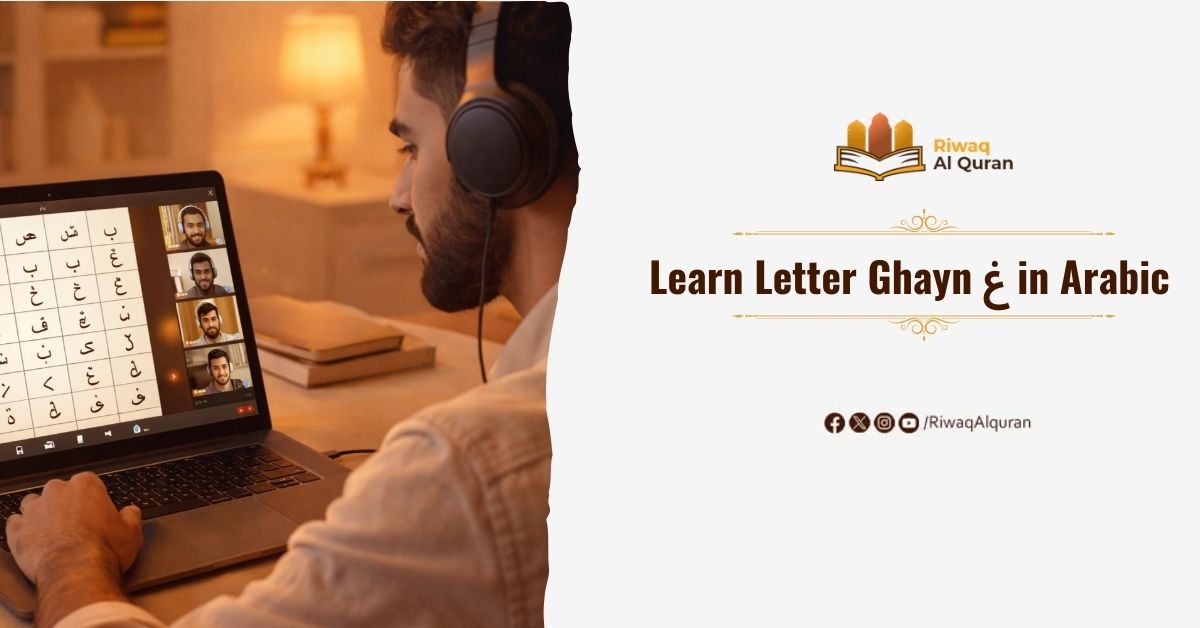
Among the 28 letters of the Arabic alphabet, Ghayn (غ) stands out as one of the most distinctive sounds for English-speaking learners. It carries a deep, resonant quality produced at the back of the throat — a sound that exists in French and Farsi but rarely in English, making it both fascinating and challenging.
Mastering the letter Ghayn in Arabic غ opens doors to hundreds of everyday Arabic words, correct Quranic recitation, and a more authentic Arabic accent. This guide walks you through pronunciation, script forms, common words, practice exercises, and Tajweed applications — step by step.
Table of Contents
What Is the Letter Ghayn in Arabic غ?
The letter Ghayn (غ) is the nineteenth letter of the Arabic alphabet. Its name is pronounced “Ghayn” (غَيْن), and it represents a sound linguists classify as a voiced uvular fricative — produced deep in the throat, not in the mouth or on the tongue tip.
For parents introducing Arabic to their children, and for adults starting their Arabic learning path, understanding Ghayn early is important.
Many foundational Arabic words — including words for heart, absent, and expensive — contain this letter, so recognizing it quickly builds reading confidence.
If you are looking for structured support, Riwaq Al Quran‘s Online Arabic Course offers expert-guided lessons covering all Arabic letters with phonetic precision, taught by native Arabic instructors. Starting with a qualified teacher makes a significant difference when learning sounds like Ghayn that have no English equivalent.
Book Your FREE Trial in Riwaq’s Arabic Classes
How to Pronounce the Letter Ghayn in Arabic غ Correctly as a Non-Native Speaker?
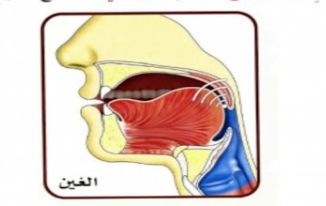
The letter Ghayn in Arabic غ is produced at the uvula — the small fleshy extension at the back of the soft palate. Air passes through a narrow opening between the uvula and the back of the tongue, creating a soft, voiced gargling friction. It is NOT a hard “G” as in “go.”
A practical way to feel this: try gargling water gently, then stop the water and continue only with air and vibration. That vibrating, back-of-throat resonance is the natural home of Ghayn.
The Makhraj (Articulation Point) of Ghayn
The makhraj of Ghayn is the Adna al-Halq — the uppermost part of the throat, where the uvula meets the back of the tongue. This is the same general region as the letter Kha (خ), its voiceless counterpart, but Ghayn adds vocal cord vibration.
The Sifat (Phonetic Attributes) of the Letter Ghayn
Understanding the sifat helps you produce and recognize Ghayn accurately in both conversation and Quranic recitation.
| Attribute (Sifa) | Classification | Meaning |
| Voicing (Jahr) | Voiced (Majhoor) | Vocal cords vibrate during production |
| Airflow (Rakhawa) | Open (Rakhwa) | Air flows continuously — no complete stop |
| Elevation (Isti’la) | Elevated (Musta’li) | Back of tongue rises toward the soft palate |
| Oral/Nasal | Oral (Ismat) | Sound exits through the mouth only |
This combination of being voiced, continuous, and elevated makes Ghayn one of the heavier Arabic letters in terms of acoustic resonance. Learners who master its sifat produce it naturally and consistently.

Common Mistakes English Speakers Make Pronouncing Ghayn in Arabic غ
English speakers almost universally default to one of three errors when encountering Ghayn. Identifying your specific error is the fastest way to correct it.
| Common Error | What Learners Do | Correct Approach |
| Hard “G” substitution | Pronounce it like “G” in “great” | Relax the tongue back, add throat vibration |
| Silent substitution | Skip the letter or whisper it | Engage vocal cords — Ghayn is always voiced |
| Kha (خ) confusion | Use the voiceless version instead | Add vibration — Ghayn hums; Kha does not |
| French “R” overuse | Use French uvular R (too strong) | Ghayn is softer — lighter friction, not rolling |
The most important correction is activating the vocal cords. If you place your hand gently on your throat and feel vibration while producing the sound, you are on the right track.
Experience Riwaq Al Quran Classes
Watch real moments from our live sessions at Riwaq Al Quran and see how we bring learning to life. These clips highlight our interactive, student-focused approach designed to keep learners engaged, motivated, and actively involved in every step of their educational journey.
How the Letter Ghayn in Arabic غ Is Written Across All Word Positions?
Like most Arabic letters, Ghayn changes shape depending on its position in a word. It connects to letters before and after it in most positions. Recognizing all four forms is essential for reading fluency.
| Position | Form | Example Word | Meaning |
| Isolated | غ | غَيْن | The letter name itself |
| Initial (start) | غـ | غَنِيّ | Rich |
| Medial (middle) | ـغـ | مَغْرِب | West / Sunset |
| Final (end) | ـغ | بَلَغ | Reached |
Notice that the base shape — a small open loop above the line — remains recognizable in all four positions. The distinguishing feature of Ghayn versus its sister letter Ayn (ع) or other curves is the dot placed above the letter body in all its forms.
Common Arabic Words Containing the Letter Ghayn غ for Everyday Vocabulary
Building vocabulary around Ghayn strengthens both your reading recognition and your pronunciation training simultaneously. Below are high-frequency Arabic words grouped by theme.
Everyday Life Words with Ghayn غ
These are words adult learners and children encounter in daily Arabic conversations:
| Arabic Word | Transliteration | English Meaning |
| غَنِيّ | Ghaniyy | Rich / Wealthy |
| غَضِب | Ghadiba | He became angry |
| غُرْفَة | Ghurfa | Room |
| غَالِي | Ghali | Expensive |
| غَاب | Ghaba | He was absent |
| غَدًا | Ghadan | Tomorrow |
| غَابَة | Ghaba | Forest |
| غَسَل | Ghasala | He washed |
| غَيْم | Ghaym | Cloud |
| غَرِيب | Gharib | Strange / Foreigner |
Nature and Environment Words with Ghayn غ
Arabic is rich in nature vocabulary, and Ghayn appears frequently in this domain:
مَغْرِب (Maghrib) means “west” or “sunset” — a word every Muslim recognizes from the daily prayer name. غَيْث (Ghayth) means “rain” in classical Arabic. مُغَرِّد (Mughharrid) means “singing bird.”
Body and Emotion Words with Ghayn غ
The word غَضَب (Ghadab) means “anger” — a foundational emotional vocabulary word. غَيْرَة (Ghayra) means “jealousy.” These words appear frequently in both modern Arabic and Quranic contexts.
Practice Exercises to Master the Letter Ghayn in Arabic غ at Home
The following exercises are designed for both children practicing with parents and adult self-learners. Progress through them sequentially for best results.
Exercise 1: Throat Activation Drill for Ghayn Pronunciation
Start without any Arabic script. Place one hand on your throat. Produce a soft humming sound deep at the back — not in the nose, not on the tongue tip.
Now gradually tighten the back of your throat slightly until you feel a gentle friction. That is the correct production zone for Ghayn.
Repeat this 10 times daily for one week.
Exercise 2: Minimal Pair Discrimination for Ghayn and Kha
Listen to or produce these pairs and identify the difference — Ghayn (voiced) versus Kha (voiceless):
- غَالِب (Ghalib — victor) vs. خَالِد (Khalid — a name)
- غَار (Ghar — cave) vs. خَار (Khar — he failed)
The vibration in your throat tells you which is Ghayn. No vibration means you are producing Kha instead.
Exercise 3: Word Repetition Ladder for Ghayn غ
Read and repeat this progression three times each, starting slowly:
- غَ — غَا — غَب — غَاب (He was absent)
- غُ — غُر — غُرْفَة (Room)
- غَ — غَنِ — غَنِيّ (Rich)
- مَ — مَغْ — مَغْرِب (West/Sunset)
Exercise 4: Sentence Reading Practice with Ghayn غ
Read these short Arabic sentences containing Ghayn. Focus on the Ghayn sound each time it appears:
- الغُرْفَةُ غَالِيَة — Al-ghurfatu ghaliya — “The room is expensive.”
- الغَيْمُ فِي السَّمَاء — Al-ghaymu fi al-sama’ — “The cloud is in the sky.”
Exercise 5: Writing Practice for All Four Forms of Ghayn غ
On lined paper or a practice notebook, write each form ten times: غ (isolated), غـ (initial), ـغـ (medial), ـغ (final). Then write three complete words from the vocabulary table above, focusing on connecting letters correctly.
Children especially benefit from tracing before writing freely. Parents can draw large Ghayn forms on paper and let young learners trace with their finger before using a pencil. If you want structured kids’ lessons, Riwaq Al Quran‘s Online Arabic Classes for Kids uses interactive methods designed specifically for young learners to master Arabic letters with confidence.
Enroll Your Kid in Riwaq’s Arabic Classes for Kids with a FREE trial
Read Also: The Letter Qaf ق in Arabic
How the Letter Ghayn in Arabic غ Appears in Quranic Recitation?
Ghayn appears throughout the Quran in significant words. Its correct pronunciation in Quranic recitation carries spiritual and phonetic weight — mispronouncing it can alter meaning and affect the validity of recitation in some cases.
The word مَغْضُوب (Maghdub — those who earned anger) from Surah Al-Fatiha contains Ghayn in the medial position, and every Muslim who recites Al-Fatiha in prayer encounters this letter multiple times daily.
The Sifa of Isti’la and Its Effect on Ghayn in Tajweed
Because Ghayn carries the sifa of Isti’la (elevation), it belongs to the group of seven letters whose back-of-tongue elevation can subtly influence surrounding vowels.
In Tajweed, awareness of this elevation ensures the letter is never flattened or softened to sound like a Western “G.” Riwaq Al Quran‘s Online Tajweed Classes address precisely these phonetic subtleties with one-on-one instructor guidance.
Enroll Now in the Best Online Tajweed Classes
Read Also: Learn The Arabic Letter Kaf (ك)
Why Students Love Learning with Riwaq Al Quran
Hear directly from our students about how Riwaq Al Quran Academy has transformed their connection with the Book of Allah. Their experiences reflect the dedication, care, and quality that guide every step of our teaching.
Learn the Letter Ghayn in Arabic غ with Riwaq Al Quran’s Expert Arabic Instructors
Mastering Ghayn — and every Arabic letter — is most effective with a qualified native instructor guiding your pronunciation from the start.
Riwaq Al Quran has been serving non-Arabic speaking learners since 2017. Here is what sets the academy apart:
- Native Arabic-speaking, Al-Azhar-certified instructors
- One-on-one personalized sessions tailored to your level
- Specialized programs: Online Arabic Course, Online Arabic Classes for Kids, and Online Tajweed Classes
- Flexible scheduling for busy families and adults
- Free trial lesson — no commitment required
Book your free trial lesson today at Riwaq Al Quran and start pronouncing Ghayn — and every Arabic letter — with authentic precision, Insha’Allah.
Beyond Arabic, we offer courses in Online Tajweed Classes, Arabic Language, and Islamic Studies.
- Online Quran Memorization Course
- Tajweed Classes
- Online Quran Classes for Kids.
- Ijazah Program.
- Arabic Language Classes.
- Islamic Studies Courses.
Enroll now for 2 Free Trial Classes and Begin Learning Arabic or Memorizing Quran Today
Conclusion
The letter Ghayn (غ) occupies a unique position in Arabic phonetics — voiced, uvular, and unmistakably resonant. Grasping its makhraj at the uppermost throat and its sifat as a voiced, open, elevated sound gives learners a precise roadmap for correct production.
Practical vocabulary exposure, combined with daily pronunciation drills, accelerates both reading recognition and spoken fluency. Words like غُرْفَة, مَغْرِب, and غَنِيّ appear constantly in Arabic speech, making Ghayn an immediately useful letter from day one.
For Quranic learners especially, getting Ghayn right is not just a linguistic achievement — it directly improves the accuracy of daily prayer recitation. Consistent, guided practice builds the muscle memory needed for this sound to become effortless over time.