Arabic contains sounds that simply do not exist in English, and the letter ح (Ha) is one of the most distinctive among them. Unlike any English consonant, this letter carries a breath-like quality that comes from deep in the throat — and mastering it opens doors to clear, confident Arabic speech.
Learning ح correctly from the beginning builds a strong phonetic foundation for everything that follows. This guide walks you through the letter’s shape, sound, articulation, common vocabulary, Quranic presence, and practical exercises — giving you everything you need in one focused lesson.
Table of Contents
What Is the Arabic Letter Ha ح?
The letter ح is the sixth letter of the Arabic alphabet. It represents a sound linguists classify as a voiceless pharyngeal fricative — produced deep in the throat with a continuous, breathy friction. This sound exists in no major European language, making it one of the most important letters for English speakers to learn early.
Many beginners confuse ح with the letter خ (Kha) or even with a simple English “h.” These are three distinct sounds, and mixing them creates real comprehension problems in Arabic. Getting ح right from the start prevents this confusion from taking root.
If your child is beginning their Arabic alphabet journey, Riwaq Al Quran’s Online Arabic Classes for Kids introduce ح through age-appropriate activities, native-speaker modeling, and interactive exercises designed specifically for young learners.
Enroll Your Kid in Riwaq’s Arabic Classes for Kids with a FREE trial

How to Recognize the Arabic Letter Ha ح in All Its Written Forms?
Before you can read ح in any Arabic text, you need to recognize it across its four positional forms. Arabic letters change shape depending on where they appear in a word — isolated, at the beginning, in the middle, or at the end.
The following table shows every form of ح clearly:
| Position | Form | Example Word | Notes |
| Isolated | ح | ح | The base shape — a rounded loop open on the right |
| Initial (beginning) | حـ | حَب (Hubb) | The loop connects forward to the next letter |
| Medial (middle) | ـحـ | مَحَبَّة (Mahabbah) | Sits between two connecting letters |
| Final (end) | ـح | صُبْح (Subh) | Loop closes at the end of the word |
The defining visual feature of ح in all its forms is the small, open loop with a rounded bottom.
This distinguishes it from its close visual relatives: ج (Jeem) and خ (Kha), which share the same base skeleton but carry different dots. ح has no dot — remember this, and you will never confuse the three.
How the Arabic Letter Ha ح Is Pronounced Correctly by Non-Native Speakers?
The sound of ح comes from the pharynx — the upper part of the throat, just behind the mouth. In classical Arabic phonetics, this is called the makhraj al-halq (مَخْرَج الحَلْق), specifically the middle section of the pharynx.
To produce it correctly, follow these steps. First, open your mouth slightly and relax your tongue — it should not touch anything.
Second, constrict the walls of your throat gently, as if you are breathing on cold glasses to fog them. Third, push air through that constriction without using your voice box.
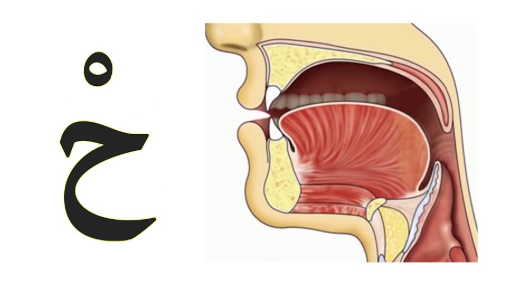
The result is a strong, breathy friction — noticeably more forceful and deeper than a simple English “h.” The English “h” originates in the larynx without any throat constriction. The Arabic ح requires deliberate pharyngeal narrowing, which is what gives it its distinctive, warm, airy quality.
| Common Error | What Happens | Correct Approach |
| Replacing ح with English “h” | Sound is too light and glottal | Add throat constriction — breathe harder through the pharynx |
| Confusing ح with خ (Kha) | Kha is velar and has a rasping quality | ح is breathier with no rasp — it is voiceless and smooth |
| Confusing ح with ع (Ayn) | Ayn is voiced; the throat vibrates | ح has zero voicing — keep the vocal cords still |
| Over-tensing the jaw | Produces a distorted, choked sound | Keep the jaw relaxed; the constriction is in the throat only |
Practice this sound in isolation first. Breathe out slowly and tighten your throat slightly — you should hear a soft, audible friction. That friction is the beginning of ح.
How to Distinguish the Arabic Letter Ha ح from Its Look-Alike Letters
Because ح, ج (Jeem), and خ (Kha) share the same skeletal shape, learners frequently mix them when reading. This confusion must be resolved at the earliest stage. Below is a clear comparison:
| Letter | Arabic | Dot | Sound | Example Word |
| Ha | ح | None | Voiceless pharyngeal fricative | حَبّ (Love) |
| Jeem | ج | One dot below | Voiced palatal affricate | جَبَل (Mountain) |
| Kha | خ | One dot above | Voiceless velar fricative | خُبز (Bread) |
The simplest rule: no dot means ح. Make this automatic. When you scan unfamiliar text, train your eye to check for dots first before attempting pronunciation.
The sounds are equally distinct. ج is voiced and produced near the front of the palate. خ has a raspy, scratchy quality produced at the back of the mouth.
ح is smooth and breathy, produced in the throat. If you can hear these three differences clearly, you are already reading at an accurate level.


Common Arabic Words Containing the Letter Ha ح for Everyday Vocabulary
One of the most effective ways to internalize a new letter is to meet it inside real words you will actually use. The letter ح appears in some of the most common and beautiful words in the Arabic language.
Here are essential words organized by category:
Everyday Words with ح
| Arabic Word | Transliteration | Meaning |
| حَبّ | Habb | Love / grain |
| حَياة | Hayah | Life |
| حَسَن | Hasan | Good / beautiful |
| حَلِيب | Halib | Milk |
| حَار | Har | Hot |
| حَيَوان | Hayawan | Animal |
| حَديقة | Hadiqah | Garden / park |
| حِذاء | Hidha | Shoe |
| حَقيبة | Haqibah | Bag |
| صَباح | Sabah | Morning |
| صُبح | Subh | Dawn |
| مَحَبَّة | Mahabbah | Affection / love |
| فَلاح | Fallah | Farmer / success |
| صَحيح | Sahih | Correct / authentic |
| نَجاح | Najah | Success |
Notice that ح appears in the initial, medial, and final positions across this list. Reading these words aloud while connecting each letter to its sound is one of the most practical exercises you can do at this stage.
Book Your FREE Trial in Riwaq’s Arabic Classes

A Step-by-Step Exercise to Practice Reading and Writing the Arabic Letter Ha ح
Exercises build what explanation alone cannot. Work through the following practice sequence slowly and deliberately.
Exercise One — Letter Recognition Practice
Look at the three letters below and identify which one is ح:
ج — ح — خ
Answer: The middle letter, ح, is the one with no dot. ج has a dot below; خ has a dot above. ح stands alone — open and unadorned.
Exercise Two — Reading Words Aloud
Read each word below and focus on producing the ح sound clearly. Do not rush:
حَياة — حَسَن — صُبح — نَجاح — مَحَبَّة
Record yourself if possible and compare your pronunciation to a native speaker. The ح in each word should sound like a controlled, breathy friction from the throat.
Exercise Three — Fill in the Missing Letter
Each word below is missing the letter ح. Write it in the correct position:
- صَبا__ (Morning)
- نَجا__ (Success)
- __َياة (Life)
- مَ__َبَّة (Love/Affection)
Exercise Four — Writing Practice
Write the letter ح in all four positions ten times each. Follow this order: isolated → initial → medial → final. Keep your loops rounded and open — do not close them into a full circle.
Experience Riwaq Al Quran Classes
Watch real moments from our live sessions at Riwaq Al Quran and see how we bring learning to life. These clips highlight our interactive, student-focused approach designed to keep learners engaged, motivated, and actively involved in every step of their educational journey.
The Phonetic Attributes (Sifat) of the Arabic Letter Ha ح
Understanding the sifat (صِفات) — phonetic attributes — of ح gives you a complete picture of its nature within Arabic linguistic science. These attributes are not decorative detail; they actively guide correct pronunciation.
The established sifat of ح according to classical Arabic phonetics are:
| Attribute | Arabic Term | Meaning |
| Voiceless | هَمْس (Hams) | The vocal cords do not vibrate during its production |
| Continuant | رِخاوة (Rakhawah) | The airflow continues without stopping |
| Lowered (non-emphatic) | اسْتِفالة (Istifala) | The tongue does not rise toward the palate |
| Non-lateral | إصْمات (Ismat) | Air flows through the center of the mouth |
These four attributes together produce the airy, unobstructed, throat-generated sound that defines ح. The voicelessness (Hams) is especially important — if any vibration enters the sound, you are producing a different letter entirely.
How the Arabic Letter Ha ح Appears in the Quran
The letter ح holds a significant and frequent presence in Quranic Arabic. It appears in one of the most profound Quranic statements about the nature of God — one that every Muslim recites regularly:
قُلْ هُوَ ٱللَّهُ أَحَدٌ
Qul huwa Allahu ahad
“Say, He is Allah, the One.” (Al-Ikhlas 112:1)
The ح appears in أَحَدٌ — “ahad,” meaning “One.” The ح here is in medial position and must be produced with full pharyngeal friction, not softened into a simple English “h.” In Tajweed, this letter carries no special lengthening rule, but its articulation must remain precise.
ح also appears at the beginning of several Quranic surahs as one of the Al-Muqatta’at — the disjointed letters whose precise meaning is known only to Allah.
The combination حم (Ha Meem) opens seven surahs of the Quran, including Surah Ghafir, Surah Fussilat, and Surah Al-Zukhruf.
When reciting these letters, each is recited by its name alone — ح is recited as “Ha” — and the pharyngeal quality must be preserved.
If you are working to improve your Quranic recitation and letter precision, Riwaq Al Quran’s Online Tajweed Classes provide structured, one-on-one instruction with Al-Azhar-certified instructors who will correct your pronunciation of letters like ح with expert guidance.
Enroll Now in the Best Online Tajweed Classes

Why Students Love Learning with Riwaq Al Quran
Hear directly from our students about how Riwaq Al Quran Academy has transformed their connection with the Book of Allah. Their experiences reflect the dedication, care, and quality that guide every step of our teaching.
Start Learning the Arabic Letter Ha ح with Riwaq Al Quran’s Expert Arabic Instructors
Mastering ح — its sound, shape, and usage — is a real milestone in your Arabic learning path. Whether you are a complete beginner or refining your Quranic recitation, expert instruction makes all the difference.
At Riwaq Al Quran, our Al-Azhar-certified instructors teach letters like ح with linguistic precision and genuine care for every student’s progress:
- Flexible one-on-one online sessions fitting any schedule
- Dedicated Online Arabic Classes for Kids with age-appropriate methods
- Structured Online Arabic Course covering alphabet, reading, and beyond
- Online Tajweed Classes for accurate Quranic recitation
- Native Arabic-speaking instructors with verified credentials
- Free trial class — no commitment required
Book your free trial session today at Riwaq Al Quran and begin learning Arabic the right way, Insha’Allah.
Beyond Arabic, we offer courses in Online Tajweed Classes, Arabic Language, and Islamic Studies.
- Online Quran Memorization Course
- Tajweed Classes
- Online Quran Classes for Kids.
- Ijazah Program.
- Arabic Language Classes.
- Islamic Studies Courses.
Enroll now for 2 Free Trial Classes and Begin Learning Arabic or Memorizing Quran Today

Conclusion
The letter ح sits at the heart of Arabic’s unique phonetic character. Its pharyngeal articulation, visual distinctiveness, and deep presence in everyday vocabulary and Quranic text make it one of the most rewarding letters to master as a non-native learner.
Recognizing ح across its four written forms builds reading fluency, while consistent pronunciation practice trains the throat muscles to produce sounds that have no equivalent in English. Both skills develop together with patient, regular effort.
Every word containing ح — from حَياة (life) to مَحَبَّة (affection) — becomes a small victory as your reading and speaking grow stronger. Approach each practice session with consistency, and the letter that once felt foreign will, Alhamdulillah, become second nature.