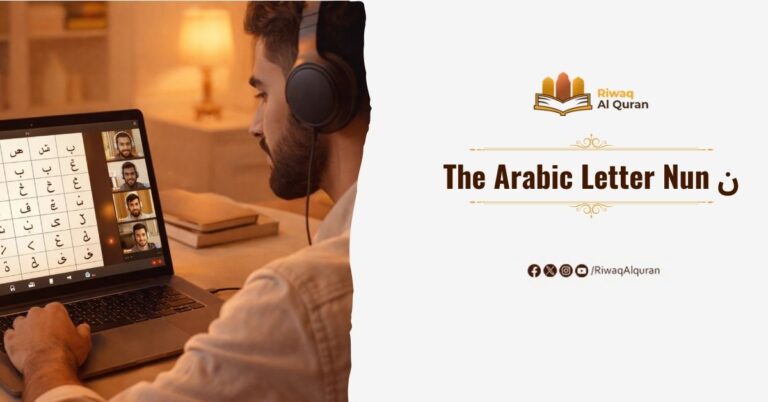

The goal of Tajweed (تجويد) [science of the correct recitation of the Quran] is to recite the Quran exactly as it was revealed, pronouncing every letter from its correct origin point and giving it its due characteristics. A small error in pronunciation can sometimes change the meaning of a word entirely. That’s why studying the Quran and the Tajweed letters’ pronunciation is very important.
In this article, we will discuss the pronunciation of the Quran alphabet and how to pronounce Arabic letters according to the Tajweed Rules. Then, we will see some examples of challenging Arabic words and sounds, especially for non-Arabs, and how to pronounce them properly. Finally, we will give some steps to learn how to pronounce these hard-to-pronounce sounds and letters
Table of Contents
Quran Alphabet Pronunciation
The Quran is not just a book to be read; it is the literal, revealed word of God (Allah) to the Prophet Muhammad (peace be upon him) through the Angel Jibril (Gabriel). Its preservation is a divine promise, and a crucial part of that preservation is its precise oral transmission. For over 1,400 years, this oral transmission has been preserved and the Quran has been passed down through an unbroken chain of reciters.
The Quran has been preserved, word for word and letter for letter. Every sound in the Quran has to be pronounced exactly as it was revealed and as Native Arabs pronounce it. Thus, Tajweed rules have to be observed so that Arabic sounds are produced correctly.
How To Pronounce Arabic Letters As Per Tajweed Rules?
As an Islamic science, Tajweed is the set of rules governing the pronunciation of the Quranic Arabic letters during recitation.
There are two main pillars of correct Tajweed pronunciation of each Arabic letter and sound. Let’s see them below in some detail:
1. Makharij Al-Huruf (مخارج الحروف): The Articulation Points:
This is the where. Every Arabic letter has a specific place in the mouth, throat, or lips from which its sound should originate. For example, the Baa (ب) sound comes from the lips.
2. Sifaat Al-Huruf (صفات الحروف): The Characteristics:
This is the how. These are the inherent qualities or attributes of each letter that distinguish it from others, even if they come from the same or similar articulation point. For example, the Raa (ر) sound has characteristics of Takreer (trilling) and Inhiraf (deviation), giving it a unique identity and preventing it from being confused with another letter that might share a similar Makhraj, such as Na (ن) and La (ل) sounds.
Arabic Letters Pronunciation In Light Of Tajweed
As the Quran is an oral tradition, every single sound must be pronounced correctly. The more a non-Arabic speaking person perfects Arabic sounds, the more their recitation of the Quran is consistent with Tajweed rules. Let’s see below some of the most difficult Arabic sounds for non-Arabs and the easiest ways to pronounce them correctly.

Examples Of Challenging Arabic Words And Sounds
There are many Arabic words that a non-Arab may find very hard to pronounce correctly. Let’s see some of these and discuss in some detail why they are hard to pronounce for non-Arabs and how to produce a correct or at least a near-native pronunciation for them.
1- Ayn Pronunciation:
The pronunciation of the letter Ayn (ع) is one of the most important and distinctive sounds in the Arabic language, and it is famously difficult for non-native speakers because it has no true equivalent in any Latin language (like English, Spanish, etc.).
The most important thing to understand is that Ayn (ع) is a consonant, not a vowel. It is a voiced, guttural sound produced by constricting the muscles in the throat.
How To Pronounce Ayn Sound:
Imagine you are at the doctor’s and they ask you to say “ahhh” to see your throat. Now, try to make that “ahhh” sound while constricting your throat muscles as if you’re gently straining or lifting a heavy object. The sound should be voiced (your vocal cords vibrate) and come from the middle part of your throat.
Point Of Articulation And Attributes:
Please see in the following diagram Ayn’s point of articulation and attributes:
| Point Of Articulation | Attributes |
| The Middle point of the throat | Jahr (Voiced sound), Istifāl (Lowering-tongue is flat), Infitāh (opening-mouth is open), and Ismāt (Non-fluency) |
Audio For The Sound By A Native:
The best way to learn how a sound is pronounced is by listening. You can hear a native speaker pronounce the letter “Ayn” here: Listen to Ayn (ع).
Example From The Quran:
“وَٱللَّهُ عَلِيمٌ حَكِيمٌۭ”
In this part of the verse, the letter Ayn “ع” comes from the middle point of the throat. Please click on the underlined word above that has the sound “ع” to listen to the precise pronunciation of the sound by an Arabic Qari (a qualified Quran reciter).
2- Saad Pronunciation:
The pronunciation of the Arabic letter Saad (ص) is crucial for Quranic recitation. Saad (ص) is essentially the heavy counterpart to the regular “S” (س) sound. However, it has a deeper, more resonant quality.
Difference between Seen (س) and Saad (ص) sounds:
Think of the difference like this:
- Seen (س): Like the “s” in “see” – light and whistling.
- Saad (ص): Like the “s” in “saw” but pronounced with a much deeper, fuller sound, as if your mouth is full of sound.
The Arabic letters ص and س share the same Makhraj [point of articulation], which is the tip of the tongue and the teeth. However, they both have some similar and some different Sifaat that make each of them unique. For example, both س and ص are Hams, Rakhāwah, and Safeer letters. However, س is an Istifāl, Infitāh, and Ismāt letter, while ص is an Isti’lā’ and Iṭbāq letter.
In addition, the most important part is that unlike Seen (س), Saad (ص) has Tafkheem (تفخيم), which means “heaviness” or “emphasis.” This is achieved by:
- Raising the back of your tongue towards the soft palate (the roof of the back of your mouth).
- Hollowing the middle part of the tongue slightly.
This action gives the sound a deep, full, and resonant quality, as if it is echoing in your mouth.
Point Of Articulation And Attributes:
Please see in the following diagram Saad’s point of articulation and attributes:
| Point Of Articulation | Attributes |
| Tip of the tongue and the Teeth [The tip of the tongue comes very close to the upper teeth, without touching them.] | Hams (Whisper), Isti’lā’ (Elevation – tongue rises), Closing (tongue touches palate), Ismāt (Non-fluency), Safeer (Whistling sound), |
Audio For The Sound By A Native:
You can hear a native speaker pronounce the letter “Saad” (ص) here.
Example From The Quran:
“إِنَّآ أَرْسَلْنَا عَلَيْهِمْ رِيحًۭا صَرْصَرًۭا فِى يَوْمِ نَحْسٍۢ مُّسْتَمِرٍّۢ”
Here, you can click on the underlined word “صَرْصَرًۭا” to hear the correct pronunciation of the sound Sadd “ص” that is repeated twice in the word.
Experience Riwaq Al Quran Classes
Watch real moments from our live sessions at Riwaq Al Quran and see how we bring learning to life. These clips highlight our interactive, student-focused approach designed to keep learners engaged, motivated, and actively involved in every step of their educational journey.
3- Qamaria Pronunciation:
Pronouncing the word “Qamaria” (Arabic: قمرية) correctly requires attention to a certain Arabic sound that does not exist in English, which is the “Qa – ق” sound.
Point Of Articulation And Attributes:
Please see in the following diagram the “Qa – ق”’s point of articulation and attributes:
| Point Of Articulation | Attributes |
| Furthest back of the tongue The furthest back tongue touches the soft palate. | Jahr (Voiced), Shiddah (Strength), Isti’lā’ (Elevation – tongue rises), Infitāh (Opening – mouth is open), Ismāt (Non-fluency), and Qalqalah (bouncing). |
Common Mistake:
Replacing “Qa” (ق) with “K” (ك): Saying “Kamaria” instead of “Qamaria” is a major error in Tajweed. The ‘Q’ must be deep and guttural. ك comes from a somewhat closer point than ق.
In addition, the main differences between these two very close sounds are that, unlike “Qa” (ق), the “K” (ك) sound has both characteristics: Hams (whisper ) and Istifāl (tongue is flat).
Audio For The Sound By A Native:
You can hear the word “قمرية” pronounced by a native Arabic speaker on Forvo.com. This will allow you to hear the Qaf clearly:
Listen to “قمرية”
4- Kairen Pronunciation:
Pronouncing the word “Kairen” (Arabic: قايرين) correctly requires learning how to pronounce the Arabic “Qa” (ق) sound without mixing it with the other very close and often easier for non-natives to pronounce: the “K” (ك) sound. Please refer to the previous paragraph (point number 3).
Audio For The Sound By A Native:
Listen to how this “Qa” (ق) sound is properly pronounced here.
Example From The Quran
“قٓ ۚ وَٱلْقُرْءَانِ ٱلْمَجِيدِ”
In this verse, you can listen to how the entire letter Qaf (قاف) is pronounced in the first word of the verse, and you can also listen to the sound Qa (ق) in the following word “ٱلْقُرْءَانِ”. You need to click on each of these words to listen to the Arabic Qari.
5- Sila Pronunciation:
The word “Sila” (Arabic: صلة) is equally challenging even for some Arabic-speaking people who do not give the full, due characteristics for the sound. Please refer to the “Saad Pronunciation” paragraph (point number 2) to learn how to differentiate between Seen (س) and Saad (ص) sounds.
Audio For The Sound By A Native:
Please listen to how this word is correctly pronounced by a native Arabic speaker here.
6- Damir Pronunciation:
The word “Damir” (Arabic: ضمير) is also difficult to pronounce, even for some native Arabic speakers. The Da (ض) sound is unique to Arabic. No other language has this sound with all its characteristics and specific place of articulation except Arabic. That’s why Arabic is called “the language of the ض sound” [لغة الضاد].
Point Of Articulation And Attributes:
Please see in the following diagram the “Da – ض”’s point of articulation and attributes:
| Point Of Articulation | Attributes |
| Side of the tongue: Side tongue presses upper molars (unique to Arabic). | Jahr (Voiced), Isti’lā’ (Elevation – tongue rises), Iṭbāq (Closing), Ismāt (Non-fluency), and Istitālah (Elongation). |
Audio For The Sound By A Native:
Please listen to how this word is correctly pronounced by a native Arabic speaker here.
7- Ghayn Pronunciation:
The Arabic letter Ghayn (غ) is one of the most distinctive sounds in the language. It is often mispronounced by learners, but with the right guidance, it can be mastered.
Ghayn (غ) is the voiced counterpart to the letter Khaa (خ). Imagine trying to make a soft, gargling or gurgling sound, but without water. It is a deep, voiced, guttural sound produced by vibrating the very back of the throat (the uvula).
Point Of Articulation And Attributes:
Please see in the following diagram the “Gha – غ”’s point of articulation and attributes:
| Point Of Articulation | Attributes |
| The closest point of the throat – Guttural (like gargling water) | Jahr (Voiced), Rakhāwah (Softness-flow of sound), Isti’lā’ (Elevation – tongue rises), Infitāh (Opening – mouth is open), and Ismāt (Non-fluency). |
Audio For The Sound By A Native:
Please listen to how this sound is correctly pronounced by a native Arabic speaker here. In the same link, you will also find how to properly pronounce words that contain this sound (غ), such as “شغف”, “غني”, “غير”, etc.
Example From The Quran:
“ثُمَّ خَلَقْنَا ٱلنُّطْفَةَ عَلَقَةًۭ فَخَلَقْنَا ٱلْعَلَقَةَ مُضْغَةًۭ فَخَلَقْنَا ٱلْمُضْغَةَ عِظَـٰمًۭا”
Please follow the link and just click on the underlined words above that have the sound “غ” to listen to the precise pronunciation of the word by a Qari.
8- Halak Pronunciation:
Pronouncing the word “Halak” (Arabic: هَلَكَ) correctly requires careful attention to the distinct “h” sound in Arabic. The challenging sound here for non-native speakers is the ha “هـ” sound. You just need to focus on producing a deep, breathy Ha (هـ) to pronounce “Halak” accurately.
Point Of Articulation And Attributes:
Please see in the following diagram the “ha – هـ”’s point of articulation and attributes:
| Point Of Articulation | Attributes |
| The furthest point of the throat – Whisper from throat’s base | Hams (Whisper), Rakhāwah (Softness-flow of sound), Istifāl (Lowering – tongue is flat), Infitāh (Opening – mouth is open), and Ismāt (Non-fluency). |
Audio For The Sound By A Native:
Please listen to how this word is correctly pronounced by a native Arabic speaker here.
Example From The Quran:
“هَلَكَ عَنِّى سُلْطَـٰنِيَهْ”
Please follow the link and click on the underlined word above “هَلَكَ” to listen to the precise pronunciation of the word by a Qari.
9- Hamza Pronunciation:
The pronunciation of Hamza (ء) is fundamental to Arabic phonology and the Quran recitation. It is often one of the first sounds learners encounter.
The Core Pronunciation: The Glottal Stop
Hamza is not a vowel; it is a consonant. Its sound is known as a glottal stop. It is the sound made by briefly closing the vocal cords to stop the flow of air, and then releasing it. Now let’s see below some pieces of information concerning this sound.
Point Of Articulation And Attributes:
Please see in the following diagram the Hamza (ء)’s point of articulation and attributes:
| Point Of Articulation | Attributes |
| The furthest point of the throat | Jahr (Voiced), Shiddah (Strength – sound stops), Istifāl (Lowering – tongue is flat), Infitāh (Opening – mouth is open), and Ismāt (Non-fluency). |
Audio For The Sound By A Native:
Please listen to how this sound (ء) is correctly pronounced in words like “جزء” by a native Arabic speaker here.
Example From The Quran:
“وَإِذْ أَنجَيْنَـٰكُم مِّنْ ءَالِ فِرْعَوْنَ يَسُومُونَكُمْ سُوٓءَ ٱلْعَذَابِ…”
Please follow the above-mentioned link and click on the underlined words “ءَالِ” and “سُوٓءَ” to listen to the precise pronunciation of the words by a Qari. The Hamza (ء) sound is the first and last sound of the words, in turn.
How To Learn Tajweed Letters Pronunciation:
Below, you can see three simple steps to follow to perfect Arabic sounds in a short time.
1. Listen And Imitate A Native Speaker:
Challenging Arabic sounds are almost impossible to learn from text alone. Consistently listen to renowned reciters (Qaris) like Shaikh Al Hossary and Shaikh Al Minshawy, who are known for their precise Tajweed.
2. Find A Teacher:
Seek a certified Tajweed teacher at a local mosque or through a reputable online platform. At Riwaq Al Quran, you can find highly qualified Quran mentors/teachers who can give you the guidance, correction, and feedback you need. You can check them here.
3. Practice One Letter/Sound At A Time:
Master the Makhraj and Sifaat of each letter/sound before moving on.
The Golden Rule: Learn from a Teacher
While this guide provides a theoretical foundation, Tajweed is a practical science that cannot be learned from text alone. The subtle differences between letters like ط and ت, or ض and د, require a qualified teacher to listen to your pronunciation and provide immediate correction. This ensures the Quran is recited correctly and its meaning preserved.
Why Students Love Learning with Riwaq Al Quran
Hear directly from our students about how Riwaq Al Quran Academy has transformed their connection with the Book of Allah. Their experiences reflect the dedication, care, and quality that guide every step of our teaching.
Learn Quran, Arabic And Islamic Studies Online With The Best Native Tutors
Riwaq Al Quran is a comprehensive online platform that offers personalized Quran, Arabic and Islamic Studies Online classes for individuals of all ages and backgrounds.
Their experienced instructors use a structured curriculum to cover Tajweed, Tafsir, and Memorization, providing easy and effective access to learning the Quran.
The advanced online classes allow for seamless communication and interaction between students and teachers. Join Riwaq Al Quran for a deeper connection with the Quran.
We offer several courses such as:
- Online courses for kids.
- Online Quran classes for kids and adults.
- Online Arabic courses
- Online Ijazah courses
- Online Islamic Studies courses.
Here are a sample of our set of Quran Courses that will be helpful for you:
- Online Tafseer Course: Delve into Quranic meanings with our insightful online Tafseer course.
- Noorani Qaida Online: Learn Quranic basics efficiently through our Noorani Qaida online program.
- Online Quran Recitation Course: Enhance Quranic recitation skills through our expert-led online course.
- Online Tajweed Classes: Master Tajweed rules for beautiful Quranic recitation in online classes.
- Quran Memorization Online Course: Memorize the Quran effectively with our specialized online memorization course.
- Online Qirat Course: Explore diverse Qirat styles with our comprehensive online Qirat course.
- Online Quran Classes for Kids: Nurture a love for the Quran in kids through interactive online classes.
Conclusion
To sum up, learning the Quran alphabet and Tajweed letters pronunciation is a profound way to connect with the words of Allah. Mastering its challenging sounds represents a significant milestone in this journey. While it requires dedicated practice and patience, it is ultimately a blessed pursuit of beauty, love, and respect, one whose spiritual fruits are reaped by those who remain steadfast and devoted.