
Few Arabic letters challenge English speakers as consistently as ع (‘Ayn). It produces a sound that simply does not exist in English, yet once you master it, your Arabic pronunciation takes a dramatic step forward — whether you are reading everyday Arabic or reciting the Quran.
Understanding ع properly means knowing where it forms in the throat, how it looks across different word positions, and how to practice it systematically. This guide walks you through every essential aspect, from its articulation point to real-world vocabulary and hands-on exercises.
Table of Contents
What Is the Arabic Letter Ayn?
The letter ع (3ayn) is the eighteenth letter of the Arabic alphabet. It is one of the most phonetically distinctive letters in the language, and mastering it signals genuine progress for any non-native Arabic speaker.
3ayn appears in thousands of common Arabic words — words used daily in conversation, reading, and Quranic recitation. Mispronouncing or skipping it changes word meanings entirely, which makes early, correct training essential.
For parents teaching young children, starting with accurate pronunciation habits prevents years of correction later.
Riwaq Al Quran’s Online Arabic Classes for Kids are specifically designed to introduce letters like ع through phonics-based, age-appropriate methods that make the sound natural from the very beginning.
Enroll Your Kid in Riwaq’s Arabic Classes for Kids with a FREE trial

How to Identify and Write the Arabic Letter 3ayn in All Its Forms?
The letter ع changes shape depending on its position within a word. Recognizing all four forms is necessary before you can read Arabic fluently.
Each form retains the letter’s core visual identity — a curved open shape — while adapting to connect with neighboring letters.
The table below presents all four positional forms clearly:
| Position | Form | Example Word | Meaning |
| Isolated | ع | — | (standalone letter) |
| Initial | عَـ | عَلِيم | All-Knowing |
| Medial | ـعـ | فِعْل | action/verb |
| Final | ـع | سَمِيع | All-Hearing |
Notice that ع connects to the letter before it but the final and isolated forms have the same tail-like descending stroke. Study these forms carefully before moving to pronunciation practice.
Where the Arabic Letter 3ayn Is Articulated in the Throat?
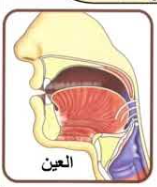
The makhraj (articulation point) of ع is the middle of the throat (وَسَط الحَلْق — wasat al-halq). This places it deeper than any English consonant, which is why English speakers initially find it unfamiliar.
To produce ع correctly, you must compress the middle throat muscles gently while voicing the sound. It shares its makhraj with the letter غ (ghayn), but ع is voiced without any friction — it is a voiced pharyngeal fricative in phonetic terminology.
Think of the sensation as a gentle, controlled squeeze in your mid-throat while your vocal cords vibrate. The sound is smooth, not raspy or scratchy.
The Phonetic Attributes of 3ayn That Define Its Correct Sound
Classical Arabic phonetics describes each letter through a set of sifat (attributes). Knowing ع’s sifat helps you refine your pronunciation beyond basic imitation.
| Attribute (Sifah) | Classification | Meaning for Pronunciation |
| الجَهْر (Al-Jahr) | Voiced | Vocal cords vibrate fully |
| الاِنفِتَاح (Al-Infitah) | Open | No mouth elevation/emphasis |
| الاِصْمَات (Al-Ismat) | Non-root letter | Does not begin Arabic root patterns |
The attribute of Al-Jahr (voicing) is particularly important. If you produce ع without vibrating your vocal cords, you risk creating a sound closer to ح (ha), which is its voiceless pharyngeal counterpart.
These two letters are minimal pairs — meaning word meaning changes entirely based on which you use.


Common Pronunciation Mistakes English Speakers Make with 3ayn
Most English speakers make predictable errors when first encountering ع. Identifying them early saves you from building incorrect habits.
The most common mistake is simply skipping the letter — pronouncing the vowel around it while ignoring the pharyngeal constriction entirely. This turns عَلِيم into “aliim,” which is not a meaningful Arabic word in the same way.
A second frequent error is replacing ع with a glottal stop (like the sound between the syllables of “uh-oh”). While closer than skipping it, a glottal stop is still not ع — it lacks the mid-throat compression and sustained voiced quality.
A third mistake is adding a harsh scratchy quality, confusing ع with غ (ghayn). Remember: ع is smooth and voiced; غ has a guttural friction similar to the French “r.”
Step-by-Step Exercise to Produce the Arabic Letter 3ayn Correctly
Mastering ع requires physical muscle training, not just listening. Follow this sequence daily for the best results.
Step 1 — Find your throat muscles: Say “ah” normally, then try to gently squeeze the sides of your mid-throat while continuing the sound. You should feel a narrowing sensation.
Step 2 — Add voicing: Place your hand on your throat. The vibration from your vocal cords must remain constant throughout the ع sound. No vibration means you are producing ح instead.
Step 3 — Sustain the sound: Hold ع for 2–3 seconds. Sustaining it builds muscle memory for the compression required.
Step 4 — Attach vowels: Practice ع with each short vowel: عَ (‘a), عِ (‘i), عُ (‘u). Repeat ten times each.
Step 5 — Try minimal pairs: Practice distinguishing عَيْن (eye) from أَيْن (where). Both start with a similar vowel sound — only the pharyngeal ع separates them.
If you want structured pronunciation coaching, Riwaq Al Quran’s Online Arabic Course pairs you with a native Arabic instructor who can provide real-time feedback on exactly this kind of phonetic training.
Book Your FREE Trial in Riwaq’s Arabic Classes

Common Arabic Words Containing the Letter 3ayn for Daily Vocabulary Practice
Building vocabulary around ع accelerates both recognition and pronunciation. The following table organizes frequently used words by the letter’s position within the word.
| Arabic Word | Transliteration | Meaning | 3ayn Position |
| عَيْن | 3ayn | eye / spring | Initial |
| عِلْم | 3ilm | knowledge | Initial |
| عَائِلَة | 3a’ilah | family | Initial |
| عَمَل | 3amal | work | Initial |
| مَعْرِفَة | ma3rifah | knowledge/recognition | Medial |
| فِعْل | fi3l | verb / action | Medial |
| تَعَلَّم | ta3allam | he learned | Medial |
| مَعَ | ma3a | with | Medial |
| سَمِيع | sami3 | All-Hearing | Final |
| رَبِيع | rabi3 | spring (season) | Final |
| وَدَّع | wadda3 | bid farewell | Final |
| مَوْضُوع | mawdoo3 | topic / subject | Final |
Study these words by reading them aloud, focusing on producing ع clearly in each position. Notice how the sound feels different when ع carries a vowel versus when it follows a vowel at the end of a syllable.
Experience Riwaq Al Quran Classes
Watch real moments from our live sessions at Riwaq Al Quran and see how we bring learning to life. These clips highlight our interactive, student-focused approach designed to keep learners engaged, motivated, and actively involved in every step of their educational journey.
How the Arabic Letter 3ayn Appears in Quranic Recitation?
The letter ع carries immense significance in Quranic Arabic. It appears in many of the most recited verses and Divine Names of Allah. Understanding its phonetic weight makes your Quranic recitation more accurate and more reverent.
One of the most powerful Names of Allah containing ع is عَلِيم (‘aleem — All-Knowing) and سَمِيع (Sami’ — All-Hearing). Mispronouncing ع in these Names alters them phonetically, which is why Tajweed scholars emphasize the makhraj of this letter extensively.
Consider this verse from Surah Al-Baqarah:
إِنَّ اللَّهَ سَمِيعٌ عَلِيمٌ
Inna Allaha sami’un ‘aleem
“Indeed, Allah is Hearing and Knowing.” (Al-Baqarah 2:227)
Both سَمِيع and عَلِيم contain ع — one in the final position and one in the initial position. Recite each with clear pharyngeal voicing.
For anyone pursuing correct Quranic recitation, Riwaq Al Quran’s Online Tajweed Classes include dedicated focus on the heavy and throat letters, with the letter ع receiving particular attention.
Enroll Now in the Best Online Tajweed Classes

Practice Exercises to Reinforce Your Learning of the Arabic Letter 3ayn
These exercises are designed for both children and adult learners. Work through them in order, as each builds on the previous.
Exercise 1 — Letter Recognition Practice
Look at the following sequence and circle every ع in all its forms:
غ — ع — ب — عَـ — ت — ـعـ — ك — ـع — ع — ن
This trains your eye to distinguish ع from visually similar letters, especially غ (ghayn), which uses the same base shape with an added dot.
Exercise 2 — Vowel Attachment Drill
Write and read aloud each of the following combinations ten times each:
عَ / عِ / عُ / عْ (sukoon) / عَا / عِي / عُو
This builds both reading fluency and pronunciation muscle memory simultaneously.
Exercise 3 — Word Reading Practice
Read the following words aloud, focusing specifically on producing ع correctly in each:
عَمَل — مَعْرِفَة — سَمِيع — تَعَلَّم — عَائِلَة — رَبِيع
Read Also: Learn The Letter Fa ف in Arabic
Exercise 4 — Minimal Pair Discrimination
Ask a teacher, parent, or fluent speaker to read one word from each pair randomly. Identify which word you hear:
- عَيْن (eye) vs. أَيْن (where)
- عَلَى (on/upon) vs. إِلَى (to/toward)
- عُمَر (Omar — a name) vs. أَمَر (he commanded)
This exercise sharpens your ear for the pharyngeal quality that defines ع.
Read Also: The Letter Qaf ق in Arabic
Exercise 5 — Sentence Reading
Once comfortable, read this sentence aloud:
تَعَلَّمَ عَلِيٌّ عِلْمَ العَرَبِيَّة.
Ta3allama 3aliyyun 3ilma al-3arabiyyah. “Ali learned the Arabic language.”
Count how many times ع appears and identify its position in each word.
Read Also: Learn The Arabic Letter Kaf (ك)
Why Students Love Learning with Riwaq Al Quran
Hear directly from our students about how Riwaq Al Quran Academy has transformed their connection with the Book of Allah. Their experiences reflect the dedication, care, and quality that guide every step of our teaching.
Learn the Arabic Letter 3ayn with Riwaq Al Quran’s Expert Arabic Instructors
Mastering ع is a milestone that improves your entire Arabic pronunciation. Riwaq Al Quran offers expert-guided courses to take you from recognition to confident reading.
- Al-Azhar-certified native Arabic instructors
- Dedicated phonetics and letter articulation training
- Online Arabic Classes for Kids with child-friendly methods
- Online Arabic Course for adults at all levels
- Online Tajweed Classes for Quranic recitation accuracy
- Flexible one-on-one scheduling to match your pace
Book your free trial lesson today at Riwaq Al Quran and start producing ع correctly from your very first session, Insha’Allah.
Beyond Arabic, we offer courses in Online Tajweed Classes, Arabic Language, and Islamic Studies.
- Online Quran Memorization Course
- Tajweed Classes
- Online Quran Classes for Kids.
- Ijazah Program.
- Arabic Language Classes.
- Islamic Studies Courses.
Enroll now for 2 Free Trial Classes and Begin Learning Arabic or Memorizing Quran Today

Conclusion
The letter ع stands apart in Arabic phonetics because its articulation point — the middle of the throat — is entirely absent in English. Understanding its makhraj, voicing attributes, and four written forms gives learners a genuinely solid foundation.
Vocabulary built around ع covers some of the most fundamental Arabic words: knowledge, family, work, and hearing. Practicing these words daily accelerates both reading fluency and spoken confidence in ways that isolated letter drills alone cannot achieve.
Consistent, accurate practice is what bridges the gap between knowing about ع and naturally producing it. With the exercises in this guide and the support of qualified instruction, the sound that once seemed impossible becomes a reliable, confident part of your Arabic voice, Alhamdulillah.