
The Arabic letter خ (Kha) carries a sound that English has no exact match for — and that alone makes it one of the most fascinating letters for new learners. Once you master it, you will notice it echoing through Quranic recitation, everyday Arabic conversation, and classical texts with unmistakable character.
Understanding خ means more than mimicking a sound. It means learning precisely where in your throat that sound originates, how the letter transforms its shape across a word, and how to read and write it with confidence. This guide takes you through every step, with exercises built right in.
Table of Contents
What does the Arabic Letter Kh Sounds Like?
The letter خ produces a voiceless velar fricative sound. To put it simply, it is the sound you make when clearing your throat gently, or the sound in the Scottish word “loch.” It does not exist in standard American or British English, which is exactly why it feels unfamiliar at first.
Many beginners mistakenly replace خ with the letter “k” or “h.” These substitutions produce completely different words and can cause real confusion in communication and Quranic recitation. Recognizing this tendency early helps you correct it before it becomes a habit.
If your child is just starting out, Riwaq Al Quran’s Online Arabic Classes for Kids pairs them with certified native Arabic instructors who address this exact challenge from lesson one — in a structured, age-appropriate environment.
Enroll Your Kid in Riwaq’s Arabic Classes for Kids with a FREE trial

Why the Kh Sound Feels Unfamiliar to English Speakers?
English uses fricatives (like “f,” “v,” “s”), but none of them are produced at the velum — the soft back portion of the palate. The خ sound requires air to pass between the back of the tongue and the soft palate, creating audible friction without full closure. This is a completely new muscle movement for most English speakers.
How to Write the Arabic Letter Kh in All Its Positional Forms?
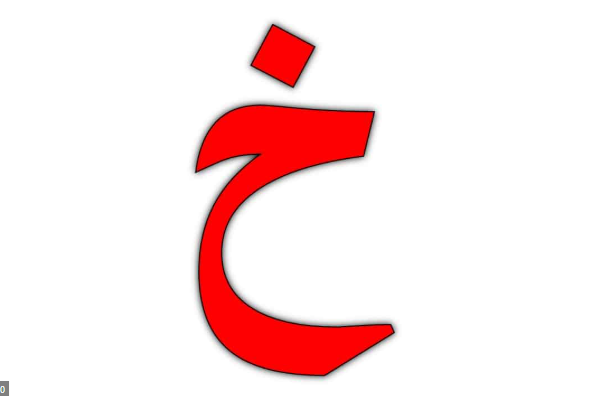
The letter خ belongs to the same base shape family as letter ح (Ha) and letter ج (Jim). All three share an identical skeleton — what distinguishes خ is the single dot placed above the letter body. This dot is not decorative; it is structurally essential and changes the letter’s identity completely.
Here is how خ appears across its four positional forms:
| Position | Form | Example Word | Meaning |
| Isolated | خ | خ | — |
| Initial (beginning of word) | خـ | خَبَر | News |
| Medial (middle of word) | ـخـ | يَخْرُج | He exits |
| Final (end of word) | ـخ | تَارِيخ | History |
Notice that in its initial and medial forms, خ connects to the following letter through a horizontal extension to the right. In its final and isolated forms, it stands with a fuller curved body.
The dot above always remains a single point — never two dots (that would be ت) and never zero dots (that would be ح).
The Dot Above خ and Why It Must Never Be Forgotten
When writing خ by hand, beginners sometimes forget the dot, accidentally producing ح instead. In Quranic Arabic, this error is significant: حَبَر and خَبَر are different words entirely.
The dot above خ is an inseparable part of its identity — train yourself to always complete it before moving to the next letter.
How to Pronounce the Arabic Letter Kh Correctly?
Producing خ correctly requires a few deliberate steps, especially when you are training a new articulation point. Follow this sequence carefully:
Step 1 – Find the position. Open your mouth slightly. Place the back of your tongue close to your soft palate (the soft, movable area at the very back of the roof of your mouth). Do not press all the way — leave a narrow gap.
Step 2 – Push air through. Exhale through your mouth while maintaining that narrow gap at the back. You should hear a rough, friction-based sound — like a gentle scrape or a hushed clearing of the throat.
Step 3 – Do not vibrate the vocal cords. Place your fingers lightly on your throat. If you feel vibration, you are producing غ (Ghayn), not خ (Kha). Relax your vocal cords and try again.
Step 4 – Isolate it from “k.” Say the English “k” and then slowly release the tongue without snapping it. That continuous release is closer to خ. Practice this bridge exercise several times.
Step 5 – Connect it to vowels. Once you can produce the isolated sound, pair it with the three short vowels: خَ (kha), خِ (khi), خُ (khu). Repeat each five times slowly before increasing speed.
Book Your FREE Trial in Riwaq’s Arabic Classes

Common Pronunciation Mistakes English Speakers Make with the Arabic Letter Kh
Even motivated learners fall into predictable patterns when tackling خ. Knowing these errors in advance helps you avoid them.
| Common Mistake | What Happens | Correct Technique |
| Replacing خ with “k” | Sounds like ك (Kaf) — a full stop, not a fricative | Release the back-tongue contact; maintain airflow |
| Replacing خ with “h” | Sounds like ه (Ha) — produced at the glottis, not the velum | Move articulation backward in the mouth |
| Voicing the sound | Produces غ (Ghayn) instead | Remove vocal cord vibration; whisper the sound |
| Over-aspirating | Creates an exaggerated breathy sound | Reduce airflow pressure; aim for smooth friction |
The most common error by far is substituting خ with the English “k.” English speakers hear the backness of the sound and default to the closest familiar consonant. Conscious repetition with feedback — ideally from a qualified Arabic instructor — is the fastest way to correct this.


Practice Exercise 1: Pronunciation Drills for the Arabic Letter Kh
Drill A – Minimal Pair Distinction Read each pair aloud and focus on the difference between خ and ك:
- خَالِد (Khalid — a name) vs. كَالِد (not a word — notice the difference in sound)
- خَيْر (goodness) vs. كَيْر (a type of blacksmith’s bellows — different meaning entirely)
Drill B – Positional Practice:
- خَرَجَ — He went out (initial position)
- يَخْرُج — He exits (medial position)
- تَارِيخ — History (final position)
Drill C – Sentence Reading Practice Try reading this short Arabic sentence aloud: خَرَجَ خَالِدٌ مِنَ الْمَخْرَجِ Kharaja Khālidun min al-makhraj “Khalid exited from the exit.”
This sentence contains خ three times across different word positions — excellent training for consistency in pronunciation.
Practice Exercise 2: Writing the Arabic Letter Kh Across All Four Forms
Instructions: In your notebook, write each form of خ five times in sequence. Then write the example word three times.
| Form | Letter | Practice Word | Meaning |
| Isolated | خ | خَيْر | Goodness |
| Initial | خـ | خَلَقَ | He created |
| Medial | ـخـ | يَخْرُج | He exits |
| Final | ـخ | تَارِيخ | History |
Pay careful attention to the dot placement above each form. The dot sits centered above the letter body in all positions. When writing quickly, this dot must remain distinct — never merge it with the letter body itself.
Why Students Love Learning with Riwaq Al Quran
Hear directly from our students about how Riwaq Al Quran Academy has transformed their connection with the Book of Allah. Their experiences reflect the dedication, care, and quality that guide every step of our teaching.
Learn the Arabic Letter Kh with Riwaq Al Quran’s Expert Arabic Instructors
Mastering خ and the full Arabic alphabet is achievable with the right guidance and consistent practice.
At Riwaq Al Quran, our Al-Azhar-certified instructors have helped thousands of non-Arabic speakers worldwide build real reading and pronunciation skills — from the very first letter.
Here is what makes learning with us different:
- One-on-one live sessions tailored to your exact level
- Specialized Arabic alphabet courses for both kids and adults
- Expert Tajweed and Makhaarij coaching for precise pronunciation
- Flexible scheduling that fits your lifestyle
- Free trial lesson — no commitment required
Book your free trial lesson today at Riwaq Al Quran and start building the foundation your Arabic learning deserves, Insha’Allah.
Beyond Arabic, we offer courses in Online Tajweed Classes, Arabic Language, and Islamic Studies.
- Online Quran Memorization Course
- Tajweed Classes
- Online Quran Classes for Kids.
- Ijazah Program.
- Arabic Language Classes.
- Islamic Studies Courses.
Enroll now for 2 Free Trial Classes and Begin Learning Arabic or Memorizing Quran Today

Conclusion
The letter خ stands as one of Arabic’s most distinctive consonants — its velar fricative sound, produced at the back of the tongue near the soft palate, has no counterpart in English, making deliberate and guided practice essential for accurate pronunciation.
Writing خ accurately across its four positional forms requires attention to both the letter’s base shape and its identifying dot. These two elements together — sound production and script recognition — form the complete skill set every learner needs when approaching this letter.
Connecting خ to real Quranic words transforms letter practice into something meaningful. Every time you pronounce خَيْر or خَلَقَ with accuracy, you are strengthening both your Arabic literacy and your engagement with the Quran’s language. That connection, built letter by letter, is genuinely worth the effort.