
Learning the Arabic letter ت (Ta) opens a door to hundreds of everyday words in Arabic and dozens of verses in the Quran. It is one of the most frequently occurring letters in the Arabic script, appearing across all word positions with consistent, learnable forms.
Mastering ت letter in Arabic means understanding its sound, recognizing its four written shapes, and practicing it in real Arabic words. This guide walks you through every step — from pronunciation to writing to exercises — so you build genuine confidence with this letter.
Table of Contents
How to Recognize the Arabic Letter Ta in All Its Written Forms?
The Arabic letter ت changes shape depending on its position within a word. However, its core identifying feature never changes: two dots above the letter body. Whether isolated, initial, medial, or final, those two dots always mark ت.
| Position | Form | Example Word | Meaning |
| Isolated | ت | ت | The letter itself |
| Initial (beginning) | تـ | تَمْر (tamr) | Dates (fruit) |
| Medial (middle) | ـتـ | كِتَاب (kitab) | Book |
| Final (end) | ـت | بَيْت (bayt) | House |
The body of ت in initial and medial positions flattens into a short horizontal stroke with a small connecting curve. In isolated and final positions, it takes a fuller boat-like shape. The two dots above are always the recognition anchor — train your eyes to look for them first.
Common Arabic Words Containing the Letter Ta for Learners to Practice
Building vocabulary around ت helps you internalize both its sound and its written forms simultaneously. Below are carefully selected common Arabic words that appear across different positions of ت in a word.
Words Where the Arabic Letter Ta Appears at the Beginning
- تَمْر (tamr) — Dates (fruit), a beloved food in Islamic culture
- تِين (teen) — Figs, also the name of Surah 95 in the Quran
- تُفَّاح (tuffah) — Apples
- تَعَب (ta’ab) — Tiredness / fatigue
- تِلْمِيذ (tilmeedh) — Student / pupil
Words Where the Arabic Letter Ta Appears in the Middle
- كِتَاب (kitab) — Book
- نتاج (Nitag) — Production
- مَكْتَب (maktab) — Office / desk
- فَتَح (fataha) — He opened
Words Where the Arabic Letter Ta Appears at the End
- بَيْت (bayt) — House
- وَقْت (waqt) — Time
- صَوْت (sawt) — Voice / sound
- مَوْت (mawt) — Death
- نَبَات (nabat) — Plants / vegetation
Practicing these words aloud is far more effective than silent reading. Say each word three times slowly, consciously placing your tongue tip against your upper front teeth for every ت sound.
If you want structured vocabulary practice alongside expert guidance, Riwaq Al Quran‘s Online Arabic Classes provides age-appropriate word sets with certified instructors who correct pronunciation in real time.
Book Your FREE Trial in Riwaq’s Arabic Classes

Experience Riwaq Al Quran Classes
Watch real moments from our live sessions at Riwaq Al Quran and see how we bring learning to life. These clips highlight our interactive, student-focused approach designed to keep learners engaged, motivated, and actively involved in every step of their educational journey.
How to Write the Arabic Letter Ta Step by Step?
Writing ت correctly requires understanding both stroke order and proportions. Arabic is written from right to left, and ت follows this direction naturally.
Step-by-Step Writing Instructions for Ta in Arabic
Step 1: Begin with the body. Draw a small, slightly curved horizontal line from right to left, with a gentle upward curve at the left end. Think of a shallow dish or boat shape.
Step 2: Lift your pen. Place the first dot above the center-left of the body. The dot should be small and round, not elongated.
Step 3: Place the second dot slightly to the right of the first, at the same height. Both dots sit at equal height above the letter body, spaced evenly.


What does the Arabic Letter Ta Sound Like?
The Arabic letter ت produces a sound very close to the English letter “T” in the word “top.” It is a voiceless dental stop, meaning no vibration occurs in the throat when you produce it.
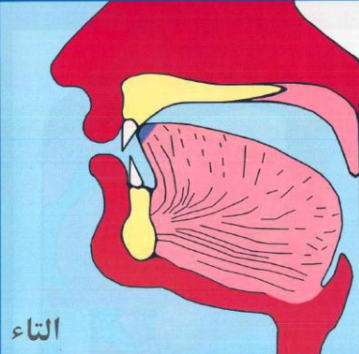
The key difference from English is the articulation point. In English, the “T” sound is produced with the tongue touching the upper ridge behind the front teeth (the alveolar ridge). In Arabic, ت is a dental stop — the tip of your tongue must touch the back of your upper front teeth directly.
This precise placement gives Arabic ت a slightly crisper, sharper quality than its English counterpart. Many English speakers unknowingly produce an alveolar “T” and wonder why their Arabic sounds slightly off to native ears. Correcting this one adjustment makes a significant difference.
The Makhraj and Sifat of the Arabic Letter Ta
| Phonetic Feature | Description |
| Makhraj (Articulation Point) | Tip of the tongue against the back of the upper front teeth |
| Voicing | Voiceless (no vocal cord vibration) |
| Manner of Articulation | Stop (complete closure then release) |
| Hams (Whispering Attribute) | Present — air flows freely at release |
| Istifal (Lowness) | Present — tongue remains low, no emphasis |
This table summarizes the classical sifat of ت as established in Arabic phonetic science. Note especially that ت carries Hams (whispering quality) and Shiddah (constriction), which together produce its characteristic crisp, voiceless sound.
The Arabic Letter Ta in the Quran and How It Sounds in Recitation
The letter ت appears throughout the Quran in high-frequency words. Recognizing it in Quranic text sharpens both your Arabic reading and your Tajweed awareness simultaneously.
One of the most commonly recited words containing ت is the word تَوْبَة (tawbah) meaning repentance.
Notice how ت appears in تُوبُوا (turn/repent) and تُفْلِحُونَ (you succeed). In Tajweed recitation, ت retains its crisp dental quality — no emphasis or heaviness should enter this sound. It must remain light, voiceless, and clearly articulated at the teeth.
Enroll Now in the Best Online Tajweed Classes

Practice Exercises for the Arabic Letter Ta at Every Learning Level
The following exercises are designed for hands-on practice. Work through them in order — each level builds on the previous one.
Exercise 1 — Recognition Practice (Beginner)
Task: Circle every ت in the following group of letters.
ب ـ ت ـ ث ـ ن ـ ت ـ ي ـ ة ـ ت ـ ب ـ ث
This exercise trains your eye to distinguish ت from visually similar letters like ب (one dot below) and ث (three dots above).
Exercise 2 — Writing Practice (Beginner to Intermediate)
Task: Write each of the following ت forms five times in your notebook.
| Form to Practice | Appears in Position |
| ت | Isolated |
| تـ | Word-initial |
| ـتـ | Word-medial |
| ـت | Word-final |
Focus on keeping both dots separated, equal in size, and placed symmetrically above the letter body.
Exercise 3 — Word Reading Practice (Intermediate)
Task: Read each word aloud, then write its meaning from memory.
- تَمْر ← ________
- كِتَاب ← ________
- بَيْت ← ________
- تِلْمِيذ ← ________
- وَقْت ← ________
Answers: Dates / Book / House / Student / Time
Say each word five times aloud after reading it. Speed is not the goal — clean dental placement of ت is.
Read Also: Learn The Arabic Letter Alif (ا / أ)
Exercise 4 — Sentence Reading Practice (Intermediate to Advanced)
Task: Read this short Arabic sentence and identify every ت.
اَلتِّلْمِيذُ فِي الْبَيْتِ Al-tilmeedhu fi al-bayt “The student is in the house.”
How many ت letters appear? Two — in التِّلْمِيذ and الْبَيْت. Practice saying the sentence until both ت sounds feel natural and dental in placement.
For learners who want guided pronunciation feedback for their kids on exercises like these, Riwaq Al Quran‘s Online Arabic Classes for Kids pairs students with native Arabic-speaking instructors who monitor exactly this kind of foundational accuracy.
Enroll Your Kid in Riwaq’s Arabic Classes for Kids with a FREE trial

Read Also: The Letter D in Arabic د
How Ta Differs from Similar Arabic Letters That Beginners Often Confuse
Three Arabic letters share the same body shape as ت but differ by dot count. Mastering this distinction early prevents persistent reading errors.
| Letter | Dots | Sound | English Approximation |
| ب (Ba) | 1 dot below | /b/ | “b” in “ball” |
| ت (Ta) | 2 dots above | /t/ | “t” in “top” (dental) |
| ث (Tha) | 3 dots above | /θ/ | “th” in “think” |
The body of all three letters is identical. Only the dots determine the letter. This is why Arabic learners must develop strong dot-recognition habits from day one.
A common mistake among English-speaking beginners is reading ث (Tha) as ت (Ta) because the English “th” sound feels unfamiliar and the eye skips past the third dot. Slow down when reading — count the dots deliberately until it becomes automatic.
Read Also: Letter Ta ط in Arabic
Why Students Love Learning with Riwaq Al Quran
Hear directly from our students about how Riwaq Al Quran Academy has transformed their connection with the Book of Allah. Their experiences reflect the dedication, care, and quality that guide every step of our teaching.
Learn Arabic Letters with Expert Instructors at Riwaq Al Quran
Mastering ت is a meaningful early step in your Arabic reading ability. The pronunciation, writing forms, and vocabulary in this guide give you a solid foundation to build on.
At Riwaq Al Quran, our Online Arabic Classes for Kids — and our broader Online Arabic Course for adults — are taught by Al-Azhar-certified Arabic instructors who specialize in guiding non-native speakers from the very first letter.
- Native Arabic-speaking, qualified teachers
- One-on-one and group class options
- Flexible scheduling across all time zones
- Structured curriculum from alphabet through fluency
- Free trial lesson — no commitment required
Book your free trial class today at Riwaq Al Quran and start building your Arabic letter foundation with expert guidance. Insha’Allah, every letter you master brings you closer to reading the Quran with understanding.
Beyond Arabic, we offer courses in Online Tajweed Classes, Arabic Language, and Islamic Studies.
- Online Quran Memorization Course
- Tajweed Classes
- Online Quran Classes for Kids.
- Ijazah Program.
- Arabic Language Classes.
- Islamic Studies Courses.
Enroll now for 2 Free Trial Classes and Begin Learning Arabic or Memorizing Quran Today

Conclusion
The Arabic letter ت is one of the most accessible entry points into Arabic script because its sound closely parallels English “T.” Adjusting your tongue placement to the upper front teeth — rather than the alveolar ridge — is the single most important correction for English speakers.
Recognizing ت across its four positional forms becomes straightforward once you anchor your recognition to the two dots above. That visual consistency makes ت one of the first letters most learners read confidently in connected Arabic text.
Consistent practice with real Arabic words — not just isolated letters — accelerates both reading speed and pronunciation accuracy. The vocabulary and exercises in this guide are designed to give you that practical foundation so that ت, Alhamdulillah, becomes second nature for you.