Learning a single Arabic letter correctly from the start builds a foundation that carries you through the entire alphabet. The letter ب (Ba) is the second letter of the Arabic alphabet, and it appears in thousands of everyday words — including the very first word of the Quran after the Basmala.
Ba is a bilabial stop produced by pressing both lips together, making it one of the most accessible Arabic letters for English speakers. Mastering its written forms, correct pronunciation, and common vocabulary will give you immediate practical reading ability and a confident start in Arabic.
Table of Contents
What Does the Arabic Letter Ba Look Like?
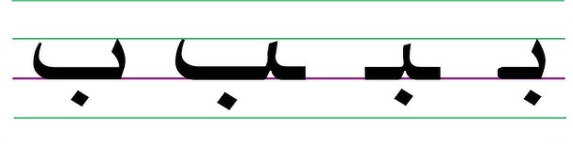
The Arabic letter Ba has one consistent shape — a horizontal baseline with a single dot placed below it. What changes is how it connects to neighboring letters depending on where it appears in a word.
Arabic is a connected script, meaning letters join together like cursive writing. Ba connects from both sides in the middle of a word and from the right side at the beginning, but it takes a slightly shorter form when it stands alone or ends a word.
How the Arabic Letter Ba Changes in Words?
The table below shows Ba in all four positional forms with clear examples:
| Position | Arabic Form | Example Word | Meaning |
| Isolated | ب | — | The letter alone |
| Initial (start of word) | بـ | بيت | House |
| Medial (middle of word) | ـبـ | حبل | Rope |
| Final (end of word) | ـب | كلب | Dog |
Notice that in every position, the single dot below the baseline never moves — it is always underneath. This distinguishes ب (Ba) from ت (Ta), which has two dots above, and ث (Tha), which has three dots above.
How to Pronounce the Arabic Letter Ba Correctly?
Ba is pronounced like the English letter “B” in words like “ball” or “book.” It is a bilabial stop — both lips press together and then release a short burst of air.
Unlike some Arabic letters that have no English equivalent, Ba presents very little difficulty for English speakers. The makhraj (articulation point) of Ba is ash-shafatan — meaning “the two lips” — and it is classified among the labial sounds in classical Arabic phonetics.
How to Write the Arabic Letter Ba?
Writing Ba correctly requires attention to proportion, dot placement, and the direction of the stroke. Arabic is written from right to left, so your pen always begins on the right side.
Follow these steps to write isolated Ba:
Step 1: Draw a slightly curved horizontal line from right to left, resembling a small boat or shallow bowl. The left end curves slightly upward.
Step 2: Lift your pen and place a single dot directly below the center of the line — not to the side and not above.
That is the complete isolated form of ب. The shape should look like a small dish sitting above its dot. When you practice in notebooks, keep the baseline flat and consistent — beginners often curve it too much, which distorts the letter’s recognizable shape.
Book Your FREE Trial in Riwaq’s Arabic Classes

Common Words Containing the Arabic Letter Ba for Practice
The best way to internalize any Arabic letter is through vocabulary. Ba appears at the beginning, middle, and end of hundreds of common Arabic words. Here is a rich selection organized by position to help you recognize the letter in context.
1. Common Arabic Words Beginning with Ba
These words give you immediate reading and speaking practice since Ba is the first sound you produce:
| Arabic Word | Transliteration | Meaning |
| بَيْت | Bayt | House |
| بَاب | Bab | Door |
| بَحْر | Bahr | Sea |
| بَقَرَة | Baqara | Cow |
| بُرْتُقَال | Burtuqal | Orange (fruit) |
| بِنْت | Bint | Girl / Daughter |
| بِسْمِ | Bismi | In the name of |
| بَرَكَة | Baraka | Blessing |
Each of these words begins with the initial form of Ba, which flows into the next connected letter. Practice reading them aloud, focusing on the clean lip-release of the B sound at the start.
2. Common Arabic Words with Ba in the Middle
| Arabic Word | Transliteration | Meaning |
| خُبْز | Khubz | Bread |
| صَبْر | Sabr | Patience |
| جَبَل | Jabal | Mountain |
| قَبْل | Qabl | Before |
| عِبَادَة | Ibada | Worship |
3. Common Arabic Words Ending with Ba
| Arabic Word | Transliteration | Meaning |
| بَاب | Bab | Door |
| كَلْب | Kalb | Dog |
| قَلْب | Qalb | Heart |
| نَسَب | Nasab | Lineage |
| أدب | Adab | Manners / Literature |
| طَلَب | Talab | Request |
Reading through these tables regularly — even 5 minutes a day — trains your eye to spot Ba instantly across different word shapes.
The Online Arabic Classes for Kids at Riwaq Al Quran introduce Ba and the full alphabet through structured, age-appropriate lessons taught by qualified native instructors.
Enroll Your Kid in Riwaq’s Arabic Classes for Kids with a FREE trial

Experience Riwaq Al Quran Classes
Watch real moments from our live sessions at Riwaq Al Quran and see how we bring learning to life. These clips highlight our interactive, student-focused approach designed to keep learners engaged, motivated, and actively involved in every step of their educational journey.
How Ba Appears in the Quran and Why Its Pronunciation Matters
Ba carries enormous weight in Quranic recitation. The very first letter a Muslim utters when beginning any action with the Basmala is ب — in
بِسْمِ اللهِ الرَّحْمَنِ الرَّحِيمِ (In the name of Allah, the Most Gracious, the Most Merciful).
In Tajweed, Ba is subject to specific recitation rules when it appears next to other letters. One important rule involves Ikhfa Shafawi — when a مِيم ساكن (sukoon Meem) is followed by Ba in the following word, the Meem is hidden with a slight nasal sound.
This is a distinct Tajweed rule and occurs only between Meem and Ba due to their shared bilabial articulation point.
Pronouncing Ba clearly in Quran recitation is not a minor detail. Swapping it for another letter changes meaning and, in Quranic recitation, affects the correctness of one’s tilawah. Alhamdulillah, Ba is one of the easier letters to master with consistent practice.
Enroll Now in the Best Online Tajweed Classes

Practice Exercises for the Arabic Letter Ba
These exercises are designed for both kids and adults. Work through them in order — each one builds on the previous.
Exercise 1: Letter Recognition
Look at the following Arabic letters and circle every Ba (ب) you see:
ب — ت — ث — ب — ن — ب — ي — ب — ت — ب
The key is the single dot below the baseline.
Exercise 2: Connecting Ba in Words
Practice writing these three words, paying attention to how Ba changes shape when connected:
بَ يْ ت — ك ل ب — خُ بْ ز
Write each word three times. As you write, say the word aloud so your ear connects the sound to the script.
Exercise 3: Fill in the Missing Letter
Each word below is missing the letter Ba. Write ب in the correct position:
- ـَيْت (house) → بَيْت
- كِتَا ـ (book) → كِتَاب
- ـَحْر (sea) → بَحْر
- قَلْـ (heart) → قَلْب
- ـَاب (door) → بَاب
Exercise 4: Sorting Words by Ba Position
Sort these words into three columns — Ba at the beginning, middle, or end:
بَرَكَة — كَلْب — جَبَل — بِنْت — أَدَب — عِبَادَة — بَحْر — صَبْر
| Ba at Beginning | Ba in Middle | Ba at End |
This sorting exercise trains your eye to locate Ba quickly regardless of word length or letter combination.
Exercise 5: Reading Aloud
Read each of the following words aloud three times, focusing on the clean bilabial stop at Ba:
بَاب — بَيْت — بَحْر — بَرَكَة — بِسْمِ
Time yourself: aim to read all five words confidently within 10 seconds after three days of practice.


Common Mistakes English Speakers Make with the Arabic Letter Ba
Ba is rarely mispronounced by English speakers since its sound exists in English. However, there are two script-related errors that beginners frequently make.
Confusing Ba with letter Ta and letter Tha is the most common written mistake. All three letters — ب ت ث — share the exact same baseline shape. The only difference is the number and position of dots: Ba has one dot below, Ta has two dots above, and Tha has three dots above. When reading quickly, beginners skip the dots and misread the letter entirely.
Misplacing the dot when writing is the second frequent error. Some beginners place the dot to the right or left of the baseline rather than directly beneath its center. In formal Arabic script and in Quranic text, dot placement is precise — train yourself from day one to place it centrally underneath.
A third, less common error involves adding aspiration to Ba — producing a slight puff of air after the B sound, as English sometimes does with “b” in certain positions. Arabic Ba should be clean and unaspirated, especially in Quranic recitation.
Read Also: Learn The Arabic Letter Alif (ا / أ)
Why Students Love Learning with Riwaq Al Quran
Hear directly from our students about how Riwaq Al Quran Academy has transformed their connection with the Book of Allah. Their experiences reflect the dedication, care, and quality that guide every step of our teaching.
Learn Arabic Letters with Expert Instructors at Riwaq Al Quran
Mastering Ba is your second step in reading Arabic fluently. Every letter you learn correctly now prevents errors that are much harder to fix later.
At Riwaq Al Quran, you get:
- Certified, native Arabic instructors trained in classical Arabic linguistics
- Dedicated Online Arabic Classes for Kids with structured alphabet progression
- Online Arabic Course for adult beginners through advanced levels
- Flexible one-on-one scheduling from anywhere in the world
- A free trial lesson to experience the teaching quality before committing
Book your free trial today at Riwaq Al Quran and start building your Arabic foundation the right way — letter by letter, Insha’Allah.
Beyond Arabic, we offer courses in Online Tajweed Classes, Arabic Language, and Islamic Studies.
- Online Quran Memorization Course
- Tajweed Classes
- Online Quran Classes for Kids.
- Ijazah Program.
- Arabic Language Classes.
- Islamic Studies Courses.
Enroll now for 2 Free Trial Classes and Begin Learning Arabic or Memorizing Quran Today

Conclusion
The Arabic letter Ba sits at the heart of everyday Arabic vocabulary, from بَيْت (house) to بَرَكَة (blessing), and its mastery combines script recognition, correct articulation, and dot precision into one accessible skill.
Writing Ba correctly across its four positional forms — isolated, initial, medial, and final — trains the hand and eye simultaneously. Paired with vocabulary practice, this dual approach accelerates reading fluency more effectively than phonics alone.
Every correct Ba you read or write in Quranic text carries weight beyond language learning. With consistent daily practice and the guidance of a qualified instructor, this second letter of the Arabic alphabet becomes second nature.