Learning Arabic opens a world of linguistic richness, and every letter you master brings you closer to reading the Quran, understanding Islamic texts, and connecting with over 400 million native speakers. Among the 28 Arabic letters, Jeem (ج) is one of the most recognizable — and most commonly mispronounced by English speakers.
The letter Jeem appears in everyday Arabic conversation, classical literature, and Quranic verses alike. Mastering its sound, shape, and usage gives both children and adult learners a confident foundation to build upon. This guide walks you through everything step by step.
Table of Contents
What Does the Arabic Letter Jeem ج Look Like in All Its Written Forms?
Before you can read Arabic, you need to recognize each letter across its four positional forms. Arabic is a connected script, meaning letters change shape depending on where they appear in a word.
Jeem is one of a group of letters that shares its base shape with two other letters: Ha (ح) and Kha (خ). The distinguishing feature of Jeem is its single dot placed inside the curve of the letter — not above or below it.
The table below shows all four positional forms of the Arabic letter Jeem:
| Position | Form | Example Word | Meaning |
| Isolated | ج | — | — |
| Initial (start of word) | جـ | جَمَل | Camel |
| Medial (middle of word) | ـجـ | يَجد | He finds |
| Final (end of word) | ـج | ثلج | Snow |
Each form shares the same core curve and interior dot. With enough practice, your eye will begin recognizing Jeem instantly, regardless of its position in a word.
How to Pronounce the Arabic Letter Jeem ج Correctly?
The Arabic letter Jeem is pronounced like the English “j” in the word jam or jump — a voiced palato-alveolar affricate. However, its precise articulation in Classical Arabic (Fusha) is slightly firmer and more defined than the casual English “j.”
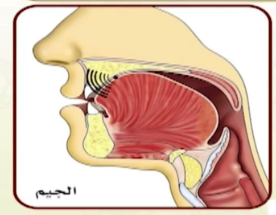
The Makhraj (Articulation Point) of Jeem
According to classical Arabic phonetic science, the makhraj of Jeem is the middle part of the tongue (wasaṭ al-lisān) making contact with the middle part of the upper palate (wasaṭ al-ḥanak). This is a palatal point of articulation — meaning the tongue rises toward the roof of the mouth.
How the Arabic Letter Jeem ج Connects to Arabic Vocabulary Building
Understanding Jeem opens access to an entire root-based vocabulary system. Arabic words are built on three-letter roots, and Jeem appears in some of the most common roots in the language.
The root ج-م-ل (J-M-L), for example, generates the words for “beautiful” (جَمِيل), “beauty” (جَمَال), “camel” (جَمَل), and “to beautify” (جَمَّلَ). Recognizing Jeem in its various forms helps you identify these root patterns quickly and expand your vocabulary organically.
Adult learners enrolled in the Online Arabic Course at Riwaq Al Quran study this root-pattern system systematically, developing reading fluency much faster than learners who study isolated vocabulary lists.
Book Your FREE Trial in Riwaq’s Arabic Classes

Common Words in Arabic That Contain the Letter Jeem ج
One of the most effective ways to internalize any Arabic letter is through vocabulary exposure. The following words are high-frequency in both Modern Standard Arabic (MSA) and everyday conversation.
Words Where Jeem ج Appears at the Beginning
| Arabic | Transliteration | Meaning |
| جَمِيل | Jamīl | Beautiful |
| جَبَل | Jabal | Mountain |
| جَامِعَة | Jāmiʿa | University |
| جِسْم | Jism | Body |
| جَنَّة | Janna | Paradise / Garden |
Words Where Jeem ج Appears in the Middle or End
| Arabic | Transliteration | Meaning |
| مَجِيد | Majīd | Glorious |
| أَجْر | Ajr | Reward |
| تَاج | Tāj | Crown |
| سِجِل | Sijil | Record |
| حَاجَة | Ḥāja | Need |
Studying these words together trains your ear and eye simultaneously. Say each word aloud, focusing on the clean, sharp Jeem sound at its articulation point.


Mistakes English Speakers Make When Pronouncing Jeem ج and How to Fix Them
English speakers bring their own phonetic habits to Arabic. With Jeem, there are two very common errors worth addressing directly.
Replacing Jeem with the “Soft J” Sound
Many learners unconsciously produce a softer version of Jeem — similar to the French “j” or the English “zh” in television. This happens because English does not consistently use the hard palatal Jeem sound in all contexts.
To correct this: Place your tongue firmly at the mid-palate, block the airflow completely for a brief moment, and then release it with a clear burst. The sound should feel definitive, not flowing.
Confusing Jeem with Ya (ي) in Writing
Some beginners mistake Jeem (ج) for the letter Ya (ي) when handwriting, particularly in the final and medial forms. The key difference is dot placement — Jeem has one dot inside its bowl, while Ya has two dots beneath the letter. Always check dot position before confirming a letter.
Experience Riwaq Al Quran Classes
Watch real moments from our live sessions at Riwaq Al Quran and see how we bring learning to life. These clips highlight our interactive, student-focused approach designed to keep learners engaged, motivated, and actively involved in every step of their educational journey.
Step-by-Step Guide to Writing the Arabic Letter Jeem ج by Hand
Writing Arabic letters requires understanding stroke direction and the letter’s natural flow within connected script. For Jeem, follow this sequence:
Start from the right. Draw a shallow rightward curve — similar to a shallow “c” shape leaning slightly to the left. Then add a tail that curves downward and slightly to the right beneath the curve. Finally, place a single dot inside the open bowl of the letter.
When Jeem connects to letters before it (medial and final forms), the tail is dropped and the letter connects at its right edge. In initial position, the bowl opens rightward and connects forward to the next letter.
Practice writing Jeem in all four positions across a full line before moving on to word-level writing. Consistent repetition builds muscle memory.
Practice Exercises for the Arabic Letter Jeem ج Inside This Guide
These exercises are designed for both parents working with children and adult self-learners. Work through them in order for the best results.
Exercise 1: Letter Recognition
Look at the following group of Arabic letters and circle every Jeem (ج) you find:
ح — ج — خ — ج — ح — خ — ج — ح — ج
Exercise 2: Identify the Position of Jeem
For each word below, identify whether Jeem appears at the beginning, middle, or end:
| Arabic Word | Transliteration | Where is Jeem? |
| جَمِيل | Jamīl | _______ |
| تَاج | Tāj | _______ |
| مَجِيد | Majīd | _______ |
| جَنَّة | Janna | _______ |
(Answers: beginning / end / middle / beginning)
Exercise 3: Pronunciation Drilling
Say each of the following words aloud three times, pausing between each repetition. Focus on making the Jeem sharp and voiced at the mid-palate:
جَمَل — جَامِعَة — أَجْر — تَاج — جِسْم
Ask a family member to listen, or record yourself and replay the audio to evaluate your clarity.
Exercise 4: Writing Practice
Write each of the following four Jeem forms five times each in sequence: ج — جـ — ـجـ — ـج
Then try writing these two full words from memory: جَبَل (mountain) and تَاج (crown).
For children learning Arabic, these exercises work well as short daily sessions of five to ten minutes. Parents who want structured, curriculum-based progression for their children can explore Online Arabic Classes for Kids at Riwaq Al Quran, where certified teachers guide young learners through each letter with age-appropriate methods.
Enroll Your Kid in Riwaq’s Arabic Classes for Kids with a FREE trial

How the Arabic Letter Jeem ج Appears in the Quran?
The Quran contains hundreds of occurrences of Jeem across its verses. Reading and reciting these examples is one of the most spiritually meaningful ways to practice this letter.
Every Arabic learner who reads the Quran will encounter Jeem frequently. When reciting Quranic Arabic, the pronunciation of Jeem must be precise — the interior dot distinguishes it visually from its sister letters Ha (ح) and Kha (خ), just as its voiced palatal sound distinguishes it phonetically.
جَعَلَ اللَّهُ الْكَعْبَةَ الْبَيْتَ الْحَرَامَ قِيَامًا لِّلنَّاسِ
Jaʿala Allāhu l-Kaʿbata l-bayta l-ḥarāma qiyāman li-n-nās
“Allah has made the Kaaba, the Sacred House, standing for the people.” (Al-Maʾidah 5:97)
The word جَعَلَ — jaʿala, meaning “has made” — opens this verse with Jeem in its initial form, providing an excellent Quranic model for practicing the letter.
For learners who want to perfect their pronunciation in Quranic recitation, Online Tajweed Classes at Riwaq Al Quran offer structured, one-on-one instruction with qualified teachers who help you produce each letter from its correct articulation point.
Enroll Now in the Best Online Tajweed Classes

Why Students Love Learning with Riwaq Al Quran
Hear directly from our students about how Riwaq Al Quran Academy has transformed their connection with the Book of Allah. Their experiences reflect the dedication, care, and quality that guide every step of our teaching.
Learn Arabic Letter Jeem and All Arabic Letters with Riwaq Al Quran Expert Instructors
Mastering Jeem is one meaningful step in a complete Arabic learning path. At Riwaq Al Quran, qualified instructors guide you from letter recognition to confident reading.
- Al-Azhar-certified instructors with specialization in Arabic phonetics and Tajweed
- Structured Online Arabic Course for adult beginners through advanced learners
- Dedicated Online Arabic Classes for Kids with age-appropriate, engaging curriculum
- Online Tajweed Classes for Quranic pronunciation mastery
- Flexible scheduling to fit your lifestyle
- Free trial lesson — no commitment required
Book your free trial today at Riwaq Al Quran and take your first confident step toward reading Arabic correctly, Insha’Allah.
Beyond Arabic, we offer courses in Online Tajweed Classes, Arabic Language, and Islamic Studies.
- Online Quran Memorization Course
- Tajweed Classes
- Online Quran Classes for Kids.
- Ijazah Program.
- Arabic Language Classes.
- Islamic Studies Courses.
Enroll now for 2 Free Trial Classes and Begin Learning Arabic or Memorizing Quran Today

Conclusion
The letter Jeem carries a single defining dot and a precise palatal sound — two details that, once mastered, make recognition and pronunciation second nature for any learner. Understanding its four written forms builds the script awareness needed for fluent Arabic reading.
Vocabulary connected to Jeem spans some of the most common words in the Arabic language, from jamīl (beautiful) to janna (paradise). Practicing these words alongside writing drills accelerates both memory retention and spoken confidence.
Every letter in Arabic is a doorway, and Jeem is among the most frequently used. With consistent daily practice — even ten minutes — both children and adults can solidify this letter completely and move forward with strong foundations, Alhamdulillah.