Learning a new alphabet can feel overwhelming, but Arabic letters are more systematic than most learners expect. The letter م (Meem) is one of the friendliest letters to start with — its sound is immediately familiar, its shape is consistent, and it appears in hundreds of everyday Arabic words.
Mastering م opens doors far beyond basic literacy. This letter carries deep phonetic logic, connects to foundational Arabic vocabulary, and appears throughout the Quran. Whether you are a parent teaching a young child or an adult starting from scratch, understanding م fully gives your Arabic learning a strong, confident foundation.
Table of Contents
What Does the Arabic Letter Meem م Look Like?
The Arabic letter م (Meem) is the 24th letter of the Arabic alphabet. Its isolated form is a small, rounded shape with a short tail descending below the baseline — recognizable and distinctive among Arabic letters.
How Does the Arabic Letter Meem’s Form Change by Position?
Like all Arabic letters, م changes shape depending on its position within a word. These changes are not random; they follow a predictable pattern that becomes second nature with practice.
| Position | Form | Example Word | Meaning |
| Isolated | م | — | — |
| Initial (beginning) | مـ | مَدْرَسَة (madrasa) | School |
| Medial (middle) | ـمـ | عمل (ʿaamal) | Work |
| Final (end) | ـم | قَلَم (qalam) | Pen |
The core circular shape of م is preserved across all four positions. In initial and medial forms, the descending tail is replaced by a connecting stroke that joins to the following letter.
Recognizing this shared circular nucleus helps learners identify م at a glance, regardless of position.


How to Write the Arabic Letter Meem م?
Writing م by hand follows a clear, learnable sequence. Unlike some Arabic letters with complex strokes, م is beginner-friendly when broken into steps.
Begin with the small rounded head — a circular stroke moving right to left (Arabic script flows right to left). Close the circle fully, then draw the short descending tail below the baseline. In connected forms, the tail is replaced by a horizontal connector moving leftward to join the next letter.
Stroke Order for Writing Meem م in All Positions
| Step | Action | Note |
| 1 | Draw circular head (right to left) | Keep circle small and even |
| 2 | Close the circle | Do not leave a gap |
| 3 | Add descending tail (isolated/final) | Curves slightly left below baseline |
| 3 (alt) | Add connecting stroke (initial/medial) | Horizontal, joins next letter |
Consistent practice with lined Arabic handwriting paper helps learners maintain proper baseline positioning. Children especially benefit from tracing exercises before freehand writing.
If you are looking for structured handwriting guidance alongside pronunciation coaching, Riwaq Al Quran’s Online Arabic Classes offer age-appropriate writing exercises taught by qualified Arabic instructors who specialize in non-native learners.
Book Your FREE Trial in Riwaq’s Arabic Classes

How to Pronounce the Letter “m” in Arabic Correctly as a Non-Native Speaker?
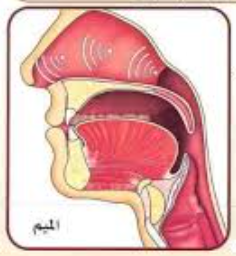
The pronunciation of م (Meem) is a bilabial nasal consonant — produced by pressing both lips together completely while allowing air to pass through the nose. This is precisely the same sound as the English letter “m” in words like “moon,” “man,” and “mother.”
Common Arabic Words That Contain the Letter Meem م
One of the most effective ways to internalize a letter is through vocabulary exposure. The letter م is extraordinarily common in Arabic — it appears in some of the most frequently used words in both Modern Standard Arabic (Fusha) and Quranic Arabic.
Below is a curated list of high-frequency words containing م across different positions, with transliterations and meanings to help you connect sound, script, and meaning simultaneously.
| Arabic Word | Transliteration | Meaning | Position of م |
| مَاء | māʾ | Water | Initial |
| مَدِينَة | madīnah | City | Initial |
| مَسْجِد | masjid | Mosque | Initial |
| كَلِمَة | kalimah | Word | Medial |
| عِلْم | ʿilm | Knowledge | Final |
| قَلَم | qalam | Pen | Final |
| أُمّ | umm | Mother | Medial/Final |
| سَمَاء | samāʾ | Sky/Heaven | Medial |
| مَلَك | malak | Angel | Initial |
| يَوْم | yawm | Day | Final |
Studying these words achieves two goals at once: you build vocabulary and reinforce letter recognition across all three positions. Read each word aloud, identify where م appears, and notice how its shape changes while its sound remains consistent.
Experience Riwaq Al Quran Classes
Watch real moments from our live sessions at Riwaq Al Quran and see how we bring learning to life. These clips highlight our interactive, student-focused approach designed to keep learners engaged, motivated, and actively involved in every step of their educational journey.
Practice Exercises for the Arabic Letter Meem م
Practical exercises accelerate letter mastery far more than passive reading. The following exercises are designed for both children and adult learners and can be completed without any additional materials.
Exercise 1: Letter Recognition in Context
Read the following Arabic words and circle every م you find. Then identify whether each م is in initial, medial, or final position.
مَكْتَب — عَالَم — مُعَلِّم — رَحِيم — مَاء — نَعِيم — أَمَل — مُسْلِم
Read Also: The Arabic Letter Haa (هـ)
Exercise 2: Writing Practice Sequence
Write the letter م ten times in each of its four forms: isolated, initial, medial, and final. Then write each of the following words three times each, focusing on accurate م formation:
مَدْرَسَة — قَلَم — عِلْم — سَمَاء
Read Also: Learn The Arabic Letter Ya (ي)
Exercise 3: Pronunciation Drill
Say each of the following words aloud five times, holding the م sound for a full beat and ensuring nasal airflow:
مَاء — مَلَك — يَوْم — أُمّ — مَسْجِد
Place your fingertips on your nose during each repetition to confirm nasal vibration is present throughout the م sound.
Read Also: The Arabic Letter W/و (Waw)
Exercise 4: Vocabulary Matching
Match each Arabic word to its meaning without looking at the table above:
| Arabic | Meaning |
| مَاء | Angel |
| مَلَك | Day |
| يَوْم | Water |
| عِلْم | Knowledge |
This recall-based exercise strengthens retention far more than passive review.
Read Also: The Arabic Letter Lam ل
How Does the Letter Meem م Appear in the Quran?
For English speakers, م carries almost no pronunciation risk. The articulation point (makhraj) is the two lips (الشَّفَتَان, al-shafatān), and its primary phonetic attribute (sifah) is nasality (الغُنَّة, al-ghunnah). This nasal quality becomes especially important in Tajweed contexts.
In classical Arabic phonetics, the makhraj of م is classified as the two lips meeting together — the same point as the letter ب (Ba), though م is nasal where ب is a plosive.
When م carries a shaddah (doubled letter) or appears in specific Tajweed contexts, its nasal resonance must be held for two counts (two beats of ghunnah), not swallowed or cut short.
The letter م appears throughout the Quran with extraordinary frequency. Entire chapters open with the detached letter م (Meem) as one of the Muqattaʿāt — the mysterious disconnected letters whose precise wisdom Allah alone knows. Surah Al-Baqarah, for instance, opens with الم (Alif, Lam, Meem).
In Tajweed, when م carries a sukoon (مْ) and is followed by ب, a rule called Ikhfāʾ Shafawi (الإخفاء الشفوي) applies — the م is not fully pronounced as a clear sound but is held in a state between full pronunciation and full assimilation, with audible ghunnah (nasality) for two counts. This is one of the most important Tajweed rules directly tied to م.
For those seeking to perfect their Quranic recitation, Riwaq Al Quran’s Online Tajweed Classes provide structured instruction in exactly these rules, guided by qualified instructors with strong grounding in classical Tajweed science.
Enroll Now in the Best Online Tajweed Classes

Read Also: The Arabic Letter Nun ن
Why Students Love Learning with Riwaq Al Quran
Hear directly from our students about how Riwaq Al Quran Academy has transformed their connection with the Book of Allah. Their experiences reflect the dedication, care, and quality that guide every step of our teaching.
Learn the Arabic Letter Meem م with Expert Instructors at Riwaq Al Quran
Mastering Arabic letters individually is the foundation of everything that follows — reading, Quran recitation, and deep language comprehension all begin here.
At Riwaq Al Quran, our qualified instructors make this foundation strong:
- Al-Azhar-certified Arabic teachers with specialized experience in non-native learners
- Structured letter-by-letter curriculum for both children and adults
- Live one-on-one sessions tailored to your pace and learning style
- Dedicated kids’ program with age-appropriate methods and engaging exercises
- Tajweed integration so your Arabic reading connects directly to Quranic recitation
Book your free trial lesson today and take your first step toward confident Arabic literacy with Riwaq Al Quran.
Beyond Arabic, we offer courses in Online Tajweed Classes, Quran Learning, and Islamic Studies.
- Online Quran Memorization Course
- Tajweed Classes
- Online Quran Classes for Kids.
- Ijazah Program.
- Arabic Language Classes.
- Islamic Studies Courses.
Enroll now for 2 Free Trial Classes and Begin Learning Arabic or Memorizing Quran Today

Conclusion
The letter م (Meem) stands out among Arabic letters for its phonetic accessibility — English speakers produce its core sound naturally, allowing energy to focus on script mastery and Tajweed precision rather than pronunciation reconstruction from scratch.
Vocabulary built around م is among the most practical in Arabic. Words like مَاء (water), عِلْم (knowledge), and يَوْم (day) appear constantly in daily speech and Quranic text, meaning every hour spent with this letter yields immediate, usable results.
Consistent daily practice — even ten minutes of writing, reading, and pronunciation drills — builds letter mastery faster than most learners expect. With patience and the right guidance, Insha’Allah, reading Arabic becomes not a distant goal but a real, attainable skill.