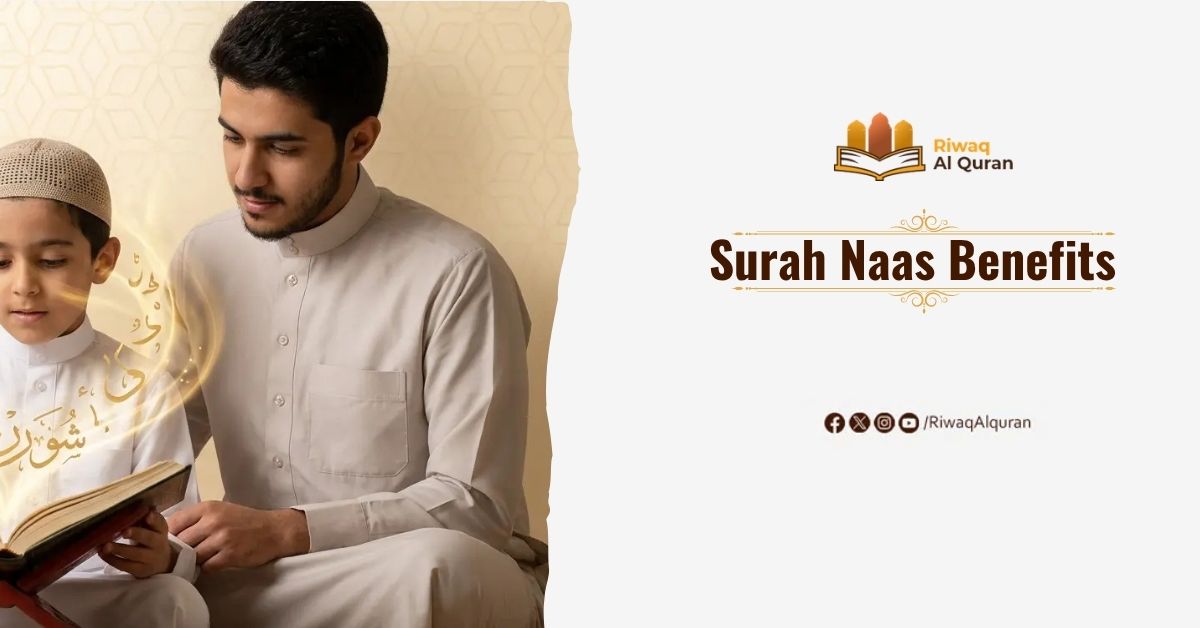
Surah An-Naas sits at the very end of the Quran for a reason. It is not an afterthought — it is a seal, a shield, and a statement of total dependence on Allah. Three verses identify who we are running to. Three more identify what we are running from. Six verses. Complete protection.
Every Muslim who recites this surah is engaging in something the Prophet ﷺ himself made a daily practice. Understanding its benefits is not merely academic — it is practical knowledge that changes how you recite, when you recite, and why every syllable carries weight.
Table of Contents
1. Surah An-Naas Directly Addresses the Root Source of Human Vulnerability
Surah An-Naas identifies the core threat to the human heart as Al-Waswas Al-Khannas — the whispering retreater. This is the entity, whether from jinn or mankind, that injects doubt, desire, and distraction into the human chest. The surah’s protection is not symbolic. It is a direct invocation against the most precise mechanism of spiritual harm.
Allah says:
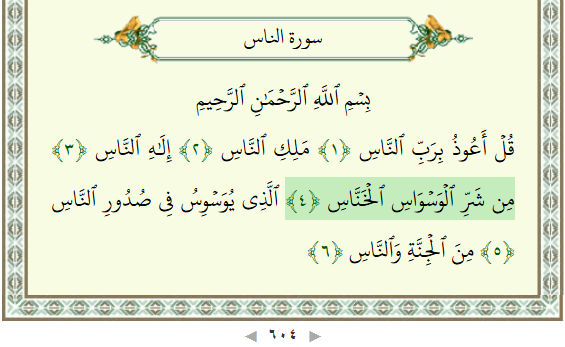
مِن شَرِّ ٱلْوَسْوَاسِ ٱلْخَنَّاسِ ٱالَّذِى يُوَسْوِسُ فِى صُدُورِ ٱلنَّاسِ مِنَ ٱلْجِنَّةِ وَٱلنَّاسِ
Min sharril-waswasil-khannas, alladhi yuwaswisu fi sudurin-nas, minal-jinnati wan-nas
“From the evil of the retreating whisperer — who whispers [evil] into the breasts of mankind — from among the jinn and mankind.” (An-Naas 114:4-6)
Classical scholars of Tafsir, including Ibn Kathir in his Tafsir al-Quran al-Azeem, explain that Al-Khannas derives from khunoos — meaning to shrink back or retreat.
The whisperer retreats specifically when the name of Allah is mentioned. This is why the scholars taught that reciting this surah is most powerful when paired with active remembrance of Allah.

2. Building an Unmatched Shield of Protection
Surah An-Naas opens with three distinct attributes of Allah, each one targeting a different dimension of human need. Together they form the theological architecture of the surah’s protection.
| Divine Attribute | Arabic | Meaning | Protection Offered |
| Rabb An-Naas | رَبِّ ٱلنَّاسِ | Lord of Mankind | He who created, sustains, and governs all people |
| Malik An-Naas | مَلِكِ ٱلنَّاسِ | The Sovereign of mankind | He who holds absolute sovereignty over every soul |
| Ilah An-Naas | إِلَٰهِ ٱلنَّاسِ | God of Mankind | He alone who deserves worship and is worthy of refuge |
Ibn Al-Qayyim noted that these three names address the complete relationship between the servant and his Lord — one of nurturing dependency, absolute authority, and exclusive devotion.
Seeking protection through all three is not repetition; it is escalating completeness.
Allah says:
قُلْ أَعُوذُ بِرَبِّ ٱلنَّاسِ مَلِكِ ٱلنَّاسِ إِلَٰهِ ٱلنَّاسِ
Qul a’udhu bi-Rabbin-nas, Malikin-nas, Ilahin-nas
“Say: I seek refuge in the Lord of mankind, the Sovereign of mankind, the God of mankind.” (An-Naas 114:1-3)
Experience Riwaq Al Quran Classes
Watch real moments from our live sessions at Riwaq Al Quran and see how we bring learning to life. These clips highlight our interactive, student-focused approach designed to keep learners engaged, motivated, and actively involved in every step of their educational journey.
3. The Prophet ﷺ Made Reciting Surah Al-Naas a Personal Daily Practice
The benefits of Surah An-Naas are not extracted from speculation — they are grounded in prophetic practice. The Messenger of Allah ﷺ recited Surah Al-Falaq and Surah An-Naas together as a consistent daily act of protection.
Aisha (may Allah be pleased with her) reported:
“Whenever the Prophet ﷺ went to bed every night, he used to cup his hands together and blow over them after reciting Surah Al-Ikhlas, Surah Al-Falaq, and Surah An-Naas, and then rub his hands over whatever parts of his body he was able to rub, starting with his head, face and front of his body. He used to do that three times.” (Sahih al-Bukhari 5017)
This practice — called nafth (blowing after recitation) — was not an occasional action. It was the Prophet’s ﷺ nightly routine.
For students at Riwaq Al Quran, this hadith is one of the first practical applications we tie to memorizing the short surahs at the end of the Quran. Knowing why you memorize changes how deeply it settles.
Connect with our Azhari tutors to learn Quran with Tafseer

4. Offering Specific Protection From Whispers in the Chest
The surah’s precision is remarkable. It does not refer to external harm in the abstract. It names the location — sudur an-nas (the chests of mankind). The chest, in Quranic usage, is the seat of the heart, intention, and spiritual state.
ٱلَّذِى يُوَسْوِسُ فِى صُدُورِ ٱلنَّاسِ
Alladhi yuwaswisu fi sudurin-nas
“Who whispers [evil] into the breasts of mankind.” (An-Naas 114:5)
Scholars of Tafsir observe that waswasa — whispering — describes the subtle, almost imperceptible nature of shaytan’s influence. It is not a loud command. It is a quiet suggestion that, if left unaddressed, grows. Reciting this surah regularly is a practice that keeps the believer alert to that subtlety.
If you want to build an authentic understanding of what this surah means verse by verse, Riwaq Al Quran’s Online Quran Tafseer Course covers the major short surahs through verified classical scholarship, taught by Azhari-certified tutors trained in the tradition of detailed Quranic interpretation.
Enroll Now in Riwaq’s Tafseer Course with a FREE trial
5. Surah Al-Naas Was Revealed Alongside Al-Falaq as a Paired Protection
Surah An-Naas was revealed together with Surah Al-Falaq. The two are inseparable in prophetic practice, scholarly discussion, and spiritual function. Together they are called Al-Mu’awwidhatayn — the two seeking-refuge surahs.
| Feature | Surah Al-Falaq | Surah An-Naas |
| Chapter Number | 113 | 114 |
| Primary Focus | Protection from external harm (darkness, envy, sorcery) | Protection from internal harm (whispering, doubt) |
| Refuge Sought Through | Rabb Al-Falaq | Rabb, Malik, and Ilah An-Naas |
| Source of Harm Addressed | Creation-based evil | Jinn and human whisperers |
The Prophet ﷺ also recited these two surahs after every obligatory prayer. Uqbah ibn Amir reported:
“The Messenger of Allah ﷺ said: ‘Do you not see that there have been revealed to me tonight verses the like of which has never been seen? They are: Say: I seek refuge in the Lord of the Daybreak, and Say: I seek refuge in the Lord of Mankind.” (Sahih Muslim 814)
At Riwaq Al Quran, we strongly encourage students working through our Online Quran Memorization Course to memorize Al-Mu’awwidhatayn together — learning them as a unit reflects their revealed pairing and strengthens retention.
Start your Hifz journey with a Free Trial
Read Also: Surah Al-Fil Benefits
The Claim of Surah Naas 100 Times Benefits
A widely circulated claim states that reciting Surah An-Naas 100 times carries specific promised rewards. This claim requires honest scholarly grounding before repeating it as religious fact. No sahih (authentic) hadith specifies a reward attached to reciting Surah An-Naas exactly 100 times.
Scholars who have researched this number have not found a verified basis in the primary collections of Bukhari, Muslim, or the major Sunan works.
What is established without dispute:
- Reciting Surah An-Naas is an act of worship rewarded according to sincerity and presence of heart
- Increasing its recitation, especially in the authenticated times, is encouraged by the general principle of engaging with Quran
- Assigning specific numerical rewards to specific surahs requires a verified hadith — without one, it remains unsupported
Scholars like Sheikh Ibn Baz and those at IslamQA have consistently emphasized that attributing specific virtue to a specific number without hadith evidence risks introducing unfounded religious claims.
We teach this principle honestly at Riwaq Al Quran — authentic Islamic knowledge, even when it corrects a popular belief, is always more valuable.
Read Also: Surah Al-Fajr Benefits
Why Students Love Learning with Riwaq Al Quran
Hear directly from our students about how Riwaq Al Quran Academy has transformed their connection with the Book of Allah. Their experiences reflect the dedication, care, and quality that guide every step of our teaching.
Begin Your Quran Studies with Riwaq Al Quran
Surah An-Naas is six verses. But within those six verses sits a complete theology of protection, a named enemy, three names of Allah, and a practice the Prophet ﷺ never abandoned. That is not a small surah — it is a profound one.
Riwaq Al Quran has been helping non-Arabic speaking Muslims worldwide study the Quran with authentic methodology since 2017. Our tutors hold Al-Azhar University certification and Ijazah chains, bringing genuine scholarly grounding to every session.
- ✅ Azhari-certified instructors — not generalist teachers
- ✅ One-on-one personalized sessions — your pace, your level
- ✅ 24/7 scheduling — built for Western Muslim students
- ✅ 2 Free Trial Classes — start before committing
- ✅ 100% Money-Back Guarantee
Explore our Online Quran Memorization Course,Online Quran Tafseer Course, or Best Islamic Studies Online Course — and begin with two free classes today, insha’Allah.
We offer courses in Online Quran & Tajweed Classes, Arabic Language, and Islamic Studies.
- Online Quran Memorization Course
- Tafseer Course
- Tajweed Classes
- Online Quran Classes for Kids.
- Ijazah Program.
- Arabic Language Classes.
- Islamic Studies Courses.
Enroll now for 2 Free Trial Classes and Begin Learning Islam and Quran Today
Read Also: Surah Al-Insan Benefits
Frequently Asked Questions About Surah An-Naas
What are the main benefits of reciting Surah An-Naas daily?
Surah An-Naas offers protection from Al-Waswas Al-Khannas — the whisperer who retreats at Allah’s remembrance. Its daily recitation, particularly before sleep and after obligatory prayers, is a prophetically established practice. The surah invokes Allah as Rabb, Malik, and Ilah of mankind, providing complete spiritual refuge grounded in authenticated hadith.
Is the benefit of reciting Surah An-Naas 100 times authentic?
No verified sahih hadith specifies a reward for reciting Surah An-Naas exactly 100 times. Scholars have consistently cautioned against assigning specific numerical rewards to surahs without hadith evidence. Reciting the surah regularly at its authenticated times — before sleep and after prayers — is the established and rewarded practice.
When did the Prophet ﷺ recite Surah An-Naas?
The Prophet ﷺ recited Surah An-Naas, Al-Falaq, and Al-Ikhlas every night before sleeping — cupping his hands, blowing into them after recitation, and wiping his body three times. He also recited Al-Mu’awwidhatayn after every obligatory prayer, as established in Sahih al-Bukhari and Sahih Muslim.
What is the meaning of Al-Waswas Al-Khannas mentioned in Surah An-Naas?
Al-Waswas refers to the whisperer — the one who injects subtle suggestions of doubt, desire, or distraction into the human heart. Al-Khannas means the retreating one — this entity shrinks back when Allah’s name is mentioned. Classical Tafsir scholars identify this as both jinn and human sources of spiritual harm, as stated explicitly in verse 6.
How does learning Tafsir improve the benefit of reciting Surah An-Naas?
Understanding the meaning of each verse activates the heart alongside the tongue. Classical scholars taught that recitation reaches its full spiritual weight when the reciter comprehends what they are saying. Knowing that sudur an-nas (chests of mankind) is where whispers enter makes the recitation a conscious act of seeking refuge — not mechanical repetition.