| Key Takeaways |
| Surah At-Tawbah (Chapter 9) is the only surah in the Quran that begins without Bismillah. |
| Classical scholars offer two main explanations: it is a continuation of Al-Anfal, or it was omitted due to its stern, warning-laden opening content. |
| Reciters must know three valid options when transitioning from Surah Al-Anfal into At-Tawbah during continuous recitation. |
Every Muslim who recites the Quran regularly notices a pattern: each surah opens with Bismillah ir-Rahman ir-Raheem. Every surah, that is, except one. Surah At-Tawbah stands alone in the entire Quran as the only chapter that begins without it — and this is not an accident or scribal omission.
Table of Contents
Which Surah in the Quran Has No Bismillah?
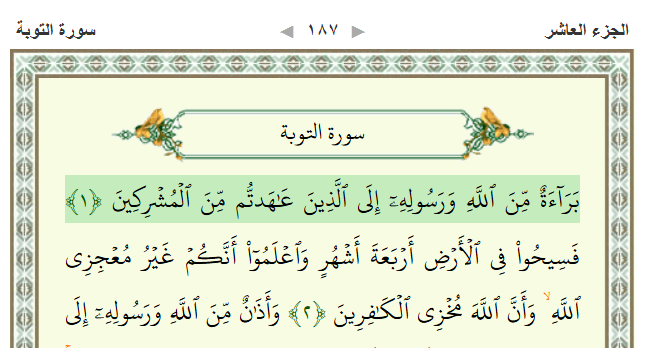
Surah At-Tawbah (Chapter 9) is the only surah in the Quran that does not begin with Bismillah ir-Rahman ir-Raheem. This is a scholarly consensus (ijma’) across all schools of Quranic recitation.
No manuscript of the Uthmani Mushaf — the standardized written Quran — includes Bismillah at the opening of At-Tawbah, and all ten Qira’at traditions confirm its absence without exception.
What Are Other Names of Surah At-Tawbah?
Surah At-Tawbah is also known by several other names, including Surah Al-Bara’ah (The Disavowal) and Surah Al-Fadhihah (The Exposer).
Surah At-Tawbah’s opening verses declare a clear disavowal from Allah and His Messenger toward those who broke their treaties — a context that directly informs the scholarly explanations for the missing Bismillah.
Experience Riwaq Al Quran Classes
Watch real moments from our live sessions at Riwaq Al Quran and see how we bring learning to life. These clips highlight our interactive, student-focused approach designed to keep learners engaged, motivated, and actively involved in every step of their educational journey.
What Did the Companions of the Prophet Say About the Omission of Bismillah in Surah At-Tawbah?
The most authentic account explaining this omission comes directly from the Companions themselves. Uthman ibn Affan (may Allah be pleased with him) was asked about why Surah At-Tawbah was placed after Surah Al-Anfal without Bismillah separating them. His recorded response, preserved in classical hadith literature, provides the clearest guidance.
Uthman ibn Affan (may Allah be pleased with him) explained that At-Tawbah and Al-Anfal were considered closely related in subject matter — both dealing with matters of war, treaty, and the relationships between Muslims and their adversaries.
The Prophet ﷺ passed away before giving explicit instruction about whether they were one surah or two. Due to this ambiguity, the Companions placed them adjacent to one another, left a gap between them (without Bismillah), and did not insert a full separation marker.
This account is the primary scholarly reference. At Riwaq Al Quran, our Azhari-certified tutors teach this historical context in our Online Quran Recitation Course because understanding why something is recited a certain way strengthens memory and proper application.
Book Your Free Session in Riwaq’s Recitation Course

What Are the Scholarly Explanations for the Absence of Bismillah in At-Tawbah?
Classical scholars have documented several explanations, with two carrying the strongest scholarly weight:
Is Surah At-Tawbah a Continuation of Surah Al-Anfal?
The first major explanation holds that At-Tawbah is effectively a continuation of Al-Anfal, making Bismillah unnecessary since it would only be required at the beginning of a new, independent surah.
Both surahs deal with jihad, treaties, and the conduct of war. Al-Anfal ends with discussion of alliances; At-Tawbah opens with a declaration canceling broken treaties. The thematic continuity supports viewing them as two parts of one unified revelation.
Does the Stern Opening of At-Tawbah Explain the Absence of Bismillah?
The second major explanation — reported from Ali ibn Abi Talib (may Allah be pleased with him) and documented in classical Tafsir — holds that Bismillah carries the qualities of mercy and security (aman), while At-Tawbah opens with a declaration of war and disavowal (bara’ah). It was therefore not appropriate to begin a chapter of warning and severing of ties with a phrase that embodies divine mercy and compassion.
Both explanations are legitimate within classical scholarship. Neither is fabricated or weak — they originate from the Companions who lived through the revelation. A student working through Tafsir study will encounter both positions discussed by scholars like Ibn Kathir and Al-Qurtubi.
Enroll Now in Riwaq’s Tafseer Course with a FREE trial

How Should a Reciter Handle the Transition from Al-Anfal to At-Tawbah?
This is a practical Tajweed question with direct consequences for your recitation — especially for students in Quran memorization who recite long portions continuously. When moving from the end of Surah Al-Anfal into the beginning of Surah At-Tawbah, classical Tajweed scholarship establishes three valid recitation options:
| Transition Option | Arabic Term | Description |
| Stop completely | Waqf (الوقف) | Pause fully at the end of Al-Anfal, then begin At-Tawbah fresh without Bismillah |
| Continue without pause | Wasl (الوصل) | Join Al-Anfal’s ending directly to At-Tawbah’s opening with no Bismillah between |
| Brief breath pause | Sakt (السكت) | A brief breath-hold without full stop, then begin At-Tawbah — used specifically in some Qira’at |
What is not permitted: reciting Bismillah between Al-Anfal and At-Tawbah. Inserting Bismillah here would contradict the unanimous scholarly position and the written Mushaf.
In our sessions at Riwaq Al Quran, this is one of the first Tajweed-related questions students ask when they reach the ninth Juz’ during memorization.
Many students assume they must say Bismillah — because that is the universal pattern everywhere else.
Correcting this assumption early prevents a deeply ingrained habit that becomes harder to undo later. Our tutors address this within the structured framework of our Online Tajweed Course.
Enroll Now in the Best Online Tajweed Classes

Does the Absence of Bismillah Affect How At-Tawbah Is Counted Among the Surahs?
No — Surah At-Tawbah is counted as a complete, independent surah and is the ninth chapter of the Quran. Its status as a full surah is not affected by the missing Bismillah. The Quran contains 114 surahs, and At-Tawbah is firmly among them.
The following table summarizes the key facts every reciter and student of Quranic sciences should know:
| Detail | Information |
| Surah Number | 9 |
| Other Names | Al-Bara’ah, Al-Fadhihah, Al-Munqidhah |
| Total Verses | 129 verses |
| Classification | Madani (revealed in Madinah) |
| Absence of Bismillah | No Opening Bismillah |
| Valid transitions from Al-Anfal | Waqf, Wasl, or Sakt — never Bismillah |
This structural awareness directly supports serious Quranic study. Students enrolled in a Quran Memorization Course who understand the architecture of the Mushaf memorize with greater precision and make fewer recitation errors.
Start your Hifz journey with a Free Trial

Where Does Bismillah Appear Inside a Surah Rather Than at Its Opening?
While At-Tawbah lacks an opening Bismillah, Surah An-Naml (Chapter 27) contains Bismillah within its body text — specifically in verse 30. This verse quotes the letter of Prophet Sulayman (Solomon, peace be upon him) to the Queen of Sheba (Bilqis):
إِنَّهُۥ مِن سُلَيْمَـٰنَ وَإِنَّهُۥ بِسْمِ ٱللَّهِ ٱلرَّحْمَـٰنِ ٱلرَّحِيمِ
Innahu min Sulaimana wa innahu bismillahir-rahmanir-raheem
“Indeed, it is from Solomon, and indeed, it reads: ‘In the name of Allah, the Most Gracious, the Most Merciful.'” (An-Naml 27:30)
This is a Quranic verse quoting Bismillah — not an opening formula. Classical scholars note that the one missing Bismillah from At-Tawbah is effectively balanced by this appearance in An-Naml, keeping the total count of Bismillah in the Quran at 114 — matching the total number of surahs. This observation is noted by scholars including Al-Qurtubi in his Tafsir Al-Jami’ li-Ahkam Al-Quran.
Read Also: What Are the Shortest, Longest, First, and Last Surahs in the Quran?
Why Students Love Learning with Riwaq Al Quran
Hear directly from our students about how Riwaq Al Quran Academy has transformed their connection with the Book of Allah. Their experiences reflect the dedication, care, and quality that guide every step of our teaching.
Read Also: When to Say Bismillah?
Start Learning with Riwaq Al Quran — Expert Guidance from Azhari Tutors
Understanding the Quran’s structure is part of reciting it correctly. If questions like this one have surfaced during your recitation or memorization, structured learning with a qualified tutor will resolve them systematically — not piecemeal.
At Riwaq Al Quran, every tutor holds an Ijazah and graduated from Al-Azhar University. Our one-on-one sessions are available 24/7, with plans starting from $32/month and two free trial classes included.
Our Online Quran Memorization Course and Online Tajweed Course are designed specifically for non-Arabic speaking students — with a 100% money-back guarantee. Register for your free trial today.
We offer courses in Online Quran & Tajweed Classes, Arabic Language, and Islamic Studies.
- Online Quran Memorization Course
- Recitation Course
- Tafseer Course
- Tajweed Classes
- Online Quran Classes for Kids.
- Ijazah Program.
- Qira’at Course.
- Arabic Language Classes.
- Islamic Studies Courses.
Enroll now for 2 Free Trial Classes

Conclusion
Surah At-Tawbah stands as a remarkable exception in the Quran — the single chapter where the familiar opening of Bismillah is absent, and where that absence carries deep meaning rooted in the wisdom of the Companions and the nature of the surah’s message. Its pairing with An-Naml’s internal Bismillah reflects the Quran’s internal coherence in ways that reward careful, scholarly study.
For reciters and memorizers, knowing how to handle this transition — and why it is handled that way — is not a minor footnote. It is a mark of genuine Quranic literacy.
Frequently Asked Questions About the Surah With No Bismillah
Which surah in the Quran has no Bismillah at its beginning?
Surah At-Tawbah (Chapter 9) is the only surah in the Quran that does not begin with Bismillah ir-Rahman ir-Raheem. This is confirmed by unanimous scholarly consensus across all ten Qira’at traditions, and the standard Uthmani Mushaf does not include Bismillah before it anywhere in its manuscript history.
Why does Surah At-Tawbah not have Bismillah?
Classical scholars report two main reasons from the Companions: first, that At-Tawbah may be a continuation of Al-Anfal, making a new Bismillah unnecessary; second, that Bismillah embodies mercy and security, while At-Tawbah opens with a stern declaration of disavowal — making the two incompatible in tone and meaning.
Does the Quran still have 114 Bismillahs despite the missing one in At-Tawbah?
Yes. The Quran contains 114 Bismillahs in total. The opening Bismillah missing from At-Tawbah is balanced by its appearance as part of verse 30 in Surah An-Naml, which quotes Prophet Sulayman’s letter. This is documented by classical scholars including Al-Qurtubi.
Can a reciter say Bismillah before Surah At-Tawbah when reciting?
No. A reciter transitioning from Surah Al-Anfal into At-Tawbah must choose between stopping fully (waqf), continuing directly (wasl), or a brief breath-pause (sakt). Reciting Bismillah between the two surahs is not permitted and contradicts scholarly consensus across all Qira’at traditions.