| Key Takeaways |
| Al-Fatihah (Surah 1) is the first Surah in the Mushaf, containing 7 verses and named “The Opening.” |
| An-Nas (Surah 114) is the final Surah in the Mushaf; Al-Alaq’s first five verses were the first passage revealed. |
| Surah An-Nasr is the last complete Surah revealed, according to Ibn Abbas (may Allah be pleased with him) in Sahih Muslim. |
| The first complete Surah revealed was Al-Muddaththir, which descended in full after the opening verses of Al-Alaq. |
| Scholarly differences on the last revealed Surah reflect companion-level ijtihad, not contradiction — all views are authenticated. |
Every Muslim recites Al-Fatihah multiple times daily, yet many don’t realize that the Quran’s opening Surah was not the first passage revealed to the Prophet ﷺ. The distinction between the Mushaf order and the revelation order is one of the most illuminating pieces of Quranic knowledge a student can carry.
Table of Contents
What Is the First Surah in the Quran According to the Mushaf Order?
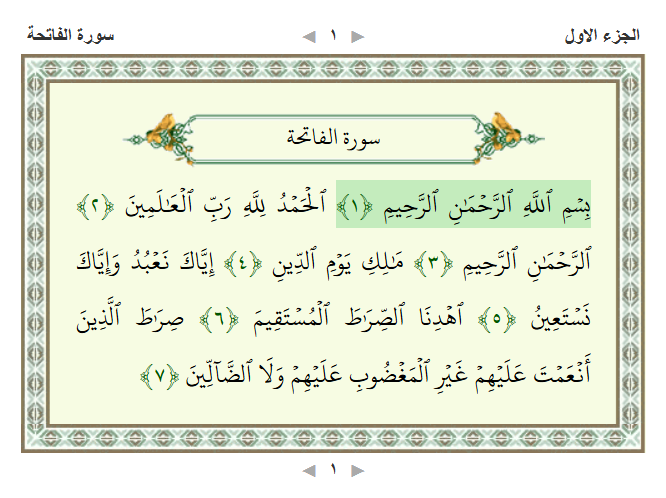
Al-Fatihah (الفاتحة) is the first Surah in the Mushaf, positioned at the very beginning of the Quran. It contains 7 verses, was revealed in Makkah, and holds a rank unlike any other Surah. Allah ﷻ described it in the Quran as “the seven oft-repeated verses” — السَّبْعَ الْمَثَانِيَ.
Why Is Al-Fatihah Placed First?
The placement of Surahs in the Mushaf follows Tawqifi order — meaning it was divinely directed, not a human editorial decision made after the Prophet’s ﷺ death.
The companion Zayd ibn Thabit and the committee assembled under Caliph Uthman (may Allah be pleased with him) arranged the Mushaf according to established narrations from the Prophet ﷺ himself.
Al-Fatihah’s position as the opener is consistent with its function: it is the gate through which every Muslim enters Salah. No prayer is valid without it. The Prophet ﷺ said:
“There is no prayer for the one who does not recite the Opening of the Book.” (Sahih al-Bukhari 756)
What Makes Al-Fatihah Unique Among All Surahs?
Al-Fatihah stands apart in several documented ways:
- It is the only Surah recited in every unit (Rak’ah) of Salah
- It is called Umm al-Kitab (أُمُّ الْكِتَابِ) — the Mother of the Book — because it encapsulates the Quran’s core themes
- It contains a complete dialogue between the servant and Allah ﷻ, as established in a Hadith Qudsi in Sahih Muslim 395
- It functions as both a prayer and a proclamation of tawhid, worship, and supplication
At Riwaq Al Quran, our Azhari-certified tutors introduce Al-Fatihah as the first memorization milestone for every new student — not just because of its brevity, but because mastering its Tajweed and meaning builds the recitation foundation that carries through the entire Quran.
If you want structured guidance from day one, explore our Online Quran Memorization course designed for non-Arabic speakers at every level.
Start your Hifz journey with a Free Trial
What Is the Last Surah in the Quran According to the Mushaf Order?
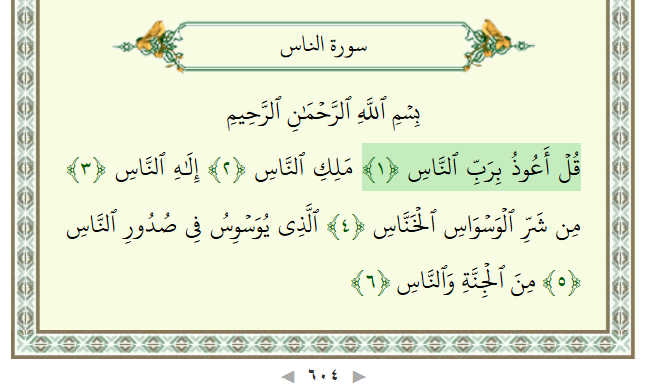
An-Nas (الناس) is the 114th and final Surah in the Mushaf. It consists of 6 verses and belongs to the pair known as Al-Mu’awwidhatayn (المعوذتان) — the two Surahs of seeking refuge — alongside Al-Falaq (Surah 113). Both were revealed together and are inseparable in their protective function.
What Is the Content and Significance of An-Nas?
An-Nas calls upon three of Allah’s attributes — Rabb (Lord), Malik (King), and Ilah (God) of humanity — as the basis for seeking refuge from the whispering of the retreating whisperer, whether from jinn or human beings.
The Surah’s thematic focus on inner, invisible harm mirrors the Quran’s closing message: the greatest threats to the believer are not always external.
Scholars of Tafsir, including Ibn Kathir in his Tafsir al-Quran al-Azim, note that An-Nas and Al-Falaq were among the most beloved recitations of the Prophet ﷺ, particularly for protection before sleep and after prayers.
How Should a Student Approach the Final Surahs in Memorization?
In our experience at Riwaq Al Quran, most students begin their Hifz from Juz’ Amma (the 30th Juz’), which means An-Nas is often the very first Surah memorized. This creates an interesting inversion: the Mushaf’s last Surah becomes the student’s first memorized text.
Understanding the Surah’s meaning from the outset — its three divine names and its protection from whispered doubt — gives students a sense of purpose from their earliest sessions. Meaning anchors memory in ways that rote repetition alone cannot.
Connect with our Azhari tutors to learn and memorize the Quran

What Was the First Quranic Content Revealed to the Prophet ﷺ?
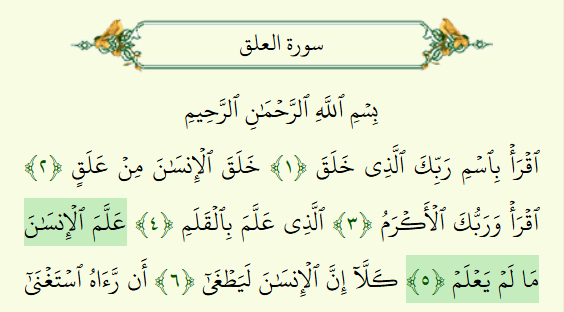
The first revealed passage of the Quran was the opening five verses of Surah Al-Alaq (العلق), Surah 96 in the Mushaf. This is established by authenticated narrations, including the famous account in both Sahih al-Bukhari and Sahih Muslim, in which Sayyidah Aisha (may Allah be pleased with her) described the first revelation in the Cave of Hira.
اقْرَأْ بِاسْمِ رَبِّكَ الَّذِي خَلَقَ
Iqra’ bismi Rabbika alladhi khalaq
“Recite in the name of your Lord who created.” (Al-Alaq 96:1)
An important distinction that many students overlook: while Al-Alaq’s opening verses were the first Quranic passage revealed, they were not revealed as a complete Surah in one descent.
The scholars of Uloom al-Quran — the sciences of the Quran — distinguish between the first revealed passage and the first complete Surah revealed.
What Was the First Complete Surah Revealed?
According to classical scholarship, the first Surah revealed in its entirety was Surah Al-Muddaththir (Surah 74 in the Mushaf). Surah Al-Muddaththir descended as a complete unit after the initial verses of Al-Alaq, at the early onset of the prophetic mission and the call to publicly convey the message.
This distinction matters for students of Tafsir and Uloom al-Quran: when scholars discuss the first revelation, they are precise about whether they mean the first words revealed, the first complete Surah, or the first Surah of a particular category (Makki or Madani). Conflating these leads to confusion that careful study of Tafsir methodology can help resolve.
What Followed Al-Alaq in the Order of Revelation?
The following table outlines the earliest revealed Surahs according to classical Islamic scholarship:
| Revelation Position | Surah Name | Surah Number in Mushaf | Nature of Revelation |
| First passage revealed | Al-Alaq (verses 1–5) | 96 | Partial — first five verses only |
| First complete Surah revealed | Al-Muddaththir | 74 | Full Surah, revealed as one unit |
| Among the earliest | Al-Muzzammil | 73 | Makki |
| Among the earliest | Al-Masad (Al-Lahab) | 111 | Makki |
| Among the earliest | Al-Takwir | 81 | Makki |
Experience Riwaq Al Quran Classes
Watch real moments from our live sessions at Riwaq Al Quran and see how we bring learning to life. These clips highlight our interactive, student-focused approach designed to keep learners engaged, motivated, and actively involved in every step of their educational journey.
What Was the Last Surah Revealed to the Prophet ﷺ?
Surah An-Nasr (Surah 110) is the last Surah revealed to the prophet. However, this is one of the nuanced questions in the science of Uloom al-Quran. The companions of the Prophet ﷺ — who were the primary sources on this matter — held different views, each based on their own knowledge and ijtihad. No direct hadith from the Prophet ﷺ specifies the last Surah revealed, which is precisely why the companions’ positions differ.
Al-Bayhaqi (may Allah have mercy on him) addressed this directly, stating: “Each one answered according to what he knew.” This was quoted by Al-Mubarakfuri in Tuhfat al-Ahwadhi.
The three authenticated companion positions are as follows:
The View of Ibn Abbas: Surah An-Nasr Was the Last Complete Surah Revealed
The strongest authenticated position regarding the last complete Surah is that of Ibn Abbas (may Allah be pleased with him), who stated that Surah An-Nasr (Surah 110) — Idha ja’a nasrullahi wal-fath — was the last Surah revealed in its entirety.
Imam Muslim recorded this in his Sahih (3024), narrated through Ubaydullah ibn Abdillah ibn Utbah, who said: Ibn Abbas asked me, “Do you know the last Surah of the Quran that was revealed as a complete unit?” I replied, “Yes — ‘When the victory of Allah has come and the conquest.'” He said, “You are correct.”
This view is further supported by what is authentically reported from both Umar and Ibn Abbas (may Allah be pleased with them both): that Surah An-Nasr signaled the approaching death of the Prophet ﷺ.
Imam Al-Bukhari recorded in his Sahih (4970) that Ibn Abbas explained the Surah to Umar ibn al-Khattab as Allah informing the Prophet ﷺ of the end of his appointed term —
“That is the sign of your end, so glorify the praise of your Lord and seek His forgiveness.” Umar confirmed: “I know of it nothing except what you have said.”
The View of Al-Bara’ ibn Azib: Surah At-Tawbah Was the Last Surah Revealed
Al-Bara’ ibn Azib (may Allah be pleased with him) held that Surah At-Tawbah (Bara’ah) was the last Surah revealed. Imam Al-Bukhari (4329) and Imam Muslim (1618) both recorded his statement:
“The last Surah revealed was Bara’ah, and the last verse revealed was the verse of Kalalah.”
The View of Aisha: Surah Al-Ma’idah Was the Last Surah Revealed
Sayyidah Aisha (may Allah be pleased with her) stated that Surah Al-Ma’idah was the last Surah revealed.
This is recorded in the Musnad of Imam Ahmad (25588), narrated by Jubayr ibn Nufayr, who reports that Aisha said:
“Al-Ma’idah is the last Surah revealed — so whatever you find in it of halal, treat it as halal, and whatever you find of haram, treat it as haram.” This hadith was authenticated by Shu’ayb al-Arna’ut in his verification of the Musnad.
How Do Scholars Reconcile These Three Positions?
These three positions are not contradictions — they are three different frames of reference, each reflecting what a companion knew at the time:
| Companion | Last Surah (in their view) | Authenticated Source | Likely Frame of Reference |
| Ibn Abbas | An-Nasr (Surah 110) | Sahih Muslim 3024 | Last complete Surah revealed as one unit |
| Al-Bara’ ibn Azib | At-Tawbah (Surah 9) | Sahih al-Bukhari 4329, Sahih Muslim 1618 | Last Surah whose final verses came down |
| Aisha | Al-Ma’idah (Surah 5) | Musnad Ahmad 25588 (authenticated) | Last Surah in terms of its legal finality and completeness of rulings |
Al-Bayhaqi’s conclusion — that each companion answered from their own knowledge — is the position adopted by later scholars of Uloom al-Quran.
There is no authentic text from the Prophet ﷺ directly specifying the last Surah, and therefore each companion spoke from firsthand knowledge of what he or she had witnessed and memorized from the Prophet ﷺ himself.
For students who want to study these scholarly distinctions in depth, our Online Quran Tafseer course covers Uloom al-Quran systematically under Azhari-certified instructors who bring this kind of nuance into every session.
Enroll Now in Riwaq’s Tafseer Course with a FREE trial
How Does the Mushaf Order Differ from the Revelation Order?
The Mushaf order and revelation order represent two distinct organizational frameworks, each with its own wisdom. Understanding this distinction is foundational for any serious student of the Quran.
| Feature | Mushaf Order | Revelation Order |
| First content | Al-Fatihah (Surah 1) | Al-Alaq, verses 1–5 (Surah 96) |
| First complete Surah | Al-Fatihah (Surah 1) | Al-Muddaththir (Surah 74) |
| Last content in Mushaf | An-Nas (Surah 114) | Debated among companions |
| Last complete Surah revealed | — | An-Nasr (view of Ibn Abbas, Sahih Muslim) |
| Basis for arrangement | Tawqifi (divinely directed) | Chronological — Makki then Madani |
| Scholarly source | Established through Sahaba narrations | Documented in Uloom al-Quran sciences |
The Mushaf opens with Al-Fatihah — a prayer of guidance — and closes with An-Nas — a plea for protection.
This structural symmetry reflects the Quran’s nature as a complete guide for the human condition: beginning with direction toward the straight path and ending with protection from what leads one away from it.
Exploring the rules of Tajweed equips you to recite both the first and last Surahs with the precision they deserve. For those committed to mastering recitation from the ground up, our Best Online Tajweed course provides systematic instruction for non-Arabic speakers.
Enroll Now in the Best Online Tajweed Classes
Read Also: Quran Verses to Memorize
Why Students Love Learning with Riwaq Al Quran
Hear directly from our students about how Riwaq Al Quran Academy has transformed their connection with the Book of Allah. Their experiences reflect the dedication, care, and quality that guide every step of our teaching.
Read Also: What Is the Shortest Surah in the Quran?
Start Learning the Quran with Riwaq Al Quran’s Expert Tutors
The Quran’s structure — from its opening Al-Fatihah to its closing An-Nas — carries wisdom that rewards every layer of study.
Riwaq Al Quran connects you with Azhari-certified, Ijazah-holding tutors who have guided thousands of non-Arabic speaking students since 2017.
Our one-on-one Online Quran Memorization course is tailored to your pace, schedule, and goals — with 24/7 availability and plans starting from $32/month.
- ✅ Al-Azhar University-certified instructors
- ✅ Two free trial classes — no commitment required
- ✅ 100% Money-Back Guarantee
- ✅ Personalized sessions for adults and children
Register for your free trial today and begin your Quran study with the guidance it deserves.
We offer courses in Online Quran & Tajweed Classes, Arabic Language, and Islamic Studies.
- Online Quran Memorization Course
- Recitation Course
- Tafseer Course
- Tajweed Classes
- Online Quran Classes for Kids.
- Ijazah Program.
- Qira’at Course.
- Arabic Language Classes.
- Islamic Studies Courses.
Enroll now for 2 Free Trial Classes
Conclusion
The Quran’s first Surah in the Mushaf is a prayer; its last is a plea for protection. The first words revealed commanded reading in Allah’s name; the first complete Surah called a man to rise and warn. The last complete Surah revealed announced a conquest — and quietly signaled the end of prophethood. These bookends are not coincidental; they reflect a divine coherence that rewards every student who looks closely.
Frequently Asked Questions About the First and Last Surahs in the Quran
What Is the First Surah in the Quran?
Al-Fatihah is the first Surah in the Quran according to the Mushaf order. It contains 7 verses, was revealed in Makkah according to the majority of scholars, and is recited in every unit of prayer. Its position at the Quran’s opening was established through Tawqifi — divinely directed arrangement — not human editorial choice.
What Is the Last Surah in the Quran According to the Mushaf?
An-Nas is the 114th and final Surah in the Mushaf. It consists of 6 verses and is one of Al-Mu’awwidhatayn — the pair of protection Surahs alongside Al-Falaq. An-Nas invokes three of Allah’s names — Rabb, Malik, and Ilah of mankind — as the basis for seeking refuge from the whispering of Shaytan and human sources of harm.
Which Surah Was First Revealed in Its Entirety?
The first Surah revealed as a complete unit was Surah Al-Muddaththir (Surah 74). The very first Quranic words revealed were the opening five verses of Surah Al-Alaq — but these came as a partial revelation, not a complete Surah. Al-Muddaththir descended in full thereafter, at the early onset of the prophetic mission.
What Was the Last Complete Surah Revealed Before the Prophet’s ﷺ Death?
According to Ibn Abbas (may Allah be pleased with him), the last complete Surah revealed was Surah An-Nasr (Surah 110). This is recorded in Sahih Muslim (3024). Companions Al-Bara’ ibn Azib and Aisha held different views, reflecting that no direct hadith from the Prophet ﷺ specified this — each companion answered from their own firsthand knowledge.