
Surah Al-Falaq is one of the most recited chapters in the Quran because the Prophet Muhammad ﷺ himself made it a daily practice. In just five verses, Allah ﷻ teaches us a direct supplication for protection from every category of harm visible and hidden.
The benefits of Surah Al-Falaq are rooted in its meaning, its authentic place in Prophetic practice, and the specific evils it addresses verse by verse. Understanding those verses deeply — not just reciting them mechanically — is what transforms this short surah into a living shield.
Table of Contents
1. Surah Al-Falaq Shields You from Four Distinct Categories of Harm
Surah Al-Falaq offers protection across four precise categories: the general evil of all creation, the harm specific to the darkness of night, the evil of those who practice harmful blowing in knots (sihr), and the harm caused by envy. Each verse targets a specific threat, making this surah a structured, complete supplication for comprehensive protection.
The surah opens with the command:
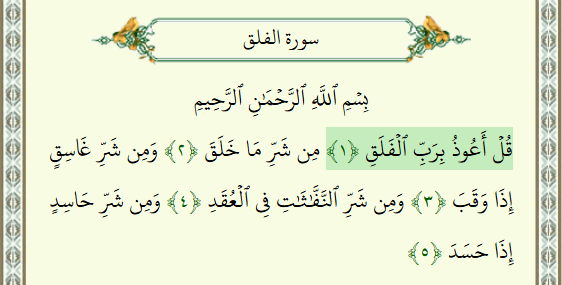
قُلْ أَعُوذُ بِرَبِّ ٱلْفَلَقِ
Qul a’udhu bi Rabbi l-falaq
“Say, ‘I seek refuge in the Lord of daybreak'” (Al-Falaq 113:1)
The word Al-Falaq — the daybreak — refers to Allah’s power to split darkness and bring forth light. Scholars of Tafsir, including Ibn Kathir, explain that seeking refuge with the “Lord of daybreak” establishes Allah’s absolute dominion over all creation before each specific protection is named.
Then the second verse broadens the scope:
مِن شَرِّ مَا خَلَقَ
Min sharri ma khalaq
“From the evil of that which He created” (Al-Falaq 113:2)
This encompasses every created thing — humans, jinn, animals, disease, and natural disaster. It is a universal protection established before the specific ones that follow.


2. Protection From The Harm That Intensifies At Night
This verse specifically addresses the harm that intensifies at night: predatory animals emerge, supernatural harms are more active, and spiritual defenses can be lower.
وَمِن شَرِّ غَاسِقٍ إِذَا وَقَبَ
Wa min sharri ghāsiqin idhā waqab
“And from the evil of darkness when it settles” (Al-Falaq 113:3)
Classical Tafsir scholars explain ghāsiq as the darkness of night, and waqab as its settling and deepening. The singling out of darkness here is not incidental — it reflects a genuine category of increased vulnerability that the surah directly names and addresses.
At Riwaq Al Quran, when students ask why this surah is recommended specifically before sleep, the answer is in this verse itself. The surah’s structure is its own explanation.
Connect with our Azhari tutors to learn Quran with Tafseer

3. Protection From The Harmful Magic
This verse explicitly references harmful sihr (magic), specifically the practice of blowing and tying knots as a form of harmful sorcery.
وَمِن شَرِّ ٱلنَّفَّـٰثَـٰتِ فِى ٱلْعُقَدِ
Wa min sharri n-naffāthāti fi l-‘uqad
“And from the evil of the blowers in knots” (Al-Falaq 113:4)
The Quran naming this in a supplication confirms its reality as a threat. Islamqa.info’s scholars clarify that this verse is one of the clearest Quranic affirmations that sihr exists and that seeking refuge from it is established in Islamic teaching.
The surah does not cause alarm — it gives the believer an authenticated weapon. For students studying Tafsir meaning and methodology, this verse is a masterclass in how the Quran addresses unseen harms through direct, actionable language.
Experience Riwaq Al Quran Classes
Watch real moments from our live sessions at Riwaq Al Quran and see how we bring learning to life. These clips highlight our interactive, student-focused approach designed to keep learners engaged, motivated, and actively involved in every step of their educational journey.
4. Protection From The Envy
Hasad — envy — is singled out in the final verse because of its spiritual potency. Unlike other harms, envy originates from the human heart and can manifest as the evil eye (‘ain).
وَمِن شَرِّ حَاسِدٍ إِذَا حَسَدَ
Wa min sharri ḥāsidin idhā ḥasad
“And from the evil of an envier when he envies” (Al-Falaq 113:5)
The Prophet ﷺ explicitly confirmed that the evil eye is real, and seeking refuge through this surah is among the primary Sunnah-established means of protection from it.
The conditional phrasing — “when he envies” — is significant. It acknowledges that envy only harms when acted upon or intensified. Scholars note this as a mercy: the surah addresses harm at its activation point, not hypothetically.
5. The Prophet ﷺ Made Reciting Surah Al-Falaq a Daily Sunnah Practice
The most important benefit of Surah Al-Falaq is that its recitation is a verified Sunnah. ‘Uqbah ibn ‘Amir reported that the Prophet ﷺ said:
“Do you not see that verses have been revealed to me tonight the like of which has never been seen before? They are Al-Mu’awwidhatain.” (Sahih Muslim 814)
The Prophet ﷺ also instructed reciting Al-Falaq and Al-Nas after every obligatory prayer. This is not general encouragement — it is a specific, structured Sunnah practice linked to daily salah.
| Sunnah Occasion | Source | Surah(s) Recited |
| After every obligatory prayer | Authenticated Hadith | Al-Ikhlas, Al-Falaq, Al-Nas |
| Before sleep (3x) | Sahih al-Bukhari | Al-Ikhlas, Al-Falaq, Al-Nas |
| Morning and evening adhkar | Authenticated Sunnah | Al-Falaq, Al-Nas (3x each) |
| When feeling unwell | Prophetic practice | Al-Mu’awwidhatayn |
Students enrolled in Riwaq Al Quran’s Online Quran Memorization Course are taught Surah Al-Falaq early in their memorization sequence precisely because its recitation is built into the daily prayer routine — making it one of the most-practiced surahs in a Muslim’s life.
Start your Hifz journey with a Free Trial

6. Reciting Surah Al-Falaq Builds a Consistent Daily Protection Routine
One of the most practical benefits of Surah Al-Falaq is how naturally it integrates into the five daily prayers. When a Muslim recites it after Fajr, Dhuhr, Asr, Maghrib, and Isha, they are renewing their supplication for protection fifteen times every single day.
In our experience at Riwaq Al Quran, students who memorize Al-Falaq with proper Tajweed — understanding the pronunciation of every word — report a fundamentally different relationship with the surah.
Reciting ghāsiqin with correct articulation and understanding it means “darkness when it settles” is not the same act as reciting it as a sequence of unfamiliar sounds.
This is why our Online Quran Tafseer Course pairs the meaning of every surah with its recitation — because comprehension deepens protection, not just repetition.
Enroll Now in Riwaq’s Tafseer Course with a FREE trial

7. Surah Al-Falaq Paired with Al-Nas Forms the Complete Prophetic Protection Pair
Al-Falaq and Al-Nas together are called Al-Mu’awwidhatayn — “the two seeking-refuge surahs.” They are never separated in the Prophetic Sunnah. Al-Falaq seeks refuge from external harms: created evil, darkness, sihr, and envy. Al-Nas seeks refuge from internal harm: the whispering of Shaytan into the hearts of humans and jinn.
Together they form a complete protection — outer and inner, seen and unseen. The Prophet ﷺ used to blow them over his hands and wipe his body before sleeping, as recorded in Sahih al-Bukhari 5017. This practice reflects that their recitation is an active, embodied act of worship — not a passive habit.
For deeper understanding of how to properly learn and apply these surahs, our Best Islamic Studies Online Course covers the Tafsir of Al-Mu’awwidhatayn within its Quranic studies curriculum.
What Are The Benefits Of Reciting Surah Al-Falaq 100 Times?
There is no authentic hadith establishing specific merits for reciting Surah Al-Falaq exactly 100 times. Such practices circulate widely but lack a verified Prophetic basis.
The authenticated Sunnah recommends reciting it after each of the five daily prayers and three times before sleep — consistent practice rooted in sound hadith is more valuable than unverified numerical formulas.
What Are The Benefits Of Surah Al-Falaq 1000 Times?
Reciting Surah Al-Falaq 1,000 times as a specific practice has no basis in authentic hadith. Scholars categorize unverified numerical recitation prescriptions as potentially falling under bid’ah (innovation) if presented as Sunnah.
The Islamqa.info scholars consistently advise adhering to the established Prophetic method rather than numerical practices without verified source.
Read Also: Surah Abasa Benefits
What Is The Significance Of Surah Al-Falaq 313 Times?
The practice of reciting Surah Al-Falaq exactly 313 times has no basis in authentic Sunnah sources. The number 313 carries significance in some Islamic contexts (the Battle of Badr), but attaching it specifically to Al-Falaq recitation as a prescription is not established in verified hadith.
Scholars advise against specifying acts of worship without authenticated Prophetic evidence.
Read Also: Surah Zalzalah Benefits
Why Students Love Learning with Riwaq Al Quran
Hear directly from our students about how Riwaq Al Quran Academy has transformed their connection with the Book of Allah. Their experiences reflect the dedication, care, and quality that guide every step of our teaching.
Begin Memorizing Surah Al-Falaq with a Structured Course at Riwaq Al Quran
The benefits of Surah Al-Falaq are only fully accessed when it is recited correctly, understood meaningfully, and practiced consistently as the Prophet ﷺ taught.
Riwaq Al Quran has guided non-Arabic speaking Muslims worldwide since 2017 with Azhari-certified Hafiz tutors available 24/7. Our key offerings:
✅ One-on-one personalized sessions — no group classes
✅ Al-Azhar University graduate instructors
✅ Online Quran Memorization Course with full Tajweed integration
✅ Online Quran Tafseer Course for deep meaning
✅ 2 Free Trial Classes — no commitment required
✅ 100% Money-Back Guarantee
Book your free trial today and recite Surah Al-Falaq the way the Prophet ﷺ recited it.
We offer courses in Online Quran & Tajweed Classes, Arabic Language, and Islamic Studies.
- Online Quran Memorization Course
- Tafseer Course
- Tajweed Classes
- Online Quran Classes for Kids.
- Ijazah Program.
- Arabic Language Classes.
- Islamic Studies Courses.
Enroll now for 2 Free Trial Classes and Begin Learning Islam and Quran Today

Read Also: Surah Al-Masad Benefits
Frequently Asked Questions About the Benefits of Surah Al-Falaq
What is the importance of Surah Al-Falaq in daily life?
Surah Al-Falaq holds daily importance because the Prophet ﷺ made its recitation part of structured daily practice: after every obligatory prayer, before sleep, and in morning and evening adhkar. It provides protection from four specific categories of harm, is part of Al-Mu’awwidhatayn, and its five verses represent one of the Quran’s most direct supplications to Allah ﷻ for refuge.
Does understanding Surah Al-Falaq’s meaning increase its benefit?
Yes — reciting any surah with understanding deepens the worshipper’s connection, focus (khushu’), and sincerity. When a Muslim understands that ghāsiqin idhā waqab means “darkness when it settles,” the supplication becomes conscious and intentional. Studying Tafsir through an Online Quran Tafseer Course transforms mechanical recitation into meaningful worship.