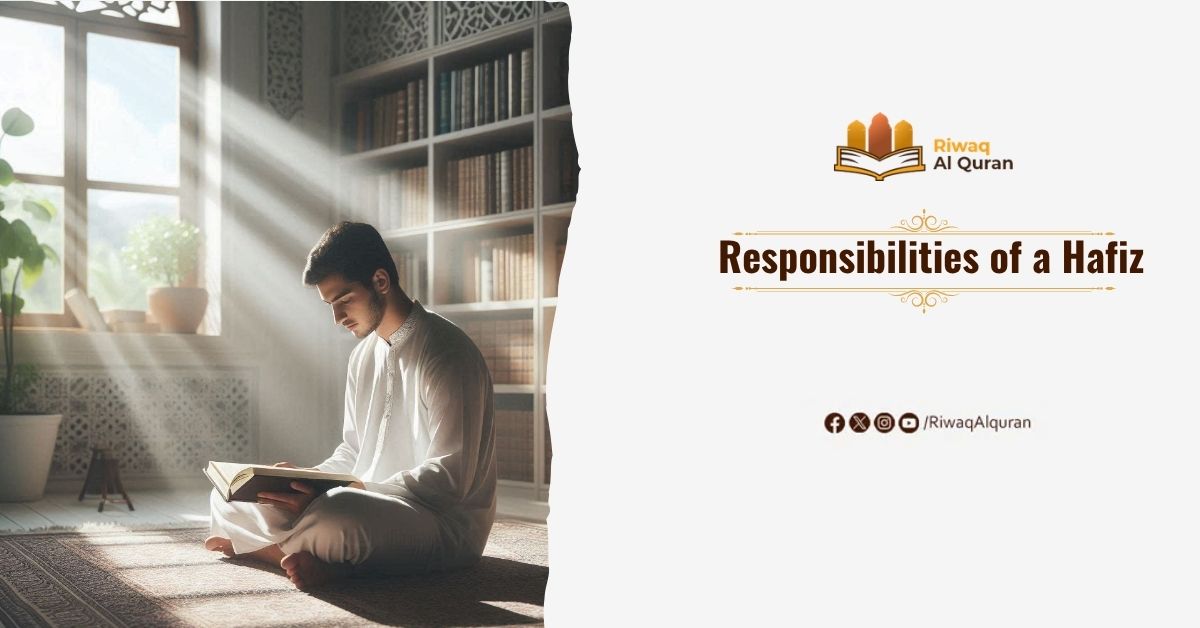
Memorizing the Quran is not merely an academic achievement; it is a lifelong covenant that shapes both the mind and heart. A Hafiz carries the sacred responsibility of preserving the divine words with precision, discipline, and spiritual devotion, ensuring the Quran remains vibrant in memory and practice.
Daily revision, mastery of Tajweed, and spiritual reflection form the core of a Hafiz’s duties. From maintaining phonetic accuracy to bridging technical recitation with heartfelt Tadabbur, each responsibility safeguards the sanctity of the Mushaf while nurturing a character aligned with the ethical and spiritual essence of the Quran.
Table of Contents
1- Daily Revision is the primary responsibility of a Hafiz
Every Hafiz is a guardian of the divine verses they have committed to memory, requiring constant attention to prevent loss. Failing to review daily leads to a gradual decline in phonetic clarity and mental stability within your long-term memory.
You must establish a fixed daily portion of recitation to ensure the words of Allah SWT remain vibrant. We advise using the Visual Anchoring method during your daily revision sessions to avoid the confusion of similar endings.
Before reciting from memory, look at the page for two minutes to stabilize your mental Mushaf image. This technique prevents the common issue of mixing up verses, which often occurs when a guardian relies solely on auditory recall.
Maintaining this rhythm over thousands of verses requires high levels of discipline and external accountability from a qualified teacher. Many students find that our tutors help them stay on track when motivation naturally dips in the middle of a Surah.
Maintaining this professional consistency is one of the most vital responsibilities of a Hafiz, and Riwaq Al Quran’s Online Quran Memorization Course offers the structured oversight needed to keep your recitation flawless.
Enroll now to stabilize your Hifz with a personalized revision plan.
2- Protecting the heart from spiritual abandonment
A Hafiz must never allow their relationship with the Mushaf to grow cold, mechanical, or purely academic in nature. Abandonment occurs when the heart stops reflecting on the meanings while the tongue recites robotically without any presence. One of the ongoing duties is to bridge the gap between technical recall and deep spiritual contemplation known as Tadabbur.
The Quran was not revealed merely for rhythmic chanting, but as a source of profound guidance that requires the heart to pause and analyze every message. Allah SWT explicitly defines the purpose of the revelation in the following verse:
كِتَابٌ أَنزَلْنَاهُ إِلَيْكَ مُبَارَكٌ لِّيَدَّبَّرُوا آيَاتِهِ وَلِيَتَذَكَّرَ أُولُو الْأَلْبَابِ {29}
Kitabun anzalnahu ilayka mubarakun liyaddabbaroo ayatihi waliyatathakkara oloo al-albab {29}
“[This is] a blessed Book which We have revealed to you, [O Muhammad], that they might reflect upon its verses and that those of understanding would be reminded. {29}”
To implement this, you should actively engage with the text; pause at verses describing Allah’s mercy to ask for His grace, and seek refuge when passing verses of punishment. This mental engagement prevents the brain from entering an “auto-pilot” mode, which is the leading cause of forgetting long-term Hifz.
If you find yourself struggling with “robotic” recitation and want to move beyond just memorizing letters to understanding the divine wisdom, Riwaq Al Quran’s Online Quran Memorization Course integrates meaning with memory to keep your heart connected.
Experience Riwaq Al Quran Classes
Watch real moments from our live sessions at Riwaq Al Quran and see how we bring learning to life. These clips highlight our interactive, student-focused approach designed to keep learners engaged, motivated, and actively involved in every step of their educational journey.
3- Mastering Tajweed
The obligation of Tajweed does not end once the last Ayah is memorized and tested by a teacher. A Hafiz must constantly refine the exit points of every letter to avoid hidden phonetic mistakes that change meanings.
Maintaining the purity of the Arabic phonetics is a heavy trust passed down through generations from Prophet Muhammad PBUH.
If you struggle with the heaviness of letters like Dhaad or Ghayn, Riwaq Al Quran’s Best Online Tajweed Classes offer real-time phonetic corrections.
Our tutors ensure you do not allow lazy tongue habits to compromise the technical integrity of your recitation. Correcting these subtle shifts is one of the most critical responsibilities of a Hafiz for preserving the Mushaf.
Monitor the position of the back of the tongue during the letter Dhaad to produce the correct elongated sound. It must touch the upper molars without turning into a simple Daal sound, which is a common mistake for non-Arabs.
Professional oversight is the only way to confirm you are meeting these technical responsibilities of a Hafiz with precision.
Enroll in our Tajweed classes to refine your articulation with Azhari experts.
4- Leading congregational Salah
A Hafiz is often called upon to lead the community in prayer, especially during the nights of Ramadan. This role requires the highest level of mental stability and the ability to recover from mistakes under pressure.
One of the public duties is to prepare so thoroughly that your Salah remains a source of tranquility for others..Recite your designated portion in Sunnah prayers before leading the obligatory prayer to test your memory stability.
This testing phase allows you to identify weak spots where your tongue might trip over complex linguistic connections.
Building this confidence is essential for fulfilling the leadership role that comes with carrying the words of Allah SWT.
During loud recitation, focus on the Idgham rules to ensure a smooth transition between words without sudden breaks. If you find your breath control failing during long verses, our tutors can provide specific breathing techniques used by masters.
Mastering your breath ensures your leadership in Salah remains technically polished and spiritually moving for the entire congregation.
5- Embodying the ethics and etiquettes of the Quran
You are now a walking representative of the Mushaf, and your actions must align with the commands of Allah SWT. Honesty, patience, and humility should be the hallmarks of anyone who carries the divine words.
To understand the depth of this responsibility, we look at the example of Prophet Muhammad PBUH, who did not just recite the verses but embodied them in every interaction. When ‘Aishah (RA) was asked about his character, she provided a description that serves as the ultimate benchmark for every guardian of the Quran:
“كَانَ خُلُقُهُ الْقُرْآنَ”
“His character was the Quran.”
Maintaining this humble presence and ethical conduct is a core spiritual duty that prevents the pitfall of arrogance. If you find it challenging to bridge the gap between memorization and practical application in your daily life, our Online Islamic Studies Classes provide the necessary guidance to help you understand how these verses apply to your modern context.
Join our Islamic Studies course today and learn to embody the Quran as you recite.

6- Mastering Mutashabihat
As you carry more portions of the Quran, you will encounter many verses that are nearly identical in structure. A significant part of your duty is to study these subtle differences to avoid “jumping” from one Surah to another.
This requires a deep analytical understanding of the unique word choices found in each chapter.
Create mental anchors for these similar verses by linking a unique word in an Ayah to the name of the Surah. For example, if one Surah uses “Inna” and another uses “Wa Inna,” memorize the specific location of each carefully.
This level of technical detail prevents confusion during high-pressure situations like leading congregational night prayers.
Pay attention to the vowel shifts in these similar verses, as a single Fatha or Damma can change the legal meaning.
Our Azhari Tutors specialize in helping students navigate these complex overlaps through advanced memory techniques. Mastering these connections is a hallmark of a proficient Hafiz who has fulfilled their duty to the Mushaf.
7- Teaching the Quran to others
Prophet Muhammad PBUH stated that the best among Muslims are those who learn the Quran and teach it. One of the long-term responsibilities of a Hafiz is to pass this knowledge to the next generation of seekers.
By teaching, you not only earn perpetual reward but also strengthen your own Hifz through constant repetition.
“خَيْرُكُمْ مَنْ تَعَلَّمَ الْقُرْآنَ وَعَلَّمَهُ”
“The best of you is he who learns the Quran and teaches it.”
Sahih al-Bukhari: 5027
When teaching, focus on the correct articulation of the Mad lengths with your students to ensure they learn correctly.
Beginners often struggle to maintain a consistent four-count duration for Mad Muttasil, and correcting them reinforces your own mastery. This cycle of learning and teaching is the backbone of the preservation of the words of Allah SWT.
Teaching also requires immense patience and empathy, reflecting the character of the Prophet Muhammad PBUH. If you are a parent, starting your children with our Online Quran Classes for Kids is a great way to begin. This ensures they receive professional instruction while you fulfill your noble duty to guide your family.
Enroll your child today and get a free assessment with our Azhari tutors.

Read Also: Countries & Statistics Related to Hafiz
8- Guarding the physical sanctity of the Mushaf
A Hafiz must maintain the highest level of respect for the physical copies of the words of Allah SWT.
This includes ensuring you are in a state of Wudu when touching the Mushaf and placing it in an honorable position. Respecting the physical vessel of the Quran is an extension of the respect you hold for the verses.
Avoid placing other books on top of the Quran and handle it with care to prevent any damage to the pages.
This outward discipline reflects the inward state of a Hafiz who recognizes the majesty of the speech they carry. Such etiquette is a vital part of the duties that should never be neglected by a guardian.
When studying from the Mushaf, ensure your eyes follow every Harakat and Sukun to reinforce your visual memory.
This careful reading prevents the tongue from slipping during oral recitation when you are leading others. The relationship between the eyes, the tongue, and the heart is what creates a truly stable and spiritually resonant Hifz.
Read Also: Easy Quran Verses to Memorize
9- Strengthening retention through nocturnal night prayers
Reciting the Quran during the night prayer is one of the most effective ways to stabilize your memorization.
One of the spiritual responsibilities of a Hafiz is to dedicate time when others are sleeping to converse with Allah SWT.
The quietude of the night allows for deeper concentration and a stronger emotional bond with the verses.
Prophet Muhammad PBUH and his companions were known for their lengthy night prayers filled with the beauty of the Quran.
Using your memorized portions in Qiyam prevents the verses from becoming “rusty” and keeps them fresh in your mind. This practice is a secret to the long-term success of the greatest Hufadh.
Focus on the Sifaat of Jahr and Hams as you recite in the silence of the night to refine your Tilawah. The contrast between these attributes becomes more apparent when the world is quiet, helping you catch subtle mistakes. Sustaining this nocturnal connection is a hallmark of a Hafiz who truly loves the speech of Allah SWT.
Read Also: Quran Memorization Online Free
Why Students Love Learning with Riwaq Al Quran
Hear directly from our students about how Riwaq Al Quran Academy has transformed their connection with the Book of Allah. Their experiences reflect the dedication, care, and quality that guide every step of our teaching.
Secure Your Quranic Trust with Specialized Azhari Mentorship
Honoring the responsibilities of a Hafiz is a mission that demands a structured environment. At Riwaq Al Quran Academy, we provide a dedicated platform to stabilize your Hifz through direct interaction with certified Azhari Tutors.
We offer Flexible Schedules, precise progress tracking, and a 100% Money-Back Guarantee to ensure your success. In addition to Hifz, we offer Online Quran Classes for Kids, Arabic Courses, and Islamic Studies to strengthen the entire family’s bond with the Mushaf..
Our Courses Include:
- Online Quran Memorization Course
- Tajweed Classes
- Online Quran Classes for Kids.
- Ijazah Program.
- Arabic Language Classes.
- Islamic Studies Courses.
Book your 2 Free Trial Classes today

Conclusion
The responsibilities of a Hafiz extends beyond memorization, encompassing ethical conduct, spiritual mindfulness, and the technical mastery of recitation. Every verse committed to memory demands careful review, consistent Tajweed practice, and attentive engagement with its meanings.
Teaching others, leading congregational prayers, and guarding the physical Mushaf further reinforce the Hafiz’s commitment to the Quran. These duties cultivate patience, humility, and responsibility, reflecting the divine trust carried by every guardian of Allah’s words.
Ultimately, the essence of Hifz lies in implementing Quranic guidance in daily life. From ethical behavior to mindful reflection, a Hafiz embodies the Quran, ensuring that memorization translates into living the wisdom and commands entrusted by Allah SWT.