| Key Takeaways |
| Quranic Arabic is a classical dialect distinct from Modern Standard Arabic, built on approximately 1,750 root words. |
| Learning Quranic Arabic begins with mastering Arabic script and short vowel markers (harakat) before tackling vocabulary. |
| A structured daily practice of 20–30 minutes consistently outperforms irregular long sessions for language retention. |
| Understanding 300 high-frequency Quranic words covers roughly 70% of the Quran’s total word occurrences. |
Most Muslims recite the Quran daily without understanding a single word — and that gap is more bridgeable than most people think. Quranic Arabic is a structured, learnable classical language, not an impenetrable ancient code.
With the right method, non-Arabic speakers can begin understanding Quranic vocabulary within weeks of consistent study.
The steps below reflect how we approach this at Riwaq Al Quran after years of teaching adult beginners from English, French, and Urdu-speaking backgrounds. This guide will move you from zero familiarity to genuine Quranic comprehension — one grounded step at a time.
Table of Contents
What Is Quranic Arabic and Why Does It Matter?
Quranic Arabic is the classical form of the Arabic language in which the Quran was revealed, characterized by precise grammatical structure, rich vocabulary, and rhetorical depth unmatched in any other Arabic text.
It differs meaningfully from Modern Standard Arabic (MSA) and spoken dialects in vocabulary, verb forms, and stylistic conventions.
The Quran uses approximately 1,750 distinct root words across its 6,236 verses. Many roots recur dozens — sometimes hundreds — of times in slightly different grammatical forms.
This structural consistency makes Quranic Arabic genuinely learnable, especially compared to modern languages with larger unpredictable vocabularies.
Allah ﷻ describes the Quran as a book revealed in clear Arabic so that people may reflect:
إِنَّآ أَنزَلْنَٰهُ قُرْءَٰنًا عَرَبِيًّا لَّعَلَّكُمْ تَعْقِلُونَ
Innā anzalnāhu Qur’ānan ‘arabiyyan la’allakum ta’qilūn
“Indeed, We have sent it down as an Arabic Qur’an that you might understand.” (Yusuf 12:2)
Comprehension transforms recitation from phonetic performance into active, conscious worship. That shift is precisely what structured Quranic Arabic study makes possible.
What is the Importance of Learning Quranic Arabic?
Quranic Arabic is important because it grants direct, unmediated access to Allah’s ﷻ words as revealed — without reliance on translation interpretations that inevitably lose nuance.
Understanding the language of the Quran deepens prayer, strengthens memorization retention, and enriches Tafsir study.
For serious students of Islam, it is the foundational scholarly skill that unlocks every other Islamic science.
1. Master Arabic Script and Harakat Before Learning Quranic Vocabulary
The single most important first step in learning Quranic Arabic is reading fluency in Arabic script — including all short vowel markers (harakat) such as fathah, kasrah, dammah, sukoon, and shaddah. No vocabulary or grammar study will hold without this foundation.
In our experience at Riwaq Al Quran, students who skip script mastery and jump directly to vocabulary lists hit a wall within two to three weeks. They can memorize word meanings but cannot decode new words they encounter in the Quran independently.
What to Cover in the Script Foundation Stage
- Individual letter recognition — all 28 letters in isolated, initial, medial, and final forms
- Harakat — short vowels that determine pronunciation and grammatical function
- Madd letters — long vowels (alif, waw, ya) and their effect on syllable length
- Shaddah — the doubling marker, which changes both pronunciation and meaning
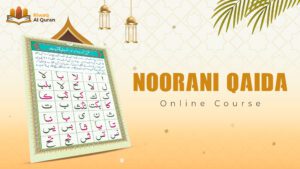
The Noorani Qaida Online Course at Riwaq Al Quran is specifically designed to build this foundation for adult beginners, using a structured phonics-based progression that native Arabic speakers learn as children — adapted for non-Arabic speaking adults.
Most adult learners complete solid script recognition within four to six weeks of daily 20-minute practice. Do not rush this stage. Every later step depends on it.
Enroll Now in Riwaq’s Noorani Qaida Online Course with a FREE trial
Experience Riwaq Al Quran Classes
Watch real moments from our live sessions at Riwaq Al Quran and see how we bring learning to life. These clips highlight our interactive, student-focused approach designed to keep learners engaged, motivated, and actively involved in every step of their educational journey.
2. Build a Core Quranic Vocabulary of High-Frequency Words
Once you read Arabic script fluently, systematic vocabulary building is your highest-leverage activity. Quranic Arabic has a finite, learnable vocabulary — and a small portion of it appears with extreme frequency.
Research in Quranic linguistics consistently shows that the 300 most common words in the Quran account for roughly 70% of all word occurrences in the text. Learning those 300 words first — before grammar, before morphology — gives you immediate partial comprehension of hundreds of verses.
Most Common Quranic Arabic Words by Category
| Category | Examples | Approximate Frequency |
| Divine names & pronouns | Allah, Huwa, Rabbuka | Hundreds of occurrences |
| Connectives & particles | Wa (and), Fa (then), Inna (indeed) | Thousands of occurrences |
| Verbs of command | Qul (say), Aqimu (establish), Ittaqū (fear) | Hundreds of occurrences |
| Nouns of worship | Salah, Zakat, Iman, Taqwa | Hundreds of occurrences |
| Time and place words | Yawm (day), Ard (earth), Sama’ (sky) | Hundreds of occurrences |
Start with connectives and particles — these are the grammatical glue of Quranic sentences.
Understanding that wa means “and,” fa means “then/so,” inna means “indeed,” and lā means “no/not” immediately unlocks sentence-level parsing even before formal grammar study.
List of Most Common Quranic Arabic Vocabulary
The following table presents a foundational selection of the most frequently occurring Quranic words. Memorizing these systematically is the fastest path to word-by-word understanding.
| Arabic Word | Transliteration | Meaning |
| اللَّهُ | Allāh | Allah |
| قَالَ | Qāla | He said |
| رَبّ | Rabb | Lord |
| إِنَّ | Inna | Indeed / Verily |
| الَّذِي | Alladhī | Who / That (masc.) |
| مَا | Mā | What / Not |
| كَانَ | Kāna | He was / It was |
| عَلَى | ‘Alā | Upon / On |
| مِن | Min | From / Of |
| فِي | Fī | In / Within |
| لَا | Lā | No / Not |
| وَ | Wa | And |
| هُوَ | Huwa | He / It |
| أَنَّ | Anna | That / Indeed |
| إِلَى | Ilā | To / Toward |
| كُلّ | Kull | Every / All |
| يَوْم | Yawm | Day |
| رَسُول | Rasūl | Messenger |
| آمَنَ | Āmana | He believed |
| عَمِلَ | ‘Amila | He did / worked |
| قَوْم | Qawm | People / Nation |
| أَرْض | Arḍ | Earth / Land |
| سَمَاء | Samā’ | Sky / Heaven |
| عَلِمَ | ‘Alima | He knew |
| كِتَاب | Kitāb | Book |
| حَقّ | Ḥaqq | Truth / Right |
| نَفْس | Nafs | Soul / Self |
| أَهْل | Ahl | People of / Family |
| شَاءَ | Shā’a | He willed |
| أُولَٰئِك | Ulā’ika | Those |
| مُؤْمِن | Mu’min | Believer |
| لَو | Law | If (hypothetical) |
| عِند | ‘Inda | At / With / Near |
| خَلَقَ | Khalaqa | He created |
| أَنزَلَ | Anzala | He sent down |
| خَيْر | Khayr | Good / Better |
| كَذَّبَ | Kadhdhaba | He denied / rejected |
| سَبِيل | Sabīl | Path / Way |
| دَعَا | Da’ā | He called / invited |
| أَمْر | Amr | Matter / Command |
| اتَّقَى | Ittaqā | He feared Allah / was pious |
| عَلِيم | ‘Alīm | All-Knowing |
| أَلْقَى | Alqā | He cast / threw |
| وَعَدَ | Wa’ada | He promised |
| أَنْفَقَ | Anfaqa | He spent (in Allah’s cause) |
| غَفَرَ | Ghafara | He forgave |
| أَحَبَّ | Aḥabba | He loved |
| أَصَابَ | Aṣāba | He struck / afflicted |
| أَضَلَّ | Aḍalla | He led astray |
| تَابَ | Tāba | He repented |
| كَسَبَ | Kasaba | He earned / acquired |
| نَزَّلَ | Nazzala | He sent down (gradually) |
| تَلَا | Talā | He recited |
| رَزَقَ | Razaqa | He provided sustenance |
| قَضَى | Qaḍā | He decreed / judged |
| نَصَرَ | Naṣara | He helped / aided |
3. Learn Arabic Root-Based Morphology to Multiply Your Vocabulary
Arabic is a root-based language, meaning most words derive from three-letter (sometimes four-letter) roots that carry a core meaning. Once you understand this system — called sarf (morphology) in classical Arabic grammar — every new root you learn generates five to fifteen related words simultaneously.
For example, the root ك-ت-ب (K-T-B) carries the core meaning of writing. From it derive: kataba (he wrote), kitāb (book), kātib (writer), maktaba (library), maktūb (written/letter). Learning one root effectively teaches you an entire word family.
This is why Quranic Arabic is more learnable than it first appears. Many adult students at Riwaq Al Quran who approach it expecting to memorize thousands of unrelated words are genuinely surprised when they discover how the root system compresses vocabulary learning dramatically.
High-Priority Roots to Learn First
| Root | Core Meaning | Quranic Examples |
| ع-ل-م | Knowledge | ‘Alima, ‘Ilm, ‘Ālim, Allahu A’lam |
| ر-ح-م | Mercy | Rahman, Raheem, Rahma |
| ع-م-ل | Action/Deed | ‘Amila, ‘Amal, ‘Āmilūn |
| ق-و-ل | Speech | Qāla, Qawl, Qul |
| ه-د-ي | Guidance | Hadā, Hudā, Muhtadīn |
Spending two to three weeks on root-based morphology before advancing to grammar will dramatically accelerate your overall learning pace. This is one of the core sequencing decisions the Quranic Arabic Course at Riwaq Al Quran is built around.
Book Your FREE Trial in Riwaq’s Quranic Arabic Classes
4. Study Core Quranic Grammar (Nahw) Systematically
Arabic grammar — nahw — governs how words function within sentences. In Quranic Arabic, grammatical case endings (i’rab) are particularly important because they directly affect meaning.
The same word with a different ending can shift from subject to object, completely altering a sentence’s meaning.
You do not need to master all of Arabic grammar to read the Quran with understanding. The foundational grammatical concepts that unlock the majority of Quranic sentences include:
- Nominal sentences (jumlah ismiyyah) — subject and predicate structure
- Verbal sentences (jumlah fi’liyyah) — verb-subject-object order
- Definite and indefinite nouns — the role of al- (the definite article)
- Verb forms and tenses — past, present/future, and imperative
- Prepositions — fī (in), min (from), ilā (to), ‘alā (upon)
At Riwaq Al Quran, our Azhari tutors teach grammar in direct application to Quranic verses rather than in abstract exercises. Students who learn the fā’il (subject) and maf’ul (object) relationship using actual Quranic examples retain the concept far more reliably than those working through textbook drills.
Connect with our Azhari tutors to learn and memorize the Quran

5. Practice Directly with Quranic Verses Using Interlinear Texts
The most effective vocabulary and grammar reinforcement method is not flashcards or workbooks — it is direct, guided engagement with Quranic text.
Use an interlinear Quran (word-by-word translation with grammatical notation) to read verses you already know by sound, now dissecting them word by word.
Start with the surahs you have memorized. Surah Al-Fatiha alone contains fundamental grammatical structures: nominal sentences, prepositional phrases, verb-object relationships, and divine attribute nouns.
One surah, analyzed carefully, teaches more applied grammar than hours of abstract study.
This approach reinforces the connection between Tajweed recitation and comprehension — a connection that deepens your relationship with the Quran on both an acoustic and intellectual level.

6. Supplement Grammar Study with Tafsir to Contextualise Understanding
Vocabulary and grammar give you the tools to decode Quranic Arabic mechanically. Tafsir — classical Quranic exegesis — gives those decoded words their full theological, historical, and spiritual weight. The two disciplines work together, not in isolation.
When you understand that the word taqwa (often translated as “fear of God”) carries layers of meaning — protective awareness, God-consciousness, and moral carefulness — your grammatical reading of any verse containing it becomes richer and more meaningful.
Riwaq Al Quran’s Online Quran Tafseer Course integrates classical exegetical sources with accessible modern explanation, taught by Azhari-certified instructors who connect Tafsir insights directly to language learning.
Enroll Now in Riwaq’s Tafseer Course with a FREE trial

Students consistently report that Tafsir study dramatically accelerates their Arabic vocabulary retention because meanings become anchored in context, not isolated definitions.
You can also explore the meaning and methodology of Tafsir to understand how classical scholars approached the Quran’s interpretation before beginning formal study.
7. Maintain Consistent Daily Practice with Measurable Milestones
Language acquisition requires consistency above all else. A 20-minute daily session produces better long-term retention than a 3-hour session once per week.
The brain consolidates language during sleep and rest — meaning frequent, shorter exposures outperform irregular intensive ones.
A realistic weekly structure for working adults looks like this:
| Day | Activity | Time |
| Saturday | New vocabulary (10 words) + root analysis | 25 min |
| Sunday | Grammar concept study + verse application | 25 min |
| Monday | Vocabulary review + interlinear reading | 20 min |
| Tuesday | New vocabulary (10 words) + sentence parsing | 25 min |
| Wednesday | Revision of previous vocabulary + Tafsir reading | 20 min |
| Thursday | Full verse analysis + grammar review | 25 min |
| Friday | Light review only — consolidate the week | 15 min |
At this pace — roughly 30 new words per week — a dedicated learner reaches the 300 high-frequency word target within ten to twelve weeks.
That milestone represents a genuine turning point: verses that once sounded entirely foreign begin to yield partial meaning on first hearing.
Why Students Love Learning with Riwaq Al Quran
Hear directly from our students about how Riwaq Al Quran Academy has transformed their connection with the Book of Allah. Their experiences reflect the dedication, care, and quality that guide every step of our teaching.
Start Your Quranic Arabic Study with Riwaq Al Quran
Learning Quranic Arabic is one of the most transformative decisions a Muslim can make for their relationship with the Quran. You have the steps — what you need now is the right guidance.
At Riwaq Al Quran, our Azhari-certified instructors have helped thousands of non-Arabic speaking Muslims build genuine Quranic comprehension since 2017. We offer:
- One-on-one personalized sessions tailored to your pace
- 24/7 scheduling for learners across all time zones
- Affordable plans starting from $32/month
- 2 Free Trial Classes — no commitment required
- 100% Money-Back Guarantee
Explore our Quranic Arabic Course, Online Quran Tafseer Course, and Best Islamic Studies Online Course — and book your free trial today.
We offer courses in Online Quran & Tajweed Classes, Arabic Language, and Islamic Studies.
- Online Quran Memorization Course
- Tafseer Course
- Tajweed Classes
- Online Quran Classes for Kids.
- Ijazah Program.
- Qirat Course.
- Arabic Language Classes.
- Islamic Studies Courses.
Enroll now for 2 Free Trial Classes
Conclusion
Quranic Arabic is not beyond reach for a dedicated non-Arabic speaking Muslim. With the right sequence — script mastery, high-frequency vocabulary, root-based morphology, applied grammar, and Tafsir — genuine comprehension becomes a realistic, measurable goal rather than a distant aspiration.
The Prophet ﷺ said: “
The best among you are those who learn the Quran and teach it.” (Sahih al-Bukhari 5027)
Understanding the language of the Quran deepens both learning and teaching. Start structured, stay consistent, and seek qualified guidance — Insha’Allah, the words of Allah ﷻ will open before you with meaning you never imagined possible.
Frequently Asked Questions About Learning Quranic Arabic
What is the difference between Quranic Arabic and Modern Standard Arabic?
Quranic Arabic is a classical dialect revealed over 1,400 years ago, with distinct grammatical structures, vocabulary, and rhetorical conventions. Modern Standard Arabic (MSA) is the contemporary formal register used in media and education. While the two share the same script and many roots, Quranic Arabic has unique verb forms, particles, and stylistic features that MSA does not replicate.
Is It Possible to Learn Quranic Arabic as a Non-Native Speaker?
Absolutely — and thousands of non-Arabic speaking Muslims have proven it. Quranic Arabic is structured around approximately 1,750 root words, making its vocabulary finite and learnable. At Riwaq Al Quran, our Azhari-certified instructors have guided adult beginners from English, French, and Urdu-speaking backgrounds to genuine Quranic reading comprehension through structured, sequenced instruction delivered one-on-one.
Is it possible to learn Quranic Arabic without prior Arabic knowledge?
Yes — Quranic Arabic is learnable from zero. Most students at Riwaq Al Quran begin with no prior Arabic background. The key is structured sequencing: script first, then vocabulary, then grammar. Attempting grammar without script fluency or vocabulary without root understanding are the most common reasons self-study attempts stall.
How long does it take to learn Quranic Arabic?
Reaching basic comprehension of common Quranic verses typically takes six to twelve months of consistent daily practice. Deeper grammatical reading fluency requires eighteen to twenty-four months. These are realistic instructional estimates based on our experience with non-Arabic speaking adult learners — individual pace varies based on prior language learning experience and daily study consistency.
If I learn Arabic, will I fully understand the Quran?
Arabic language proficiency gives you the linguistic tools to decode Quranic text — but full understanding requires Tafsir study alongside language learning. Classical exegesis clarifies the historical context, scholarly interpretations, and theological implications that vocabulary and grammar alone cannot supply. Language and Tafsir together produce genuine Quranic comprehension.
Where can I learn Quranic Arabic for free?
Several resources offer free introductory Quranic Arabic content, including various YouTube channels covering basic vocabulary and grammar. However, free resources typically lack the structured progression, personalized correction, and accountability that accelerate real progress. Riwaq Al Quran offers 2 free trial classes so you can experience structured, tutor-led instruction before committing to a plan.