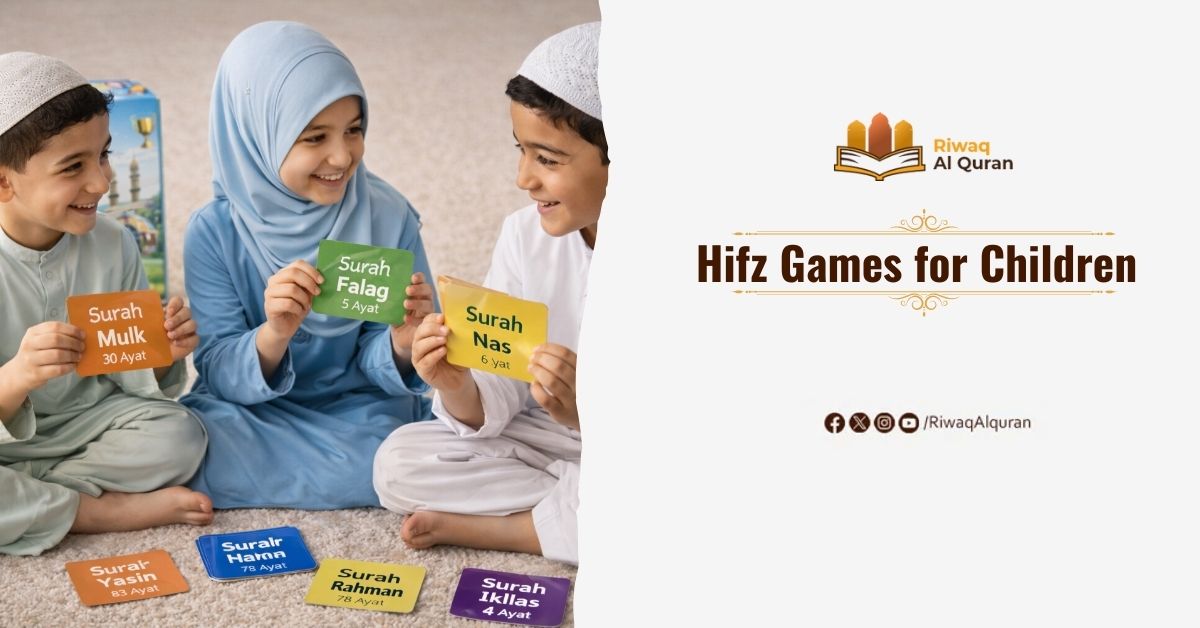
For many children, memorizing the Quran begins with excitement, then slowly meets resistance when repetition feels heavy. Parents often sense this shift early—when eagerness turns into avoidance.
Preserving reverence for the Quran while nurturing joy becomes a delicate balance that requires thoughtful, child-centered approaches.
Young minds thrive on interaction, curiosity, and emotional connection. When learning feels participatory rather than performative, children stay engaged longer and absorb more deeply.
Effective Hifz for children blends active recall, listening skills, visual reinforcement, understanding of meaning, and gradual Tajweed awareness through structured yet playful activities. From auditory games and role reversal to puzzles, technology, and visual associations, these methods transform memorization into a meaningful, lasting spiritual habit.
Table of Contents
1. The “Fill the Void” Hifz Game for Kids
This Hifz game for kids is an excellent auditory activity that tests a child’s focus and memory recall without them realizing they are being tested.
You recite a Surah your child is memorizing but intentionally stop at specific words, signaling them to fill in the blank immediately.
Psychologically, this triggers “active recall.” It helps children overcome the common hesitation they feel when transitioning between verses.
This game of Hifz games for children turns the recitation into a collaborative effort rather than a solo performance.
Example using Surah Al-Ikhlas:
- Parent: Qul huwal laahu… (Pause)
- Child: …Ahad!
- Parent: Allahus… (Pause)
- Child: …Samad!
“قُلْ هُوَ اللَّهُ أَحَدٌ”
Qul huwal laahu ahad.
[Say, “He is Allah, [who is] One.”] (Surah Al-Ikhlas: 1)
While these home activities build excitement, they are most effective when paired with structured guidance. Riwaq Al Quran’s Online Quran Classes for Kids provide the expert foundation and consistent correction needed to ensure these fun methods lead to solid, permanent memorization.
Get Your Kid a Free Trial Quran Class Now
2. Flashcard Matching as a Visual Hifz Activity for Kids
For visual learners, creating simple flashcards can transform abstract verses into tangible memories.
Write the first half of an Ayah on one card and the second half on another, or match the Arabic verse with its English translation. The goal is for the child to pair them correctly on a table.
This game of Hifz games for children requires a child to recognize Arabic script effectively. If your child struggles with reading the letters, a strong start begins with our Noorani Qaida Online Course with Native Arabic Tutors. This course ensures they master proper pronunciation (Makharij) from day one, making visual games much easier.
Book the Free Trial Arabic Session for Your Child Today

3. The “Recitation Relay” Group Memorization Game for Kids
This activity works wonderfully if you have multiple children or as a parent-child duo.
You sit in a respectful circle, and each person recites one Ayah, passing the “turn” to the next person. The rule is to maintain the flow without breaking the rhythm.
This game of Hifz games for children removes the pressure of reciting a long Surah alone. It also teaches the child to listen intently to the reciter before them, sharpening their listening skills—a core component of Hifz.
Example using Surah Al-Fatiha:
- Person A: Alhamdu lillaahi Rabbil ‘aalameen
- Person B: Ar-Rahmaanir-Raheem
- Person C: Maaliki Yawmid-Deen
4. The “Tiny Teacher” Roleplay for Quran Memorization Activity for Children
Children love to be in charge. In this respectful activity, you reverse the roles: the child becomes the “Sheikh” or “Ustadha,” and you become the student.
Ask them to listen to your recitation and catch your “mistakes” (which you make intentionally).
To correct you, the child must be hyper-focused on the correct version of the verse. Teaching is the highest form of learning. When they confidently correct your intentional error, it boosts their confidence significantly.
5. “Ayah Meaning Connection” Hifz Activity for Kids
Memorization is strongest when understanding is present. In this activity, you describe a meaning, and the child must recite the specific Ayah that matches that description.
Connecting the words to their divine message is crucial for long-term retention.
Example using Surah An-Nasr:
- Parent: “Which verse tells us to praise Allah and ask for forgiveness?”
- Child: Fasabbih bihamdi Rabbika wastaghfirh…
Text: فَسَبِّحْ بِحَمْدِ رَبِّكَ وَاسْتَغْفِرْهُ Transliteration: Fasabbih bihamdi Rabbika wastaghfirh. Translation: Then exalt [Him] with praise of your Lord and ask forgiveness of Him. (Surah An-Nasr: 3)
To help your child understand the stories and commandments they are memorizing, we recommend our Islamic Studies for Kids Course. This helps them not just memorize the Quran, but live by it.
Get Your Kid a Free Trial Class in Islamic Studies Classes for Kids

6. The “Digital Recorder” Hifz Game for Kids
Children are naturally drawn to technology. Utilize this by having your child record their own recitation using a phone or a simple voice recorder.
The task is for them to listen to the playback and identify one area they can improve, whether it is a hesitation or a pronunciation slip.
Hearing one’s own voice provides a different perspective than speaking. It builds self-awareness and critical listening skills.
However, self-correction has limits; for professional feedback on hidden errors, enrolling in our Online Quran Classes for Kids ensures an expert Azhari tutor refines their recitation.
Connect with our Azhari tutors to help your kid

7. “Scrambled Text of Verses” Puzzle Activity for Kids
Write the words of a short Ayah on separate slips of paper and mix them up on a table. Ask your child to arrange the slips in the correct order to form the complete verse.
This is particularly helpful for visual learners who struggle with the sequence of words.
This game of Hifz games for children forces the brain to process the visual shape of each word individually and its grammatical place in the sentence. It slows down the memorization process to ensure precision rather than rushed rote learning.
Example using Surah Al-Kawthar:
- Slips: Al-Kawthar – A’taynaaka – Innaa
- Correct Order: Innaa a’taynaakal kawthar
“إِنَّا أَعْطَيْنَاكَ الْكَوْثَرَ”
Innaa a’taynaakal kawthar.
“Indeed, We have granted you, [O Muhammad], al-Kawthar.” (Surah Al-Kawthar: 1)
8. The “Tajweed Detective” Game for Kids
Turn the page into a map of hidden treasures. Ask your child to find and circle (on a printed copy, not the Mushaf) specific Tajweed rules.
For example, “Find three places where we must bounce the sound (Qalqalah)” or “Find all the Noon letters with a Shaddah.”
Identifying the rule is the first step to applying it. If your child struggles to identify these rules, our Noorani Qaida Online Course is the perfect solution to teach them the theoretical and practical rules of Tajweed from the ground up.
Example using Surah Al-Falaq (identifying Qalqalah):
- Parent: “Where is the bouncing letter in the second verse?”
- Child: “The letter Qaf in Khalaq!”
“مِنْ شَرِّ مَا خَلَقَ”
Min sharri maa khalaq.
“From the evil of that which He created.” (Surah Al-Falaq: 2)
Read Also: Dua for Children Memorizing Quran
Experience Riwaq Al Quran Classes
Watch real moments from our live sessions at Riwaq Al Quran and see how we bring learning to life. These clips highlight our interactive, student-focused approach designed to keep learners engaged, motivated, and actively involved in every step of their educational journey.
9. “Surah Sketching” for Visual Memory Association
For younger children, associating a Surah with a respectful symbol can anchor the memory.
After memorizing a Surah, ask them to draw a simple object mentioned in it—like an elephant for Surah Al-Fil, a fig for Surah At-Tin, or the sun for Surah Ash-Shams.
This creates a “visual hook.” When the child struggles to recall the Surah name or start, the image triggers the associated words.
This also opens a conversation about the meaning.
Example using Surah At-Tin:
- Drawing: A simple fig or an olive branch.
- Verse to Recite:
“وَالتِّينِ وَالزَّيْتُونِ”
Wat-teeni waz-zaytoon.
“By the fig and the olive.” (Surah At-Tin: 1)
Read Also: Quran Memorization App for Kids
10. The “Odd Word Out” Quran Memorization Activity
Recite a verse correctly but intentionally swap one word with a word from a different Surah (or a synonym). The child must catch the “intruder” word and replace it with the correct one.
This requires intense focus and ensures the child is not just memorizing the rhythm/melody, but the actual specific wording of the Quran. It solidifies the difference between similar-sounding verses (Mutashabihat).
Read Also: How to Make Your Child Memorize the Quran?
Why Students Love Learning with Riwaq Al Quran
Hear directly from our students about how Riwaq Al Quran Academy has transformed their connection with the Book of Allah. Their experiences reflect the dedication, care, and quality that guide every step of our teaching
Start Your Child’s Hifz Journey with Riwaq Al Quran
While these Hifz games for children create a warm and engaging atmosphere at home, professional guidance is necessary for structured progress.
At Riwaq Al Quran, we specialize in teaching non-Arab children, ensuring they memorize with Tajweed and proper etiquette.
Why choose us?
- Certified Azhari Tutors: Experts in child education.
- Interactive Learning: We keep kids engaged online.
- Monthly Progress Reports: So you can track their achievements.
Explore our specialized courses:
Book the Free Trial Arabic Session for Your Child Today
Get Your Kid a Free Trial Quran Class Now
Get Your Kid a Free Trial Class in Islamic Studies Classes for Kids
Other Available Courses:
- Online Quran Memorization Course
- Tajweed Classes
- Online Quran Classes for Kids.
- Ijazah Program.
- Arabic Language Classes.
- Islamic Studies Courses.
Get 2 Free Trial Classes For Your Child

Conclusion
Interactive Hifz activities for children reduce pressure by shifting memorization from isolated repetition to shared engagement.
Hifz games for kids like fill-in-the-blank recitation, relays, and error detection strengthen focus, listening accuracy, and confidence, helping children recall verses fluently without fear or hesitation.
Visual and conceptual techniques—such as flashcards, scrambled verses, sketching, and meaning-based prompts—anchor Quranic words more firmly in memory.
These methods encourage recognition of Arabic script, word order, and thematic connections, supporting precision rather than surface-level memorization.
When combined with qualified instruction, playful learning leads to strong foundations in Tajweed and understanding.