Memorizing the Quran at a steady pace is less about raw effort and more about following a system that works with how the mind remembers. When structure, sound, and meaning come together, daily hifz becomes sustainable rather than overwhelming.
A disciplined one-page-a-day approach relies on visual consistency, precise recitation, and intentional repetition. When these elements are applied correctly, memorization stops feeling fragile and starts settling naturally into long-term memory.
In a nutshell: A successful one-page Quran memorization routine is built on a fixed Mushaf, correct recitation before memorizing, cumulative ayah stacking, strong verse linking, and intensive repetition. Daily review of recent pages, paired with understanding the meaning and real-life relevance of the verses, transforms fragile new hifz into lasting, confident memorization anchored in both mind and heart.
Table of Contents
Step 1: Choosing a Standard Mushaf for Daily Quran Memorization
The first technical rule in the Azhari methodology is the stabilization of your visual memory. You must choose a specific layout of the Mushaf and never change it.
For a daily Quran memorization schedule, we strongly recommend the standard “15-Line Madani Mushaf” (often known as the Huffaz Mushaf). In this layout, every page begins with the start of an Ayah and ends with the completion of an Ayah.
Why is choosing a standard Mushaf critical?
Hifz is not just auditory; it is photographic. Your brain “prints” the location of the verses on the page—knowing that a specific verse is at the top right or bottom left helps you recall it later.
If you switch between different Mushaf editions (e.g., using a phone app one day and a physical copy the next), you destroy this mental image, making retention significantly harder.
Step 2: Correcting Pronunciation Before You Memorize a Page of Quran
The concept of Talaqqi (receiving knowledge orally from a teacher) is foundational to learning the Quran. You must never attempt to memorize a new page by reading it silently or relying solely on your own knowledge of Arabic reading rules.
Before you begin memorizing, listen to the page recited by a master Qari known for precision, such as Sheikh Mahmoud Khalil Al-Husary. Listen at least three times while following along with your finger.
This prevents “fossilized errors”—mistakes in vowels or articulation that become embedded in your memory and are extremely difficult to fix later.
If you find yourself struggling to articulate specific letters or apply rules like Ghunna and Qalqalah, you are likely not ready for the intensity of a one-page-a-day schedule yet.
In this case, we highly recommend enrolling in Riwaq’s Online Tajweed Classes to rectify your recitation foundation before proceeding with Hifz.
Enroll Now in the Best Online Tajweed Classes

Step 3: The “Ayah-by-Ayah” Technique to Memorize One Page of Quran a Day
To successfully memorize one page of Quran a day, you must avoid the “Passive Reading Trap”—where you read a page repeatedly hoping it sticks. That is reading, not memorizing.
Instead, you must use the “Cumulative Stacking” (Al-Binaa) method to ensure the bottom of the page is as strong as the top. The Technical Sequence:
1. Identify Your First Ayah
If the Ayah is long (more than one line in the 15-line Mushaf), break it into logical phrases based on breath pauses (Waqf).
2. The “Photographic” Read of the Quran Page
Read the Ayah 5 times while staring intentionally at the first word and the last word of the line. You are anchoring its location in your mind.
3. Recite & verify
Look away and recite. If you hesitate even for a second, you have not memorized it. Repeat until fluent.
- The “Stacking” Rule:
- Memorize Ayah 1.
- Memorize Ayah 2.
- Combine: Recite Ayah 1 + 2 together (3 times).
- Memorize Ayah 3.
- Combine: Recite Ayah 1 + 2 + 3 together.
- The Half-Page Checkpoint:
Do not stack more than 5 Ayahs (or half a page) in one continuous run initially. Once you reach the middle of the page, stop.
Recite the top half 10 times until solid. Then, treat the bottom half as a new session. Only join the two halves at the very end.
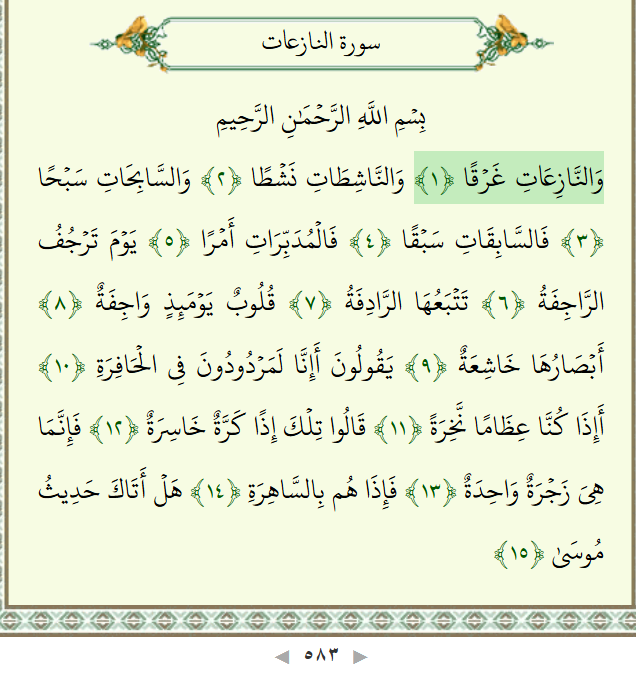
Practical Example: Imagine you are memorizing Surah An-Nazi’at (Page 583).
- You memorize Ayah 1 (Wan-nazi’ati gharqa).
- You memorize Ayah 2 (Wan-nashitati nashta).
- STOP. Do not move to Ayah 3 yet. You must recite 1 and 2 together fluently.
- Only after the flow between 1 and 2 is seamless do you add Ayah 3 (Was-sabihati sabha).
- Now recite 1 + 2 + 3.
- Why? If you memorize 1, then 2, then 3 separately without stacking, by the time you reach Ayah 10, you will have forgotten Ayah 1.
Step 4: The “Linking” (Rabt) Method in Your 1 Page Quran Hifz Plan
A common failure point in a 1 page Quran hifz plan is “Ayah Isolation.” The student knows every Ayah individually but cannot flow from one to the next without a prompt. To solve this, you must apply Audio-Visual Rabt (Linking) at the transition points.
You must create a “Mental Hook” between the ending of one verse and the beginning of the next.
- Identify the last word of Ayah A and the first word of Ayah B.
- For memorization purposes only, ignore the breath stop (Waqf) and recite the two words together as a single compound phrase.
- Recite this 2-word phrase 5–10 times until your tongue moves automatically from the first to the second.
Actual Quranic Example of Rabt Method in Your 1 Page Quran Hifz Plan
Let’s look at Surah Al-Baqarah, Page 3 (Ayahs 6-7).
End of Ayah 6: “…aa-an zartahum am lam tunzirhum la yu’minoon.” (Ends with yu’minoon)
Start of Ayah 7: Khatama Allahu… (Starts with Khatama)
You should repeat the phrase: “…yu’minoon-a-Khatama” rapidly.
By drilling the sound “na-Khatama” into your ear, your brain will automatically trigger the word Khatama the moment you finish saying yu’minoon.
This eliminates the “awkward silence” where you stare at the tutor waiting for a hint. Once the link is memorized, you can return to observing the proper pause (Waqf) during actual recitation, but the mental bridge remains active.
However, self-study often lacks the necessary rigor for long-term retention. The most efficient way to ensure you stick to this rigorous pace without errors is by reciting to a qualified tutor who can correct you instantly.
This is where Riwaq Al Quran’s Online Quran Memorization Course acts as the vital accountability partner needed to maintain consistency in your Hifz journey.
Start your Hifz journey with a Free Trial

Step 5: Repetition Strategy to Solidify Memorizing Quran Page by Page
Memorization is only the first step; consolidation is where the real work happens. “New Hifz” is volatile and evaporates quickly if not solidified immediately.
To master memorizing Quran page by page, you must apply the “Odd Number Repetition” rule. Once you have memorized the full page using the steps above, you are not done. You must now recite the entire page from memory, continuously, at least 20 to 40 times in a single sitting.
Do not skip this step. If you memorize a page in the morning but do not repeat it extensively, it will likely be forgotten by the evening. This repetition transfers the data from your short-term memory to your long-term memory.
Read Also: How Long Does it Take to Memorize One Surah of the Quran?
Step 6: Reviewing Yesterday’s Page in Your Daily Quran Memorization Schedule
You cannot build a building on a weak foundation. Therefore, your daily Quran memorization schedule must include a “Cumulative Review” of the near past.
Before starting today’s new page, you must recite the page you memorized yesterday and the 4 pages before that (a total of 5 previous pages).
If you stumble or make mistakes on yesterday’s page, do not start the new page. Stop and repair the weak page first. The rule is simple: Quality over quantity. Moving forward with weak Hifz leads to a chaotic memory structure that will eventually collapse.
Read Also: How to Memorize a Page of Quran in 5 Minutes?
Experience Riwaq Al Quran Classes
Watch real moments from our live sessions at Riwaq Al Quran and see how we bring learning to life. These clips highlight our interactive, student-focused approach designed to keep learners engaged, motivated, and actively involved in every step of their educational journey.
Step 7: Understanding the Meaning of the Verses
Take the time to understand the meaning of the verses you are memorizing. When you comprehend the context and message, it becomes easier to remember and retain the information. Connect the verses to their respective themes and concepts.
Memorization without comprehension fades fast. Here’s how to lock in meaning:
1. The 3-Layer Understanding Method
Read the English/Tafseer summary (e.g., “This verse warns against arrogance”).
Underline 3 key words per verse (e.g., “رَحْمَةً”, “هُدًى”, “بَشِيرًا”).
Imagine the scene (e.g., Prophet Yunus in the whale for Surah As-Saffat).
2. Connect Verses to Real Life
Ask: “How does this apply to me?” (e.g., “وَاصْبِرْ عَلَىٰ مَا أَصَابَكَ” → Patience in daily struggles).
Use emotional hooks (e.g., verses about forgiveness when seeking it).
Read Also: How Much Quran Should I Memorize Daily
Why Students Love Learning with Riwaq Al Quran
Hear directly from our students about how Riwaq Al Quran Academy has transformed their connection with the Book of Allah. Their experiences reflect the dedication, care, and quality that guide every step of our teaching.
Start Your Hifz Journey with Riwaq Al Quran Today
Memorizing the Quran is a lifelong journey, and having a professional guide makes the path clearer and the burden lighter. At Riwaq Al Quran, we understand the importance of memorizing the Quran and provide structured support to ensure you reach your goals.
- Learn from certified Sheikhs and female tutors from Al-Azhar University.
- Classes available 24/7 to fit your busy routine.
- We offer 2 Free Trials so you can experience our teaching quality firsthand.
We are so confident in our methodology that we offer a 100% Money-Back Guarantee if you are not satisfied.
Ready to commit?
- Join our Online Quran Memorization Course today.
- For younger family members, explore our Online Quran Classes for Kids.
- Enhance your understanding of the text with our specialized Arabic Courses.
Our Courses Include:
- Online Quran Memorization Course
- Tajweed Classes
- Online Quran Classes for Kids.
- Ijazah Program.
- Arabic Language Classes.
- Islamic Studies Courses.
Enroll now for 2 Free Trial Classes and Begin Memorizing Quran Today.

Conclusion
Consistent Quran memorization begins with stabilizing visual memory by committing to one standard Mushaf and never switching formats. This fixed layout allows the mind to recall verses by their position on the page, strengthening retention and reducing confusion over time.
Accurate pronunciation before memorization, combined with ayah-by-ayah stacking and deliberate linking between verses, prevents gaps and hesitation during recitation. These techniques ensure flow, eliminate isolated verses, and build a solid page from top to bottom.
Long-term mastery depends on heavy repetition, structured daily review, and understanding the meanings of the verses. When memorization is reinforced through revision, comprehension, and accountability with a qualified teacher, progress remains strong, stable, and spiritually connected.