Arabic contains sounds that simply do not exist in English, and the letter ذ is one of the most fascinating examples. This voiced interdental fricative challenges English speakers at first but becomes natural with the right guidance. Understanding it properly opens the door to clear, confident Arabic reading.
The letter Dh (ذ) appears frequently in everyday Arabic words, Quranic verses, and common expressions. Mastering its sound, shape, and behavior across different word positions gives learners a significant advantage in both spoken Arabic and accurate Quranic recitation.
Table of Contents
What Is the Letter Dh ذ in Arabic?
The letter ذ is the ninth letter of the Arabic alphabet. It belongs to the same phonetic family as ث (Tha) and ظ (Dha), sharing the interdental articulation point but each producing a distinct sound.
In Modern Standard Arabic (Fusha), ذ represents a voiced sound — meaning your vocal cords vibrate when producing it. This distinguishes it immediately from its voiceless counterpart ث.
If you are starting your Arabic learning from scratch, Riwaq Al Quran’s Online Arabic Course offers structured, step-by-step instruction covering every letter with expert phonetic guidance tailored specifically for English-speaking learners.
Book Your FREE Trial in Riwaq’s Arabic Classes

How to Correctly Pronounce the Letter Dh ذ in Arabic?
The letter ذ is pronounced like the “th” sound in the English word “the,” “this,” or “that” — not like “th” in “think.” The key difference is voicing: your vocal cords are active when producing ذ.
The Makhraj (Articulation Point) of the Letter Dh in Arabic
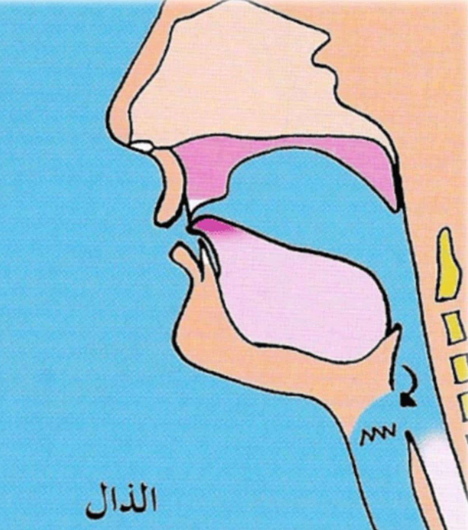
The makhraj of ذ is interdental. You place the tip of your tongue lightly between your upper and lower front teeth, allowing air to pass through while your vocal cords vibrate simultaneously.
This placement is precise. The tongue should not press hard against the teeth. A light, gentle contact while exhaling produces the correct sound.
The Sifat (Phonetic Attributes) of the Letter Dh in Arabic
Understanding the sifat helps learners produce ذ with accuracy and consistency. Below is a summary of its classified phonetic attributes:
| Attribute | Classification | Explanation |
| Voicing (Jahr) | Voiced (Majhoor) | Vocal cords vibrate during production |
| Air Flow (Rakhawa) | Continuous (Rikhwa) | Air flows continuously without complete stop |
| Tongue Position | Interdental | Tongue tip between teeth |
| Emphasis (Tafkheem) | Non-emphatic (Mustafil) | Tongue stays low, no heaviness |
| Openness (Infitah) | Open (Munfatih) | Teeth are slightly separated |
This table reflects classical Arabic phonetic science as established in Al-Azhar scholarship. Each attribute directly affects how the letter sounds in connected speech.
How the Letter Dh in Arabic Changes Shape Across Word Positions?
Like most Arabic letters, ذ changes its written form depending on where it appears in a word. However, ذ is one of the non-connecting letters in Arabic script — meaning it never connects to the letter that follows it, only to the letter before it.
This is an important script rule every learner must internalize early. Here is how ذ appears across all positions:
| Position | Arabic Form | Visual Feature |
| Isolated | ذ | Full form with one dot above |
| Initial | ذ | Same as isolated — does not connect forward |
| Medial | ـذ | Connects from previous letter only, then breaks |
| Final | ـذ | Connects from previous letter, tail extends slightly |
The single dot above ذ is what distinguishes it from دال (د). Both letters share the same base shape, but ذ carries a dot above it. Train your eye to spot this dot immediately.
For children learning to write Arabic letters, Riwaq Al Quran’s Online Arabic Classes for Kids make letter formation engaging and structured, using methods designed specifically for young learners’ attention spans and motor development.
Enroll Your Kid in Riwaq’s Arabic Classes for Kids with a FREE trial

Common Words in Arabic That Contain the Letter Dh
One of the fastest ways to internalize any Arabic letter is through repeated exposure to real words. The letter ذ appears in many common, high-frequency Arabic words used daily.
Common Arabic Words Beginning with the Letter Dh
| Arabic Word | Transliteration | English Meaning |
| ذَهَبَ | Dhahaba | He went |
| ذَكَرَ | Dhakara | He remembered / He mentioned |
| ذِئْب | Dhi’b | Wolf |
| ذَنْب | Dhanb | Sin / Fault |
| ذَكَاء | Dhaka’ | Intelligence |
| ذَوْق | Dhawq | Taste |
| ذِكْر | Dhikr | Remembrance (especially of Allah) |
These words cover practical, Quranic, and everyday contexts. Notice how ذ at the beginning of a word is clear and prominent — it is an excellent starting point for pronunciation practice.
Common Arabic Words with the Letter Dh in Middle or Final Position
| Arabic Word | Transliteration | English Meaning |
| هَذَا | Hadha | This (masculine) |
| هَذِهِ | Hadhihi | This (feminine) |
| كَذَلِكَ | Kadhalika | Likewise / Similarly |
| أَخَذَ | Akhadha | He took |
| نَفَّذَ | Naffadha | He executed / implemented |
| لَذِيذ | Ladheedh | Delicious |
The word هَذَا (Hadha) — meaning “this” — is perhaps the most frequently encountered Arabic word containing ذ. You will meet it on the very first day of Arabic learning.


The Letter Dh in Arabic in the Quran and Its Importance in Recitation
The letter ذ appears extensively throughout the Quran. Pronouncing it correctly is not merely a linguistic achievement — it is a matter of Tajweed accuracy and proper recitation.
In Tajweed science, مخرج الذال (the articulation point of ذ) must be maintained precisely. Replacing ذ with a “d” or “z” sound — which many beginners instinctively do — constitutes a recitation error (لحن جلي, Lahn Jali) if it distorts meaning.
إِنَّا نَحْنُ نَزَّلْنَا ٱلذِّكْرَ وَإِنَّا لَهُۥ لَحَـٰفِظُونَ
Inna nahnu nazzalna aldhikra wa-inna lahu lahafidoon
“Indeed, it is We who sent down the Qur’an and indeed, We will be its guardian.” (Al-Hijr 15:9)
The word الذِّكْر — Al-Dhikr — contains ذ in medial position connected to the preceding ل. The ذ here carries a shaddah, intensifying the sound. Focus on maintaining the interdental position even under this emphasis.
For learners who want to recite the Quran with proper pronunciation, Riwaq Al Quran’s Online Tajweed Classes provide specialized instruction on exactly these kinds of letter-level details under certified instructors.
Enroll Now in the Best Online Tajweed Classes

Most Common Pronunciation Mistakes English Speakers Make with the Letter Dh in Arabic
English speakers consistently make three predictable errors when first encountering ذ. Identifying these errors in advance helps you avoid them.
Replacing the Letter Dh with a “Z” Sound
Many learners produce “z” instead of ذ because both are voiced sounds. The critical difference is placement: “z” is produced with the tongue behind the teeth, while ذ requires the tongue between the teeth.
Say “zoo” — then slowly move your tongue forward until its tip touches the gap between your upper and lower front teeth. That forward movement is the correction.
Replacing the Letter Dh with a “D” Sound
Some learners, especially those familiar with South Asian pronunciation traditions, substitute a “d” sound for ذ. This completely loses the interdental fricative quality and distorts meaning in many words.
The word ذَنْب (Dhanb — sin) sounds entirely different from دَنْب if such a word existed. The distinction matters both linguistically and in Quranic recitation.
Confusing the Letter Dh with the Letter Tha (ث)
Both ث and ذ are interdental sounds produced at the same makhraj. The difference is voicing: ث is voiceless (no vocal cord vibration), while ذ is voiced.
Place your hand on your throat. When saying ذ, you should feel vibration. When saying ث, you should feel silence. Practice alternating between the two to build muscle memory.
Experience Riwaq Al Quran Classes
Watch real moments from our live sessions at Riwaq Al Quran and see how we bring learning to life. These clips highlight our interactive, student-focused approach designed to keep learners engaged, motivated, and actively involved in every step of their educational journey.
Step-by-Step Pronunciation Exercises for the Letter Dh in Arabic
Practice builds confidence. These exercises progress from isolated sounds to full words, following the method used in professional Arabic phonetics instruction.
Exercise 1 — Isolated Sound Production
Repeat ذ as an isolated sound 10 times: “Dh… Dh… Dh…” Place your tongue between your teeth. Feel the vibration in your throat. Breathe out steadily without stopping the airflow.
Exercise 2 — Minimal Pair Contrast Drilling
Alternate between these pairs to sharpen discrimination:
- ذ (voiced) vs. ث (voiceless): Dh… Th… Dh… Th…
- ذ (interdental) vs. د (dental stop): Dha… Da… Dha… Da…
- ذ (interdental) vs. ز (alveolar fricative): Dhi… Zi… Dhi… Zi…
Repeat each pair 5 times slowly, then 5 times at normal speed. This trains your ear and mouth simultaneously.
Exercise 3 — Word-Level Practice with the Letter Dh
Read these words aloud, paying full attention to the ذ sound in each:
- ذَهَبَ (Dhahaba) — He went
- هَذَا (Hadha) — This
- ذِكْر (Dhikr) — Remembrance
- أَخَذَ (Akhadha) — He took
- لَذِيذ (Ladheedh) — Delicious
Repeat each word three times. On the third repetition, say it at normal conversational speed.
Exercise 4 — Sentence-Level Practice with the Letter Dh
Read these short sentences aloud:
- ذَهَبَ إِلَى هُنَاكَ — Dhahaba ila hunak — He went there.
- هَذَا كِتَابٌ ذَكِيٌّ — Hadha kitabun dhakiyy — This is a smart book.
- أَخَذَ الذَّهَبَ — Akhadha al-dhahab — He took the gold.
Focus on maintaining the interdental position for every ذ, even when speaking at speed.
How to Write the Letter Dh in Arabic by Hand Correctly
Writing ذ begins with its base shape — identical to the letter دال (د) (Dal). Starting from the right, draw a small angled line that curves slightly downward and then hooks back up at the bottom.
The stroke is short and compact. After completing the base, lift your pen and place a single dot above the letter. That dot is what makes ذ distinct from دال.
Practice the stroke order: base shape first, then the dot. Never place the dot first — this breaks proper Arabic handwriting conventions.
Read Also: Learn The Letter Z ز in Arabic
Why Students Love Learning with Riwaq Al Quran
Hear directly from our students about how Riwaq Al Quran Academy has transformed their connection with the Book of Allah. Their experiences reflect the dedication, care, and quality that guide every step of our teaching.
Learn the Arabic Letter Dh with Riwaq Al Quran’s Expert Arabic Instructors
Mastering ذ is entirely achievable with the right guidance. Riwaq Al Quran has been helping English-speaking learners read, write, and recite Arabic accurately since 2017.
Our expert instructors offer:
- Online Arabic Course for adults — structured, phonetics-focused learning
- Online Arabic Classes for Kids — age-appropriate, engaging alphabet instruction
- Online Tajweed Classes — precise Quranic recitation training letter by letter
- Al-Azhar-certified instructors with deep linguistics expertise
- Flexible scheduling for learners worldwide
- Free trial lesson to experience the teaching approach firsthand
Book your free trial today and take the first real step toward confident Arabic reading, Insha’Allah.
Beyond Arabic, we offer courses in Online Tajweed Classes, Arabic Language, and Islamic Studies.
- Online Quran Memorization Course
- Tajweed Classes
- Online Quran Classes for Kids.
- Ijazah Program.
- Arabic Language Classes.
- Islamic Studies Courses.
Enroll now for 2 Free Trial Classes and Begin Learning Arabic or Memorizing Quran Today

Conclusion
The letter ذ stands apart from all other Arabic letters through its voiced interdental articulation — a sound produced with the tongue between the teeth while the vocal cords remain active. Recognizing this precise mechanism is the foundation of correct pronunciation.
Writing ذ correctly requires distinguishing its single dot from the dot-free دال beneath it. This visual habit, combined with consistent pronunciation drilling, builds the reading speed and accuracy every Arabic learner needs at the foundational stage.
Exposure to real Arabic vocabulary containing ذ accelerates mastery more than isolated drill alone. Words like هَذَا, ذِكْر, and أَخَذَ appear constantly in everyday Arabic and throughout the Quran, giving learners endless natural practice opportunities.