Surah Al-Alaq holds a position unlike any other in the Quran — it is where divine revelation began. The first five verses descended upon the Prophet Muhammad ﷺ in the Cave of Hira, and with them, the entire mission of Islam was set into motion. The surah’s benefits reach beyond history into daily recitation and spiritual practice.
Understanding the benefits of Surah Al-Alaq means understanding why Allah chose these words first. The command to read, the reminder of human origin, and the warning against pride form a complete ethical and spiritual framework. For every Muslim seeking to deepen their connection with the Quran, this surah is an essential starting point.
Table of Contents
1. Surah Al-Alaq Grounds Every Muslim’s Faith in the Command to Seek Knowledge
Surah Al-Alaq opens with
“Iqra bismi rabbika alladhi khalaq” — “Recite in the name of your Lord who created.”
Classical scholars of Tafsir understood this as a command establishing that knowledge pursued with awareness of Allah is itself an act of worship.
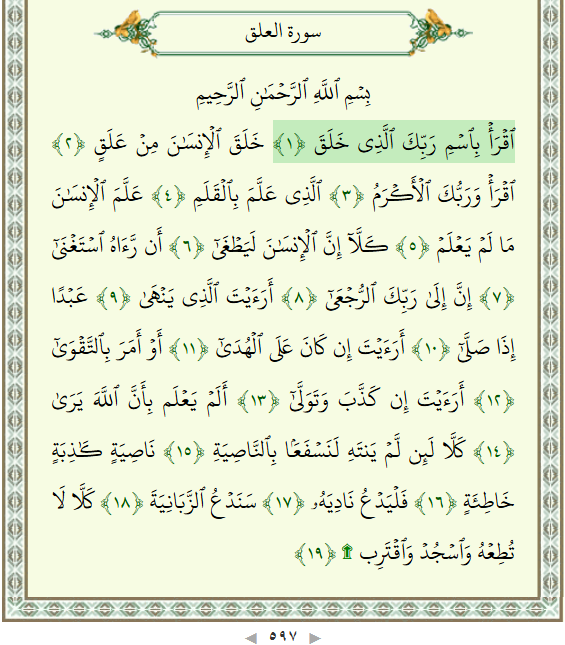
اقْرَأْ بِاسْمِ رَبِّكَ الَّذِي خَلَقَ
Iqra’ bismi rabbika alladhī khalaq
“Recite in the name of your Lord who created.” (Al-Alaq 96:1)
The benefit here is foundational. Every time a Muslim opens the Quran, picks up a book of Islamic knowledge, or sits with a teacher, they are responding to this first divine command. The surah does not begin with ritual — it begins with learning. This positions knowledge as the gateway to all other acts of faith.
At Riwaq Al Quran, our Azhari-certified tutors teach students that understanding the why behind a surah transforms recitation from mechanical repetition into living connection.
If you want to study the Quran with that depth, our Online Quran Tafseer Course is specifically designed for non-Arabic speaking Muslims who want to understand what they recite.
Enroll Now in Riwaq’s Tafseer Course with a FREE trial

2. Reminding Humans of Their Origin and Dependence on Allah
One of the most spiritually grounding benefits of Surah Al-Alaq is its direct reminder of where human beings come from. After commanding the Prophet ﷺ to read, Allah states:
خَلَقَ الْإِنسَانَ مِنْ عَلَقٍ
Khalaqa al-insāna min ‘alaq
“Created man from a clinging substance.” (Al-Alaq 96:2)
The word ‘Alaq (عَلَق) refers to a clot or something that clings — the earliest stage of human embryonic development. Classical mufassirun noted that this reminder is deliberate: the very surah that commands you to read immediately reminds you of your humble biological origin. The message is clear — whatever knowledge or status you acquire, remember that you began as something fragile and dependent.
This is one of the most repeated lessons in my years of teaching Hifz students at Riwaq Al Quran. Students who internalize Al-Alaq’s opening verses approach their memorization with humility rather than pride — and humility, in our experience, is the single greatest predictor of consistent progress.
Experience Riwaq Al Quran Classes
Watch real moments from our live sessions at Riwaq Al Quran and see how we bring learning to life. These clips highlight our interactive, student-focused approach designed to keep learners engaged, motivated, and actively involved in every step of their educational journey.
3. Allah Teaches Humans What They Could Never Know Alone
A benefit that often goes underappreciated in Surah Al-Alaq is its explicit statement that Allah is the ultimate Teacher. The surah states:
عَلَّمَ الْإِنسَانَ مَا لَمْ يَعْلَمْ
‘Allama al-insāna mā lam ya’lam
“He taught man what he did not know.” (Al-Alaq 96:5)
This verse carries a profound benefit for the believer: no matter how much you study, how many teachers you sit with, or how long you revise, ultimate knowledge flows from Allah alone.
This is a call to approach learning with du’a, with reliance on Allah, and with the understanding that tawfiq (divine facilitation) is what makes knowledge stick.
| Verse | Key Concept | Practical Benefit for the Believer |
| 96:1 | Read in Allah’s name | Frames all learning as worship |
| 96:2 | Created from ‘Alaq | Instills humility in pursuit of knowledge |
| 96:3–4 | Allah taught with the pen | Validates writing, scholarship, and study |
| 96:5 | Taught what was unknown | Encourages reliance on Allah in learning |
| 96:6–7 | Man transgresses in wealth | Warns against arrogance from worldly gain |
This table reflects the remarkable internal logic of Al-Alaq: each verse builds on the previous, creating a complete ethical and spiritual framework within 19 short verses.
4. Warning Against Arrogance and Transgression
After establishing the dignity of knowledge, Surah Al-Alaq pivots sharply to a warning. This transition is itself one of the surah’s most important benefits — it shows that knowledge without humility leads to destruction.
كَلَّا إِنَّ الْإِنسَانَ لَيَطْغَىٰ أَن رَّآهُ اسْتَغْنَىٰ
Kallā inna al-insāna layaṭghā. An ra’āhu ‘staghnā.
“No! [But] indeed, man transgresses. Because he sees himself self-sufficient.” (Al-Alaq 96:6–7)
Ibn Kathir, in his Tafsir, explains that this passage was revealed in the context of Abu Jahl’s arrogance — but its application is universal. Wealth, status, and power can cause a person to forget Allah entirely.
The benefit of reciting and reflecting on this verse is a constant internal checkpoint: Am I acting as though I am self-sufficient? Have I forgotten my Lord?
This warning becomes especially relevant in an era where material success is often treated as the ultimate measure of human worth. Al-Alaq directly challenges that framework.

5. The Ultimate Return Is to Allah Alone
One of the most sobering benefits of Surah Al-Alaq comes in its reminder that all arrogance is temporary, because the return is to Allah alone. The surah states:
إِنَّ إِلَىٰ رَبِّكَ الرُّجْعَىٰ
Inna ilā rabbika ar-ruj’ā
“Indeed, to your Lord is the return.” (Al-Alaq 96:8)
This single verse functions as a complete reorientation of priorities. Whatever a person accumulates, whatever status they reach, the final destination is Allah. Classical scholars of ‘Aqeedah noted that this verse reinforces Yawm Al-Qiyamah consciousness in the briefest possible phrasing.
For the student memorizing this surah, this verse is particularly powerful to internalize during revision. When we teach it at Riwaq Al Quran, we encourage students to pause after this ayah and let its weight settle — not to rush past it. Recitation that carries meaning produces far stronger memorization than recitation that is purely mechanical. Our Quran memorization techniques resource expands on exactly this approach.
Connect with our Azhari tutors to learn Quran with Tafseer

Read Also: Surah At-Tahrim Benefits
6. Surah Al-Alaq Commands the Believer to Prostrate and Draw Near to Allah
The surah closes with one of the most direct divine commands in the entire Quran, one that carries enormous benefit for the reciter:
وَاسْجُدْ وَاقْتَرِب
Wasjud waqtarib
“Prostrate and draw near to Allah.” (Al-Alaq 96:19)
This is one of the 15 prostration verses (Ayat As-Sajdah) in the Quran. Scholars of Fiqh across all four major madhabs agree that upon reciting or hearing this verse, a prostration of recitation (Sajdat At-Tilawah) is recommended (wajib according to the Hanafi madhab, and sunnah according to others). The benefit of this verse is therefore not only spiritual but also practical — it adds an act of worship to your recitation.
The Prophet ﷺ highlighted the power of sujud directly:
“The closest that a servant is to his Lord is when he is in prostration, so make many supplications in it.” (Sahih Muslim 482)
| Fiqh Ruling on Sajdat Al-Tilawah | Madhab | Status |
| Wajib (obligatory) | Hanafi | Must be performed upon recitation |
| Sunnah Mu’akkadah | Shafi’i | Strongly recommended |
| Sunnah | Maliki | Recommended |
| Wajib | Hanbali | Must be performed |
Understanding these rulings requires proper Islamic Studies grounding. Riwaq Al Quran‘s Best Islamic Studies Online Course covers Fiqh rulings like these with proper scholarly depth for non-Arabic speaking Muslims.
Begin your Islamic Studies with a FREE trial lesson
Read Also: Surah Al-Fath Benefits
Why Students Love Learning with Riwaq Al Quran
Hear directly from our students about how Riwaq Al Quran Academy has transformed their connection with the Book of Allah. Their experiences reflect the dedication, care, and quality that guide every step of our teaching.
Begin Your Quranic Study with Riwaq Al Quran’s Expert Tutors
Surah Al-Alaq is not just a surah to memorize — it is a surah to live. Its command to read, its warning against pride, and its call to prostrate represent the complete arc of a believer’s relationship with knowledge and Allah.
At Riwaq Al Quran, our Azhari-certified tutors help non-Arabic speaking Muslims connect with the Quran exactly this way — with depth, accuracy, and personalized guidance. Our programs include:
- Online Quran Memorization Course — structured Hifz with Tajweed, one-on-one sessions, 24/7 scheduling
- Online Quran Tafseer Course — understand what you recite, with authentic scholarly commentary
- Best Islamic Studies Online Course — Fiqh, ‘Aqeedah, and Islamic knowledge from certified scholars
Two free trial classes are available. Book yours today — no commitment required.
We offer courses in Online Quran & Tajweed Classes, Arabic Language, and Islamic Studies.
- Online Quran Memorization Course
- Tafseer Course
- Tajweed Classes
- Online Quran Classes for Kids.
- Ijazah Program.
- Arabic Language Classes.
- Islamic Studies Courses.
Enroll now for 2 Free Trial Classes and Begin Learning Islam and Quran Today
Read Also: Surah Hadid Benefits
Frequently Asked Questions About Surah Al-Alaq Benefits
What are the main benefits of reciting Surah Al-Alaq regularly?
Reciting Surah Al-Alaq regularly reconnects the believer to the first divine command — to read and seek knowledge in Allah’s name. It cultivates humility through the reminder of human origin, strengthens consciousness of the Day of Judgment, and includes a verse of prostration that draws the reciter closer to Allah through Sajdat At-Tilawah.
Is there an authentic hadith about the benefits of Surah Al-Alaq specifically?
No specific hadith isolates the virtues of Surah Al-Alaq independently. However, the surah’s status as the first revelation is authentically established in both Sahih Al-Bukhari and Sahih Muslim through the hadith of Sayyidah Aisha describing the first moments of revelation. General virtues of Quran recitation apply fully to this surah.
What does Surah Al-Alaq teach about the importance of knowledge in Islam?
Surah Al-Alaq establishes knowledge as a divine command, not a personal preference. The repeated command “Iqra” (Read) in verses 1 and 3, combined with Allah’s description of Himself as the One who teaches by the pen, positions learning as an act of worship. Classical scholars used this surah as primary evidence that seeking knowledge is an obligation upon every Muslim.
Is the claim that Surah Al-Alaq cures joint pain an authentic Islamic teaching?
No. There is no authentic hadith or established scholarly opinion attributing a specific physical cure for joint pain to the recitation of Surah Al-Alaq. Assigning specific medical cures to specific surahs without authentic textual evidence constitutes an innovation (Bid’ah) and must be avoided. The surah’s documented benefits are spiritual, moral, and educational — as established by authentic Tafsir sources.
How should a beginner approach memorizing Surah Al-Alaq?
Begin by listening to a proficient reciter — focusing on correct Tajweed, especially the pronunciation of ع (Ayn) in ‘Alaq and the Sajdah verse at the end. Memorize in three segments: verses 1–5, verses 6–13, and verses 14–19. Review each segment before moving forward. Connecting each verse’s meaning to its memorization, as taught in our Quran memorization techniques guide, deepens retention significantly.