Every student who has ever sat with a mushaf and tried to keep a verse long enough for it to settle in the heart knows the feeling: effort alone is not enough. Repetition helps, but it does not guarantee retention. The Prophet ﷺ described the Quran as something that does not remain with a person the way ordinary information does — it must be actively held in place, and the holding requires permission from the One who revealed it.
The dua for memorizing the Quran is that permission, asked for directly. This guide gives you five authenticated supplications from the Quran and the Sunnah, explains their sources with links to the original texts, shows you the best times and conditions for making them, and provides a practical daily routine for building them into your Hifz practice.
Whether you are a beginning student working through your first juz, a parent supporting a child on their memorization journey, or someone returning to Hifz after a long pause — these supplications, understood and used correctly, form the spiritual backbone of the entire effort.
What You’ll Learn in This Article
- Why the Quran itself promises ease for those who seek to remember it — and what three Prophetic Hadiths say about the station of the hafidh.
- The Three Layers of Hifz Dua — a framework for knowing which supplication to reach for and when.
- 5 authenticated duas with full Arabic text (with tashkeel), transliteration, translation, source links, and practical commentary.
- The specific conditions and times that make duas more likely to be accepted.
- A before/during/after dua routine built specifically for Hifz students.
- The one theological mistake that quietly prevents many students from benefiting from their supplications.
Table of Contents
Why Allah Made Quran Memorization Possible — and What He Promises Those Who Try
Before identifying which duas to recite, it helps to understand what basis of hope a Hifz student has from the Quran and Sunnah themselves. Two categories of text establish this foundation — one from the Quran and one from the Hadith — and together they fundamentally change how a student approaches both effort and difficulty.
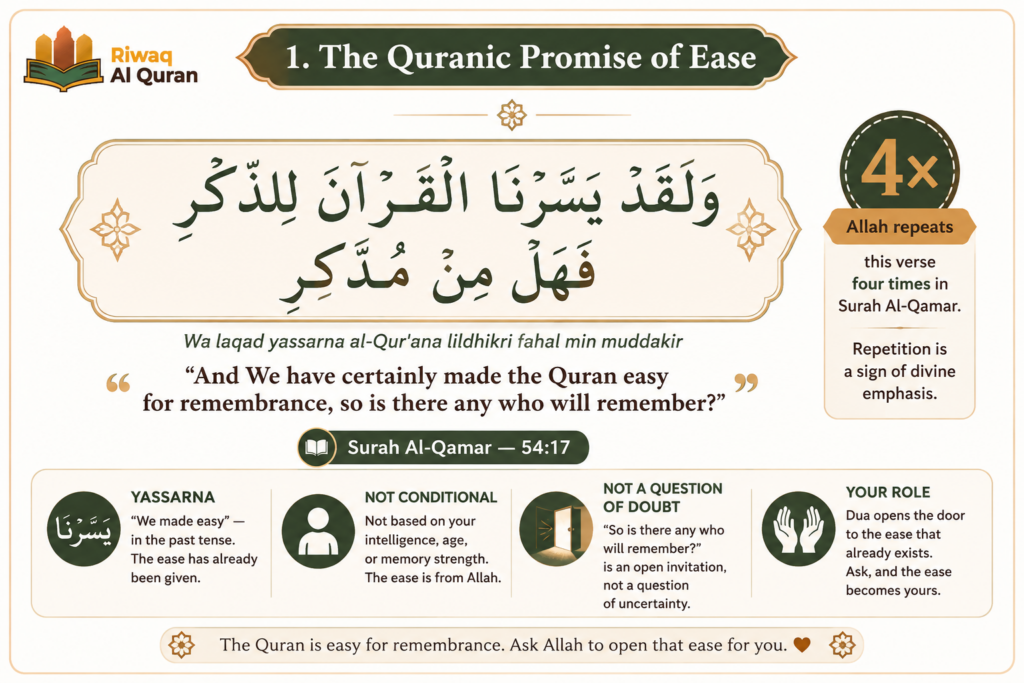
1. The Quranic Promise of Ease
Allah repeats this statement four times in a single surah — Surah Al-Qamar — and that repetition is itself a sign of emphasis:
“وَلَقَدۡ يَسَّرۡنَا ٱلۡقُرۡءَانَ لِلذِّكۡرِ فَهَلۡ مِن مُّدَّكِرٍ“
“Wa laqad yassarna al-Qur’ana lildhikri fahal min muddakir” “And We have certainly made the Quran easy for remembrance, so is there any who will remember?”(Surah Al-Qamar — 54:17)
The verb يَسَّرۡنَا (yassarna — “We made easy”) is past tense with Allah as the subject. The ease is not conditional on the student’s intelligence, age, or memory strength — it has already been given. The closing phrase “so is there any who will remember?” is not a question of doubt; it is an open invitation. This verse teaches that when a verse refuses to settle after many repetitions, the problem is not that the Quran is too difficult. The ease already exists — what the student is asking for in dua is for that ease to be opened specifically for them.
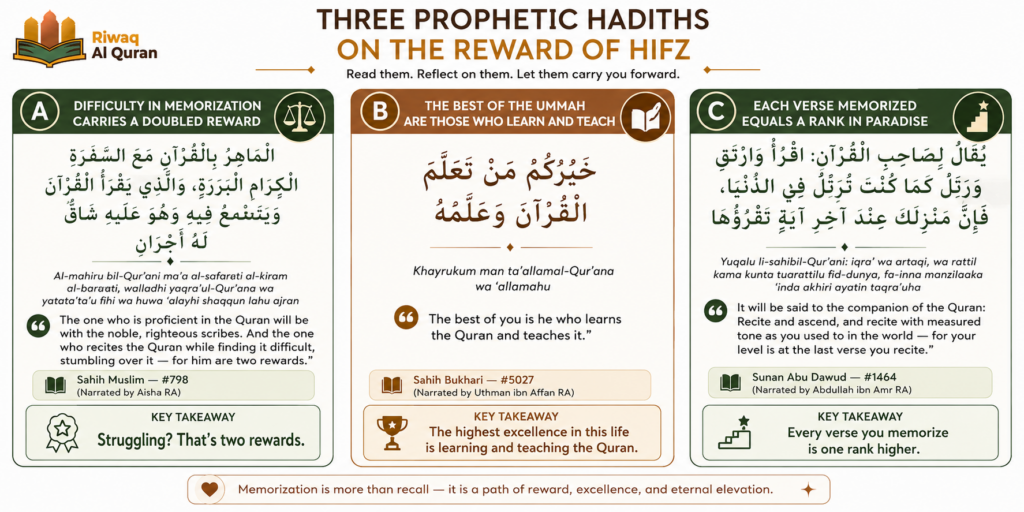
2. Three Prophetic Hadiths on the Reward of Hifz
The following narrations from the Prophet ﷺ establish the station of the Quran memorizer in both this life and the next. Reading them before beginning the memorization journey — or during its hardest phases — gives every student a concrete reason to continue.
A. Difficulty in memorization carries a doubled reward:
“الْمَاهِرُ بِالْقُرْآنِ مَعَ السَّفَرَةِ الْكِرَامِ الْبَرَرَةِ، وَالَّذِي يَقْرَأُ الْقُرْآنَ وَيَتَتَعْتَعُ فِيهِ وَهُوَ عَلَيْهِ شَاقٌّ لَهُ أَجْرَانِ“
“Al-mahiru bil-Qur’ani ma’a al-safarati al-kiram al-bararati, walladhi yaqra’ul-Qur’ana wa yatata’ta’u fihi wa huwa ‘alayhi shaqqun lahu ajran” “The one who is proficient in the Quran will be with the noble, righteous scribes. And the one who recites the Quran while finding it difficult, stumbling over it — for him are two rewards.”(Sahih Muslim — #798, narrated by Aisha RA)
The student who sits with a verse for forty minutes without retaining it is not failing — they are earning a reward the easily proficient student does not receive. Difficulty in memorization is not a sign of rejection; it is a sign of doubled compensation.
B. The best of the ummah are those who learn and teach:
“خَيْرُكُمْ مَنْ تَعَلَّمَ الْقُرْآنَ وَعَلَّمَهُ“
“Khayrukum man ta’allamal-Qur’ana wa ‘allamahu” “The best of you is he who learns the Quran and teaches it.”(Sahih Bukhari — #5027, narrated by Uthman ibn Affan RA)
This is not a statement about afterlife rank only — it is a definition of excellence in this life. The Prophet ﷺ used the word خَيْرُكُمۡ (khayrukum — “the best of you”), placing Quran learners and teachers at the highest tier of the ummah’s virtue hierarchy. For anyone questioning whether the years of sacrifice required by Hifz are worth it, the Prophet ﷺ has already answered.
C. Each verse memorized equals a rank in Paradise:
“يُقَالُ لِصَاحِبِ الْقُرْآنِ: اقْرَأْ وَارْتَقِ وَرَتِّلْ كَمَا كُنْتَ تُرَتِّلُ فِي الدُّنْيَا، فَإِنَّ مَنْزِلَكَ عِنْدَ آخِرِ آيَةٍ تَقْرَؤُهَا“
“Yuqalu li-sahibil-Qur’ani: iqra’ wa artaqi, wa rattil kama kunta tuarattilu fid-dunya, fa-inna manzilaaka ‘inda akhiri ayatin taqra’uha” “It will be said to the companion of the Quran: Recite and ascend, and recite with measured tone as you used to in the world — for your level is at the last verse you recite.”(Sunan Abu Dawud — #1464, narrated by Abdullah ibn Amr RA)
Each verse memorized corresponds directly to a rank in Paradise — not a vague promise, but a proportional ratio of effort to station. For a student deciding whether to push from Juz 15 to Juz 16, the answer from this hadith is clear: every verse added is one rank higher.
The Three Layers of Dua for Memorizing the Quran
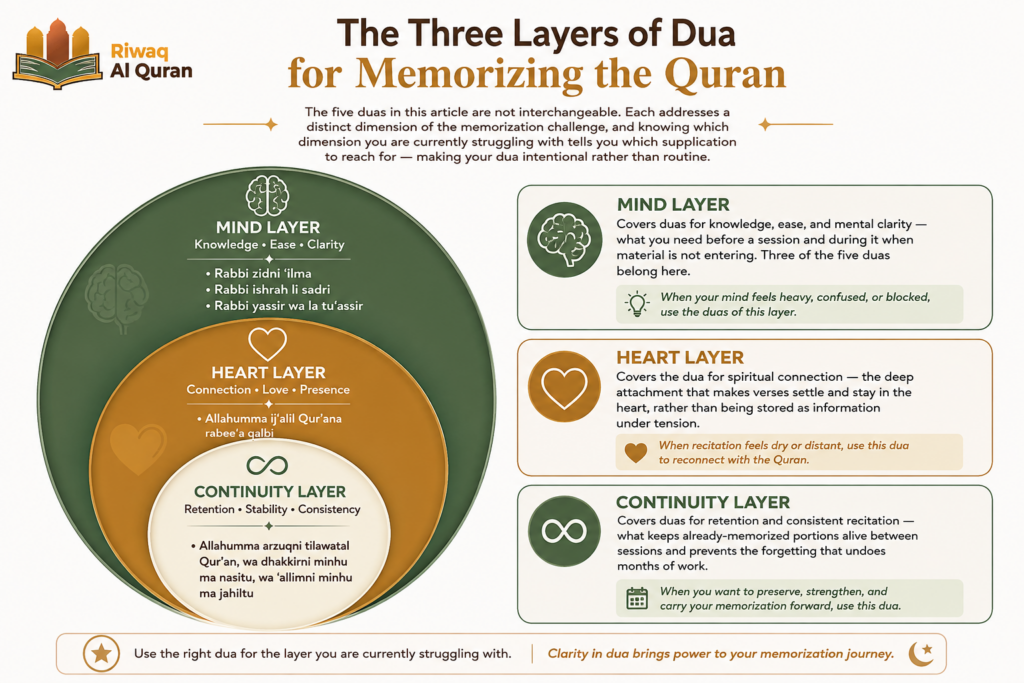
The five duas in this article are not interchangeable. Each addresses a distinct dimension of the memorization challenge, and knowing which dimension you are currently struggling with tells you which supplication to reach for — making your dua intentional rather than routine.
- The Mind Layer covers duas for knowledge, ease, and mental clarity — what you need before a session and during it when material is not entering. Three of the five duas belong here.
- The Heart Layer covers the dua for spiritual connection — the deep attachment that makes verses settle and stay in the heart, rather than being stored as information under tension.
- The Continuity Layer covers duas for retention and consistent recitation — what keeps already-memorized portions alive between sessions and prevents the forgetting that undoes months of work.
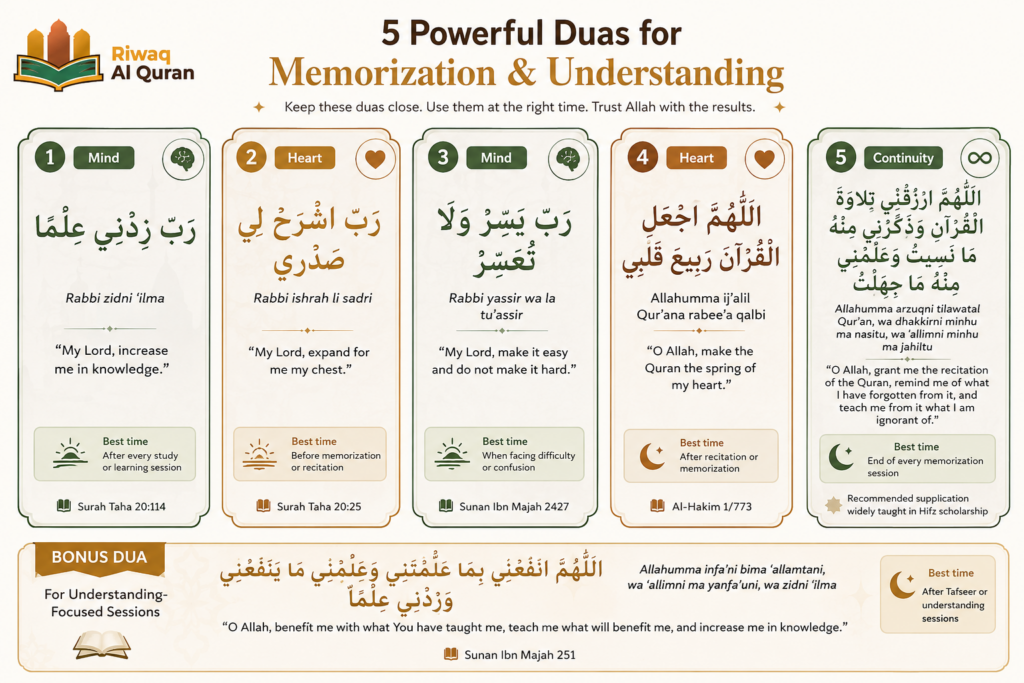
Quick Reference — The 5 Duas for Memorizing the Quran at a Glance
Before the full explanation of each supplication, the table below maps all five duas to their source, layer, and optimal moment — so you can identify the right dua quickly without reading through the entire article each time.
| # | Dua Name | Source | Layer | Best Used |
|---|---|---|---|---|
| 1 | Rabbi Zidni Ilma | Quran (Ta-Ha 20:114) | Mind | After every fard salah |
| 2 | Rabbi Ishrah Li Sadri | Quran (Ta-Ha 20:25–28) | Mind | Before each session |
| 3 | Allahumma La Sahla | Sahih Ibn Hibban | Mind | During difficult passages |
| 4 | Allahumma Ij’al Al-Quran Rabi’a Qalbi | Musnad Ahmad | Heart | In sujood at tahajjud |
| 5 | Allahumma Arzuqni Tilawat Al-Quran | Scholarly supplication | Continuity | End of every session |


The 5 Authenticated Duas for Memorizing the Quran
Each supplication below is presented with its full Arabic text with tashkeel, source reference with a link to the original text, transliteration, translation, and practical commentary connecting it directly to the memorization experience.
1. Rabbi Zidni Ilma — The Quranic Command to Seek Knowledge
Layer: Mind | Best time: After every fard salah
“وَقُل رَّبِّ زِدۡنِي عِلۡمًا“
“Wa qul rabbi zidni ‘ilma” “And say: My Lord, increase me in knowledge.”(Surah Ta-Ha — 20:114)
Three details make this the most foundational dua in this list:
- It is a divine command — Allah instructed the Prophet ﷺ to recite it, making it the only supplication for knowledge that is itself a Quranic verse.
- It was revealed after portions of the Quran had already been given to the Prophet ﷺ — meaning even someone in receipt of divine revelation was instructed to keep asking for more. No student outgrows this dua.
- The word زِدۡنِي (zidni — “increase me”) assumes the person already has some knowledge and asks for growth, not a starting grant. It has no ceiling and applies at every level of learning.
Recite it after every obligatory salah as a consistent daily supplication, whether or not a memorization session follows that day.
2. Rabbi Ishrah Li Sadri — Moses’s Dua for Clarity and Ease of Expression
Mind | Best time – Before each memorization session
“رَبِّ ٱشۡرَحۡ لِي صَدۡرِي وَيَسِّرۡ لِيٓ أَمۡرِي وَٱحۡلُلۡ عُقۡدَةً مِّن لِّسَانِي يَفۡقَهُواْ قَوۡلِي“
“Rabbi ishrah li sadri, wa yassir li amri, wahlul ‘uqdatan min lisani, yafqahu qawli” “My Lord, expand for me my chest, ease my task for me, and untie the knot from my tongue so they may understand my speech.”(Surah Ta-Ha — 20:25–28)
This supplication was made by Prophet Musa ﷺ before facing Pharaoh — when he knew exactly what he was called to do but felt genuinely unequal to the task. Most Hifz students recognize that feeling. It contains three layered, specific requests:
- Expanded chest (اشۡرَحۡ لِي صَدۡرِي) — mental openness and the confidence to begin and continue, even when the material feels overwhelming.
- Eased task (يَسِّرۡ لِيٓ أَمۡرِي) — the memorization process itself, named directly in the supplication.
- Loosed tongue (احۡلُلۡ عُقۡدَةً مِّن لِّسَانِي) — clarity in pronunciation and articulation, particularly relevant for students working on Arabic sounds that do not exist in their native language.
Recite it at the start of every memorization session before opening the mushaf. I
3. Allahumma La Sahla — For When the Same Verse Refuses to Stay
Mind | Best time – During difficult passages
ٱللَّهُمَّ لَا سَهۡلَ إِلَّا مَا جَعَلۡتَهُۥ سَهۡلًا وَأَنتَ تَجۡعَلُ ٱلۡحَزۡنَ إِذَا شِئۡتَ سَهۡلًا
“Allahumma la sahla illa ma ja’altahu sahlan, wa anta taj’alul hazna idha shi’ta sahlan” “O Allah, there is no ease except in that which You have made easy. And You make the difficult easy when You will.”(Sahih Ibn Hibban)
What separates this supplication from a general prayer for help is its theological precision — it does not ask Allah to take away difficulty. It acknowledges that ease is something Allah actively creates, not something that emerges naturally from more repetition. This reframes the experience entirely:
- When a verse refuses to settle after twenty attempts, the problem is not a lack of effort.
- The ease has not yet been given — and this dua specifically asks for it to be given.
- Its brevity makes it easy to say under the breath between repetitions without breaking session rhythm.
If sessions also have structural problems alongside the spiritual barrier — unclear revision cycles, uncorrected pronunciation, inconsistent scheduling — the Quran Memorization Online Course at Riwaq Al Quran pairs structured method with qualified instructor support.
For further context on how dua and study work together practically, this guide on dua for studying and memory covers the same principles applied to learning environments.
4. Allahumma Ij’al Al-Quran Rabi’a Qalbi — For When Memorization Feels Mechanical
Heart | Best time – In sujood at tahajjud
“ٱللَّهُمَّ ٱجۡعَلِ ٱلۡقُرۡءَانَ رَبِيعَ قَلۡبِي وَنُورَ صَدۡرِي وَجَلَاءَ حُزۡنِي وَذَهَابَ هَمِّي“
“Allahumma ij’al al-Qur’ana rabi’a qalbi, wa nura sadri, wa jila’a huzni, wa dhahaba hammi” “O Allah, make the Quran the spring of my heart, the light of my chest, the dispeller of my sadness, and the reliever of my distress.”(Musnad Imam Ahmad)
This dua belongs to the Heart Layer because it is not asking for cognitive help — it is asking for a relationship. Each element of the supplication requests something distinct:
- Spring of my heart (رَبِيعَ قَلۡبِي) — A spring is not somewhere you visit; it is a source that flows continuously. The dua asks for the Quran to become a living center, not a subject.
- Light of my chest (نُورَ صَدۡرِي) — Illumination from within; the Quran’s guidance becoming the lens through which everything is understood.
- Dispeller of sadness and reliever of distress — The Quran as an active presence in emotional life, not a text accessed only during study hours.
Students who memorize through years of repetition without developing this inner connection frequently find their Hifz becomes brittle — they hold the verses, but the verses do not hold them. When revision starts feeling like reciting a phone number rather than addressing Allah, this is the dua to make.
For related reading on supplication and its conditions, this article on whether dua requires wudu offers important practical context.
5. Allahumma Arzuqni Tilawat Al-Quran — For Retention Between Sessions
Continuity | Best time – End of every memorization session
“ٱللَّهُمَّ ٱرۡزُقۡنِي تِلَاوَةَ ٱلۡقُرۡءَانِ وَذَكِّرۡنِي مِنۡهُ مَا نَسِيتُ وَعَلِّمۡنِي مِنۡهُ مَا جَهِلۡتُ“
“Allahumma arzuqni tilawatal Qur’an, wa dhakkirni minhu ma nasitu, wa ‘allimni minhu ma jahiltu” “O Allah, grant me the recitation of the Quran, remind me of what I have forgotten from it, and teach me from it what I am ignorant of.”
(Recommended supplication widely taught in Hifz scholarship)
Three distinct requests in one sentence, each covering a different problem across the Hifz journey:
- Arzuqni tilawah — treats recitation as a divine provision (rizq), something given rather than produced; asks Allah to keep giving it consistently.
- Dhakkirni ma nasitu — directly addresses the forgetting that undermines months of memorization; a specific request for Allah’s help in retention.
- ‘Allimni ma jahiltu — extends beyond memorization into comprehension; asking to be taught what has been memorized but not yet understood.
Most end-of-session duas ask only for acceptance; this one goes further and asks Allah to preserve and deepen everything just worked on through the night. Recite it as the final word before closing the mushaf each day.
Bonus Dua — Allahumma Infa’ni Bima ‘Allamtani (For Understanding-Focused Sessions)
When a session focuses on Tafseer, meaning, or comprehension rather than pure memorization, add this authenticated supplication:
“ٱللَّهُمَّ ٱنفَعۡنِي بِمَا عَلَّمۡتَنِي وَعَلِّمۡنِي مَا يَنفَعُنِي وَزِدۡنِي عِلۡمًا“
“Allahumma infa’ni bima ‘allamtani, wa ‘allimni ma yanfa’uni, wa zidni ‘ilma” “O Allah, benefit me with what You have taught me, teach me what will benefit me, and increase me in knowledge.”(Sunan Ibn Majah — #251)
The opening word انفَعۡنِي (infa’ni — “benefit me”) makes this unique: it asks not just for more knowledge, but for what has already been given to become genuinely beneficial — a guard against memorizing without meaning, or understanding without application.
The Etiquette of Dua — What Makes a Supplication More Likely to Be Accepted
Reciting the right words is the beginning of dua, not the whole of it. Islamic scholarship has established a set of conditions — known as shuroot al-ijabah (conditions of acceptance) — that strengthen a supplication. These are not bureaucratic requirements; they reflect the reality that dua is a form of worship that deserves preparation, presence, and the right state.
A. Conditions That Strengthen Your Dua for Hifz
Before reciting any of the duas above, scholars identify the following as conditions that directly affect acceptance:
- Halal sustenance. The Prophet ﷺ described a traveler, dusty from the road, raising his hands and crying “Ya Rabb, Ya Rabb” — then noted:
“وَمَطۡعَمُهُ حَرَامٌ وَمَشۡرَبُهُ حَرَامٌ وَمَلۡبَسُهُ حَرَامٌ وَغُذِيَ بِٱلۡحَرَامِ فَأَنَّى يُسۡتَجَابُ لِذَٰلِكَ“
“His food is haram, his drink is haram, his clothing is haram, and he is nourished by haram — so how can his dua be answered?”(Sahih Muslim — #1015)
- Opening with praise of Allah and salawat on the Prophet ﷺ, Every dua is strengthened by beginning with hamd (praise) and sending blessings on the Prophet ﷺ before stating the request. (Sunan Abu Dawud — #1481)
- Full presence and awareness. Recite each dua knowing what every word means. A supplication made as a formality, with the mind elsewhere, lacks the sincerity that drives acceptance.
- Ongoing repentance. Known, unrepented sin creates a distance between the heart and Allah. Returning to tawbah before making dua reopens the channel.
- Persistence without impatience. The Prophet ﷺ taught that Allah does not tire of being asked — it is the person who tires of asking. Continue making the same dua session after session; do not assume one request is sufficient.
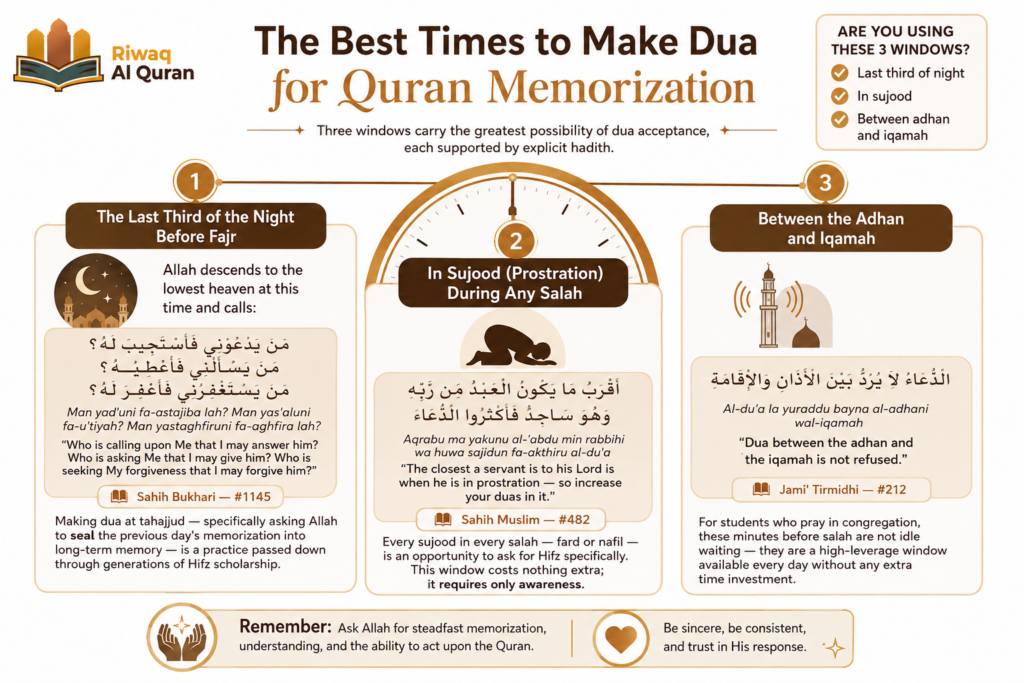
B. The Best Times to Make Dua for Quran Memorization
Three windows carry the greatest possibility of dua acceptance, each supported by explicit hadith:
1. The last third of the night — before Fajr:
Allah descends to the lowest heaven at this time and calls:
مَن يَدۡعُونِي فَأَسۡتَجِيبَ لَهُۥ؟ مَن يَسۡأَلُنِي فَأُعۡطِيَهُۥ؟ مَن يَسۡتَغۡفِرُنِي فَأَغۡفِرَ لَهُۥ؟
“Man yad’uni fa-astajiba lah? Man yas’aluni fa-u’tiyah? Man yastaghfiruni fa-aghfira lah?” “Who is calling upon Me that I may answer him? Who is asking Me that I may give him? Who is seeking My forgiveness that I may forgive him?”(Sahih Bukhari — #1145)
Making dua at tahajjud — specifically asking Allah to seal the previous day’s memorization into long-term memory — is a practice passed down through generations of Hifz scholarship.
2. In sujood (prostration) during any salah:
“أَقۡرَبُ مَا يَكُونُ ٱلۡعَبۡدُ مِن رَّبِّهِۦ وَهُوَ سَاجِدٌ فَأَكۡثِرُوا ٱلدُّعَاءَ“
“Aqrabu ma yakunu al-‘abdu min rabbihi wa huwa sajidun fa-akthiru al-du’a” “The closest a servant is to his Lord is when he is in prostration — so increase your duas in it.”(Sahih Muslim — #482)
Every sujood in every salah — fard or nafil — is an opportunity to ask for Hifz specifically. This window costs nothing extra; it requires only awareness.
3. Between the adhan and iqamah:
“ٱلدُّعَاءُ لَا يُرَدُّ بَيۡنَ ٱلۡأَذَانِ وَٱلۡإِقَامَةِ“
“Al-du’a la yuraddu bayna al-adhani wal-iqamah” “Dua between the adhan and the iqamah is not refused.”(Jami’ Tirmidhi — #212)
For students who pray in congregation, these minutes before salah are not idle waiting — they are a high-leverage window available every day without any extra time investment.
A Daily Dua Routine for Hifz Students
A routine converts individual duas from a list into a working daily system. The placement below is based on what each supplication addresses — not arbitrary tradition — so each one lands at the moment it serves most directly.
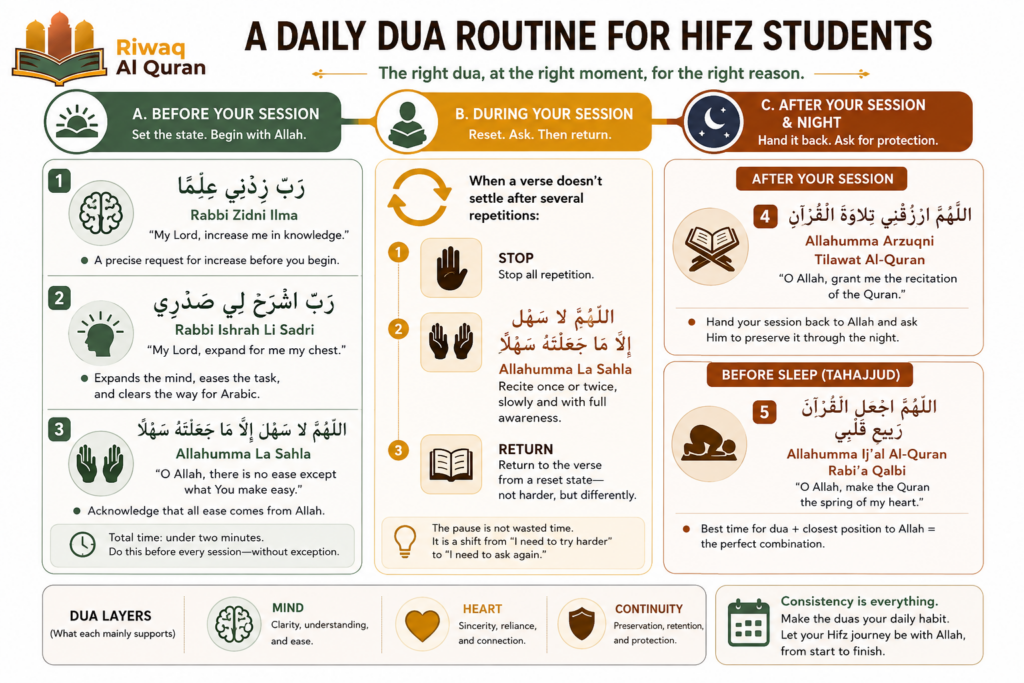
A. Before Your Session
Three supplications establish the right state before the mushaf is opened:
- Begin with Rabbi Ishrah Li Sadri (Dua #2) — to expand the mind, ease the task, and clear the tongue for Arabic.
- Follow immediately with Allahumma La Sahla (Dua #3) — acknowledging that whatever ease arrives in today’s session comes from Allah, not from effort alone.
- Close with Rabbi Zidni Ilma (Dua #1) — a precise, final request for divine increase before work begins.
Total time: under two minutes. Done consistently before every session without exception, these three duas establish a ritual boundary — a signal to the mind that serious work is beginning and that the student is not facing it alone.
B. During Your Session
When a verse refuses to settle after multiple repetitions, the standard response is to repeat it more times from the same mental state — which rarely produces a different result. Instead:
- Stop all repetition.
- Recite Allahumma La Sahla once or twice, slowly, with full awareness of what each word means.
- Return to the verse from a reset state — not harder, but differently.
The pause is not wasted time. It is a deliberate shift from “I need to try harder” to “I need to ask again.” That shift, even brief, regularly breaks the block where continued repetition does not.
C. After Your Session and Before Sleep
Two supplications close the day’s Hifz work:
- End every session with Allahumma Arzuqni Tilawat Al-Quran (Dua #5) — handing the session’s content back to Allah and asking Him to preserve it through the night.
- At tahajjud, in sujood, recite Allahumma Ij’al Al-Quran Rabi’a Qalbi (Dua #4) — combining the best time for dua (last third of the night) with the position of closest proximity to Allah (prostration).
If your sessions currently lack the structure that makes this routine effective — fixed schedule, qualified teacher, consistent revision tracking — the Quran Memorization Online Course at Riwaq Al Quran builds exactly that framework. For parents supporting younger students through this journey alongside their own, dua for an obedient child may complement this routine as well.
The One Mistake That Makes Duas for Hifz Ineffective
Many students recite duas faithfully while treating memorization passively — attending sessions inconsistently, skipping revision, and waiting for retention to improve without structured method. This is a misunderstanding of tawakkul (reliance on Allah).
Tawakkul in the Islamic framework is not passivity. It is full effort, followed by trust. The Prophet ﷺ made this explicit when a Bedouin asked whether to tie his camel or leave it and rely on Allah:
قَالَ: اعۡقِلۡهَا وَتَوَكَّلۡ“
“Qala: i’qilha wa tawakkal” “He said: Tie it, then put your trust in Allah.”(Jami’ Tirmidhi — #2517)
For a Hifz student, tying the camel means:
- Showing up to every session without exception — not only on high-motivation days.
- Following a structured revision cycle: new material plus daily review of already-memorized portions.
- Working with a qualified teacher who catches errors before they harden into habits.
- Continuing through difficult weeks, not only productive ones.
Dua opens the divine side of memorization. Method and consistency are the student’s side. Neither works fully without the other. For additional reading on how supplication and preparation work together, this article on the most powerful dua for exam success applies the same principle to focused academic effort.
Begin Your Hifz Journey with Qualified Guidance
Memorizing the Quran independently is possible. Doing it correctly — with proper Tajweed, efficient revision cycles, and a teacher who identifies errors before they become permanent habits — is what makes the memorization last.
Riwaq Al Quran is a comprehensive online platform that provides personalized Quran, Arabic, and Islamic Studies classes for individuals of all ages and backgrounds. Experienced instructors use a structured curriculum covering Tajweed, Tafsir, and Memorization, with advanced online sessions designed for seamless communication between students and teachers.
Hear directly from our students about how Riwaq Al Quran Academy has transformed their connection with the Book of Allah:
For students at every stage of the journey, the available programs include:
- Quran Memorization Online Course — structured Hifz with daily revision tracking and qualified instructor support, from Juz 1 to completion
- Online Tajweed Classes — master the rules of correct recitation before memorization locks in pronunciation errors
- Online Quran Recitation Course — build fluency and confidence in reading aloud with expert guidance
- Online Tafseer Course — understand the meaning behind what you are memorizing, deepening both retention and connection
- Noorani Qaida Online — foundational Quranic reading for complete beginners and young students starting from scratch
- Online Qirat Course — explore the established styles of Quranic recitation for advanced students
- Online Quran Classes for Kids — interactive, age-appropriate learning that builds a genuine love for the Quran from an early age
- Online Arabic Courses — deepen the Quran relationship through the language it was revealed in
- Online Ijazah Courses — certified authorization in Quranic recitation for advanced students seeking scholarly transmission
- Online Islamic Studies Courses — broaden your understanding of the Islamic sciences alongside your Quran work
Book your free trial class today and start your Hifz with the support it deserves.
Hear directly from our students about how Riwaq Al Quran Academy has transformed their connection with the Book of Allah. Their experiences reflect the dedication, care, and quality that guide every step of our teaching.

Conclusion
The dua for memorizing the Quran is not a single supplication — it is a structured set of five, each addressing a different dimension of what the Hifz journey demands: knowledge, ease, clarity, heart-connection, and long-term retention. They come from the Quran itself and from authenticated Hadith collections, with their sources linked directly so you can read them in their original context and recite them with full confidence.
Use them with intention: identify which layer you need — Mind, Heart, or Continuity — recite them at the proven windows (tahajjud, sujood, between adhan and iqamah), observe the conditions for acceptance, and pair each dua with daily consistent effort and qualified guidance. That combination is what the Prophet ﷺ modeled, what Islamic scholarship has taught across generations, and what every completed Hifz has required: divine help and human effort — neither one a substitute for the other.
Frequently Asked Questions
The questions below address what students and Hifz seekers ask most often — which duas to use, when to recite them, how to make them effective, and what to do when memorization becomes difficult. Each answer is grounded in the Quran, authenticated Hadith, and established scholarly practice.
What is the best dua for memorizing the Quran?
The most authenticated and foundational dua for Quran memorization is وَقُل رَّبِّ زِدۡنِي عِلۡمًا — “Rabbi zidni ‘ilma” (My Lord, increase me in knowledge), from Surah Ta-Ha (20:114). It is a divine command to the Prophet ﷺ himself — the only supplication for knowledge that is itself a Quranic verse — making it the clearest and most authenticated starting point for any student.
Which duas in this article come from the Quran and which from Hadith?
Quranic verses: Rabbi Zidni Ilma (Ta-Ha 20:114) and Rabbi Ishrah Li Sadri (Ta-Ha 20:25–28)
Hadith collections: Allahumma La Sahla from Sahih Ibn Hibban; Allahumma Ij’al Al-Quran Rabi’a Qalbi from Musnad Imam Ahmad; the bonus supplication Allahumma Infa’ni from Sunan Ibn Majah (#251)
Scholarly supplication: Allahumma Arzuqni Tilawat Al-Quran (Dua #5) — widely taught in Hifz programs without a single specific hadith chain
When is the best time to make dua for Hifz?
three strongest windows, each backed by explicit hadith:
The last third of the night before Fajr — Sahih Bukhari #1145
In sujood during any salah — Sahih Muslim #482
Between the adhan and iqamah — Tirmidhi #212
For Hifz students, combining tahajjud with sujood is the highest-value dua window available in the daily routine.
Can I make dua for Quran memorization in my own language?
Yes. Dua in any language is accepted in Islam — the Prophet ﷺ emphasized sincerity over form. You can address Allah in English or any other language asking for ease, retention, and understanding, before or after the Arabic supplications above. For guidance on the broader conditions of dua, including whether it requires wudu, see this article on dua etiquette.
Does making dua mean I can reduce my effort in memorization?
No. Islamic tawakkul — full reliance on Allah — requires full effort first. The Prophet ﷺ told the Bedouin to tie his camel before trusting Allah with its safety (Tirmidhi #2517). Consistent sessions, structured revision, and a qualified teacher are the student’s side of the equation. Dua and method work together — neither replaces the other.
What should I do when I keep forgetting the same verse?
Stop repeating from the same mental state — it rarely produces a different result
Recite Allahumma La Sahla (Dua #3) once or twice, acknowledging that ease is something Allah gives, not something repetition alone produces
Return to the verse from a reset state — not harder, but differently
End every session with Allahumma Arzuqni Tilawat Al-Quran (Dua #5), which specifically asks Allah to remind you of what you have forgotten
For a broader framework on supporting study with supplication, this guide on dua for studying and memory covers the conditions and timing in detail