
Inna Lillahi Wa Inna Ilayhi Raji’un is one of the most repeated phrases in the Muslim world, yet many people who say it every week could not tell you which verse it comes from or what each word individually means.
The phrase means “Indeed, we belong to Allah, and indeed, to Him we shall return.” It is written in Arabic as إِنَّا لِلَّهِ وَإِنَّا إِلَيْهِ رَاجِعُونَ, and Muslims recite it upon hearing of a death, or during any moment of hardship, loss, or distress.
This article covers the meaning of Inna Lillahi Wa Inna Ilayhi Raji’un, its Quranic origin, how to write and pronounce it correctly, when to say it, and a question many people search for but rarely find answered: what to say back when someone recites it to you.
What You’ll Learn in This Article
- The exact meaning of Inna Lillahi Wa Inna Ilayhi Raji’un and its source in the Quran.
- How the phrase is written in Arabic, Urdu, Hindi, and Tamil.
- The situations in which the Prophet Muhammad ﷺ recited it himself.
- How to respond when someone says this dua to you.
- The most common mistake Muslims make when reciting it out of habit — and the authentic hadith that corrects it.
Table of Contents
What Does Inna Lillahi Wa Inna Ilayhi Raji’un Mean?
Inna Lillahi Wa Inna Ilayhi Raji’un means “Indeed, we belong to Allah, and indeed, to Him we shall return.” It states that everything a person has — their life, their family, their possessions — ultimately belongs to Allah, and that death is a return to Him rather than an end.
This idea of belonging appears elsewhere in the Quran too:
(وَلِلَّهِ مِيرَٰثُ ٱلسَّمَـٰوَٰتِ وَٱلْأَرْضِ)
“…and to Allah belongs the inheritance of the heavens and the earth.” — [Surah Ali ‘Imran, 3:180]
This verse widens the lens. Death isn’t only a personal event — it’s a reminder that ownership itself was always temporary. Nothing reverts to Allah at death that wasn’t already His; the illusion of ownership simply ends.
The phrase is not a saying invented by scholars or culture. It is a direct quotation from the Quran, and reciting it is described as an act of patience (sabr) that carries its own reward.
1. The Quranic Origin in Surah Al-Baqarah
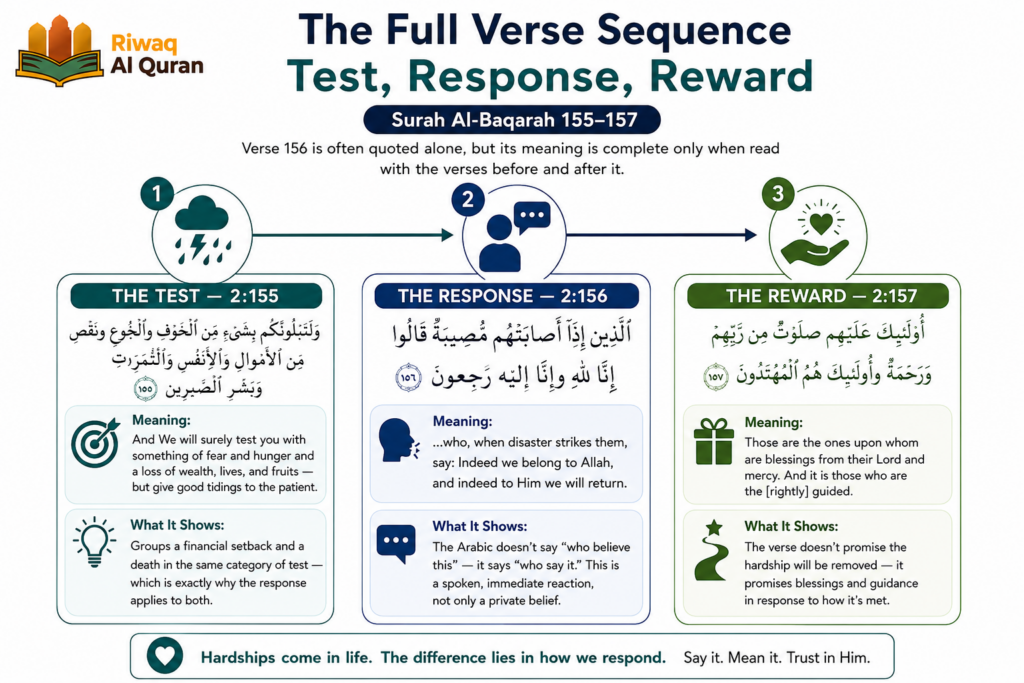
Inna Lillahi Wa Inna Ilayhi Raji’un sits inside a three-verse passage (2:155–157) that first warns of hardship, then gives the believer’s response, then states the reward. Reading the three together is what gives the phrase its full weight — most explanations only quote the middle verse. The table below lays out all three in sequence:
| Verse | Ayah (Arabic) | Meaning | What It Shows |
|---|---|---|---|
| The Test — 2:155 | ﴿وَلَنَبْلُوَنَّكُم بِشَىْءٍ مِّنَ ٱلْخَوْفِ وَٱلْجُوعِ وَنَقْصٍ مِّنَ ٱلْأَمْوَٰلِ وَٱلْأَنفُسِ وَٱلثَّمَرَٰتِ ۗ وَبَشِّرِ ٱلصَّـٰبِرِينَ﴾ | “And We will surely test you with something of fear and hunger and a loss of wealth, lives, and fruits — but give good tidings to the patient.” | Groups a financial setback and a death in the same category of test — which is exactly why the response applies to both. |
| The Response — 2:156 | ﴿ٱلَّذِينَ إِذَآ أَصَـٰبَتْهُم مُّصِيبَةٌ قَالُوٓا۟ إِنَّا لِلَّهِ وَإِنَّآ إِلَيْهِ رَٰجِعُونَ﴾ | “…who, when disaster strikes them, say: Indeed we belong to Allah, and indeed to Him we will return.” | The Arabic doesn’t say “who believe this” — it says “who say it.” This is a spoken, immediate reaction, not a private belief held in the heart. |
| The Reward — 2:157 | ﴿أُو۟لَـٰٓئِكَ عَلَيْهِمْ صَلَوَٰتٌ مِّن رَّبِّهِمْ وَرَحْمَةٌ ۖ وَأُو۟لَـٰٓئِكَ هُمُ ٱلْمُهْتَدُونَ﴾ | “Those are the ones upon whom are blessings from their Lord and mercy. And it is those who are the [rightly] guided.” | The verse doesn’t promise the hardship will be removed — it promises blessings and guidance in response to how it’s met. |
2. Word-by-Word Breakdown
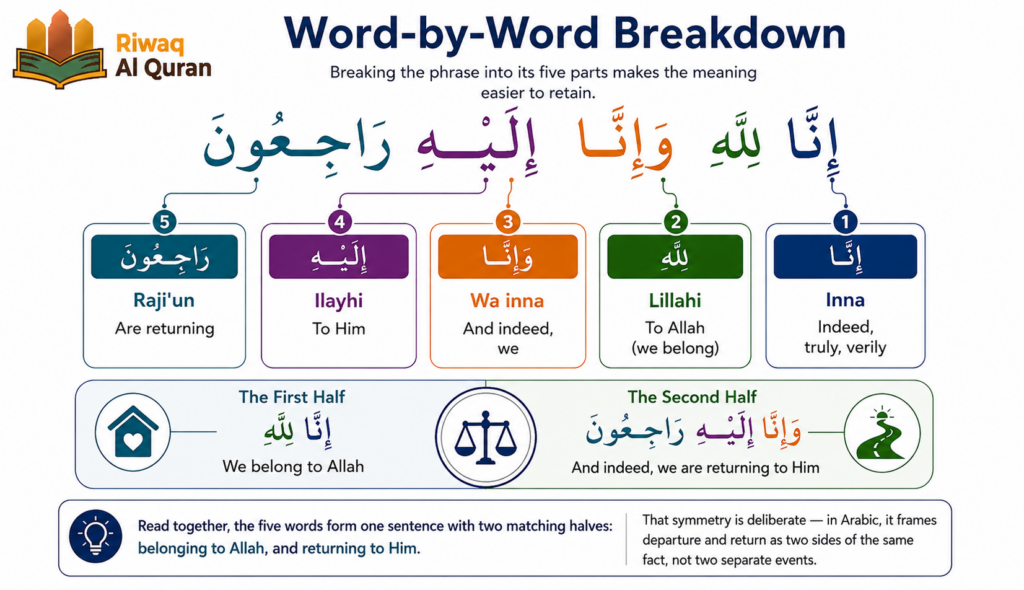
Breaking the phrase into its five parts makes the meaning easier to retain, as the table below shows:
| Word | Meaning |
|---|---|
| Inna | Indeed, truly, verily |
| Lillahi | To Allah (we belong) |
| Wa inna | And indeed, we |
| Ilayhi | To Him |
| Raji’un | Are returning |
Read together, the five words form one sentence with two matching halves: belonging to Allah, and returning to Him. That symmetry is deliberate — in Arabic, it frames departure and return as two sides of the same fact, not two separate events.
How to Write Inna Lillahi Wa Inna Ilayhi Raji’un in Arabic and Other Languages
Because this phrase moves between languages so often — spoken, texted, and printed on condolence cards — it appears in more spelling variations than almost any other Islamic expression. The Arabic original never changes; what changes is how each language tries to represent its sounds.
1. Arabic Text and Common English Transliterations
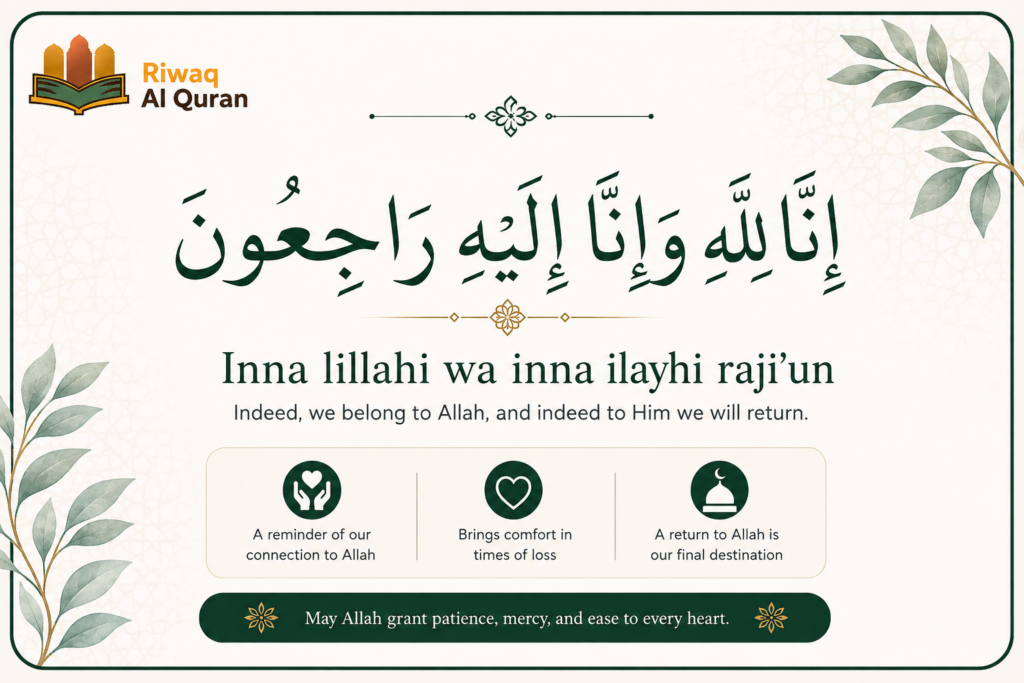
The Arabic text is written: إِنَّا لِلَّهِ وَإِنَّا إِلَيْهِ رَاجِعُونَ
Arabic sounds do not map perfectly onto the Latin alphabet, so English speakers write the phrase several different ways, as shown below:
| Transliteration | Note |
|---|---|
| Inna lillahi wa inna ilayhi raji’un | Closest to the original Arabic pronunciation |
| Inna lillahi wa inallah-e-raji’oon | Common variant |
| Inna lillahi wa inna ilaihi rajioon | Common variant |
| Innalillahi wa innailaihi rojiun | Common condensed variant |
| Ina lilah waina allah rajiun | Simplified phonetic variant |
None of these change the meaning — they are pronunciation attempts, not different phrases. If you’re writing it for a card or a caption, “Inna lillahi wa inna ilayhi raji’un” is the version closest to the original Arabic sound.
2. Urdu, Hindi, and Tamil Translations
Muslim communities outside the Arabic-speaking world often learn this phrase in translation first. Each version below carries the same two-part meaning: belonging to Allah, and returning to Him.
| Language | Translation |
|---|---|
| Urdu | بے شک ہم اللہ کے لیے ہیں اور اسی کی طرف ہمیں لوٹنا ہے۔ |
| Hindi | हम अल्लाह के हैं और उसी की ओर लौटेंगे |
| Tamil | நாம் அல்லாஹ்வுக்கே உரியவர்கள், அவனிடமே திரும்புவோம் |
Reading the phrase in translation is a useful starting point, but a direct grasp of the Arabic changes how it feels to recite. Riwaq Al Quran’s online Arabic classes are built around closing exactly this gap — reading Quranic Arabic with understanding, not just recitation, so a verse like this one stops being a memorized sound and becomes something you can follow word by word.
You can read more on this in Riwaq Al Quran’s guide to the importance of learning Arabic in Islam.
When Do Muslims Say Inna Lillahi Wa Inna Ilayhi Raji’un?
The phrase is most associated with news of death, but the Quran’s own wording is broader than that. Understanding both uses — the specific and the general — explains why you’ll hear this dua in situations that have nothing to do with a funeral.
1. Upon Hearing of a Death
The most common use of Inna Lillahi Wa Inna Ilayhi Raji’un is as a Muslim’s first reaction to hearing that someone has died, usually followed by a prayer for the deceased such as “may Allah grant them Jannat-ul-Firdaus.”
This connects to a wider Quranic idea: that death is unavoidable, regardless of a person’s wealth, health, or status.
(أَيْنَمَا تَكُونُوا۟ يُدْرِككُّمُ ٱلْمَوْتُ وَلَوْ كُنتُمْ فِى بُرُوجٍ مُّشَيَّدَةٍ)
“Wherever you may be, death will overtake you, even if you are in fortified towers.”— [Surah An-Nisa, 4:78]
The verse was revealed addressing people who thought physical safety could be engineered against death. It’s not a verse about war or fortresses specifically — it’s a rebuttal to the idea that death is a risk that can be managed away.*
A related verse makes the same point about the certainty of death and the temporary nature of this life:
(كُلُّ نَفْسٍ ذَآئِقَةُ ٱلْمَوْتِ ۗ وَمَا ٱلْحَيَوٰةُ ٱلدُّنْيَآ إِلَّا مَتَـٰعُ ٱلْغُرُورِ)
“Every soul will taste death… and the life of this world is only the enjoyment of delusion.” — [Surah Ali ‘Imran, 3:185]
Taste” (ذائقة) is a deliberate word choice — it implies something universal and personally experienced, not something that happens to other people. Every soul tastes it individually; no one is exempted or represented by someone else’s death.
2. During Hardship, Loss, or Minor Calamities
Beyond death, the phrase applies to any form of loss — financial setbacks, illness, a failed exam, or a minor accident. Hadith collections record that Prophet Muhammad ﷺ recited it in small daily moments too:
- When his shoelace snapped.
- When a thorn pricked him.
- When a lamp went out.
That detail matters because it shows the dua was never meant to be reserved for tragedy alone. It was part of an everyday response to friction — redirecting attention to Allah the moment something goes wrong, at any scale.
How Do You Respond When Someone Says This Dua to You?
This is one of the most searched follow-up questions about the phrase, and it rarely gets a clear answer. There are two moments this comes up: reciting it as the person affected, and responding after someone else recites it to you.
1. The Full Prophetic Dua for Calamity
The Quranic phrase is often only the first half of what is recommended. A hadith narrated by Umm Salamah records the Prophet Muhammad ﷺ teaching a longer version to say when a calamity strikes:
“إِنَّا لِلَّهِ وَإِنَّا إِلَيْهِ رَاجِعُونَ، اللَّهُمَّ عِنْدَكَ احْتَسَبْتُ مُصِيبَتِي فَأْجُرْنِي فِيهَا وَعُضْنِي مِنْهَا”
“Truly, to Allah we belong and truly, to Him we shall return. O Allah, with You I seek reward for my affliction, so reward me for it and compensate me with something better than it.” — [Sunan Ibn Majah 1598], graded Hasan by Darussalam.
The hadith doesn’t stop at acceptance — it asks Allah directly for a reward and a replacement. It turns the moment of loss into a request, not just a statement of resignation.*
Umm Salamah later said that after her husband Abu Salamah died, she recited this dua for him — and Allah compensated her with the Prophet Muhammad ﷺ himself, whom she then married.
2. What to Say for Condolences
There is no single required response when someone recites Inna Lillahi Wa Inna Ilayhi Raji’un after a death — Islam doesn’t prescribe a fixed reply the way some cultures expect “you’re welcome” after “thank you.” Common, accepted responses include:
- Repeating the phrase back.
- Saying “Ameen” to any dua that follows it.
- Offering a short prayer for the deceased, such as “Allah yerhamha” (may Allah have mercy on her).
The safest response, in any language, is to acknowledge the loss and pair it with a prayer. The specific wording matters less than the sincerity behind it.
Knowing how a hadith reference is graded, and how to weigh one narration against another, is exactly what a structured Tafseer course covers. Riwaq Al Quran’s Tafseer classes walk through verses like Al-Baqarah 2:155–157 in their full context, rather than as an isolated quote, which is where a lot of the phrase’s deeper meaning gets lost.
Common Mistakes Muslims Make When Reciting This Dua
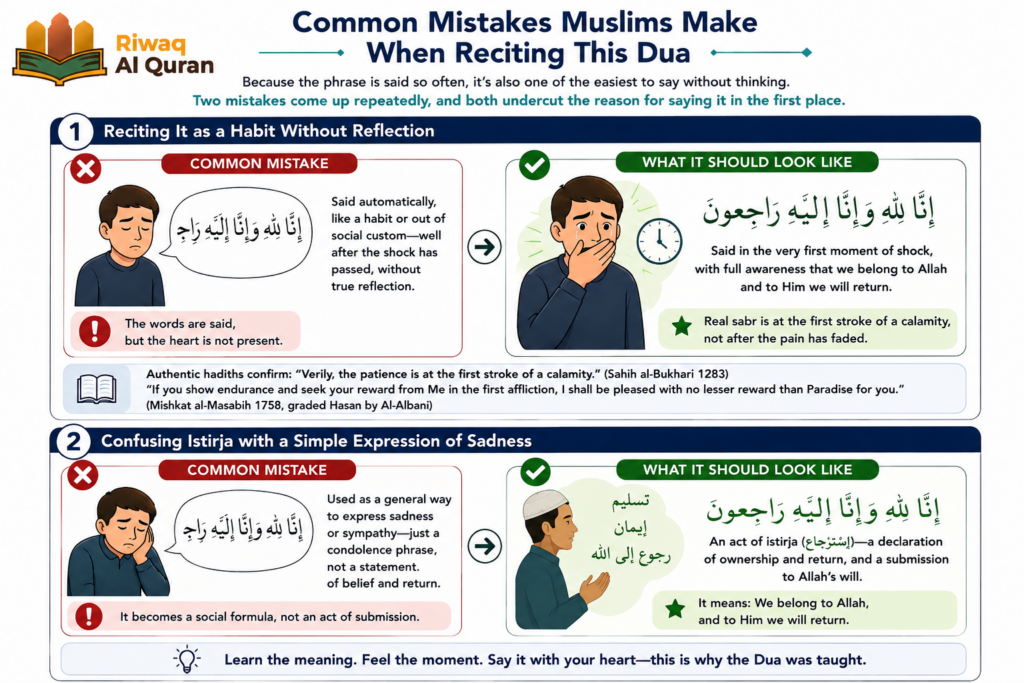
Because the phrase is said so often, it’s also one of the easiest to say without thinking. Two mistakes come up repeatedly, and both undercut the reason for saying it in the first place.
1. Reciting It as a Habit Without Reflection
There’s an authentic hadith that speaks directly to this. Anas ibn Malik narrated that the Prophet ﷺ passed a woman weeping at a grave and told her to fear Allah and be patient. Not recognizing him, she snapped back that he hadn’t suffered a calamity like hers. When she later learned it was the Prophet ﷺ and came to apologize, he told her:
“إِنَّمَا الصَّبْرُ عِنْدَ الصَّدْمَةِ الأُولَى”
“Verily, the patience is at the first stroke of a calamity.” — Sahih al-Bukhari 1283
This is the hadith that actually defines what “patience” means here. It isn’t the calm someone eventually reaches after grief has settled — that’s just time passing. Real sabr, by this hadith’s definition, is the reaction in the first moment of shock. That’s precisely the moment Inna Lillahi Wa Inna Ilayhi Raji’un is meant to be said — not as a phrase recited once the pain has already faded.*
A second hadith reinforces the same idea, this time framed as a reward rather than a definition. Abu Umama reported that the Prophet ﷺ said Allah says:
“ابْنَ آدَمَ إِنْ صَبَرْتَ وَاحْتَسَبْتَ عِنْدَ الصَّدْمَةِ الْأُولَى لَمْ أَرْضَ لَكَ ثَوَابًا دُونَ الْجَنَّةِ”
“Son of Adam, if you show endurance and seek your reward from Me in the first affliction, I shall be pleased with no lesser reward than Paradise for you.” — Mishkat al-Masabih 1758, graded Hasan by Al-Albani.
Together, these two hadiths turn “patience” from a vague virtue into something with a specific timestamp — the instant the news lands, not the version of composure a person performs for others afterward.*
A common mistake, then, is reciting the phrase automatically — the way someone might say “bless you” after a sneeze — well after the initial reaction has already passed, without the words carrying any of the weight described above.
2. Confusing Istirja with a Simple Expression of Sadness
Inna Lillahi Wa Inna Ilayhi Raji’un is also known as istirja (إِسْتِرْجَاع), from the Arabic root ر-ج-ع, meaning “to return.” Istirja is specifically an act of submission to Allah’s will, distinct from simply expressing that something sad has happened.
Treating it as a generic condolence phrase, rather than a statement of ownership and return, is the second common mistake — and it’s why many Muslims are encouraged to learn the phrase’s meaning in Arabic rather than only memorizing its sound.
Learn Quran, Arabic And Islamic Studies Online With The Best Native Tutors
Riwaq Al Quran is a comprehensive online platform that offers personalized Quran, Arabic and Islamic Studies Online classes for individuals of all ages and backgrounds. Their experienced instructors use a structured curriculum to cover Tajweed, Tafsir, and Memorization, providing easy and effective access to learning the Quran.
Hear directly from our students about how Riwaq Al Quran Academy has transformed their connection with the Book of Allah:
The advanced online classes allow for seamless communication and interaction between students and teachers. Join Riwaq Al Quran for a deeper connection with the Quran.
Here are a sample of our set of Quran Courses that will be helpful for you:
- Online Tafseer Course: Delve into Quranic meanings with our insightful online Tafseer course.
- Noorani Qaida Online: Learn Quranic basics efficiently through our Noorani Qaida online program.
- Online Quran Recitation Course: Enhance Quranic recitation skills through our expert-led online course.
- Online Tajweed Classes: Master Tajweed rules for beautiful Quranic recitation in online classes.
- Quran Memorization Online Course: Memorize the Quran effectively with our specialized online memorization course.
- Online Qirat Course: Explore diverse Qirat styles with our comprehensive online Qirat course.
- Online Quran Classes for Kids: Nurture a love for the Quran in kids through interactive online classes.


Why Students Love Learning with Riwaq Al Quran
Hear directly from our students about how Riwaq Al Quran Academy has transformed their connection with the Book of Allah. Their experiences reflect the dedication, care, and quality that guide every step of our teaching.
So, one can recite Innalillahi Wa Innailaihi Rojiun, إِنَّا لِلَّٰهِ وَإِنَّا إِلَيْهِ رَاجِعُونَ, in any language when facing distress or discomfort. It is important to learn that this is not only a statement but a prayer. Reciting it with a pure heart and true intentions that we all are destined to return to Allah SWT will give us much reward.
Riwaq Al Quran makes it easier for all Muslim brothers and sisters by offering multiple Online Arabic Courses to have a good grasp of the Arabic language and get help in understanding the dua.
Also, you can now enroll in our special Quran Tafseer Course that is specifically designed for students who wish to understand the true meaning of the Quran and ponder its greatness.
FAQs
The questions below cover the details readers most often search for around this phrase — from pronunciation to how to respond when you hear it.
What does Inna Lillahi Wa Inna Ilayhi Raji’un mean?
Inna Lillahi Wa Inna Ilayhi Raji’un means “Indeed, we belong to Allah, and indeed, to Him we shall return.” It comes from Surah Al-Baqarah, 2:156 and is recited upon hearing of a death or during hardship.
How do you pronounce Inna Lillahi Wa Inna Ilayhi Raji’un?
The closest phonetic pronunciation is “In-nah lil-lah-hee wa in-nah ee-lay-hee raa-jee-oon.” The emphasis falls on the long vowels in “lillahi” and “raji’un.”
How do you respond when someone says this dua to you?
There is no single fixed reply. Common responses include repeating the phrase back, saying “Ameen” after any dua that follows it, or offering a short prayer for the deceased such as “may Allah grant them Jannah.”
When should you say Innalillahi Wa Innailaihi Rojiun?
The primary use is upon hearing news of a death, but Sahih al-Bukhari 1283 shows the Prophet ﷺ tied its patience specifically to the first moment a calamity strikes — and other hadith record him saying it during small daily setbacks too, such as a broken shoelace or a thorn prick.
Is Inna Lillahi Wa Inna Ilayhi Raji’un only said for death?
No. Surah Al-Baqarah, 2:155 frames the test in terms of “fear and hunger and a loss of wealth, lives, and fruits” — grouping death with other hardships scholars extend to illness and financial loss.
What is istirja?
Istirja (إِسْتِرْجَاع) is the Arabic term for reciting Inna Lillahi Wa Inna Ilayhi Raji’un in response to hardship. It comes from the root meaning “to return,” and refers specifically to submitting to Allah’s will rather than simply expressing sadness.
Sources
| Reference | Grade / Type | Link |
|---|---|---|
| Al-Baqarah 2:155 | Quran | quran.com/2:155 |
| Al-Baqarah 2:156 | Quran | quran.com/2:156 |
| Al-Baqarah 2:157 | Quran | quran.com/2:157 |
| An-Nisa 4:78 | Quran | quran.com/4:78 |
| Ali ‘Imran 3:180 | Quran | quran.com/3:180 |
| Ali ‘Imran 3:185 | Quran | quran.com/3:185 |
| Sahih al-Bukhari 1283 | Sahih | sunnah.com/bukhari:1283 |
| Sunan Ibn Majah 1598 | Hasan (Darussalam) | sunnah.com/ibnmajah:1598 |
| Mishkat al-Masabih 1758 | Hasan | sunnah.com/mishkat:1758 |
2. Hadith References
Each hadith below is graded according to sunnah.com’s classification:
| Hadith | Grade | Link |
|---|---|---|
| Sahih al-Bukhari 1283 | Sahih | sunnah.com/bukhari:1283 |
| Sunan Ibn Majah 1598 | Hasan (Darussalam) | sunnah.com/ibnmajah:1598 |
| Mishkat al-Masabih 1758 | Hasan (Al-Albani) | sunnah.com/mishkat:1758 |