
Surah Al Ala carries a message so essential that the Prophet Muhammad ﷺ chose it for his most important congregational prayers. Its 19 verses move from glorifying Allah’s perfection to reminding every soul of its ultimate purpose — purification, remembrance, and the eternal life to come.
For non-Arabic speaking Muslims, understanding the Surah Al-Ala’s benefits goes far beyond recitation. Each verse holds practical spiritual guidance, doctrinal clarity, and a direct call to align one’s inner and outer life with the remembrance of Allah. This article examines those benefits in depth, grounded in the surah’s own words.
Table of Contents
1. Reciting Surah Al Ala Reconnects You to the Foundational Act of Worship
Surah Al Ala opens with a direct divine command: glorify the name of your Lord, the Most High. This is not a suggestion — it is the very posture Islam asks of every believer in every moment. The Arabic verb سَبِّحِ (sabbih) calls for active, continuous glorification, making this surah an ongoing lesson in the correct orientation of the human heart toward Allah.
سَبِّحِ ٱسْمَ رَبِّكَ ٱلْأَعْلَى
Sabbiḥ isma rabbika l-aʿlā
“Glorify the name of your Lord, the Most High.” (Al-A’la 87:1)
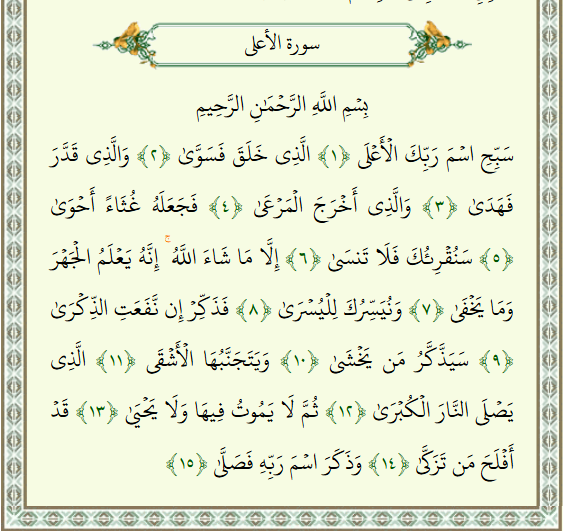
The surah immediately follows with Allah’s attributes — He who created and proportioned, He who determined and guided. These verses train the reciter to see creation itself as evidence of Allah’s perfection.
In our sessions at Riwaq Al Quran, students who study this surah with its meaning report a tangible shift in how they approach their daily dhikr — it becomes purposeful rather than mechanical.
If you want to recite and understand the Quran with this depth of engagement, our Online Quran Tafseer Course guides you through the meaning and context of each surah with Azhari-certified instructors.
Enroll Now in Riwaq’s Tafseer Course

2. Surah Al Ala Strengthens Your Belief in Allah’s Complete Knowledge and Control
One of the most profound surah al ala benefits is found in verses 6 and 7, where Allah directly reassures the Prophet ﷺ — and by extension every believer — that nothing of the Quran will be forgotten, except what Allah wills.
سَنُقْرِئُكَ فَلَا تَنسَىٰٓ إِلَّا مَا شَآءَ ٱللَّهُ
Sanuqri’uka falā tansā, illā mā shā’a Allāh
“We will make you recite, and you will not forget — except what Allah should will.” (Al-A’la 87:6-7)
This verse has particular relevance for Quran memorization students. The guarantee that Allah preserves His word — and enables His servants to carry it — is itself a source of spiritual strength.
For Huffaz students who experience forgetting as discouragement, this verse reframes the entire experience: retention is ultimately in Allah’s hands, and consistent effort is the believer’s responsibility.
For students building their Hifz with this conviction, Riwaq Al Quran’s Online Quran Memorization Course pairs you with an Azhari-certified Hafiz for structured, one-on-one sessions with 24/7 scheduling flexibility. Explore proven strategies to support your memorization through our guide on Quran memorization techniques.
Start your Hifz journey with a Free Trial

3. Building the Habit of Making Things Easy Through Divine Guidance
Verse 8 of Surah Al Ala contains one of the most comforting promises in the entire Quran: Allah will ease the believer toward the easier path.
وَنُيَسِّرُكَ لِلْيُسْرَىٰ
Wa nuyassiruka lil-yusrā
“And We will ease you toward ease.” (Al-A’la 87:8)
Classical scholars of Tafsir understood this verse as a broader principle: that divine guidance — when followed — leads a person toward ease in both worship and life. This is not a passive promise.
The preceding verses establish that ease comes after effort, after recitation, after glorification. The believer who acts on the opening commands of the surah is the one who receives this ease.
This surah teaches that difficulty in worship is not a sign of rejection. It is part of a process that Allah Himself facilitates.
Students who struggle with Tajweed or memorization plateaus often need this reminder most.
To deepen your understanding of how such Quranic promises apply practically, explore the Tafsir meaning and what it means to study the Quran contextually.
Experience Riwaq Al Quran Classes
Watch real moments from our live sessions at Riwaq Al Quran and see how we bring learning to life. These clips highlight our interactive, student-focused approach designed to keep learners engaged, motivated, and actively involved in every step of their educational journey.
4. Reminding the Believer That Reminder Benefits Those Who Fear Allah
Verse 9 and 10 present a spiritual law that governs all Islamic teaching and preaching — reminder benefits the one who possesses reverence for Allah.
فَذَكِّرْ إِن نَّفَعَتِ ٱلذِّكْرَىٰ سَيَذَّكَّرُ مَن يَخْشَىٰ
Fa dhakkir in nafa’at idh-dhikrā, sa-yadhdhakkaru man yakhshā
“So remind, if the reminder should benefit. He who fears Allah will be reminded.” (Al-A’la 87:9-10)
This verse carries a quietly profound message: receptivity to Islamic knowledge is itself connected to the presence of khashyah — awe and fear of Allah — in the heart.
It explains why two people can sit in the same lesson and leave with entirely different outcomes. The one who approaches Quranic study with genuine reverence absorbs it differently.
For Muslim parents raising children in Western contexts, this surah offers a framework for Islamic education. The goal is not just transmitting information — it is cultivating khashyah so that knowledge takes root. Our Islamic Studies Classes for Kids and Best Islamic Studies Online Course are designed around this exact principle — building reverence alongside knowledge.
Begin your Islamic Studies with a FREE trial lesson

5. Teaching the Eternal Consequence of Turning Away from Allah
Verses 11 through 13 shift tone sharply, addressing those who turn away from remembrance and choose the lower life over the higher one.
وَيَتَجَنَّبُهَا ٱلْأَشْقَى ٱلَّذِى يَصْلَى ٱلنَّارَ ٱلْكُبْرَىٰ
Wa yatajannabuhā l-ashqā, alladhī yaṣlā n-nāra l-kubrā
“But the most wretched will avoid it — he who will enter the greatest Fire.” (Al-A’la 87:11-12)
The surah does not leave this consequence without context. It is directly tied to choosing the lower life — the worldly over the eternal.
This is not a condemnation of those who struggle; it is a warning to those who have deliberately prioritized dunya above all else. For the sincere believer, these verses function as a spiritual recalibration tool.
Reading and reflecting on these verses regularly guards the heart against gradual spiritual negligence — a state that creeps in slowly, especially in busy Western lifestyles.
| Verse Reference | Core Message | Spiritual Benefit |
| Al-A’la 87:1 | Glorify Allah’s name actively | Establishes correct worship posture |
| Al-A’la 87:6-7 | Allah preserves the Quran | Strengthens Hifz students’ trust in Allah |
| Al-A’la 87:8 | Allah eases the believer toward ease | Encourages persistence through difficulty |
| Al-A’la 87:9-10 | Reminder benefits the God-fearing | Motivates reverence in Islamic learning |
| Al-A’la 87:14-15 | Success belongs to those who purify | Ties Tazkiyah to Salah and remembrance |
6. Linking Success to Self-Purification and Remembrance of Allah
The most actionable spiritual formula in Surah Al Ala appears in verses 14 and 15 — one of the most cited passages in Islamic scholarship on Tazkiyah (purification of the soul).
قَدْ أَفْلَحَ مَن تَزَكَّىٰ وَذَكَرَ ٱسْمَ رَبِّهِۦ فَصَلَّىٰ
Qad aflaḥa man tazakkā, wa dhakara isma rabbihī faṣallā
“He has certainly succeeded who purifies himself, and mentions the name of his Lord and prays.” (Al-A’la 87:14-15)
These two verses contain the complete Islamic formula for falah — success in the fullest sense. Purification of the soul (Tazkiyah), remembrance of Allah (Dhikr), and establishing prayer (Salah) are presented as a unified, sequential path.
The Prophet ﷺ recited this surah in Jumu’ah and Eid prayers precisely because its message is communal — this formula applies to every Muslim, in every generation.
The Prophet ﷺ said:
“The best of you are those who learn the Qur’an and teach it.” (Sahih al-Bukhari 5027)
Learning this surah with its meaning transforms recitation into active self-purification.
7. Establishing That the Hereafter Is Immeasurably Better Than This World
The final two verses of Surah Al Ala deliver the surah’s doctrinal climax — a reminder that this life is temporary, and the Hereafter is far superior for those who believe.
بَلْ تُؤْثِرُونَ ٱلْحَيَوٰةَ ٱلدُّنْيَا وَالْآخِرَةُ خَيْرٌ وَأَبْقَىٰ
Bal tu’thirūna l-ḥayāta d-dunyā, wa l-ākhiratu khayrun wa abqā
“But you prefer the worldly life, while the Hereafter is better and more enduring.” (Al-A’la 87:16-17)
These verses close the surah with a contrast — between what is preferred and what is better. The believer who recites these verses regularly builds a conscious awareness of this contrast in their daily decisions.
The surah then concludes by noting that this truth was present in the earlier scriptures — those of Ibrahim and Musa (peace be upon them both) — confirming that Islam’s message is the continuation of a single divine tradition.


Read Also: Surah Noor Benefits
The Sunnah Practice of Reciting Surah Al Ala in Friday and Eid Prayers
One of the most established surah al ala benefits from the Sunnah is its regular recitation in congregational worship. The Prophet ﷺ would recite Surah Al Ala alongside Surah Al Ghashiyah in the Friday prayer and in both Eid prayers.
Nu’man ibn Bashir reported: “The Messenger of Allah ﷺ used to recite in the two Eids and in Friday prayer: ‘Glorify the Name of your Lord, the Most High’ (Surah Al-A’la) and ‘Has there come to you the news of the Overwhelming’ (Surah Al-Ghashiyah).” (Sahih Muslim 878)
This consistent Sunnah practice demonstrates that Surah Al Ala was not simply memorized but actively embedded into the most significant communal acts of worship.
For any Muslim seeking to revive a Sunnah in their recitation practice, learning this surah with correct Tajweed is a meaningful starting point.
Proper Tajweed application transforms your recitation quality significantly. Understanding the benefits of Tajweed and learning the Tajweed rules will strengthen every surah you recite, including Al Ala.
| Worship Context | Surah Recited Alongside | Source |
| Jumu’ah (Friday) Prayer | Al Ala + Al Ghashiyah | Sahih Muslim 878 |
| Eid Al-Fitr Prayer | Al Ala + Al Ghashiyah | Sahih Muslim 878 |
| Eid Al-Adha Prayer | Al Ala + Al Ghashiyah | Sahih Muslim 878 |
| Witr Prayer (narrated) | Al Ala + Al Kafirun + Al Ikhlas | Various Hadith collections |
Read Also: Surah Saffat Benefits
Why Students Love Learning with Riwaq Al Quran
Hear directly from our students about how Riwaq Al Quran Academy has transformed their connection with the Book of Allah. Their experiences reflect the dedication, care, and quality that guide every step of our teaching.
Begin Studying Surah Al Ala with Riwaq Al Quran Today
The benefits of Surah Al Ala — from deepening Tazkiyah to reviving Sunnah recitation — are fully accessible to every Muslim willing to learn it with meaning and correct recitation.
At Riwaq Al Quran, our Azhari-certified instructors help non-Arabic speaking students:
- Recite Surah Al Ala with proper Tajweed and makharij
- Understand its Tafsir through our Online Quran Tafseer Course
- Memorize it correctly through our Online Quran Memorization Course
- Build broader Islamic knowledge through our Best Islamic Studies Online Course
We offer 2 free trial classes, 24/7 scheduling, and a 100% money-back guarantee. Book your free trial today — Insha’Allah, one surah studied deeply is worth more than ten recited without understanding.
We offer courses in Online Quran & Tajweed Classes, Arabic Language, and Islamic Studies.
- Online Quran Memorization Course
- Tajweed Classes
- Online Quran Classes for Kids.
- Ijazah Program.
- Arabic Language Classes.
- Islamic Studies Courses.
Enroll now for 2 Free Trial Classes and Begin Learning Islam and Quran Today

Read Also: Surah Yunus Benefits
Frequently Asked Questions About Surah Al Ala Benefits
What are the main benefits of reciting Surah Al Ala regularly?
The main benefits of reciting Surah Al Ala include reinforcing the act of glorifying Allah, strengthening belief in divine preservation of the Quran, building awareness of the superiority of the Hereafter, and connecting to the Prophet’s ﷺ Sunnah recitation in Friday and Eid prayers. Its verses directly teach Tazkiyah — the purification of the soul.
What is the importance of Surah Al Ala in Islamic worship?
Surah Al Ala holds elevated importance because the Prophet ﷺ consistently chose it for the most significant congregational prayers — Jumu’ah and both Eids. Its opening verse establishes the foundation of all Islamic worship: active glorification of Allah. Classical scholars consider it among the most doctrinally rich short surahs in the Quran.
What are the benefits of reading Surah Al Ala for Quran memorization students?
Surah Al Ala contains a direct divine assurance in verse 6 that Allah will enable the reciter not to forget. This verse has deep significance for Hifz students, reminding them that memorization is a divinely facilitated process. Studying the surah’s meaning alongside its memorization builds both spiritual motivation and doctrinal grounding for the memorization journey.
Is there a specific time or prayer when Surah Al-Ala is recommended to be recited?
Yes. The established Sunnah is to recite Surah Al Ala in the Friday prayer and in Eid prayers, paired with Surah Al Ghashiyah, as authentically narrated in Sahih Muslim (878). Some scholars also report its recitation in Witr prayer. Outside of formal prayer, reciting it in daily Nawafil (voluntary prayers) is a widely practiced means of reviving this Sunnah.