Surah An-Noor sits at the heart of Quranic social ethics. Revealed in Madinah, its 64 verses address matters that every Muslim community — in any century — must navigate: protecting reputations, maintaining modesty, guarding relationships, and living under divine light. These are not abstract ideals. They are practical moral anchors.
What makes Surah An-Noor extraordinary is that its benefits operate on multiple levels simultaneously. It legislates, it purifies, it warns, and it illuminates — all within a single chapter. Engaging with it seriously, through recitation, memorization, and Tafsir study, opens dimensions of meaning that transform how a Muslim conducts daily life.
Table of Contents
1. Surah An-Noor Guards the Dignity and Honor of Believers
Surah An-Noor’s opening verses establish its foundational purpose directly: protecting the honor of Muslim individuals and communities. Allah ﷻ begins by declaring it a chapter He has revealed and made obligatory — a direct signal of its weight.
Its first major legislation addresses false accusations of adultery (Qadhf), prescribing serious consequences for those who slander chaste believers without evidence.
This is one of the most significant Surah Noor benefits for community life: it creates a legal and moral firewall around personal reputation. In a time when slander spreads instantly through social media, these verses speak with startling urgency.
The Quran states in Surah An-Noor 24:4:
وَٱلَّذِينَ يَرْمُونَ ٱلْمُحْصَنَـٰتِ ثُمَّ لَمْ يَأْتُوا۟ بِأَرْبَعَةِ شُهَدَآءَ فَٱجْلِدُوهُمْ ثَمَـٰنِينَ جَلْدَةً
Walladhīna yarmūna al-muḥṣanāti thumma lam ya’tū bi-arba’ati shuhadā’a fajlidūhum thamānīna jaldah
“And those who accuse chaste women and then do not produce four witnesses — lash them with eighty lashes.” (An-Noor 24:4)
Ibn Kathir notes in his Tafsir that this legislation was revealed partly in response to the incident of the Ifk — the false accusation against Sayyidah Aisha (may Allah be pleased with her).
The chapter therefore carries a deeply human origin: real people were harmed, and Allah ﷻ responded with revelation that permanently protected believers from such harm.
2. The Light Verse Offers the Deepest Quranic Description of Divine Guidance
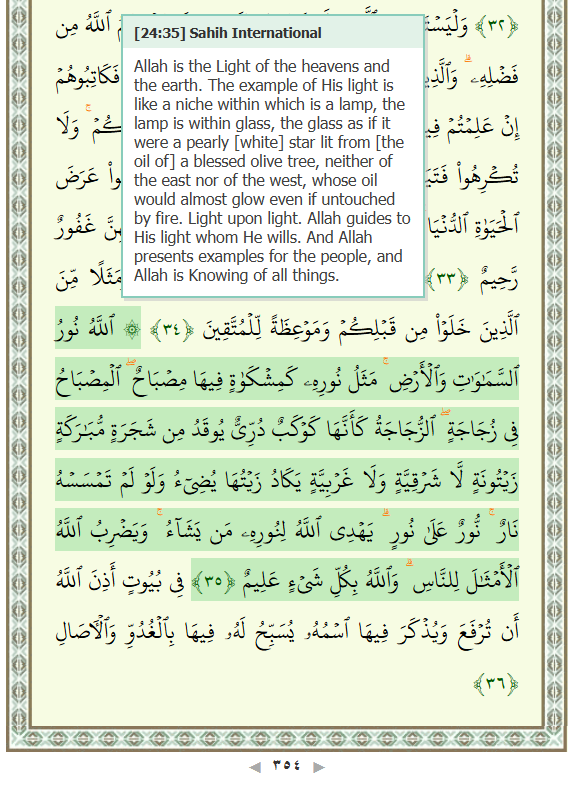
Ayat An-Noor — verse 35 of Surah An-Noor — is one of the most celebrated verses in the entire Quran. Surah Noor Ayat 35 benefits extend beyond recitation: scholars throughout Islamic history have written entire treatises on its imagery alone.
It describes Allah ﷻ as the Light of the heavens and earth, using a layered metaphor of a lamp within glass within a niche — each image compounding the intensity of divine illumination.
ٱللَّهُ نُورُ ٱلسَّمَـٰوَٰتِ وَٱلْأَرْضِ ۚ مَثَلُ نُورِهِۦ كَمِشْكَوٰةٍ فِيهَا مِصْبَاحٌ
Allāhu nūru as-samāwāti wa-al-arḍ, mathalu nūrihi kamishkātin fīhā miṣbāḥ
“Allah is the Light of the heavens and the earth. The example of His light is like a niche within which is a lamp.” (An-Noor 24:35)
Imam Al-Ghazali dedicated a full work — Mishkat Al-Anwar — to unpacking this single verse. He identified it as a description of prophetic and divine illumination cascading through levels of spiritual reality.
For the student of Quran, engaging with this verse through proper Tafsir study is not optional — it is where the verse’s benefit truly begins.
In our sessions at Riwaq Al Quran, students who encounter this verse for the first time often feel its weight before they understand it. That emotional recognition is genuine — and it deepens dramatically once proper Tafsir is applied.
Connect with our Azhari tutors to learn Quran with Tafseer

3. Surah An-Noor Builds Genuine Modesty
One of the most practical Surah Noor benefits is its direct instruction on lowering the gaze and guarding private parts — addressed explicitly to both men and women. This is not a cultural suggestion; it is a Quranic command backed by divine reasoning: Allah ﷻ is fully aware of what people do.
قُل لِّلْمُؤْمِنِينَ يَغُضُّوا۟ مِنْ أَبْصَـٰرِهِمْ وَيَحْفَظُوا۟ فُرُوجَهُمْ
Qul lil-mu’minīna yaghuḍḍū min abṣārihim wa-yaḥfaẓū furūjahum
“Tell the believing men to reduce some of their vision and guard their private parts.” (An-Noor 24:30)
The verse that follows addresses believing women with equivalent directness (An-Noor 24:31). This symmetry is itself a benefit: the Surah establishes mutual moral responsibility — modesty is not a burden placed on one gender alone.
| Quranic Instruction | Addressed To | Core Command | Spiritual Purpose |
| Lower the gaze | Believing men | Reduce vision from what is prohibited | Guard the heart from corruption |
| Guard private parts | Believing men | Protect chastity | Maintain personal sanctity |
| Lower the gaze | Believing women | Reduce vision from what is prohibited | Guard the heart from corruption |
| Display adornments modestly | Believing women | Conceal except what is apparent | Preserve dignity and honor |
These instructions, when practiced consistently, build what classical scholars call Haya (modesty) as a living spiritual quality — not merely an external code.
Experience Riwaq Al Quran Classes
Watch real moments from our live sessions at Riwaq Al Quran and see how we bring learning to life. These clips highlight our interactive, student-focused approach designed to keep learners engaged, motivated, and actively involved in every step of their educational journey.
4. Strengthening the Muslim Household
Among the Surah Noor benefits that are most overlooked is its detailed instruction on household conduct. The Surah introduces the concept of Isti’dhan — seeking permission before entering another’s private space.
Three specific times are highlighted for children and household members: before Fajr prayer, at midday rest, and after Isha prayer.
يَـٰٓأَيُّهَا ٱلَّذِينَ ءَامَنُوا۟ لِيَسْتَـْٔذِنكُمُ ٱلَّذِينَ مَلَكَتْ أَيْمَـٰنُكُمْ
Yā ayyuhā alladhīna āmanū liyasta’dhinkumu alladhīna malakat aymānukum
“O you who have believed, let those whom your right hands possess and those who have not yet reached puberty among you ask permission of you.” (An-Noor 24:58)
This instruction creates a culture of mutual respect and privacy within the family unit. For Western Muslim families navigating household boundaries in shared living situations, these verses provide practical divine guidance that modern psychology confirms as healthy boundary-setting.
5. Consistent Recitation of Surah An-Noor Purifies the Heart and Conduct
There is a weak narration that the Prophet ﷺ encouraged learning and teaching Surah An-Noor as a protection for women within Muslim households.
The Messenger of Allah ﷺ said:
“Teach your men Surah Al-Ma’idah and teach your women Surah An-Noor.”
This narration is reported by Al-Bayhaqi in Shu’ab Al-Iman and has been discussed by scholars regarding its chain, and it is weak.
What is established without doubt is that reciting the Quran generally carries immense reward. The Prophet ﷺ said:
“The one who is proficient in the recitation of the Qur’an will be with the honourable and obedient scribes (angels).” (Sahih Muslim 798)
Surah An-Noor, as part of the Quran, carries this reward fully. Its recitation — with proper Tajweed and understanding — purifies the reciter and reinforces the moral qualities the Surah legislates. If you want to recite it with the precision it deserves, Riwaq Al Quran’s Quran Recitation Course provides Azhari-certified instruction with two free trial classes.
Book Your Free Session in Riwaq’s Recitation Course

6. Promised Divine Protection and Victory to Righteous Believers
One of the most uplifting Surah Noor benefits appears in its closing section. Allah ﷻ promises succession, empowerment, and security to those who believe and do righteous deeds — connecting individual moral conduct directly to collective divine support.
وَعَدَ ٱللَّهُ ٱلَّذِينَ ءَامَنُوا۟ مِنكُمْ وَعَمِلُوا۟ ٱلصَّـٰلِحَـٰتِ لَيَسْتَخْلِفَنَّهُمْ فِى ٱلْأَرْضِ
Wa’ada Allāhu alladhīna āmanū minkum wa-‘amilū aṣ-ṣāliḥāti layastakhlifannahum fī al-arḍ
“Allah has promised those who have believed among you and done righteous deeds that He will surely grant them succession upon the earth.” (An-Noor 24:55)
This verse is not limited to political succession in a historical sense. Scholars of Tafsir, including Ibn Kathir, understand it as a conditional divine promise: righteousness and worship bring divine facilitation.
For the Muslim student memorizing or studying this Surah, this verse is both a motivation and a reminder that moral excellence carries consequences far beyond the individual.

Addressing Common Claims About Surah Noor Benefits for Marriage and Beauty
Two popular claims circulate widely online: that reciting Surah An-Noor brings beauty to the face, and that it facilitates marriage. These require careful scholarly treatment.
Regarding beauty: No verified hadith or authenticated scholarly statement establishes that reciting Surah An-Noor specifically beautifies the face. What is established is that the noor (light) of Quran recitation affects the heart and, by extension, the demeanor and presence of the believer.
Regarding marriage: The Surah’s deep emphasis on chastity, modesty, and halal relationships naturally positions it as relevant for anyone seeking a righteous marriage. Reading it with understanding reinforces the qualities that make one a suitable, God-conscious spouse. However, no authenticated hadith specifies Surah An-Noor as a prescribed recitation for facilitating marriage specifically.
| Popular Claim | Authenticity Status | What Is Established |
| Reciting Surah Noor beautifies the face | No verified hadith confirms this specifically | Quran recitation brings spiritual light and positive change in character |
| Reciting Surah Noor facilitates marriage | No authenticated hadith confirms this specifically | The Surah’s moral teachings build qualities of a righteous spouse |
| Surah Noor Ayat 35 has special recitation benefits | No specific reward narrated in sahih hadith | It is among the most profound verses in the Quran, rewarded as part of Quran recitation generally |
Attributing specific outcomes to specific Surahs without authenticated evidence risks introducing Bid’a — innovation in worship — into one’s practice. The safe, scholarly position is to recite Surah An-Noor with understanding and sincerity, trusting in the general Quranic promise of reward, without attaching unverified specific benefits to it.
Deep Understanding of Surah An-Noor Requires Tafsir, Not Translation Alone
Surah An-Noor contains some of the most legally and linguistically dense content in the Quran. Translation alone — even accurate translation — fails to convey the full weight of its commands, the context of its revelation (Asbab Al-Nuzul), or the nuances that classical scholars spent centuries unpacking.
Understanding concepts like Li’an (mutual oath of condemnation between spouses in 24:6–9), the legal threshold of four witnesses for accusations, and the multi-layered imagery of Ayat An-Noor (24:35) requires structured Tafsir study.
Riwaq Al Quran’s Online Quran Tafseer Course approaches the Quran the way it was always meant to be studied — through qualified scholarship, authentic classical sources, and one-on-one instruction with Azhari-certified tutors. This is where Surah An-Noor’s benefits move from theoretical to lived.
Enroll Now in Riwaq’s Tafseer Course with a FREE trial

You can also explore more about what Tafsir means and why it matters in Quranic education as a starting point for that study.
Read Also: Surah Al Ala Benefits
Memorizing Surah An-Noor Accelerates Your Hifz Progress Significantly
Surah An-Noor is located in Juz’ 18, spanning approximately 8 pages of the standard Mushaf. For students working through structured Quran memorization, it represents a significant and deeply rewarding milestone. Its legislative content — with its clear, direct sentence structures — is often more accessible to memorize than highly poetic Makkan Surahs.
At Riwaq Al Quran, students in our Online Quran Memorization Course who work through Juz’ 18 consistently report that Surah An-Noor’s verses remain among the most deeply internalized.
The reason is straightforward: when you understand what you are memorizing — its commands, its context, its wisdom — retention is dramatically stronger.
Start your Hifz journey with a Free Trial
You can review proven Quran memorization techniques and explore building a Quran memorization schedule to approach it systematically.
Read Also: Surah Saffat Benefits
Why Students Love Learning with Riwaq Al Quran
Hear directly from our students about how Riwaq Al Quran Academy has transformed their connection with the Book of Allah. Their experiences reflect the dedication, care, and quality that guide every step of our teaching.
Begin Learning Surah An-Noor Deeply with Riwaq Al Quran
Surah An-Noor’s benefits are realized through engagement — recitation, memorization, and genuine understanding. Surface-level reading is only the beginning.
Riwaq Al Quran offers Azhari-certified instruction across three programs most relevant to studying Surah An-Noor deeply:
- Online Quran Memorization Course — Memorize with precision under Hafiz tutors
- Online Quran Tafseer Course — Understand every verse with scholarly depth
- Best Islamic Studies Online Course — Build the Islamic knowledge framework that brings Quranic study to life
2 free trial classes. 24/7 scheduling. 100% Money-Back Guarantee. Start today, Insha’Allah.
We offer courses in Online Quran & Tajweed Classes, Arabic Language, and Islamic Studies.
- Online Quran Memorization Course
- Tafseer Course
- Tajweed Classes
- Online Quran Classes for Kids.
- Ijazah Program.
- Arabic Language Classes.
- Islamic Studies Courses.
Enroll now for 2 Free Trial Classes and Begin Learning Islam and Quran Today

Read Also: Surah Yunus Benefits
Frequently Asked Questions About Surah An-Noor Benefits
Is There an Authentic Hadith Specifically About the Benefits of Surah An-Noor?
One weak narration encourages teaching Surah An-Noor to women in the household, reported by Al-Bayhaqi. However, scholars have noted weakness in its chain, and it should be understood as encouragement to study its ethical teachings — not as a basis for specific ritual prescriptions. General Quranic recitation rewards apply fully to Surah An-Noor through well-authenticated hadiths.
What Are the Confirmed Surah Noor Benefits for Marriage?
No sahih hadith confirms a specific marriage benefit tied to Surah An-Noor by name. However, the Surah’s verses on modesty, lowering the gaze, and guarding chastity build the qualities of a God-conscious, righteous spouse. Reciting and studying it with sincere intention to embody its guidance is the most authentic approach to benefiting from it in this area.
Is Reciting Surah Noor for a Beautiful Face Authentically Established?
No, verified hadith establishes facial beauty as a specific outcome of reciting Surah An-Noor. Classical scholarship does affirm that consistent Quran recitation produces a spiritual light (noor) visible in a believer’s character and presence. Claiming it as a specific beauty formula without authenticated evidence risks attributing to the Quran what has not been confirmed by authentic narration.
Why Is Surah Noor Ayat 35 Considered So Significant in Islamic Scholarship?
Ayat An-Noor (24:35) is among the most analyzed single verses in the Quran. Imam Al-Ghazali dedicated Mishkat Al-Anwar entirely to its exegesis. It uses a multi-layered light metaphor to describe divine guidance — a niche, lamp, glass, blessed olive tree — each element representing a dimension of how Allah’s ﷻ light reaches the believer. It demands Tafsir study, not translation alone.
How Long Does It Take to Memorize Surah An-Noor?
Surah An-Noor spans approximately 8 pages in the standard 604-page Mushaf. A student memorizing one page per day would complete it in roughly 8 days of new memorization — but proper retention through daily revision typically extends meaningful consolidation to 3–4 weeks. At Riwaq Al Quran, our tutors build personalized revision schedules to ensure what is memorized stays memorized.