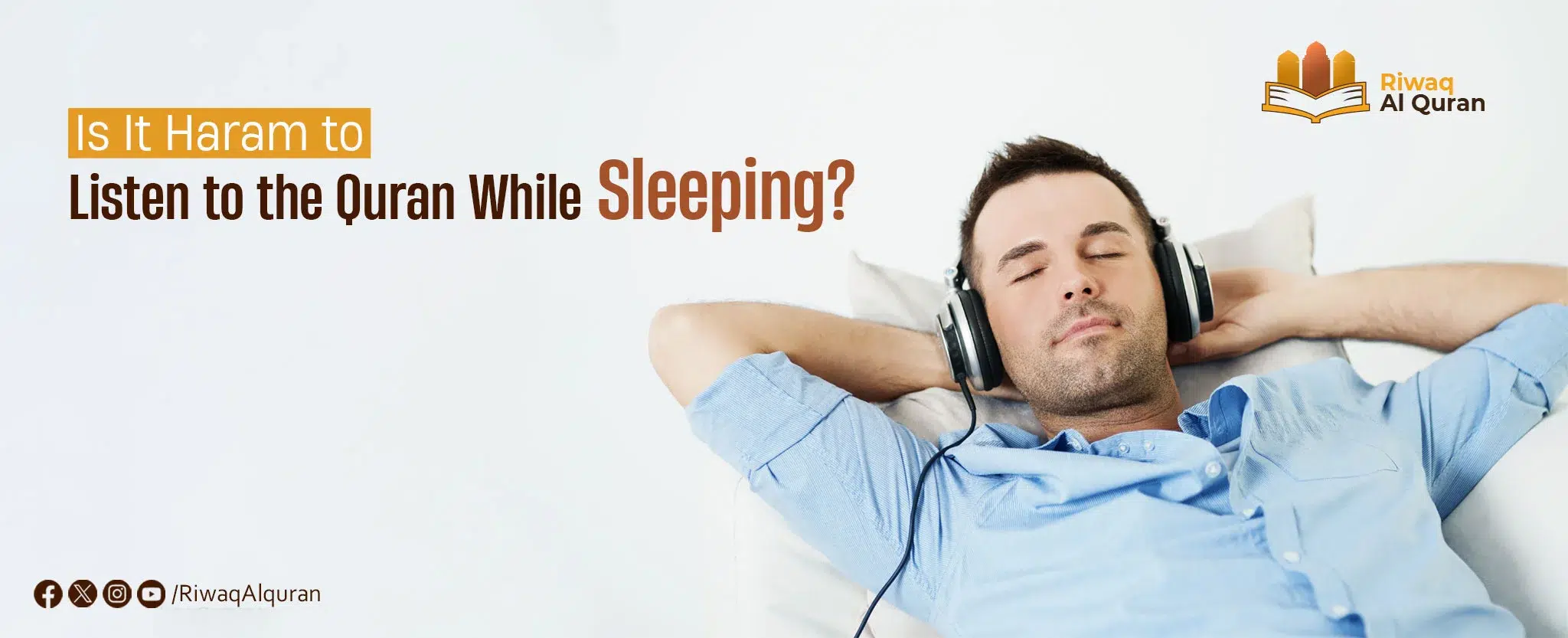
Listening to the Quran while sleeping is not haram — it is permissible, and scholars generally agree it can bring real spiritual benefit, as long as it’s approached with the intention of drawing closer to Allah.
This is one of the more commonly asked questions about everyday Quran engagement, since falling asleep to recitation feels natural to many people but raises a fair concern about whether it shows proper respect to the text.
This guide answers that question directly, explains why feeling sleepy during Quran engagement means different things in different contexts, and covers a specific, often-misunderstood nuance around Surah Al-Mulk and sleep that most articles on this topic get vague about.
What You’ll Learn in This Article
- Whether listening to the Quran while sleeping is haram, with the Quranic basis for the ruling.
- Why feeling sleepy while listening is not always the same thing spiritually.
- The real benefits of listening to the Quran before bed.
- Whether passive listening helps with memorization.
- The precise nuance around Surah Al-Mulk’s protective virtue — and why listening alone may not be enough for it.
Table of Contents
Is Listening to the Quran While Sleeping Haram?
No, listening to the Quran while sleeping is not haram. It is permissible and, with sincere intention, rewarded — there is no restriction in Islamic teaching against leaving a device playing Quran recitation while you drift off to sleep.
The Quranic Basis for Why This Is Permissible
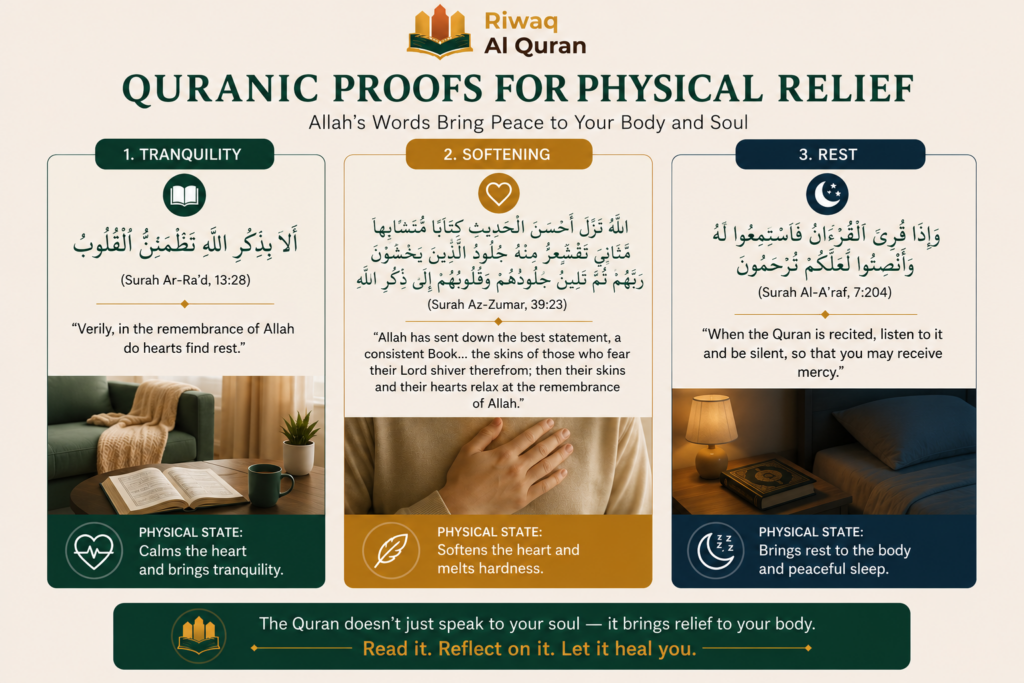
Allah describes the effect of His words on the heart directly:
(أَلَا بِذِكْرِ ٱللَّهِ تَطْمَئِنُّ ٱلْقُلُوبُ)
“Verily, in the remembrance of Allah do hearts find rest.” (Surah Ar-Ra’d, 13:28)
This isn’t conditioned on being fully alert; the Quran’s calming effect works precisely because it settles the heart, which is exactly the state a person is in right before sleep.
The verse doesn’t say hearts find rest only through active, conscious remembrance — it names remembrance itself as the mechanism, which is broad enough to include a recitation playing softly as a person drifts off.
(ٱللَّهُ نَزَّلَ أَحْسَنَ ٱلْحَدِيثِ كِتَـٰبًۭا مُّتَشَـٰبِهًۭا مَّثَانِىَ تَقْشَعِرُّ مِنْهُ جُلُودُ ٱلَّذِينَ يَخْشَوْنَ رَبَّهُمْ ثُمَّ تَلِينُ جُلُودُهُمْ وَقُلُوبُهُمْ إِلَىٰ ذِكْرِ ٱللَّهِ)
“Allah has sent down the best statement, a consistent Book… the skins of those who fear their Lord shiver therefrom; then their skins and their hearts relax at the remembrance of Allah.” (Surah Az-Zumar, 39:23)
This verse describes a two-stage physical and emotional pattern — tension, then relaxation — that mirrors the same transition happening naturally as a person falls asleep.
It’s worth noting this verse describes the trembling and softening as sequential, not simultaneous, which is a detail scholars often use to explain why the same recitation can feel intense on first hearing and settling on repeated exposure.
(وَإِذَا قُرِئَ ٱلْقُرْءَانُ فَٱسْتَمِعُوا۟ لَهُۥ وَأَنصِتُوا۟ لَعَلَّكُمْ تُرْحَمُونَ)
“When the Quran is recited, listen to it and be silent, so that you may receive mercy.” (Surah Al-A’raf, 7:204)
This is a general instruction toward attentiveness, not a strict condition that voids the benefit the moment attention naturally fades into sleep. The verse’s purpose is to establish listening as an act of worship in its own right, comparable to reciting — it doesn’t set a minimum alertness threshold below which the listening no longer counts.
If you want to understand the deeper meaning behind verses like these rather than just their calming sound, our Online Tafseer Course walks through Quranic meaning, context, and interpretation directly with a qualified instructor.
Why Do You Feel Sleepy While Listening to or Reciting the Quran?
This is worth separating into two very different situations, since they’re often confused with each other and treated as the same phenomenon.
1. Drowsiness During Active Recitation or Study
If you’re actively trying to recite, memorize, or study the Quran and find yourself suddenly overcome with drowsiness in that moment, some scholars describe this as a distraction worth resisting — a pull away from focused worship. In this context, it’s recommended to:
- Seek refuge in Allah before continuing.
- Perform wudu if you feel able to.
- Return to the task with renewed attention rather than giving in to the drowsiness.
Getting your pronunciation and pacing right in the first place also makes it easier to stay alert during active recitation, since mistakes and hesitation are often what make a study session feel draining.
Our Online Tajweed Classes are built specifically to help you recite with confidence instead of constantly second-guessing yourself mid-verse.
Part of what makes active recitation tiring is exactly this — a few common mistakes worth knowing before they turn into habits:
2. Falling Asleep While Passively Listening at Bedtime
This is a different situation entirely. If you’ve intentionally set the Quran playing as you go to sleep — not as an active task you’re being pulled away from, but as the deliberate way you’re winding down — falling asleep during it is simply the natural outcome of what you set out to do.
There’s nothing to resist here, since the listening itself was never meant to require the same sustained alertness as active study.
What Are the Benefits of Listening to the Quran Before Sleep?
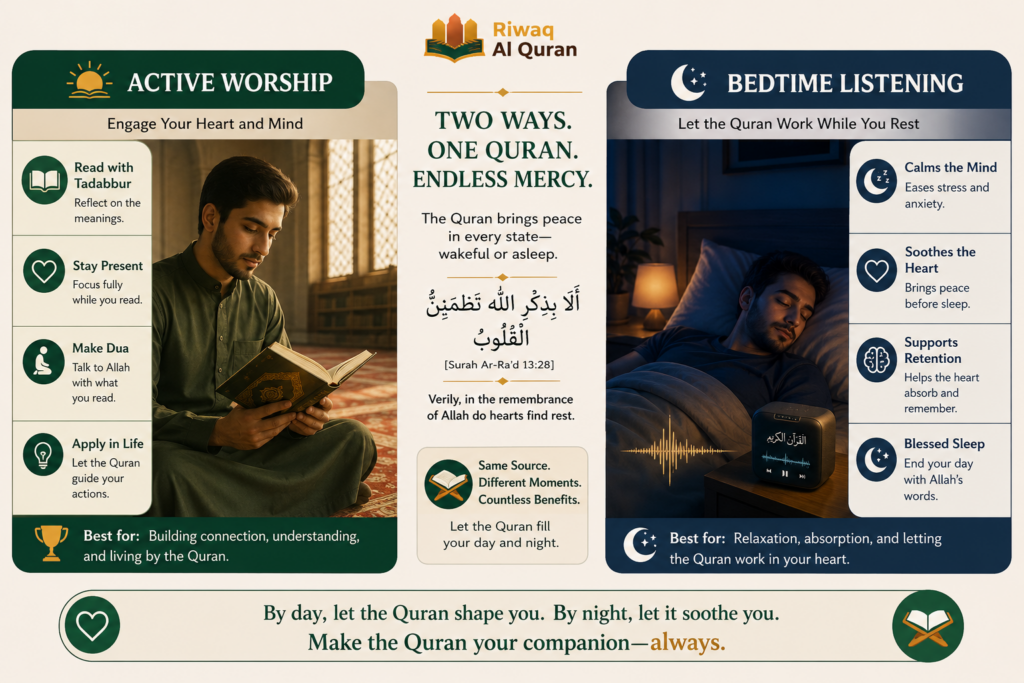
Listening to the Quran before sleep is widely described by scholars and Quran teachers as beneficial for both spiritual connection and general relaxation, even without claiming it as a medical treatment. The benefits break down into a few distinct areas:
1. Calming the Mind Before Sleep
The rhythmic, unhurried quality of Quran recitation can help lower stress and ease the transition into sleep, functioning similarly to any calming, familiar sound at bedtime — but with the added spiritual dimension of remembrance of Allah rather than a neutral background noise.
Reciters known for a slower, measured tarteel style tend to work best for this purpose, since the point is calm, not performance.
You can utilize the 5 benefits of learning with a live Quran tutor to go beyond passive listening and start actively building a real connection to what you’re hearing, rather than relying on background recitation alone.
2. Building Early Familiarity for Children
For a family with young children, playing recitation at bedtime is a simple, low-effort way to build early familiarity with the Quran’s sound and rhythm, well before a child begins formal study.
If you want to build on that early exposure with real, structured learning, our Online Quran Classes for Kids are designed to nurture that connection through age-appropriate, interactive lessons.
3. Strengthening Ongoing Spiritual Habit
Beyond the specific bedtime moment, regularly ending the day with Quran listening reinforces the Quran as a normal, constant part of daily life rather than something reserved only for formal study sessions — which for many people makes consistent engagement easier to sustain over the long term than sessions that feel effortful every time.

Does Listening to the Quran While Sleeping Help With Memorization?
Not meaningfully — memorization requires active, conscious effort, not passive exposure. Repetition, understanding the meaning, and deliberately focusing on specific verses during waking hours are what actually build retention; listening while asleep may build some familiarity with the sound of a verse, but it isn’t a substitute for the deliberate work of memorization.
If building real Hifz progress is the actual goal rather than passive listening, you may want to enroll in an Online Quran Memorization Course to get a structured, teacher-guided schedule built around your own pace, rather than relying on background listening to carry the work.
Does Reciting Surah Al-Mulk Protect You During Sleep?
This is one of the more specific and commonly cited practices around sleep, and it comes with a nuance worth knowing precisely.
a. The Hadith Behind This Practice
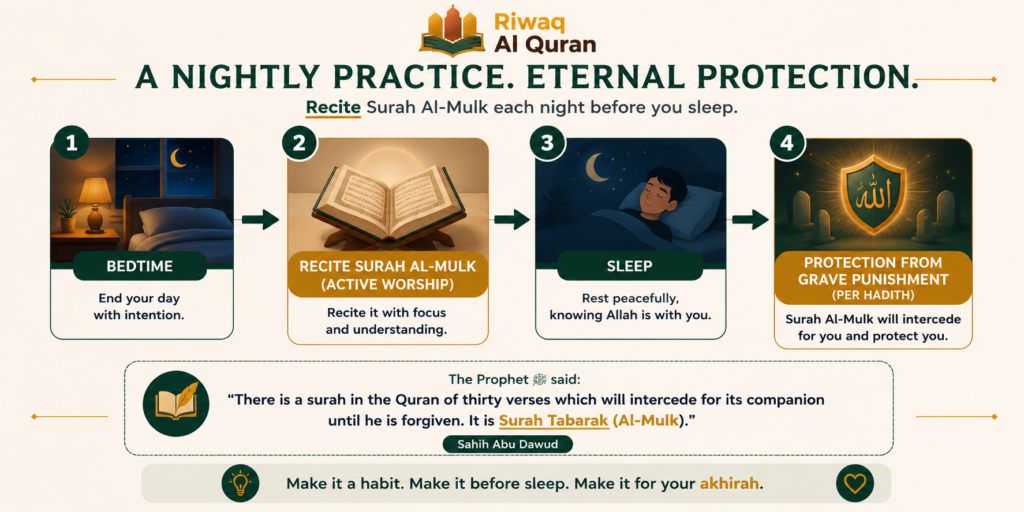
The Prophet ﷺ said:
(إِنَّ سُورَةً مِنَ القُرآنِ ثَلَاثُونَ آيَةً شَفَعَتْ لِصَاحِبِهَا حَتَّى غُفِرَ لَهُ، وَهِيَ سُورَةُ تَبَارَكَ)
“There is a Surah of the Quran, thirty verses long, which will intercede for a man until he is forgiven — it is Surat al-Mulk.” (Jami’ at-Tirmidhi 2891, graded Hasan)
A separate report describes his own nightly habit:
(كَانَ رَسُولُ اللَّهِ ﷺ لَا يَنَامُ حَتَّى يَقْرَأَ الم تَنْزِيلُ وَتَبَارَكَ الَّذِي بِيَدِهِ الْمُلْكُ)
“The Prophet ﷺ would not sleep until he had recited Surah As-Sajdah and Surah Al-Mulk.” (Jami’ at-Tirmidhi 2892)
Notice this second hadith describes the Prophet’s ﷺ own consistent habit, not a one-time recommendation — he paired these two specific Surahs every single night, which is part of why scholars treat this practice as more than an optional suggestion.
b. Why Listening Alone May Not Be Enough
The important nuance many articles skip: scholars generally hold that this specific virtue is tied to actually reciting the Surah yourself, not simply listening to it played by a device.
If you’re not confident reciting it from memory, following along and repeating after a reciter is considered a reasonable substitute, but passive listening alone — without any active engagement — is not treated as equivalent to reciting it for the purpose of this particular hadith’s promise.
This is exactly the kind of distinction that’s easier to apply correctly with guidance — consider enrolling in the top online Qirat course to build the confidence to recite Surah Al-Mulk from memory yourself, rather than relying on listening alone.
Deepen Your Nightly Connection to the Quran With Riwaq Al Quran
Listening at bedtime is a good habit — building the confidence to actually recite Surah Al-Mulk yourself, from memory, is a better one.
Riwaq Al Quran is a comprehensive online platform offering personalized Quran, Arabic, and Islamic Studies classes for individuals of all ages and backgrounds.

Experienced instructors guide you through a structured curriculum covering Tajweed, Tafsir, and Memorization, with real-time interaction between student and teacher rather than one-way listening.
Here’s a closer look at the course this article already pointed to for building that recitation confidence:
Depending on what you’re looking to build next:
- If you want to understand what you’re reciting, start with the Online Tafseer Course.
- If your goal is confident, correct recitation, the Online Tajweed Classes and Online Quran Recitation Course both build that foundation.
- If you’re working toward real memorization rather than passive familiarity, the Quran Memorization Online Course is built for that.
- For children, the Online Quran Classes for Kids nurture the same connection in an age-appropriate way.
- If Arabic itself is a barrier to understanding meaning, the Online Arabic Courses and Islamic Studies Courses build that alongside your Quran study.


- For those pursuing certified recitation, the Online Ijazah Program and Online Qirat Course go further into formal qualification.
- New to reading the Quran itself? Noorani Qaida Online covers the basics efficiently before you move into full recitation.

Conclusion
Listening to the Quran while sleeping is not haram. That’s the whole answer to the question most people are actually asking, and it doesn’t need hedging.
What the Quran itself describes makes this clear:
(أَلَا بِذِكْرِ ٱللَّهِ تَطْمَئِنُّ ٱلْقُلُوبُ)
“Verily, in the remembrance of Allah do hearts find rest.” (Surah Ar-Ra’d, 13:28)
A heart doesn’t need to be fully awake to find rest — that’s precisely the state falling asleep already puts you in. But two things worth remembering sit underneath that simple answer, and conflating them is where most confusion about this topic comes from:
- Sleepiness means different things in different moments, Drowsiness that pulls you away from active recitation or study is worth resisting. Falling asleep while you intentionally let recitation play at bedtime isn’t a distraction from anything — it’s just what you set out to do.
- Not every virtue transfers to passive listening, Surah Al-Mulk’s specific protection is tied to reciting it yourself, not to having it play in the background while you drift off. Listening at bedtime is genuinely good. Reciting it yourself is better, and it’s the one that carries this particular promise.
Play the Quran tonight without hesitation, And when you’re ready for more than background comfort, learn Al-Mulk well enough to say it yourself — that’s the version of this habit worth building toward.
FAQs
These are the questions people most often ask after learning that listening to the Quran while sleeping is permitted.
Is it haram to leave the Quran playing on a device while you sleep?
No, there is no prohibition against leaving a device playing Quran recitation while you sleep, and doing so with the intention of drawing closer to Allah is considered rewarded.
Does listening to the Quran while sleeping help you memorize it?
Not meaningfully — memorization requires active, conscious repetition and focus during waking hours, and passive listening while asleep builds familiarity at best, not real retention.
Why do I feel sleepy when trying to actively recite the Quran?
Sudden drowsiness during focused recitation or study is described by some scholars as a distraction worth actively resisting, unlike naturally falling asleep while passively listening at bedtime, which is simply the expected outcome of winding down.
Does the Quran help you fall asleep?
Yes, many people find the calming, rhythmic quality of Quran recitation helps ease the transition into sleep, similar to any calming, familiar sound at bedtime, with the added benefit of spiritual remembrance.
Does listening to Surah Al-Mulk while asleep protect you from punishment of the grave?
The specific virtue described in Hadith is tied to actually reciting Surah Al-Mulk yourself, not passive listening alone, though repeating along with a reciter if you can’t recite from memory is considered a reasonable way to engage with it actively.