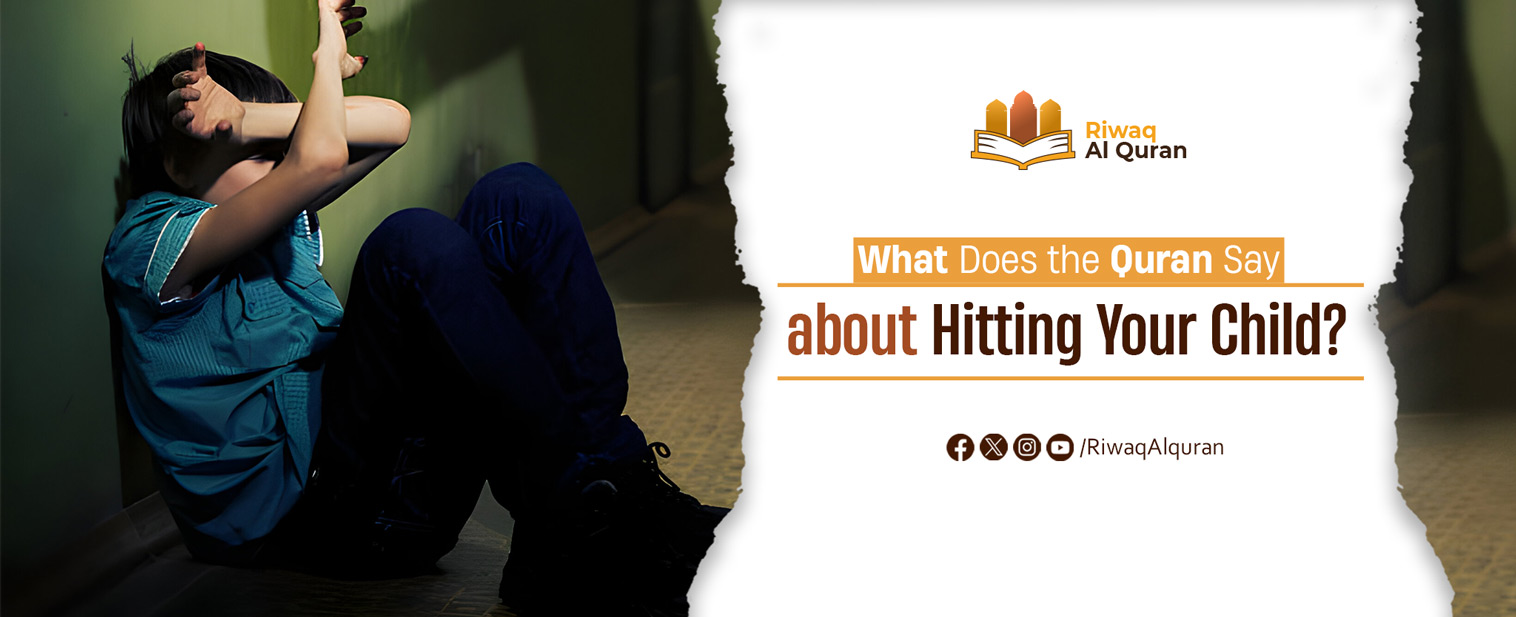
Islam does not explicitly declare hitting a child haram in a single clear verse, but the hadith most directly connected to this question comes with strict conditions most people citing it never mention. Understanding what Islam actually says about hitting a child means looking at that hadith in full, not in isolation, alongside the Prophet’s ﷺ own example with children.
This guide covers the specific hadith scholars discuss on this question, the conditions attached to it, the Prophet’s ﷺ documented approach to disciplining children without hitting, and what Islamic teaching says specifically about daughters and about striking the face.
Table of Contents
What You’ll Learn in This Article?
- The exact hadith scholars cite when discussing physical discipline, and its stated conditions
- Why many contemporary scholars discourage physical discipline even where it’s technically permitted?
- What the Prophet ﷺ said and did regarding controlling anger before disciplining a child?
- Why Islam specifically prohibits striking the face?
- What the Quran and Hadith say about the treatment of daughters?
Before looking at how the Prophet ﷺ treated children directly, it’s worth remembering the story of his own beginning:
Is Hitting a Child Haram in Islam?
The Quran does not contain a direct verse addressing physical discipline of children, which is why this question is answered mainly through Hadith and the interpretation scholars have built around it over centuries.
a. The Hadith Scholars Cite Directly on This Question
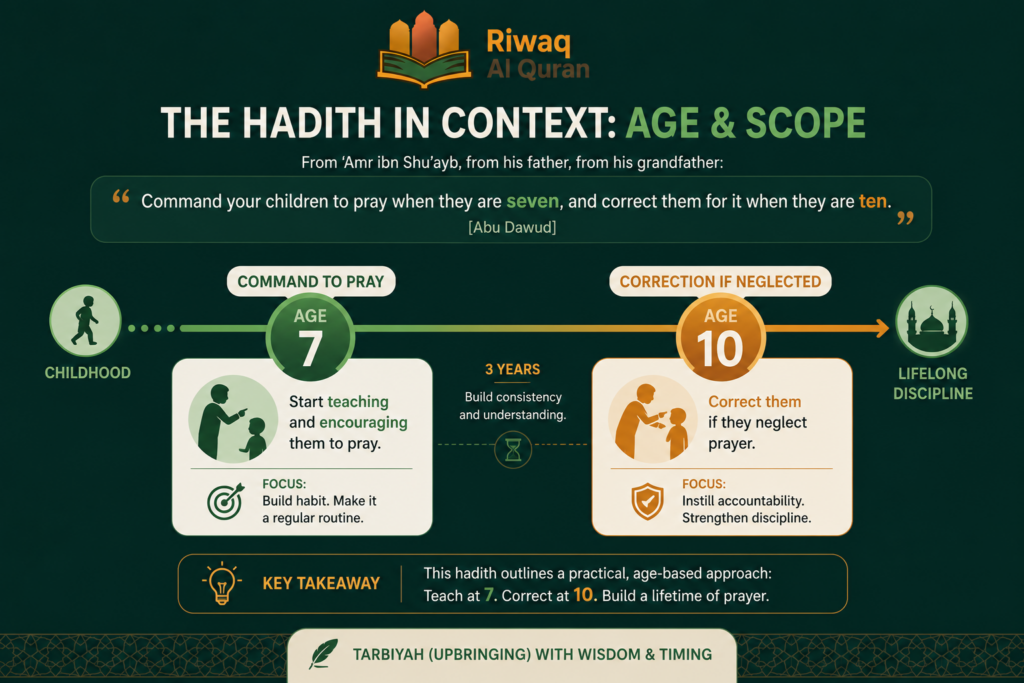
The hadith most central to this discussion states:
(مُرُوا أَوْلَادَكُمْ بِالصَّلَاةِ وَهُمْ أَبْنَاءُ سَبْعِ سِنِينَ، وَاضْرِبُوهُمْ عَلَيْهَا وَهُمْ أَبْنَاءُ عَشْرٍ، وَفَرِّقُوا بَيْنَهُمْ فِي الْمَضَاجِعِ)
“Command your children to pray when they become seven years old, and beat them for it (prayer) when they become ten years old; and arrange their beds to sleep separately.” (Sunan Abi Dawud 495, graded Hasan)
This hadith is specific in scope, not a general license to discipline physically for any reason. It addresses neglect of prayer specifically once a child reaches ten years old, not general misbehavior unrelated to prayer, and it does not stand alone without further conditions attached — those conditions are covered next.
b. The Conditions Scholars Attach to This Ruling
Classical scholars who discuss this hadith attach clear limits to it, not a blanket permission:
- Any physical correction must be light and non-injurious.
- It must never be directed at the face.
- It should be used only as a last resort, after commands and reminders have failed.
- It applies specifically to consistent prayer neglect, not general disobedience.
- Many contemporary scholars discourage it entirely, citing modern understanding of child psychology.
This means the honest answer to “is hitting a child haram” is: not universally prohibited by texts, but tightly conditioned, widely discouraged, and treated by many scholars today as something to avoid altogether.
What the Prophet’s ﷺ Own Example Shows?
Beyond the specific hadith on prayer, the Prophet’s ﷺ documented behavior with children provides the clearest practical model for parents, since he is reported to have never struck a child himself.
a. Controlling Anger Before Disciplining
The PThe Prophet ﷺ directly addressed the emotional state that leads to harsh discipline. He said:
(إِذَا غَضِبَ أَحَدُكُمْ فَلْيَسْكُتْ)
“When one of you becomes angry, let him remain silent.” (Musnad Ahmad)
He also said:
(لَيْسَ الشَّدِيدُ بِالصُّرَعَةِ، إِنَّمَا الشَّدِيدُ الَّذِي يَمْلِكُ نَفْسَهُ عِنْدَ الْغَضَبِ)
“The strong is not the one who overcomes people by his strength, but the strong is the one who controls himself while in anger.” (Sahih al-Bukhari 6114)
Since anger is the most common trigger for hitting a child, this instruction functions as a practical first check before any disciplinary ac
b. The Prohibition on Striking the Face
The Prophet ﷺ specifically singled out the face as off-limits in any physical correction:
(لَا تَضْرِبُوا الْوَجْهَ وَلَا تُقَبِّحُوا)
“Do not hit the face, do not disfigure.” (Sahih Muslim 2612)
Scholars extend this instruction to children specifically, since the face carries particular dignity in Islamic teaching, and striking it is treated as a form of disrespect regardless of the person’s age.
This is one of the clearest, most specific limits in the entire discussion — even in the narrow case where the prayer hadith permits some physical correction, the face remains categorically excluded.
Read more about: Dua for Child’s Righteousness, Piousness, Devotion, Steadfastness, and Good Behaviour and Habits
Understanding the full context behind hadith like these — rather than a single quoted line — is exactly what a structured Islamic Studies course covers. Riwaq Al Quran’s online classes work through Hadith and its scholarly commentary with a qualified instructor, not just the text alone.
How Islam Prioritizes Non-Physical Discipline?
Given the conditions and limits above, Islamic teaching in practice leans heavily toward non-physical methods, several of which are directly tied to Quranic guidance rather than general parenting advice.
- Leading by example is central to this approach, since children are described throughout Hadith as learning primarily by observing a parent’s own character rather than by instruction alone.
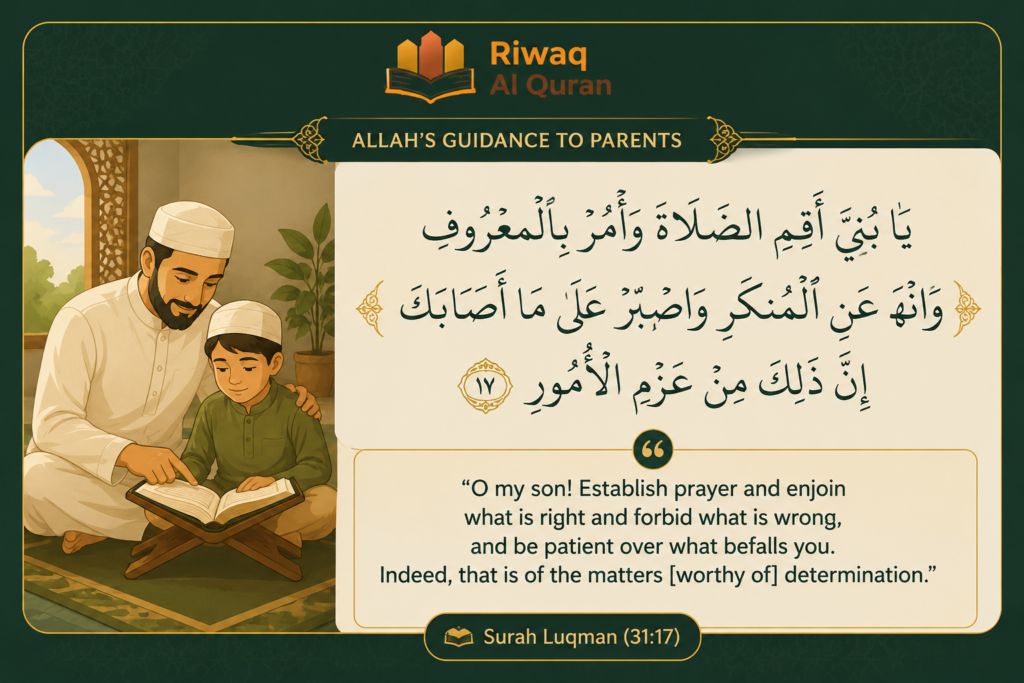
- The Quran also models this directly through Luqman’s advice to his son:
(يَـٰبُنَىَّ أَقِمِ ٱلصَّلَوٰةَ وَأْمُرْ بِٱلْمَعْرُوفِ وَٱنْهَ عَنِ ٱلْمُنكَرِ وَٱصْبِرْ عَلَىٰ مَآ أَصَابَكَ)
“My son, establish prayer, enjoin what is right, forbid what is wrong, and be patient over what befalls you” (Surah Luqman, 31:17)
— a father teaching through calm, direct guidance rather than force.
- Using the Quran’s own stories as teaching material is a distinctly Islamic method with no real equivalent in generic parenting advice — narratives like the story of Yusuf or Luqman’s counsel give a parent a built-in way to discuss consequences and character without resorting to punishment at all.
Read more about: Duties of Parents Towards Their Child in Islam: Rights, Treatment, and Responsibilities
Are Daughters Treated Differently in This Ruling?
No distinct ruling on physical discipline exists for daughters specifically, but the Quran addresses the treatment of daughters directly enough that it’s worth covering on its own.
The Quran directly condemns the pre-Islamic practice of viewing daughters as a burden:
(وَإِذَا بُشِّرَ أَحَدُهُم بِٱلْأُنثَىٰ ظَلَّ وَجْهُهُۥ مُسْوَدًّا وَهُوَ كَظِيمٌۭ)
“When one of them is given news of a daughter, his face becomes dark, and he is filled with grief.” (Surah An-Nahl, 16:58)
The Prophet ﷺ reinforced this reversal directly:
(مَنِ ابْتُلِيَ مِنَ الْبَنَاتِ بِشَيْءٍ فَأَحْسَنَ إِلَيْهِنَّ كُنَّ لَهُ سِتْرًا مِنَ النَّارِ)
“He who is involved in bringing up daughters, and he accords benevolent treatment towards them, they will be a protection for him against Hellfire.” (Sahih Muslim 2629)
Given this explicit elevation of how daughters should be treated, singling out a daughter for harsher physical treatment than a son runs directly against the weight of the textual evidence, not just general values of kindness.
The contrast the Quran draws — grief at a daughter’s birth versus protection from Hellfire for raising her well — is deliberately stark, and it’s worth reading as a corrective aimed specifically at attitudes the text considered common enough to name directly.
Riwaq Al Quran’s Islamic Studies classes cover verses like these in their full context, helping parents connect Quranic teaching directly to how they raise their own children.
Are Parents Accountable for How They Treat Their Children?
Yes, and this accountability is framed in the Quran as a matter of guardianship, not just general parental duty. Allah instructs believers directly:
(يَـٰٓأَيُّهَا ٱلَّذِينَ ءَامَنُوا۟ قُوٓا۟ أَنفُسَكُمْ وَأَهْلِيكُمْ نَارًۭا)
“O believers, protect yourselves and your families from a Fire.” (Surah At-Tahrim, 66:6)
This places a parent’s responsibility for a child’s wellbeing and moral upbringing on the same level as their own — the verse does not separate the two. The Prophet ﷺ reinforced this with a direct warning about guardianship:
(كُلُّكُمْ رَاعٍ وَكُلُّكُمْ مَسْئُولٌ عَنْ رَعِيَّتِهِ)
“Each of you is a shepherd, and each of you is responsible for his flock.” (Sahih al-Bukhari 893; Sahih Muslim 1829)
Mistreating a child, physically or otherwise, falls squarely within that accountability — the hadith frames guardianship as an active responsibility that will be questioned, not a passive title.
Read more about: What Does the Quran Say About Children?
Learn the Full Context Behind These Rulings With Riwaq Al Quran
A single hadith or verse rarely tells the whole story — understanding the conditions, the scholarly discussion, and the surrounding context is what turns a quoted line into real guidance for how you raise your children.
Riwaq Al Quran is a comprehensive online platform that offers personalized Quran, Arabic, and Islamic Studies online classes for individuals of all ages and backgrounds. Their experienced instructors use a structured curriculum to cover Tajweed, Tafsir, and Memorization, providing easy and effective access to learning the Quran.
The advanced online classes allow for seamless communication and interaction between students and teachers. Join Riwaq Al Quran for a deeper connection with the Quran.
We offer several courses, including:
- Online courses for kids
- Online Quran classes for kids and adults
- Online Arabic courses
- Online Ijazah courses
- Online Islamic Studies courses
Here is a sample of our Quran courses that will be helpful for you:
- Online Tafseer Course: Delve into Quranic meanings with our insightful online Tafseer course.
- Noorani Qaida Online: Learn Quranic basics efficiently through our Noorani Qaida online program.
- Online Quran Recitation Course: Enhance Quranic recitation skills through our expert-led online course.
- Online Tajweed Classes: Master Tajweed rules for beautiful Quranic recitation in online classes.
- Quran Memorization Online Course: Memorize the Quran effectively with our specialized online memorization course.
- Online Qirat Course: Explore diverse Qirat styles with our comprehensive online Qirat course.
- Online Quran Classes for Kids: Nurture a love for the Quran in kids through interactive online classes.
Conclusion
Islam does not ban hitting a child outright — but the honest version of that answer has four conditions attached to it, not one.
- The hadith itself is narrow, Sunan Abi Dawud 495 addresses one thing specifically: neglect of prayer at age ten, after commands and reminders have already failed. It was never a general license for discipline.
- The conditions matter more than the permission, Light, never on the face, last resort only — and even scholars who accept the hadith’s narrow scope generally treat it as a ceiling, not a starting point.
- The Prophet’s ﷺ own example sets the real standard, He is documented as never having struck a child. What he modeled instead was concrete: control anger before acting, and never touch the face, a boundary he stated without exception.
- Accountability runs in both directions, A parent is answerable for how a child is raised —
(يَـٰٓأَيُّهَا ٱلَّذِينَ ءَامَنُوا۟ قُوٓا۟ أَنفُسَكُمْ وَأَهْلِيكُمْ نَارًۭا)
“O believers, protect yourselves and your families from a Fire”(Surah At-Tahrim, 66:6)
— and that same weight falls specifically on how daughters are treated, given how directly the Quran condemns viewing a daughter as a burden.
Put together, this isn’t permission to reach for a narrow hadith and stop reading. It’s a standard built almost entirely around restraint — control your anger first, protect the face always, default to Luqman’s model of guidance over force, and remember that the accountability for getting this right sits with the parent, not the child.
FAQs
The questions below cover what people most often search after encountering this topic — from the core “is it haram” question to specific edge cases like daughters and striking the face.
Is hitting your child haram in Islam?
Not universally prohibited by name, but the hadith most directly addressing it (Sunan Abi Dawud 495) applies narrowly to prayer neglect at age ten, requires the correction to be light and non-injurious, and is discouraged outright by many contemporary scholars.
Did the Prophet Muhammad ﷺ ever hit a child?
No, the Prophet ﷺ is documented as never having struck a child, and his own teachings emphasized controlling anger and never striking the face as core principles of any physical correction.
Is it haram to hit your daughter specifically in Islam?
There is no separate ruling for daughters, but the Quran (Surah An-Nahl, 16:58) directly condemns viewing daughters as a burden, and the Prophet ﷺ specifically praised parents who treat daughters with kindness, making harsher treatment of a daughter inconsistent with this teaching.
What does Islam say about hitting a child’s face?
Striking the face is specifically prohibited in Hadith regardless of age — the Prophet ﷺ said, “Do not hit the face, do not disfigure” (Sahih Muslim), a principle scholars apply directly to disciplining children.
Are parents held accountable in Islam for how they raise their children?
Yes, the Quran (Surah At-Tahrim, 66:6) instructs believers to protect their families from harm as they would themselves, and the Prophet ﷺ described guardianship, including of children, as something every person will be asked about.