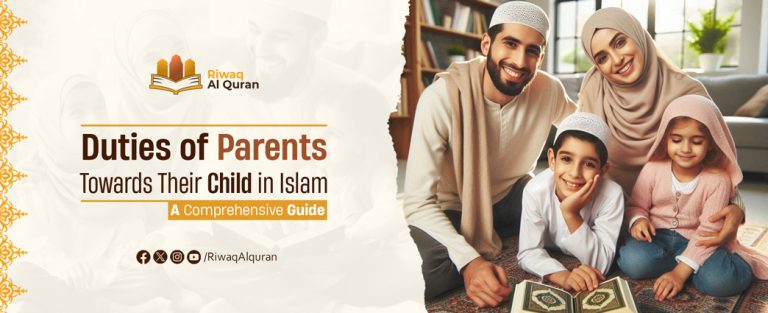
Every child born into a Muslim household is a trust from Allah — not a possession, not an extension of a parent’s ambitions. The Prophet Muhammad (peace be upon him) said:
“كُلُّكُمْ رَاعٍ وَكُلُّكُمْ مَسْئُولٌ عَنْ رَعِيَّتِهِ”
“Every one of you is a guardian, and every one of you is responsible for those under his guardianship.” — Sahih al-Bukhari 893
This hadith is the foundation of Islamic parenting. Guardianship here is not simply authority — it is accountability before Allah for how a child is raised, educated, loved, and protected.
The duties of parents towards their child in Islam span four dimensions: provision, Islamic education, emotional nurture, and protection. This guide covers all four, alongside the specific duties a father carries toward his daughter, the practical standards Islam sets for daily treatment of children, and the three-phase parenting framework drawn from classical Islamic scholarship. For a broader look at what the Quran says about children, you can explore our dedicated article.
What You Will Learn in This Article
- The mutual system of rights and duties between parents and children in Islam.
- A three-phase Islamic parenting model rooted in classical scholarship.
- The four core parental responsibilities supported by Quran and authentic Sunnah.
- Specific duties a father holds toward his daughter.
- How Islam instructs parents to treat children fairly, consistently, and with wisdom.
- Commentary on every Quranic verse and hadith cited..
Table of Contents
Rights and Duties of Parents Towards Their Children in Islam
The parent-child relationship in Islam is a bilateral covenant, not a one-way hierarchy. Both generations carry real rights over the other, and both carry real obligations. A child’s willingness to honor and obey is directly tied to how faithfully parents fulfill their own side of this covenant. Neither party can demand rights while neglecting duties.
1. Rights of Parents Over Their Children
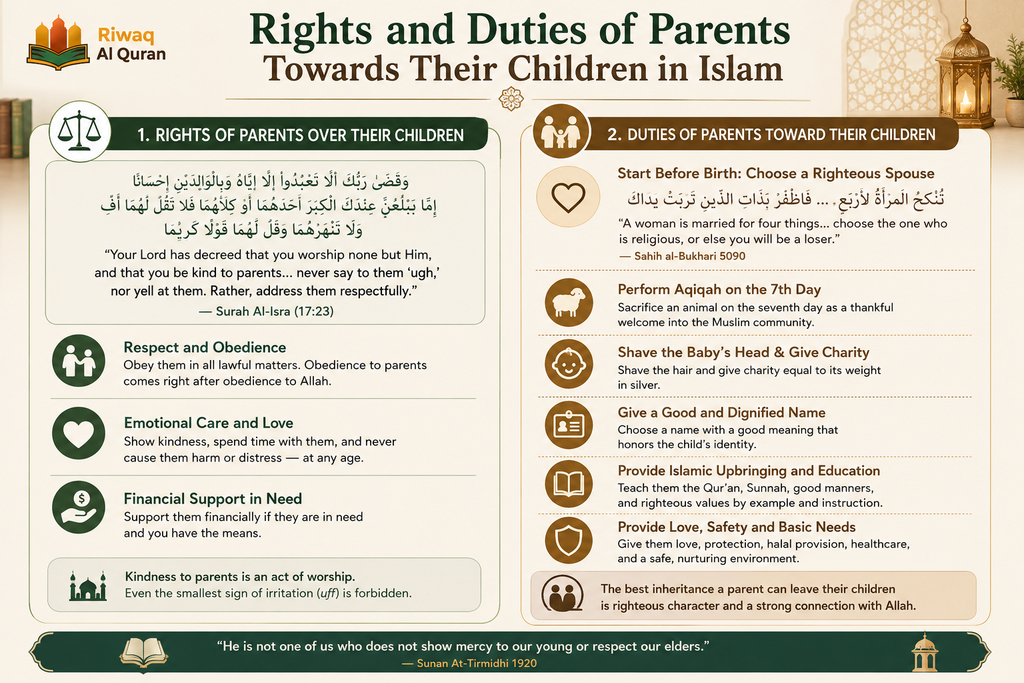
Islam establishes three rights that adult children owe their parents. Uniquely, the Quran links these rights directly to the command to worship Allah alone — placing them in the same verse:
“وَقَضَىٰ رَبُّكَ أَلَّا تَعْبُدُوٓا۟ إِلَّآ إِيَّاهُ وَبِٱلْوَٰلِدَيْنِ إِحْسَـٰنًا ۚ إِمَّا يَبْلُغَنَّ عِندَكَ ٱلْكِبَرَ أَحَدُهُمَآ أَوْ كِلَاهُمَا فَلَا تَقُل لَّهُمَآ أُفٍّۢ وَلَا تَنْهَرْهُمَا وَقُل لَّهُمَا قَوْلًۭا كَرِيمًۭا”
“Your Lord has decreed that you worship none but Him, and that you be kind to parents. Whether one or both of them reach old age in your care, never say to them ‘ugh,’ nor yell at them. Rather, address them respectfully.” — Surah Al-Isra (17:23)
The grammatical structure here is deliberate — Allah pairs the command to worship Him with the command to honor parents in the same sentence. Kindness to parents is therefore not simply a social virtue; it is an act of worship.
The benchmark is set at uff — the smallest audible sound of irritation — which is explicitly prohibited. If even that syllable is forbidden, the bar for how children must speak to and behave with their parents is extraordinarily high.
The three rights children owe their parents are:
- Respect and obedience — Children must comply with any lawful request their parents make. Obedience to parents ranks in several narrations immediately after obedience to Allah Himself.
- Emotional care and love — Children must give their parents consistent attention, visit them regularly, and never cause them distress — whether intentionally or not. This obligation is lifelong, not only when parents grow old.
- Financial support in need — A child who has the means to support a needy parent is obligated under Islamic law to do so — not merely encouraged.
2. Duties of Parents Toward Their Children — The Foundation
The obligations of parents do not begin at birth. Islam places the first parenting duty before conception: choosing a righteous spouse. The Prophet (peace be upon him) said:
“تُنْكَحُ الْمَرْأَةُ لأَرْبَعٍ لِمَالِهَا وَلِحَسَبِهَا وَجَمَالِهَا وَلِدِينِهَا، فَاظْفَرْ بِذَاتِ الدِّينِ تَرِبَتْ يَدَاكَ”
“A woman is married for four things: her wealth, her lineage, her beauty, and her religion. Choose the one who is religious, or else you will be a loser.” — Sahih al-Bukhari 5090
The same principle applies in reverse — a woman choosing a husband must prioritize his deen. Why? Because the spouse you choose becomes the co-parent of your children.
The home environment, the values modeled daily, and the language of faith or its absence all flow from that original choice. Islamic parenting, in this sense, begins the moment a person selects their life partner.
After birth, the Sunnah establishes several early duties that parents must fulfill:
- Performing aqiqah on the seventh day as a public welcoming of the child into the Muslim community.
- Shaving the baby’s head and giving charity equivalent to the weight of the hair in silver.
- Choosing a good, dignified name that honors the child’s identity before Allah.
“كُلُّ غُلَامٍ رَهِينَةٌ بِعَقِيقَتِهِ، تُذْبَحُ عَنْهُ يَوْمَ سَابِعِهِ، وَيُحْلَقُ رَأْسُهُ وَيُسَمَّى”
“Every child is in pledge for his Aqiqah, which is sacrificed for him on his seventh day, and he is named on it, and his head is shaved.” — Sunan Abu Dawud 2838
The aqiqah is not merely a celebratory tradition — it is an act that binds the child to the Muslim community from the very first week of life. The Prophet (peace be upon him) changed names that carried negative meanings and instructed parents to choose names that honor the child’s dignity. The name given on the seventh day is the name this person will carry before Allah.
The Islamic Three-Phase Parenting Framework
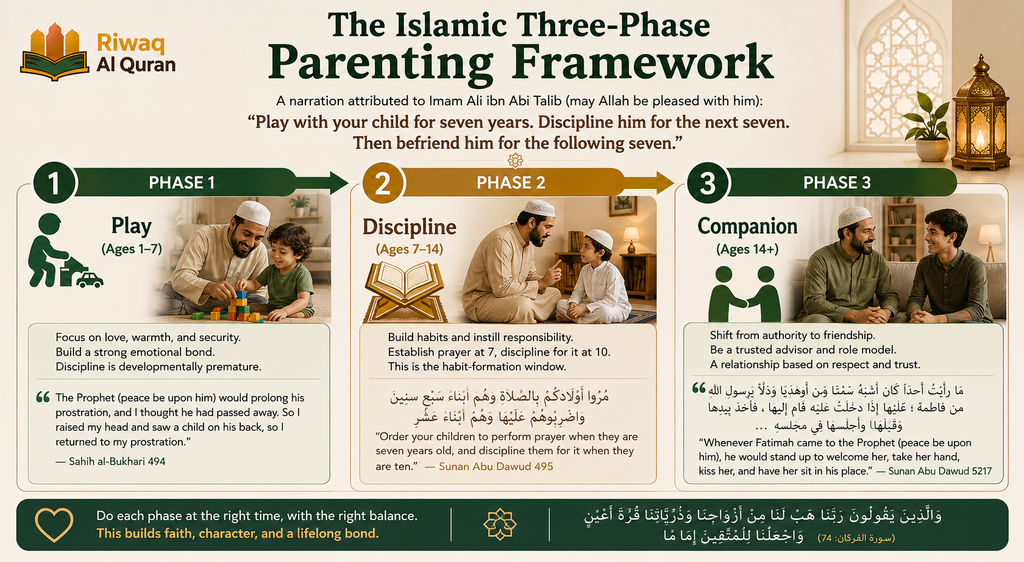
A narration attributed to Imam Ali ibn Abi Talib (may Allah be pleased with him) offers perhaps the most precise parenting framework in classical Islamic literature:
“الْعَبْ مَعَ ابْنِكَ سَبْعَ سِنِينَ، وَأَدِّبْهُ سَبْعَ سِنِينَ، وَصَاحِبْهُ سَبْعَ سِنِينَ”
“Play with your child for seven years. Discipline him for the next seven. Then befriend him for the following seven.” Attr. ʿAlī ibn Abī Ṭālib
This Play–Discipline–Companion model predates modern developmental psychology by fourteen centuries, yet maps almost exactly onto what contemporary research confirms about how children develop.
The most common failure in Muslim households is applying Phase Two strictness during Phase One — producing a child who neither bonded securely with their parents nor internalized the habits of faith — and then shifting into Phase Three friendship too early during the critical habit-formation window.
1. Play and Unconditional Bonding (Ages 1–7)
In the first seven years, the primary parental duty is warmth, presence, and security. Formal discipline in this phase is developmentally premature — a child’s prefrontal cortex, the seat of moral reasoning, is still largely undeveloped. The Prophet (peace be upon him) modeled this beautifully:
خَرَجَ عَلَيْنَا رَسُولُ اللَّهِ ﷺ فِي إِحْدَى صَلَاتَيِ الْعِشَاءِ وَهُوَ حَامِلٌ حَسَنًا أَوْ حُسَيْنًا، فَتَقَدَّمَ رَسُولُ اللَّهِ ﷺ فَوَضَعَهُ، ثُمَّ كَبَّرَ لِلصَّلَاةِ، فَصَلَّى فَسَجَدَ بَيْنَ ظَهْرَانَيْ صَلَاتِهِ سَجْدَةً أَطَالَهَا… فَرَفَعْتُ رَأْسِي وَإِذَا الصَّبِيُّ عَلَى ظَهْرِ رَسُولِ اللَّهِ ﷺ وَهُوَ سَاجِدٌ فَرَجَعْتُ إِلَى سَجْدَتِي
“The Prophet (peace be upon him) would prolong his prostration, and I thought he had passed away. So I raised my head and saw a child on his back, so I returned to my prostration.” — Sahih al-Bukhari 494
The Prophet (peace be upon him) was leading prayer — the most sacred act of Muslim worship — and chose to prolong his sujood rather than disrupt his grandchild who had climbed onto his back. This is not sentimentality. It is a prophetic instruction on how to prioritize the emotional security of a young child.
A parent who is rigid with a toddler misses the entire goal of Phase One: make this child feel loved enough to trust you when Phase Two begins. A child who enters Phase Two feeling genuinely secure attaches, corrects, and learns far more readily than one who approaches discipline already doubting their parent’s love.
2. Discipline and Habit Formation (Ages 7–14)
At seven, the Prophet (peace be upon him) instructed parents to establish the prayer — the cornerstone of a Muslim child’s daily life:
“مُرُوا أَوْلَادَكُمْ بِالصَّلَاةِ وَهُمْ أَبْنَاءُ سَبْعِ سِنِينَ وَاضْرِبُوهُمْ عَلَيْهَا وَهُمْ أَبْنَاءُ عَشْرٍ وَفَرِّقُوا بَيْنَهُمْ فِي الْمَضَاجِعِ”
“Order your children to perform prayer when they are seven years old, and discipline them for it when they are ten, and separate them in their sleeping arrangements.” — Sunan Abu Dawud 495
Prayer is introduced at seven not because the child is religiously obligated — they are not until puberty — but because habits formed between seven and fourteen are among the most durable a person carries into adulthood.
The goal is to make salah feel normal, natural, and non-negotiable before the child reaches the age of full religious responsibility. Parents who wait until puberty to establish prayer have lost the critical formation window.
The scholarly consensus is that “discipline” at age ten refers to measured, non-abusive correction for consistent neglect of prayer — not a general permission for physical punishment. For a deeper understanding of the role of prayer in a child’s Islamic upbringing, see our dedicated guide.
3. Companionship and Mentorship (Ages 14+)
As children mature, the Islamic model shifts from authority to friendship. The goal of this phase is a relationship where the adult child chooses to come to their parents for counsel — not because they fear them, but because they trust them. This is the relationship the Prophet (peace be upon him) had with his daughter Fatimah (may Allah be pleased with her):
عن عائشة أم المؤمنين رضي الله عنها قالت: «ما رأيتُ أحدًا كان أشبهَ سَمْتًا وهَديًا ودَلًّا برسولِ اللهِ ﷺ من فاطمةَ؛ كانت إذا دخلتْ عليه قام إليها، فأخذ بيدِها وقبَّلها وأجلسَها في مجلسِه…»
“Whenever Fatimah (may Allah be pleased with her) came to the Prophet (peace be upon him), he would stand up to welcome her, take her hand, kiss her, and have her sit in his place.” — Sunan Abu Dawud 5217
The Prophet (peace be upon him) stood for his adult daughter, kissed her, and gave her his own seat. This is Phase Three in action — mutual respect where parental authority has been converted into relational trust and genuine friendship. That conversion only happens if Phase One and Phase Two were done faithfully and in the right order.
Core Responsibilities of Parents to Their Children in Islam
Islam structures parental responsibility across four clearly defined domains, each grounded in the Quran and authentic Sunnah. These are not cultural preferences — they are obligations that parents will be asked about before Allah on the Day of Judgment.
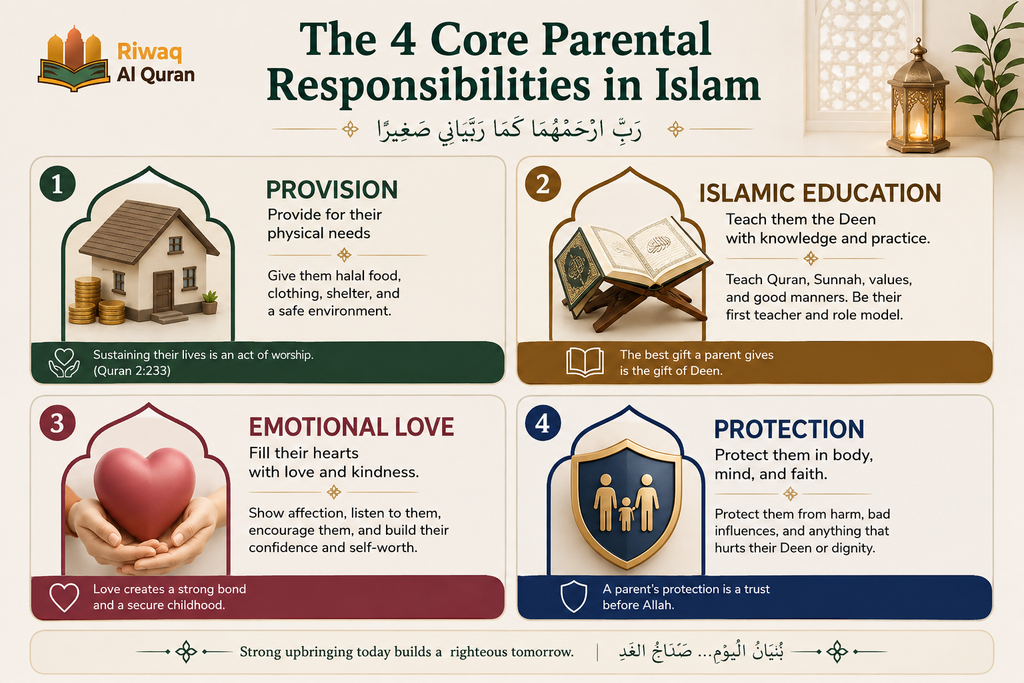
1. Providing for Physical Needs
The duty to provide for a child’s food, clothing, shelter, healthcare, and education rests primarily with the father as the head of the household. Allah says:
ٱلرِّجَالُ قَوَّٰمُونَ عَلَى ٱلنِّسَآءِ بِمَا فَضَّلَ ٱللَّهُ بَعْضَهُمْ عَلَىٰ بَعْضٍۢ وَبِمَآ أَنفَقُوا۟ مِنْ أَمْوَٰلِهِمْ”
“Men are the caretakers of women, as Allah has given some of them an advantage over others, and because they spend from their wealth.” — Surah An-Nisa (4:34)
The Arabic word qawwamun (قَوَّٰمُونَ) conveys ongoing, active guardianship — not a passive title of authority. A qawwam is someone who perpetually stands over the wellbeing of those in his charge.
This verse establishes that the father’s financial provision is not generosity — it is the foundational obligation upon which his entire guardianship rests. A father who withholds provision while capable is not merely failing his family; he is in direct violation of a Quranic command.
The Prophet (peace be upon him) confirmed that this spending carries immense spiritual weight:
عن أبي هريرة رضي الله عنه قال: قال رسولُ اللهِ ﷺ: «دينارٌ أنفقتَه في سبيلِ اللهِ، ودينارٌ أنفقتَه في رقبةٍ، ودينارٌ تصدَّقتَ به على مسكينٍ، ودينارٌ أنفقتَه على أهلِكَ، أعظمُها أجرًا الذي أنفقتَه على أهلِكَ»
“The dinar you spend for the sake of Allah, the dinar you spend to free a slave, the dinar you give in charity to a poor person, and the dinar you spend on your family — the greatest in reward is the one you spend on your family.” — Sahih Muslim 995
Spending on your children is not a worldly act that competes with worship — it is worship, and among the highest-rewarded forms of spending in this hadith. The father who provides faithfully is engaging in continuous ibadah with every dirham he spends.
2. Raising Children with Islamic Knowledge and Character
The Quran presents the clearest model of Islamic parenting in the story of Luqman — a wise man whose advice to his son Allah preserved as a complete educational curriculum:
وَإِذْ قَالَ لُقْمَـٰنُ لِٱبْنِهِۦ وَهُوَ يَعِظُهُۥ يَـٰبُنَىَّ لَا تُشْرِكْ بِٱللَّهِ ۖ إِنَّ ٱلشِّرْكَ لَظُلْمٌ عَظِيمٌ
“And ˹remember˺ when Luqman said to his son, while advising him: ‘O my dear son! Never associate anything with Allah in worship, for associating others with Him is truly the gravest wrong.'” — Surah Luqman (31:13)
يَـٰبُنَىَّ أَقِمِ ٱلصَّلَوٰةَ وَأْمُرْ بِٱلْمَعْرُوفِ وَٱنْهَ عَنِ ٱلْمُنكَرِ وَٱصْبِرْ عَلَىٰ مَآ أَصَابَكَ ۖ إِنَّ ذَٰلِكَ مِنْ عَزْمِ ٱلْأُمُورِ”
“O my dear son! Establish prayer, encourage what is good and forbid what is evil, and endure patiently whatever befalls you. Surely this is a resolve to aspire to.” — Surah Luqman (31:17)
Luqman’s curriculum follows a precise sequence every Muslim parent should note: he begins with theology (tawheed), moves to worship (prayer), then to moral conduct (commanding good), and finally to character (patience).
This is the correct Islamic priority order — first establish the correct understanding of Allah, then the daily worship that renews that connection, then ethical conduct in the world. Parents who begin with rules and skip theology have the order wrong.
The Islamic education parents must provide their children includes:
- Teaching children to recite and understand the Quran — enrolling in an Online Quran Recitation Course or Online Tajweed Classes builds this foundation early.
- Teaching children the Arabic language, the language of the Quran — Online Arabic courses designed for children make this accessible from home.
- Building consistent Islamic character: honesty, patience, generosity, and compassion — Online Islamic Studies courses provide structured, age-appropriate guidance on these values.
- Quran memorization where possible — a Quran Memorization Online Course helps children build this lifelong gift with expert support.
The Prophet (peace be upon him) confirmed the centrality of Quran education with one of the most celebrated statements in the Sunnah:
“خَيْرُكُمْ مَنْ تَعَلَّمَ الْقُرْآنَ وَعَلَّمَهُ”
“The best among you are those who learn the Quran and teach it.” — Sahih al-Bukhari 5027
Teaching Quran to your child places you — as the parent-teacher — among the best of people according to this hadith. It is one of the few acts where both teacher and student simultaneously earn the highest described rank.
A parent who ensures their child learns to recite and understand the Quran is not simply giving them a religious education — they are positioning themselves among the khayr of this Ummah.
3. Emotional Security and Unconditional Love
Islam not only permits emotional expression toward children — it commands it. The Prophet (peace be upon him) publicly demonstrated affection and explicitly rebuked parents who withheld it:
عن أبي هريرة رضي الله عنه قال: «قبَّل رسولُ اللهِ ﷺ الحسنَ بنَ عليٍّ، وعندَه الأقرعُ بنُ حابسٍ التميميُّ جالسًا، فقال الأقرعُ: إن لي عشرةً من الولدِ ما قبَّلتُ منهم أحدًا! فنظر إليه رسولُ اللهِ ﷺ ثم قال: «مَن لا يَرحَمْ لا يُرحَمْ»
“Al-Aqra ibn Habis saw the Prophet (peace be upon him) kissing Al-Hassan and said: ‘I have ten children and I have never kissed any of them.’ The Messenger of Allah (peace be upon him) looked at him and said: ‘He who does not show mercy will not be shown mercy.'” — Sahih al-Bukhari 5997
Al-Aqra’s statement was not met with polite silence. The Prophet (peace be upon him) rebuked it directly, connecting the withholding of affection to the withdrawal of divine mercy.
This is one of the clearest statements in the entire Sunnah that emotional affection toward children is not optional or culturally variable — it is a parental obligation with a direct spiritual consequence.
Key principles for providing genuine emotional security in the Islamic framework:
- Love must be unconditional — a child should feel loved for who they are, not for their grades, their behavior, or their achievements. Conditional phrases like “I won’t love you if you do that” are impermissible and cause lasting psychological harm.
- Physical affection is a Sunnah — kissing, hugging, and holding children is not a modern indulgence; it is a prophetic practice with a documented spiritual return.
- Consistent presence — spending quality time with children builds the bond that makes obedience natural rather than forced.
- Emotional safety at home — the household must be a place where children feel safe to make mistakes and learn, not a place where they walk on eggshells fearing a parent’s anger.
The primary carrier of emotional security in the home is the mother, whom Allah has equipped with a natural capacity for nurture. The father’s role is to create a stable home environment where that nurture can flourish — through his provision, his presence, and his own consistent affection toward the children.
4. Protection from Physical and Spiritual Harm
Allah frames the protection of children as a matter of eternal consequence — not a parenting preference:
“يَـٰٓأَيُّهَا ٱلَّذِينَ ءَامَنُوا۟ قُوٓا۟ أَنفُسَكُمْ وَأَهْلِيكُمْ نَارًۭا وَقُودُهَا ٱلنَّاسُ وَٱلْحِجَارَةُ”
“O you who believe, protect yourselves and your families from a Fire whose fuel is people and stones.” — Surah At-Tahrim (66:6)
The verb qoo (قُوٓا۟) is an imperative — a direct command, not a recommendation. Classical scholars including Ibn Qayyim al-Jawziyyah wrote that this protection covers corrupt companions, sinful environments, and — in today’s context — unfiltered exposure to harmful digital content. A parent who provides a child with a connected device and no oversight has neglected a Quranic command, not a cultural norm.
The Prophet (peace be upon him) also confirmed the irreversible power of the parenting environment itself:
“كُلُّ مَوْلُودٍ يُولَدُ عَلَى الْفِطْرَةِ فَأَبَوَاهُ يُهَوِّدَانِهِ أَوْ يُنَصِّرَانِهِ أَوْ يُمَجِّسَانِهِ”
“Every child is born upon the fitrah (pure natural disposition). It is his parents who make him a Jew, a Christian, or a Zoroastrian.” — Sahih al-Bukhari 1385
Every child arrives in this world with an innate inclination toward truth and the worship of Allah. What happens next is entirely in the parents’ hands. The parents’ language, values, and daily practice form the lens through which the child understands all of reality — for the rest of their life. There is no neutral parenting.
Protection in Islam covers several practical dimensions parents must actively manage:
- Physical safety — providing a secure, stable home environment.
- Emotional protection — shielding children from humiliation, verbal harm, and emotional neglect.
- Digital protection — actively screening content, setting clear screen-time boundaries, and being the first person a child turns to in confusion or fear.
- Social protection — monitoring peer groups and remaining alert to corrupting influences.
For a detailed Islamic perspective on physical correction and its strict limits, see What Does the Quran Say About Hitting Your Child?
Duties of a Father Towards His Daughter in Islam
The father-daughter relationship holds a status in Islam that most people underestimate. The Prophet (peace be upon him) attached a specific spiritual reward to raising daughters — not to raising children generically, but to daughters in particular:
“مَنْ كَانَتْ لَهُ ثَلَاثُ بَنَاتٍ فَصَبَرَ عَلَيْهِنَّ وَأَطْعَمَهُنَّ وَسَقَاهُنَّ وَكَسَاهُنَّ مِنْ جِدَتِهِ كُنَّ لَهُ حِجَابًا مِنَ النَّارِ يَوْمَ الْقِيَامَةِ”
“Whoever has three daughters, is patient with them, feeds them, gives them to drink, and clothes them from his wealth — they will be a shield for him from the Fire on the Day of Resurrection.” — Sunan Ibn Majah 3669
The reward attached to raising daughters is not a consolation for those who “didn’t get sons.” It is a distinct and superior spiritual rank. The word hijaban (حِجَابًا) — a shield or barrier — is striking: the father’s consistent investment in his daughters becomes, on the Day of Judgment, a physical protection between him and the Fire. This is among the most concrete investment-return relationships in all of hadith literature.
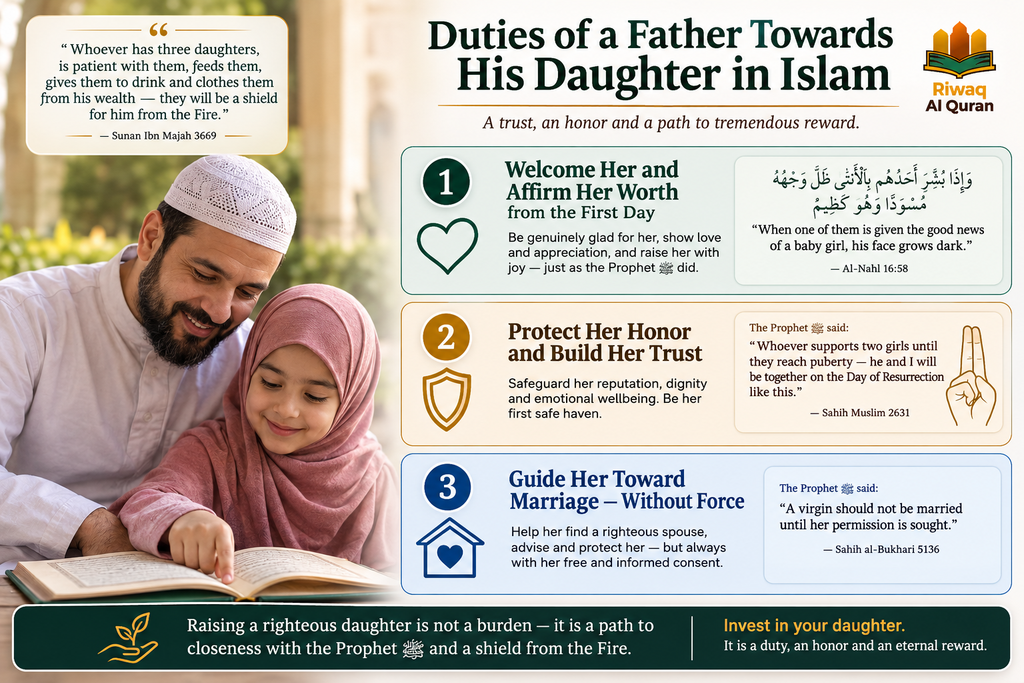
1. Welcome Her and Affirm Her Worth from the First Day
A father’s duty to his daughter begins at birth: welcoming her with the same joy, gratitude, and celebration he would show for a son. The Quran explicitly condemns the pre-Islamic mindset that treated daughters as burdens:
“وَإِذَا بُشِّرَ أَحَدُهُم بِٱلْأُنثَىٰ ظَلَّ وَجْهُهُۥ مُسْوَدًّا وَهُوَ كَظِيمٌ”
“When one of them is given the good news of a baby girl, his face grows dark and he is filled with suppressed grief.” — Surah An-Nahl (16:58)
The Quran describes this reaction — a darkened face at the news of a daughter — with clinical precision that implies clear moral censure. The Prophet (peace be upon him) replaced this attitude entirely through his own example: he publicly honored his daughter Fatimah, rose when she entered a room, seated her beside him, and kissed her on the forehead.
A daughter who grows up knowing her father is genuinely glad she exists develops a psychological security that links to healthier relationships, stronger identity, and greater resilience throughout life.
The Prophet (peace be upon him) attached a specific promise to fathers who invest in their daughters:
“عن أنس بن مالك رضي الله عنه أن رسول الله ﷺ قال: «مَن عالَ جاريتَينِ حتى تَبلُغَا، جاء يومَ القيامةِ أنا وهو» وضمَّ أصابعَه”
“Whoever supports two girls until they reach puberty — he and I will come together on the Day of Resurrection like this.” And he joined his fingers together to illustrate. — Sahih Muslim 2631
The Prophet (peace be upon him) used a visual gesture — joined fingers — to show closeness with himself on the Day of Judgment. There is no clearer image of spiritual proximity in the hadith literature.
The word “supports” (kafala) means comprehensive care: emotional, financial, educational, and social. Not one dimension alone.
2. Protect Her Honor and Build the Trust That Makes Protection Possible
A father’s protective duty toward his daughter extends beyond physical safety. The full scope of what he must protect includes:
- Her reputation and modesty from social and communal harm.
- Her emotional wellbeing from humiliation, neglect, and dismissiveness.
- Her sense of dignity — she must know she is valued, not tolerated.
- Her access to him as a safe haven — he must be the first person she turns to with fear, confusion, or shame — not the last resort.
That trust is not automatic. It must be built consistently across Phase One and Phase Two of childhood. A father who is absent, dismissive, or harsh during his daughter’s early years cannot suddenly expect her to turn to him in crisis. Protection without prior relationship is an empty promise.
3. Guide Her Toward Marriage — Without Force
Among the father’s clearest duties is actively helping his daughter find a righteous and compatible husband. The operative word is actively help — Islam explicitly forbids forcing a woman into marriage without her free, informed consent:
عن أبي هريرة رضي الله عنه أن رسول الله ﷺ قال: «لا تُنكَحُ الأيِّمُ حتى تُستأمَرَ، ولا تُنكَحُ البِكرُ حتى تُستأذَنَ». قالوا: يا رسولَ الله، وكيف إذنُها؟ قال: «أن تَسكُتَ»
“A previously married woman should not be married until she has been consulted, and a virgin should not be married until her permission is sought.” — Sahih al-Bukhari 5136
This hadith closes the door entirely on forced marriage. The father’s role in his daughter’s marriage is to participate, protect, advise, and vet — not to override her consent. The Islamic model is collaborative: the father uses his judgment and experience to identify suitable candidates, but the final decision belongs to the daughter.
This preparation should begin years before the search — helping her understand what to look for, what marriage requires, and what she is entitled to expect from a husband.
For supplications for your children’s righteousness and good character throughout this journey, see our collection of Dua for Child’s Righteousness.
How Should Parents Treat Their Child in Islam?
Islam does not leave the daily treatment of children to guesswork or cultural habit. The Quran and Sunnah establish clear, practical principles that define what Islamic parenting looks and feels like on a day-to-day basis.
A. Fairness Among All Children — The Zero-Tolerance Rule
Islam’s prohibition on favoritism between siblings is one of the most specific rulings in the entire body of family fiqh. When Nu’man ibn Bashir came to the Prophet (peace be upon him) to have him witness a gift given to one of his children, the Prophet responded:
عن النعمان بن بشير رضي الله عنهما: أن أباه أتى به إلى رسول الله ﷺ فقال: إني نَحَلتُ ابني هذا غلامًا. فقال رسول الله ﷺ: «ألكَ ولدٌ سِواه؟» قال: نعم. قال: «أكلَّهم نَحَلتَه مثلَ هذا؟» قال: لا. قال: «فلا تُشهِدني إذًا، فإني لا أشهدُ على جَورٍ»“
‘Do you have other children?’ He said: ‘Yes.’ The Prophet said: ‘Have you given them something similar to what you gave this one?’ He said: ‘No.’ The Prophet said: ‘Then do not ask me to witness injustice.'” — Sunan an-Nasa’i 3683
The Prophet (peace be upon him) called the unequal gift jawran (جَوْرٍ) — injustice and wrongdoing. He refused to witness it. Scholars including Imam an-Nawawi extend this ruling beyond financial gifts to cover:
- Physical affection — hugs, kisses, and praise given to one child and withheld from another in the same moment.
- Time and dedicated attention.
- Educational opportunities provided to one and denied to another.
- Verbal encouragement and public praise.
The applicable standard is simple: if you cannot give the same to all your children, do not give it to one.
B. Correct with Patience, Boundaries, and Constant Love
Children misbehave. The Islamic method for responding is neither anger nor permissiveness — it is a specific, ordered sequence that every Muslim parent should internalize:
- Name the behavior — identify precisely what the child did wrong, calmly and specifically.
- Explain why it is wrong — ground the explanation in Islamic ethics or clear moral reasoning the child can understand.
- Apply the agreed consequence — consistently and without anger or emotional escalation.
- Return to normal — close the episode entirely; do not carry the correction forward as ongoing punishment.
The Quran models this patient, loving approach in the story of Prophet Yaqub (peace be upon him), who continued to pray for the sons who had deceived him for decades — without withdrawing his love or his supplication for them. Parental love in Islam is not conditioned on a child’s performance.
One specific prohibition stands out: telling a child “I will not love you if you do that again” is impermissible. It violates the principle of unconditional parental love and causes lasting harm to both the child’s self-worth and their understanding of Allah’s mercy.
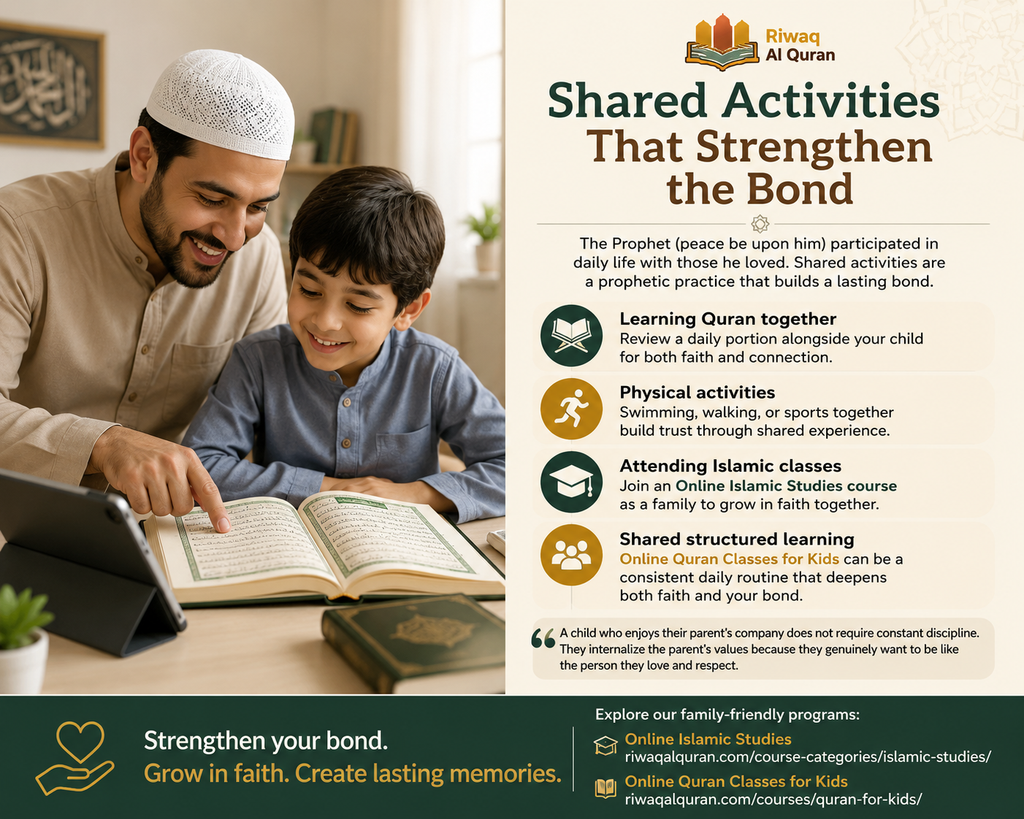
C. Shared Activities That Strengthen the Bond
The Prophet (peace be upon him) participated in daily life with those he loved. He raced with his wife Aisha, played with his grandchildren, and sat with his Companions in leisure as well as worship. Shared activities between parent and child are not a modern parenting trend — they are a prophetic practice with a documented record spanning fourteen centuries.
Key ways parents can build this bond through shared activities:
- Learning Quran together — reviewing a daily portion alongside your child creates both a religious habit and a relational anchor
- Physical activities — swimming, walking, or sports done together build trust through shared experience
- Attending Islamic classes — joining an Online Islamic Studies course as a family activity reinforces both faith and relationship
- Shared structured learning — programs like Online Quran Classes for Kids can become a consistent daily family routine that deepens both faith and the parent-child bond
A child who enjoys their parent’s company does not require constant discipline. They internalize the parent’s values because they genuinely want to be like the person they love and respect.
Give Your Child the Islamic Education They Deserve
Fulfilling your parental duty in Islam means ensuring your child can read, recite, and understand the Quran — in the language it was revealed in. Riwaq Al Quran is a comprehensive online platform offering personalized Quran, Arabic, and Islamic Studies classes for individuals of all ages and backgrounds.
Experienced instructors use a structured curriculum covering Tajweed, Tafsir, and Quran Memorization — making Islamic learning effective, accessible, and genuinely engaging from wherever you are.
Watch real moments from our live sessions at Riwaq Al Quran and see how we bring learning to life:
Courses available for your child and family include:
- Online courses for kids — age-appropriate Islamic education from the earliest years
- Online Quran classes for kids and adults — structured recitation with qualified native tutors
- Online Arabic courses — building the language of the Quran from the ground up
- Online Ijazah courses — for those seeking certified Quranic authority
- Online Islamic Studies courses — values, beliefs, and Islamic practices in a structured curriculum
Book your child’s free trial lesson today — no commitment required.
Conclusion
The duties of parents towards their child in Islam are not a checklist to complete — they are a covenant held directly with Allah over the most valuable trust He places in human hands. Choose a righteous spouse before the child arrives.
Play freely and love unconditionally in the early years. Discipline consistently and with clarity through adolescence. Walk beside them as a companion and advisor in adulthood. Welcome your daughter. Be present for your son. Be fair to every single one of them.
Children raised inside this covenant do not simply obey — they love their parents, care for them in old age, and make dua for them after death. And that dua matters more than most parents realize. The Prophet (peace be upon him) named a righteous child who prays for their parent as one of three acts of ongoing charity that continue to benefit a person after they die:
“إِذَا مَاتَ الإِنْسَانُ انْقَطَعَ عَنْهُ عَمَلُهُ إِلاَّ مِنْ ثَلاَثَةٍ إِلاَّ مِنْ صَدَقَةٍ جَارِيَةٍ أَوْ عِلْمٍ يُنْتَفَعُ بِهِ أَوْ وَلَدٍ صَالِحٍ يَدْعُو لَهُ”
“When a human being dies, all of his deeds are terminated except for three: an ongoing charity, knowledge from which others benefit, and a righteous child who makes dua for him.” — Sahih Muslim 1631
That is the ultimate return on faithful Islamic parenting: a child whose prayer for you continues to reach Allah long after you have left this world. For more guidance on raising righteous children in Islam and understanding their place in the Quran, explore our article on What Does the Quran Say About Children?
Frequently Asked Questions
The questions below cover the most commonly searched topics on parenting in Islam. Each answer is grounded directly in Quranic guidance or authentic hadith and is written to give you a clear, actionable response — not a vague overview.
1. What are the main duties of parents towards their child in Islam?
The four core duties are provision (meeting physical and material needs), Islamic education (Quran, Arabic, moral character, and the five pillars), emotional nurture (unconditional love, physical affection, and consistent presence), and protection (physical, emotional, and spiritual — including digital protection). All four are grounded in the Quran and the authentic Sunnah and are obligatory, not optional.
2. At what age should Muslim parents start teaching children to pray?
Parents should begin instructing children to pray at seven, based on a direct prophetic command in Sunan Abu Dawud 495. At ten, measured correction is permitted for consistent neglect. The goal is for prayer to become a natural, internalized habit before puberty — when it becomes a binding religious obligation. Starting at puberty is too late for effective habit formation.
3. What are the duties of a father towards his daughter in Islam?
A father’s specific duties include welcoming her birth with genuine joy, providing comprehensively for her needs, protecting her physically and emotionally, giving her consistent affection and dedicated time, and guiding — never forcing — her toward a righteous marriage. Sahih Muslim 2631 records a specific promise: a father who supports two daughters until they reach puberty will stand beside the Prophet (peace be upon him) on the Day of Judgment.
4. Is favoritism between children allowed in Islam?
No — it is explicitly forbidden. The Prophet (peace be upon him) called an unequal gift between siblings joor (injustice) and refused to witness it (Sunan an-Nasa’i 3683). Scholars extend this ruling to physical affection, time, attention, and verbal praise. The standard: if you cannot give the same to all your children, do not give it to one.
5. Is it permissible to tell a child “I won’t love you” as a form of discipline?
No. Islamic scholarship consistently holds this impermissible because it violates the principle of unconditional parental love and causes lasting harm to the child’s self-worth and their image of Allah’s mercy. The Islamic method is to correct the behavior calmly, explain why it is wrong, apply the agreed consequence — and keep love completely unconditional throughout.
6. Does Islam address protecting children from harmful digital content?
Yes. Surah At-Tahrim (66:6) commands parents to protect their families from the Fire — a command contemporary scholars apply directly to harmful digital content, unmonitored internet access, and corrupting media. A parent who provides a child with a connected device and no oversight is neglecting a recognized Quranic obligation.
Sources
Surah Al-Isra (17:23) · Surah An-Nisa (4:34) · Surah At-Tahrim (66:6) · Surah Luqman (31:13) · Surah Luqman (31:17) · Surah An-Nahl (16:58) · Sahih al-Bukhari 893 · Sahih al-Bukhari 494 · Sahih al-Bukhari 5090 · Sahih al-Bukhari 5027 · Sahih al-Bukhari 5997 · Sahih al-Bukhari 1385 · Sahih al-Bukhari 5136 · Sahih Muslim 995 · Sahih Muslim 1631 · Sahih Muslim 2631 · Sunan Abu Dawud 495 · Sunan Abu Dawud 2838 · Sunan Abu Dawud 5217 · Sunan an-Nasa’i 3683 · Sunan Ibn Majah 3669