Undoubtedly, our children are the most beloved and dearest of all to us, and we care about their success even more than our own. We are always ready to back them up in every way we can, whenever they need us to stand through any hardship — a life situation, or a regular exam.
Every parent can help their child in their own way, but some approaches are specifically rooted in Quran and Sunnah, suited to supporting a successful Muslim child, whatever their age or wherever they are. Seeking knowledge itself is described directly in Hadith as a religious obligation, not just a worldly pursuit:
(طَلَبُ الْعِلْمِ فَرِيضَةٌ عَلَى كُلِّ مُسْلِمٍ)
“Seeking knowledge is an obligation upon every Muslim.” (Sunan Ibn Majah 224)
This framing matters — it means the effort a child puts into studying for an exam isn’t separate from their religious life, it’s part of it. Dua doesn’t replace that effort; it works alongside it. Teach your child to recite these duas themselves during study and before the exam, alongside your own sincere supplication on their behalf — both matter, and neither replaces the other.
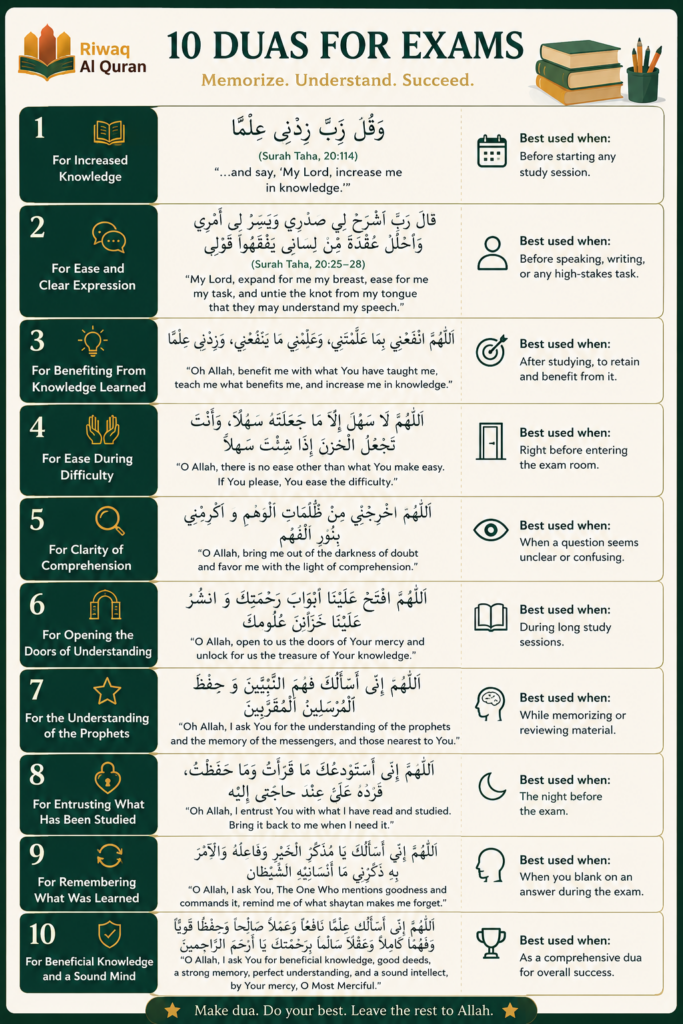
Each dua below suits a slightly different moment in the exam process, from the study session itself to the moment of sitting the exam.
Table of Contents
Dua Is Meant to Accompany Study, Not Replace It
Before working through the ten duas, it’s worth being explicit about something many families get slightly wrong: reciting a dua for exam success is not a substitute for actual preparation. The Prophet ﷺ was once asked whether a person should still tie their camel or simply trust in Allah, and his answer was direct:
(اعْقِلْهَا وَتَوَكَّلْ)
“Tie it, and then place your trust in Allah.” (Jami’ at-Tirmidhi 2517)
This principle applies exactly to exam preparation: a child recites these duas while studying, not instead of studying. The dua addresses the parts of exam success a child can’t fully control — memory, clarity of mind, composure under pressure — while the studying itself remains the child’s own responsibility.
Teaching a child this distinction early prevents dua from becoming an excuse to under-prepare, which defeats the purpose of asking for Allah’s help in the first place.
1. A Dua for Increased Knowledge, Recited Before Study Begins
Before opening a book, the Quran gives believers a direct, short request to make of Allah rather than relying on effort alone:
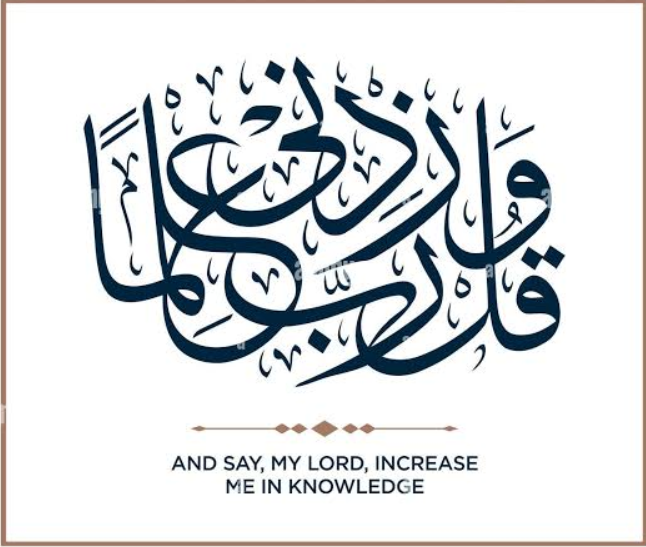
(…وَقُل رَّبِّ زِدْنِى عِلْمًۭا)
“…and say, ‘My Lord, increase me in knowledge.'” (Surah Taha, 20:114)
What makes this verse especially worth teaching a child is who it was originally addressed to: the Prophet Muhammad ﷺ himself, already the most knowledgeable person in creation, was instructed by Allah to keep asking for more.
If the most knowledgeable person was told to keep requesting increase, no child should feel embarrassed asking the same, regardless of how confident or unconfident they feel about their preparation.
How to use it?
Recite this once at the very start of each study session, not just once before the exam — its brevity is part of its value, since a child can say it in seconds without breaking concentration, making it easy to build into a daily habit rather than something reserved only for exam days.
For more duas built specifically around learning and study, see our full list of Duas for Learning.
2. Dua For Ease and Clear Expression in The Exam
When a child feels nervous about speaking or being understood, this beautiful dua of Prophet Musa (AS) asks Allah for confidence, ease, aWhen a child feels nervous about speaking or being understood, this is the exact dua Prophet Musa (AS) made before facing Pharaoh — arguably the highest-stakes speaking situation described in the Quran:
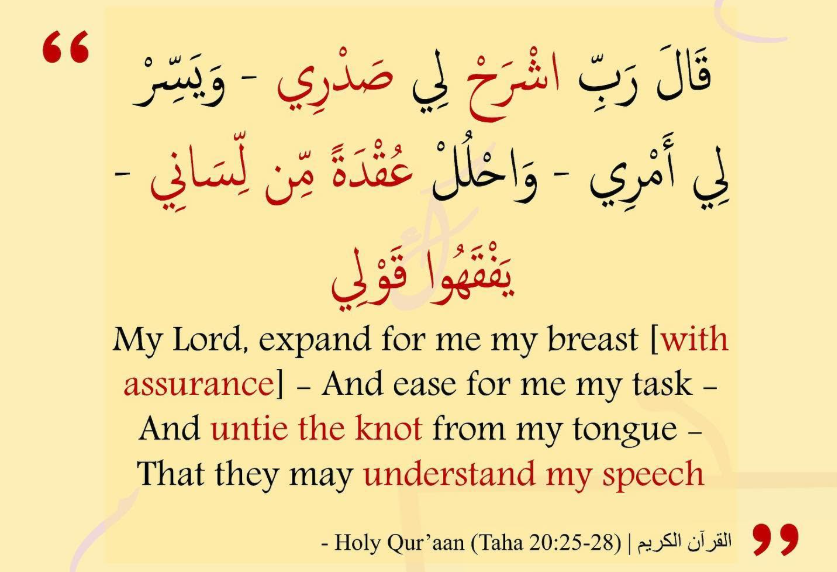
(قَالَ رَبِّ ٱشْرَحْ لِى صَدْرِى وَيَسِّرْ لِىٓ أَمْرِى وَٱحْلُلْ عُقْدَةًۭ مِّن لِّسَانِى يَفْقَهُوا۟ قَوْلِى)
“My Lord, expand for me my breast, ease for me my task, and untie the knot from my tongue, that they may understand my speech.” (Surah Taha, 20:25–28)
Musa (AS) made this exact request when he was anxious about his own speech being understood by an audience that held real power over him — Pharaoh, ruling over the very people threatening Musa’s life.
This context is worth explaining to a child directly: if a prophet facing a tyrant felt the need to ask for composure and clear speech, feeling the same before a school exam isn’t a weakness, it’s the same honest request scaled down to a smaller but still real challenge.
The three requests inside this dua map onto three distinct fears worth naming separately:
- An expanded breast addresses composure and calm.
- An eased task addresses the difficulty of the work itself.
- An untied tongue addresses clear expression.
— a child can mentally check which of the three they need most in a given moment and lean into that phrase specifically.
If your child is preparing for an exam that includes Quran recitation or Tajweed, Riwaq Al Quran’s Tajweed classes can help build the confidence that makes reciting under pressure feel far less intimidating.
3. A Dua for Benefiting From Knowledge Already Learned
BefStudying and actually recalling material under pressure are two different skills, and this dua addresses the gap between them directly:
(اللَّهُمَّ انْفَعْنِي بِمَا عَلَّمْتَنِي، وَعَلِّمْنِي مَا يَنْفَعُنِي، وَزِدْنِي عِلْمًا)
“Oh Allah, benefit me with what You have taught me, teach me what benefits me, and increase me in knowledge.” (Sunan Ibn Majah 251)
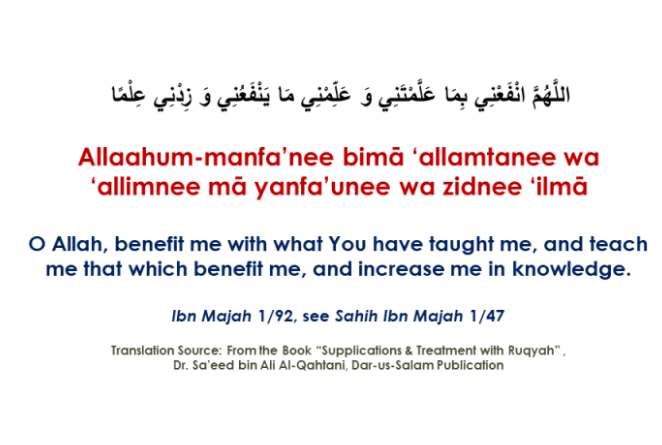
Notice the order of the three requests here, since it’s deliberate rather than arbitrary: benefit from what’s already been learned comes first, before asking for anything new.
This is a useful reminder for a child who’s spent weeks studying — the dua isn’t asking Allah to make up for a lack of preparation, it’s asking that the preparation already done actually surfaces when it’s needed, which is a completely different request than asking to somehow know material never studied.
The Dua works especially well as a dua recited right after finishing a revision session, sealing in what was just reviewed rather than only being used at the start of study.
4. A Dua for Ease Right Before Walking Into the Exam Room
This is a well-documented supplication from the Sunnah, and it’s especially suited to the moment right before walking into the exam room, when anxiety often peaks:
(اَللّٰهُمَّ لا سَهْلَ إِلاّ ما جَعَلتَهُ سَهلاً، وَأَنْتَ تَجْعَلُ الحزنَ إِذا شِئْتَ سَهلاً)
“O Allah, there is no ease other than what You make easy. If You please, You ease the difficulty.” (Sahih Ibn Hibban 974)

This dua doesn’t ask Allah to remove the exam’s difficulty — a distinction genuinely worth explaining to a child rather than glossing over. It acknowledges the difficulty is real, and asks that it become manageable rather than pretending it isn’t hard in the first place.
That’s a more honest, and ultimately more useful, framing than telling a nervous child “it’ll be easy,” since it doesn’t set up a false expectation that collapses the moment the exam feels difficult anyway.
Recite this specifically in the minutes right before entering the exam room, not earlier — its wording is built for that exact transition moment, between preparation being finished and the test itself beginning.
5. Say This Dua for Clarity When a Question Seems Confusing
This dua is useful specifically for the moment a question seems confusing at first read, before panic sets in:
(اَللّٰهُمَّ اَخْرِجْنِيْ مِنْ ظُلُمَاتِ الْوَهْمِ وَ اَكْرِمْنِيْ بِنُوْرِ الْفَهْمِ)
“O Allah, bring me out of the darkness of doubt and favor me with the light of comprehension.”
The imagery here — darkness giving way to light — mirrors a common, genuinely universal experience during exams: a question that looks impossible on first read often becomes clear within a minute once the initial confusion passes. This dua gives a child something concrete and specific to say in that exact pause, rather than letting the confusion compound into panic and wasted time re-reading the same line repeatedly without absorbing it.
Teach a child to recite this silently the moment they notice themselves re-reading a question without understanding it, as a deliberate reset rather than continuing to stare at the same words with rising anxiety.
6. A Broader Dua for Insight During Longer Study Sessions
Unlike the exam-moment duas above, this one is suited to longer study sessions rather than the exam itself:
(اَللّٰهُمَّ افْتَحْ عَلَيْنَا اَبْوَابَ رَحْمَتِكَ وَ انْشُرْ عَلَيْنَا خَزَآئِنَ عُلُوْمِكَ)
“O Allah, open to us the doors of Your mercy and unlock for us the treasure of Your knowledge.”
The plural phrasing here — “open to us,” “unlock for us” — is worth pointing out to a child directly, since it makes this a good dua to recite together as a family before a study session, rather than only individually. It frames learning as something sought collectively, with the parent’s own effort and dua bound up alongside the child’s, not just an individual burden the child carries alone.
This is a strong choice to recite together as a family right before a longer study block — an hour or more — rather than a quick dua for a five-minute review session.
7. A Dua Asking for the Understanding of the Prophets
This is a strong choice for a child memorizing material specifically, since it directly names memory alongside understanding rather than treating them as the same thing:
(اللَّهُمَّ إِنِّي أَسْأَلُكَ فَهْمَ النَّبِيِّينَ وَ حِفْظَ الْمُرْسَلِينَ الْمُقَرَّبِينَ)
“Oh Allah, I ask You for the understanding of the prophets and the memory of the messengers, and those nearest to You.”
Understanding (fahm) and memory (hifz) are two genuinely distinct skills a student needs, and conflating them is a common mistake — a child can understand a concept perfectly and still forget it under pressure, or memorize something word for word without truly understanding what it means.
This dua asks for both together explicitly, which is exactly what real exam performance requires: material that’s both understood and retained, not just one or the other.
It is particularly useful for subjects requiring memorization alongside comprehension — Quran, history dates, formulas, or vocabulary — where both skills genuinely need to work together.
8. A Dua For Entrusting What Has Been Studied, the Night
This dua is best recited the night before an exam, after study is finished, as a way of releasing anxiety about forgetting rather than continuing to cram:
(اللَّهُمَّ إِنِّي أَسْتَوْدِعُكَ مَا قَرأتُ وَمَا حَفَظْتُ، فَردُهُ عَليّ عِنْدَ حَاجَتِي إِلَيهِ)
“Oh Allah, I entrust You with what I have read and studied. Bring it back to me when I need it.”
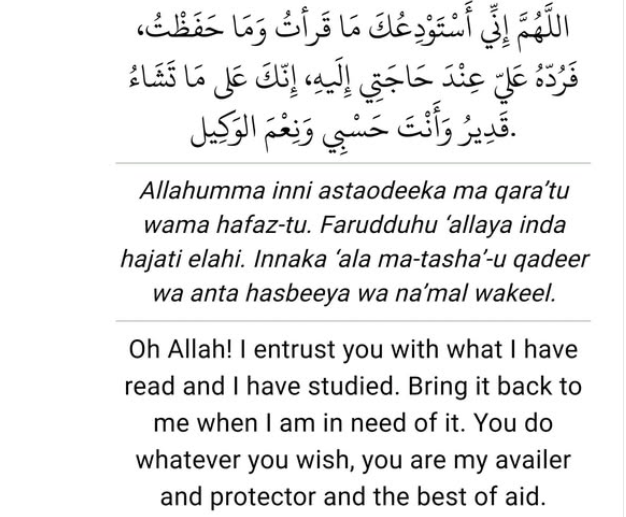
This dua is built on the concept of amanah — a trust placed with someone for safekeeping until it’s needed again. The child is explicitly handing over what they’ve studied to Allah’s safekeeping for the night, rather than lying awake worrying about whether it will still be there in the morning.
It’s a genuinely practical tool for winding down the night before an exam, not just a spiritual formality — the act of saying it out loud gives an anxious mind a specific point to stop reviewing and actually go to sleep.
Recite this as the very last study-related act of the night, ideally right before turning off the lights, as a deliberate signal to stop reviewing and let the material rest.
9. A Remembering Dua for What Was Learned, in the Exam Itself
This dua is specifically aimed at the moment of blanking on an answer during the exam itself, which is a different situation from general nervousness beforehand:
(اللَّهُمَّ إِنِّي أَسْألُكَ يَا مُذَكِرَ الخَيْرِ وَفَاعِلَهُ وَالآمِرَ بِهِ ذَكِرّنِي مَا اَنّسَانِهِ الشّيطَان)
“O Allah, I ask You, The One Who mentions goodness and commands it, remind me of what shaytan makes me forget.”
Notice this dua attributes the forgetting specifically to shaytan’s influence, not to the child’s own lack of preparation or ability — a reframe genuinely worth explaining, since it can help a child who blanks mid-exam avoid spiraling into self-doubt (“I studied wrong,” “I’m not smart enough”) and instead treat the moment as something external and temporary to actively push back against, rather than a verdict on their own ability.
Teach this specifically as the “blank moment” dua — the one to recite silently the instant a known answer suddenly won’t come, before moving on to another question and returning to it later.
For a deeper collection focused specifically on retention, our Duas for Memory guide is worth reviewing alongside this one.
10. A Comprehensive Closing Dua for Beneficial Knowledge and a Sound Mind
The Prophet ﷺ regularly recited this dua after the Fajr prayer, as narrated by his wife Umm Salamah (RA):
(اللَّهُمَّ إِنِّي أَسْأَلُكَ عِلْمًا نَافِعًا وَرِزْقًا طَيِّبًا وَعَمَلًا مُتَقَبَّلًا)
“O Allah, I ask You for beneficial knowledge, good provision, and accepted deeds.” (Sunan Ibn Majah 925, graded Sahih by Al-Albani)
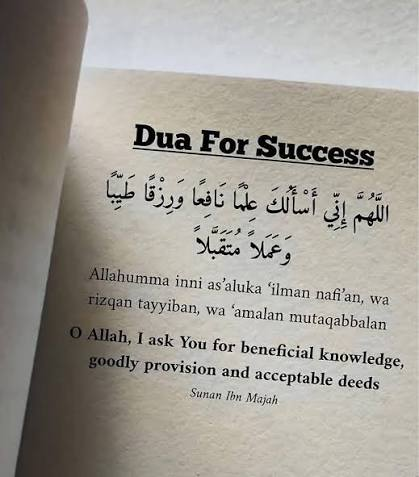
Five distinct requests appear in this single dua:
- Beneficial knowledge.
- Good deeds
- Strong memory
- Complete understanding
- A sound intellect
— making it worth teaching a child as a general, all-purpose dua for any exam season, not just a single test.
Its comprehensiveness is precisely the point: on a morning when a child isn’t sure which specific thing to ask for, this dua covers all of it at once.
This is the dua to fall back on when a child doesn’t know which of the other nine fits their current worry — reciting all five requests together covers most of what an exam actually demands.
Why Dua Matters for Exam Success?
Dua is not a symbolic gesture in Islam — it is described in the Quran as a direct channel to Allah’s response, available for everyday matters like an exam, not reserved only for major life events.
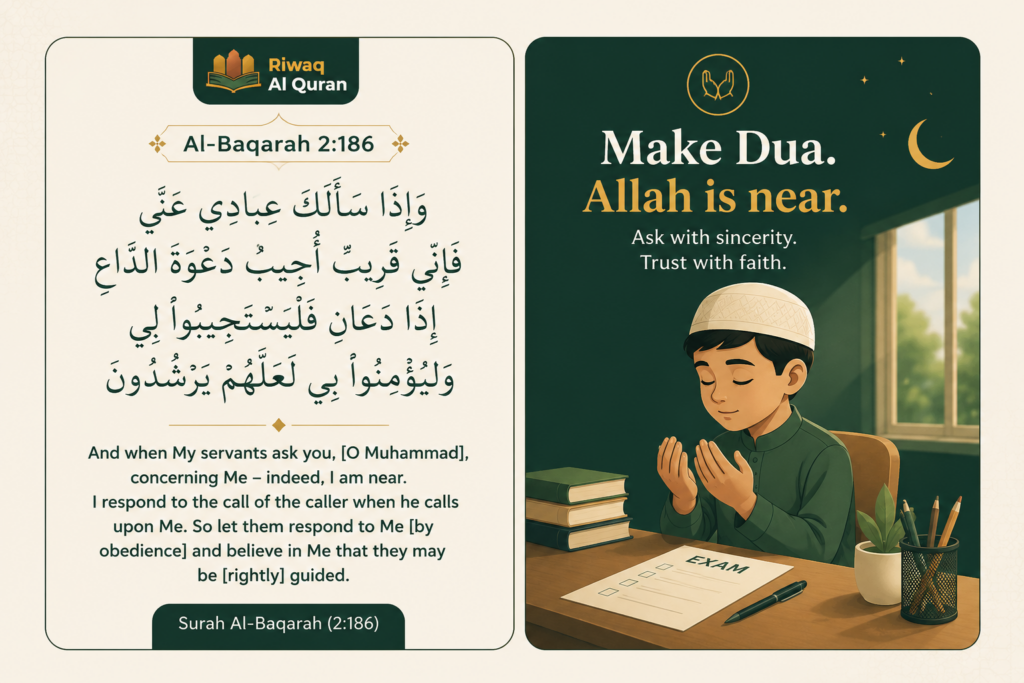
Allah states:
(وَإِذَا سَأَلَكَ عِبَادِى عَنِّى فَإِنِّى قَرِيبٌ ۖ أُجِيبُ دَعْوَةَ ٱلدَّاعِ إِذَا دَعَانِ)
“And when My servants ask you concerning Me, indeed I am near. I respond to the invocation of the supplicant when he calls upon Me.” (Surah Al-Baqarah, 2:186)
— This promise carries three specific implications worth teaching a child directly:
- Allah’s nearness is stated as a fact, not something a person has to earn through the size or importance of the request.
- The response is tied to sincerity and calling upon Him, not to the scale of the matter — an exam qualifies just as much as any larger concern.
- The verse closes with a condition: believers should respond to Allah in turn through obedience, meaning dua and good conduct are meant to reinforce each other, not stand apart.
Allah’s capacity to ease any difficulty is described just as directly:
(إِنَّمَآ أَمْرُهُۥٓ إِذَآ أَرَادَ شَيْـًٔا أَن يَقُولَ لَهُۥ كُن فَيَكُونُ)
“His command is only when He intends a thing that He says to it, ‘Be,’ and it is.”(Surah Ya-Sin, 36:82)
— This is the theological basis for treating exam-day nerves as something dua can genuinely address, not just soothe.
If you’d like to build a broader dua habit with your child beyond exam season, our guide to Top Duas to Teach Your Kids covers the everyday supplications worth teaching alongside these.
Here’s what that kind of consistent support looks like from a parent’s side, in a different context:
Why the Real Exam Isn’t the One at School
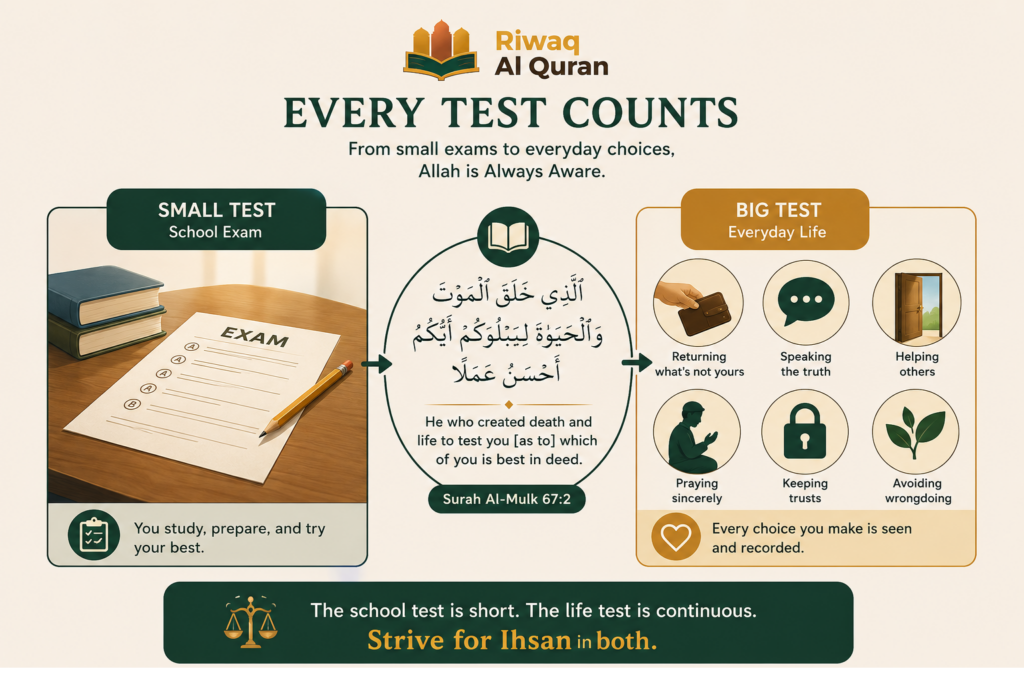
A school exam matters, but Islamic teaching frames it as a small test within a much larger one, and this framing is worth teaching a child directly rather than leaving it implicit.
Allah states:
(ٱلَّذِى خَلَقَ ٱلْمَوْتَ وَٱلْحَيَوٰةَ لِيَبْلُوَكُمْ أَيُّكُمْ أَحْسَنُ عَمَلًۭا)
“He who created death and life to test you as to which of you is best in deed.”(Surah Al-Mulk, 67:2)
— Everything a person does across an entire lifetime is the actual test this verse describes — a single exam grade is one small data point inside it, not the test itself.
This distinction matters practically for three reasons:
- It puts exam anxiety in proportion — a difficult exam result is not, on its own, evidence of failing the test that actually counts.
- It gives a concrete reason to reject cheating: a child who passes a school exam dishonestly may clear that one hurdle while directly failing the larger, lifelong test of honest conduct.
- It gives dua itself a bigger purpose beyond the exam — asking Allah for beneficial knowledge and a sound mind serves this lifetime test, not just Tuesday’s math exam.
Teaching a child that honest effort matters more than a dishonest pass connects directly to the character-building duas covered in our guide to Dua for Your Child’s Righteousness, Piousness, Devotion, Steadfastness, and Good Behaviour — worth reading alongside this one if exam honesty is a conversation you want to have early.
Support Your Child’s Growth With Riwaq Al Quran
Dua and diligent study go hand in hand, and so does building a child’s broader connection to their faith beyond just exam season.
Riwaq Al Quran is a comprehensive online platform that offers personalized Quran, Arabic, and Islamic Studies classes for individuals of all ages and backgrounds. Our experienced instructors use a structured curriculum covering Tajweed, Tafsir, and Memorization, with easy, effective access to learning the Quran and seamless communication between students and teachers.
If exam season has you thinking about what else your child could be building toward, here’s a quick look at what that can include:
We offer several course types, including:
- Online courses for kids
- Online Quran classes for kids and adults
- Online Arabic courses
- Online Ijazah courses
- Online Islamic Studies courses


A few specific courses worth exploring if this article resonated with you:
- Online Tafseer Course — go deeper into Quranic meaning, including the verses cited throughout this guide
- Quran Memorization Online Course — build the same memory strength several of the duas above ask Allah for
- Online Quran Classes for Kids — nurture your child’s connection to the Quran through interactive, age-appropriate sessions
And if exam season has you thinking about your child’s wellbeing more broadly, our guide on Dua for Children’s Protection, Safety, and Righteousness covers supplications that go beyond a single test — for their health, character, and safety day to day.
A few specific courses worth exploring if this article resonated with you:
- Online Tafseer Course — go deeper into Quranic meaning, including the verses cited throughout this guide
- Quran Memorization Online Course — build the same memory strength several of the duas above ask Allah for
- Online Quran Classes for Kids — nurture your child’s connection to the Quran through interactive, age-appropriate sessions

Conclusion
Every parent has sat outside an exam room feeling helpless, because the studying is already done and there’s nothing left to control. Dua is what fills that gap — not a replacement for preparation, but the one thing left to do once preparation has run its course.
That’s why these ten duas matter more than they might seem to at first: “My Lord, increase me in knowledge” before opening a book. “There is no ease other than what You make easy” walking into the exam room. “Bring back to me what I have entrusted to You” the night before, when sleep matters more than one more page of review.
Each one has a moment it belongs to, because Allah’s promise isn’t vague:
(إِنِّى قَرِيبٌ أُجِيبُ دَعْوَةَ ٱلدَّاعِ إِذَا دَعَانِ)
“I am near. I respond to the invocation of the supplicant when he calls upon Me.” (Surah Al-Baqarah, 2:186)
But teach your child the harder truth alongside these duas: a grade earned by cheating is a grade earned by failing the only exam that actually follows them home.
(ٱلَّذِى خَلَقَ ٱلْمَوْتَ وَٱلْحَيَوٰةَ لِيَبْلُوَكُمْ أَيُّكُمْ أَحْسَنُ عَمَلًۭا)
“He who created death and life to test you as to which of you is best in deed.”(Surah Al-Mulk, 67:2)
A child who learns to bring both — sincere dua and honest effort — to a school exam is quietly rehearsing for the one exam that was never going to end when the school year did.
FAQs
These are the questions parents most often ask once they’ve started incorporating exam duas into their child’s routine.
What is the best dua for a child before an exam?
“Allaahumma laa sahla illaa maa ja’altahu sahlan” (“O Allah, there is no ease other than what You make easy”) is one of the most widely used duas immediately before an exam, specifically because it directly addresses the fear of difficulty in the moment ahead.
Should the parent make dua, or should the child recite it themselves?
Both matter — a parent’s sincere dua on the child’s behalf is valuable, but teaching the child to recite these duas themselves also builds their own habit of reliance on Allah that continues well beyond any single exam.
Is it okay to ask Allah for exam success specifically?
Yes, asking Allah for success in a specific, lawful matter like an exam is fully appropriate, since the Quran describes Allah as responding to the sincere supplication of anyone who calls upon Him, without restricting that promise to only major life matters.
Does dua replace the need to study?
No, dua is meant to accompany genuine study and preparation, not substitute for it — asking Allah for ease and success works alongside real effort, not in place of it.
Why does the Quran say cheating still leads to failure, even if the exam is passed?
Because Islamic teaching frames life itself as the real test of righteous deeds, so a child who cheats to pass a school exam may still fail the larger, lasting test of honesty and obedience to Allah that the Quran describes as the true purpose of this life.