Drinking Quran water — water over which Quranic verses have been recited — is a permissible practice in Islam known as Ruqyah, with clear support from both the Quran and authentic hadith.
What’s less commonly explained accurately is which benefits this practice actually carries according to Islamic teaching, and which claims go beyond what the evidence supports.
This guide covers what Quran water is, the Islamic ruling behind it, the specific hadith on Surah Al-Baqarah’s role in this practice, and an honest look at where the line sits between spiritual blessing and claims Islamic scholarship doesn’t actually make.
What You’ll Learn in This Article
- What Quran water is and the Quranic and hadith basis for its permissibility.
- Which benefits are genuinely supported by Islamic teaching, and which aren’t.
- Why Surah Al-Baqarah specifically is tied to this practice, with the actual hadith behind it.
- Whether reciting over water has a literal physical effect, or a spiritual one.
- How to approach this practice without overstating what it promises.
Table of Contents
What Is Quran Water and Is It Permissible?
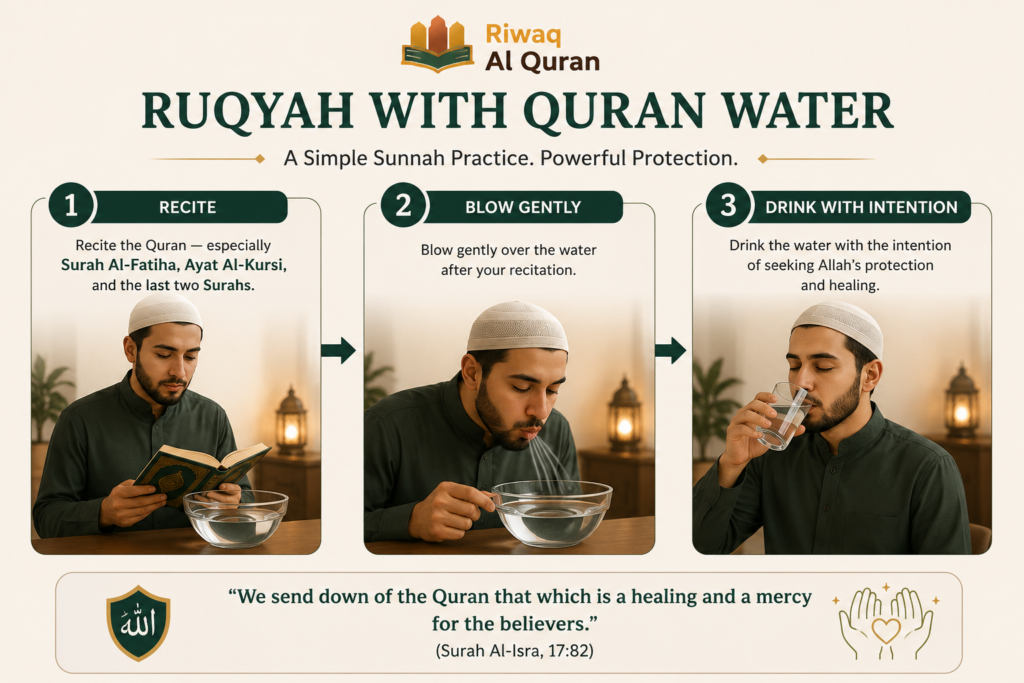
Quran water is water over which a person has recited Quranic verses and then blown gently, following a form of spiritual treatment known as Ruqyah, before drinking or using the water for purification.
This practice has clear precedent in both the Quran and Hadith, provided the recitation is sincere and involves no association of partners with Allah.
The Islamic Ruling on Reciting Over Water
Two sourcTwo sources establish this practice as permissible rather than superstition. Allah describes the Quran’s healing nature directly:
(وَنُنَزِّلُ مِنَ الْقُرْآنِ مَا هُوَ شِفَاءٌ وَرَحْمَةٌ لِّلْمُؤْمِنِينَ)
“And We send down of the Quran that which is healing and mercy for the believers.” (Surah Al-Isra, 17:82)
This verse forms the core basis for Ruqyah as a permissible practice. Notice the condition built into the same verse, worth reading in full: it continues by saying the Quran “does not increase the wrongdoers except in loss” — meaning the healing described here isn’t a mechanical property of the words themselves, but an effect tied to the sincerity of the person receiving them. That distinction is the foundation for everything else this article covers.
The Prophet’s ﷺ own ruling on the underlying practice is recorded directly. When companions asked him about Ruqyah as it was practiced before Islam, he replied:
(لَا بَأْسَ بِالرُّقَى مَا لَمْ يَكُنْ فِيهِ شِرْكٌ)
“There is no harm in Ruqyah so long as it does not involve shirk (associating partners with Allah).” (Sahih Muslim 2200)
This is a genuinely significant ruling, since it means the Prophet ﷺ didn’t reject the pre-Islamic practice of Ruqyah outright — he kept the practice and corrected only the theology underneath it.
That’s the model this entire topic follows: the outward act (reciting over water) stays the same; what makes it permissible or not is exclusively where reliance is placed.
This condition — no shirk, no reliance on anything besides Allah — is the boundary that makes the practice permissible rather than superstition. It also means Ruqyah is not a private ritual with its own independent power; its permissibility is entirely tied to keeping reliance fixed on Allah alone, with the recitation as the means, not the source, of any benefit.
Benefits of Quran Water:
Islamic teaching supports genuine spiritual benefit from this practice, but it’s worth being precise about what that means rather than treating it as a general-purpose remedy for unrelated physical or cognitive concerns.
1. Spiritual Benefits Rooted in Intention
Consuming Quran water with sincere intention is described by scholars as a means of seeking Allah’s blessing (barakah) and healing (shifa), rooted in the same verse that establishes Ruqyah’s permissibility.
The benefit is tied directly to the sincerity of the intention and reliance on Allah — not to any property the water itself is claimed to acquire independent of that reliance.
In practice, this means the same water carries no benefit at all for someone reciting mechanically, without belief or sincerity, since the mechanism scholars describe is spiritual reliance, not the water’s composition.
2. What Islam Does Not Claim
There is no scholarly basis for treating Quran water as a guaranteed cure for specific illnesses, a cognitive enhancer, or a source of worldly gains like wealth or improved exam performance.
Presenting it that way overstates what even the strongest supporting hadith actually establish, and risks turning a sincere spiritual practice into something closer to a claimed remedy it was never described as being.
To be specific about where the boundary sits:
- Quran water is not described anywhere in hadith as treating named physical conditions the way a medicine would.
- It is not linked in any authentic source to improved memory, focus, or exam performance.
- It is not described as producing wealth, career success, or other worldly outcomes.
- Its documented role is spiritual — seeking Allah’s healing and blessing — with the actual outcome remaining entirely in Allah’s hands, not guaranteed by the practice itself.
If you want to understand the Quranic basis for Ruqyah in more depth rather than relying on generalized claims, Riwaq Al Quran’s Online Tafseer Course covers exactly this kind of thematic study, verse by verse, with a qualified instructor.
Surah Al-Baqarah And Quran Water
Surah Al-Baqarah holds a specific, hadith-documented role that goes beyond a general reputation for being “powerful” — this is the actual reason many people recite it over water rather than another chapter.
For a full breakdown of every documented virtue this Surah carries, see Benefits of Surah Baqarah.
1. The Hadith Behind Surah Al-Baqarah’s Protective Role
The Prophet ﷺ said directly:
(لَا تَجْعَلُوا بُيُوتَكُمْ مَقَابِرَ، إِنَّ الشَّيْطَانَ يَنْفِرُ مِنَ الْبَيْتِ الَّذِي تُقْرَأُ فِيهِ سُورَةُ الْبَقَرَةِ)
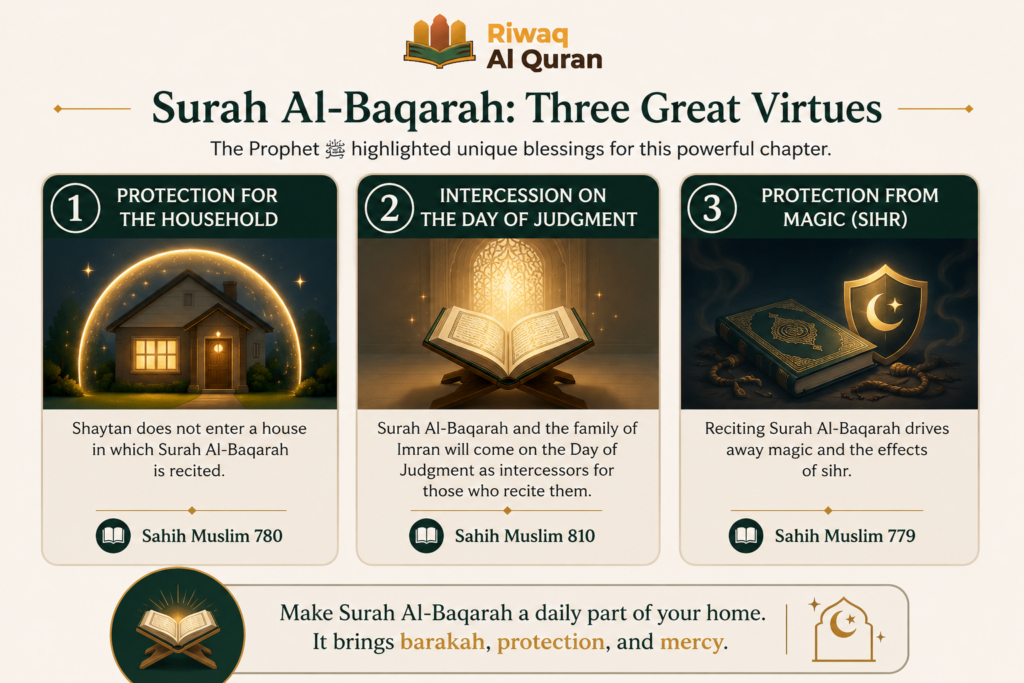
“Do not make your homes like graveyards. Verily, the Shaytan will not enter the home in which Surah Al-Baqarah is recited.” (Sahih Muslim 780)
This hadith is specifically about protection within a household from Shaytan’s influence, which is why Surah Al-Baqarah is the chapter most closely associated with household and personal protection practices, including reciting it over water intended for spiritual protection.
Notice the comparison the Prophet ﷺ draws — a home without this recitation is likened to a graveyard, a place with no life or activity, which frames regular recitation as something that actively animates a household’s spiritual state, not a one-time protective charm.
Reciting a Surah like Al-Baqarah correctly matters here too — a few common mistakes worth knowing before they become habits:
2. Other Documented Virtues of Surah Al-Baqarah
SuSurah Al-Baqarah’s role in Islamic practice extends beyond household protection, which is part of why it’s chosen so often for this specific practice. The Prophet ﷺ described its role on the Day of Judgment directly, alongside Surah Aal-e-Imran:
(اقْرَءُوا الزَّهْرَاوَيْنِ الْبَقَرَةَ وَسُورَةَ آلِ عِمْرَانَ فَإِنَّهُمَا تَأْتِيَانِ يَوْمَ الْقِيَامَةِ كَأَنَّهُمَا غَمَامَتَانِ)
“Recite the two bright ones, Al-Baqarah and Surah Aal-e-Imran, for they will come on the Day of Resurrection like two clouds, shading their reciters.” (Sahih Muslim 804a)
The same hadith continues with a second statement specifically about Al-Baqarah alone: that reciting it regularly is a blessing, forsaking it is a cause of regret, and it cannot be overcome by magic. This is why the Surah carries a documented connection to protection from magic specifically, not just a general reputation — scholars point to this exact wording as the basis for that connection.
Together, these documented virtues — not vague reputation — are why Surah Al-Baqarah specifically, rather than any other chapter, is the one most commonly recited for this purpose.
Other chapters carry their own distinct, documented virtues as well — see Benefits of Surah Yaseen for a comparable breakdown of a different Surah’s specific role in Islamic practice.
Learning to recite a Surah like Al-Baqarah correctly and with proper Tajweed is its own undertaking — Riwaq Al Quran’s Online Tajweed Classes are built to help you do exactly that with qualified, native-speaking instructors.
Does Reciting Over Water Have a Literal Effect on the Water Itself?
This is a fair question to ask precisely, since the honest answer sits between “no effect at all” and “a measurable physical change.”
a. What the Evidence Actually Supports?
Islamic teaching treats the water as a vessel for something sought through Allah’s permission and mercy — not as a substance that undergoes some direct physical transformation from sound waves or vibration, a framing closer to unrelated, scientifically unsupported claims about “water memory” than to anything in Islamic scholarship.
The blessing sought through Ruqyah operates through Allah’s will and the sincerity of the person reciting and drinking, consistent with how the Quran describes its own healing nature in Surah Al-Isra 17:82 — as something Allah sends down for the believers, not as an independent chemical property the water acquires on its own.
b. A Quick Summary of the Evidence
Here’s a condensed view of the sources this article’s rulings are built on, so you can see at a glance where each claim comes from:
| Source | Reference | What It Establishes |
|---|---|---|
| Quran | Surah Al-Isra, 17:82 | The Quran itself is described as healing and mercy for believers — the core basis for Ruqyah. |
| Hadith | Sahih Muslim 2200 | Ruqyah is permissible as long as it involves no association of partners with Allah. |
| Hadith | Sahih Muslim 780 | Shaytan does not enter a home where Surah Al-Baqarah is recited — the specific basis for using this Surah. |
Deepen Your Understanding of the Quran With Riwaq Al Quran
Understanding practices like Ruqyah properly means going beyond general claims and into what the Quran and Hadith actually establish.
Building real recitation confidence is part of what this practice depends on — here’s a closer look at one path toward that:
Riwaq Al Quran is a comprehensive online platform offering personalized Quran, Arabic, and Islamic Studies classes for all ages, with experienced instructors covering Tajweed, Tafsir, and Memorization through a structured curriculum — all in live, interactive sessions with real teacher contact.
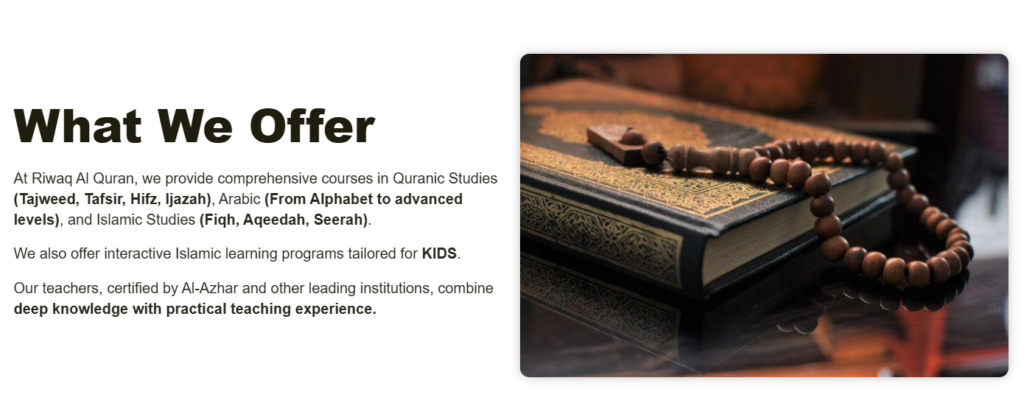
If reciting confidently over water, or reciting Surah Al-Baqarah in full, feels out of reach right now, that’s exactly what the Online Quran Recitation Course is built to fix — and for anyone working toward a recognized certification path afterward, the Online Ijazah Course is the natural next step.


Conclusion
Drinking Quran water is permissible — that much is settled, and it doesn’t need overstating to matter.
(وَنُنَزِّلُ مِنَ الْقُرْآنِ مَا هُوَ شِفَاءٌ وَرَحْمَةٌ لِّلْمُؤْمِنِينَ)
“And We send down of the Quran that which is healing and mercy for the believers.” (Surah Al-Isra, 17:82),
That’s the real basis for the practice. Everything else worth knowing sits on top of it:
- Surah Al-Baqarah isn’t chosen for a vague reputation. The Prophet ﷺ tied it to a specific promise — Shaytan does not enter a home where it is recited (Sahih Muslim 780). That’s the actual reason it’s the chapter most people reach for, not just tradition repeating itself.
- The benefit is spiritual, not mechanical. Nothing in the Quran or Hadith supports treating this water as chemically or cognitively altered. What changes is what you’re seeking through it — Allah’s blessing and mercy, sought sincerely, not a property the water carries on its own.
- It was never meant to replace anything, Not medical care, not honest effort, not the sincerity the whole practice depends on.
Strip away every exaggerated claim you’ve heard, and what’s left is still worth doing: a real, permissible way to seek healing from Allah — as long as you’re asking for exactly that, and nothing more than what the evidence actually promises.
FAQs
These are the questions people most often ask once they understand the basic permissibility of this practice.
Is drinking Quran water haram?
No, drinking Quran water is not haram — it’s a form of Ruqyah with support from the Quran and Hadith, permissible as long as the recitation involves no association of partners with Allah.
Does Quran water have proven physical health benefits?
No, there is no scholarly or scientific basis for claiming Quran water cures specific physical illnesses or improves cognitive function; its benefit is understood as spiritual, sought through Allah’s permission rather than guaranteed by the practice itself.
Why is Surah Al-Baqarah specifically recited over water?
Surah Al-Baqarah is tied to a specific hadith in which the Prophet ﷺ said Shaytan does not enter a home where it is recited (Sahih Muslim 780), which is why it’s commonly used for protection-focused practices like Quran water rather than a general reputation for power.
How do you make Quran water correctly?
Recite Quranic verses with sincere intention and blow gently onto the water, without associating anything besides Allah with the source of any benefit sought, following the same principle the Prophet ﷺ set for Ruqyah generally.
Can Quran water replace medical treatment?
No, Quran water is a spiritual practice, not a substitute for medical care, and it should be approached alongside proper treatment rather than in place of it.