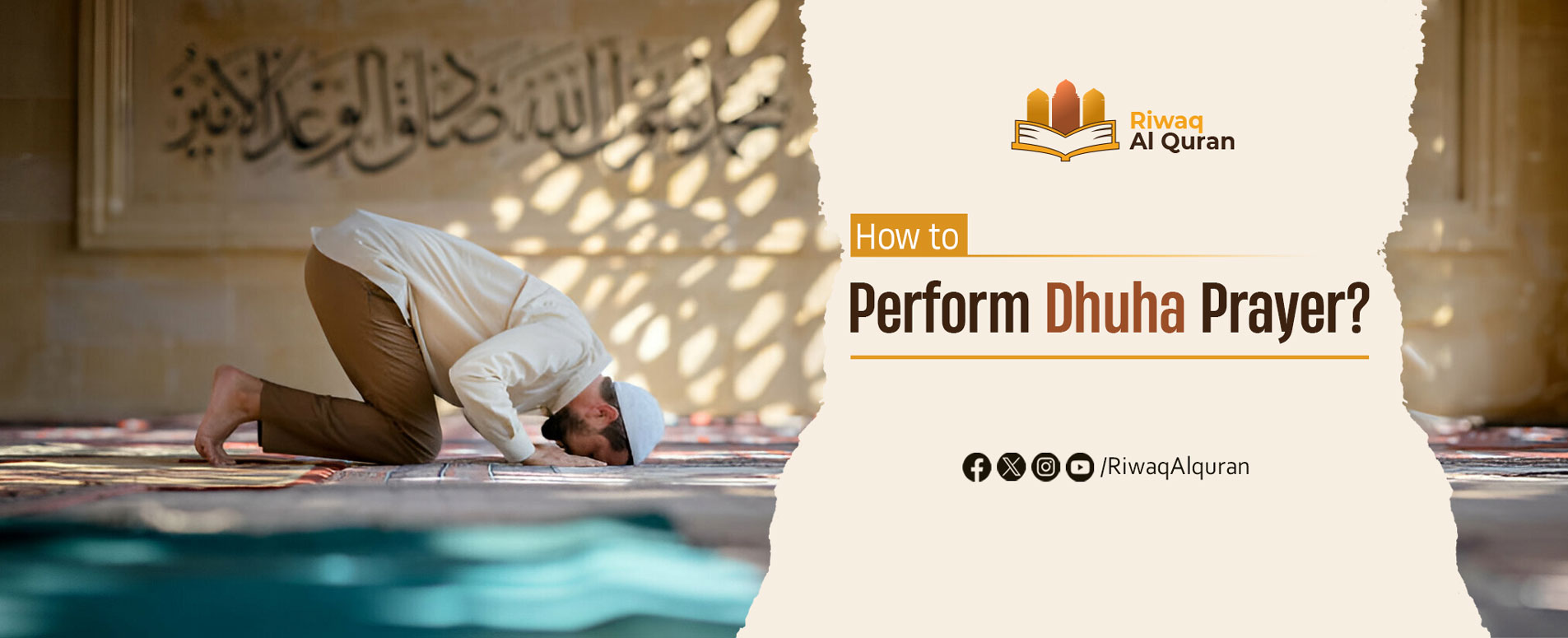
Every morning, between the point when the sun has fully risen and the moment Dhuhr approaches, there is a window most people move through without noticing. The Prophet Muhammad ﷺ named that window Duha — and the prayer performed within it is one of the most consistently recommended voluntary acts in the entire Sunnah.
Two rakat of Duha, performed in under five minutes, covers the daily charity obligation for every one of the 360 joints in the human body, earns the specific title “the prayer of the repentant,” and was one of only three practices the Prophet ﷺ advised his companions to maintain for life.
This guide gives you everything: what Duha prayer is and why it matters, the exact timing rules including the two forbidden windows most guides miss, a full step-by-step walkthrough, the authentic hadith with Arabic text and commentary, common mistakes that invalidate the prayer, and the complete niyyah and dua framework.
Table of Contents
What You Will Learn in This Article
- What Duha prayer is and its deep Quranic roots.
- The precise time window — including the forbidden periods that bracket it.
- A complete step-by-step method for performing Duha prayer correctly.
- Four key authentic hadith on Duha, with Arabic text, translation, source, and commentary.
- Common mistakes that invalidate or weaken the prayer.
- How to multiply your reward through layered intentions.
What Is Duha Prayer?
Duha prayer is a voluntary (nafl) prayer performed during the forenoon — the late morning period after sunrise and before midday. It sits outside the five obligatory daily prayers but is among the most emphasized acts of worship in the Sunnah, narrated in authentic hadith collected by al-Bukhari, Muslim, Abu Dawud, and others.
The prayer takes its name from the Arabic word الضُّحَى (Ad-Duha) — the forenoon, the spreading warmth of the mid-morning sun. This time carries a unique spiritual weight in the Quran: Allah swears by it in two separate surahs, a distinction shared by very few moments in the day.
a. The Quranic Root of Duha
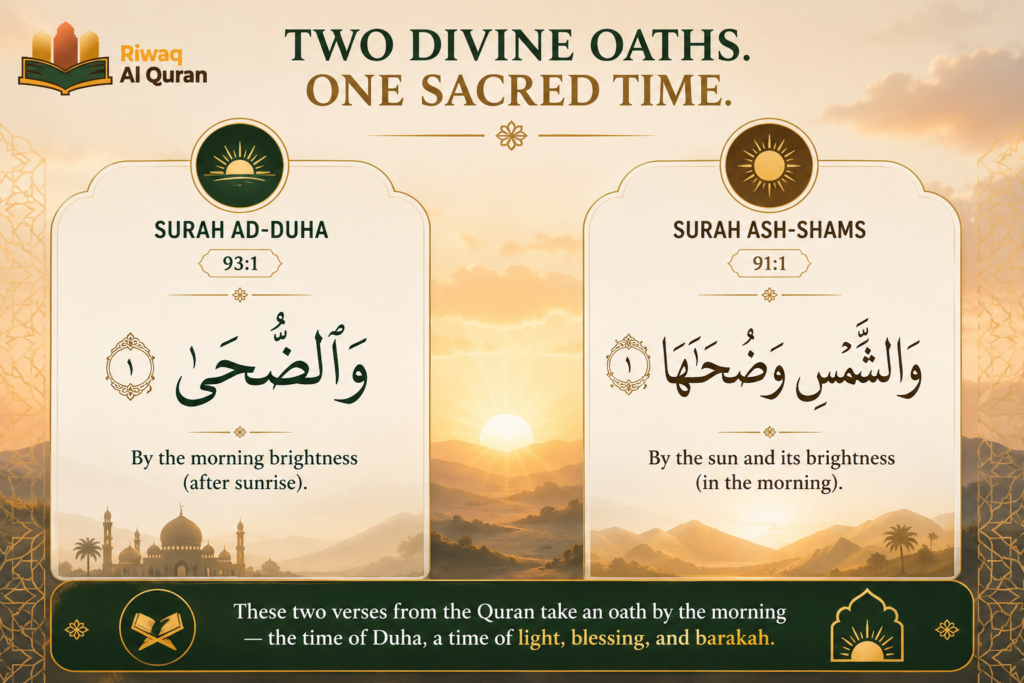
The divine oath sworn by the Duha time appears in two different surahs of the Quran — a distinction that places this moment among the most spiritually significant in the entire day. Both oaths are presented below with their translations and commentary.
وَالضُّحَىٰ ﴿١﴾ وَاللَّيْلِ إِذَا سَجَىٰ ﴿٢﴾ مَا وَدَّعَكَ رَبُّكَ وَمَا قَلَىٰ ﴿٣﴾ وَلَلْآخِرَةُ خَيْرٌ لَّكَ مِنَ الْأُولَىٰ ﴿٤﴾ وَلَسَوْفَ يُعْطِيكَ رَبُّكَ فَتَرْضَىٰ ﴿٥﴾
“By the morning brightness, and by the night when it is still — your Lord has not abandoned you, nor is He displeased. And the Hereafter is better for you than the first life. And your Lord is going to give you, and you will be satisfied.” (Surah Ad-Duha, 93:1–5)
وَالشَّمْسِ وَضُحَاهَا ﴿١﴾ (Surah Ash-Shams, 91:1) “By the sun and its brightness.”
When Allah swears by a time in the Quran, He is drawing attention to something extraordinary about it. The Duha period is the subject of two separate divine oaths in two different surahs. Surah Ad-Duha was revealed as a direct reassurance to the Prophet ﷺ during a period of distress — and the surah opens with an oath by the very time of his prayer.
Every Muslim who prays Duha steps into the same moment that comforted the Prophet ﷺ himself. This is not incidental; it is why scholars across generations considered Duha among the most spiritually dignified of all voluntary prayers.
b. Why Is Duha Called the Prayer of the Repentant?
Duha prayer carries the title salat al-awwabin — the prayer of those who constantly return to Allah. The word أَوَّاب (awwab) refers to someone who returns to Allah repeatedly, not someone who repented once long ago. It describes a continuous, active orientation back toward Allah — through every ordinary morning.
“صَلَاةُ الْأَوَّابِينَ حِينَ تَرْمَضُ الْفِصَالُ”
“The prayer of the awwabeen — those who constantly repent and return to Allah — is when the young weaned camels feel the heat of the ground.”—Narrated by Zaid ibn Arqam (رضي الله عنه) Sahih Muslim
The Arabic تَرْمَضُ (tarmadu) describes the physical sensation of heat burning up through the ground — the intense late-morning warmth when camels lift their feet from a scorched surface. This is a precise temporal image in a pre-clock culture: not a time on a dial, but a felt moment in the day.
By the time this heat arrives, most people are consumed by their work and responsibilities. The person who stops at that moment to pray is someone whose first instinct, even inside the fullness of an ordinary morning, is to return to Allah. That is the definition of awwab — not someone who waits for a quiet moment, but someone who turns back to Allah in the middle of a busy one.
How to Perform Duha Prayer — Step by Step
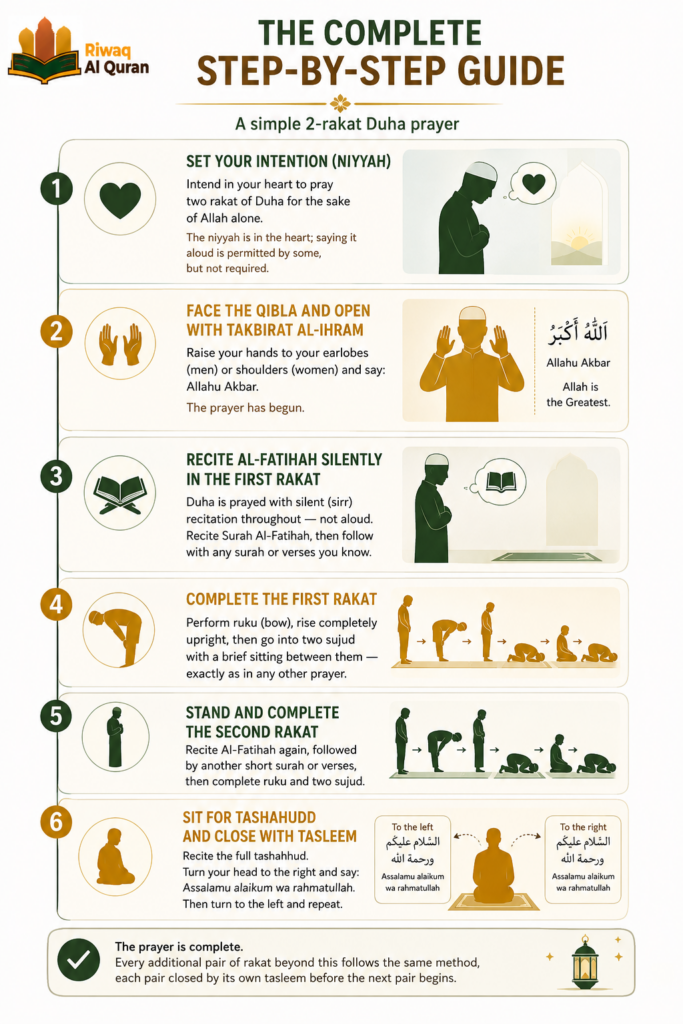
Duha prayer follows the same structure as any two-rakat voluntary prayer. There are no special movements, no unique opening, and no difference in how rakat are performed compared to other nafl prayers. What distinguishes Duha is timing and intention — not a separate physical method.
One structural rule is critical: if you pray more than two rakat, you must make tasleem after every two rakat before continuing. This is not optional. The Prophet ﷺ said: “The prayer of the night and the day is in pairs.” (Sahih Muslim) Four rakat of Duha = two rakat + tasleem + two rakat + tasleem — not four rakat closed by a single tasleem at the end.
a. The Complete Step-by-Step Guide
Before beginning, confirm three prerequisites: you have wudu, your prayer space is clean, and Duha time has entered — at minimum 15 to 20 minutes after sunrise (see the timing section below for the full detail). Once confirmed, proceed through the following steps.
- 1. Set your intention (niyyah): Intend in your heart to pray two rakat of Duha for the sake of Allah alone. The niyyah lives in the heart; saying it quietly aloud is permitted by some scholars but not required.
- 2. Face the Qibla and open with Takbirat al-Ihram: Raise your hands to your earlobes (men) or shoulders (women) and say: Allahu Akbar. The prayer has begun.
- 3. Recite Al-Fatihah silently in the first rakat: Duha is prayed with silent (sirr) recitation throughout — not aloud. Recite Surah Al-Fatihah, then follow with any surah or verses you know comfortably.
- 4. Complete the first rakat: Perform ruku (bow with your back horizontal), rise completely upright, then go into two sujud with a brief sitting between them — exactly as in any other prayer.
- 5. Stand and complete the second rakat: Recite Al-Fatihah again, followed by another short surah or verses, then complete ruku and two sujud.
- 6. Sit for tashahhud and close with tasleem: Recite the full tashahhud. Close the prayer by turning to the right and saying Assalamu alaikum wa rahmatullah, then to the left.
The prayer is complete. Every additional pair of rakat beyond this follows the same method, each pair closed by its own tasleem before the next pair begins.
b. How Many Rakat Is Duha Prayer?
The minimum is two rakat, established directly by the Prophet ﷺ — and the wording of the hadith makes clear that two is not merely a starting point but a fully complete act of worship in itself.
“وَرَكْعَتَانِ يَرْكَعُهُمَا فِي الضُّحَى تُجْزِئَانِ”
“And two rakat which one prays in the forenoon will suffice.” Sahih Muslim
The word تُجْزِئَانِ (tujzi’an) means “will suffice” — not “the bare minimum before adding more.” The Prophet ﷺ is declaring that two rakat are, in themselves, a complete and fulfilling prayer. This is a liberation from the pressure to always pray more. The minimum was not set low as a compromise; it was set low as a lifelong design.
The Prophet ﷺ prayed four rakat of Duha regularly. On the day Makkah was conquered, he prayed eight rakat at the house of Umm Hani (may Allah be pleased with her), completing bowing and prostration fully in each rakat despite praying them lightly. This establishes eight as the maximum confirmed by direct prophetic action. Some scholars extend the maximum to twelve, and others hold there is no upper limit — but eight is the strongest supported position.
Practical guidance for those building the habit:
- Start with two rakat and hold that number until it is fully consistent, day after day.
- Consistency at two is more valuable in the sight of Allah than occasional performance at eight.
- Only increase the number once the two-rakat habit is firmly established in your daily routine.
c. Which Surah to Recite in Duha Prayer?
No specific surah is designated for Duha prayer in any authentic hadith. Recite Al-Fatihah in every rakat, then follow with any surah or Quranic verses you know well. Reciting only Al-Fatihah in a voluntary prayer when you know more is against the Sunnah practice — add a short surah after it.
A personally meaningful choice many Muslims make: Surah Ad-Duha (93) in the first rakat and Surah Al-Asr (103) in the second. Both are short, both connect thematically to time, effort, and conscious return to Allah — and both can be recited with full presence of mind without being rushed. This is a personal choice, not a ruling.
Duha Prayer Time — The Complete Timing Guide
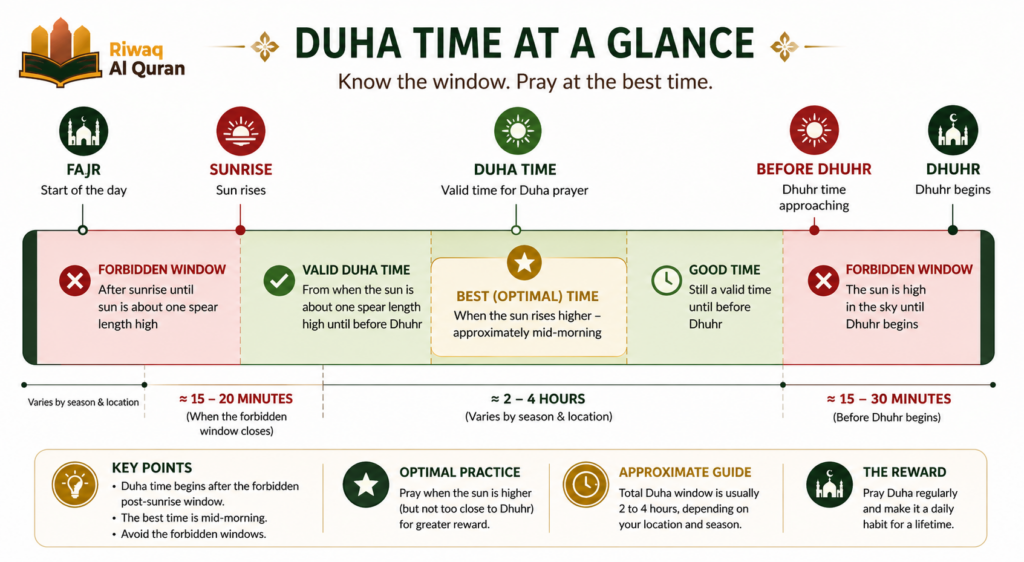
The Duha window is bounded by two forbidden periods, one at each end. Most guides say “after sunrise” and stop there — but praying inside either forbidden window makes the prayer invalid. Knowing these boundaries precisely is not a technicality; it is a prerequisite for the prayer to count.
a. When Does Duha Time Start?
Duha time begins approximately 15 to 20 minutes after sunrise — not at sunrise itself. When the sun first appears at the horizon, a forbidden period opens. It lasts until the sun has risen to roughly a “spear’s length” above the horizon — the classical Arabic measurement equivalent to 15 to 20 minutes after the sun first appears.
How to apply this practically: Find the exact sunrise time for your city on a reliable prayer app, then add 15 minutes. If sunrise is at 6:10 AM, Duha time opens at approximately 6:25 to 6:30 AM. Do not begin before that point.
b. When Does Duha Time End?
Duha time ends approximately 15 minutes before Dhuhr. As the sun reaches its zenith, a second forbidden window opens. The prayer must be completed before that point.
The full valid window runs from 15 to 20 minutes after sunrise until roughly 15 minutes before Dhuhr. Any point within this range is valid.
c. The Best Time to Pray Duha
The optimal time is when the day has genuinely warmed — roughly a quarter to a third of the way through the morning, not immediately when the valid window opens. The Prophet ﷺ directed his companions to delay Duha until the heat intensifies. Praying at the very first moment the window opens is not wrong, but it is not the recommended practice.
The spiritual logic is deliberate: by mid-morning, most people are fully absorbed in their day. The person who pauses at that point for two rakat is making a conscious choice to return to Allah in the midst of the world pulling at them — which is precisely what makes them among the awwabin.
d. Ishraq vs. Duha — What Is the Difference?
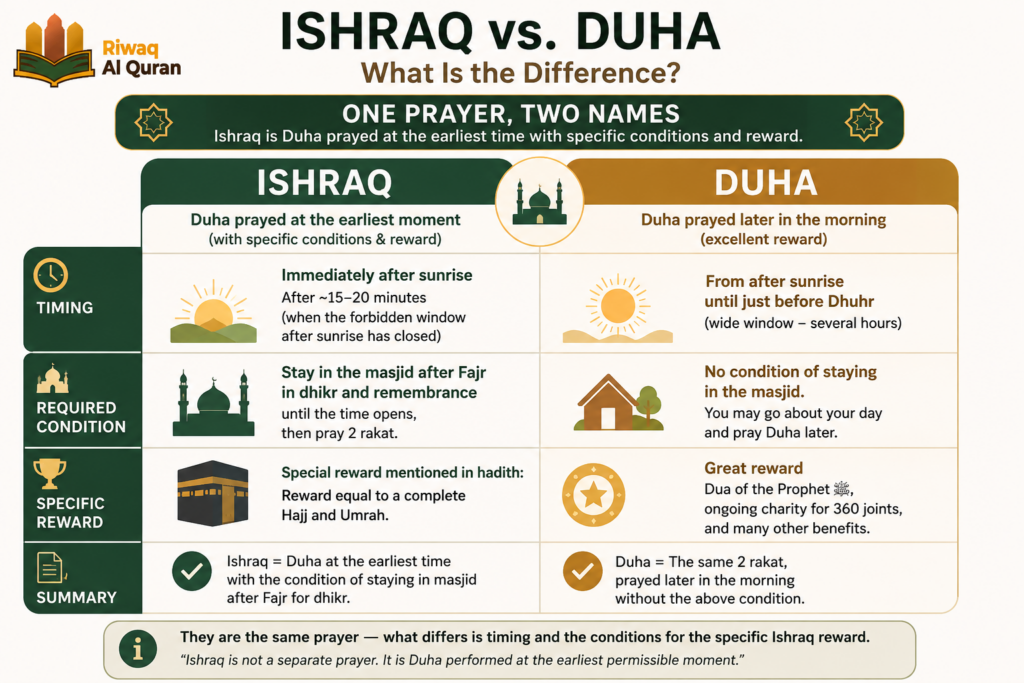
Ishraq is not a separate prayer. It is Duha performed at the earliest permissible moment — immediately after the post-sunrise forbidden window closes. The specific reward mentioned in hadith — the equivalent in reward of a complete Hajj and Umrah — applies to a person who remains in the masjid after Fajr in dhikr and remembrance, and then prays two rakat when the window opens.
A person who goes home after Fajr, returns later in the morning, and prays two rakat is performing Duha — an excellent act with its own great reward — but is not performing Ishraq as described by the hadith. The two are the same prayer; what differs is timing and the specific conditions for the Ishraq reward.
The Authentic Hadith on Duha Prayer — With Arabic Text and Commentary
Duha prayer is documented in multiple hadith collections and narrated independently by several companions of the Prophet ﷺ. This consistency across different chains of transmission is not coincidental — it reflects how widespread and regular the practice was among those closest to him.
1. The Three Lifelong Deeds
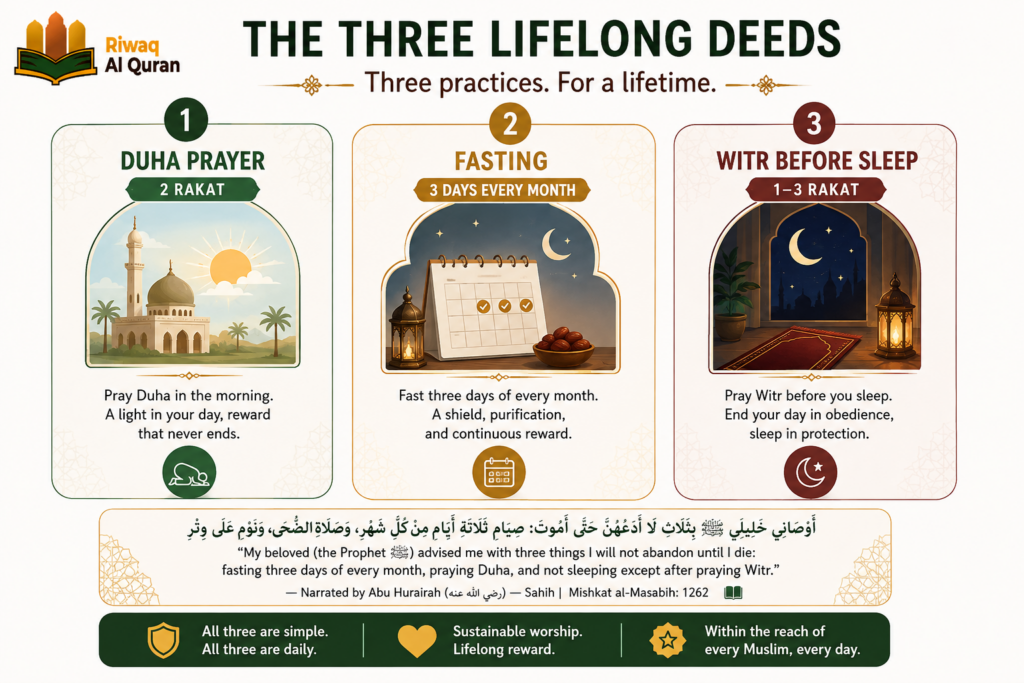
Among the most compelling evidence for the importance of Duha is that the Prophet ﷺ designated it as one of only three practices he advised his companions to maintain for the rest of their lives — a narration reported independently by multiple companions in nearly identical words.
“أَوْصَانِي خَلِيلِي صَلَّى اللَّهُ عَلَيْهِ وَسَلَّمَ بِثَلَاثٍ لَا أَدَعُهُنَّ حَتَّى أَمُوتَ: صِيَامِ ثَلَاثَةِ أَيَّامٍ مِنْ كُلِّ شَهْرٍ، وَصَلَاةِ الضُّحَى، وَنَوْمٍ عَلَى وِتْرٍ “
“My beloved (the Prophet ﷺ) advised me with three things I will not abandon until I die: fasting three days of every month, praying Duha, and not sleeping except after praying Witr.” Narrated by Abu Hurairah (رضي الله عنه) — Sahih | Mishkat al-Masabih
The Prophet ﷺ did not give this advice to one companion — it was narrated with nearly identical wording by Abu Hurairah, Abu Darda, and Abu Dharr (may Allah be pleased with them all). When multiple companions independently report the same personal advice from the Prophet ﷺ, it indicates he gave it repeatedly and considered it universally applicable, not personal counsel for one individual.
The three practices share a design principle: all three are daily, all three are minimal, and all three are structured specifically for lifetime consistency. Two rakat of Duha, three days of fasting per month, and Witr before sleep are not heroic acts of worship — they are sustainable anchors, placed deliberately within the realistic reach of any Muslim, on any day, in any circumstance.
2. Two Rakat Cover the Charity of 360 Joints
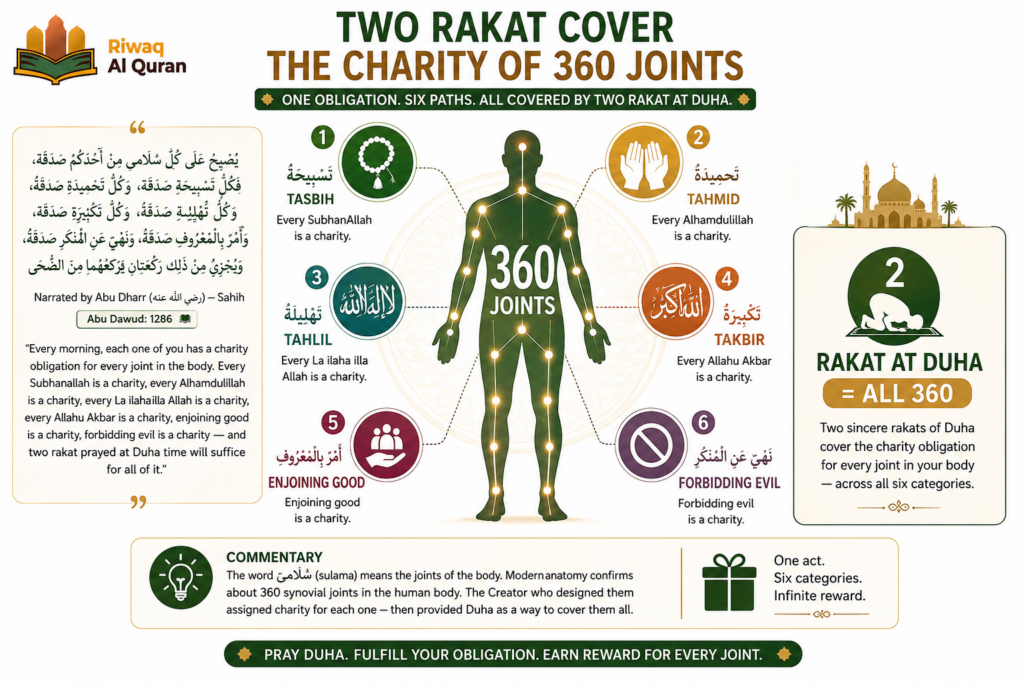
One of the most remarkable hadith on Duha connects the prayer to a daily obligation most Muslims are unaware of — the charity owed every morning for every single joint in the human body. The following text establishes that obligation and resolves it entirely through two rakat.
يُصْبِحُ عَلَى كُلِّ سُلَامَى مِنْ أَحَدِكُمْ صَدَقَةٌ، فَكُلُّ تَسْبِيحَةٍ صَدَقَةٌ، وَكُلُّ تَحْمِيدَةٍ صَدَقَةٌ، وَكُلُّ تَهْلِيلَةٍ صَدَقَةٌ، وَكُلُّ تَكْبِيرَةٍ صَدَقَةٌ، وَأَمْرٌ بِالْمَعْرُوفِ صَدَقَةٌ، وَنَهْيٌ عَنِ الْمُنْكَرِ صَدَقَةٌ، وَيُجْزِئُ مِنْ ذَلِكَ رَكْعَتَانِ يَرْكَعُهُمَا مِنَ” الضُّحَى”
“Every morning, each one of you has a charity obligation for every joint in the body. Every Subhanallah is a charity, every Alhamdulillah is a charity, every La ilaha illa Allah is a charity, every Allahu Akbar is a charity, enjoining good is a charity, forbidding evil is a charity — and two rakat prayed at Duha time will suffice for all of it.” Narrated by Abu Dharr (رضي الله عنه) — Sahih | Abu Dawud
The word سُلَامَى (sulama) refers specifically to the body’s joints. The hadith specifies the obligation as applying to each one of them individually, across the entire body. This number is not symbolic — modern anatomy confirms approximately 360 synovial joints in the human body, a figure that was extraordinary medical knowledge at the time of the hadith.
The specificity is an invitation to reflection: the Creator who designed the body to this exact count is the same One who assigned charity for each joint and then provided a way to cover all 360 in two rakat. The hadith presents six independent categories of charity — verbal dhikr, active virtue, moral courage — and then offers Duha as a single act that absorbs the obligation for all of them combined.
3. The Prayer of the Repentant
This hadith is the source of Duha’s most recognized spiritual title. It uses a sensory image drawn from daily life in Arabia to mark the precise moment when the awwabin pray — and in doing so defines a character as much as it defines a practice.
“صَلَاةُ الْأَوَّابِينَ حِينَ تَرْمَضُ الْفِصَالُ”
“The prayer of the awwabeen — those who constantly repent and return to Allah — is when the young weaned camels feel the heat of the ground.”Narrated by Zaid ibn Arqam (رضي الله عنه) — Sahih Muslim
The image of young camels (الْفِصَالُ — al-fisaal, weaned camels, plural of fasil) lifting their feet from scorching ground is a precise, sensory description of the mid-morning heat in Arabia. This is not poetic decoration; it is a functional time-marker in a culture without mechanical clocks.
The Prophet ﷺ is pointing to a moment that every person in his audience could feel physically — not read on a dial. And he is saying: the person who prays in that moment is among the awwabin. This hadith defines a character before it defines a practice. Praying Duha is an act; being an awwab is a state of heart that the act expresses.
4. Eight Rakat on the Day of Conquest
The following narration establishes the maximum confirmed number of Duha rakat through direct prophetic action — and carries a detail most summaries omit that teaches something equally important about how those rakat are to be performed.
“عن عبدالرحمن بن أبي ليلى قال: ما حدَّثنا أحدٌ أنه رأى النبي ﷺ يُصلي الضحى غير أمِّ هانئ، فإنها قالت: إنَّ النبيَّ ﷺ دخل بيتها يوم فتح مكة، فاغتسل، وصلَّى ثماني ركعات، فلم أرَ صلاةً قطُّ أخفَّ منها، غير أنه يُتِمُّ الركوعَ والسجودَ”
“Narrated by Umm Hani bint Abi Talib (رضي الله عنها): On the day Makkah was conquered, the Prophet ﷺ entered her house and prayed eight rakat of Duha. She said she had never seen him pray a lighter prayer — yet he completed the bowing and prostration fully in every rakat. Sahih al-Bukhari
Umm Hani described the prayer as “the lightest she had ever seen him pray” while also confirming that the bowing and prostration were complete in each rakat. The two observations together teach something important — extending Duha to eight rakat is not an invitation to a heavy, slow performance.
The Prophet ﷺ on the most historically significant day of his life prayed eight rakat with lightness and completeness at the same time. Quality of presence within each rakat, not the weight of duration, is the standard.


Common Mistakes in Duha Prayer
Most errors in Duha prayer come from misunderstanding the timing or the tasleem rule. They are easy to correct once identified, but can invalidate the prayer entirely if not addressed.
a. Praying During the Forbidden Window
The most frequent practical mistake is praying Duha before the post-sunrise forbidden period has passed. A person who finishes Fajr and immediately prays two additional rakat is praying inside the forbidden window, not inside Duha time. Wait at least 15 to 20 minutes after the sun has risen before beginning the prayer.
The same applies at the end: misjudging the Dhuhr time and praying Duha after the pre-Dhuhr forbidden window has opened also invalidates the prayer. Check your prayer app for accurate sunrise and Dhuhr times for your location.
b. Joining More Than Two Rakat Without Tasleem
Praying four rakat of Duha as a single unit with one tasleem at the end is structurally incorrect. The Prophet ﷺ explicitly said that voluntary day prayer is “in pairs” — meaning each pair of rakat is a complete, independent prayer closed by its own tasleem.
Four rakat of Duha is performed as two separate prayers of two rakat each, not one prayer of four. This applies to six and eight rakat as well.
c. Treating Duha as Too Small to Maintain on Busy Days
This is not a ritual mistake but a conceptual one, and it has the heaviest consequence — missing the prayer entirely. The minimum of two rakat was set at two specifically because a five-minute prayer can be sustained through illness, travel, grief, a demanding workday, and every pressure life places on a morning. The Prophet ﷺ said:
“أَحَبُّ الْأَعْمَالِ إِلَى اللَّهِ أَدْوَمُهَا وَإِنْ قَلَّ”
“The most beloved of deeds to Allah are the most consistent, even if small.” Sahih Muslim
This hadith is the interpretive key for the entire Duha prayer. The minimum was not a concession — it was the design. Two rakat that are prayed every morning of a lifetime are more beloved to Allah than eight rakat prayed on days when there is time and energy and skipped on all the others.
Niyyah for Duha Prayer — How to Layer Intentions for Greater Reward
Niyyah (النِّيَّة) is intention, and the Prophet ﷺ opened the foundational hadith on all Islamic action with:
“إِنَّمَا الْأَعْمَالُ بِالنِّيَّاتِ، وَإِنَّمَا لِكُلِّ امْرِئٍ مَا نَوَى”
“Deeds are by their intentions, and every person will have what they intended.”— Narrated by Umar ibn al-Khattab (رضي الله عنه) Sahih al-Bukhari
This is the first hadith in Sahih al-Bukhari — not by coincidence, but by the deliberate arrangement of Imam al-Bukhari, who considered it the foundational principle underlying every chapter that follows. The niyyah is not a formality pronounced before the prayer; it is the internal reality that determines the nature and reward of everything you do.
Applying this to Duha means entering the prayer with genuine awareness of why you are praying and what you are asking for — not as a ritual formula, but as an actual orientation of the heart.
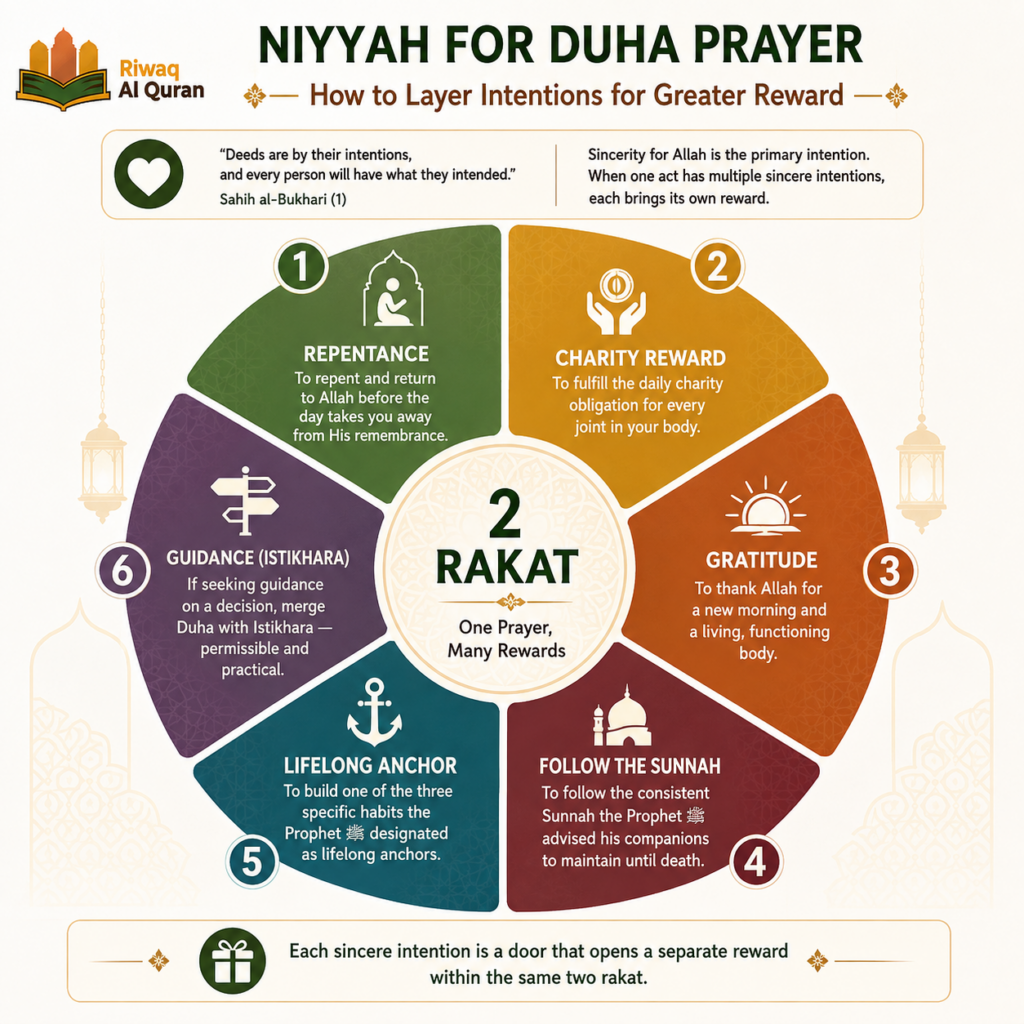
The primary intention must be sincerity — performing the prayer purely for Allah, without seeking praise or recognition from anyone. Beyond that, a sound principle in Islamic jurisprudence holds that when one act fulfills multiple genuine intentions, each intention carries its own reward. You may enter Duha carrying several sincere intentions at once:
- To repent and return to Allah before the day pulls you further from His remembrance.
- To fulfill the daily charity obligation for every joint in your body.
- To express gratitude for the blessing of a new morning and a living, functioning body.
- To follow the consistent Sunnah that the Prophet ﷺ advised his companions to maintain until death.
- To build one of the three specific habits he designated as lifelong anchors.
- If seeking guidance on a decision: to merge Duha with Istikhara — permissible and practical (see FAQ below).
This is not overthinking worship — it is how the companions understood and lived it. Each intention is a door that opens a separate reward within the same two rakat.
Dua After Duha Prayer
There is no specific dua designated for after Duha prayer in any authentic hadith. You may make any supplication from the morning adhkar, from the Quran, or from the heart. These two are particularly fitting given the spirit and timing of Duha:
“اللَّهُمَّ إِنِّي أَسْأَلُكَ عِلْمًا نَافِعًا وَرِزْقًا طَيِّبًا وَعَمَلًا مُتَقَبَّلًا”
“Morning supplication “O Allah, I ask You for beneficial knowledge, good provision, and accepted deeds.”— Sunan Ibn Majah
رَبِّ زِدْنِي عِلْمًا ﴿١١٤﴾
“My Lord, increase me in knowledge.”(Surah Ta-Ha, 20:114)
Commentary: These two supplications are oriented toward the day ahead — asking for knowledge, provision, and accepted deeds at the very hour when work and responsibilities begin. Rabbi zidni ilma is a Quranic dua that the Prophet ﷺ was directly commanded to say, and asking for it after Duha, at the opening of a new morning, places the desire for knowledge at the front of your intention for everything that follows. The pairing of these two supplications — one asking for beneficial knowledge and good provision together, one asking for more knowledge specifically — forms a complete morning orientation: give me what I need for this day, and give me understanding of what I receive.
You may also extend personal dua freely after the tasleem — for your specific needs, for gratitude, for others. The post-prayer moment is one of the best-attested times for dua to be accepted.
Deepen Your Understanding of Islamic Prayer with Qualified Teachers
Duha prayer takes five minutes. But the deeper your understanding of its Quranic foundations, the hadith behind it, and the fiqh that governs its timing — the more present and intentional those five minutes become.
Watch real moments from our live sessions at Riwaq Al Quran and see how we bring learning to life:
Start Learning Quran and Islamic Studies with Riwaq Al Quran
You do not need to be a scholar to understand your prayer. You need one good teacher, a consistent schedule, and the right starting point.
Riwaq Al Quran connects you with qualified native Arab instructors for live one-on-one and group classes in Quran, Tajweed, Arabic, and Islamic studies — from wherever you are in the world, at times that fit your life. Children and adults. Complete beginners and advanced students. Their full course catalogue includes:
- Online Quran Classes for Kids and Adults
- Online Quran Classes for Kids
- Online Tajweed Classes
- Quran Memorization Online Course
- Online Tafseer Course
- Noorani Qaida Online
- Online Quran Recitation Course
- Online Ijazah Courses
- Online Arabic Courses
- Online Islamic Studies Courses
- Online Qirat Course
Your first class is free with no commitment required.

Conclusion
Duha prayer is two rakat performed during the late morning — starting roughly 15 to 20 minutes after sunrise and ending about 15 minutes before Dhuhr. It is voluntary, not obligatory, yet it is documented across multiple hadith collections, advised by the Prophet ﷺ to his companions as a lifelong practice, and connected in the Quran to one of the two times Allah swears by in its most personal surah.
Two rakat of Duha covers the daily charity for all 360 joints in the body, earns the title of the prayer of the repentant, and was designed with a minimum of two rakat so that no Muslim — regardless of schedule, health, or circumstance — would have an excuse to miss it. The minimum was not set low as a compromise. It was set low as a statement about how to build acts of worship that last a lifetime.
Begin with two rakat. Pray them consistently, every morning, after the forbidden window passes and before the day takes over completely. Make them consistent before making them longer. Consistency is, as the Prophet ﷺ said, the single quality that makes any deed most beloved to Allah.
Frequently Asked Questions
The following answers address the most common questions about Duha prayer — covering its definition, timing, structure, and relationship to other forms of voluntary worship.
What is Duha prayer?
Duha prayer is a voluntary Islamic prayer performed during the late morning, from approximately 15 to 20 minutes after sunrise until 15 minutes before Dhuhr. It requires a minimum of two silent rakat, each pair closed with tasleem, and is documented in authentic hadith as one of the most emphasized voluntary acts of worship in the Sunnah.
What is the best time to pray Duha?
The best time is when the sun is visibly high and the morning has warmed — roughly a quarter to a third of the way into the morning, not immediately when the valid window opens. The Prophet ﷺ specifically advised delaying Duha until the heat intensifies, and connected that timing to its spiritual character as the prayer of those who consciously return to Allah in the middle of a busy day.
What is the difference between Ishraq and Duha prayer?
Ishraq is Duha prayed at the earliest possible moment after the post-sunrise forbidden window closes. The specific reward — equivalent to a complete Hajj and Umrah — applies to someone who remains in the masjid from Fajr in dhikr and then prays when the window opens. A person who leaves after Fajr and prays Duha later in the morning is performing Duha, which carries its own great reward, but does not qualify for the specific Ishraq reward as described.
How many rakat is Duha prayer and what is the maximum?
The minimum is two rakat. The Prophet ﷺ most often prayed two or four. Eight rakat is the maximum confirmed by direct prophetic action, based on his eight rakat at the house of Umm Hani on the day of the Conquest of Makkah. All rakat beyond two must be arranged in pairs, each closed by its own tasleem before the next pair begins.
Can I combine Duha with Istikhara prayer?
Yes. You may pray two rakat of Duha with the intention of Istikhara and then recite the Istikhara dua after the tasleem. Istikhara cannot be combined with an obligatory prayer but may be combined with a voluntary prayer like Duha. This is a practical way to incorporate seeking guidance from Allah into a prayer you are already performing.
Is there a specific surah prescribed for Duha prayer?
No. No specific surah is designated for Duha in any authentic hadith. Recite Surah Al-Fatihah in every rakat followed by any surah or verses you know. Surah Ad-Duha (93) and Surah Al-Asr (103) are a personally meaningful choice given the context, but they are not obligatory. The standard applies to all voluntary prayers: recite what is easy, with presence of mind.
Sources
- Surah Ad-Duha (93:1–5) — quran.com/93/1-5
- Surah Ash-Shams (91:1) — quran.com/91/1
- Surah Ta-Ha (20:114) — quran.com/20/114
- Hadith — Prayer of the awwabeen, Sahih Muslim — sunnah.com/muslim:748a
- Hadith — Two rakat of Duha will suffice, Sahih Muslim — sunnah.com/muslim:783b
- Hadith — Most consistent deeds are most beloved, Sahih Muslim — sunnah.com/muslim:783
- Hadith — Charity for every joint, Sahih Abu Dawud — sunnah.com/abudawud:1286
- Hadith — Three lifelong deeds, Mishkat al-Masabih (Sahih) — sunnah.com/mishkat:1262
- Hadith — Eight rakat on the day of Conquest (Umm Hani), Sahih al-Bukhari — sunnah.com/bukhari:1176
- Hadith — Deeds are by their intentions, Sahih al-Bukhari — sunnah.com/bukhari:1
- Morning supplication (knowledge and provision), Sunan Ibn Majah — sunnah.com/ibnmajah:925