| Key Takeaways |
| Reading 20 pages (approximately 4 Juz’) daily allows any Muslim to complete the full Quran within Ramadan’s 30 days. |
| The Quran contains 604 pages across 30 Juz’; dividing this into 5 daily reading sessions of 4 pages each is the most sustainable approach. |
| Linking your reading sessions to the five daily prayers creates a natural structure that prevents missed portions and builds consistency. |
| Students menstruating during Ramadan can maintain completion goals through Tafsir study, listening, and dhikr during their period days. |
| A qualified tutor correcting your Tajweed before Ramadan significantly increases both the quality and pace of your daily recitation. |
Ramadan is the month the Quran descended — and completing it within these thirty days is one of the most profound acts of worship a Muslim can offer.
Yet most non-Arabic speaking Muslims approach this goal without a concrete plan, and by the second week, the pages begin to accumulate. The result is a familiar guilt that replaces the barakah Ramadan is meant to bring.
Knowing precisely how to complete the Quran in Ramadan — with an honest schedule, realistic page targets, and a structured daily rhythm — changes everything. This guide provides exactly that: a step-by-step plan built for real lives, not ideal ones.
Table of Contents
1. Understand the Quran’s Structure Before Setting Your Daily Ramadan Target
To complete the Quran in Ramadan, you must read approximately 20 pages (roughly one Juz’) per day across 30 days. The Quran contains 604 pages divided into 30 Juz’, with each Juz’ averaging around 20 pages in the standard Mushaf. Knowing this number is your foundation — everything else is time management around it.
This is not an impossible target. Twenty pages, when spread across five reading sessions tied to the daily prayers, becomes just 4 pages per session.
At a moderate recitation pace with basic Tajweed applied, 4 pages typically takes between 10 and 15 minutes for most non-Arabic speakers with intermediate reading fluency.
Before Ramadan arrives, honestly assess your current reading speed using a standard Mushaf (the Medina Mushaf is the most widely used globally).
Time yourself reciting one page aloud. Multiply by 20 — that is your current daily commitment. If it exceeds 90 minutes total, you need to work on your recitation fluency before Ramadan begins.


2. Build Your Daily Ramadan Quran Schedule Around the Five Prayers
The most reliable method to complete the Quran in Ramadan is anchoring your reading to the five daily prayers — not to free time, which disappears in Ramadan’s busy rhythm of Suhoor, Iftar, and Tarawih.
The table below shows the prayer-linked schedule used by many of our students at Riwaq Al Quran:
| Prayer Time | Reading Session | Pages to Read |
| Fajr (after prayer) | Morning session | 4 pages |
| Dhuhr (after prayer) | Midday session | 4 pages |
| Asr (after prayer) | Afternoon session | 4 pages |
| Maghrib (after Iftar) | Evening session | 4 pages |
| Isha / Tarawih (after) | Night session | 4 pages |
Total: 20 pages per day — one complete Juz’.
This structure works because it removes the question of when to read. Each prayer becomes a trigger.
The moment you complete your Sunnah rakaat after Fajr, you open your Mushaf. Consistency comes from habit design, not willpower alone.
In our experience at Riwaq Al Quran, students who pre-schedule their reading sessions against specific prayers complete Ramadan Quran goals at a significantly higher rate than those who plan to “find time throughout the day.”
Connect with our Azhari tutors to learn and memorize the Quran

3. Choose the Right Mushaf and Recitation Tools for Faster, Accurate Reading
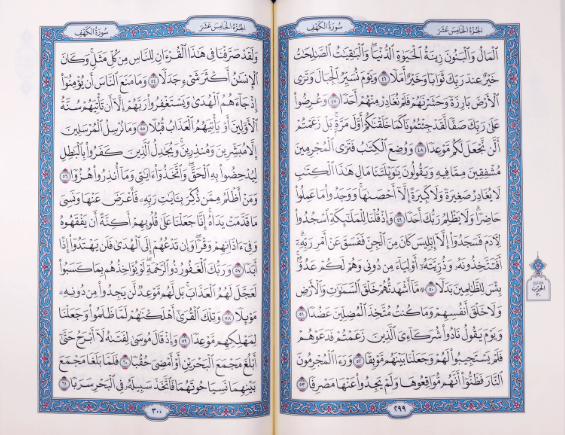
The physical Mushaf you use directly affects your reading speed and accuracy. For completing the Quran in Ramadan, use a 15-line Mushaf (also called the Madinah Mushaf or Indo-Pak 15-line edition), where each Juz’ begins and ends at page breaks. This makes tracking your daily Juz’ effortless.
For non-Arabic speakers, pairing your silent reading with an audio reciter significantly improves both comprehension and Tajweed application. Recommended reciters for following along:
- Sheikh Mahmoud Khalil Al-Husary — clear, measured Tajweed; ideal for learning
- Sheikh Abdul Basit Abdul Samad — classic Murattal pace, widely accessible
- Sheikh Mishary Al-Afasy — modern, widely available on most Quran apps
Apps such as Quran.com and Ayat (Saudi Iqra) allow you to track your daily page progress, set bookmarks per Juz’, and follow along with audio. Using a tracking tool prevents the small miscounts that derail completion plans.
If your Tajweed fundamentals need strengthening before Ramadan, our Online Quran Recitation Course at Riwaq Al Quran provides targeted one-on-one sessions with Azhari-certified tutors who can correct your recitation errors systematically.
Book Your Free Session in Riwaq’s Recitation Course

4. Apply a Weekly Progress Check to Stay on Track Throughout Ramadan
Completing one Juz’ per day is the goal — but life in Ramadan is unpredictable. Family, social obligations, and physical fatigue during fasting days can cause missed sessions. A weekly checkpoint prevents a one-day gap from becoming an unrecoverable deficit.
| Week | Juz’ to Complete | Cumulative Progress |
| Week 1 (Days 1–7) | Juz’ 1–7 | 140 pages |
| Week 2 (Days 8–14) | Juz’ 8–14 | 280 pages |
| Week 3 (Days 15–21) | Juz’ 15–21 | 420 pages |
| Week 4 (Days 22–29) | Juz’ 22–29 | 580 pages |
| Day 30 | Juz’ 30 | 604 pages ✓ |
If you reach the end of Week 1 and have completed only 5 Juz’ instead of 7, you know immediately: add one extra page to three sessions daily in Week 2 to recover. Catching shortfalls weekly is manageable. Discovering them on Day 28 is not.
Experience Riwaq Al Quran Classes
Watch real moments from our live sessions at Riwaq Al Quran and see how we bring learning to life. These clips highlight our interactive, student-focused approach designed to keep learners engaged, motivated, and actively involved in every step of their educational journey.
5. Maintain Recitation Quality Without Sacrificing Your Completion Target
Speed and quality are not opposites in Quran recitation — but they require deliberate management during Ramadan. The goal is Tarteel, not rushed mumbling. Allah ﷻ commands:
وَرَتِّلِ ٱلْقُرْءَانَ تَرْتِيلًا
Wa rattil il-Qur’āna tartīlā
“And recite the Qur’an with measured recitation.” (Al-Muzzammil 73:4)
Tarteel does not require slow recitation — it requires correct recitation at whatever pace allows you to apply fundamental Tajweed rules accurately. The key rules to maintain throughout Ramadan are:
- Ghunnah — nasal resonance for Noon and Meem with shaddah
- Madd — correct elongation lengths (2, 4, or 6 counts)
- Waqf — stopping at correct points to preserve meaning
- Makharij — articulating letters from their correct points of origin
Letting these rules collapse entirely in pursuit of page count undermines the spiritual quality of your recitation. However, perfectionism that halts you on every minor error defeats the completion goal.
Aim for applied, flowing Tajweed — not performance-level precision. For deeper understanding of these rules, our blog on Tajweed rules provides a structured reference.
At Riwaq Al Quran, our Online Quran Memorization Course pairs students with Azhari-certified Hafiz tutors who specifically train Hifz students to maintain Tajweed accuracy under time pressure — a skill directly applicable to Ramadan completion goals.
Start your Hifz journey with a Free Trial

6. Use Tarawih and Night Prayers to Reinforce Your Daily Progress
Tarawih is not separate from your Quran completion plan — it is part of it. In mosques that complete the Quran across Ramadan, the Imam recites approximately one Juz’ per night in Tarawih. Following attentively in congregation reinforces the same pages you read independently during the day.
If your local mosque follows this full-Quran Tarawih schedule, coordinate your daily reading to precede — not repeat — the night’s Tarawih portion.
This means you read Juz’ 5 in your daytime sessions on the day the Imam will recite Juz’ 5 in Tarawih. You hear the same content twice: once actively, once in listening worship.
This dual exposure — active recitation plus attentive listening — strengthens your familiarity with each Juz’ and helps non-Arabic speakers begin connecting Arabic sounds to meaning over the month.
For those interested in deeper Quranic understanding, our Online Quran Tafseer Course builds exactly this comprehension layer.
Enroll Now in Riwaq’s Tafseer Course with a FREE trial

7. Handle Missed Days Without Losing the Completion Goal
Missing a day of reading in Ramadan is common — and it does not mean failure. The critical response is structured recovery, not guilt-driven marathon sessions that exhaust you and reduce quality.
The 2-day recovery rule: If you miss one full day (20 pages), distribute the makeup across the following two days. Add 10 pages to each of the next two days, spread across your existing prayer-linked sessions.
That means 5 pages per session instead of 4 — a difference of approximately 10–15 extra minutes per session.
If you miss two consecutive days (40 pages), a longer recovery window is needed. Use the weekly checkpoint table to recalculate remaining pages divided by remaining days, then set a new daily target.
Do not attempt to make up 40 pages in a single day — this guarantees quality collapse and physical fatigue during fasting.
For practical memorization strategies that apply year-round beyond Ramadan, our blog on Quran memorization techniques provides structured approaches used by our instructors.
8. Prepare Spiritually and Practically Before Ramadan Begins
The most overlooked step in completing the Quran in Ramadan is the two-week preparation period before it begins. Students who complete their Ramadan Quran goals consistently are those who begin preparing in Sha’ban.
Practical preparation steps:
- Read your current Mushaf fluency — time yourself on 4 pages and adjust your session lengths accordingly
- Memorize your daily schedule — write it down and place it somewhere visible
- Download and set up your Quran app — configure bookmarks for each Juz’
- Complete a Tajweed refresher — even a few sessions correcting your worst recitation errors before Ramadan pays dividends across 30 days
The Prophet ﷺ used to increase his engagement with the Quran as Ramadan approached. As narrated in Sahih al-Bukhari 1902, Jibril ﷺ would review the Quran with the Prophet ﷺ each Ramadan — and in the final year, they reviewed it twice. This Sunnah signals that intentional, structured engagement with the Quran in Ramadan has prophetic precedent.
Our Quran memorization schedule blog provides additional scheduling frameworks applicable to Ramadan preparation.
How to Finish Quran in Ramadan with Periods?
Muslim women experiencing menstruation during Ramadan can maintain their Quran completion goal through alternative forms of engagement that preserve the spiritual momentum of the month.
The practical plan during period days (typically 5–7 days) involves substituting direct recitation from the Mushaf with:
- Reading the Quran from an app, not a physical Mushaf.
- Listening to the Quran with full attention and following along mentally
- Tafsir study — deepening understanding of the Juz’ you would have read
- Dhikr and Du’a — maintaining connection with Allah ﷻ throughout the day
- Reviewing previously memorized portions — reciting internally or in a whisper, according to the scholarly position you follow
For a woman with a 7-day period during Ramadan, this leaves 23 days of direct recitation.
To complete the Quran in those 23 days, the adjusted daily target becomes approximately 26 pages (roughly 1 Juz’ + 6 extra pages).
This is achievable by adding one additional reading session of 6 pages on non-period days — for example, extending the Fajr session.
Consulting a qualified scholar about your specific situation regarding Quran recitation during menstruation is always recommended, as this is an area of legitimate scholarly discussion.
Why Students Love Learning with Riwaq Al Quran
Hear directly from our students about how Riwaq Al Quran Academy has transformed their connection with the Book of Allah. Their experiences reflect the dedication, care, and quality that guide every step of our teaching.
Start Your Ramadan Quran Journey with Riwaq Al Quran
Completing the Quran in Ramadan is entirely achievable — with the right structure and the right support. At Riwaq Al Quran, our Azhari-certified tutors have helped thousands of non-Arabic speaking Muslims worldwide build the recitation fluency and scheduling discipline to reach this goal.
Why students choose Riwaq Al Quran:
- One-on-one sessions with Al-Azhar University graduates
- Flexible 24/7 scheduling for students in any timezone
- Personalized Tajweed correction built into every session
- Affordable plans starting from $32/month
- 2 Free Trial Classes with no commitment
- 100% Money-Back Guarantee
Explore our Online Quran Memorization Course and Best Islamic Studies Online Course — and book your free trial today.
We offer courses in Online Quran & Tajweed Classes, Arabic Language, and Islamic Studies.
- Online Quran Memorization Course
- Recitation Course
- Tafseer Course
- Tajweed Classes
- Online Quran Classes for Kids.
- Ijazah Program.
- Qirat Course.
- Arabic Language Classes.
- Islamic Studies Courses.
Enroll now for 2 Free Trial Classes

Conclusion
Completing the Quran in Ramadan is not reserved for scholars or those with unlimited time. It belongs to every Muslim willing to plan with honesty and act with consistency. Twenty pages a day, anchored to five daily prayers, tracked weekly, and supported by even occasional expert guidance — this is a blueprint that works for real lives.
The spiritual weight of finishing the Quran in the month it was revealed carries a meaning no other act of Ramadan quite replicates.
Begin your preparation now, structure your days around this goal, and let Ramadan’s own barakah carry you to completion. Insha’Allah, the last page will come before Day 30 ends.
Frequently Asked Questions About Completing the Quran in Ramadan
How Many Pages Do You Need to Read Per Day to Complete the Quran in Ramadan?
To complete the Quran across Ramadan’s 30 days, you need to read exactly 20 pages per day. The Quran contains 604 pages divided into 30 Juz’, with each Juz’ averaging 20 pages in the standard Madinah Mushaf. Spreading these 20 pages across five prayer-linked sessions of 4 pages each is the most sustainable daily structure.
How Many Pages Do You Need to Read Per Day to Complete the Quran in Ramadan?
To complete the Quran across Ramadan’s 30 days, you need to read exactly 20 pages per day. The Quran contains 604 pages divided into 30 Juz’, with each Juz’ averaging 20 pages in the standard Madinah Mushaf. Spreading these 20 pages across five prayer-linked sessions of 4 pages each is the most sustainable daily structure.
How to Complete the Quran in Ramadan if You Read Slowly?
If your current reading pace makes 20 pages feel out of reach, begin a recitation fluency program at least four weeks before Ramadan. Work with an Azhari-certified tutor to identify and correct the specific Tajweed errors that slow your reading. Most non-Arabic speaking adults increase their recitation speed measurably within three to four weeks of targeted daily practice.
Is It Better to Understand the Quran or Simply Complete the Recitation in Ramadan?
Both have distinct spiritual value, and they are not mutually exclusive. Completing the recitation is a Sunnah-supported act with deep reward in Ramadan. Simultaneously, even brief engagement with meaning — through a reliable Tafsir or structured Quran Tafseer course — enriches the experience. Many scholars recommend completing the recitation while dedicating a portion of each day to understanding the meaning of at least a few verses.
What If You Miss Several Days and Fall Behind in Ramadan?
Calculate your remaining pages, divide by remaining days, and set a new adjusted daily target immediately. Avoid single-day marathon catch-up sessions, which reduce recitation quality and physical stamina during fasting. The weekly checkpoint table in this guide helps you catch shortfalls early when recovery requires only small daily adjustments rather than drastic makeup sessions.