Helping a child memorize the Quran requires sincerity, consistency, accurate recitation, and age-appropriate methods that respect how children learn. By combining professional instruction, daily routines, listening techniques, revision balance, and positive reinforcement, parents can nurture both strong memorization and a lasting love for the Quran.
Every Muslim parent dreams of the moment their child completes the memorization of the Book of Allah. We want that distinct honor on the Day of Judgment, we want the Quran to be our child’s companion in this life, and we want to know how to help the kids to hifz Quran
We, at Riwaq Al Quran, have also seen children blossom into confident Huffaz when the approach is right. It requires patience, a system, and a lot of Dua.
If you are wondering how to make your child memorize the Quran without tears and resentment, this guide is your roadmap.
Table of Contents
Step 1: Start with Sincere Intention and a Positive Environment
Success in Hifz for kids begins with the parents’ mindset and creating a calm, distraction-free atmosphere at home before the child even opens the Mushaf.
Children are incredibly perceptive. If you view Quran hifz for kids as a chore or a burden, they will feel it.
If you are scrolling on your phone while shouting at them to recite, they will resent the double standard. You must model the love you want them to feel.
To prepare your child for Quran memorization, establish a dedicated “Quran Corner” in your house. It doesn’t need to be fancy—just a clean, quiet spot with their Mushaf on a stand (Rehal). This physical space signals to their brain that it is time to switch focus from playing to worshiping.
Step 2: Hiring a Professional Quran Tutor for Structure is Crucial for Kids
While parents provide emotional support, a professional teacher provides the necessary discipline, correct Makharij (articulation points), and consistency that parents often struggle to enforce.
I often see parents trying to teach kids Quran at home entirely on their own. While noble, this often leads to conflict.
You are the parent; your role is to nurture. When you become the strict disciplinarian regarding memorization, it can strain your relationship.
A professional tutor creates a healthy boundary. Children tend to behave better and focus longer for a teacher than they do for Mom or Dad.
Let Riwaq Al Quran Help You
If you want to ensure your child loves the process rather than fearing it, our Azhari tutors specialize in making Hifz accessible for children.
We understand child psychology and how to handle low-motivation days. Our Online Quran Memorization Course for Kids takes the heavy lifting off your shoulders, ensuring your child learns from expert Huffaz while you remain their cheerleader.
Get Your Kid a Free Trial Quran Class Now

Step 3: Establish a Consistent Routine for Kids to Memorize Quran
Consistency beats intensity every time; a focused 20-minute daily session is far superior to a four-hour marathon on the weekend.
The brain is like a muscle. It needs regular exercise to retain information. The best schedule for kids Quran memorization depends on your child’s energy levels, but I usually recommend two specific times:
1. After Fajr
The mind is fresh, the house is quiet, and “Barakah” is in the time.
2. After School (Before Play)
Give them a snack, let them rest for 15 minutes, and then do Hifz before they get distracted by toys or screens.
Whatever time you choose, stick to it. Routine reduces resistance because the child knows exactly what to expect.
Step 4: Reading the Quran Instead of Lullabies
We mentioned that this age group (1-3) records what they hear very quickly in their minds. It is one of the most effective ways used on how to memorize Quran for kids.
Memorizing the Quran with Toddlers is possible as if you make it a habit to read the Quran while your toddler falls asleep with a nice and fluent voice tone, your child will automatically start the memorizing process.
Experience Riwaq Al Quran Classes
Watch real moments from our live sessions at Riwaq Al Quran and see how we bring learning to life. These clips highlight our interactive, student-focused approach designed to keep learners engaged, motivated, and actively involved in every step of their educational journey.
Step 5: Be in the Same Room with Your Children While Reading the Quran
Being a role model for your children and doing what you want them to do is of great importance as kids learn by actions, not words. If you really want to know how to memorize Quran for kids and instill the love of Allah’s book in their little hearts, do it yourself first and start reading and memorizing the Quran in front of them.
Imam Ghazali says in his Alchemist of Happiness: “The child is entrusted to his parents. His heart is as pure as a precious gem. Like a candle, it can take any shape. It is far from all writings and shapes.
It is like a clean earth, whichever seed is planted, grows. If the seed of goodness is planted, religion and world happiness will be attained. His mother, father, and teacher share his reward…”
In short, as your children hear the beautiful verses of the Quran, the beautiful sounds and words stay in their ears and minds.
Over time, they begin to say the things they hear constantly. But at this point, be careful not to bore your children. Whatever children are raised with, what they see and hear will remain in their memories.
Step 6: Reading Quran Stories for Kids
Reading Quran stories will make memorization easier. If you read small Quran stories after the verses you read, your child will easily remember them.
In addition to that, kids love storytelling and can learn numerous lessons from the Quranic stories and how prophets led their lives and guided a lot of people.
Connect the Arabic verses to their meanings or the stories behind them, as children memorize what they understand much faster than abstract sounds.
Simply explaining that Surah Al-Fil is about the “Elephant Army” gives the child a mental hook to hang the verses on. When the brain engages with the narrative, the wording sticks.
Enhance their understanding If you want your child to truly connect with the words rather than just parroting them, consider our Islamic Studies Classes for Kids.
Understanding the language of the Quran shifts Hifz from a memory test to a spiritual journey.
Get Your Kid a Free Trial Class in Islamic Studies Classes for Kids

Step 7: Simplify Language To Make The Quran More Accessible For Kids
Use age-appropriate language and simplified explanations to make the Quran more accessible for kids.
Break down complex concepts into simpler terms that children can understand. Consider using storytelling techniques to narrate Quranic stories in a way that captivates their imagination and fosters understanding.
Step 8: Master Pronunciation Before Memorization (Tajweed)
Never allow your child to memorize a verse until they can pronounce every letter correctly, as unlearning mistakes takes three times longer than learning correctly.
A common mistake parents make is rushing to increase the quantity of memorization while ignoring the quality.
If a child memorizes a page with the wrong vowel signs (Harakat) or substitutes letters (like reading ‘Ha’ as ‘Haa’), that error becomes “fossilized” in their memory.
Children have “sponge” ears—they pick up sounds faster than adults. Use this to your advantage.
Need Help with Accuracy?
If you aren’t confident in your own Tajweed, do not guess. Ensure your child recites with the elegance of the Arabs by enrolling them in a structured foundation course.
Our Online Tajweed Classes or Noorani Qaida Course are designed to fix these issues before they become permanent bad habits.
Enroll Now in the Best Online Tajweed Classes

Step 9: Use Audio Aids to Help Your Child Memorize
Utilizing the “Talqin” method by listening to a master Qari on repeat helps imprint the verses into the child’s subconscious memory.
To help your child memorize Quran, use audio tools strategically. There are two types of listening you should use:
Active Listening
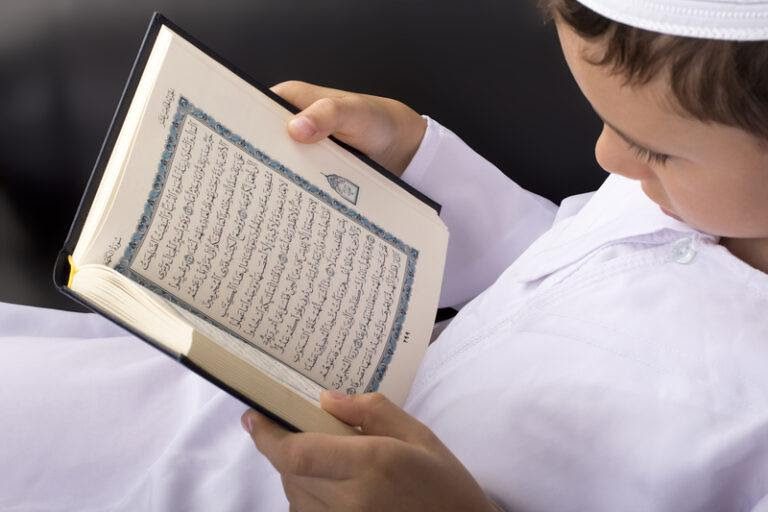
The child sits with the Mushaf, following the text with their finger while listening to the Qari. This connects the sound to the visual script.
Passive Listening
Play the Surah they are memorizing in the background while they are playing with Lego, drawing, or riding in the car.
For children, We highly recommend listening to Sheikh Mahmoud Khalil Al-Husary. His recitation is slow, clear, and pedagogically perfect for learners.
Step 10: Balance New Lessons with Daily Revision for Kids Memorizing Quran
The golden ratio for long-term retention is devoting 80% of the session to revision and only 20% to new memorization.
In Hifz, we have three categories your child needs to manage:
- New Lesson: The new verses they are memorizing today.
- Recent Revision: The portion they memorized in the last 7 days.
- Old Revision: Everything memorized prior to that.
The “Snowball Effect” is real. If you keep adding new snow (New Lessons) without packing the center (Revision), the snowball will fall apart. Do not let your child advance if their revision is weak.
At Riwaq Al Quran, we use Monthly Progress Reports to track this balance for you, so you know exactly where your child stands without having to constantly nag them.
Get 2 Free Trial Classes For Your Child

Step 11: Celebrate Small Wins to Motivate Your Child
Positive reinforcement through small, immediate rewards creates a dopamine association that makes the child want to return to the Quran.
Punishment may work for a day, but love works for a lifetime.
Make it easy for them. Host a “Hifz Party” when they finish a Juz. Give them a special treat when they complete a difficult Surah. These positive memories will anchor their faith as they grow older.
Read Also: Juz Amma Memorization for Kids
Do Children Memorize the Quran Before Learning to Read?
Yes, absolutely. Children can start memorizing through oral transmission (“Talqin”) long before they can read the Arabic script.
We, at Riwaq Al Quran, often see parents waiting until their child is 6 or 7 years old to start, thinking they must know how to read first.
This is a missed opportunity. Between the ages of 3 and 6, a child’s auditory memory is at its peak.
They can mimic complex sounds without knowing the alphabet—just look at how they learn their native language.
In this stage, the method is simple:
- Repetition: You (or a recording) recite a verse.
- Mimicry: The child repeats it back.
- Correction: You fix any pronunciation errors immediately.
However, while oral memorization is excellent for Juz Amma (the 30th part), it is not sustainable for the whole Quran.
Eventually, the child must learn to read to correct themselves and review independently.
Start with oral memorization for short Surahs to build their love for the Quran.
Simultaneously, enroll them in a foundational reading course. Our Noorani Qaida Course is specifically designed to bridge this gap, taking them from simple listening to fluent reading.

Quran Memorization Techniques for Kids
Children have amazing memorization potential. Using this capacity in a positive way is in their parent’s hands, who are their first teachers with their behavior, what they talk about, and what they show them as children always record what happens around them.
In fact, when these amazing memorization and learning speeds are channeled correctly, it becomes very easy how to memorize Quran for kids. Here are three techniques for Quran memorization, each tailored to suit different learning styles and capabilities:
Chunking Technique:
One effective approach on how to teach your child to memorize Quran is the “chunking” method. In this method, Quranic verses are broken down into smaller, manageable chunks or phrases, making memorization more digestible for children.
Each chunk is memorized individually before moving on to the next, gradually building up to memorize longer passages and eventually complete Surahs.
By focusing on mastering smaller sections at a time, children can experience a sense of accomplishment with each milestone reached, boosting their motivation and confidence.
Additionally, incorporating visual aids, recitation practice, and regular repetition further enhances retention. With consistent practice and structured guidance, the chunking method can expedite Quran memorization for kids while ensuring a thorough understanding and appreciation of the sacred text.
Repetition Technique:
Repetition is an effective method, especially for children who cannot read and write yet. Children naturally excel in imitation, making this technique ideal for Quran education. By repeatedly reciting verses, children internalize the Quranic text even without full comprehension.
This method capitalizes on their ability to mimic sounds and patterns, laying a strong foundation for future learning. Consistent practice is key, ensuring steady progress without overwhelming them.
Read Also: Dua for Children Memorizing Quran
Listening Technique:
For auditory learners, memorization through listening is highly effective. Children can memorize Quranic verses simply by listening to skilled reciters.
However, the success of this method depends on factors such as the reciter’s voice tone, fluency, and speed. To maximize results, a structured approach is essential, maintaining regular listening sessions without monotony.
This method harnesses the power of auditory learning, fostering a deep connection with the Quran.
Read Also: Quran Memorization App for Kids
Continuous Reading Technique:
For children who are proficient in reading and writing, continuous reading of the Quran is a powerful technique. Many Hafizs utilize this method to complete their memorization journey.
Each child learns at their own pace, and memorizing the entire Quran requires a well-planned program guided by a knowledgeable educator.
With consistent practice and a supportive learning environment, children can achieve the remarkable feat of memorizing the Quran. Also, check this blog to know the right way of how to revise Quran Hifz after memorizing it with your child.
These techniques underscore the diverse approaches available for Quran memorization, highlighting the importance of tailoring the method to each child’s unique abilities and preferences.
Read Also: Hifz Games for Children
Why Students Love Learning with Riwaq Al Quran
Hear directly from our students about how Riwaq Al Quran Academy has transformed their connection with the Book of Allah. Their experiences reflect the dedication, care, and quality that guide every step of our teaching.
Start Your Child’s Hifz Journey with Riwaq Al Quran Today
You do not have to walk this path alone. Riwaq Al Quran has been a trusted guide for thousands of families since 2017. We bridge the gap between traditional Islamic scholarship and modern online education. Why choose Riwaq Al Quran for your child?
Certified Azhari Teachers
Your child learns from tutors graduated from Al-Azhar University.
2 Free Trial Classes
We offer this so you can test the compatibility between the tutor and your child risk-free.
Flexible Scheduling (24/7)
We fit into your school and work life, not the other way around.
One-on-One Focus
No crowded Zoom rooms; your child gets 100% of the teacher’s attention.
Book the Free Trial Arabic Session for Your Child Today
Get Your Kid a Free Trial Quran Class Now
Get Your Kid a Free Trial Class in Islamic Studies Classes for Kids
Available Courses:
- Online Quran Memorization Course
- Tajweed Classes
- Online Quran Classes for Kids.
- Ijazah Program.
- Arabic Language Classes.
- Islamic Studies Courses.
Get 2 Free Trial Classes For Your Child

Conclusion
A child’s Quran memorization flourishes when the home environment reflects calm focus and genuine reverence for the Quran. Modeling good habits, simplifying meanings, and linking verses to stories allows memorization to grow naturally without resistance or burnout.
Structured learning plays a vital role in long-term success. Qualified teachers ensure proper pronunciation, steady progress, and a healthy balance between new lessons and revision, preventing errors that are difficult to correct later.
Above all, motivation thrives on encouragement, not pressure. Celebrating small milestones, using listening tools wisely, and adapting techniques to each child’s learning style transforms Hifz into a meaningful spiritual journey that stays with them for life.
ncourage exploration to keep children motivated and connected to the Quran.