Dhuhr prayer is usually the first prayer new Muslims learn to perform with full confidence, because it falls in the middle of the day when focus comes easier than at dawn or after dark. Learning how to perform Dhuhr prayer step by step also gives you a template for the other four daily prayers, since all five share the same basic structure of standing, bowing, and prostration.
Dhuhr — also called Zuhr, especially in South Asian English — is the second of the five daily obligatory prayers in Islam. It consists of four rak’ahs, and it’s often the prayer beginners find easiest to practice first, since it doesn’t fall at an unusual hour.
This guide walks through the full prayer from wudu to Taslim, grounds each rule in its actual Quranic or hadith source rather than just stating it, and covers the real situations beginners run into — extreme heat, illness, a rushed prayer — that most guides skip.
What You’ll Learn in This Article
- Exactly when Dhuhr prayer’s time window starts and ends, and the Quranic basis for it.
- A full rak’ah-by-rak’ah walkthrough of Dhuhr prayer, from Takbeer to Taslim.
- The Sunnah rak’ahs before and after Dhuhr, with the authentic hadiths behind them.
- What to do if you’re sick, in extreme heat, or worried you rushed through your prayer.
- Direct answers to the questions people ask most about Dhuhr prayer.
Table of Contents
What Is Dhuhr Prayer, and When Should You Pray It?
Before working through the steps, it helps to know what Dhuhr prayer actually is and when its time window falls — this is also the part most guides get wrong, so it’s worth getting right first.
1. What Is Dhuhr Prayer?
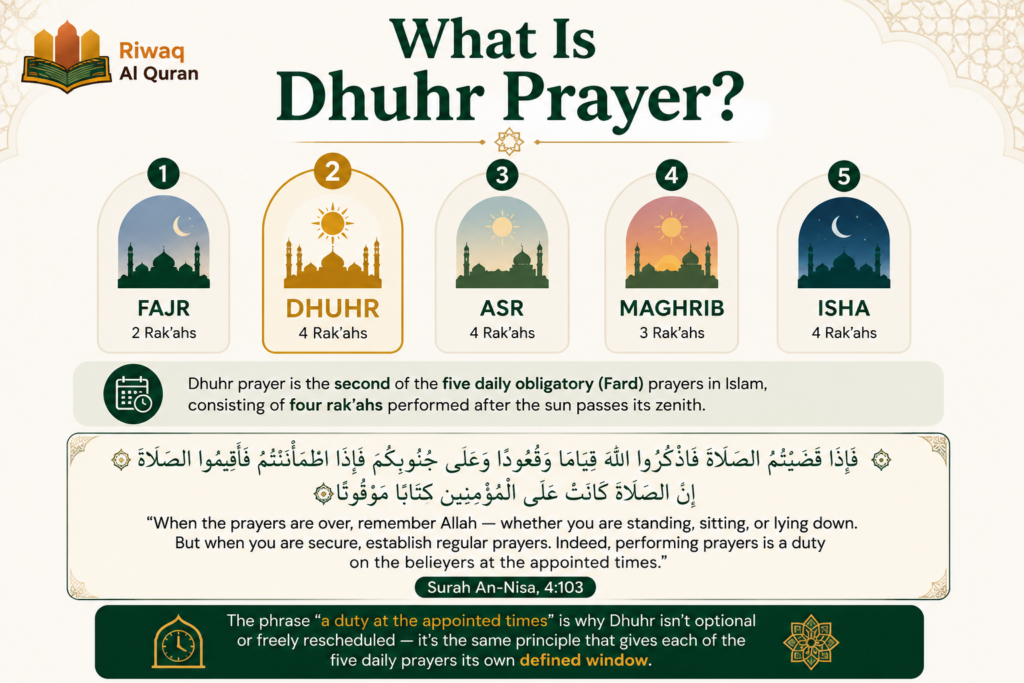
Dhuhr prayer is the second of the five daily obligatory (Fard) prayers in Islam, consisting of four rak’ahs performed after the sun passes its zenith. The Quran is direct about prayer being tied to fixed times rather than personal convenience:
“فَإِذَا قَضَيْتُمُ الصَّلَاةَ فَاذْكُرُوا اللَّهَ قِيَامًا وَقُعُودًا وَعَلَىٰ جُنُوبِكُمْ ۚ فَإِذَا اطْمَأْنَنتُمْ فَأَقِيمُوا الصَّلَاةَ ۚ إِنَّ الصَّلَاةَ كَانَتْ عَلَى الْمُؤْمِنِينَ كِتَابًا مَوْقُوتًا”
“When the prayers are over, remember Allah — whether you are standing, sitting, or lying down. But when you are secure, establish regular prayers. Indeed, performing prayers is a duty on the believers at the appointed times.” — Surah An-Nisa, 4:103
The phrase “a duty at the appointed times” is why Dhuhr isn’t optional or freely rescheduled — it’s the same principle that gives each of the five daily prayers its own defined window.
2. When Does Dhuhr Prayer Start and End?
Dhuhr prayer has a specific time window during the day, beginning after midday and continuing until the start of Asr prayer.
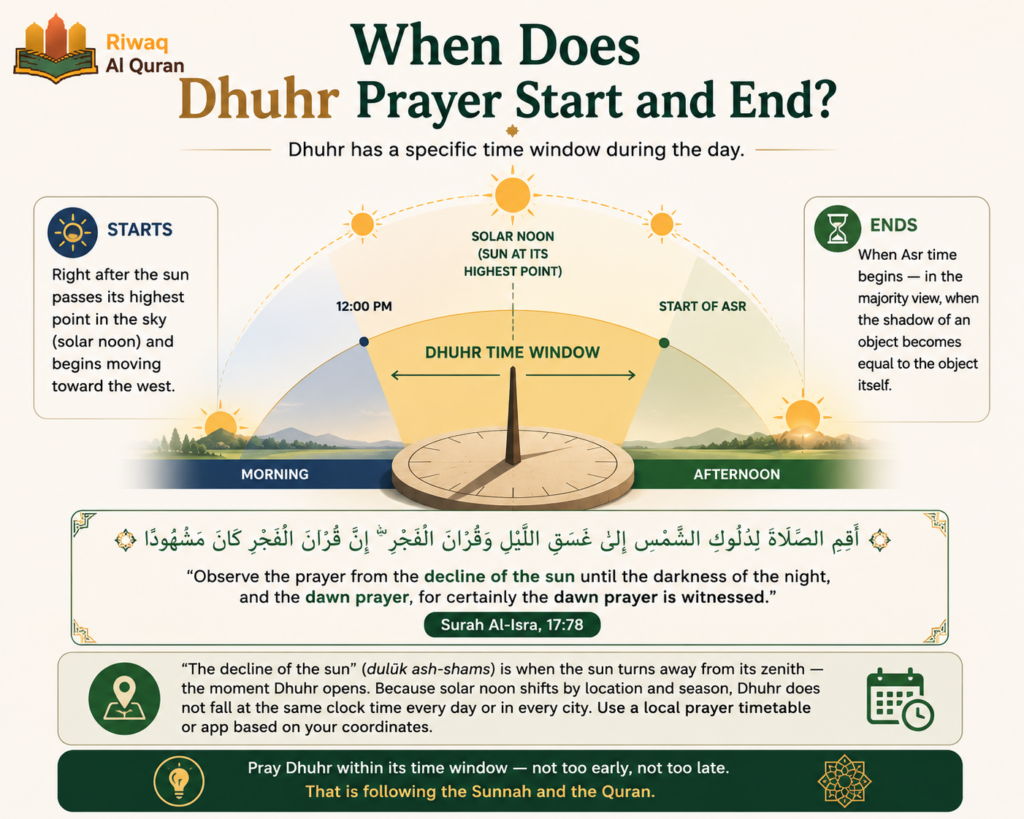
- Starts: right after the sun passes its highest point in the sky (solar noon) and begins moving toward the west.
- Ends: when Asr time begins — in the majority scholarly view, when the shadow of an object becomes equal in length to the object itself.
This window traces directly back to the Quran:
“أَقِمِ الصَّلَاةَ لِدُلُوكِ الشَّمْسِ إِلَىٰ غَسَقِ اللَّيْلِ وَقُرْآنَ الْفَجْرِ ۖ إِنَّ قُرْآنَ الْفَجْرِ كَانَ مَشْهُودًا”
“Observe the prayer from the decline of the sun until the darkness of the night, and the dawn prayer, for certainly the dawn prayer is witnessed.” — Surah Al-Isra, 17:78
Classical commentators identify “the decline of the sun” (dulūk ash-shams) as the sun’s turn away from its zenith — the exact moment Dhuhr time opens. Because solar noon shifts with your location and the season, Dhuhr does not fall at the same clock time every day or in every city, which is why Muslims rely on a local prayer timetable or app tied to their coordinates rather than memorizing one fixed hour.
3. How Many Rak’ahs Does Dhuhr Have?
Dhuhr prayer consists of a set number of units that every Muslim should know, along with additional voluntary prayers that can be performed around it.
- Four obligatory (Fard) rak’ahs make up Dhuhr prayer itself.
- Additional Sunnah rak’ahs are recommended before and after it, covered later in this guide.
Getting the recitation of Al-Fatiha right in each of those four rak’ahs is easier with someone correcting your pronunciation in real time — this is the exact gap Riwaq Al Quran’s live Tajweed classes are built to close for beginners.
How to Perform Dhuhr Prayer Step by Step
Once your wudu is done and you understand Dhuhr’s timing, you’re ready to move through the four rak’ahs in order. Here’s exactly what happens at each stage.
1. Prepare With Wudu, Niyyah, and Qibla
Before beginning the prayer, make sure you are physically prepared and ready to focus your heart and mind on worship.
- Complete your wudu before starting.
- Quietly set your Niyyah (intention) in your heart to pray Dhuhr — no specific words are required.
- Stand facing the Qibla, raise your hands to your earlobes, and say “Allahu Akbar” to begin.
- Tip: if you’re unsure of the Qibla direction, any prayer-times app using your phone’s location will point you to it accurately — no compass or prior knowledge needed.
2. Complete the First Rak’ah
The first rak’ah establishes the basic sequence of movements and recitations that you will follow throughout the prayer.
- Fold your hands over your chest (right hand over left) and recite Surah Al-Fatiha, followed by a short additional surah.
- Say “Allahu Akbar,” bow into Ruku with your back straight and hands on your knees, and say “Subhana Rabbiyal Azeem” three times.
- Rise back to standing, saying “Sami Allahu liman hamidah,” then “Rabbana wa lakal hamd.”
- Lower into Sujud with your forehead, nose, palms, knees, and toes touching the ground, and say “Subhana Rabbiyal A’la” three times.
- Sit briefly in the Jalsa position and say “Rabbighfirli.”
- Prostrate again for the second Sujud, repeating “Subhana Rabbiyal A’la” three times, then rise for the second rak’ah.
3. The Second Rak’ah and First Tashahhud
The second rak’ah follows a similar pattern, but it concludes with a brief sitting that marks the halfway point of the prayer.
- Repeat the same sequence as the first rak’ah: Al-Fatiha plus an additional surah, Ruku, standing, and both Sujud positions.
- After the second Sujud of this rak’ah, sit for the first Tashahhud instead of standing back up:
“التَّحِيَّاتُ لِلَّهِ وَالصَّلَوَاتُ وَالطَّيِّبَاتُ، السَّلَامُ عَلَيْكَ أَيُّهَا النَّبِيُّ وَرَحْمَةُ اللَّهِ وَبَرَكَاتُهُ، السَّلَامُ عَلَيْنَا وَعَلَىٰ عِبَادِ اللَّهِ الصَّالِحِينَ، أَشْهَدُ أَنْ لَا إِلَٰهَ إِلَّا اللَّهُ وَأَشْهَدُ أَنَّ مُحَمَّدًا عَبْدُهُ وَرَسُولُهُ”
(“All greetings, prayers, and good deeds are due to Allah. Peace be upon you, O Prophet, and the mercy and blessings of Allah. Peace be upon us and upon the righteous servants of Allah. I bear witness that there is no god but Allah, and I bear witness that Muhammad is His servant and messenger.”) Sahih Muslim 402
4. Stand for the Third and Fourth Rak’ahs
The final two rak’ahs complete the four-unit prayer, with a simpler recitation pattern than the first two.
- After the first Tashahhud, say “Allahu Akbar” and rise for the third rak’ah.
- In both the third and fourth rak’ahs, recite Surah Al-Fatiha only — no additional surah.
- Repeat the same Ruku and double-Sujud sequence as before.
5. Recite the Final Tashahhud and Finish With Taslim
After completing the final rak’ah, the prayer concludes with the final sitting and the prescribed salutation.
- After the second Sujud of the fourth rak’ah, sit for the final Tashahhud.
- Add the salawat (blessings on the Prophet) after the Tashahhud you already know:
“اللَّهُمَّ صَلِّ عَلَىٰ مُحَمَّدٍ وَعَلَىٰ آلِ مُحَمَّدٍ، كَمَا صَلَّيْتَ عَلَىٰ إِبْرَاهِيمَ وَعَلَىٰ آلِ إِبْرَاهِيمَ، إِنَّكَ حَمِيدٌ مَجِيدٌ. اللَّهُمَّ بَارِكْ عَلَىٰ مُحَمَّدٍ وَعَلَىٰ آلِ مُحَمَّدٍ، كَمَا بَارَكْتَ عَلَىٰ إِبْرَاهِيمَ وَعَلَىٰ آلِ إِبْرَاهِيمَ، إِنَّكَ حَمِيدٌ مَجِيدٌ”
“O Allah, send prayers upon Muhammad and the family of Muhammad, as You sent prayers upon Ibrahim and the family of Ibrahim; indeed You are Praiseworthy, Glorious. O Allah, bless Muhammad and the family of Muhammad, as You blessed Ibrahim and the family of Ibrahim; indeed You are Praiseworthy, Glorious.” Sahih al-Bukhari 3370
- Turn your head to the right, saying “Assalamu Alaikum wa Rahmatullah.”
- Turn your head to the left and repeat it — this is the Taslim, and it ends the prayer.
Quick Reference – What Changes in Each Rak’ah
Here’s a simple breakdown of what’s different from one rak’ah to the next, useful to glance back at while you’re still memorizing the sequence:
| Rak’ah | After Al-Fatiha | After the second Sujud |
| 1st | Additional surah | Rise for 2nd rak’ah |
| 2nd | Additional surah | Sit for first Tashahhud |
| 3rd | Nothing extra | Rise for 4th rak’ah |
| 4th | Nothing extra | Sit for final Tashahhud + Taslim |
If memorizing enough short surahs to rotate through your prayers feels like the hard part right now, that’s a completely normal starting point — Riwaq Al Quran’s memorization courses are built specifically to help beginners build that small rotation with a teacher checking pronunciation as they go.
Sunnah Prayers Before and After Dhuhr
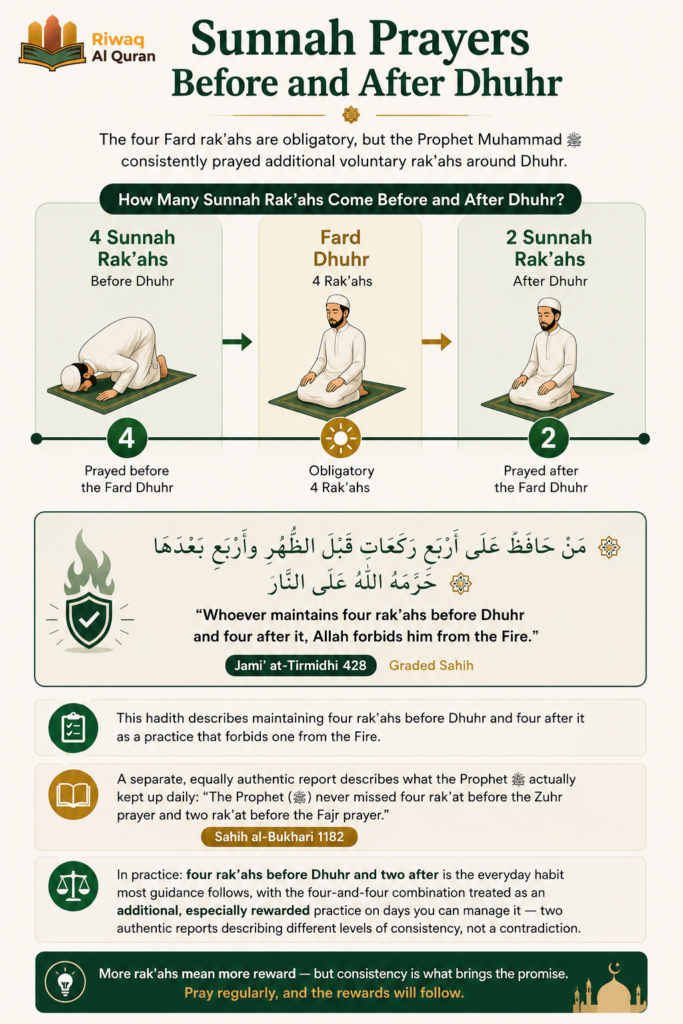
The four Fard rak’ahs are obligatory, but the Prophet Muhammad ﷺ consistently prayed additional voluntary rak’ahs around Dhuhr, and the hadith literature is specific about both how many and why.
1. How Many Sunnah Rak’ahs Come Before and After Dhuhr?
The Prophet ﷺ didn’t just recommend these extra rak’ahs — he tied them directly to one of the most serious promises in the Sunnah:
“مَنْ حَافَظَ عَلَى أَرْبَعِ رَكَعَاتٍ قَبْلَ الظُّهْرِ وَأَرْبَعٍ بَعْدَهَا حَرَّمَهُ اللَّهُ عَلَى النَّارِ”
Whoever maintains four rak’ahs before Dhuhr and four after it, Allah forbids him from the Fire.” — Jami’ at-Tirmidhi 428, graded Sahih
- This hadith describes maintaining four rak’ahs before Dhuhr and four after it as a practice that forbids one from the Fire.
- A separate, equally authentic report describes what the Prophet ﷺ actually kept up daily: “The Prophet (ﷺ) never missed four rak’at before the Zuhr prayer and two rak’at before the Fajr prayer” — Sahih al-Bukhari 1182.
- In practice: four rak’ahs before Dhuhr and two after is the everyday habit most guidance follows, with the four-and-four combination treated as an additional, especially rewarded practice on days you can manage it — two authentic reports describing different levels of consistency, not a contradiction.
2. Why These Extra Rak’ahs Matter
Beyond protection from the Fire, the Prophet ﷺ gave these voluntary prayers a second, equally compelling reason — one that Umm Habibah said she never forgot after hearing it:
“مَنْ صَلَّى اثْنَتَيْ عَشْرَةَ رَكْعَةً فِي يَوْمٍ وَلَيْلَةٍ بُنِيَ لَهُ بِهِنَّ بَيْتٌ فِي الْجَنَّةِ”
“Whoever prays twelve rak’ahs in a day and night, a house is built for him in Paradise.” — Sahih Muslim 728, narrated by Umm Habibah
Umm Habibah, who narrated this hadith, said she never stopped praying these rak’ahs after hearing it from the Prophet ﷺ herself — worth noting, since the four before Dhuhr and two after are two of the twelve prayers this hadith counts.
Practical Situations Beginners Ask About
The steps above assume ideal conditions, but real life doesn’t always cooperate. These are the situations that come up often enough to address directly, each grounded in an authentic hadith rather than general advice.
1. Why Does Islam Allow Delaying Dhuhr in Extreme Heat?
The Prophet ﷺ didn’t leave this to personal judgment — he grounded the permission in a vivid theological reason that makes the ruling unforgettable:
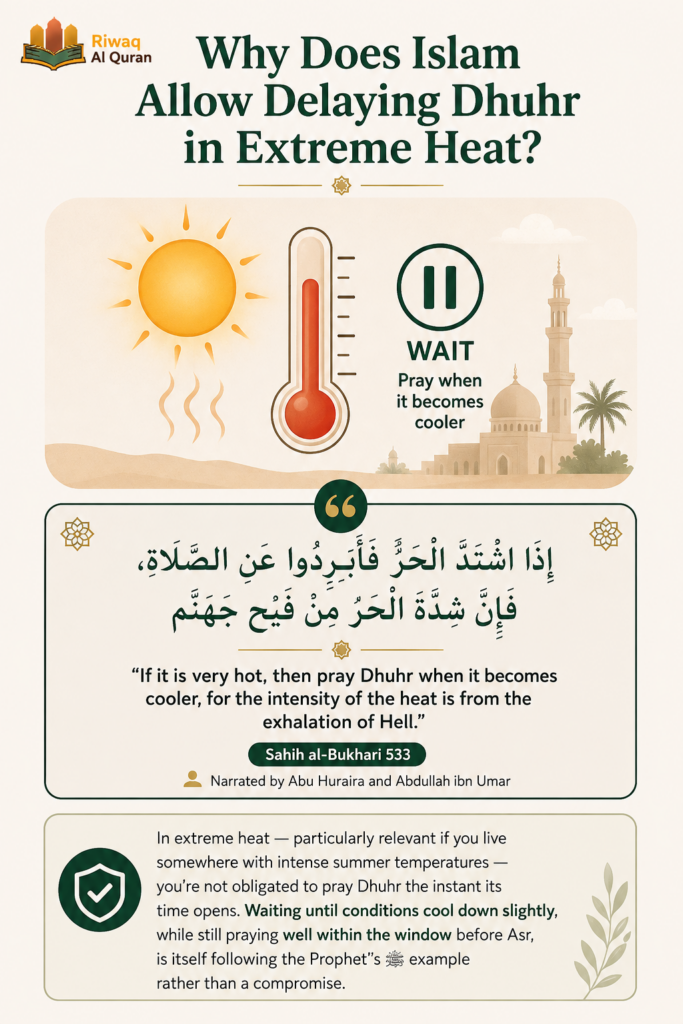
“إِذَا اشْتَدَّ الْحَرُّ فَأَبْرِدُوا عَنِ الصَّلَاةِ، فَإِنَّ شِدَّةَ الْحَرِّ مِنْ فَيْحِ جَهَنَّمَ”
“If it is very hot, then pray Dhuhr when it becomes cooler, for the intensity of the heat is from the exhalation of Hell.” — Sahih al-Bukhari 533, narrated by Abu Huraira and Abdullah ibn Umar
In extreme heat — particularly relevant if you live somewhere with intense summer temperatures — you’re not obligated to pray Dhuhr the instant its time opens. Waiting until conditions cool down slightly, while still praying well within the window before Asr, is itself following the Prophet’s ﷺ example rather than a compromise.
2. Can You Pray Dhuhr Sitting or Lying Down If You’re Sick?
A companion came to the Prophet ﷺ with a physical condition he feared would prevent him from praying properly — and the answer he received established a graduated rule that applies to every prayer, including Dhuhr:
“كَانَتْ بِي بَوَاسِيرُ فَسَأَلْتُ النَّبِيَّ صَلَّى اللَّهُ عَلَيْهِ وَسَلَّمَ عَنِ الصَّلَاةِ فَقَالَ صَلِّ قَائِمًا، فَإِنْ لَمْ تَسْتَطِعْ فَقَاعِدًا، فَإِنْ لَمْ تَسْتَطِعْ فَعَلَىٰ جَنْبٍ”
“I had piles, so I asked the Prophet (ﷺ) about prayer. He said: ‘Pray standing; if you can’t, then sitting; if you can’t, then lying on your side.'” — Sahih al-Bukhari 1117, narrated by Imran ibn Husain
Dhuhr prayer follows the same graduated rule as any other prayer: standing is the default, but illness, injury, or physical limitation moves you down this list rather than excusing you from praying altogether.
3. What If You Miss Dhuhr Prayer or Need to Combine It With Asr?
Understanding what to do when your Dhuhr prayer is missed or when circumstances affect your usual prayer schedule can help you handle these situations correctly and with greater peace of mind.
- If you miss Dhuhr prayer, you pray it as soon as you remember — there’s no substitute prayer that replaces it.
- Combining Dhuhr with Asr (praying them back-to-back at one of the two times) is permitted in the majority scholarly view for travelers or in cases of genuine hardship, such as illness, but it isn’t meant to be a routine substitute for praying Dhuhr in its own time.


4. Are There Special Rules for Women in Dhuhr Prayer?
Women should observe the general requirements of prayer while also taking into account circumstances that may affect whether the prayer is performed at all.
Visual idea: a text-based infographic listing the covering requirements (no human figure needed).
- Dress code: men must be covered from the navel to the knee, while women must be covered from head to ankles, with only the face and hands left exposed.
- Menstruation and postpartum bleeding: women do not pray Dhuhr (or any other prayer) during that time, and these prayers are not made up afterward — a specific exemption, not an oversight to correct later.
Common Mistakes Beginners Make in Dhuhr Prayer
Beyond the steps themselves, a handful of mistakes come up often enough among beginners that they’re worth naming directly — including one the Prophet ﷺ corrected in person.
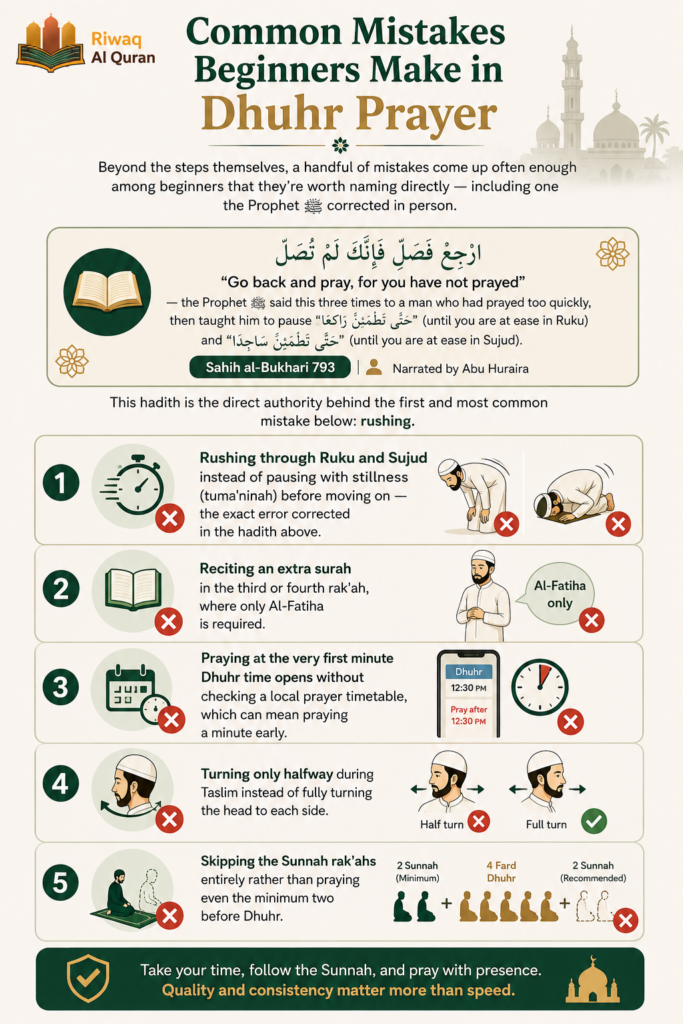
“ارْجِعْ فَصَلِّ فَإِنَّكَ لَمْ تُصَلِّ”
“Go back and pray, for you have not prayed” — the Prophet ﷺ said this three times to a man who had prayed too quickly, then taught him to pause “حَتَّى تَطْمَئِنَّ رَاكِعًا” (until you are at ease in Ruku) and “حَتَّى تَطْمَئِنَّ سَاجِدًا” (until you are at ease in Sujud). — Sahih al-Bukhari 793, narrated by Abu Huraira
This hadith is the direct authority behind the first and most common mistake below: rushing.
- Rushing through Ruku and Sujud instead of pausing with stillness (tuma’ninah) before moving on — the exact error corrected in the hadith above.
- Reciting an extra surah in the third or fourth rak’ah, where only Al-Fatiha is required.
- Praying at the very first minute Dhuhr time opens without checking a local prayer timetable, which can mean praying a minute early.
- Turning only halfway during Taslim instead of fully turning the head to each side.
- Skipping the Sunnah rak’ahs entirely rather than praying even the minimum two before Dhuhr.
If mispronunciation is the mistake you keep repeating, that’s specifically what a live Tajweed class corrects — one-on-one, in real time, rather than leaving you to guess.
Start Learning to Recite the Qur’an with Confidence Today
Knowing the steps of Dhuhr prayer is the foundation — reciting Al-Fatiha and your additional surahs correctly is what makes the prayer feel complete.
Riwaq Al Quran is a comprehensive online platform offering personalized Quran, Arabic, and Islamic Studies classes for individuals of all ages and backgrounds. Experienced instructors follow a structured curriculum covering Tajweed, Tafsir, and Memorization, with live, interactive sessions between student and teacher that make learning to recite correctly practical rather than abstract.
Watch real moments from our live sessions at Riwaq Al Quran and see how we bring learning to life:
Here’s a sample of our Quran courses that will be helpful for you:
- Online Tafseer Course: deepen your understanding of Quranic meanings with insightful, expert-led lessons.
- Noorani Qaida Online: learn Quranic basics efficiently through a structured beginner program.
- Online Quran Recitation Course: enhance your recitation skills with expert-led online lessons.
- Online Tajweed Classes: master Tajweed rules for accurate, beautiful Quranic recitation.
- Quran Memorization Online Course: memorize the Quran effectively with a specialized program.
- Online Qirat Course: explore diverse Qirat styles in a comprehensive online course.
- Online Quran Classes for Kids: nurture a love for the Quran in kids through interactive classes.

Conclusion
Dhuhr prayer is the second of the five daily prayers, made up of four Fard rak’ahs performed once the sun passes its zenith and lasting until Asr begins — a window the Quran itself describes as fixed, not flexible. Each rak’ah follows the same core sequence of recitation, Ruku, and double Sujud, with the third and fourth rak’ahs reciting Al-Fatiha only and the prayer closing with Tashahhud and Taslim.
The Sunnah rak’ahs, the concessions for heat and illness, and the correction the Prophet ﷺ himself gave for a rushed prayer all point to the same thing: Dhuhr is meant to be prayed with care, not just completed. Getting the steps right matters less than practicing them attentively each time.
FAQs
Here are quick, direct answers to the questions people search most often about Dhuhr prayer:
How many rak’ahs is Dhuhr prayer?
Dhuhr prayer has four obligatory (Fard) rak’ahs, plus recommended Sunnah rak’ahs — commonly four before and two after the Fard, based on authentic hadith.
Can I delay Dhuhr prayer because of extreme heat?
Yes, delaying Dhuhr slightly until it cools down during extreme heat follows the Prophet’s ﷺ own guidance in Sahih al-Bukhari, as long as you still pray before Asr time begins.
Can I pray Dhuhr sitting down if I’m sick?
Yes, if you cannot stand you may pray sitting, and if you cannot sit you may pray lying on your side, based on the graduated rule the Prophet ﷺ taught in Sahih al-Bukhari.
What happens if I miss Dhuhr prayer?
You pray it as soon as you remember, since there’s no separate prayer that substitutes for a missed Dhuhr, and no extra penalty prayer is required beyond praying it late.
Do I recite an extra surah in every rak’ah of Dhuhr?
No, an additional surah after Al-Fatiha is only recited in the first and second rak’ahs; the third and fourth rak’ahs use Al-Fatiha alone.
Can women pray Dhuhr during their period?
No, women do not pray Dhuhr or any other prayer while menstruating or in postpartum bleeding, and these missed prayers are not made up afterward.
Sources
Sahih al-Bukhari 793 — narrated by Abu Huraira
Sahih Muslim 728 — narrated by Umm Habibah
Jami’ at-Tirmidhi 428 — graded Sahih
Sahih al-Bukhari 533 — narrated by Abu Huraira and Abdullah ibn Umar
Sahih al-Bukhari 1117 — narrated by Imran ibn Husain