Surah Al-Muddaththir arrived at a moment of profound spiritual weight — when the Prophet Muhammad ﷺ, shaken by the first revelation, retreated in contemplative seclusion. Allah’s call was immediate and direct: arise, warn, and purify. These opening commands contain a message that extends far beyond their historical moment.
The benefits of Surah Al-Muddaththir are rooted in its content — its verses are a sustained invitation toward accountability, sincere worship, and moral clarity. For every Muslim who recites this surah with understanding, it becomes a mirror for self-examination and a reminder of what worship truly demands.
Table of Contents
1. Surah Al-Muddaththir Carries the First Public Call to Warn Mankind
Surah Al-Muddaththir contains one of the earliest and most direct divine commissions in Quranic history. Allah commands the Prophet ﷺ to rise from personal comfort and carry a warning to all people. This is not merely a historical event — it is a model for every believer to understand that faith is never passive and that awareness of truth carries responsibility.
The opening verses establish this with unmistakable directness:
يَٰٓأَيُّهَا ٱلْمُدَّثِّرُ ﴿١﴾ قُمْ فَأَنذِرْ ﴿٢﴾
Yā ayyuhal-muddaththir. Qum fa-andhir.
“O you who covers himself [with a garment] — Arise and warn.” (Al-Muddaththir 74:1–2)
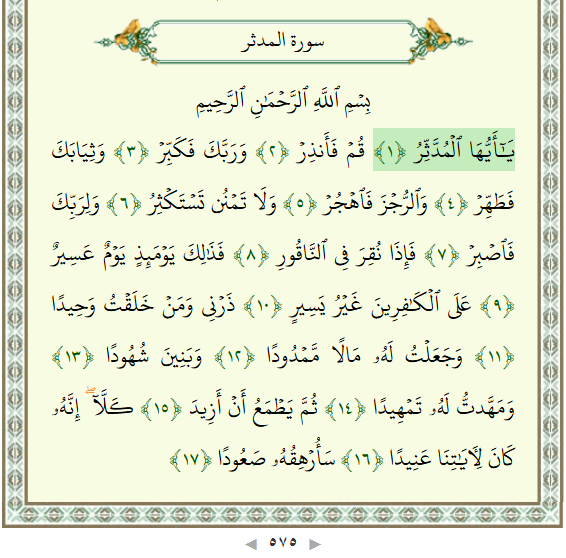
Ibn Kathir, in his Tafsir, explains that this command marked the transition from private revelation to public prophetic mission — the formal beginning of Islam’s message to humanity.
For the student of Quran, reciting these verses with this understanding transforms the experience from mere recitation into an encounter with prophetic history.
At Riwaq Al Quran, our Online Quran Tafseer Course teaches students precisely this kind of contextual understanding — connecting each surah’s verses to their historical and spiritual weight so that recitation carries genuine meaning.
Enroll Now in Riwaq’s Tafseer Course with a FREE trial

2. Instilling Deep Consciousness of Allah’s Greatness
One of the most immediate benefits of engaging with this surah is the reinforcement of Takbir — the conscious magnification of Allah above all else. The command follows directly after the call to warn, as if to establish the only foundation on which warning can be delivered.
وَرَبَّكَ فَكَبِّرْ ﴿٣﴾
Wa rabbaka fa-kabbir.
“And your Lord glorify.” (Al-Muddaththir 74:3)
This single verse carries extraordinary pedagogical weight. A believer cannot genuinely warn others, purify themselves, or maintain patience without first anchoring every action in the greatness of Allah. Classical scholars note that this verse establishes the proper hierarchy of the believer’s heart — Allah first, always.
Reciting this verse regularly, especially with its Tafsir in mind, builds what scholars call Ikhlas al-niyyah — sincerity of intention — which is the foundation of accepted worship.
It is a reminder that the believer’s concern must never be status, recognition, or approval. The orientation is singular: toward Allah alone.
3. Purification of Character and Conduct
The surah’s benefit extends into the practical dimension of a Muslim’s daily character. The command in verse four is among the most direct instructions for personal refinement found in the early Makkan surahs.
وَثِيَابَكَ فَطَهِّرْ ﴿٤﴾
Wa thiyābaka fa-tahhir.
“And your clothing purify.” (Al-Muddaththir 74:4)
Classical Tafsir scholars, including Imam Al-Tabari and Ibn Kathir, note that while the literal meaning refers to physical cleanliness, the scholarly majority holds that it encompasses purity of character, deeds, and inner conduct.
The Arabic word thiyab (garments) has long been used in classical Arabic to signify the totality of a person’s character and outward presentation.
For the Muslim student or professional, this verse is a standing reminder that faith is not compartmentalized. Your character at work, in your family, and in your community is part of your worship.
The benefit of this verse lies in its daily applicability — every interaction becomes an opportunity to honor this command.


4. Teaching Believers to Give Without Expectation of Return
Among the most transformative personal ethics this surah instills is the discipline of giving solely for Allah’s sake — without expectation of increase, gratitude, or worldly return.
وَلَا تَمْنُن تَسْتَكْثِرُ ﴿٦﴾
Wa lā tamnun tastakthir.
“And do not confer favor to acquire more.” (Al-Muddaththir 74:6)
This verse strikes at a subtle but widespread spiritual disease: transactional generosity. Ibn Kathir explains this as a prohibition against giving only when one expects a greater return — whether material, social, or reputational.
The Prophet ﷺ was commanded to embody a generosity that is untainted by calculation.
The benefit for the believer who internalizes this verse is profound. It refines one’s motivation in charity, in teaching, in support of others — stripping away hidden transactional impulses and replacing them with sincerity.
This is a quality the surah builds gradually through repeated recitation with conscious reflection.
Experience Riwaq Al Quran Classes
Watch real moments from our live sessions at Riwaq Al Quran and see how we bring learning to life. These clips highlight our interactive, student-focused approach designed to keep learners engaged, motivated, and actively involved in every step of their educational journey.
5. Building Patience as an Essential Pillar of Faith
The surah follows its commands with a command that ties everything together: patience in pursuit of Allah’s pleasure. Without this, no sustained worship is possible.
وَلِرَبِّكَ فَٱصْبِرْ ﴿٧﴾
Wa li-rabbika fasbir.
“And be patient for the sake of your Lord.” (Al-Muddaththir 74:7)
This verse is among the earliest Quranic commands regarding Sabr — and it is characteristically precise. The patience commanded here is not general endurance but patience for Allah’s sake — meaning its motivation must be entirely divine. This is a higher station than mere resilience.
In our experience at Riwaq Al Quran, students who approach Hifz and Tajweed practice with this understanding of Sabr experience meaningfully different results. Patience rooted in divine purpose sustains effort through plateaus in a way that willpower alone never does.
Connect with our Azhari tutors to learn Quran with Tafseer

If you are building your Quranic practice, our Quran Memorization Techniques guide reinforces this principle with practical structure.
Read Also: The Benefits of Ayatul Kursi
6. Warning About the Day of Judgment for Tawbah
The surah does not soften its account of what awaits those who reject divine guidance. Verses 8–10 describe the Naqur — the blast of the trumpet — and declare that Day to be one of immense hardship for those who turned away.
فَإِذَا نُقِرَ فِى ٱلنَّاقُورِ ﴿٨﴾ فَذَٰلِكَ يَوْمَئِذٍ يَوْمٌ عَسِيرٌ ﴿٩﴾
Fa-idhā nuqira fin-nāqūr. Fadhālika yawma’idhin yawmun ‘asīr.
“And when the trumpet is blown — that Day will be a difficult day.” (Al-Muddaththir 74:8–9)
The benefit here is the benefit of Tawbah and awakening. The Quran uses vivid eschatological language not to terrify but to redirect. Scholars of Tafsir consistently note that such descriptions are merciful warnings — they arrive before the Day itself, giving every soul time to turn back.
Reciting these verses with this understanding instills a healthy urgency in worship and self-examination.
Read Also: Benefits of Surah Yaseen
7. Benefit of Surah Al-Muddaththir for Job
No authentic hadith or verified Tafsir source establishes a specific recitation practice for Surah Al-Muddaththir as a means for securing employment or worldly benefit.
Attributing such specific worldly outcomes to this surah without textual evidence would constitute an innovation (Bid’ah). The correct approach is to recite it for its established Quranic guidance, and to pursue one’s affairs with sincere dua and lawful means.
Read Also: Surah Al-Kafirun Benefits
Why Students Love Learning with Riwaq Al Quran
Hear directly from our students about how Riwaq Al Quran Academy has transformed their connection with the Book of Allah. Their experiences reflect the dedication, care, and quality that guide every step of our teaching.
Begin Your Deeper Engagement with the Quran at Riwaq Al Quran
Surah Al-Muddaththir is a surah of action, purification, and accountability — its benefits are realized through recitation with understanding, not recitation alone.
At Riwaq Al Quran, our Azhari-certified tutors help non-Arabic speaking students move beyond surface recitation into genuine comprehension and connection:
- Online Quran Tafseer Course — verse-by-verse understanding with qualified scholars
- Online Quran Memorization Course — structured Hifz with certified Hafiz tutors
- Best Islamic Studies Online Course — authentic Islamic education for Western Muslim learners
All programs offer one-on-one sessions, 24/7 scheduling, and 2 free trial classes with a 100% money-back guarantee. Book your free trial today and bring the Quran into your life with depth and certainty.
We offer courses in Online Quran & Tajweed Classes, Arabic Language, and Islamic Studies.
- Online Quran Memorization Course
- Tafseer Course
- Tajweed Classes
- Online Quran Classes for Kids.
- Ijazah Program.
- Arabic Language Classes.
- Islamic Studies Courses.
Enroll now for 2 Free Trial Classes and Begin Learning Islam and Quran Today

Read Also: Surah Tawbah Benefits
Frequently Asked Questions About Surah Al-Muddaththir Benefits
What are the main benefits of reciting Surah Al-Muddaththir regularly?
Regular recitation of Surah Al-Muddaththir reinforces awareness of divine accountability, the obligation of sincere worship, and the importance of patient character. Its early verses instill Takbir and purification of conduct, while its closing verses remind believers that the Quran is a universal guidance accessible to every willing heart, regardless of background.
How does Surah Al-Muddaththir differ from other early Makkan surahs?
Surah Al-Muddaththir is distinctive for containing the earliest direct commission to the Prophet ﷺ for public warning, and for presenting an explicit conversation between the inhabitants of Paradise and Hellfire. Unlike purely devotional early surahs, it combines prophetic directives with eschatological accountability in remarkably direct and structured language.
Is Surah Al-Muddaththir suitable for beginning Hifz students?
Yes. Its relatively short verses, consistent rhyme scheme, and thematic coherence make it memorization-friendly for intermediate students who have already established basic Tajweed foundations. Students at Riwaq Al Quran benefit from pairing its memorization with Tafsir instruction so that understanding reinforces retention throughout the process.
How can understanding Tafsir of Surah Al-Muddaththir improve my recitation?
When a student understands that verse 74:3 is a command of Takbir, that verse 74:4 carries both literal and character-based meaning, and that verses 74:43–46 are a direct testimony from those held accountable — recitation slows, deliberateness increases, and pronunciation naturally improves. Meaning and Tajweed are not separate disciplines; they reinforce each other. Explore our Islamic studies resources to understand how integrated learning works.