| Key Takeaways |
| The story of Habil and Qabil appears in Surah Al-Ma’idah (5:27–31), making it the only Quranic account of the first human murder. |
| Qabil killed Habil out of jealousy after Allah accepted Habil’s sacrifice and rejected Qabil’s offering. |
| The Quran does not mention the reason for the offering rejection explicitly; classical tafsir scholars link it to sincerity and piety. |
| Allah sent a crow to teach Qabil how to bury his brother’s body — the first burial in human history, according to classical scholarship. |
The story of Habil and Qabil in the Quran is narrated in Surah Al-Ma’idah, and it strikes with the full weight of jealousy, divine justice, regret, and consequence all at once.
What makes this narrative so enduring is that it is not merely a historical account. It is a timeless lesson about the soul’s capacity for both devotion and destruction. Every phase of this story carries a moral the Quran intends for all of humanity to absorb — not just the sons of Adam.
Table of Contents
1. The Two Brothers Are Commanded to Offer a Sacrifice to Allah
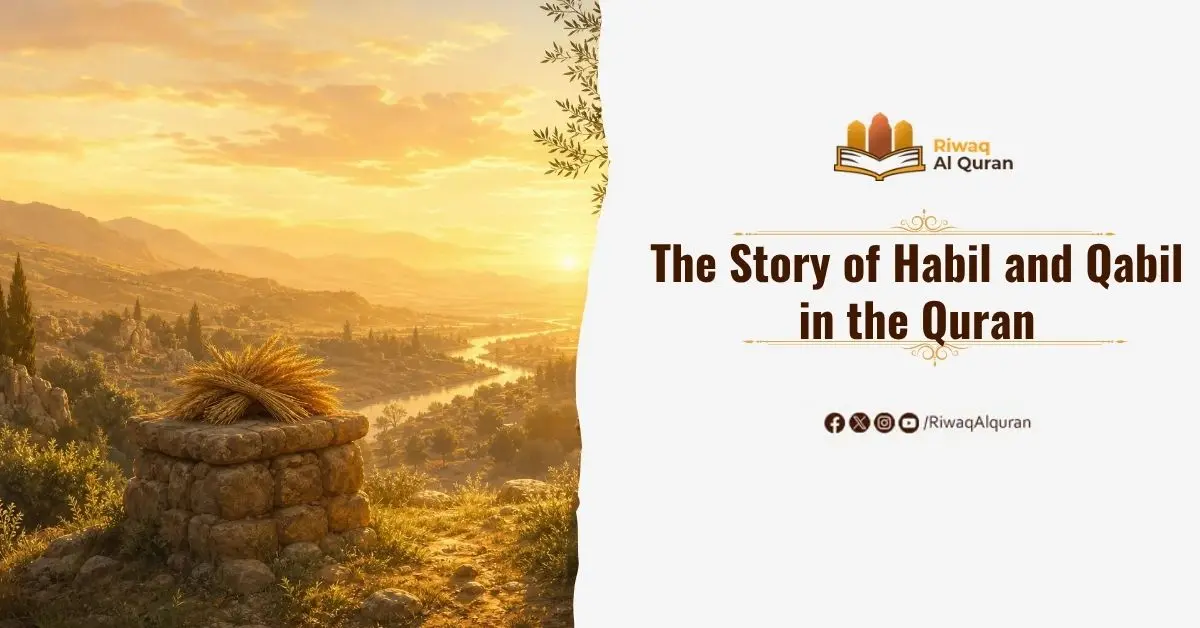
The story of Habil and Qabil begins when both sons of Adam were instructed to present an offering to Allah. This is established directly in the Quran in Surah Al-Ma’idah (5:27), which states:
وَاتْلُ عَلَيْهِمْ نَبَأَ ابْنَيْ آدَمَ بِالْحَقِّ إِذْ قَرَّبَا قُرْبَانًا فَتُقُبِّلَ مِن أَحَدِهِمَا وَلَمْ يُتَقَبَّلْ مِنَ الْآخَرِ
Watlu ʿalayhim nabaʾa ibnay Ādam bilḥaqq, idh qarrabā qurbānan fataqubbila min aḥadihimā wa lam yutaqabbal minal-ākhar.
“And recite to them the story of Adam’s two sons, in truth, when they both offered a sacrifice [to Allah], and it was accepted from one of them but was not accepted from the other.” (Al-Ma’idah 5:27)
Classical tafsir scholars explain that Habil offered the best of his flock — a choice, healthy animal — while Qabil offered inferior produce from his harvest.
The acceptance of Habil’s offering was signaled by a fire from the sky consuming it, which was a recognized sign of divine acceptance among people of that era according to classical scholarship.
The Quran does not explicitly name the mechanism of rejection, but the broader Islamic scholarly tradition consistently links it to sincerity of intention and piety, reinforcing the principle that Allah evaluates the state of the heart behind every act of worship.
2. Qabil’s Jealousy Ignites and He Threatens to Kill His Brother
After the sacrifice, Qabil’s response was not grief or self-reflection — it was rage. The Quran records his threat immediately and without softening:
قَالَ لَأَقْتُلَنَّكَ
Qāla la-aqtulannaka.
“[Qabil] said, ‘I will surely kill you.'” (Al-Ma’idah 5:27)
This moment is psychologically precise. The Quran identifies jealousy rooted in divine favor as the trigger. Qabil’s offering was rejected, Habil’s was accepted, and rather than examining his own shortcoming, Qabil directed his fury outward at his brother.
Some classical commentators note that some narrations from the People of the Book mention that disputes over marriage arrangements may have also been a contributing worldly factor.
However, the Quran itself centers the narrative squarely on the rejected offering and the jealousy it produced.
Scholars advise caution with Isra’iliyyat (narrations from Jewish and Christian traditions) that are not corroborated Islamically.
Experience Riwaq Al Quran Classes
Watch real moments from our live sessions at Riwaq Al Quran and see how we bring learning to life. These clips highlight our interactive, student-focused approach designed to keep learners engaged, motivated, and actively involved in every step of their educational journey.
3. Habil Responds with Profound Calm and Refusal to Retaliate
What distinguishes Habil in this story is not just his piety — it is his deliberate, principled refusal to respond to violence with violence. His reply to Qabil’s death threat is one of the most morally striking passages in the Quran:
لَئِن بَسَطتَ إِلَيَّ يَدَكَ لِتَقْتُلَنِي مَا أَنَا بِبَاسِطٍ يَدِيَ إِلَيْكَ لِأَقْتُلَكَ ۖ إِنِّي أَخَافُ اللَّهَ رَبَّ الْعَالَمِينَ
La-in basaṭta ilayya yadaka litaqtulanī mā anā bibāsiṭin yadiya ilayka li-aqtulak, innī akhāfullāha Rabb al-ʿālamīn.
“If you should raise your hand against me to kill me — I shall not raise my hand against you to kill you. Indeed, I fear Allah, Lord of the worlds.” (Al-Ma’idah 5:28)
This is not passivity born of weakness. Classical scholars explain this as taqwa in action — Habil’s fear of Allah was more powerful than his fear of death. He then adds, in verse 29, that he would rather Qabil carry the burden of both his own sin and Habil’s sin than commit the transgression himself.
If your children are learning the Quran and its stories, Riwaq Al Quran’s Islamic Studies Classes for Kids introduce these profound moral lessons through age-appropriate, structured one-on-one sessions with Azhari-certified tutors.
Enroll Your Kid in Riwaq’s Islamic studies for Kids with a FREE trial
4. Qabil Commits the First Murder in Human History
Despite Habil’s powerful words, Qabil’s soul could not contain its corruption. The Quran states plainly:
فَطَوَّعَتْ لَهُ نَفْسُهُ قَتْلَ أَخِيهِ فَقَتَلَهُ فَأَصْبَحَ مِنَ الْخَاسِرِينَ
Faṭawwaʿat lahu nafsuhu qatla akhīhi faqatalahu fa-aṣbaḥa minal-khāsirīn.
“And his soul permitted to him the murder of his brother, so he killed him and became among the losers.” (Al-Ma’idah 5:30)
The phrase “his soul permitted to him” (ṭawwaʿat lahu nafsuhu) is deeply significant. Classical Quranic commentators, including Imam al-Qurtubi in his Al-Jami’ li-Ahkam al-Qur’an, explain this as the nafs al-ammara — the commanding self that inclines toward evil — overcoming Qabil’s moral resistance entirely.
The Quran does not describe the method of killing. Scholars note this deliberate omission, understanding it as a sign that the act itself and its consequence are what matter — not the graphic details.
| Phase | Key Character | Quranic Verse | Core Lesson |
| Offering | Both brothers | 5:27 | Sincerity determines acceptance |
| Threat | Qabil | 5:27 | Jealousy corrupts the soul |
| Habil’s response | Habil | 5:28–29 | Taqwa overcomes fear of death |
| Murder | Qabil | 5:30 | The nafs can overpower moral will |
| Regret | Qabil | 5:31 | Transgression brings shame and loss |
5. A Crow Teaches Qabil How to Bury His Brother’s Body
After committing the murder, Qabil was left standing over his brother’s body — paralyzed, not knowing what to do. This moment of human ignorance in the face of death is met with a remarkable divine lesson through creation:
فَبَعَثَ اللَّهُ غُرَابًا يَبْحَثُ فِي الْأَرْضِ لِيُرِيَهُ كَيْفَ يُوَارِي سَوْءَةَ أَخِيهِ
Fabaʿatha Allāhu ghurāban yabḥathu fī al-arḍi liyuriyahu kayfa yuwārī sawʾata akhīh.
“Then Allah sent a crow searching in the ground to show him how to hide the disgrace of his brother.” (Al-Ma’idah 5:31)
Qabil watched the crow scratch the earth and bury something — and then, in one of the Quran’s most humanly poignant moments, he felt shame. He said:
يَا وَيْلَتَا أَعَجَزْتُ أَنْ أَكُونَ مِثْلَ هَذَا الْغُرَابِ
Yā waylatā aʿajaztu an akūna mithla hādhā al-ghurāb.
“Woe to me! Have I failed to be like this crow and hide the body of my brother?” (Al-Ma’idah 5:31)
According to Ibn Kathir and the broader classical tafsir tradition, this was the first burial in human history. A crow — the most humble of teachers — demonstrated to the first murderer what to do with the first victim.
The layers of meaning here are extraordinary: the killer learned mercy and dignity toward the dead from a bird, after having denied it to his own brother while alive.
Qabil then became, as the verse states, “among the regretful.” His regret, however, came after the act — not before. This is the Quran’s quiet but devastating commentary on how sin operates.
Why Did Qabil Kill Habil?
The Quran’s answer to why Qabil killed Habil is unambiguous: his soul overpowered his conscience through jealousy and entitlement. The Arabic term ṭawwaʿat in verse 5:30 — often translated as “his soul permitted” or “his soul enticed” — is a clinical description of moral surrender.
The rejection of his offering exposed a wound Qabil was unwilling to examine honestly. Rather than turning inward with humility — asking why Allah did not accept his offering — he turned outward with fury toward the one whose offering was accepted.
This pattern — projecting internal failure onto an external target — is what the Quran identifies as the root of the first murder. It is also why the story carries universal weight. The mechanism of Qabil’s sin is not unique to him. It is a documented tendency of the human soul when pride is wounded.
Understanding Quranic stories at this depth requires engaging with authentic tafsir. Riwaq Al Quran’s Online Quran Tafseer Course is taught by Azhari-certified instructors who guide students through classical commentaries with the care this knowledge deserves.
Enroll Now in Riwaq’s Tafseer Course with a FREE trial
What Surah Contains the Habeel and Qabeel Story in the Quran?
The Habeel and Qabeel story in the Quran is found exclusively in Surah Al-Ma’idah, verses 27 through 31. Al-Ma’idah is the fifth surah of the Quran, revealed in Madinah, and it covers themes of covenant, law, and moral accountability.
The placement of this story within Al-Ma’idah is contextually deliberate. The surah opens with themes of fulfilling obligations and divine covenants. The story of the two sons of Adam arrives as a living illustration of what happens when personal interest overrides divine command.
| Detail | Information |
| Surah name | Al-Ma’idah (The Table Spread) |
| Surah number | 5 |
| Verse range | 27–31 |
| Revelation type | Madani (revealed in Madinah) |
| Primary theme | Moral accountability and the sanctity of life |
| Key figures | Habil (Abel), Qabil (Cain), Adam (implied) |
Surah Al-Ma’idah is among the later revelations, and scholars note that its legal and moral content reflects a period of mature Islamic community building. The story of Habil and Qabil arrives not as mythology, but as a foundational moral case study.
The Universal Law the Quran Derives from This Story
Immediately after narrating the story, Allah establishes a universal moral principle — one of the most quoted verses in Islamic ethics:
مِنْ أَجْلِ ذَٰلِكَ كَتَبْنَا عَلَىٰ بَنِي إِسْرَائِيلَ أَنَّهُ مَن قَتَلَ نَفْسًا بِغَيْرِ نَفْسٍ أَوْ فَسَادٍ فِي الْأَرْضِ فَكَأَنَّمَا قَتَلَ النَّاسَ جَمِيعًا
Min ajli dhālika katabnā ʿalā Banī Isrāʾīl annahu man qatala nafsan bighayri nafsin aw fasādin fī al-arḍi faka-annamā qatala al-nāsa jamīʿā.
“Because of that, We decreed upon the Children of Israel that whoever kills a soul unless for a soul or for corruption done in the land — it is as if he had slain mankind entirely.” (Al-Ma’idah 5:32)
This verse is the Quran’s explicit derivation from the story. The killing of one innocent human being is not merely a personal crime — it carries, in divine scales, the weight of an offense against all of humanity. This principle forms a cornerstone of Islamic legal ethics regarding the sanctity of human life.
Read Also: The Story of Prophet Ayyub in the Quran
Why Students Love Learning with Riwaq Al Quran
Hear directly from our students about how Riwaq Al Quran Academy has transformed their connection with the Book of Allah. Their experiences reflect the dedication, care, and quality that guide every step of our teaching.
Read Also: The Prophet Hud Story in the Quran
The Story of Habil and Qabil for Kids: Core Lessons to Teach
The story of Habil and Qabil for kids can be presented through its human moments — two brothers, a choice, a mistake, and its consequences — without graphic detail.
The Quran itself models this approach by focusing on the moral logic of each phase rather than violent description. Here are the lessons most suitable for young learners:
1. Sincerity matters in worship:
Allah accepted the offering given with a pure heart. Children learn that the quality of intention shapes the value of any act of worship.
2. Jealousy is a dangerous emotion:
Qabil’s jealousy did not hurt Habil first — it destroyed Qabil himself. Teaching children to recognize jealousy early is a practical application of this story.
3. Responding to anger with calm is strength:
Habil’s response to the death threat is a model of emotional intelligence rooted in taqwa.
4. Every action has a consequence:
Qabil became regretful — not free. Sin carries its own weight.
5. Even a crow can be a teacher:
The humility of learning from creation is a beautiful, child-friendly moral.
At Riwaq Al Quran, our Quran Studies Classes for Kids weave stories like this into structured, engaging sessions that help children internalize Quranic values — not just memorize them. Our Azhari-certified tutors know how to meet children at their level with warmth and clarity.
Enroll Your Kid in Riwaq’s Quran Classes for Kids with a FREE trial

Read Also: The Story of Khidr in the Quran
Start Learning the Quran and Its Stories with Riwaq Al Quran
The story of Habil and Qabil is one of many narratives the Quran uses to build moral wisdom — but understanding them deeply requires authentic guidance.
Surface readings miss the tafsir dimensions, the linguistic precision, and the ethical architecture that makes Quranic storytelling uniquely powerful.
Riwaq Al Quran has been guiding non-Arabic speaking Muslims worldwide since 2017 through:
- Al-Azhar University-certified instructors with 9+ years of teaching experience
- One-on-one personalized sessions tailored to your level and pace
- 24/7 scheduling flexibility for families and adults across time zones
- 2 free trial classes with a 100% money-back guarantee
- Plans starting from $32/month
Explore our Online Quran Tafseer Course, our Best Islamic Studies Online Course, or our Online Quran Classes For Kids — and register for your free trial today.
We offer courses in Online Quran & Tajweed Classes, Arabic Language, and Islamic Studies.
- Online Quran Memorization Course
- Recitation Course
- Tafseer Course
- Tajweed Classes
- Online Quran Classes for Kids.
- Ijazah Program.
- Qira’at Course.
- Arabic Language Classes.
- Islamic Studies Courses.
Enroll now for 2 Free Trial Classes
Conclusion
The story of Habil and Qabil in the Quran is not ancient history filed away in a distant chapter. It is a living moral document — five verses that capture the full arc of human moral failure: from wounded pride, to threat, to murder, to shame, to regret. The Quran tells it without sensationalism and draws from it a universal law about the sanctity of every human soul.
What Habil modeled — calm, principled, fearful only of Allah — remains the Quranic ideal. What Qabil represents is the soul in surrender to its worst impulses. Both are within us. The story asks which one we will feed.
Frequently Asked Questions About the Story of Habil and Qabil in the Quran
Which Surah Contains the Story of Habil and Qabil in the Quran?
The story of Habil and Qabil appears in Surah Al-Ma’idah, the fifth surah of the Quran, specifically in verses 27 through 31. Al-Ma’idah is a Madani surah, meaning it was revealed in Madinah. The story is the only Quranic account of the first murder in human history and is followed directly by a universal principle about the sanctity of human life in verse 32.
Why Did Qabil Kill Habil According to the Quran?
The Quran identifies jealousy as the root cause. Allah accepted Habil’s sacrifice and rejected Qabil’s, and rather than reflecting on his own shortcoming, Qabil turned his anger toward his brother. Verse 5:30 uses the phrase ṭawwaʿat lahu nafsuhu — “his soul permitted him” — indicating that his moral resistance was gradually overcome by his commanding self, leading to the first murder in human history.
What Is the Main Lesson of the Habeel and Qabeel Story in the Quran?
The primary lesson is the absolute sanctity of human life — formalized in verse 5:32, where Allah declares that killing one innocent soul is equivalent to killing all of humanity. Alongside this, the story teaches that sincere worship is accepted by Allah, that jealousy destroys the one who harbors it, and that responding to injustice with fear of Allah — not retaliation — reflects true strength of character.