Every Muslim performs Wudu multiple times a day, yet most carry a quiet gap in understanding: they know the physical steps but not the weight behind each one — which acts are obligatory, which are recommended, and what exactly happens spiritually when they are performed with full awareness.
The sunnah of wudu are not formalities. They are the precise way the Prophet Muhammad ﷺ purified himself before standing before Allah — each act layered with spiritual purpose, physical benefit, and scholarly evidence. To understand the full steps of Wudu is to understand not just the how, but the why behind every motion.
The pillars are the six acts that make Wudu legally valid. Missing one means the Wudu — and the Salah performed with it — must be repeated.
Allah announces His love for those who purify themselves:
“إِنَّ اللَّهَ يُحِبُّ التَّوَّابِينَ وَيُحِبُّ الْمُتَطَهِّرِينَ“
“Indeed, Allah loves those who are constantly repentant and loves those who purify themselves.” — Surah Al-Baqarah (2:222)
The pairing of tawbah (repentance) with tahara (purification) in this verse is not coincidental. Wudu is simultaneously a physical and moral act of cleansing. Scholars like Imam Ibn al-Qayyim observed that the outward and inward states of purity mirror each other: the more attentive a person is during Wudu, the greater its effect on the heart before prayer.
And in Surah Al-Tawbah:
“وَاللَّهُ يُحِبُّ الْمُطَّهِّرِينَ“
“And Allah loves those who purify themselves.” — Surah Al-Tawbah (9:108)
This verse was revealed in praise of the people of Quba, singled out by the Prophet ﷺ for their attention to purification. It establishes that tahara is not merely a ritual prerequisite — it is a quality Allah actively loves in His servants, making every act of Wudu an opportunity to draw closer to Him.
The sunnah of wudu refers to the recommended acts the Prophet Muhammad ﷺ performed consistently during ablution — acts that deepen its spiritual quality and increase its reward, but whose omission does not invalidate the Wudu.
The term Sunnah in Islamic jurisprudence carries specific weight. It means: the Prophet ﷺ did this, encouraged it, and it becomes an act of worship when followed — not optional in the sense of unimportant, but optional in the sense of non-obligatory.
This guide gives you both layers: the 17 Sunnah acts with their Arabic hadith texts, linked sources, and scholarly commentary, followed by the 6 Pillars grounded in the Quran — plus a practical decision framework so you always know whether a mistake requires repeating your Wudu.
Table of Contents
The 17 Sunnah Acts of Wudu
The following 17 acts are established from authenticated narrations of the Prophet Muhammad ﷺ. Each is presented with its Arabic text, linked source, translation, and practical commentary. None of these overlap with the 6 obligatory Pillars.
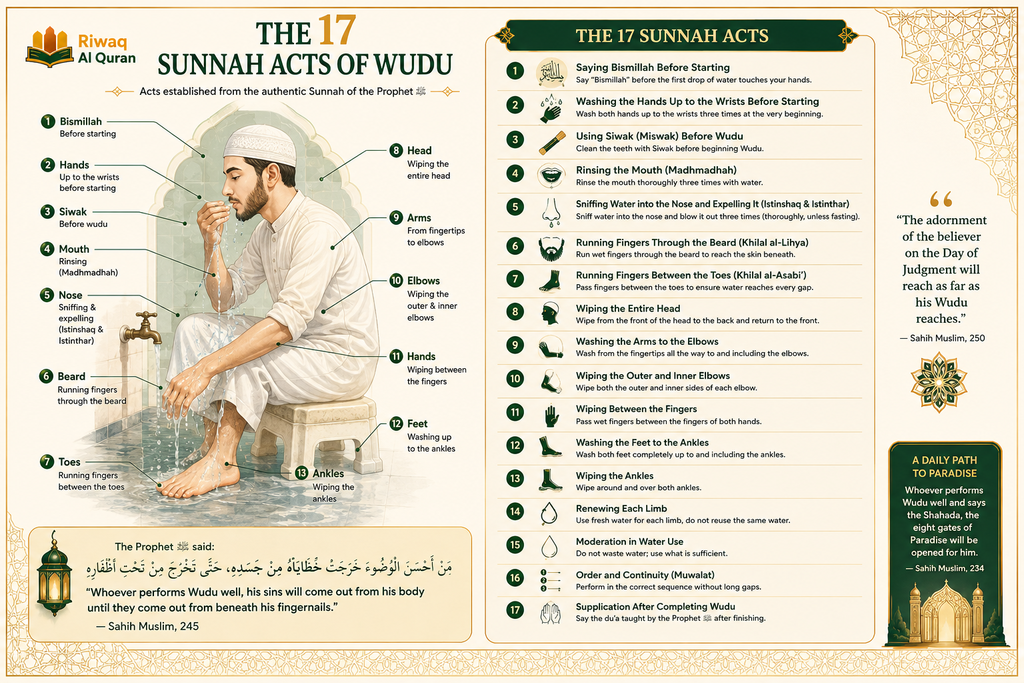
1. Saying Bismillah Before Starting
Of all the preparatory acts of Wudu, the Bismillah is the only one where the Prophet ﷺ issued a ruling that touches the validity of the act itself. The narration is direct:
“لَا وُضُوءَ لِمَنْ لَمْ يَذْكُرِ اسْمَ اللَّهِ عَلَيْهِ“
“There is no Wudu for the one who does not mention the name of Allah over it.” — Sunan Ibn Majah, Hadith 399 | Graded Hasan
Key points about this Sunnah:
- The Hanbali Madhab considers Bismillah obligatory when remembered; Shafi’i and Maliki treat it as Sunnah.
- Say it before the first drop of water touches your hands — not midway through.
- The Bismillah marks the transition from routine hygiene to an act of worship.
- Forgetting it is excused across all Madhabs; deliberate omission is more serious in the Hanbali position.
Spiritual & Scientific Benefits
Bismillah does more than open an act — it reorients the intention. The moment the name of Allah is invoked, the act of Wudu ceases to be a preparatory routine and becomes an act of dhikr (remembrance of Allah) in itself. Scholars of the spiritual dimensions of worship note that Bismillah creates what they call hudur al-qalb — presence of the heart — from the very first action.
A person who begins with this invocation is less likely to rush through Wudu mechanically, because the name of Allah keeps them anchored in awareness.
From a psychological standpoint, ritualised opening statements have a documented effect on task-completion quality. Beginning with a declared intention restructures the act from an unconscious background task into a deliberate foreground action. The brain registers the transition, and attention follows. This is precisely what Bismillah achieves before Wudu.
Position of the Four Madhabs
| Madhab | Ruling | Notes |
|---|---|---|
| Hanbali | Obligatory (Wajib) when remembered | Deliberate omission invalidates Wudu in the relied-upon position; forgetting it is excused |
| Maliki | Sunnah Mu’akkadah (strongly recommended) | Not reciting it does not affect the validity of Wudu |
| Shafi’i | Sunnah | Omission carries no legal consequence |
| Hanafi | Sunnah Mu’akkadah | Some Hanafi scholars consider it obligatory by the stronger report |
2. Washing the Hands Up to the Wrists Before Starting
This pre-Wudu hand wash is documented in Sahih Bukhari as part of the detailed description of the Prophet’s ﷺ Wudu — though it is specific to the arms, the principle it contains extends to the hands that precede them:
“كَانَ إِذَا تَوَضَّأَ أَدَارَ الْمَاءَ عَلَى مِرْفَقَيْهِ“
“He (the Prophet ﷺ) would run water over his elbows when performing Wudu.” — Sahih Bukhari, Hadith 186
This pre-Wudu hand wash is distinct from the obligatory arm wash in the Pillars:
- Its purpose is to remove surface impurities from the hands before they touch the water vessel.
- The Prophet ﷺ washed his hands three times at the very opening of every Wudu.
- The principle it embeds: preparation before the act, not just the act itself. The hands that will wash the face must themselves be clean first.
Islamic Codes:عن أبي هريرة رضي الله عنه أن رسول الله ﷺ قال: «لَولا أن أَشُقَّ على أُمَّتي -أو على الناسِ- لَأمَرتُهم بالسِّواكِ مع كُلِّ صَلاةٍ»
“Were it not that I would make it difficult for my Ummah — or for the people — I would have commanded them to use the tooth-stick (siwak) with every prayer.” Sahih al-Bukhari 887


Spiritual & Scientific Benefits
This pre-Wudu hand wash embeds a principle that runs through the entire Shari’ah: al-taharatu min al-taharah — purity must itself proceed from purity. The hands that will distribute water across the face, inside the ears, and between the toes must first be clean themselves. Allowing impure hands into a vessel or onto a limb would undermine the very act being performed.
Scientifically, hand surfaces carry a high concentration of transient bacteria — pathogens picked up from everyday contact with objects and surfaces. Washing the hands before Wudu removes this surface load before it is spread to the face and mouth in the steps that follow. The WHO’s hand hygiene guidelines identify handwashing before food and before touching the face as two of the highest-impact hygiene actions — the pre-Wudu hand wash covers both.
Position of the Four Madhabs
| Madhab | Ruling | Notes |
|---|---|---|
| Hanbali | Sunnah | Specifically the three-wash method at the very start, before any water touches the vessel |
| Maliki | Sunnah | Recommended before dipping into a vessel; conditions apply if the hand is already known to be impure |
| Shafi’i | Sunnah | Recommended as a precaution, especially on waking from sleep |
| Hanafi | Sunnah | Particularly emphasised on waking from sleep; narrations on this point are well-known across all four schools |
3. Using Siwak (Miswak) Before Wudu
No single statement about the Siwak captures both its status and the Prophet’s ﷺ restraint in not imposing it as well as this narration from al-Nasa’i:
“لَوْلَا أَنْ أَشُقَّ عَلَى أُمَّتِي لَأَمَرْتُهُمْ بِالسِّوَاكِ مَعَ كُلِّ وُضُوءٍ “
“If it were not that I would be overburdening my Ummah, I would have commanded them to use the Siwak with every Wudu.” — Sunan al-Nasa’i, Hadith 92 | Graded Sahih
Why the Siwak matters beyond oral hygiene:
- The Prophet’s ﷺ conditional phrasing reveals his wish for it to be obligatory — his merciful restraint is what kept it a Sunnah.
- It purifies the mouth before it recites the words of Allah in Salah.
- The Siwak (Salvadora persica tree stick) has documented antibacterial properties, making it effective for plaque-forming bacteria reduction.
- It is the most consistently mentioned Sunnah connected to Wudu preparation across the hadith corpus.
Spiritual & Scientific Benefits
The Prophet’s ﷺ phrasing — “If it were not that I would be overburdening my Ummah” — is one of the most revealing constructions in the Sunnah. It tells us his personal wish while simultaneously showing his mercy in not imposing it.
The scholars of Usul al-Fiqh use this type of narration to argue that the Siwak carries the highest level of Sunnah emphasis, just below obligatory. His merciful restraint should motivate the believer toward it more, not less.
Spiritually, the mouth is the instrument of Quranic recitation, dhikr, and du’a. Purifying it before Salah — which follows Wudu — is not merely about breath; it is about honouring the words of Allah with the cleanest possible vessel.
Scientifically, studies on Salvadora persica (the Miswak tree) have identified multiple active compounds including salvadorine, triclosan precursors, fluoride, and silica that collectively inhibit plaque formation, reduce Streptococcus mutans (the primary bacterium responsible for tooth decay), and exhibit measurable antibacterial action.
A 2003 comparative study in the Journal of Periodontology found Siwak users had lower gingival index scores than toothbrush users without fluoride toothpaste. Its antibacterial action occurs without any added chemicals.
Position of the Four Madhabs
| Madhab | Ruling | Notes |
|---|---|---|
| Hanbali | Sunnah Mu’akkadah (highest emphasis) | Specifically recommended at Wudu, before prayer, on entering the home, and on waking |
| Maliki | Sunnah Mu’akkadah | Makruh to use it after Dhuhr on the day of fasting (differing opinion from other schools) |
| Shafi’i | Sunnah | Recommended before every prayer and at every Wudu |
| Hanafi | Sunnah Mu’akkadah | Narrated that Ibn Mas’ud considered it a major Sunnah; time restriction for fasting does not apply in this school |
4. Rinsing the Mouth (Madhmadhah)
The authentic Sunnah method — combining the mouth rinse and the nose sniff into a single handful — is preserved in Sahih Bukhari with a specificity that rules out improvised alternatives:
“تَمَضْمَضَ وَاسْتَنْشَقَ مِنْ كَفٍّ وَاحِدَةٍ“
“He (the Prophet ﷺ) rinsed his mouth and sniffed water from a single handful.” — Sahih Bukhari, Hadith 191
Practical method:
- Take water into the mouth, swirl it, and expel it fully.
- Combine it with the nose sniff (Sunnah #5) from the same single handful — this is the authentic Sunnah method, not separate scoops.
- Repeat three times, using fresh water each time.
Spiritual & Scientific Benefits
The mouth occupies a unique position in worship: it is where the Fatiha is recited in every rak’ah, where the Tashahud is spoken, and where du’a is formed. Cleansing it before Salah — via Wudu — is an act of honouring the Divine speech about to be uttered.
There is also the matter of ghaflah (heedlessness): a mouth left uncleaned carries the traces of food, drink, or morning staleness into prayer. The Madhmadhah is not perfunctory — it is a real rinse, swirled and expelled fully.
Oral bacteria thrive in the residue left between the teeth and along the gumline; rinsing with water — even without toothpaste — disrupts this biofilm mechanically. When combined with the Siwak, the two Sunnahs together provide the most comprehensive pre-prayer oral hygiene possible.
Position of the Four Madhabs
| Madhab | Ruling | Notes |
|---|---|---|
| Hanbali | Obligatory (Wajib) | Deliberate omission invalidates Wudu; applies equally to Ghusl |
| Maliki | Sunnah in Wudu; obligatory in Ghusl | An important distinction — the same act carries different weight depending on the type of purification |
| Shafi’i | Sunnah | Does not affect the validity of Wudu if omitted |
| Hanafi | Sunnah (some say Wajib in Ghusl) | In Hanafi Ghusl, omitting madhmadhah is considered a deficiency; in Wudu it is Sunnah |
5. Sniffing Water into the Nose and Expelling It (Istinshaq and Istinthar)
This act is one of the few Sunnahs of Wudu where the Prophet ﷺ used the imperative form of a verb that denotes thoroughness — leaving no room to treat it as a token gesture. The narration in Sunan Abu Dawud preserves this exactly:
“بَالِغْ فِي الِاسْتِنْشَاقِ إِلَّا أَنْ تَكُونَ صَائِمًا“
“Sniff water thoroughly into the nose, unless you are fasting.” — Sunan Abu Dawud, Hadith 142 | Graded Sahih
Key scholarly and practical points:
- The word baalig (بَالِغْ — “do it thoroughly”) establishes this is not a token gesture.
- The exception for fasting — not sniffing too deeply to prevent water reaching the throat — shows the Sunnah is real and deliberate in both cases, adjusted only in intensity.
- The Hanbali Madhab elevates both madhmadhah and istinshaq to obligatory acts; in that Madhab, leaving them out deliberately invalidates Wudu.
Spiritual & Scientific Benefits
The nasal cavity is the body’s primary air filtration system. Every breath passes through it, and particulates, bacteria, allergens, and airborne pathogens accumulate in the nasal passages continuously. Rinsing the nose with water — genuinely, as the hadith commands with the word baalig (do it thoroughly) — physically dislodges this accumulated matter before prayer.
Research published in the American Journal of Rhinology has demonstrated that nasal irrigation reduces bacterial load in the nasal passages and provides relief from chronic rhinosinusitis symptoms. Muslims who perform Istinshaq five times a day have been completing this practice for fourteen centuries. The spiritual benefit is inseparable: the nose is the channel of breath, and the Prophet ﷺ elevated it with the same command he gave the mouth.
The exception for fasting — not sniffing too deeply — is a mark of the Sunnah’s precision. The rule is not “sniff less because it doesn’t matter”; the rule is “sniff thoroughly, but adjust the depth to protect the fast.” Both the fast and the Istinshaq are taken seriously.
Position of the Four Madhabs
| Madhab | Ruling | Notes |
|---|---|---|
| Hanbali | Obligatory (Wajib) | Both Istinshaq (water in) and Istinthar (water out) are required; omitting either invalidates Wudu |
| Hanafi | Obligatory (Wajib) | Required in Wudu; omitting it is a deficiency that carries legal consequence |
| Maliki | Sunnah in Wudu; varies in Ghusl | Does not invalidate Wudu if omitted |
| Shafi’i | Sunnah | Recommended strongly but not obligatory |
6. Running Fingers Through the Beard (Khilal al-Lihya)
What makes this narration particularly valuable is that it does not merely establish that the Prophet ﷺ performed this act — it preserves the specific technique he used:
“كَانَ إِذَا تَوَضَّأَ أَخَذَ كَفًّا مِنْ مَاءٍ فَأَدْخَلَهُ تَحْتَ حَنَكِهِ فَخَلَّلَ بِهِ لِحْيَتَهُ“
“When he (the Prophet ﷺ) performed Wudu, he would take a handful of water and put it under his chin and run it through his beard.” — Sunan al-Tirmidhi, Hadith 31 | Graded Hasan Sahih
Practical notes:
- The technique — water under the chin, fingers running upward through the beard toward the face — is described specifically in this narration.
- This ensures water reaches the skin of the face beneath a thick beard, particularly along the jawline.
- A person with a thin or no beard still benefits from ensuring full facial coverage in this area.
Spiritual & Scientific Benefits
The face is the most visible part of the body — it is what a person presents to the world and, symbolically, what is turned toward the Qiblah in prayer. Ensuring that the skin beneath a thick beard is reached by water fulfils a spiritual obligation with greater certainty. The Khilal al-Lihya is an act of itqan — doing a thing properly rather than sufficing with what appears adequate.
Spiritually, this Sunnah also reflects a broader principle: worship is not performed for outward appearances. A person with a full, thick beard who skips this step may appear to have washed his face, yet the skin beneath remains unwashed. The Khilal al-Lihya ensures the inner reality of the act matches its outward form.
From a hygiene standpoint, dense facial hair traps sebum, dead skin cells, and bacteria close to the skin surface. Water poured over the exterior of a beard does not penetrate to the skin reliably. Running wet fingers through the beard disrupts this trapped layer.
Position of the Four Madhabs
| Madhab | Ruling | Notes |
|---|---|---|
| Hanbali | Sunnah | Specifically recommended using the technique described in the Tirmidhi narration |
| Shafi’i | Sunnah | Applicable when the beard is thick enough that water does not reach the skin underneath |
| Hanafi | Sunnah | Also recommended; some Hanafi texts discuss whether water reaching the skin is obligatory for a thick beard |
| Maliki | Makruh (disliked) | A notable exception — the Maliki position holds that combing fingers through the beard risks removing stray hairs, which is considered undesirable; washing the surface of the beard is considered sufficient |
7. Running Fingers Between the Toes (Khilal al-Asabi’)
The Prophet ﷺ addressed the inter-digital spaces of the toes not as a byproduct of foot washing, but as a separate, named act. The command in al-Tirmidhi is specific and direct:
“إِذَا تَوَضَّأْتَ فَخَلِّلْ بَيْنَ أَصَابِعِكَ“
“When you perform Wudu, pass your fingers between your toes.” — Sunan al-Tirmidhi, Hadith 39 | Graded Hasan Sahih
The practical importance of this Sunnah:
- Water poured over the top of the foot does not reliably reach the gaps between the toes — especially the outer smaller toes.
- The Prophet ﷺ named this as a separate, specific act, not a byproduct of foot washing.
- Correct method: use the little finger of the hand to pass through each inter-digital gap, starting from the small toe of the right foot toward the large toe, then repeat on the left.
Spiritual & Scientific Benefits
Athlete’s foot (tinea pedis) and interdigital fungal infections are among the most common dermatological conditions globally — and the inter-digital spaces of the toes are their primary breeding ground, precisely because water and air do not reach these areas sufficiently in normal washing. The Prophet’s ﷺ specific instruction to pass fingers between the toes addresses this anatomical reality directly.
Spiritually, the instruction carries the same lesson as the beard Khilal: thoroughness in worship is not assumed — it is commanded. The narration does not say “make sure your feet are wet”; it says “pass your fingers between your toes.” The Sunnah elevates the standard from appearance to actuality.
The method prescribed in the hadith — starting from the small toe of the right foot toward the large toe, using the little finger of the hand — ensures every inter-digital space is covered in a systematic sequence, leaving no gap.
Position of the Four Madhabs
| Madhab | Ruling | Notes |
|---|---|---|
| Hanbali | Sunnah; obligatory if water cannot otherwise reach | If the toes are tightly pressed together such that water cannot penetrate, the Khilal becomes obligatory to ensure the obligatory washing area is covered |
| Shafi’i | Sunnah | Recommended specifically for the toes; less clear guidance on fingers |
| Maliki | Sunnah | Recommended for both fingers and toes |
| Hanafi | Sunnah | Recommended; some texts note it is more important for the toes than the fingers due to anatomy |
8. Starting with the Right Side Before the Left
This preference was not limited to Wudu — it extended across every deliberate action in the Prophet’s ﷺ daily life. The narration from Sahih Bukhari is comprehensive:
“كَانَ يُعْجِبُهُ التَّيَمُّنُ فِي تَنَعُّلِهِ وَتَرَجُّلِهِ وَطُهُورِهِ وَفِي شَأْنِهِ كُلِّهِ“
“He (the Prophet ﷺ) liked to start from the right side when putting on his sandals, when combing his hair, when purifying himself, and in all his affairs.” — Sahih Bukhari, Hadith 168
Applying this Sunnah in Wudu:
- Wash the right arm fully, then the left arm fully.
- Wash the right foot fully, then the left foot fully.
- This deliberate sequencing also produces a slower, more attentive pace — one of the unintended benefits of following the Sunnah sequence.
Spiritual & Scientific Benefits
The preference for the right side in Islamic practice is not arbitrary symmetry — it is a theological statement about honour. In the Quran, the people of the right (ashab al-yamin) are the blessed; the right hand is associated with giving, receiving, and greeting.
When the Prophet ﷺ applied this principle to Wudu, he embedded a moment of conscious orientation into each limb wash: this is honoured, this comes first, this is deliberate.
Neurologically, following a fixed sequence has a grounding effect on the performing mind. A person who always washes the right arm before the left will notice — and pause — if they begin with the left. That noticing is itself a form of attention to the act. The Sunnah sequence creates attentiveness as a byproduct.
Spiritually, following the same sequence as the Prophet ﷺ is an act of ittiba’ (following), which the Quran links directly to the love of Allah: “Say: if you love Allah, follow me — Allah will love you.” (Surah Al-Imran, 3:31)
Position of the Four Madhabs
| Madhab | Ruling | Notes |
|---|---|---|
| Hanbali | Sunnah | Applying right-before-left to arms and feet specifically |
| Shafi’i | Sunnah | The same principle applies; the Shafi’i school also applies it to wiping the head (right side first) |
| Maliki | Sunnah | Considered a well-established Sunnah; some Maliki texts discuss its application to the face wipe as well |
| Hanafi | Sunnah | Agreed upon across the school; no Hanafi position considers starting with the left to invalidate Wudu |
9. Washing Each Limb Three Times
Both the Sunnah of three washes and the explicit ceiling on excess come from closely related narrations. The first establishes the practice:
“تَوَضَّأَ ثَلَاثًا ثَلَاثًا“
“He (the Prophet ﷺ) performed Wudu washing each limb three times.” — Sahih Bukhari, Hadith 159
The three levels — and an important limit:
| Washes | Status |
| Once | Obligatory minimum (Pillar fulfilled) |
| Twice | Recommended |
| Three times | Complete Sunnah — maximum established by the Prophet ﷺ |
The same source records a strict warning about exceeding three times:
مَنْ زَادَ عَلَى هَذَا فَقَدْ أَسَاءَ وَتَعَدَّى وَظَلَمَ
“Whoever adds more than this has done wrong, gone beyond the limit, and wronged himself.” — Sunan Abu Dawud, Hadith 135
Washing more than three times carries no additional reward and is explicitly called isa’a (wrongdoing) by the Prophet ﷺ — a detail rarely paired alongside the “three times” Sunnah in most articles.
Spiritual & Scientific Benefits
The ears are among the sensory gateways most responsible for a person’s religious formation — they receive the Adhan, the Quran, the khutbah, the du’a. Including them in Wudu — specifically through the ruling that they are part of the head — ensures they are not treated as an afterthought. The wiping is brief, but its significance is in its presence.
Practically, the outer ear and the entrance to the ear canal accumulate dust, sebaceous secretions, and debris that are rarely addressed in routine hygiene. The thumb-and-index-finger motion of ear wiping in Wudu addresses both the internal canal opening and the cartilage folds of the outer ear (auricle), providing a form of mechanical cleaning.
The Prophetic statement “the ears are part of the head” also resolves a practical question that might otherwise consume repeated consultation: no separate water, no separate intention, no separate wash — the same wipe, the same moment, the same water.
Position of the Four Madhabs
| Madhab | Ruling | Fresh Water? | Notes |
|---|---|---|---|
| Hanbali | Sunnah | No — use remaining moisture from head | Both inner and outer surface wiped |
| Shafi’i | Sunnah | No — remaining moisture from head wiping | Inner canal with index finger; outer with thumb |
| Maliki | Sunnah; some say obligatory | No | Some Maliki positions elevate ear wiping to Fard alongside the head |
| Hanafi | Sunnah | No — same water as head; some texts mention fresh water as permitted | Inner and outer both covered in one motion |
10. Wiping Both Ears After Wiping the Head
A single Prophetic statement settles both the ruling and the method of this Sunnah, leaving no ambiguity about the ears’ status relative to the head:
“الْأُذُنَانِ مِنَ الرَّأْسِ“
“The ears are part of the head.” — Sunan Ibn Majah, Hadith 442 | Graded Sahih
Practical method and ruling:
- No fresh water is taken for the ears — they use the moisture remaining on the hands after wiping the head.
- Index finger enters the ear canal; thumb wipes the outer cartilage.
- This ruling also answers a common question: the Prophet’s statement that ears are part of the head means they require no separate water — same wipe, same motion, immediately after the head.
Spiritual & Scientific Benefits
The ears are among the sensory gateways most responsible for a person’s religious formation — they receive the Adhan, the Quran, the khutbah, the du’a. Including them in Wudu — specifically through the ruling that they are part of the head — ensures they are not treated as an afterthought. The wiping is brief, but its significance is in its presence.
Practically, the outer ear and the entrance to the ear canal accumulate dust, sebaceous secretions, and debris that are rarely addressed in routine hygiene. The thumb-and-index-finger motion of ear wiping in Wudu addresses both the internal canal opening and the cartilage folds of the outer ear (auricle), providing a form of mechanical cleaning.
The Prophetic statement “the ears are part of the head” also resolves a practical question that might otherwise consume repeated consultation: no separate water, no separate intention, no separate wash — the same wipe, the same moment, the same water.
Position of the Four Madhabs
| Madhab | Ruling | Fresh Water? | Notes |
|---|---|---|---|
| Hanbali | Sunnah | No — use remaining moisture from head | Both inner and outer surface wiped |
| Shafi’i | Sunnah | No — remaining moisture from head wiping | Inner canal with index finger; outer with thumb |
| Maliki | Sunnah; some say obligatory | No | Some Maliki positions elevate ear wiping to Fard alongside the head |
| Hanafi | Sunnah | No — same water as head; some texts mention fresh water as permitted | Inner and outer both covered in one motion |
Spiritual & Scientific Benefits
The ears are among the sensory gateways most responsible for a person’s religious formation — they receive the Adhan, the Quran, the khutbah, the du’a. Including them in Wudu — specifically through the ruling that they are part of the head — ensures they are not treated as an afterthought. The wiping is brief, but its significance is in its presence.
Practically, the outer ear and the entrance to the ear canal accumulate dust, sebaceous secretions, and debris that are rarely addressed in routine hygiene. The thumb-and-index-finger motion of ear wiping in Wudu addresses both the internal canal opening and the cartilage folds of the outer ear (auricle), providing a form of mechanical cleaning.
The Prophetic statement “the ears are part of the head” also resolves a practical question that might otherwise consume repeated consultation: no separate water, no separate intention, no separate wash — the same wipe, the same moment, the same water.
Position of the Four Madhabs
| Madhab | Ruling | Fresh Water? | Notes |
|---|---|---|---|
| Hanbali | Sunnah | No — use remaining moisture from head | Both inner and outer surface wiped |
| Shafi’i | Sunnah | No — remaining moisture from head wiping | Inner canal with index finger; outer with thumb |
| Maliki | Sunnah; some say obligatory | No | Some Maliki positions elevate ear wiping to Fard alongside the head |
| Hanafi | Sunnah | No — same water as head; some texts mention fresh water as permitted | Inner and outer both covered in one motion |
11. Washing Slightly Beyond the Required Boundaries
The narration for this act is recorded in Sahih Muslim within the same chain that includes the famous description of the radiance of Wudu on the Day of Resurrection:
“كَانَ إِذَا تَوَضَّأَ أَدَارَ الْمَاءَ عَلَى مِرْفَقَيْهِ“
“When he (the Prophet ﷺ) performed Wudu, he would run water around and beyond his elbows.” — Sahih Muslim, Hadith 246
This Sunnah connects directly to the Day of Judgment reward hadith (Spiritual Rewards, #2):
- The further the water extends in this life, the further the radiance extends on the Day of Resurrection.
- In practice: wash a few centimetres past the elbows and a few centimetres above the ankles.
- This simultaneously ensures the obligatory area is fully covered and carries the additional Sunnah reward.
Spiritual & Scientific Benefits
This Sunnah connects the present act to a future promise in a direct, physical way. The hadith of the ghurra and tahjeel — the radiance that will appear on the limbs of Wudu on the Day of Resurrection — makes the extra centimetres washed today into marks of recognition in the next life. No other act of Wudu links the physical extent of the wash to a specific eschatological reward as explicitly as this.
Practically, this Sunnah also solves a technical problem: the human eye cannot perfectly determine where the elbow ends or where the ankle begins, especially when dressed. Washing “a little beyond” creates a margin of certainty that the obligatory area — which ends exactly at the elbow and exactly at the ankle — has been fully covered. The Sunnah turns a potential gap into a guaranteed completeness.
Position of the Four Madhabs
| Madhab | Ruling | Notes |
|---|---|---|
| Hanbali | Sunnah — explicitly based on the Sahih Muslim narration | Extends to a few centimetres past the elbow and ankle |
| Shafi’i | Sunnah | The Shafi’i school ties this directly to the hadith about radiance on the Day of Judgment |
| Maliki | Sunnah | Recommended as a precaution to guarantee the obligatory boundary is met |
| Hanafi | Sunnah | Agreed upon; the Hanafi school also uses this as an argument for why the arm must be washed “generously” |
12. Using a Modest Amount of Water
Two narrations together establish the complete picture of this Sunnah — one a prohibition, the other a Prophetic benchmark. The prohibition first:
“لَا تُسْرِفْ وَإِنْ كُنْتَ عَلَى نَهَرٍ جَارٍ“
“Do not be wasteful, even if you are at a flowing river.” — Sunan Ibn Majah, Hadith 425 | Graded Hasan
And the authenticated standard:
“كَانَ يَتَوَضَّأُ بِالْمُدِّ“
“He (the Prophet ﷺ) would perform Wudu with one Mudd of water.” — Sahih Bukhari, Hadith 201
Key points:
- One Mudd equals approximately 750 millilitres — less than a standard water bottle.
- The prohibition on waste even at a flowing river removes any justification based on abundance.
- Using a bucket rather than an open running tap helps control the amount used and reflects the Islamic principle of moderation in all acts of worship.
Spiritual & Scientific Benefits
The prohibition on wasteful water use — even at a flowing river — is one of the most environmentally forward statements in the classical hadith corpus. The Prophet ﷺ did not frame moderation as a conditional rule based on scarcity; he made it an absolute principle by invoking the flowing river as the most extreme case of abundance. Even then: do not waste.
One Mudd — approximately 750 millilitres — is the Prophetic standard for a complete Wudu. This is remarkably efficient. Many modern Wudu practices at open taps use several litres per session. The practical implication is not merely ecological: using measured water slows down the Wudu, forces attention to each limb, and prevents the hurried, splashing approach that often leaves parts of the required area only partially wet.
Spiritually, this Sunnah embeds qana’ah (contentment and sufficiency) into worship. The same principle that governs Zakat — enough, not excess — also governs water in Wudu. Moderation is an act of worship in itself.
Position of the Four Madhabs
| Madhab | Position on Israf (Waste) | Notes |
|---|---|---|
| Hanbali | Prohibited; exceeding three washes is explicitly condemned | Directly linked to the hadith on not exceeding three washes |
| Maliki | Prohibited | The Maliki school discusses israf in worship broadly; Wudu is one of the primary examples |
| Shafi’i | Prohibited | Scholars note that israf in any act of worship is at minimum disliked and potentially sinful |
| Hanafi | Prohibited | Some Hanafi texts distinguish between israf (waste) and tabdhir (squandering), both of which are condemned |
13. Performing Wudu Continuously Without Long Interruption (Muwalat)
Muwalat means performing the acts of Wudu in sequence without pausing so long that a washed limb dries before the next is reached under normal conditions.
Scholarly position by Madhab:
- Shafi’i and Hanafi: Sunnah — if Muwalat is broken, continue from where you stopped.
- Maliki: Pillar (obligatory) — a significant pause that causes a limb to dry requires restarting the Wudu.
In every narrated description of the Prophet’s ﷺ Wudu, no interruptions appear. Performing Wudu in a continuous, uninterrupted flow is the established practice and the safer position for all Madhabs.
Spiritual & Scientific Benefits
The spiritual significance of Muwalat is the experience of Wudu as a single, unified act of worship rather than a series of disconnected hygiene steps. A person who washes their face, then stops to answer a phone call, then washes their arms, then pauses to check messages, is not performing Wudu — they are performing interruptions. The continuity of the act preserves its character as ibadah (worship).
Psychologically, sustained attention to a single act of worship without interruption produces a qualitatively different internal experience than the same acts performed in fragments. The unbroken sequence of Wudu — from Bismillah to the closing du’a — is one of the few acts of worship with a defined start, a defined sequence, and a defined ending. Its continuity makes that structure meaningful.
Position of the Four Madhabs
| Madhab | Ruling | Consequence of Breaking Muwalat |
|---|---|---|
| Maliki | Obligatory (Fard) | If a limb dries before the next is washed (under normal conditions, not extreme heat), the Wudu must be restarted from the beginning |
| Hanbali | Obligatory | Same as Maliki — a significant pause causing drying requires restarting |
| Shafi’i | Sunnah | A break does not invalidate Wudu; resume from where you stopped |
| Hanafi | Sunnah | Same as Shafi’i — a break is disliked but does not require restarting |
14. Reciting the Du’a After Completing Wudu
The closing supplication of Wudu is one of the most rewarding brief acts in the daily practice of a Muslim. The core text — the Shahada — is from Sahih Muslim:
“أَشْهَدُ أَنْ لَا إِلَٰهَ إِلَّا اللَّهُ وَحْدَهُ لَا شَرِيكَ لَهُ، وَأَشْهَدُ أَنَّ مُحَمَّدًا عَبْدُهُ وَرَسُولُهُ“
“I bear witness that there is no deity worthy of worship except Allah alone, with no partner, and I bear witness that Muhammad is His servant and Messenger.” — Sahih Muslim, Hadith 234
You may add after it:
“اللَّهُمَّ اجْعَلْنِي مِنَ التَّوَّابِينَ وَاجْعَلْنِي مِنَ الْمُتَطَهِّرِينَ“
“O Allah, make me among those who constantly repent and among those who purify themselves.” — Sunan al-Tirmidhi, Hadith 55
This addition echoes the exact language of Surah Al-Baqarah (2:222) quoted at the opening of this article — creating a circle between the Quranic command and the personal supplication that closes the act of Wudu.
Spiritual & Scientific Benefits
The du’a after Wudu is one of the most reward-laden closing invocations in the Sunnah. The narration in Sahih Muslim adds that reciting the Shahada after Wudu opens all eight gates of Paradise for the believer to enter through whichever they wish. This is one of only a handful of acts in the hadith literature that is said to open all eight gates simultaneously — the vast majority open one or two.
The structure of the du’a also mirrors the structure of Wudu itself: Wudu begins with the name of Allah (Bismillah) and closes with the testimony that Allah is One and that Muhammad ﷺ is His Messenger. The act of worship is framed by monotheism at both ends.
The optional addition — “O Allah, make me among those who constantly repent and among those who purify themselves” — uses the exact words of Surah Al-Baqarah (2:222), where Allah declares His love for those who repent and purify. Ending Wudu with a request to be among those Allah loves is a completion that no amount of water alone can provide.
Position of the Four Madhabs
| Madhab | Ruling | Notes |
|---|---|---|
| Hanbali | Sunnah | Specifically the Shahada formula from Sahih Muslim; the Tirmidhi addition is also recommended |
| Shafi’i | Sunnah | Recommended to face the Qiblah and raise the gaze to the sky while reciting |
| Maliki | Sunnah | The du’a is established and recommended; scholars recommend the Shahada formula |
| Hanafi | Sunnah | The closing du’a is part of the recommended Wudu etiquette across Hanafi texts |
15. Renewing Wudu Before Each Prayer
The Prophet ﷺ did not wait for a nullifier to renew his Wudu — the approach of each prayer was itself the signal. The narration documenting this practice is from Sahih Bukhari:
“كَانَ النَّبِيُّ ﷺ يَتَوَضَّأُ عِنْدَ كُلِّ صَلَاةٍ“
“The Prophet ﷺ would perform Wudu before each prayer.” — Sahih Bukhari, Hadith 214
Why this matters beyond legal requirement:
- The previous Wudu may still be technically valid — this Sunnah is not about necessity.
- It signals to the self a deliberate re-entry into a state of preparation for each prayer.
- It reflects the Prophet’s ﷺ consistent orientation: each Salah approached fresh, not carried over from hours earlier.
Spiritual & Scientific Benefits
The Prophet’s ﷺ practice of renewing Wudu before each prayer — even when the previous one remained valid — reflects a principle of tajdid al-niyyah (renewal of intention and state).
Each prayer is a new standing before Allah, and approaching it with a freshly performed Wudu reinforces the sense that each prayer is an independent act of devotion, not a continuation of the previous one.
There is also the matter of ghaflah between prayers. Hours pass between Dhuhr and Asr; distractions accumulate; the mind moves far from the state it was in at the last Wudu. Renewing Wudu serves as a physical ritual of re-entry — the same sequence of acts that preceded the last prayer now precedes this one. The body’s memory of the ritual helps re-orient the heart.
Position of the Four Madhabs
| Madhab | Ruling on Renewal | Notes |
|---|---|---|
| Hanbali | Sunnah Mu’akkadah | Strongly recommended to renew before each prayer even if the previous Wudu is valid |
| Shafi’i | Sunnah | Agreed upon; one Wudu may serve multiple prayers legally, but renewal is the superior practice |
| Maliki | Sunnah | Same position — legally one Wudu covers multiple prayers; renewal is preferred |
| Hanafi | Sunnah | The Hanafi school records the hadith on this and trea |
16. Praying Two Rak’ahs After Completing Wudu (Salat al-Wudu)
This Sunnah is one of the few voluntary acts of prayer whose reward is described with the specific language of forgiveness. The narration is agreed upon by both Bukhari and Muslim:
“مَنْ تَوَضَّأَ نَحْوَ وُضُوئِي هَذَا، ثُمَّ صَلَّى رَكْعَتَيْنِ لَا يُحَدِّثُ فِيهِمَا نَفْسَهُ، غُفِرَ لَهُ مَا تَقَدَّمَ مِنْ ذَنْبِهِ“
“Whoever performs Wudu as I have performed it, and then prays two rak’ahs without letting his mind wander, his previous sins will be forgiven.” — Sahih Bukhari, Hadith 159 | Sahih Muslim, Hadith 226
Key points on this Sunnah:
- The condition la yuhaddith fihima nafsahu — “without letting his mind wander” — defines the standard of focus required.
- “Previous sins” here refers to minor sins (saghira); major sins require specific repentance.
- Two rak’ahs of genuinely focused prayer immediately after a well-performed Wudu combine two of the highest-reward acts in the Prophet’s daily practice.
Spiritual & Scientific Benefits
The hadith explicitly combines two conditions for this reward: performing Wudu as the Prophet ﷺ performed it and praying two rak’ahs with full presence of mind. Neither alone is specified — both together. This is significant: it means the Wudu described in this article — with its Sunnahs observed — is the Wudu the Prophet ﷺ meant when he made the promise.
The condition la yuhaddith fihima nafsahu (without letting the mind wander) defines what the two rak’ahs actually require. This is not a formality — it is one of the most demanding conditions attached to any voluntary act of prayer. The reward of having previous minor sins forgiven is attached not to the physical performance alone, but to the quality of presence brought to it.
These two rak’ahs — performed immediately after Wudu, when the person is in the freshest state of physical and intentional purity — are among the most accessible voluntary prayers in the day. They require no special time, no special place, and no separate intention beyond completing the Wudu.
Position of the Four Madhabs
| Madhab | Ruling | Notes |
|---|---|---|
| Hanbali | Sunnah | Based on mutually agreed-upon narrations in Bukhari and Muslim |
| Shafi’i | Sunnah | The Shafi’i school also discusses combining the Salat al-Wudu with the Tahiyyat al-Masjid when entering the mosque |
| Maliki | Sunnah | Recommended; some Maliki scholars discuss whether the Fard prayer immediately after Wudu fulfils this if the intention is made |
| Hanafi | Sunnah | The Hanafi school records the hadith and treats these rak’ahs as recommended; they may be offered at any time when prayer is not prohibited |
17. Performing Wudu Independently
In every authenticated description of the Prophet’s ﷺ Wudu, he performed it himself — no one poured water for him or assisted, except in narrations of illness or specific travel.
The principle this Sunnah establishes:
- Wudu is a personal act of worship between the individual and Allah.
- Its deliberateness and self-direction are part of its character, not incidental.
- Assistance is legitimate in situations of genuine necessity — illness, injury, age — the qualifier is always necessity.
- For able-bodied individuals, doing it independently keeps the intention present, personal, and internally focused.
Spiritual & Scientific Benefits
The act of performing Wudu independently — without delegating the pouring, the holding, or the execution to another — preserves its character as a personal covenant between the worshipper and Allah. Scholarship on the spirituality of worship consistently identifies direct personal engagement as a condition for the deepest spiritual benefit.
A person who has a servant pour water over their hands has technically performed Wudu; a person who does it themselves has performed it and experienced it.
The principle applies beyond Wudu: Islam places the performance of personal obligations directly on the individual. The prayer cannot be performed by proxy; the fast cannot be delegated to another in the same way; and Wudu, as the gateway to both, follows the same logic. Physical ability is the threshold — necessity is the only exception.
Position of the Four Madhabs
| Madhab | Position on Assistance | Notes |
|---|---|---|
| Hanbali | Permissible in necessity; independence is Sunnah for the able-bodied | Assistance during illness, injury, or advanced age is explicitly permitted |
| Shafi’i | Permissible without restriction, but self-performance is the Sunnah | The Shafi’i school does not restrict assistance; the Sunnah of independence is maintained by preference |
| Maliki | Permissible; independence is preferred | Some Maliki texts discuss whether the helper’s actions affect the intention of the one performing Wudu |
| Hanafi | Permissible; assistance is not disliked in any circumstance | The Hanafi school is the most permissive on this point; no condition of necessity is required |
Riwaq Al Quran offers structured Fiqh al-Ibadat courses — covering Wudu, Salah, and the jurisprudence of worship — in live, one-on-one sessions with certified scholars. Students learn not just what to do, but why every act has its ruling and how to apply it confidently. Explore our Online Islamic Studies courses or deepen your Quran recitation through our Online Tajweed Classes.
The Spiritual Rewards of Wudu
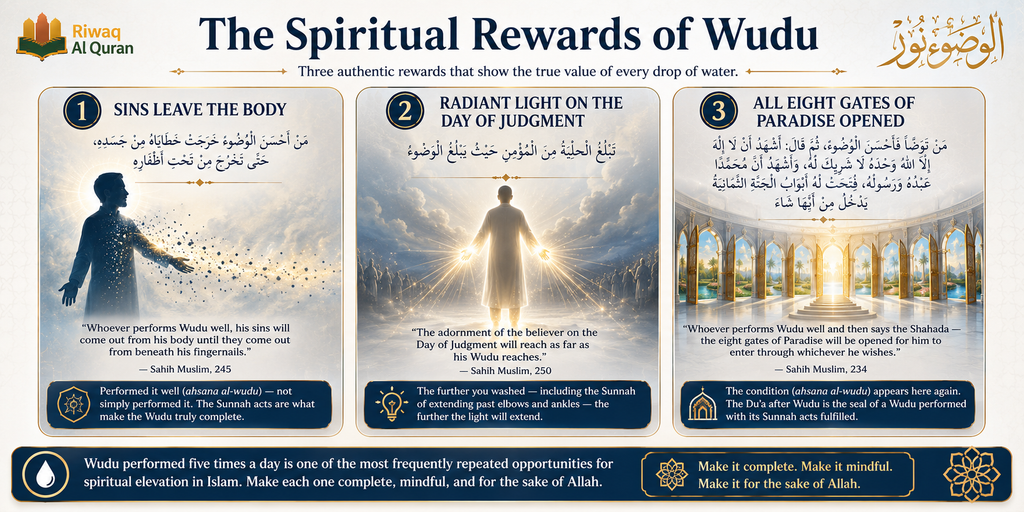
Before covering the Sunnah acts, it is worth understanding why Wudu carries such weight in Islamic practice. Most people perform it as a mechanical prerequisite for prayer. These three authenticated hadiths reframe what Wudu actually is.
1. Sins Leave the Body
The first reward addresses what Wudu removes — not visible dirt, but something the eye can’t see at all.
“مَنْ أَحْسَنَ الْوُضُوءَ خَرَجَتْ خَطَايَاهُ مِنْ جَسَدِهِ، حَتَّى تَخْرُجَ مِنْ تَحْتِ أَظْفَارِهِ“
“Whoever performs Wudu well, his sins will come out from his body until they come out from beneath his fingernails.” — Sahih Muslim, Hadith 245
The hadith specifies ahsana al-wudu — performed it well, not simply performed it. This is the textual basis for why the Sunnah acts matter: they are what transforms a minimum wash into a well-performed one. The imagery of sins exiting from beneath the fingernails points to the extreme thoroughness the Prophet ﷺ intended.
2. Radiant Light on the Day of Judgment
The second reward extends beyond this life entirely, tying a physical act performed today to something visible on a day far in the future.
“تَبْلُغُ الْحِلْيَةُ مِنَ الْمُؤْمِنِ حَيْثُ يَبْلُغُ الْوَضُوءُ“
“The adornment of the believer on the Day of Judgment will reach as far as his Wudu reaches.” — Sahih Muslim, Hadith 250
Scholars explain this as the light radiating from the washed limbs of believers on the Day of Resurrection. The further a person washed — including the Sunnah of extending slightly past the elbows and ankles — the further that light extends. This transforms what seems like a minor procedural detail into an act with eternal visible consequence.
3. All Eight Gates of Paradise Opened
The third reward shows that Wudu’s value isn’t sealed by the washing alone — it depends on what’s said immediately after.
“مَنْ تَوَضَّأَ فَأَحْسَنَ الْوُضُوءَ، ثُمَّ قَالَ: أَشْهَدُ أَنْ لَا إِلَٰهَ إِلَّا اللَّهُ وَحْدَهُ لَا شَرِيكَ لَهُ، وَأَشْهَدُ أَنَّ مُحَمَّدًا عَبْدُهُ وَرَسُولُهُ، فُتِحَتْ لَهُ أَبْوَابُ الْجَنَّةِ الثَّمَانِيَةُ يَدْخُلُ مِنْ أَيِّهَا شَاءَ“
“Whoever performs Wudu well and then says the Shahada — the eight gates of Paradise will be opened for him to enter through whichever he wishes.” — Sahih Muslim, Hadith 234
The condition ahsana al-wudu appears here again. The Du’a after Wudu is not a standalone reward that comes regardless of how the Wudu was done — it is the seal of a Wudu performed with its Sunnah acts fulfilled. Wudu performed five times a day makes this one of the most frequently repeated opportunities for spiritual elevation in Islam.
The 6 Pillars of Wudu — Established by Quran and Sunnah
The Pillars of Wudu are the six acts that are obligatory for ablution to count. Omitting any single one — whether out of forgetfulness, negligence, or incorrect performance — invalidates the Wudu, and any Salah performed with it must be repeated.
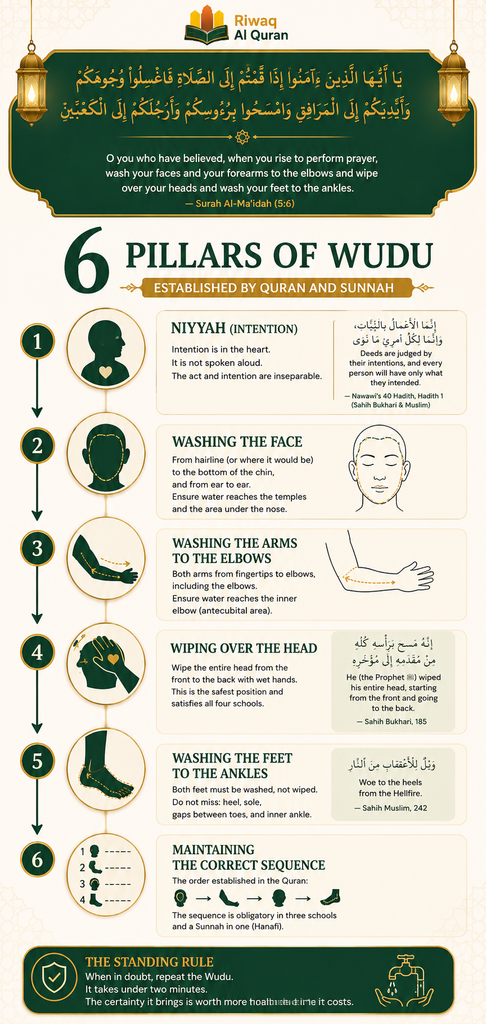
The primary Quranic foundation for four of the six Pillars comes from one verse:
“يَا أَيُّهَا الَّذِينَ آمَنُوا إِذَا قُمْتُمْ إِلَى الصَّلَاةِ فَاغْسِلُوا وُجُوهَكُمْ وَأَيْدِيَكُمْ إِلَى الْمَرَافِقِ وَامْسَحُوا بِرُءُوسِكُمْ وَأَرْجُلَكُمْ إِلَى الْكَعْبَيْنِ“
“O you who have believed, when you rise to perform prayer, wash your faces and your forearms to the elbows and wipe over your heads and wash your feet to the ankles.” — Surah Al-Ma’idah (5:6)
Four actions are commanded directly: wash the face, wash the arms to the elbows, wipe the head, and wash the feet to the ankles. In Arabic grammar, the feet are grammatically coupled with the face and hands — both in the accusative case indicating washing — rather than with the head, which is wiped.
This grammatical structure is the basis for the unanimous ruling that the feet must be washed, not wiped. The remaining two Pillars — Intention and Sequence — are established by the Sunnah and scholarly consensus.
1. Intention (Niyyah)
Before any physical action begins, Wudu depends on something unseen — the intention behind it. Without this, the washing that follows is just washing, not worship.
“إِنَّمَا الْأَعْمَالُ بِالنِّيَّاتِ، وَإِنَّمَا لِكُلِّ امْرِئٍ مَا نَوَى“
“Deeds are judged by their intentions, and every person will have only what they intended.” — Nawawi’s 40 Hadith, Hadith 1 | Sahih Bukhari and Muslim
Key points about the intention:
- Niyyah is an act of the heart — it is not spoken aloud.
- Saying “nawaitu an atawadda’…” verbally before Wudu is not established from the Prophet ﷺ or his Companions.
- A person who washes their face purely for hygiene, with no intention of Wudu, has not performed the Pillar.
- The act and the intention are inseparable in Wudu — one without the other fulfills neither the legal nor the spiritual purpose.
2. Washing the Face
The face is defined by all four Madhabs as:
- Vertical: from the beginning of the forehead’s hairline (not affected by baldness) to the bottom of the chin.
- Horizontal: from the right ear to the left ear.
Practical method and common mistake:
- Gather water in cupped palms, pour it onto the face, and wipe from the hairline downward.
- Ensure water reaches the temples and the area under the nose — two spots frequently missed in a rushed wash.
- For a bald person, the boundary extends to where the hairline would normally begin, not only to the exposed skin.
3. Washing the Hands and Arms to the Elbows
Both arms — from fingertips to elbows, with the elbows themselves included — must be fully covered with water. Key rulings:
- The verse’s phrasing ila al-marafiq (“to the elbows”) is interpreted by all four Madhabs as inclusive of the elbows.
- The direction of washing does not matter — from fingertips to elbow or elbow to fingertips — as long as water covers the full area.
- The inner fold of the elbow (the antecubital area) is a commonly missed spot; it must be explicitly covered.
4. Wiping Over the Head
The head marks a shift in the ritual itself — where washing gives way to wiping, a distinction the Quran makes deliberately rather than by coincidence.
Wiping (Mash) and washing (Ghasl) are legally distinct acts. The Quran commands wiping for the head — not washing. Wiping means passing a wet hand over the area without running water.
“إِنَّهُ ﷺ مَسَحَ بِرَأْسِهِ كُلِّهِ مِنْ مُقَدَّمِهِ إِلَى مُؤَخَّرِهِ“
“He (the Prophet ﷺ) wiped his entire head, starting from the front and going to the back.” — Sahih Bukhari, Hadith 185
Madhab positions on the extent of wiping:
- Maliki and Hanbali: Wiping the entire head is obligatory.
- Shafi’i and Hanafi: Wiping any part of the head fulfills the minimum Pillar.
- Safest position: A full front-to-back wipe takes five seconds and satisfies all four schools simultaneously — this is the stronger and practically easier choice.
5. Washing the Feet to the Ankles
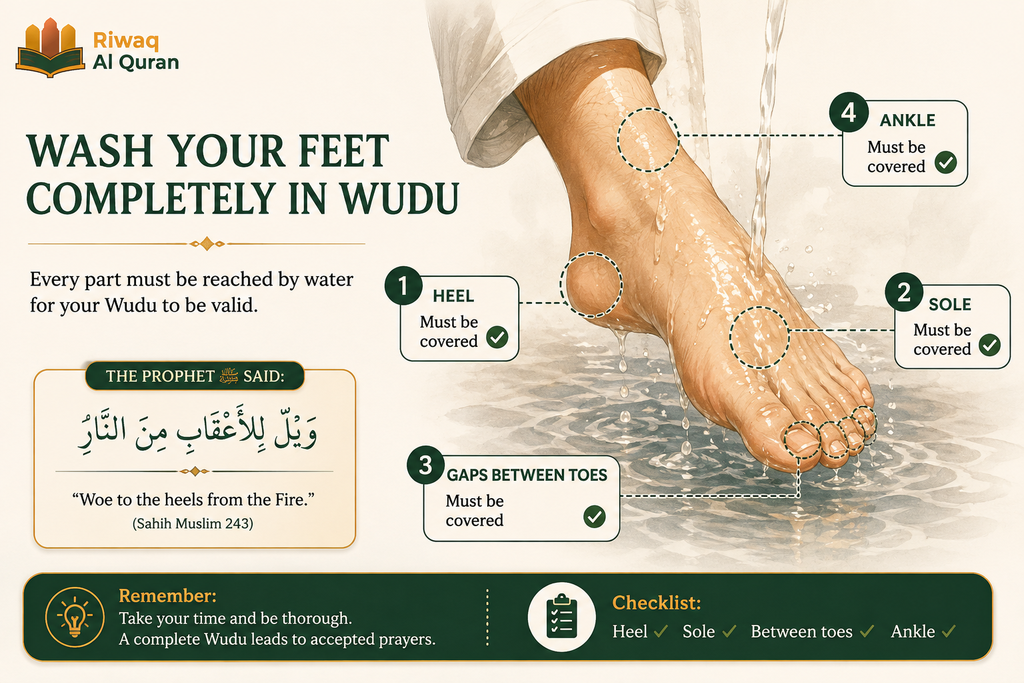
Wudu closes where it’s most often rushed — and where the Prophet ﷺ gave one of his sharpest warnings about the cost of . carelessness.Both feet must be washed — not wiped. The Prophet ﷺ made the consequence of missing a specific area explicit:
“وَيْلٌ لِلْأَعْقَابِ مِنَ النَّارِ“
“Woe to the heels from the Hellfire.” — Sahih Muslim, Hadith 242
This warning was said when the Prophet ﷺ saw men leaving the backs of their heels dry in a hurried Wudu. The four areas most commonly under-washed:
- The heel (back of the foot)
- The sole
- The gaps between the toes
- The inner ankle
For those who wear socks, a separate ruling applies — learn about performing Wudu over socks and the conditions under which it is valid.
6. Maintaining the Correct Sequence
Wudu must be performed in the order the Quran establishes: face → arms → head → feet. Key positions:
- Shafi’i, Hanbali, and Maliki: The Quranic sequence is obligatory for validity.
- Hanafi: The sequence is a Sunnah — Wudu performed out of order is valid, though a Sunnah was missed.
- Most evidenced position: There is no narration in which the Prophet ﷺ performed Wudu in any order other than the Quranic sequence. Following it places a person safely within the agreement of three of four major schools.
Understanding the fiqh behind acts of worship — the exact ruling for each step, and how to apply it to real situations — is precisely what a structured Islamic Studies course covers.
At Riwaq Al Quran, certified scholars teach Fiqh al-Ibadat live, one-on-one, for all levels. You can also pair this knowledge with Quran recitation through our Online Quran Recitation Course or begin at the foundations with Noorani Qaida Online.
Does This Mistake Invalidate My Wudu?
The question “did I perform valid Wudu?” is one most people cannot answer with confidence, and most articles do not address directly. The following framework gives a reliable answer for the most common situations.
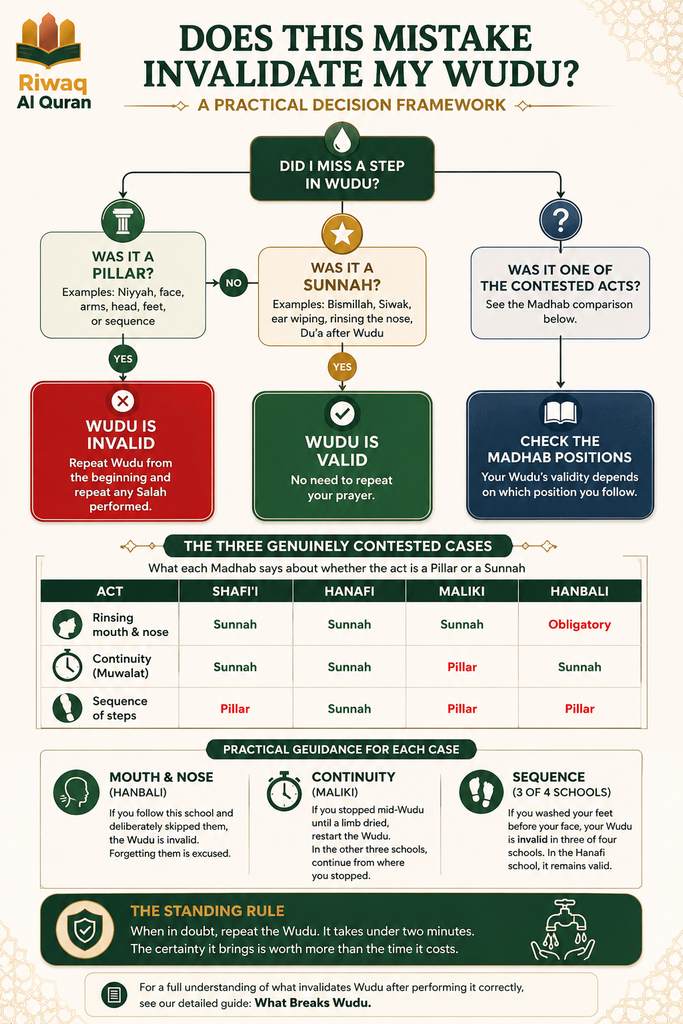
The primary question to ask yourself:
Is the step I missed a Pillar or a Sunnah?
- If it was a Pillar — Niyyah, face, arms, head, feet, or sequence — the Wudu is invalid. Stop, perform Wudu again from the beginning, and repeat any Salah performed with the invalid Wudu.
- If it was a Sunnah — Bismillah, Siwak, ear wiping, rinsing the nose, the Du’a after — the Wudu is valid. Do not repeat the prayer.
The three genuinely contested cases — what each Madhab says:
The following table covers the acts where the four Madhabs disagree on whether the step is a Pillar or a Sunnah. What you do if you miss these depends on which position you follow.
The table below provides a quick-reference summary of the contested positions:
| Act | Shafi’i | Hanafi | Maliki | Hanbali |
| Rinsing mouth & nose | Sunnah | Sunnah | Sunnah | Obligatory |
| Continuity (Muwalat) | Sunnah | Sunnah | Pillar | Sunnah |
| Sequence of steps | Pillar | Sunnah | Pillar | Pillar |
Practical guidance for each:
- Mouth and nose (Hanbali): If you follow this school and deliberately skipped them, the Wudu is invalid. Forgetting them is excused.
- Continuity (Maliki): If you stopped mid-Wudu until a limb dried, restart the Wudu. In the other three schools, continue from where you stopped.
- Sequence: If you washed your feet before your face, your Wudu is invalid in three of four schools. In the Hanafi school, it remains valid.
The standing rule: When in doubt, repeat the Wudu. It takes under two minutes. The certainty it brings is worth more than the time it costs. For a full understanding of what invalidates Wudu after performing it correctly, see our detailed guide on what breaks Wudu.
Start Learning Quran and Islamic Studies with Certified Scholars
The sunnah of wudu is one part of a complete Islamic education. Riwaq Al Quran is a comprehensive online platform offering personalized Quran, Arabic, and Islamic Studies classes for individuals of all ages and backgrounds.
Experienced instructors use a structured curriculum to cover Tajweed, Tafsir, and Memorization — making access to authentic Islamic learning accessible, flexible, and effective for both children and adults.
Watch real moments from our live sessions at Riwaq Al Quran and see how we bring learning to life:
Explore our specialized Quran courses:
- Online Tafseer Course — explore the meanings and interpretation of the Quran with scholarly guidance
- Noorani Qaida Online — build a strong Quran-reading foundation from the very basics
- Online Quran Recitation Course — improve your recitation with expert-led classes
- Online Tajweed Classes — master Tajweed rules for accurate and beautiful Quranic recitation
- Quran Memorization Online Course — memorize the Quran with a proven, structured method
- Online Qirat Course — explore the diverse recitation styles of the Quran
- Online Quran Classes for Kids — build a love of the Quran in children through interactive, age-appropriate learning
Conclusion
Wudu has two layers, and understanding both is what separates a conscious act of worship from a mechanical habit. The six Pillars are the legal framework — leave one out and the Wudu does not count. The 17 Sunnah acts are the spiritual and practical completion of that framework — they are how the Prophet ﷺ actually performed his ablution, every detail deliberate and evidenced.
The sunnah of wudu is not a secondary concern. It is the difference between a sin-erasing, Paradise-gate-opening act of purification and a minimum-compliance wash. The Prophet ﷺ said sins come out from under the fingernails when Wudu is performed well — and “well” means the Sunnah acts are present. It means the Bismillah is said, the water is used with care, the right side precedes the left, and the Du’a is recited at the end.
Once the Wudu is complete, the next question becomes: what preserves it and what breaks it? For a full guide on the acts that nullify Wudu, see What Breaks Wudu? — Full Guide.
Perform Wudu as the Prophet ﷺ performed it — with awareness of every act’s weight — and it becomes one of the most accessible and repeatedly rewarding forms of worship in a Muslim’s day.
Frequently Asked Questions
The questions below address the most common points of confusion about the Sunnah and Pillars of Wudu. Each answer is written to give you a direct, applicable ruling — not a general overview.
What is the difference between the Sunnah and Pillars of Wudu?
The six Pillars — intention, washing the face, washing the arms to the elbows, wiping the head, washing the feet to the ankles, and maintaining the Quranic sequence — are obligatory acts. Omitting any one of them invalidates Wudu. The 17 Sunnah acts are the recommended practices of the Prophet ﷺ — omitting them does not invalidate Wudu but reduces its reward and spiritual completeness.
Does forgetting Bismillah invalidate Wudu?
No. Bismillah is a Sunnah — important and rewarded, but not among the six Pillars. Wudu remains valid without it. The Hanbali Madhab considers it obligatory when remembered; even within that school, most scholars hold that Wudu performed without Bismillah is still legally valid.
How many times should each limb be washed in Wudu?
Washing once is the obligatory minimum. Washing twice is recommended. Washing three times is the established Sunnah and the maximum the Prophet ﷺ ever performed. Washing more than three times is explicitly prohibited — the Prophet ﷺ called it wrongdoing — and carries no additional reward. Sunan Abu Dawud, Hadith 135
Is the sequence of Wudu steps obligatory?
Three of the four major Madhabs — Shafi’i, Hanbali, and Maliki — hold the Quranic sequence (face → arms → head → feet) to be obligatory for validity. The Hanafi Madhab considers it a Sunnah. Following the Quranic order in every Wudu is the safest and most evidenced position.
What should I say after completing Wudu?
After completing Wudu, recite:
“أَشْهَدُ أَنْ لَا إِلَٰهَ إِلَّا اللَّهُ وَحْدَهُ لَا شَرِيكَ لَهُ، وَأَشْهَدُ أَنَّ مُحَمَّدًا عَبْدُهُ وَرَسُولُهُ““I bear witness that there is no deity worthy of worship except Allah alone, with no partner, and I bear witness that Muhammad is His servant and Messenger.”
You may add: اللَّهُمَّ اجْعَلْنِي مِنَ التَّوَّابِينَ وَاجْعَلْنِي مِنَ الْمُتَطَهِّرِينَ — as narrated in Sunan al-Tirmidhi, Hadith 55. The Prophet ﷺ said whoever says the Shahada after Wudu will have all eight gates of Paradise opened. Sahih Muslim, Hadith 234
Does wiping only part of the head fulfill the Pillar?
This is a genuine scholarly disagreement. The Shafi’i and Hanafi Madhabs hold that wiping any part of the head fulfills the minimum Pillar. The Maliki and Hanbali Madhabs require wiping the entire head. Every narrated description of the Prophet’s ﷺ Wudu records a full head wipe — making the complete wipe the stronger and safer practice regardless of Madhab.
What are the three main spiritual rewards of Wudu?
Three major rewards are established in authentic narrations:
Sins leave the body and come out from beneath the fingernails when Wudu is performed well. Muslim, Hadith 245
Radiant light extends from the washed limbs on the Day of Judgment, reaching as far as the Wudu reached. Muslim, Hadith 250
All eight gates of Paradise are opened for the one who says the Shahada after completing Wudu well. Muslim, Hadith 234
Sources:
Sahih Bukhari · Sahih Muslim · Sunan Abu Dawud · Sunan al-Tirmidhi · Sunan al-Nasa’i · Sunan Ibn Majah · Nawawi’s 40 Hadith · Quran: quran.com · Fiqh references: al-Majmu’ (al-Nawawi) · al-Mughni (Ibn Qudama) · Hashiyat al-Dusuqi