Reading the Quran is the most direct conversation a Muslim can have with their Creator. Every single letter earns a reward. Every study session calls down angels. Every hour spent with the Book of Allah is an investment that pays dividends not just in this life, but on the Day of Judgment — when you will need every advocate you can get.
Most Muslims know the benefits of reading the Quran in general terms. The question that actually moves people is: how much? What exactly did the Prophet ﷺ promise? What does consistent Quran reading earn? And what separates the person the Quran intercedes for from the person it testifies against?
The answer lies in these ten authenticated hadiths — each transmitted through verified chains of narration, graded by leading Islamic scholars, and drawn from the most trusted hadith collections in history.
The following hadiths are authenticated across the six major collections. Each one reveals a different dimension of what it means to have a living relationship with the Book of Allah — and together, they form a complete picture that no single hadith captures alone.
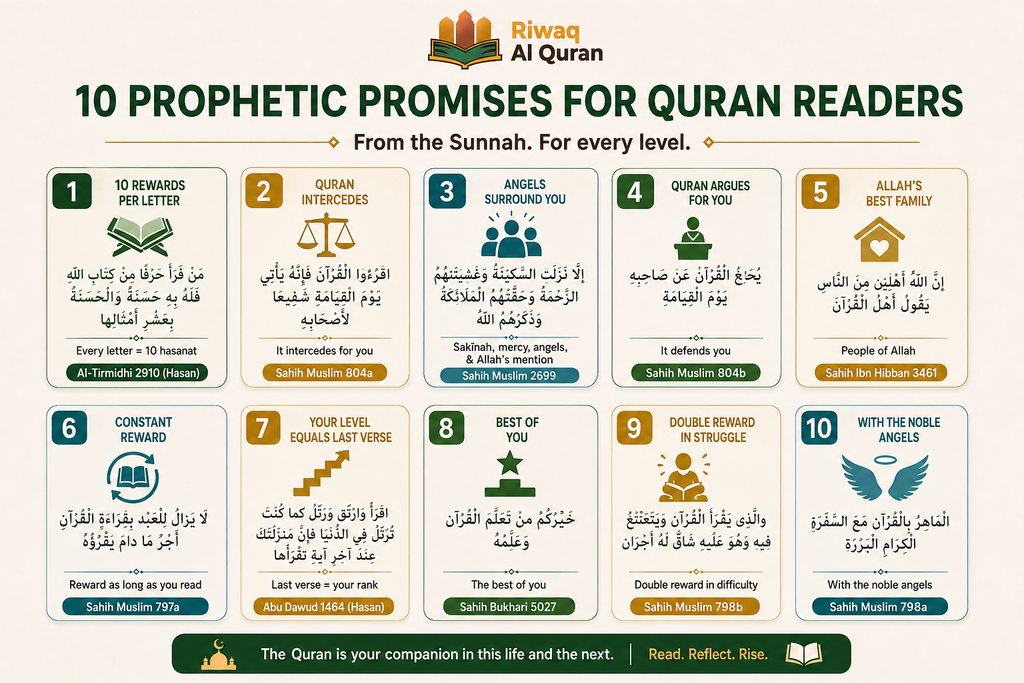
Table of Contents
1. Every Letter You Read Earns 10 Good Deeds
One of the most motivating truths in the entire Sunnah about Quran recitation comes from a single hadith that reframes how a Muslim should think about every moment spent with the Quran. The Prophet ﷺ said:
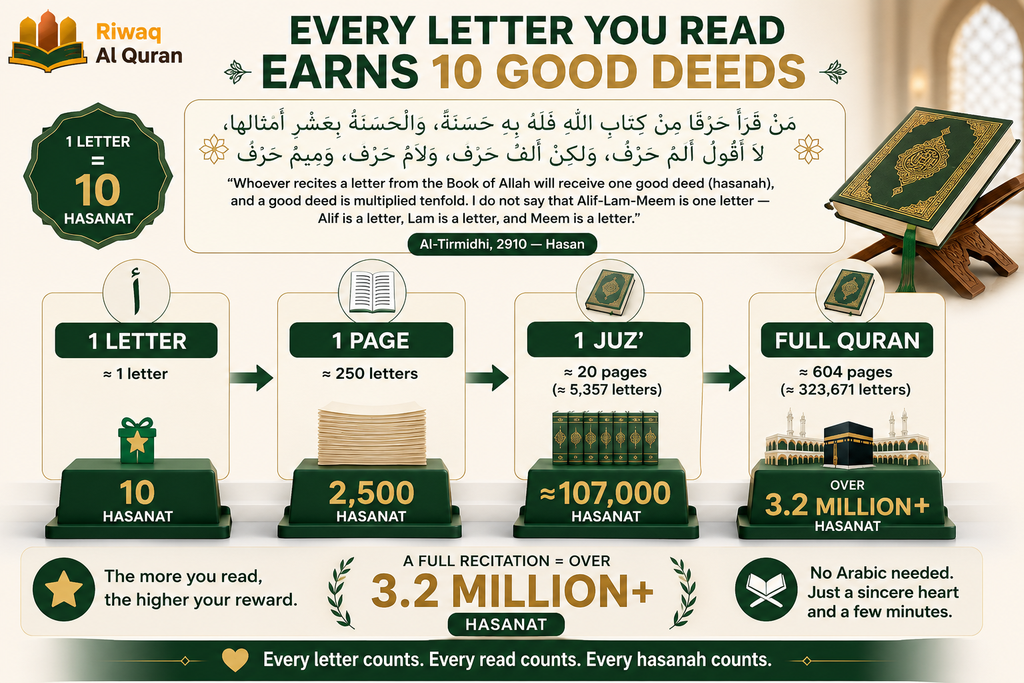
«مَنْ قَرَأَ حَرْفًا مِنْ كِتَابِ اللَّهِ فَلَهُ بِهِ حَسَنَةٌ، وَالْحَسَنَةُ بِعَشْرِ أَمْثَالِهَا، لَا أَقُولُ آلم حَرْفٌ، وَلَكِنْ أَلِفٌ حَرْفٌ، وَلَامٌ حَرْفٌ، وَمِيمٌ حَرْفٌ»
“Whoever recites a letter from the Book of Allah will receive one good deed (hasanah), and a good deed is multiplied tenfold. I do not say that Alif-Lam-Meem is one letter — Alif is a letter, Lam is a letter, and Meem is a letter.” — Al-Tirmidhi, 2910 — Hasan
The most widely cited hadith about reading the Quran contains a detail most people overlook entirely. The Prophet ﷺ was not making a general statement — he was correcting a specific misunderstanding by using the example of Alif-Lam-Meem, the mysterious letters that open Surah Al-Baqarah, to demonstrate that even letters whose meaning is known only to Allah count individually and completely.
The practical scale of this reward is extraordinary:
- 1 letter = a minimum of 10 hasanat.
- 1 average page (≈250 letters) = a minimum of 2,500 hasanat.
- 1 juz’ (one of 30 parts) = approximately 107,000 hasanat.
- A full Quran recitation (≈323,671 letters) = over 3.2 million hasanat.
This reward structure does not require fluency, memorization, or a minimum amount of time. It applies to a beginner sounding out individual letters just as much as it applies to a hafiz reciting from memory.
The only condition is sincerity and the act of reading itself — making the Quran one of the most accessible and consistently rewarded acts a Muslim can perform at any stage of life.
No other act of worship in Islam comes with this precise, letter-by-letter accounting — and no knowledge of Arabic is required to access it.
2. The Quran Intercedes for Its Companions on the Day of Judgment
Most Muslims are familiar with the concept of intercession on the Day of Judgment. What is less often appreciated is that the Quran itself — not only scholars or righteous people — is described in the Sunnah as an active intercessor. The Prophet ﷺ said:
«اقْرَءُوا الْقُرْآنَ فَإِنَّهُ يَأْتِي يَوْمَ الْقِيَامَةِ شَفِيعًا لِأَصْحَابِهِ»
“Read the Quran, for it will come on the Day of Resurrection as an intercessor (shafi’) for its companions.” — Sahih Muslim, 804a
The word shafi’ (شَفِيع) carries a specific legal meaning: someone who stands before a judge and presents a case on another’s behalf. On the Day of Judgment, the Quran does not merely sit on your scale of deeds — it actively argues, pleads, and advocates for you before Allah.
The key condition is the word “companions” (أَصْحَابُهُ). In Arabic, sahib denotes an ongoing relationship — the same word used for the Companions of the Prophet ﷺ, people who were in his continuous company. The Quran’s intercession belongs to those who kept its company consistently — not those who opened it twice a year.
The nature of this companionship is not passive. Allah describes the Quran itself as something that demands a certain quality of relationship from the one who approaches it. He says in Surah Al-Waqia:
﴿إِنَّهُ لَقُرْآنٌ كَرِيمٌ فِي كِتَابٍ مَّكْنُونٍ لَّا يَمَسُّهُ إِلَّا الْمُطَهَّرُونَ﴾
“Indeed, it is a noble Quran, in a well-protected Book. None can touch it except the purified.” — (Surah Al-Waqia, 56:77–79)
Building a consistent relationship with the Quran does not require completing it in a set number of days. What it requires is regularity — returning to it daily, even briefly, so that the relationship never fully breaks.
Scholars of Tajweed note that maintaining a daily wird (a regular personal recitation portion) is the practice that separates the occasional reader from the genuine sahib.
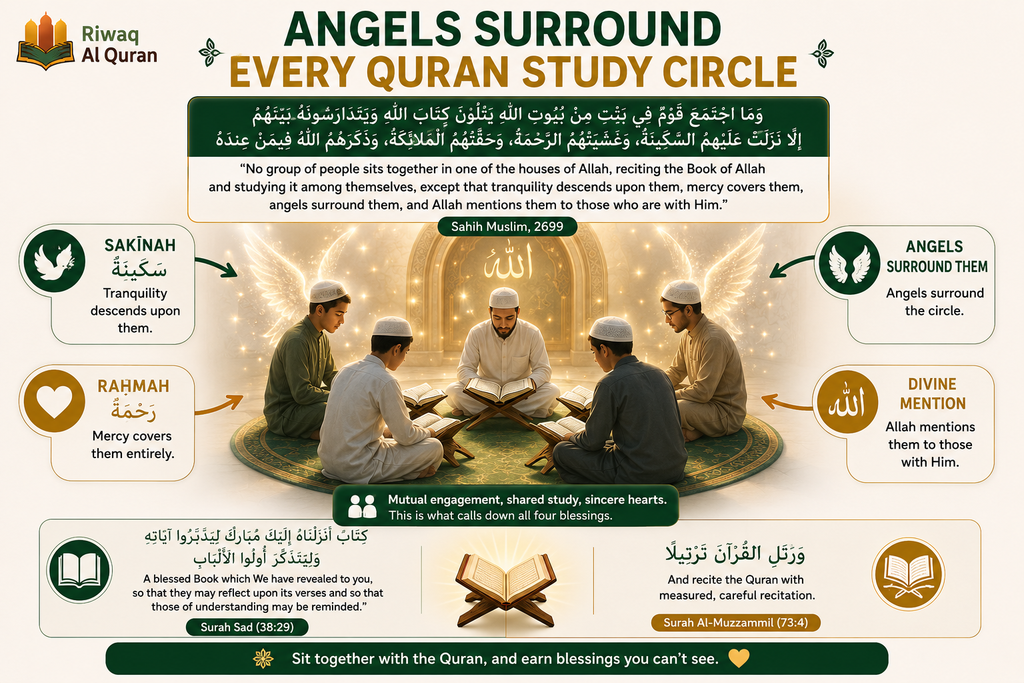
3. Angels Surround Every Quran Study Circle
The rewards of Quran recitation multiply when people gather with a shared intention to study it together. This is not metaphor or spiritual language — the Prophet ﷺ described what happens in precise, physical terms. He said:
«وَمَا اجْتَمَعَ قَوْمٌ فِي بَيْتٍ مِنْ بُيُوتِ اللَّهِ يَتْلُونَ كِتَابَ اللَّهِ وَيَتَدَارَسُونَهُ بَيْنَهُمْ إِلَّا نَزَلَتْ عَلَيْهِمُ السَّكِينَةُ، وَغَشِيَتْهُمُ الرَّحْمَةُ، وَحَفَّتْهُمُ الْمَلَائِكَةُ، وَذَكَرَهُمُ اللَّهُ فِيمَنْ عِنْدَهُ»
“No group of people sits together in one of the houses of Allah, reciting the Book of Allah and studying it among themselves, except that tranquility (sakīnah) descends upon them, mercy (rahmah) covers them, angels surround them, and Allah mentions them to those who are with Him.” — Sahih Muslim, 2699
Any sincere Quran study circle receives four simultaneous blessings — with no minimum knowledge level required, no certified scholar needed to lead, and no minimum number of participants. The four blessings are:
- Sakīnah (سَكِينَة) — tranquility that descends upon the group.
- Rahmah (رَحْمَة) — mercy that covers them entirely.
- Angelic presence — the angels surround the circle.
- Divine mention — Allah mentions them by name before those with Him.
The verb yatadarasunahu (يَتَدَارَسُونَهُ) means mutual engagement — passing the text between each other, studying it together — not one person reciting while others passively listen. Active, shared study is what calls down all four blessings simultaneously.
The instruction to reflect rather than simply recite is not a recommendation — it is a Quranic command. Allah describes the purpose of the Quran’s revelation in Surah Sad:
﴿كِتَابٌ أَنزَلْنَاهُ إِلَيْكَ مُبَارَكٌ لِّيَدَّبَّرُوا آيَاتِهِ وَلِيَتَذَكَّرَ أُولُو الْأَلْبَابِ﴾
“A blessed Book which We have revealed to you, so that they may reflect upon its verses and so that those of understanding may be reminded.” — (Surah Sad, 38:29)
And He gives the practical method for how this reflection should unfold during recitation. In Surah Al-Muzzammil, Allah tells the Prophet ﷺ directly:
﴿وَرَتِّلِ الْقُرْآنَ تَرْتِيلًا﴾
“And recite the Quran with measured, careful recitation.” — (Surah Al-Muzzammil, 73:4)
Tartil is not fast, performative recitation — it is word-by-word deliberateness that allows genuine reflection, exactly the spirit of a study circle.
A Quran study circle does not need to be large or formally organized. Two people sitting together to recite and discuss a passage — sharing observations, correcting each other’s pronunciation, asking what a verse means — qualifies completely.
The four blessings described in this hadith descend on every gathering that meets this standard, regardless of size, location, or how much Quran the participants already know.
4. The Quran Is an Argument — For You or Against You
There is a statement in the Sunnah about the Quran that carries more weight than almost any other — and it is one of the least discussed. It appears in a longer hadith about the foundations of Islam, where the Prophet ﷺ says directly:
«وَالْقُرْآنُ حُجَّةٌ لَكَ أَوْ عَلَيْكَ»
“And the Quran is an argument either for you or against you.” — Sahih Muslim, 223
This is the most sobering statement the Prophet ﷺ ever made about the Quran — and the most consistently underexplained. Reading the Quran is not a neutral act that automatically lands in your favor. It generates a hujjah — a legal proof, a piece of evidence that will be presented on the Day of Judgment. That evidence goes one of two ways.
The Quran argues FOR you when you:
- Read with the sincere intention to understand.
- Reflect on its meaning during and after recitation.
- Implement its commands in your daily decisions.
- Allow it to shape your character and conduct over time.
The Quran argues AGAINST you when you:
- Recite mechanically without reflection or understanding.
- Know its rulings but consistently choose to ignore them.
- Treat it as ritual while contradicting its values in daily life.
Allah illustrated the danger of carrying the Quran without engaging with it through one of the most striking comparisons in the entire Quran. Addressing those who were entrusted with divine scripture but failed to live by it, He says in Surah Al-Jumu’ah:
﴿مَثَلُ الَّذِينَ حُمِّلُوا التَّوْرَاةَ ثُمَّ لَمْ يَحْمِلُوهَا كَمَثَلِ الْحِمَارِ يَحْمِلُ أَسْفَارًا ۚ بِئْسَ مَثَلُ الْقَوْمِ الَّذِينَ كَذَّبُوا بِآيَاتِ اللَّهِ﴾
“The likeness of those who were entrusted with the Torah but did not carry it is that of a donkey carrying volumes of books. How wretched is the example of the people who deny the signs of Allah.” — (Surah Al-Jumu’ah, 62:5)
The standard implied by this hadith is not perfection. It is direction — a consistent, sincere effort to understand, reflect, and apply. A Muslim who reads the Quran while genuinely trying to act on what they understand is building a hujjah in their favor, even if their knowledge is incomplete. The danger lies not in imperfect understanding, but in deliberate detachment from what is already understood.
A donkey gains nothing from the weight on its back. The Quran transforms the person who carries it with understanding and obedience. Without both elements, the recitation accumulates — in the wrong column.
5. The People of the Quran Are the People of Allah
In a tradition recorded by Ibn Majah, the Prophet ﷺ made one of the most direct and personal statements about the status of those who give their lives to the Quran. The hadith opens with a statement that surprised even the Companions:
«إِنَّ لِلَّهِ أَهْلِينَ مِنَ النَّاسِ» قِيلَ: مَنْ هُمْ يَا رَسُولَ اللَّهِ؟ قَالَ: «هُمْ أَهْلُ الْقُرْآنِ، أَهْلُ اللَّهِ وَخَاصَّتُهُ»
“Indeed, Allah has His own people among mankind.” They asked: “Who are they, O Messenger of Allah?” He said: “They are the people of the Quran — the people of Allah and His closest ones.” — Ibn Majah, 215 — Hasan
Note the full exchange in this hadith: the Companions asked in genuine surprise. The Prophet’s ﷺ answer confirmed what they perhaps dared not assume — the highest human distinction before Allah is not prophethood (which is sealed), nor wealth, nor political power, nor conventional scholarship. It is the Quran relationship. Two Arabic terms define that distinction:
- Ahl Allah (أَهْلُ اللهِ) — implies family-level closeness, people who belong to a household.
- Khassatuhu (خَاصَّتُهُ) — His intimate circle, those He singles out as closest.
These are people who made the Quran their home: the first thing they turned to in difficulty, the standard they measured decisions against, the companion they never went long without.
This is not a conditional honor reserved for scholars or the memorized. Allah extends it to anyone who maintains a living, active engagement with the Quran, as He says in Surah Fatir:
﴿إِنَّ الَّذِينَ يَتْلُونَ كِتَابَ اللَّهِ وَأَقَامُوا الصَّلَاةَ وَأَنفَقُوا مِمَّا رَزَقْنَاهُمْ سِرًّا وَعَلَانِيَةً يَرْجُونَ تِجَارَةً لَّن تَبُورَ﴾
“Indeed, those who recite the Book of Allah, establish prayer, and spend from what We have provided — secretly and publicly — are hoping for a transaction that will never fail.” — (Surah Fatir, 35:29)
The investment described in this verse — recitation, prayer, and giving — are three actions any Muslim can perform regardless of level or background.
The promise attached to them, tijarah lan taboor, a transaction that will never fail, is one of the most direct divine guarantees in the Quran. It applies to the student in their first month of learning to read as much as it applies to the scholar who has memorized every word.
6. Read Together in Unity, Not in Dispute
The Prophet ﷺ gave precise guidance on the ethics of communal Quran recitation — guidance that is rarely quoted but describes a failure mode that occurs in nearly every serious study circle. He said:
«اقْرَءُوا الْقُرْآنَ مَا ائْتَلَفَتْ عَلَيْهِ قُلُوبُكُمْ، فَإِذَا اخْتَلَفْتُمْ فَقُومُوا عَنْهُ»
“Read the Quran as long as your hearts are in agreement about it. When you dispute, then stand up and leave it.” — Sahih Bukhari, 7364
The phrase i’talafat alayhi qulubukum — “your hearts are in agreement about it” — uses the Arabic i’tilaf, meaning harmony and unity of purpose. The Prophet ﷺ is not prohibiting scholarly disagreement — the history of Islamic jurisprudence is built on respectful scholarly difference. He is prohibiting something more destructive: the ego corrupting the sacred space of Quran study. The three-step rule embedded in this hadith is clear:
- When a gathering is seeking Allah’s guidance together — continue.
- When the Quran becomes a battleground for personal positions — stop.
- When sincerity is restored and hearts are aligned again — return.
The practical rule for any Quran circle is this: the moment someone is defending their opinion rather than seeking guidance, that is the signal to pause, re-set the intention, and resume only when the hearts have returned to unity.
This hadith also answers a question many learners face: what to do when a Quran session becomes tense, competitive, or dominated by a single voice insisting on a single position. The answer is not to push through or to win the argument — it is to pause.
The Quran deserves to be approached with a united heart, and no lesson learned in a spirit of conflict carries the same weight as one received in sincerity. When the intention is reset and the atmosphere is restored, the study circle resumes with full blessing.
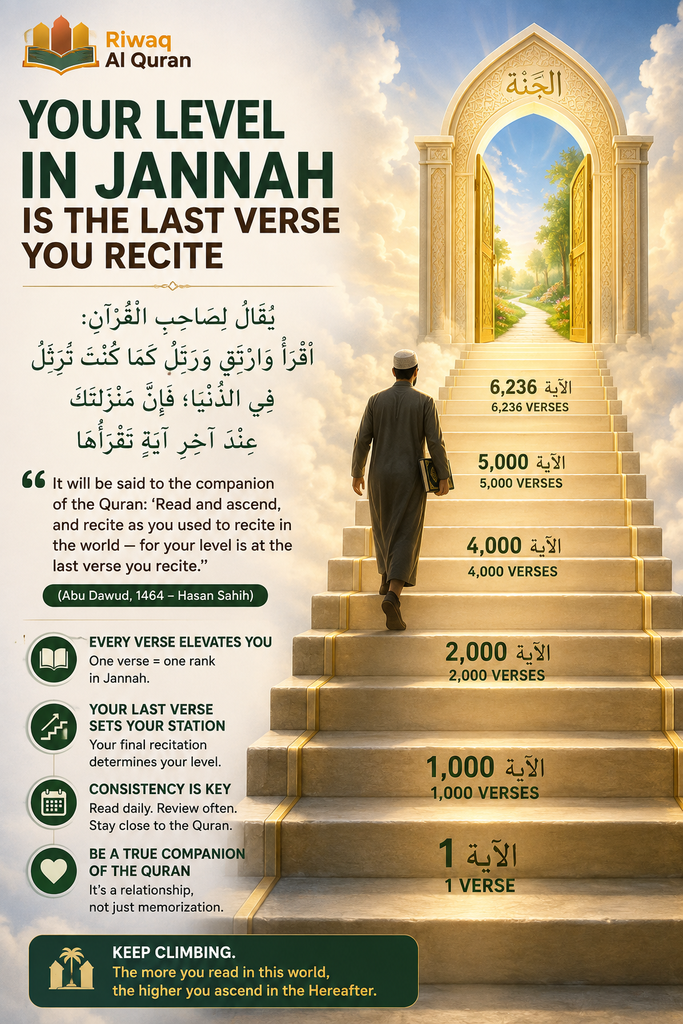
7. Your Level in Jannah Is the Last Verse You Recite
One of the most personal descriptions of the Day of Judgment for a Quran reader appears in a hadith that connects every verse a person recites in this world directly to their eternal station in the next. The Prophet ﷺ said:
«يُقَالُ لِصَاحِبِ الْقُرْآنِ: اقْرَأْ وَارْتَقِ وَرَتِّلْ كَمَا كُنْتَ تُرَتِّلُ فِي الدُّنْيَا؛ فَإِنَّ مَنْزِلَتَكَ عِنْدَ آخِرِ آيَةٍ تَقْرَأُهَا»
“It will be said to the companion of the Quran: ‘Read and ascend, and recite as you used to recite in the world — for your level is at the last verse you recite.'” — Abu Dawud, 1464 — Hasan Sahih
This hadith describes one of the most personal honors of the Day of Judgment. Every person who made the Quran their companion will be invited to recite — not to be tested, but to be honored and elevated one rank with every verse:
- The final verse a person recites determines their eternal station in Jannah.
- Islamic scholars note that the levels of Jannah correspond to the 6,236 verses of the Quran.
- The more Quran a person carried and consistently recited in this world, the higher their ascent.
The title sahib al-Quran (صَاحِبُ الْقُرْآن) is built through a lifetime of consistent reading and review — not only through memorization. A person who reads regularly from the mushaf and maintains a living relationship with the text is a genuine sahib. The question is not whether you memorized everything; it is whether you stayed close.
This hadith reframes the entire question of how much Quran a person should aim to read. It is not about completing a reading plan or reaching a specific number — it is about how consistently a person stayed in the company of the Quran across their lifetime.
Every verse reviewed, every surah maintained, every page read in a quiet moment before sleep is, according to this hadith, a direct investment in what a person will be invited to recite on their most important day. The question is not how much you memorized — it is how much you stayed close.
8. The Best of You Learn and Teach the Quran
Among all the ways the Prophet ﷺ described excellence in a Muslim’s life, one statement stands above the rest in defining the highest rank specifically through the Quran. He said:
«خَيْرُكُمْ مَنْ تَعَلَّمَ الْقُرْآنَ وَعَلَّمَهُ»
“The best of you are those who learn the Quran and teach it.” — Sahih Bukhari, 5027
Khayrukum — “the best of you” — is a ranking. The Prophet ﷺ used this same construction to identify the best in specific, measurable terms. Here he assigns the highest rank to the person who both learns and teaches the Quran. As explored in The Best Amongst You, the dual requirement is precise:
- Learning alone is an incomplete trust — knowledge in Islam is always meant to be passed forward.
- Teaching alone, without ongoing personal study, becomes detached from its source over time.
- The combination creates a self-sustaining cycle that has preserved the Quran unchanged across 1,400 years.
The ijazah system — the chain of Quran transmission that connects every certified teacher back to the Prophet ﷺ — is the direct product of this hadith lived out across 1,400 years. Every person who completed their memorization under a certified teacher and received permission to teach others extended that chain by one link.
The system has never broken because each generation produced people who took both halves of this hadith seriously: learning with full commitment, and then teaching without holding back. Entering that chain today is possible for anyone willing to learn correctly and with patience.
Every qualified Quran teacher alive today holds a sanad — a chain of transmission traceable name by name back to the Prophet ﷺ. This is the ijazah system: the longest surviving, unbroken, verified educational chain in human history. Online Ijazah courses make it possible to enter this chain and continue it from anywhere in the world.
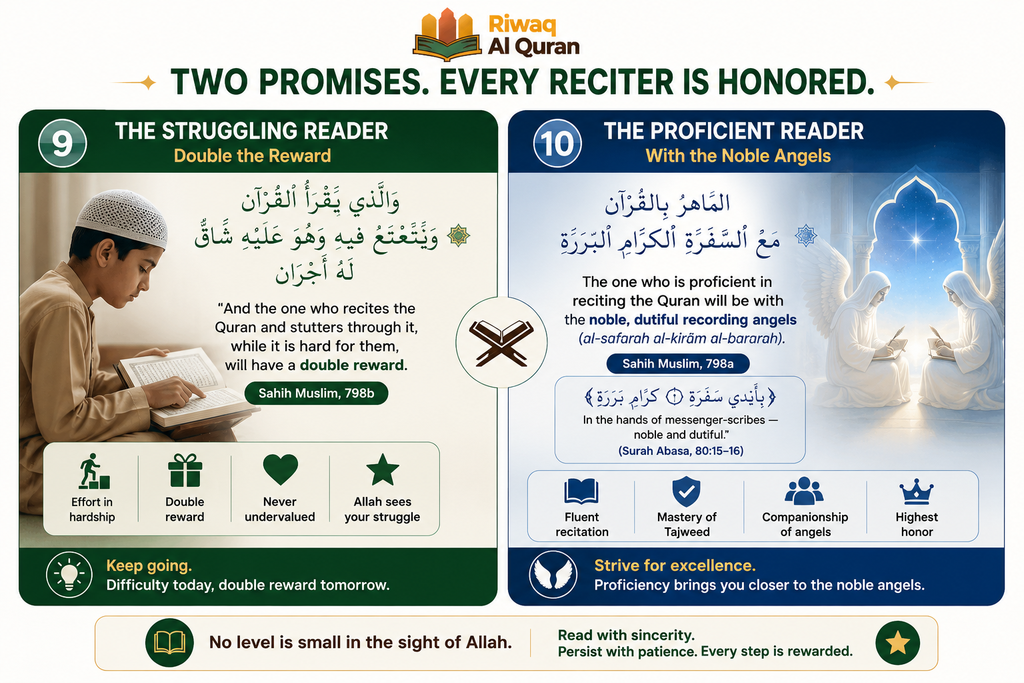
9. Double the Reward When Recitation Is Hard
The Prophet ﷺ addressed one of the most discouraging experiences a Quran learner faces — the feeling of struggling through recitation while others seem to read with ease. His response did not offer consolation alone. He assigned a specific, elevated reward to the difficulty itself. He said:
«وَالَّذِي يَقْرَأُ الْقُرْآنَ وَيَتَتَعْتَعُ فِيهِ وَهُوَ عَلَيْهِ شَاقٌّ لَهُ أَجْرَانِ»
“And the one who recites the Quran and stutters through it, while it is hard for them, will have a double reward.” — Sahih Muslim, 798b
The Arabic verb yatata’ta’u (يَتَتَعْتَعُ) describes a very specific physical experience: stumbling over words, hesitating, stopping and retrying. The Prophet ﷺ chose this honest, unglamorous description deliberately — to leave no room for anyone who struggles to feel they are in a lesser category. This hadith addresses directly:
- Beginners learning Arabic recitation from scratch.
- New Muslims navigating an unfamiliar script and language.
- Elderly readers whose fluency has declined with age.
- Anyone whose recitation is slow, imperfect, or frequently interrupted.
This hadith also addresses a common reason people delay beginning their Quran journey: the belief that they should wait until they can read more fluently before the effort counts. The Prophet ﷺ reversed that logic entirely. The struggle is not a sign that the recitation is less valuable — it is a sign that it is worth more.
Starting now, reading slowly, making mistakes and correcting them, is the exact path described in this hadith. The double reward does not come later, after fluency is achieved. It comes during the hardship itself.
Reading the Quran in Arabic even when it is difficult is one of the highest-rewarded forms of recitation described in the Sunnah. If you are at the very beginning, Noorani Qaida Online is designed specifically to build that foundation correctly from the first lesson.
10. The Proficient Reader Sits With the Noble Angels
For those who invest years in mastering their recitation — building fluency, accuracy, and full command of Tajweed — the Prophet ﷺ described a specific honor that awaits them. He said:
«الْمَاهِرُ بِالْقُرْآنِ مَعَ السَّفَرَةِ الْكِرَامِ الْبَرَرَةِ»
“The one who is proficient in reciting the Quran will be with the noble, dutiful recording angels (al-safarah al-kirām al-bararah).” — Sahih Muslim, 798a
The safarah al-kirām al-bararah are not angels mentioned only in hadith — they are named directly in the Quran. Allah describes them in Surah Abasa:
﴿بِأَيْدِي سَفَرَةٍ كِرَامٍ بَرَرَةٍ﴾
“In the hands of messenger-scribes — noble and dutiful.” — (Surah Abasa, 80:15–16)
Reaching the standard of māhir is not reserved for those who began young or who grew up in Arabic-speaking households. It is a skill built through structured, consistent practice under qualified instruction — the same path that every proficient reciter throughout history has followed.
The pairing of hadiths 9 and 10 in the original text of Sahih Muslim was deliberate: the struggling reader and the proficient reader are both honored, at different levels, for the same commitment to the Quran. The door is open at every level of entry.
To share their company is the highest honor described across all ten hadiths. The word māhir (مَاهِر) means genuinely proficient: fluent recitation with correct Arabic pronunciation and the rules of Tajweed fully observed. This is a skill built through structured practice, not natural ability. There are many hadiths about Tajweed that reinforce this standard — and Online Tajweed Classes provide the structured path to reach it.
Hadiths 9 and 10 form a deliberate paired statement. The struggling reader is honored with double reward. The proficient reader is honored with angelic companionship. The Prophet ﷺ acknowledged both ends of the spectrum — the door to Quranic reward is open to every level of reciter.
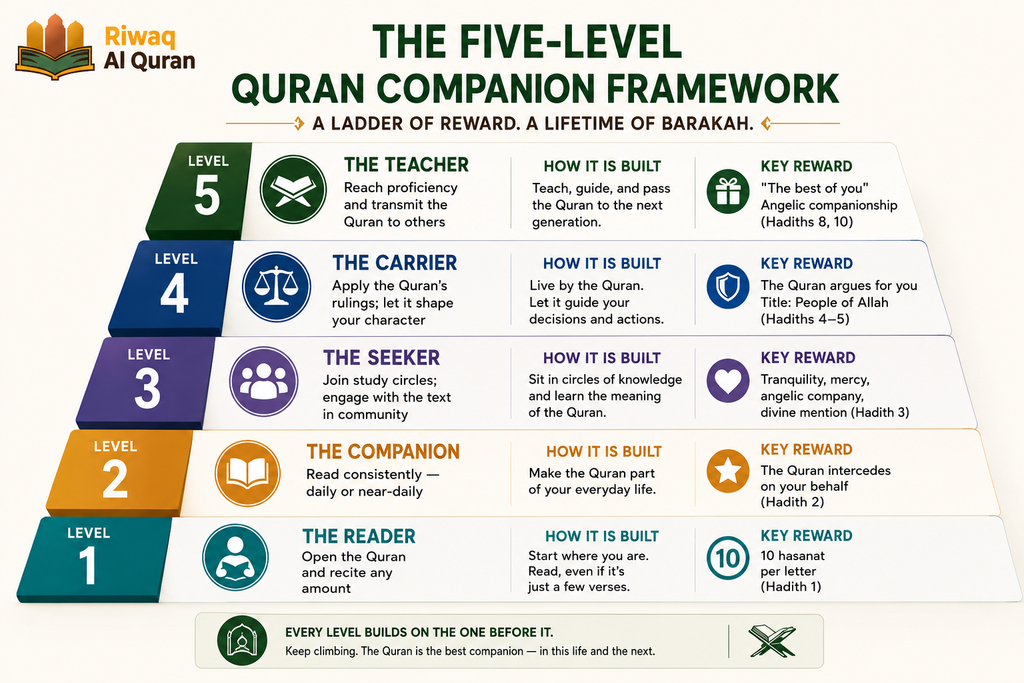
The Five-Level Quran Companion Framework
The ten hadiths above are not isolated promises — they describe a progression. A ladder of relationship with the Quran, with each level unlocking distinct rewards described directly by the Prophet ﷺ.
This framework is drawn entirely from the hadith evidence above — not a modern invention, but a pattern that has always been present in how the Prophet ﷺ described the Quran relationship.
The table below maps that progression clearly so you can identify where you are, what each level earns, and what comes next:
| Level | Title | How It Is Built | Key Reward |
| Level 1 | The Reader | Open the Quran and recite any amount | 10 hasanat per letter (Hadith 1) |
| Level 2 | The Companion | Read consistently — daily or near-daily | The Quran intercedes on your behalf (Hadith 2) |
| Level 3 | The Seeker | Join study circles; engage with the text in community | Tranquility, mercy, angelic company, divine mention (Hadith 3) |
| Level 4 | The Carrier | Apply the Quran’s rulings; let it shape your character | The Quran argues for you; title: People of Allah (Hadiths 4–5) |
| Level 5 | The Teacher | Reach proficiency and transmit the Quran to others | “The best of you”; angelic companionship (Hadiths 8, 10) |
Every Muslim begins at Level 1. The levels are not exclusive — you can be a Level 3 Seeker while still building the consistency of Level 2. What matters is direction. For those working toward Level 5, online Ijazah courses provide a structured entry point into the formal transmission chain.
4 Practical Ways to Apply These Hadiths Every Day
Knowing these hadiths is the beginning. These four habits, drawn directly from the hadith evidence above, translate the promises into daily practice. For a deeper guide on engaging with the text, see how to study and understand the Quran.
1. Set a Daily Minimum You Will Not Break
The companionship described in Hadith 2 is built through consistency, not volume:
- A small, unbroken daily portion builds a genuine Quran relationship; an hour once a week does not.
- Set a minimum — one page, half a page, a single surah — and treat it as non-negotiable, the way you treat Fajr.
- The Prophet ﷺ said the most beloved deed to Allah is the one done consistently, even if small.
- Use the Quran memorization techniques that reinforce daily review, even for non-memorizers.
2. Find or Form a Weekly Quran Study Circle
The four blessings of Hadith 3 cannot be earned alone:
- Two people reading together is enough to qualify — a family circle, a group of colleagues, or a structured online Quran class all fulfill the spirit of the hadith.
- The sakīnah and rahmah the hadith promises are exclusive to the gathering — they are not available in isolation.
- Active, mutual engagement with the text — not passive listening — is what calls down all four blessings.
3. Practice One Minute of Tadabbur After Every Session
The difference between the Quran arguing for you versus against you (Hadith 4) comes down to one habit:
- After any recitation — even a single page — pause for one minute before closing the mushaf.
- Ask: What is this verse instructing me to do? What does it ask me to avoid? What does it reveal about Allah?
- This single habit is the line between recitation that accumulates for you and recitation that accumulates against you.
4. Never Let Difficulty Stop You From Starting
Hadith 9 makes the promise unconditional and direct:
- The harder the recitation, the higher the reward per verse — there is no minimum fluency threshold.
- Waiting until your Arabic is “good enough” is the most common reason people delay — and the most common mistake.
- Begin now, recite imperfectly, trust the hadith, and seek guidance.
- An Online Quran Recitation Course provides immediate structured guidance to improve without delay.
Start Your Quran Journey With Certified Native Teachers
The Prophet ﷺ said the best of you are those who learn the Quran and teach it (Hadith 8). Learning comes first — and structured learning under a qualified teacher is what builds the proficiency that earns the rank of the noble angels (Hadith 10).
Riwaq Al Quran is a comprehensive online platform offering personalized Quran, Arabic, and Online Islamic Studies courses for all ages and backgrounds. Experienced instructors use a structured curriculum covering Tajweed, Tafsir, and Memorization through live, one-on-one sessions with native Arab teachers — each holding a certified ijazah chain traceable to the Prophet ﷺ.
Watch real moments from our live sessions at Riwaq Al Quran and see how we bring learning to life:
Available courses include:
- Online Quran Recitation Course — Enhance your recitation skills under expert-led guidance
- Online Tajweed Classes — Master Tajweed rules for beautiful, accurate recitation
- Quran Memorization Online Course — Memorize effectively with structured review and expert support
- Online Tafseer Course — Understand Quranic meanings through in-depth Tafseer study
- Noorani Qaida Online — Build your Arabic Quran foundations from the very first lesson
- Online Qirat Course — Explore all ten Qirat styles with comprehensive instruction
- Online Quran Classes for Kids — Interactive, age-appropriate classes that build a lifelong love of the Quran
- Online courses for kids — A full range of Quran and Islamic learning designed for young learners
- Online Arabic Courses — Structured Arabic learning for all levels and goals
- Online Ijazah Courses — Earn your certified ijazah through the authenticated transmission chain
Your first lesson is free. No commitment. No pressure.
Conclusion
The ten hadiths about reading the Quran gathered here are not parallel statements — they are a map. They begin with the immediate reward of a single letter (Hadith 1) and build through every dimension of the Quran-reader’s journey: the companionship that earns intercession (Hadith 2), the circles that summon angels (Hadith 3), the warning that reading alone is not enough (Hadith 4), the title that places you among Allah’s closest (Hadith 5), the honor of ascending in Jannah (Hadith 7), and the highest rank any Muslim can hold in this life (Hadith 8).
What unites all ten is a single condition: sincerity. The Quran rewards those who approach it genuinely, consistently, and with the intent to understand and apply. As Hadith 4 states without ambiguity: the Quran argues. The only question is which direction it argues for you.
The Prophet ﷺ — whose central role and deep relationship with revelation is detailed in our guide on Prophet Muhammad in the Quran — left us everything we need to build a lasting relationship with the Book of Allah. May Allah make us among the companions of the Quran, its people, and those who ascend through its verses into the highest ranks of Jannah.
Frequently Asked Questions
The questions below address the most common searches related to hadiths about reading the Quran — from the reward of a single letter to the conditions for the Quran’s intercession on the Day of Judgment. Each answer is drawn directly from the authenticated hadith evidence above.
What does the hadith say about reading one letter of the Quran?
The Prophet ﷺ said that every letter earns one good deed multiplied tenfold, and clarified that Alif, Lam, and Meem each count as separate letters (Al-Tirmidhi, 2910). With over 320,000 letters in the Arabic Quran, a complete recitation earns a minimum of 3.2 million hasanat — the most precisely defined reward in all of Islamic worship.
Who are “the people of the Quran” in hadith?
They are those the Prophet ﷺ called ahl Allah — the people of Allah and His closest ones (Ibn Majah, 215). The title belongs to those with a living, consistent, daily relationship with the Quran: reading it, understanding it, and applying its guidance — not to any academic credential or formal rank alone.
Is there a hadith about struggling to recite the Quran?
Yes. The Prophet ﷺ said in Sahih Muslim (798b) that the one who recites while it is hard for them earns a double reward. The hadith uses yatata’ta’u — specifically describing someone who stumbles and hesitates. Difficulty is the direct source of extra reward, not a reason to stop or delay starting.
Can the Quran testify against a Muslim on the Day of Judgment?
Yes. The Prophet ﷺ stated in Sahih Muslim (223) that the Quran is an argument either for you or against you. A Muslim who recites without reflection, ignores its commands, and allows it to have no effect on their conduct risks the Quran testifying against them. Protection lies in reading with genuine understanding and the sincere intention to apply what you learn.
What is the reward for joining a Quran study circle?
Any group gathering to recite and study the Quran together receives four blessings simultaneously: tranquility, mercy, angelic company, and being mentioned by Allah before those with Him (Sahih Muslim, 2699). These blessings apply to any sincere group at any knowledge level — the only condition is sincere, mutual engagement with the text.
What did the Prophet ﷺ say about those who learn and teach the Quran?
He said in Sahih Bukhari (5027): “The best of you are those who learn the Quran and teach it.” Both elements are required. This is the highest ranking the Prophet ﷺ assigned to any Muslim activity — above wealth, lineage, or social standing — and it is achieved by entering the Quran transmission chain and continuing it forward.