| Key Takeaways |
| The Ten Qiraat are ten authenticated, mutawatir recitation traditions traced through unbroken chains back to the Prophet ﷺ. |
| Learning Qirat properly requires mastering Hafs ‘an ‘Asim first, as it forms the foundational reference point for all other readings. |
| A qualified, Ijazah-certified sheikh is non-negotiable — Qiraat cannot be self-taught from books or recordings alone. |
| The classical roadmap moves from Hafs → Shu’bah → Qalun/Warsh → individual rawis → full Khatma of the seven Qiraat → Ten Qiraat Kubra. |
| Memorizing the Shatibiyyah and Durrah poems alongside recitation practice is the traditional and most effective method for mastery. |
The Quran was revealed in multiple authentic modes of recitation — not as textual variants, but as living oral traditions preserved through chains of transmission reaching back to the Prophet Muhammad ﷺ himself.
Learning how to read Quran with Qiraat means entering one of the most precisely preserved sciences in human history, where every vowel, pause, and phonetic nuance is documented and transmitted with the rigor of a witnessed covenant.
Most students approach Qirat study backwards — memorizing rule names before their tongue has felt a single distinction in live recitation.
The correct method follows a gradual, sheikh-led progression: solidify one riwayah completely, then layer the next systematically, building toward the full Ten Qiraat through tested classical stages that Azhari scholars have refined across centuries.
Table of Contents
1. Find a Qualified Sheikh with an Unbroken Isnad
To learn Qirat of Quran properly, your absolute first step is locating a sheikh who holds a verified Ijazah in the Qiraat — meaning their chain of transmission connects, link by link, back to the Prophet ﷺ. No book, recording, or online resource can substitute for this. The oral transmission of Qiraat is itself part of what makes them authentic.
This is not a formality. The science of Qiraat is defined by talaqqi — direct, mouth-to-ear transmission. When you recite before a qualified sheikh, they are not simply checking your pronunciation; they are transmitting a living trust deposited by the Companions, preserved through generations of Huffaz and muqri’een.
In our experience at Riwaq Al Quran, students who attempt to “learn” Qiraat independently — even diligent, intelligent students — frequently internalize errors that take months to correct. The sheikh’s ear catches what no software or recording can.
Connect with our Azhari tutors to read Quran with Qiraat

2. Complete a Full Khatmah in Hafs ‘an ‘Asim as Your Foundation
Before studying any other riwayah, recite the entire Quran — from Surah Al-Fatihah to Surah An-Nas — before your sheikh in Hafs ‘an ‘Asim from the Shatibiyyah path, from memory. This is the non-negotiable foundation that every classical scholar of Qiraat has required before proceeding further.
Hafs ‘an ‘Asim is today the most widely recited riwayah across the Muslim world. Hafs ibn Sulayman al-Asadi (d. 180 AH) transmitted from his teacher Imam ‘Asim ibn Abi al-Najud (d. 127 AH), who himself read from Abu Abdur-Rahman al-Sulami and Zirr ibn Hubaysh — both transmitting from ‘Abdullah ibn Mas’ud, ‘Ali ibn Abi Talib, ‘Uthman ibn ‘Affan, Ubayy ibn Ka’b, and Zayd ibn Thabit, may Allah be pleased with them all.
This complete khatmah serves two purposes. First, it trains your tongue in the precision Qiraat demands — proper makhraj, sifat, and waqf rules at the level of mastery. Second, it gives your sheikh a complete picture of your recitation quality before more complex distinctions are introduced.
Make sure your Tajweed rules are solid at this stage. Foundational errors in makhraj or ghunnah duration will compound across every subsequent riwayah you study.
Enroll Now in the Best Online Tajweed Classes

3. Add Shu’bah ‘an ‘Asim in a Combined Khatmah to Master the Full Reading of ‘Asim
After completing your Hafs khatmah, read a second full khatmah combining both rawis of Imam ‘Asim: Shu’bah and Hafs together.
This approach is pedagogically sound because you are still working within a single qira’ah — that of ‘Asim al-Kufi — while training your ear and tongue to distinguish between two closely related but distinct transmission lines.
For preparation, the Al-Riayash text on Shu’bah ibn ‘Ayyash’s riwayah is a practical reference for identifying the key differences.
Your sheikh may, after evaluating your recitation quality, allow you to begin this combined khatmah directly — skipping a separate Hafs-only khatmah if your Hafs is already at a high level. Follow your sheikh’s judgment in this.

4. Study Qalun or Warsh ‘an Nafi’ to Begin the Second Qira’ah
With ‘Asim’s full reading established, you are ready to study a second Imam’s qira’ah. Scholars and contemporary specialists, including Dr. Walid al-Munaysi, recommend beginning with either Qalun or Warsh — both rawis of Imam Nafi’ al-Madani — as the most accessible entry into a new qira’ah for a Hafs-trained student.
For preparation, the works of Sheikh Muhammad Nabhan al-Masri are highly practical: they present the differences between Hafs and Qalun (or Hafs and Warsh) in comparative table format, making self-study preparation efficient before recitation before your sheikh.
Alongside textual preparation, listening extensively to authenticated recitations of Qalun and Warsh — reciting along quietly — trains the ear before the tongue. This is not a replacement for your sheikh; it is preparation that maximizes the quality of your sessions.
The benefits of Tajweed become especially evident at this stage, as the phonetic distinctions between rawis are precisely the kind of nuance that careful Tajweed training prepares the student to hear and produce.
If you’re seeking structured, certified instruction, Riwaq Al Quran’s Online Qirat Course pairs students with Ijazah-certified Azhari tutors who hold verified isnads in the Ten Qiraat — with two free trial classes to begin.
Begin Learning Qirat with a FREE trial lesson

5. Practice Each Rawi Individually on the First Hizb of Al-Baqarah Before Full Khatmahs
Before reading a complete khatmah in each riwayah separately, classical methodology prescribes drilling each rawi individually on a concentrated passage. The recommended portion is the first Hizb of Surah Al-Baqarah — a sufficiently complex section that contains most of the foundational asl (principle) distinctions of any rawi.
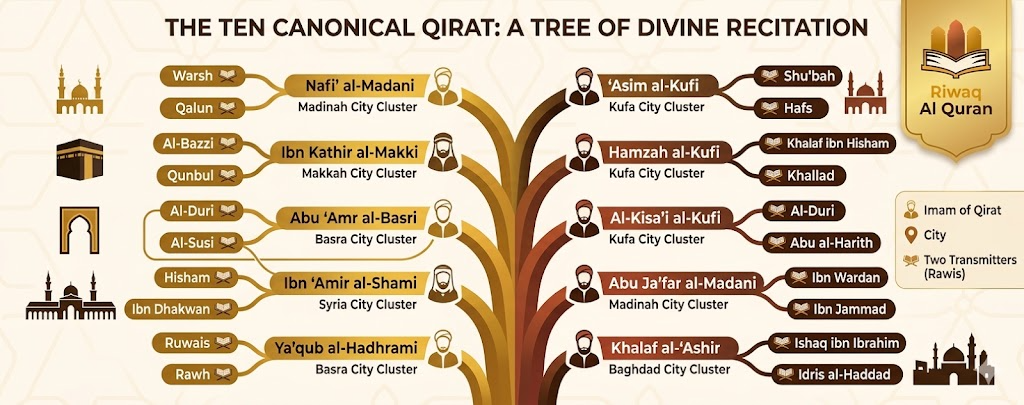
Work through each of the Twenty Rawis of the Ten Qiraat in sequence:
| Imam | Rawi 1 | Rawi 2 |
| Nafi’ al-Madani | Qalun | Warsh |
| Ibn Kathir al-Makki | Al-Bazzi | Qunbul |
| Abu ‘Amr al-Basri | Al-Duri | Al-Susi |
| Ibn ‘Amir al-Shami | Hisham | Ibn Dhakwan |
| ‘Asim al-Kufi | Shu’bah | Hafs |
| Hamzah al-Kufi | Khalaf ibn Hisham | Khallad ibn Khalid |
| Al-Kisa’i al-Kufi | Al-Duri | Abu al-Harith |
| Abu Ja’far al-Madani | Ibn Wardan | Ibn Jammad |
| Ya’qub al-Hadhrami | Ruways | Rawh |
| Khalaf al-‘Ashir | Ishaq | Idris |
For this stage, you need the following classical references: Matn al-Shatibiyyah, Matn al-Durrah, a reliable commentary on both, Al-Idha’ah by Sheikh al-Dabbagh, and Al-Budur al-Zahirah by Sheikh ‘Abd al-Fattah al-Qadi.
6. Memorize the Shatibiyyah and Durrah Poems Systematically Alongside Recitation
Memorizing the Shatibiyyah — the 1,173-line poem of Imam al-Qasim ibn Firruh al-Shatibi (d. 590 AH) — is not optional. It is the primary codification of the Seven Qiraat from the Shatibiyyah path, and every classical mujaz in Qiraat has committed it to memory.
The recommended pace is five lines daily, recited from memory before your sheikh at each session. At this pace, the Shatibiyyah is completed in approximately eight months. Immediately follow with the Durrah al-Mudiyyah of Imam Ibn al-Jazari (d. 833 AH) — 241 lines covering the Three Additional Qiraat — at the same five-lines-daily pace.
This memorization serves a function beyond academic retention. The Shatibiyyah is structured so that its poetic framework organizes the principles (usul) and word-specific rulings (farsh) in a sequence that mirrors the cognitive map an expert muqri’ uses during recitation. Knowing the poem lets you locate any ruling instantly.
Allah ﷻ promises the preservation of this Book:
إِنَّا نَحْنُ نَزَّلْنَا ٱلذِّكْرَ وَإِنَّا لَهُۥ لَحَـٰفِظُونَ
Inna nahnu nazzalna al-dhikra wa inna lahu lahafizun
“Indeed, it is We who sent down the Reminder, and indeed, We will be its guardian.” (Al-Hijr 15:9)
The Qiraat are the living fulfillment of this promise — transmitted sound by sound across fourteen centuries.
Experience Riwaq Al Quran Classes
Watch real moments from our live sessions at Riwaq Al Quran and see how we bring learning to life. These clips highlight our interactive, student-focused approach designed to keep learners engaged, motivated, and actively involved in every step of their educational journey.
7. Complete the Full Khatmah of the Qiraat from the Shatibiyyah Path
After individual rawi drilling and ongoing Shatibiyyah memorization, you are ready for the defining milestone of the ‘Ashr al-Sughra path: a complete khatmah of the Seven Qiraat (or all Ten from Shatibiyyah and Durrah combined), read continuously from Surah Al-Fatihah to Surah An-Nas before your sheikh.
Your sheikh will direct whether to begin with the Sab’ah (Seven) or proceed immediately to the ‘Asharah (Ten). Either way, your preparation for each session draws from the classical references listed in Step 5, with your Shatibiyyah and Durrah memorization as the structural backbone.
Upon completing this khatmah with your sheikh’s satisfaction, and receiving your Ijazah from him — with his sanad connecting through a chain of scholars to the Prophet ﷺ, through Jibril ‘alayhi al-salam, from Allah ﷻ — you have completed the ‘Ashr al-Sughra.
This is one of the highest certifications attainable in Quranic sciences. The Prophet ﷺ said:
“The one who is proficient in the recitation of the Qur’an will be with the honourable and obedient scribes (angels), and he who recites the Qur’an and finds it difficult, stuttering and struggling over it, will have two rewards.” (Sahih Muslim 798)
To support your memorization journey alongside Qiraat study, Riwaq Al Quran’s Online Quran Memorization Course provides structured, one-on-one Hifz sessions with Azhari-certified Hafiz tutors — available 24/7 for students worldwide.
Start your Hifz journey with a Free Trial
How Long Does It Realistically Take to Learn the Ten Qiraat?
Learning the Ten Qiraat properly — through the ‘Ashr al-Sughra path — typically takes between five and ten years for a dedicated student who studies consistently. This estimate assumes prior Hifz of the Quran, strong Tajweed foundations, and regular sessions with a qualified sheikh.
The timeline varies significantly based on:
- Prior Hifz quality — a solid Hafiz progresses faster than one who must strengthen memorization simultaneously
- Session frequency — students with daily or near-daily sheikh sessions advance substantially faster
- Shatibiyyah memorization pace — five lines daily is sustainable; fewer lines extend the timeline proportionally
- Cognitive familiarity — students with prior exposure to Arabic phonetics grasp rawi distinctions more quickly
The ‘Ashr al-Kubra — reading all Ten Qiraat through the paths of Tayyibat al-Nashr by Ibn al-Jazari — requires additional years beyond the Sughra and is the domain of advanced scholars. Most students pursue the Sughra first and consider the Kubra a subsequent, separate endeavor.
How to Improve Qirat Quality During Your Studies?
Improving Qirat quality is not only about adding more riwayat — it is about deepening accuracy within each one.
At Riwaq Al Quran, tutors consistently observe that students who plateau in Qirat quality share one habit: they recite without active listening. They produce sounds without monitoring whether the output matches the target.
The following practices, applied consistently, accelerate quality:
1. Record and review
Record your recitation and compare it directly against a verified reciter of that riwayah; ear-training is as important as production
2. Targeted usul drilling
Isolate the foundational principles (imālah, idghām, hamzah handling, madd lengths) of the riwayah you are studying and drill them in isolation before applying them in connected recitation
3. Sheikh correction cycles
After your sheikh corrects an error, repeat the corrected form a minimum of ten times immediately; motor memory requires repetition
4. Contextual Tafsir integration
Understanding the meaning of the passage you are reciting improves prosodic naturalness; Riwaq Al Quran’s Online Quran Tafseer Course is an excellent parallel study alongside Qiraat training
Deep engagement with the Tafsir of the verses you are reciting also develops the kind of reverence that prevents mechanical, rote recitation — one of the subtler errors that even advanced students fall into.
Why Students Love Learning with Riwaq Al Quran
Hear directly from our students about how Riwaq Al Quran Academy has transformed their connection with the Book of Allah. Their experiences reflect the dedication, care, and quality that guide every step of our teaching.
Start Your Qiraat Journey with Riwaq Al Quran
The path of the Ten Qiraat is one of the most honored in Islamic scholarship — and one of the most demanding. What every successful student shares is not exceptional talent, but consistent access to a qualified teacher and a structured, proven method.
Riwaq Al Quran has guided students from across the Western world through this path since 2017 — with Ijazah-certified Azhari tutors, verified isnads, and one-on-one instruction scheduled around your life.
- ✅ Al-Azhar University–certified instructors with verified Ijazahs
- ✅ One-on-one personalized sessions — no group classes
- ✅ 24/7 scheduling flexibility
- ✅ 2 Free Trial Classes — no commitment required
- ✅ 100% Money-Back Guarantee
Enroll in the Ten Qiraat Course and begin your first free trial class today, Insha’Allah.
We offer courses in Online Quran & Tajweed Classes, Arabic Language, and Islamic Studies.
- Online Quran Memorization Course
- Tafseer Course
- Tajweed Classes
- Online Quran Classes for Kids.
- Ijazah Program.
- Qirat Course.
- Arabic Language Classes.
- Islamic Studies Courses.
Enroll now for 2 Free Trial Classes and Begin Learning Islam and Quran Today
Conclusion
Learning how to read Quran with Qirat properly is not a matter of studying rules in isolation — it is a matter of entering a living tradition of transmission, step by carefully guided step. From solidifying Hafs as your foundation, to drilling individual rawis, to memorizing the Shatibiyyah and completing the full khatmah of the Ten — every stage builds directly on the last.
The science of Qiraat has been preserved with extraordinary precision across fourteen centuries precisely because each generation insisted on qualified teachers, verified chains, and patient, unhurried progression.
That same insistence is what will carry your recitation forward. Alhamdulillah, this path remains fully open — and it begins with the first step of finding your sheikh.
Frequently Asked Questions About Learning Qirat of Quran
Do I Need to Memorize the Entire Quran Before Studying the Ten Qiraat?
Yes — prior Hifz of the complete Quran is a prerequisite for serious Qiraat study. Reciting before a sheikh from memory in each riwayah is the classical method; reading from the mushaf significantly limits the depth of transmission and the sheikh’s ability to assess your mastery of each rawi’s complete characteristics.
How Do I Understand the Ten Qiraat of the Quran Without Getting Confused Between Rawis?
Study one rawi fully before introducing the next. Classical methodology prescribes isolating each rawi on a concentrated passage — such as the first Hizb of Al-Baqarah — before combining rawis in a full khatmah. This sequential exposure prevents conflation and builds a distinct cognitive map for each rawi’s characteristics. Your Quran memorization techniques also support retention of these distinctions.
Can I Learn Qirat Online, or Does It Require In-Person Study?
Online study with a qualified, Ijazah-certified sheikh is fully valid — the transmission criterion is direct recitation before the sheikh, not physical proximity. Thousands of students today receive their Ijazah through verified online transmission. What matters is the sheikh’s qualification, the real-time nature of the session, and the documented correction of recitation errors.
How Many Years Does It Typically Take to Complete the Ten Qiraat?
For a student who is already a solid Hafiz with strong Tajweed foundations, completing the ‘Ashr al-Sughra realistically takes five to eight years of consistent study. This assumes regular sessions with a sheikh, daily Shatibiyyah memorization at approximately five lines per day, and systematic progression through each rawi before moving to the next. Explore a structured Quran memorization schedule to support your parallel Hifz maintenance during this period.