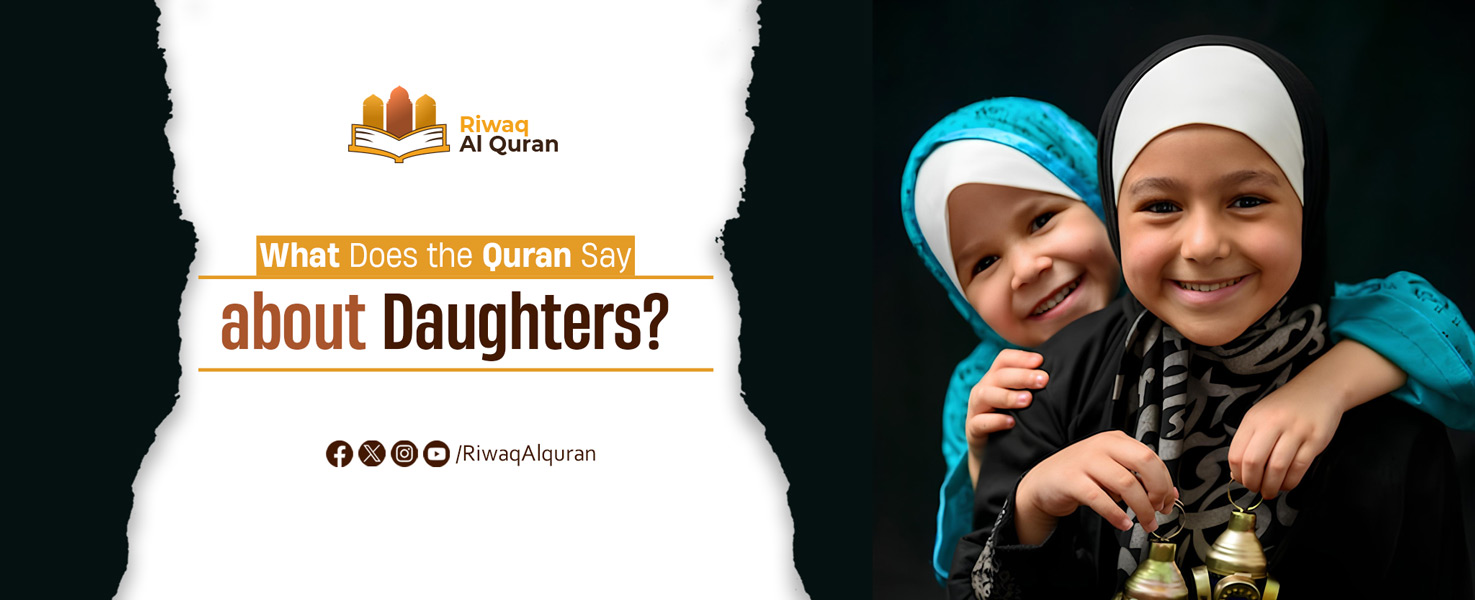
Before Islam, a father in pre-Islamic Arabia could bury his newborn daughter alive without legal consequence — and some did. Within a single generation, the same society produced men who wept with gratitude at the birth of a girl, who stood when their daughters entered the room, and who competed to raise daughters well because they understood the spiritual reward attached to it. That transformation was not gradual cultural evolution. It was a direct result of Quranic revelation and Prophetic example.
The Quran addresses daughters across multiple chapters and in multiple contexts — prohibition, gift, creation, and equality. The Prophet Muhammad ﷺ then translated those principles into lived practice through his relationship with Fatimah (ra), giving every Muslim father a visible, documented standard to follow.
This article draws on those verses, authenticated hadiths, and their classical commentary to answer the question completely — with sources you can verify, commentary that extracts real meaning, and a practical framework for applying these teachings today.
What You’ll Learn in This Article
- Every major Quranic verse about daughters — Arabic text with full diacritics, translation, source, and commentary.
- Authenticated hadiths about daughters and their rewards — with hadith grades and verified references.
- What specific rights Islam gives daughters, from education to inheritance.
- How Prophet Muhammad ﷺ modeled the treatment of daughters through Fatimah (ra).
- Whether sons and daughters are equal in Islam — and what the Quranic and hadith evidence actually shows.
- A 3-stage Prophetic framework for raising daughters from childhood to adulthood.
Table of Contents
What Does the Quran Say About Daughters?
The Quran’s position on daughters is not confined to a single verse or a single angle. It addresses the topic through condemnation of past attitudes, explicit language of divine gifting, a prohibition against harm, and an entire chapter carrying women’s name.
Reading these verses together reveals a coherent Quranic philosophy: daughters are not a consolation prize when a son was expected — they are a direct gift from Allah, carrying their own spiritual value for the family that receives them.
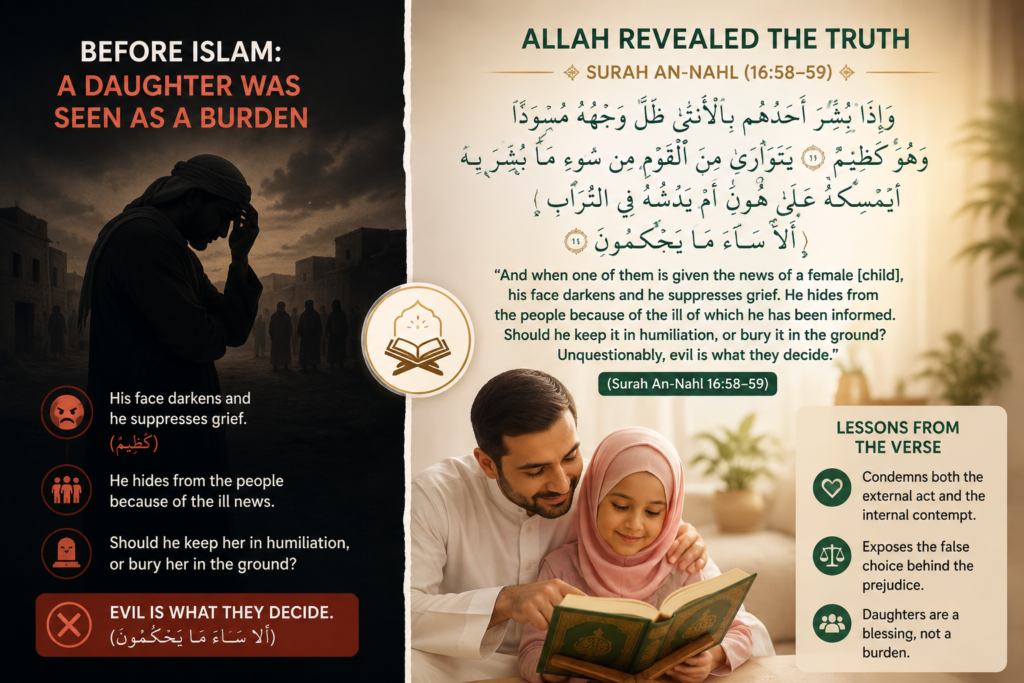
1. The Verse That Condemned Female Infanticide — Surah An-Nahl (16:58–59)
The Quran’s most direct address of the daughter question appears in Surah An-Nahl, where Allah describes and condemns the pre-Islamic reaction to a daughter’s birth:
وَإِذَا بُشِّرَ أَحَدُهُم بِالْأُنثَىٰ ظَلَّ وَجْهُهُ مُسْوَدًّا وَهُوَ كَظِيمٌ يَتَوَارَىٰ مِنَ الْقَوْمِ مِن سُوءِ مَا بُشِّرَ بِهِ ۚ أَيُمْسِكُهُ عَلَىٰ هُونٍ أَمْ يَدُسُّهُ فِي التُّرَابِ ۗ أَلَا سَاءَ مَا يَحْكُمُونَ“
“And when one of them is given the news of a female [child], his face darkens and he suppresses grief. He hides from the people because of the ill of which he has been informed. Should he keep it in humiliation, or bury it in the ground? Unquestionably, evil is what they decide.”Surah An-Nahl 16:58–59
- The word كَظِيمٌ (kadheem) does not mean simply sad — it means one who suppresses and swallows emotion inward, revealing that the Quran targets the internalized prejudice, not only the physical act of infanticide.
- Allah presents the father with a false binary — keep the daughter in humiliation or bury her — to expose that both options flow from the same corrupt premise: that a daughter is a problem to manage, not a person to love.
- A society can stop the physical practice while the internal contempt remains; this verse condemns both simultaneously.
2. Daughters as a Direct Gift from Allah — Surah Al-Shura (42:49–50)
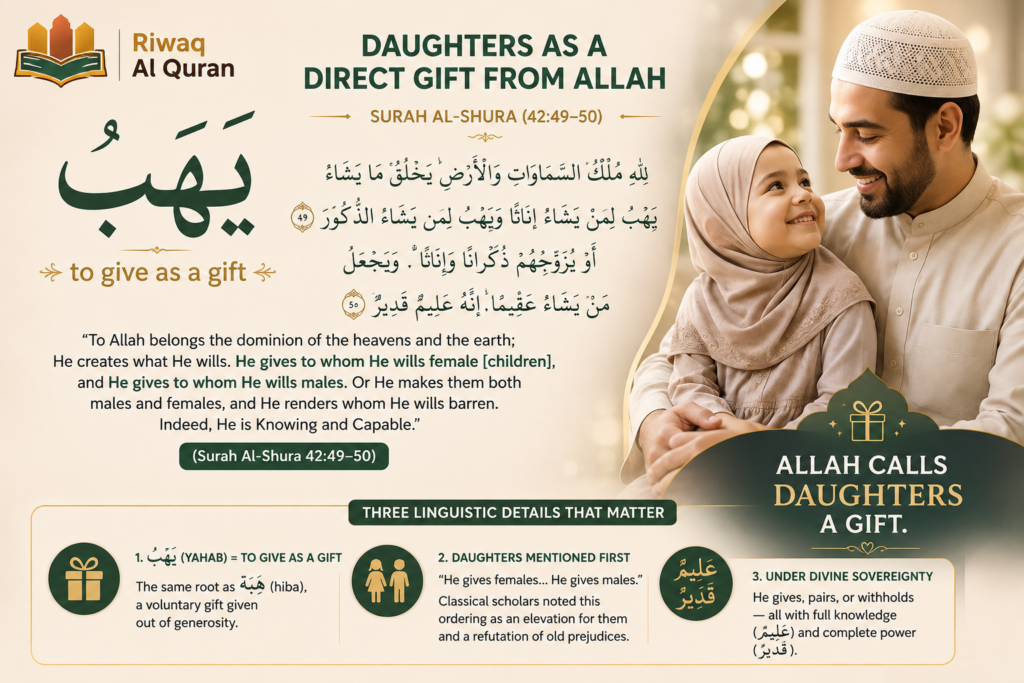
This verse is consistently overlooked in articles on this topic, yet it may be the most theologically significant of all. Allah describes daughters explicitly using the language of divine gifting:
لِلَّهِ مُلْكُ السَّمَاوَاتِ وَالْأَرْضِ ۚ يَخْلُقُ مَا يَشَاءُ ۚ يَهَبُ لِمَن يَشَاءُ إِنَاثًا وَيَهَبُ لِمَن يَشَاءُ الذُّكُورَ أَوْ يُزَوِّجُهُمْ ذُكْرَانًا وَإِنَاثًا ۚ وَيَجْعَلُ مَن يَشَاءُ عَقِيمًا ۚ إِنَّهُ عَلِيمٌ قَدِيرٌ“
“To Allah belongs the dominion of the heavens and the earth; He creates what He wills. He gives to whom He wills female [children], and He gives to whom He wills males. Or He makes them both males and females, and He renders whom He wills barren. Indeed, He is Knowing and Capable.”Surah Al-Shura 42:49–50
Three linguistic details carry decisive weight:
- يَهَبُ (yahab) means to give as a gift — the same root as هِبَة (hiba), a voluntary gift given out of generosity. Allah does not “assign” or “decree” daughters as a neutral outcome; He uses the language of gifting.
- Daughters are mentioned before sons — “He gives females… He gives males.” Classical commentators including Imam al-Zamakhshari (Al-Kashshaf) and Imam al-Qurtubi (Al-Jami’) noted this ordering specifically. Al-Qurtubi wrote that daughters are mentioned first as an elevation for them — a direct Quranic refutation of the pre-Islamic hierarchy that valued sons above daughters.
- The verse frames all of this under absolute divine sovereignty. A father who receives a daughter has received exactly what Allah — with full knowledge (عَلِيمٌ) and complete power (قَدِيرٌ) — chose to gift him.
3. The Explicit Prohibition Against Harming Children — Surah Al-Isra (17:31)
The Quran does not leave daughters’ protection to implication. It addresses directly the economic fear that drove female infanticide in pre-Islamic Arabia:
“وَلَا تَقْتُلُوا أَوْلَادَكُمْ خَشْيَةَ إِمْلَاقٍ ۖ نَّحْنُ نَرْزُقُهُمْ وَإِيَّاكُمْ ۚ إِنَّ قَتْلَهُمْ كَانَ خِطْئًا كَبِيرًا”
“And do not kill your children for fear of poverty. We provide for them and for you. Indeed, their killing is ever a great sin.” Surah Al-Isra 17:31 :
- The verse addresses the practical fear behind female infanticide — the belief that daughters were an economic burden who could not contribute to tribal survival while consuming food and requiring a dowry.
- The Quran responds with a direct theological transfer: نَّحْنُ نَرْزُقُهُمْ (We provide for them) — the majestic plural indicating absolute divine authority over provision. The burden of a daughter’s livelihood is explicitly placed on Allah, not the anxious father.
- خِطْئًا كَبِيرًا (khit’an kabira) — “a great sin” — is among the strongest moral condemnations in Quranic language, placing the harming of daughters in the category of major sins (kaba’ir) requiring full accountability before Allah.
4. Surah An-Nisa — The Chapter Named After Women (4:1)
Most readers note this fact in passing, but its implication deserves full attention. The fourth and one of the longest chapters of the Quran carries the name An-Nisa (The Women). Its opening verse establishes the shared origin of all human beings:
“يَا أَيُّهَا النَّاسُ اتَّقُوا رَبَّكُمُ الَّذِي خَلَقَكُم مِّن نَّفْسٍ وَاحِدَةٍ وَخَلَقَ مِنْهَا زَوْجَهَا وَبَثَّ مِنْهُمَا رِجَالًا كَثِيرًا وَنِسَاءً”
“O mankind, fear your Lord, who created you from one soul and created from it its mate and dispersed from both of them many men and women.”Surah An-Nisa 4:1
- Sons and daughters come from the same single origin (نَّفْسٍ وَاحِدَةٍ, nafs wahida). This shared origin is stated as the very basis for the taqwa the verse commands — because all of humanity comes from one soul, how you treat one another is a direct matter of your relationship with Allah.
- Surah An-Nisa then legislates daughters’ rights to inheritance, marriage consent, and financial maintenance — giving the principle of shared origin an immediate legal expression across the chapter.
- Naming this chapter after women was not incidental. It was a theological declaration about women’s centrality in Islamic moral and legal life.
The Specific Rewards Islam Promises for Raising Daughters
The Quran establishes the principle of daughters’ value; the authenticated hadiths make the reward structure concrete and specific. These are not vague encouragements — they are conditional promises tied to exactly defined parental behaviors. Understanding them transforms how a Muslim parent sees the daily act of raising a daughter.
1. The Hadith of the Joined Fingers — Proximity to the Prophet ﷺ in Paradise
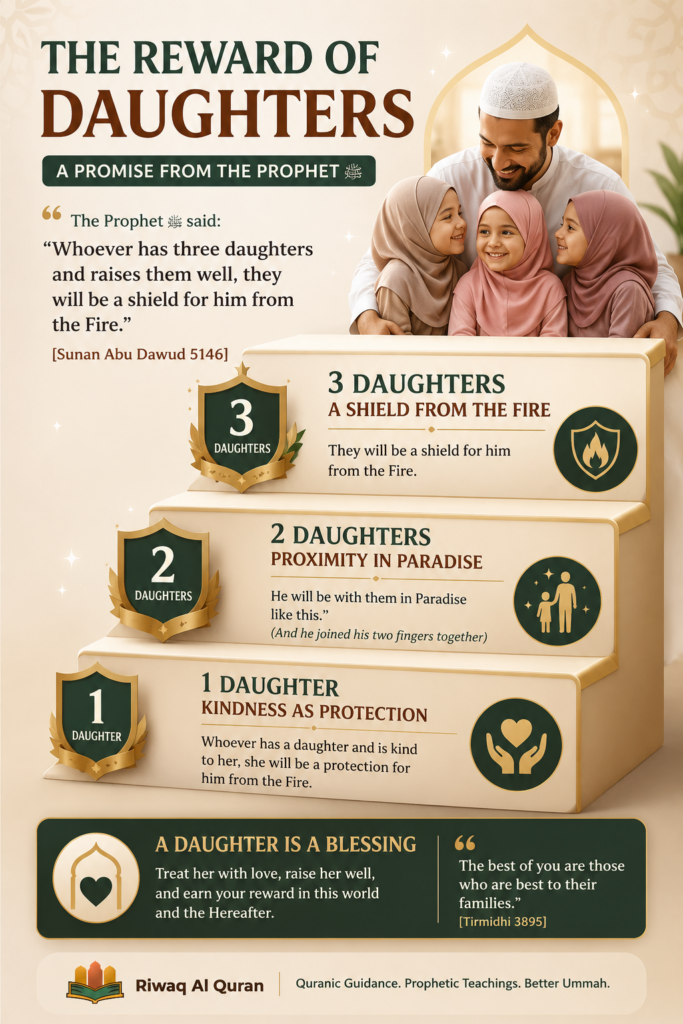
Narrated by Anas ibn Malik (ra), the Prophet Muhammad ﷺ said:
“عن أنس بن مالك رضي الله عنه أن رسول الله ﷺ قال: «مَن عالَ جاريتَينِ حتى تَبلُغَا، جاء يومَ القيامةِ أنا وهو» وضمَّ أصابعَه”
“Whoever supports two daughters until they reach adulthood, he and I will come on the Day of Resurrection like this” — and he joined his fingers together. Sahih Muslim 2631
- The visual image — two fingers pressed together — specifies closeness, not just companionship. The Prophet ﷺ chose a physical gesture every companion watching could see, understand, and remember.
- The condition is حَتَّى يَبْلُغَا (hatta yablugha) — until they reach adulthood — meaning the reward is earned through sustained investment across years, not a single act of kindness.
- The word كفالة (kafala) used in this and related narrations means comprehensive guardianship — financial provision, emotional care, education, and moral guidance all combined. Providing materially while neglecting the rest does not complete the condition.
2. Three Daughters, A Shield from the Fire on the Day of Resurrection
Narrated by Uqbah ibn Amir (ra): he said, I heard the Messenger of Allah ﷺ say:
“عن عقبة بن عامر رضي الله عنه قال: سمعتُ رسولَ اللهِ ﷺ يقول: «مَن كان له ثلاثُ بناتٍ فصبَر عليهنَّ، وأطعمَهنَّ، وسقاهنَّ، وكساهنَّ من جِدَتِه، كنَّ له حجابًا من النارِ يومَ القيامةِ”
“Whoever has three daughters and is patient with them, feeds them, gives them drink, and clothes them from his wealth — they will be a shield for him from the Fire on the Day of Resurrection.”
A companion asked: “And two, O Messenger of Allah?” The Prophet ﷺ replied: “And two.”Sunan Ibn Majah
- Sabr (صبر) — patient endurance — is listed as a condition alongside feeding and clothing. A father who provides materially while treating his daughter as a burden has met one condition and missed the essential one.
- The reward scales down progressively: three daughters → a shield; two daughters → a shield. The companion’s follow-up question — and the Prophet’s immediate confirmation — reveals the principle is not a threshold to clear but a continuous earning that grows with sustained investment.
- The word جُنَّةٌ (junna, shield) is the same word used elsewhere in hadith to describe the protective power of fasting — equating the spiritual impact of raising daughters with one of Islam’s greatest acts of worship.
3. The Story of Aisha (ra) and the Woman with Two Daughters — Kindness Under Constraint
Narrated by Aisha (ra):
“عن عائشة أم المؤمنين رضي الله عنها قالت: «جاءتني امرأةٌ، ومعها ابنتانِ لها، فسألتني، فلم تجد عندي شيئًا غيرَ تمرةٍ واحدةٍ، فأعطيتُها إياها، فقسَمتْها بين ابنتَيها، ولم تأكل منها شيئًا، ثم قامت فخرجت، فدخل عليَّ النبيُّ ﷺ فحدَّثتُه حديثَها، فقال: «مَن ابتُليَ من هذه البناتِ بشيءٍ، فأحسنَ إليهنَّ، كُنَّ له سِترًا من النارِ»”
“A woman came to me with two daughters seeking charity. She found nothing with me except one date, which I gave to her. She divided it between her two daughters and ate nothing herself, then got up and left. The Prophet ﷺ came in and I told him. He said: ‘Whoever is put to trial by these daughters and treats them kindly, they will be a protection for him from the Hellfire.'” Sahih Muslim 2629 — Sunnah.com | Also in Sahih al-Bukhari
- The word ابتُلي (ibtuli) — put to trial or tested — is critical. The Prophet ﷺ is not pretending that raising daughters is always easy. He is telling parents that the difficulty itself is the mechanism of reward.
- The woman in the story had almost nothing, yet she prioritized her daughters’ hunger over her own. The Prophet ﷺ described this exact behavior — kindness under real constraint — as the act that produces protection from Hellfire.
- The hadith rewards not wealth, not comfort, and not ease. It rewards kindness under constraint, making the reward accessible to parents at every level of financial means.
What Rights Do Daughters Have in Islam?
Understanding a daughter’s worth in Islam requires knowing the specific rights Islam assigned to her — from the moment of birth to adulthood and beyond.
These are not abstract ideals; they are enforceable obligations on fathers, husbands, and the broader community. For a fuller picture of how Islam addresses Muslim women and their standing in faith and society, these rights form the foundational framework.
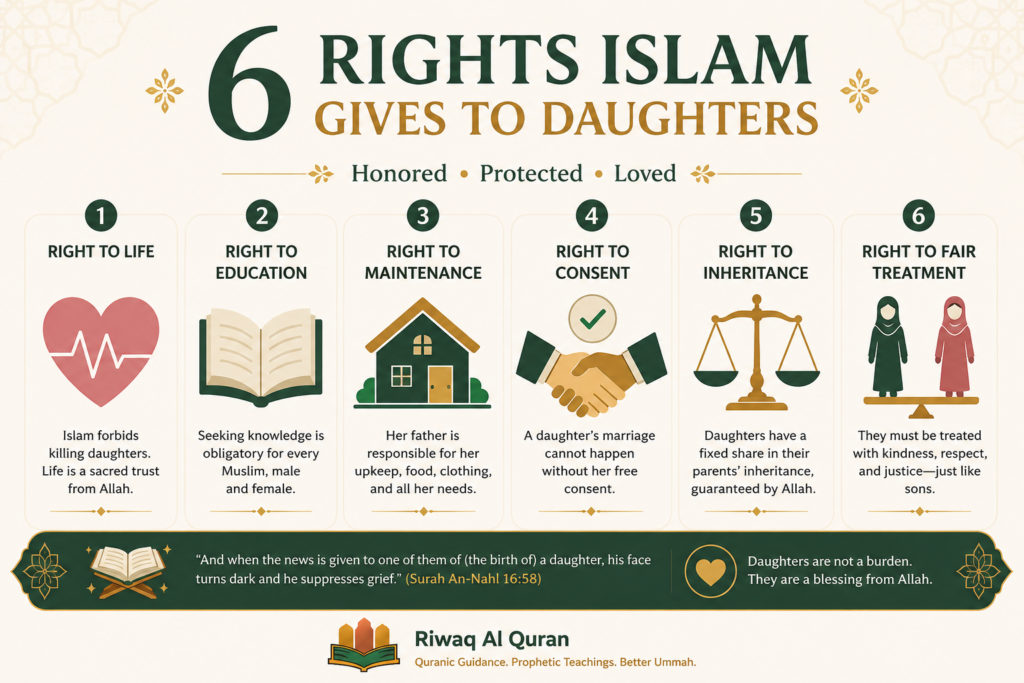
1. The Right to Life — Protected Absolutely
- Islam eliminated female infanticide through direct Quranic prohibition in Surah An-Nahl (16:58–59) and Surah Al-Isra (17:31).
- A daughter’s right to life is absolute from birth — it is not contingent on the family’s financial situation, the father’s preference, or social circumstance.
- In Islamic jurisprudence, taking a daughter’s life is classified among the major sins (kaba’ir), carrying consequences in both this life and before Allah on the Day of Judgment.
2. The Right to Education — An Equal Obligation
The Prophet ﷺ said:
“عن أنس بن مالك رضي الله عنه قال: قال رسولُ اللهِ ﷺ: «طلَبُ العِلمِ فريضةٌ على كلِّ مسلمٍ”
“Seeking knowledge is an obligation upon every Muslim.” — (Sunan Ibn Majah 224)
- The Arabic مُسْلِمٍ (Muslim) carries no gender qualifier — the obligation applies without restriction.
- Imam al-Nawawi (Sharh Sahih Muslim) and Ibn Hajar al-Asqalani (Fath al-Bari) both confirmed that this includes men and women equally. This is the historical majority scholarly position, not a modern reinterpretation.
- A daughter denied access to Islamic education — Quran, its meaning, the fundamentals of her faith — is being denied a right the Prophet ﷺ declared universal.
- Denying a daughter’s education on the grounds that she will eventually marry, or that sons take priority, directly contradicts this hadith.
Riwaq Al Quran’s online Quran classes and online Arabic courses make this right accessible for daughters of all ages and all levels of prior knowledge.
3. The Right to Financial Maintenance (Nafaqa)
- A daughter’s financial maintenance (nafaqa) is the legal responsibility of her father until she marries, and of her husband after marriage.
- She is never legally required to support herself from her own resources at any life stage.
- This arrangement was a deliberate protective structure: it ensures a woman is never financially abandoned — as a child, as a wife, or as a widow.
- The obligation of nafaqa is enforceable through Islamic family law, not a voluntary act of generosity.
4. The Right to Marital Consent — Her Opinion is Required
- A daughter’s consent is a legal condition for the validity of her marriage contract — not a courtesy gesture.
- The Prophet ﷺ said:
“عن أبي هريرة رضي الله عنه أن رسول الله ﷺ قال: «لا تُنكَحُ الأيِّمُ حتى تُستأمَرَ، ولا تُنكَحُ البِكرُ حتى تُستأذَنَ». قالوا: يا رسولَ الله، وكيف إذنُها؟ قال: «أن تَسكُتَ»
“A virgin cannot be given in marriage until her permission is sought.” — (Sahih al-Bukhari and Sahih Muslim)
- A marriage contracted without a daughter’s genuine consent is considered invalid in Islamic jurisprudence.
- Her wali (guardian) manages the contract on her behalf but cannot override her decision.
5. The Right to Inheritance
- The Quran mandates in Surah An-Nisa (4:11) that daughters receive a defined share of their parents’ estate — a legally protected right, not a family custom.
- In the classical scholarly framework, a daughter typically receives half of a son’s share. This differential reflects a corresponding difference in financial obligation:
- A daughter has no Islamic obligation to financially support a husband or children from her own wealth.
- A son bears full financial responsibility (nafaqa) for his wife and children from his own resources.
- The system distributes wealth proportionally to financial responsibility across the life cycle — it is a structural balance, not a statement about worth.
6. The Right to Equal Treatment Among Siblings
The Prophet ﷺ commanded:
“عن النعمان بن بشير رضي الله عنهما… قال رسولُ اللهِ ﷺ: «اتقوا اللهَ واعدلوا بين أولادِكم”
“Fear Allah and be just among your children.” — (Sahih al-Bukhari 2587 )
- Equal treatment is framed as an act of taqwa — the highest standard of Islamic moral obligation, and the same measure established in Surah Al-Hujurat (49:13) as the sole criterion of worth before Allah.
- A parent who invests more in a son’s education, gives a son preferential gifts, or shows greater affection toward a son than a daughter is in direct violation of this command.
- Justice between children means treating a daughter’s needs — academic, emotional, and spiritual — with the same seriousness and resources applied to a son’s needs.
How Prophet Muhammad ﷺ Treated His Daughters
The most consistent gap in competing articles on this topic is the absence of the Prophet’s own behavior. He did not only legislate about daughters — he demonstrated the standard publicly, in front of his companions, in a way every Muslim man could observe and replicate.
To understand the full role of Prophet Muhammad in the Quran and Sunnah, his treatment of daughters stands as one of the most documented expressions of applied Islamic values in history.
1. Fatimah (ra) — The Prophetic Standard Made Visible
The Prophet ﷺ did not only teach about daughters in principle — he demonstrated what that teaching looked like in practice, through his relationship with his own daughter.
What he said about Fatimah (ra) was not private affection kept within the household. It was a public declaration, witnessed by companions, recorded in the most authoritative collections of hadith, and preserved precisely because it was meant to set a standard.
عن علي بن أبي طالب رضي الله عنه: أن فاطمةَ عليها السلام أتت النبيَّ ﷺ تشكو إليه ما تلقى في يدها من الرحى، فلم تجده… فقال ﷺ: «ألا أدُلُّكما على خيرٍ مما سألتُماه؟ إذا أخذتُما مضاجعَكما فسبِّحا ثلاثًا وثلاثين، واحمَدا ثلاثًا وثلاثين، وكبِّرا أربعًا وثلاثين، فهو خيرٌ لكما من خادمٍ»
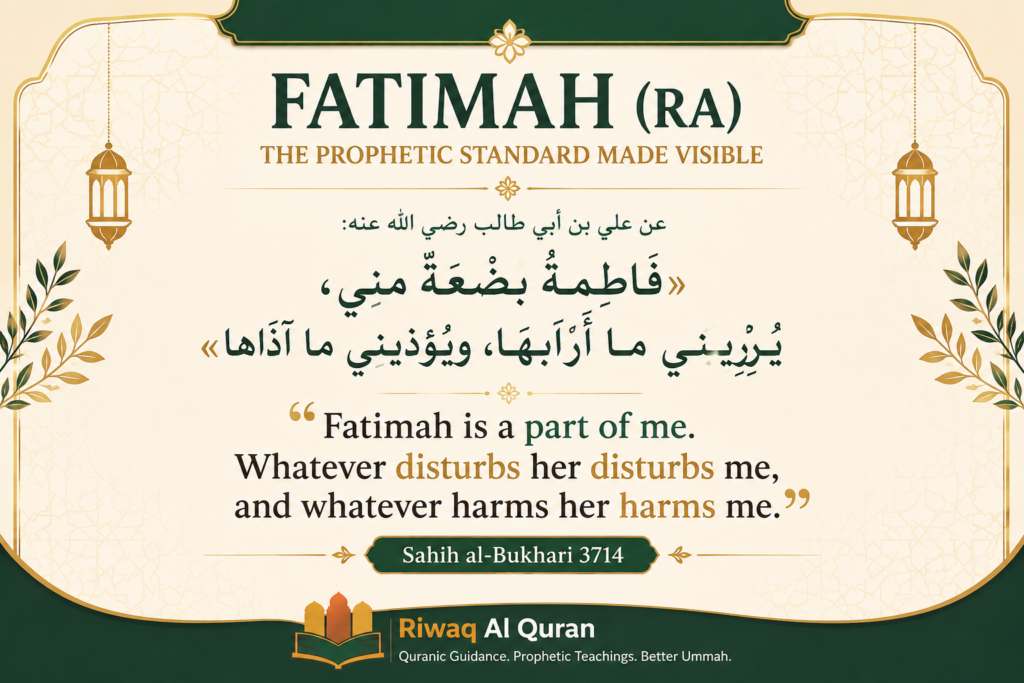
“Fatimah is a part of me. Whatever disturbs her disturbs me, and whatever harms her harms me.”Sahih al-Bukhari 3714
- This statement was made publicly — in front of companions, during a sensitive family matter. The Prophet ﷺ was not expressing private sentiment; he was establishing a principle of honor.
- A daughter’s dignity is inseparable from her father’s honor before Allah. A man who allows his daughter to be humiliated or treated as lesser has allowed something connected to himself to be diminished.
- This framing places the treatment of daughters directly into a man’s sense of his own integrity and standing before Allah — not as an external rule but as an internal standard.
2. Standing When She Entered — A Public Act of Honor
Respect can be spoken, or it can be shown. The Prophet ﷺ chose to show it — repeatedly, consistently, in front of others. Aisha (ra) narrated what she witnessed firsthand: a pattern of behavior so habitual and so deliberate that it could only be read as intentional instruction. Every time Fatimah entered, the Prophet ﷺ stood. Aisha (ra) narrated:
عن عائشة أم المؤمنين رضي الله عنها قالت: «ما رأيتُ أحدًا كان أشبهَ سَمْتًا وهَديًا ودَلًّا برسولِ اللهِ ﷺ من فاطمةَ؛ كانت إذا دخلتْ عليه قام إليها، فأخذ بيدِها وقبَّلها وأجلسَها في مجلسِه، وكان إذا دخل عليها قامتْ إليه، فأخذتْ بيدِه فقبَّلتْه وأجلستْه في مجلسِها»
“Whenever Fatimah came to the Prophet ﷺ, he would stand up to greet her, take her hand, kiss her, and seat her in his own place.” — (Sunan Abu Dawud, Kitab al-Adab)
- Standing for another person is a universal mark of respect. The Prophet ﷺ — leader of the Muslim community, a man whose companions competed for the honor of sitting near him — stood for his daughter, consistently, not as a one-time gesture.
- Every companion who witnessed it received a clear and visible teaching: honoring a daughter is not a private sentiment. It is an active, practiced behavior that defines the character of a Muslim man.
- This public consistency also signals to every child present: the most respected person in the room treats his daughter as worthy of that same respect.
3. Investing in Her Spiritual Education — Not Only Her Comfort
When Fatimah (ra) came to her father with a practical need — the exhaustion of household labor and a request for help — the Prophet ﷺ listened, and then responded with something she had not asked for: a spiritual practice that would outlast any material relief. His answer reveals the hierarchy of a father’s obligations as he understood them.
عن المسورِ بن مخرمةَ رضي الله عنه، أن رسول الله ﷺ قال: «إنما فاطمةُ بَضعةٌ مني، يُؤذيني ما آذاها»
“Shall I not direct you to something better than a servant? When you go to bed, say SubhanAllah thirty-three times, Alhamdulillah thirty-three times, and Allahu Akbar thirty-four times. That is better for you than a servant.”Sahih al-Bukhari 5361
- His response to a practical request was a spiritual investment. He redirected her toward something more lasting than material relief — a daily practice that builds closeness to Allah.
- This reflects the Prophetic understanding that a father’s highest responsibility to his daughter is not her comfort or social status, but her active, practiced connection to her faith.
- A father who provides materially but does not invest in a daughter’s spiritual and religious development has fulfilled the lesser obligation while missing the greater one.
Among the most valuable investments a parent can make today is enrolling their daughter in a structured online Tafseer course or Tajweed program — building exactly the kind of active Quranic connection the Prophet ﷺ modeled through his relationship with Fatimah (ra).
Are Sons and Daughters Equal in Islam?
Sons and daughters are equal in their standing before Allah, equal in their obligation to seek knowledge, and equal in their right to just treatment from their parents. This is the Quranic position and the Prophetic standard — consistently applied, not occasionally invoked.
As the Quran makes clear when addressing children broadly, the obligations of parents toward sons and daughters are grounded in the same principles of justice and taqwa.
1. Equal in Worth Before Allah — Surah Al-Hujurat (49:13)
The Quran opens its declaration of human worth with an undeniable foundation: all people — male and female — share the same origin and stand before Allah on the same measure. No bloodline, no gender, and no cultural tradition can override what Allah has made structurally clear in a single verse.
“يَا أَيُّهَا النَّاسُ إِنَّا خَلَقْنَاكُم مِّن ذَكَرٍ وَأُنثَىٰ وَجَعَلْنَاكُمْ شُعُوبًا وَقَبَائِلَ لِتَعَارَفُوا ۚ إِنَّ أَكْرَمَكُمْ عِندَ اللَّهِ أَتْقَاكُمْ ۚ إِنَّ اللَّهَ عَلِيمٌ خَبِيرٌ”
“O mankind, indeed We have created you from male and female and made you peoples and tribes that you may know one another. Indeed, the most noble of you in the sight of Allah is the most righteous of you. Indeed, Allah is Knowing and Acquainted.”Surah Al-Hujurat 49:13
- أَكْرَمَكُمْ عِندَ اللَّهِ (akramakum ‘inda Allah) is singular — there is one measure, and it is taqwa (God-consciousness). Gender is not on the scale.
- A daughter who prays, who reads Quran, who fears Allah and acts accordingly is more noble before Allah than a son who does not. The verse makes this structurally inescapable.
- The diversity of male and female is described as a basis for human connection and community — not as a hierarchy of value.
2. Equal in the Obligation to Seek Knowledge
When the Prophet ﷺ spoke of the obligation to seek knowledge, he used the most inclusive language possible. The ruling was not directed at men, nor at scholars, nor at any specific group — it was addressed to every Muslim, without exception. That universality was deliberate, and the scholars of hadith confirmed it.
The Prophet ﷺ said:
“عن أنس بن مالك رضي الله عنه قال: قال رسولُ اللهِ ﷺ: «طلَبُ العِلمِ فريضةٌ على كلِّ مسلمٍ، وواضِعُ العِلمِ عند غيرِ أهلِه كمُقلِّدِ الخنازيرِ الجوهرَ واللؤلؤَ والذهبَ» ”
“Seeking knowledge is an obligation upon every Muslim.” Sunan Ibn Majah 224
- Classical scholars including Imam al-Nawawi and Ibn Hajar al-Asqalani confirmed that “every Muslim” applies without gender distinction — this is the historical majority scholarly position, not a contemporary view.
- As the best amongst you are those who learn the Quran and teach it, that standard and that honor apply equally to daughters and sons.
- A parent who denies a daughter access to Islamic knowledge — on any cultural or logistical grounds — contradicts a hadith the Prophet ﷺ declared universal and binding.
3. Equal in the Right to Fair Treatment
This is not a principle left to parental discretion. When a father came to the Prophet ﷺ seeking his endorsement of unequal treatment among his children, the Prophet ﷺ refused — and responded with a command, not a recommendation. The word he used was taqwa, placing justice between children at the level of God-consciousness itself.
The Prophet ﷺ said to Nu’man ibn Bashir (ra), who sought to give one child a privileged gift without giving equally to the others:
عن النعمان بن بشير رضي الله عنهما، وهو على المنبر يقول: «أعطاني أبي عطيةً، فقالت عمرةُ بنتُ رواحةَ: لا أرضى حتى تُشهِدَ رسولَ اللهِ ﷺ، فأتى رسولَ اللهِ ﷺ فقال: إني أعطيتُ ابني من عمرةَ بنتِ رواحةَ عطيةً، فأمرتني أن أُشهدَك يا رسولَ الله، قال: أعطيتَ سائرَ ولدِك مثلَ هذا؟ قال: لا، قال: فاتقوا اللهَ واعدلوا بين أولادِكم»
“Fear Allah and be just among your children.” — (Sahih al-Bukhari 2587 ) | Graded: Sahih
- Equal treatment is framed as an act of taqwa — not optional advice or cultural preference.
- The command applies to financial gifts, educational investment, emotional attention, and time — not only material provision.
- A parent who consistently invests more in a son’s future than a daughter’s has failed both the parenting obligation and the taqwa standard the Prophet ﷺ named directly.
A 3-Stage Framework for Raising Daughters the Prophetic Way
Most Islamic parenting discussions address general principles without a practical timeline. This framework translates Prophetic practice and the classical understanding of tarbiyah (the Islamic upbringing of character, knowledge, and faith) into stage-specific actions — drawn directly from the hadiths and Prophetic examples covered throughout this article.
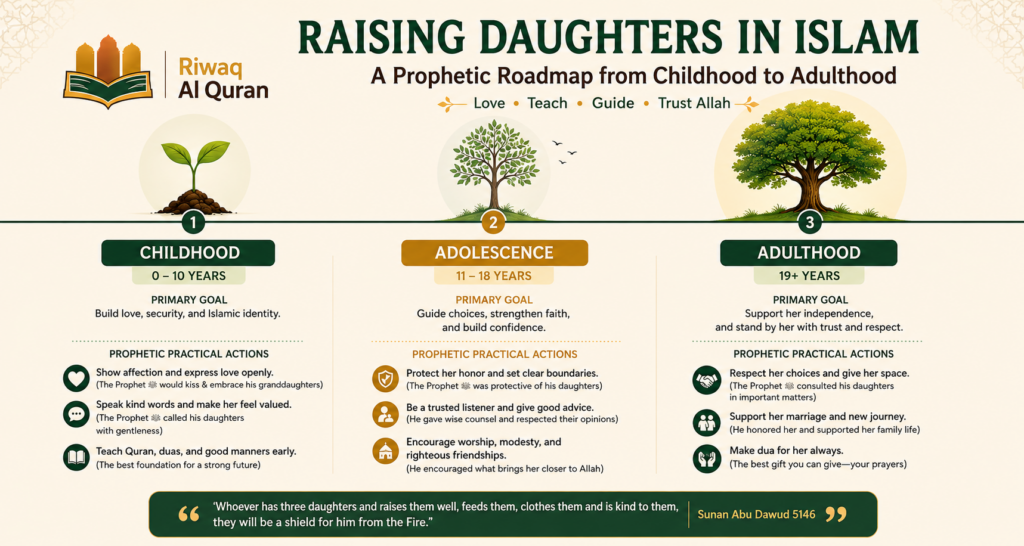
1. Childhood — Planting Identity (Birth to Age 10)
The primary task at this stage is identity formation. A daughter who knows she is loved and valued by her family, and that she is valuable in the sight of Allah, will carry that foundation through every challenge she faces later. The Prophet ﷺ’s consistent affection for Fatimah (ra) was demonstrated from her earliest years — he did not wait until she had accomplished something to honor her.
Practical priorities at this stage:
- Begin Quranic listening and Arabic letter recognition before age 7, when a child’s ear and memory are most receptive to language acquisition.
- Express affection visibly and consistently — the Prophet ﷺ’s example of standing, taking the hand, and kissing is a template for daily practice.
- Never use gender as a reason to limit a daughter’s questions, curiosity, or access to learning.
- A common mistake: delaying formal Quran education until a daughter is “ready.” Foundational tajweed skills are most naturally acquired before age 10.
For daughters beginning their Quran journey, Riwaq Al Quran’s online Quran classes for kids and Noorani Qaida online program build this foundation from as early as age 4 — the stage the Prophetic model prioritizes most.
2. Adolescence — Building Knowledge and Character (Ages 10–18)
This is the most critical and most frequently neglected stage in practice. Adolescence is when peer identity, self-image, and moral reasoning are actively forming — and it is precisely when a strong Quranic foundation functions as an anchor that no other education can replicate.
“خَيْرُكُمْ مَنْ تَعَلَّمَ الْقُرْآنَ وَعَلَّمَهُ”
“The best amongst you are those who learn the Quran and teach it.” — (Sahih al-Bukhari 5027 ) | Graded: Sahih
Practical priorities at this stage:
- Move beyond recitation into comprehension — a daughter who can recite Quran but does not understand its meaning has the form without the substance.
- Enroll in structured Tajweed classes and an online Tafseer course — the two disciplines that transform Quran learning from rote performance into meaningful engagement.
- Treat religious education with the same scheduling consistency and qualified-teacher standard applied to academic school subjects.
- A specific practitioner mistake: parents assume Quranic education is complete once a daughter can recite. Tajweed (correct recitation) and tafseer (understanding) are entirely different disciplines, and both are the parent’s responsibility to provide.
Riwaq Al Quran’s online Quran recitation course is structured for exactly this stage — live, teacher-led, and sequenced from foundational tajweed through advanced recitation.
3. Adulthood — Supporting Independent Practice (18+)
At this stage, a daughter is an adult Muslim with her own religious obligations before Allah. The parent’s role shifts from teacher and director to supporter and companion in faith.
Key realities and priorities at this stage:
- The intensive tarbiyah phase has a natural endpoint — the hadith’s reward language (“until they reach adulthood”) reflects this built-in transition.
- The relationship after adulthood becomes a spiritual partnership between two believers, not a continuation of the parent-led instruction dynamic.
- A daughter who reaches adulthood with Quranic knowledge, a practiced prayer life, and a secure sense of her worth in Islam is the fulfillment of what every hadith about daughters promises her parents.
- For daughters pursuing advanced Quranic learning at this stage, Ijazah certification programs and the online Qirat course offer the deepest level of formal Quranic engagement available online.
Her upbringing — sustained, patient, grounded in both knowledge and love — becomes the shield described in the hadith of Uqbah ibn Amir (ra). The investment is complete; the reward, according to the Prophet ﷺ, is guaranteed.
Give Your Daughter the Quranic Education She Deserves — Start Today
Every hadith about daughters and paradise connects to one thing: how you raise her — not simply whether you love her. Patient upbringing and investment in her knowledge are the exact conditions the Prophet ﷺ attached to the reward. As covered in resources on how to learn Quran online, access to structured Quranic education has never been wider — but qualified, teacher-led instruction remains the most effective path to real understanding.
Riwaq Al Quran is a comprehensive online platform offering personalized Quran, Arabic, and Islamic Studies classes for individuals of all ages and backgrounds. Experienced instructors use a structured curriculum covering Tajweed, Tafseer, and Memorization — providing accessible, high-quality Quranic learning for daughters at every stage of life, from first letters to full certification.
Hear directly from our students about how Riwaq Al Quran Academy has transformed their connection with the Book of Allah:
Available courses include:
- Online Quran Classes for Kids and Adults — structured programs for all levels
- Online Courses for Kids — designed for early learners from age 4
- Online Tafseer Course — understand Quranic meaning, not only recitation
- Online Tajweed Classes — master the rules of beautiful, correct Quranic recitation
- Quran Memorization Online Course — effective, personalized hifz programs
- Noorani Qaida Online — foundational Quranic literacy for complete beginners
- Online Quran Recitation Course — expert-led fluency building at every level
- Online Qirat Course — explore all ten styles of Quranic recitation
- Online Quran Classes for Kids — interactive, nurturing, and age-appropriate
- Online Arabic Courses — the language of the Quran, taught by specialists
- Online Islamic Studies Courses — comprehensive Islamic education for all ages
- Online Ijazah Courses — formal certification in Quranic transmission
Book a free trial lesson today. Your daughter attends from home, at a time that fits your family’s schedule, with no commitment required to continue.
Conclusion
The Quran addresses daughters across four distinct frameworks — by condemning the attitude that devalued them (Surah An-Nahl 16:58–59), by describing daughters as a divine gift and placing them before sons in Quranic verse order (Surah Al-Shura 42:49–50), by establishing shared human origin as the basis for taqwa (Surah An-Nisa 4:1), and by making righteousness — not gender — the sole measure of worth before Allah (Surah Al-Hujurat 49:13).
The Prophet Muhammad ﷺ translated those principles into a visible, lived standard through Fatimah (ra) — standing when she entered, declaring her dignity inseparable from his own, and investing in her spiritual development with the same seriousness he brought to every other religious obligation. The authenticated hadiths complete the picture with a reward structure that is specific, conditional, and extraordinary: proximity to the Prophet ﷺ in paradise, a shield from the Fire, and protection on the Day of Resurrection — available to every parent who raises daughters with patience, justice, and faith.
What Islam says about daughters is not a historical correction limited to 7th-century Arabia. It is an active instruction set for every Muslim parent today, grounded in revelation and demonstrated through Prophetic example. For further reading on related obligations within the family, the Quran’s guidance on parents and their responsibilities toward children forms the broader framework in which daughters’ rights and rewards are situated.
Frequently Asked Questions
The questions below address the most common searches on this topic — from the specific Quranic verses about daughters to the Prophetic rewards for raising them, their rights in Islam, and practical guidance for parents on where to begin.
What does the Quran say about daughters directly?
The Quran condemns devaluing daughters in Surah An-Nahl (16:58–59), describes daughters as a divine gift — using the verb yahab (to give as a gift) and naming them before sons — in Surah Al-Shura (42:49–50), prohibits harming children in Surah Al-Isra (17:31), and establishes in Surah Al-Hujurat (49:13) that righteousness, not gender, is the only measure of worth before Allah. An entire Quranic chapter, Surah An-Nisa, carries women’s name — a theological declaration of their centrality in Islamic life.
What is the Islamic reward for raising daughters?
The Prophet ﷺ said that whoever supports two daughters until adulthood will stand beside him in paradise as close as two joined fingers (Sahih Muslim 2631). For three daughters raised with patience and provision, the reward is a shield from the Fire on the Day of Resurrection (Musnad Ahmad; Sunan Ibn Majah, chain graded sahih). Both hadiths attach the reward to sustained patient care — not merely to having daughters.
What rights do daughters have in Islam?
Islam gives daughters six specific rights:
The right to life — protected by direct Quranic prohibition
The right to education — an obligation on every Muslim per Sunan Ibn Majah 224
The right to financial maintenance from their father until marriage
The right to marital consent — a legal condition, not a courtesy
The right to a defined inheritance share
The right to equal treatment among siblings — commanded directly in Sahih al-Bukhari 2587
Are sons and daughters equal in Islam?
Yes — in terms of worth before Allah. Surah Al-Hujurat (49:13) establishes that the most noble person before Allah is the most righteous, not the male one. The obligation to seek knowledge applies equally to both genders (Sunan Ibn Majah 224), and parents are commanded to treat sons and daughters with equal justice (Sahih al-Bukhari 2587). Different legal roles in certain areas of Islamic family law reflect different financial obligations across the life cycle — not different human worth or spiritual standing.
How did Prophet Muhammad ﷺ honor his daughters?
He stood when Fatimah (ra) entered the room, took her hand, kissed her, and seated her in his own place — consistently and publicly. He declared: “Fatimah is a part of me; whatever disturbs her disturbs me” (Sahih al-Bukhari 3714). He invested in her spiritual education, redirecting her requests toward dhikr and closeness to Allah rather than only material comfort (Sahih al-Bukhari 5361). His example is the most documented and detailed model in Islamic history for how a father should honor a daughter.
At what age should daughters start Quranic education?
Islamic educational tradition and qualified Quran teachers consistently recommend beginning Quranic exposure before age 7 — starting with listening, then Arabic letter recognition, then structured recitation. Foundational Arabic literacy and basic tajweed are most naturally acquired before adolescence. Formal learning with a qualified teacher — such as the Noorani Qaida online program or dedicated online Quran classes for kids — can begin as early as age 4 or 5, and the earlier the start, the stronger the foundation.
Sources and References
The following table lists every Quranic verse and hadith cited in this article, with direct links to peer-recognized Islamic reference platforms for easy verification and further study.
| Source | Reference |
| Quran — Surah An-Nahl 16:58–59 | Quran.com/16/58-59 |
| Quran — Surah Al-Shura 42:49–50 | Quran.com/42/49-50 |
| Quran — Surah Al-Isra 17:31 | Quran.com/17/31 |
| Quran — Surah An-Nisa 4:1 | Quran.com/4/1 |
| Quran — Surah Al-Hujurat 49:13 | Quran.com/49/13 |
| Sahih Muslim 2629 — Aisha (ra) and the woman with two daughters | Sunnah.com/muslim:2629 |
| Sahih Muslim 2631 — Two daughters until adulthood | Sunnah.com/muslim:2631 |
| Sahih al-Bukhari 2587 — Be just among your children | Sunnah.com/bukhari:2587 |
| Sahih al-Bukhari 3714 — Fatimah is a part of me | Sunnah.com/bukhari:3714 |
| Sahih al-Bukhari 5027 — Best of you learn the Quran | Sunnah.com/bukhari:5027 |
| Sahih al-Bukhari 5361 — The Prophet’s advice to Fatimah (ra) | Sunnah.com/bukhari:5361 |
| Sunan Ibn Majah 224 — Seeking knowledge | Sunnah.com/ibnmajah:224 |
| Musnad Ahmad / Sunan Ibn Majah — Three daughters, shield from Fire | Sunnah.com/ibnmajah |