The most recognised Quranic dua for exam success is:
“وَقُل رَّبِّ زِدْنِي عِلْمًا“
“Rabbi zidni ilma”“O my Lord, increase me in knowledge.” — Surah Taha, 20:114
Recite this before every study session and before entering the exam hall. It is the only verse in the Quran where Allah ﷻ commands the Prophet ﷺ to ask for an increase in something — and that something is knowledge. Imaam al-Qurtubi notes this shows that no believer should ever consider themselves as having learned “enough.”
What You’ll Learn in This Article
- The single most effective dua for exam success, with Arabic text, transliteration, and translation.
- A curated list of the best Quranic duas and Prophetic supplications to recite before, during, and after exams.
- How to structure your exam preparation spiritually: from sincere intention (niyyah) to practical study habits grounded in the Sunnah.
- The Islamic perspective on effort and reliance on Allah: understanding “tie your camel, then trust in Allah” in the context of exams.
- Common mistakes students make when combining dua and study, and how to avoid them.
- What to do if you don’t get the grade you hoped for, with Islamic guidance on patience, gratitude, and next steps.
- Answers to key questions such as: the best time to make dua for exams, how many times to repeat it, and whether it’s accepted if you haven’t studied.
Table of Contents
The Islamic Foundation – Why Seeking Knowledge Is Worship
Before diving into the duas themselves, it is worth understanding the spiritual weight of what you are doing when you sit an exam. In Islam, the act of seeking knowledge is not merely academic — it is an act of worship.
The Prophet Muhammad (peace be upon him) said:
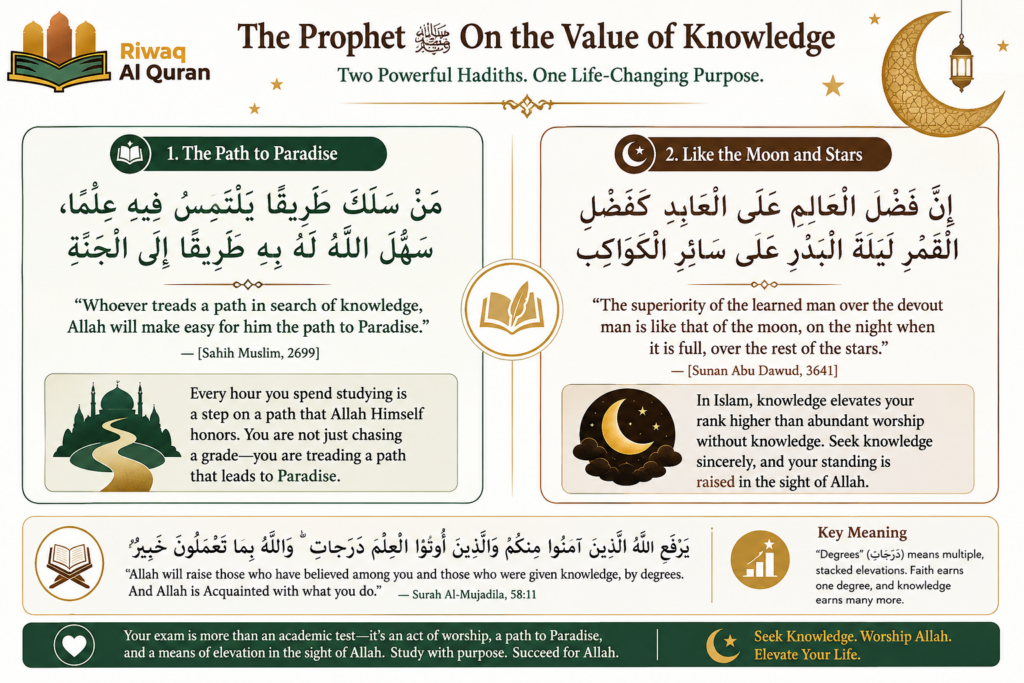
«مَنْ سَلَكَ طَرِيقًا يَلْتَمِسُ فِيهِ عِلْمًا، سَهَّلَ اللَّهُ لَهُ بِهِ طَرِيقًا إِلَى الْجَنَّةِ»
“Whoever treads a path in search of knowledge, Allah will make easy for him the path to Paradise.”— [Sahih Muslim, 2699]
Every hour you spent studying, every question you reviewed, every concept you worked to understand — Allah was recording it as an act that brings you closer to Paradise.
This reframes the exam entirely. You are not just chasing a grade; you are treading a path that Allah Himself honors. Go into your exam knowing that the effort alone is already rewarded.
The Prophet (peace be upon him) also said:
«إِنَّ فَضْلَ الْعَالِمِ عَلَى الْعَابِدِ كَفَضْلِ الْقَمَرِ لَيْلَةَ الْبَدْرِ عَلَى سَائِرِ الْكَوَاكِبِ»
“The superiority of the learned man over the devout man is like that of the moon, on the night when it is full, over the rest of the stars.”— [Sunan Abu Dawud, 3641]
This hadith shows that in Islam, the scholar holds a rank above even the one who worships abundantly but lacks knowledge. This is a profound motivation: every exam you study for, every skill you develop, every degree you pursue — when done with the right intention, it elevates your standing in the sight of Allah.
“يَرْفَعِ اللَّهُ الَّذِينَ آمَنُوا مِنكُمْ وَالَّذِينَ أُوتُوا الْعِلْمَ دَرَجَاتٍ ۚ وَاللَّهُ بِمَا تَعْمَلُونَ خَبِيرٌ”
“Allah will raise those who have believed among you and those who were given knowledge, by degrees. And Allah is Acquainted with what you do.”— Surah Al-Mujadila, 58:11
The word “degrees” (دَرَجَاتٍ) here is plural — it implies multiple, stacked elevations. Scholars of tafsir explain that those who combine faith with knowledge receive a compound elevation: one degree for their faith, and further degrees for their knowledge.
This is your exam seen through an Islamic lens: every step forward in education is a step upward in your standing before Allah. If you want to deepen your Quranic knowledge beyond your formal studies, explore Online Tafseer courses that help you understand Allah’s words at a deeper level.
The Complete Exam Dua – Full Supplication for Students
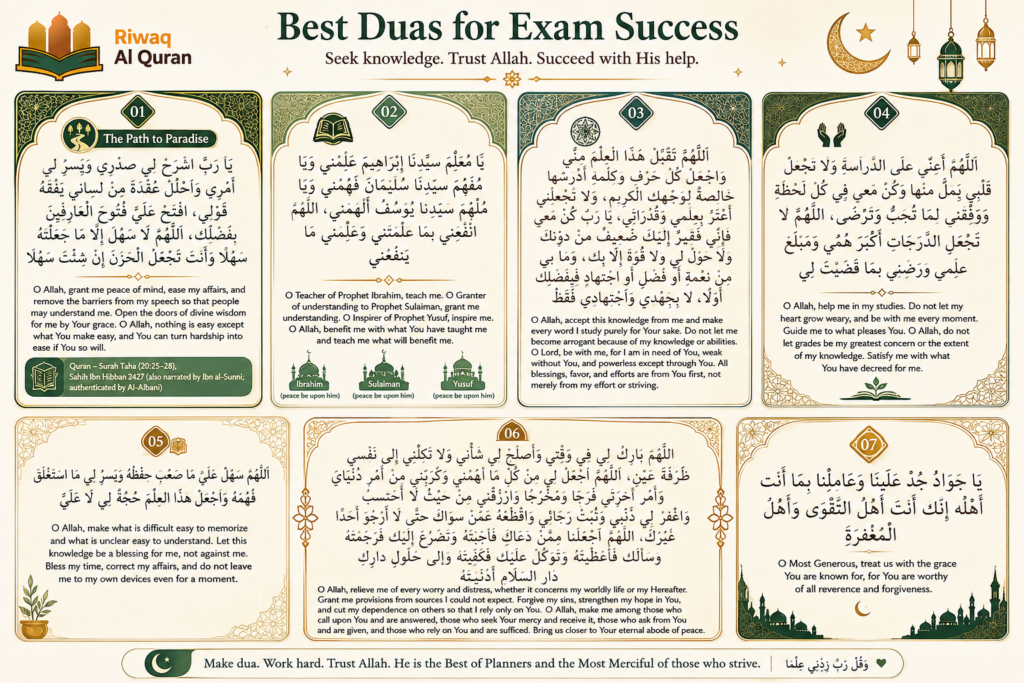
The following is the comprehensive dua recommended for students before an exam. Read it in full, understanding each part as you recite it. These supplications draw on Quranic verses, authenticated hadiths, and the prayers of scholars across generations.
Opening — Seeking Ease and Clarity (Dua of Prophet Musa ﷺ)
Before opening a textbook or entering an exam hall, the most honest thing a student can do is acknowledge that preparation alone is not enough. The greatest of the Prophets knew this well. When faced with an impossible task, Musa ﷺ turned first not to strategy, but to supplication — asking Allah for the three inner gifts that make any outward effort possible.
“يَا رَبِّ اشْرَحْ لِي صَدْرِي وَيَسِّرْ لِي أَمْرِي وَاحْلُلْ عُقْدَةً مِنْ لِسَانِي يَفْقَهُ قَوْلِي، افْتَحْ عَلَيَّ فُتُوحَ الْعَارِفِينَ بِفَضْلِكَ، اللَّهُمَّ لَا سَهْلَ إِلَّا مَا جَعَلْتَهُ سَهْلًا وَأَنْتَ تَجْعَلُ الْحَزَنَ إِنْ شِئْتَ سَهْلًا”
“O Allah, grant me peace of mind, ease my affairs, and remove the barriers from my speech so that people may understand me. Open the doors of divine wisdom for me by Your grace. O Allah, nothing is easy except what You make easy, and You can turn hardship into ease if You so will. Quran – Surah Taha (20:25–28), Sahih Ibn Hibban 2427 (also narrated by Ibn al-Sunni; authenticated by Al-Albani)
This is the supplication of Prophet Musa ﷺ when Allah commanded him to confront Pharaoh — one of the most powerful rulers on earth. He did not ask for weapons or armies. He asked for a calm heart, ease in his task, and the ability to speak clearly. These are exactly the three things every student needs walking into an exam hall.
Seeking Divine Wisdom
There is a kind of knowledge that goes beyond memorisation — the understanding that settles in the heart, connects ideas across disciplines, and makes meaning clear when others only see complexity. That depth of comprehension was given, in extraordinary measure, to three Prophets whose stories fill the Quran.
This dua calls upon Allah by the same names He used when He guided them, asking that some trace of that divine gift reach you too.
“يَا مُعَلِّمَ سَيِّدِنَا إِبْرَاهِيمَ عَلِّمْنِي وَيَا مُفَهِّمَ سَيِّدِنَا سُلَيْمَانَ فَهِّمْنِي وَيَا مُلْهِمَ سَيِّدِنَا يُوسُفَ أَلْهِمْنِي، اللَّهُمَّ انْفَعْنِي بِمَا عَلَّمْتَنِي وَعَلِّمْنِي مَا يَنْفَعُنِي”
“O Teacher of Prophet Ibrahim, teach me. O Granter of understanding to Prophet Sulaiman, grant me understanding. O Inspirer of Prophet Yusuf, inspire me.
The three Prophets mentioned are extraordinary: Ibrahim (peace be upon him) was taught by Allah directly and became the father of monotheism; Sulaiman (peace be upon him) was given a level of wisdom and understanding so deep that he could communicate with birds and lead the most complex kingdom in history; and Yusuf (peace be upon him) was gifted with inspiration and the ability to interpret knowledge in ways that no one else could.
When you say this dua, you are asking Allah to touch your mind with the same divine gift He gave to His own Prophets — that is a powerful act of hope and trust.
Seeking Sincerity and Humility in Learning
Knowledge studied for the wrong reasons — for status, for praise, or simply to outperform others — loses something essential on the way. The student who sits with this dua is asking not just to learn, but to be protected from the very trap that knowledge can set: the illusion that understanding something makes you self-sufficient.
This is the dua of a learner who knows that every insight is borrowed, and every ability is on loan.
“اللَّهُمَّ تَقَبَّلْ هَذَا الْعِلْمَ مِنِّي وَاجْعَلْ كُلَّ حَرْفٍ وَكَلِمَةٍ أَدْرُسُهَا خَالِصَةً لِوَجْهِكَ الْكَرِيمِ، وَلَا تَجْعَلْنِي أَغْتَرَّ بِعِلْمِي وَقُدُرَاتِي، يَا رَبِّ كُنْ مَعِي فَإِنِّي فَقِيرٌ إِلَيْكَ ضَعِيفٌ مِنْ دُونِكَ وَلَا حَوْلَ لِي وَلَا قُوَّةَ إِلَّا بِكَ، وَمَا بِي مِنْ نِعْمَةٍ أَوْ فَضْلٍ أَوِ اجْتِهَادٍ فَبِفَضْلِكَ أَوَّلًا، لَا بِجَهْدِي وَاجْتِهَادِي فَقَطْ”
“O Allah, benefit me with what You have taught me and teach me what will benefit me. Accept this knowledge from me and make every word I study purely for Your sake. Do not let me become arrogant because of my knowledge or abilities. O Lord, be with me, for I am in need of You, weak without You, and powerless except through You. All blessings, favor, and efforts are from You first, not merely from my effort or striving. To You belongs all praise and gratitude.
Seeking Help with Studies
The long hours of a study session test more than memory — they test patience, motivation, and the ability to stay present when the mind wants to wander elsewhere. This dua addresses that reality directly. It asks Allah not just for comprehension, but for endurance; not just for results, but for a heart that doesn’t lose itself in the pursuit of grades.
“اللَّهُمَّ أَعِنِّي عَلَى الدِّرَاسَةِ وَلَا تَجْعَلْ قَلْبِي يَمَلُّ مِنْهَا وَكُنْ مَعِي فِي كُلِّ لَحْظَةٍ وَوَفِّقْنِي لِمَا تُحِبُّ وَتَرْضَى، اللَّهُمَّ لَا تَجْعَلِ الدَّرَجَاتِ أَكْبَرَ هَمِّي وَمَبْلَغَ عِلْمِي وَرَضِّنِي بِمَا قَضَيْتَ لِي”
“O Allah, help me in my studies. Do not let my heart grow weary, and be with me every moment. Guide me to what pleases You. O Allah, do not let grades be my greatest concern or the extent of my knowledge. Satisfy me with what You have decreed for me.
Seeking Ease in Memorisation and Understanding
Every student encounters material that simply won’t stick — concepts that blur each time they’re revisited, pages that seem to resist understanding no matter how many times they’re read.
This dua doesn’t ask to be spared from difficulty, but asks Allah to unlock it. It carries within it the recognition that comprehension is ultimately a gift, and that what the mind struggles to hold, the heart can ask Allah to place there.
“اللَّهُمَّ سَهِّلْ عَلَيَّ مَا صَعُبَ حِفْظُهُ وَيَسِّرْ لِي مَا اسْتَغْلَقَ فَهْمُهُ وَاجْعَلْ هَذَا الْعِلْمَ حُجَّةً لِي لَا عَلَيَّ”
“O Allah, make what is difficult easy to memorize and what is unclear easy to understand. Let this knowledge be a blessing for me, not against me. Bless my time, correct my affairs, and do not leave me to my own devices even for a moment.
Closing — Seeking Relief, Provision, and Acceptance
After all the preparation, all the revision, and all the effort that has gone before, the student arrives at the end of the session with one thing left to do: let go.
This closing dua is an act of complete surrender — placing time, outcome, sustenance, and hope entirely in Allah’s hands, and cutting the thread of dependence on anything or anyone else. It is how every sincere effort should end.
“اللَّهُمَّ بَارِكْ لِي فِي وَقْتِي وَأَصْلِحْ لِي شَأْنِي وَلَا تَكِلْنِي إِلَى نَفْسِي طَرْفَةَ عَيْنٍ، اللَّهُمَّ اجْعَلْ لِي مِنْ كُلِّ مَا أَهَمَّنِي وَكَرَبَنِي مِنْ أَمْرِ دُنْيَايَ وَأَمْرِ آخِرَتِي فَرَجًا وَمَخْرَجًا وَارْزُقْنِي مِنْ حَيْثُ لَا أَحْتَسِبُ وَاغْفِرْ لِي ذَنْبِي وَثَبِّتْ رَجَائِي وَاقْطَعْهُ عَمَّنْ سِوَاكَ حَتَّى لَا أَرْجُوَ أَحَدًا غَيْرَكَ، اللَّهُمَّ اجْعَلْنَا مِمَّنْ دَعَاكَ فَأَجَبْتَهُ وَتَضَرَّعَ إِلَيْكَ فَرَحِمْتَهُ وَسَأَلَكَ فَأَعْطَيْتَهُ وَتَوَكَّلَ عَلَيْكَ فَكَفَيْتَهُ وَإِلَى حُلُولِ دَارِكَ دَارِ السَّلَامِ أَدْنَيْتَهُ”
“O Allah, relieve me of every worry and distress, whether it concerns my worldly life or my Hereafter. Grant me provisions from sources I could not expect. Forgive my sins, strengthen my hope in You, and cut my dependence on others so that I rely only on You. O Allah, make me among those who call upon You and are answered, those who seek Your mercy and receive it, those who ask from You and are given, and those who rely on You and are sufficed. Bring us closer to Your eternal abode of peace.
“يَا جَوَادُ جُدْ عَلَيْنَا وَعَامِلْنَا بِمَا أَنْتَ أَهْلُهُ إِنَّكَ أَنْتَ أَهْلُ التَّقْوَى وَأَهْلُ الْمَغْفِرَةِ”
“O Most Generous, treat us with the grace You are known for, for You are worthy of all reverence and forgiveness.
Exam Dua List – Six Duas for Every Stage
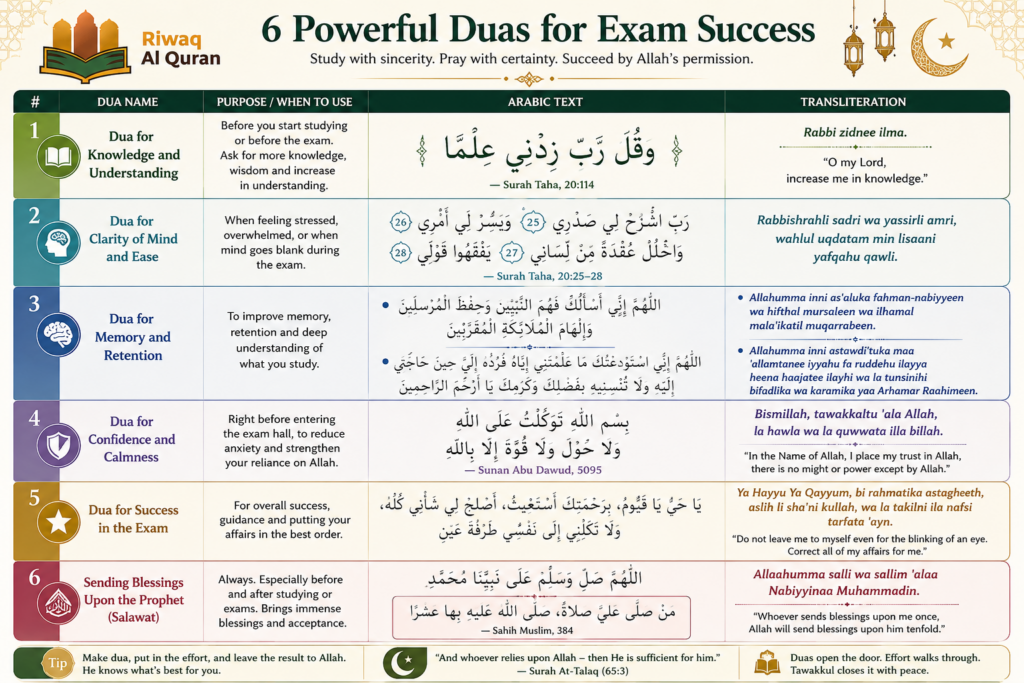
These duas serve different purposes across different stages of your exam journey. Each one is distinct, and each addresses a specific need.
1. For Knowledge and Understanding
When to use: At the start of every study session and before the exam.
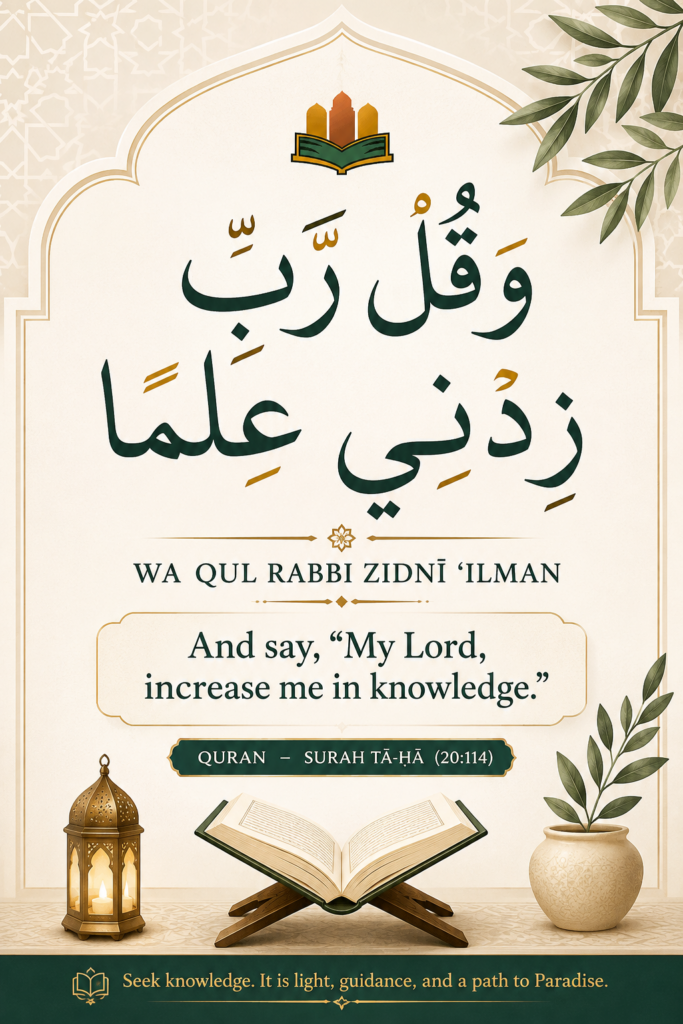
“وَقُل رَّبِّ زِدْنِي عِلْمًا“
“Rabbi zidni ilma.””O my Lord, increase me in knowledge.” — Surah Taha, 20:114
This is directly from the Quran and is the simplest yet most profound exam dua of all. Imam al-Qurtubi noted that this is the only verse in the Quran in which the Prophet ﷺ is commanded to ask for an increase in something — and that something is knowledge. Its brevity is its beauty: five words that open an infinite conversation with Allah about the most honoured pursuit in Islam.
2. For Clarity of Mind and Ease
When to use: When you feel stressed, overwhelmed, or anxious — before or during the exam.
“اللَّهُمَّ أَخْرِجْنِي مِنْ ظُلُمَاتِ الْوَهْمِ وَأَكْرِمْنِي بِنُورِ الْفَهْمِ”
“Allahumma akhrijni min zhulumatil wahmi wa akrimni binuril fahmi.””O Allah, remove me from the darkness of doubt and bless me with the light of understanding.”
This dua frames understanding as a form of light (نُور) and confusion as darkness (ظُلُمَات). This is not merely poetic — it reflects the Quranic worldview in which knowledge is consistently described as light and ignorance as darkness. When you recite this, you are asking Allah to switch on the light inside your mind.
3. For Memory and Retention
When to use: During exam preparation, especially after a study session.
“اللَّهُمَّ إِنِّي أَسْأَلُكَ فَهْمَ النَّبِيِّينَ وَحِفْظَ الْمُرْسَلِينَ وَإِلْهَامَ الْمَلَائِكَةِ الْمُقَرَّبِينَ”
“Allahumma inni as’aluka fahman-nabiyyeen wa hifthal mursaleen wa ilhamal mala’ikatil muqarrabeen.””O Allah, grant me the understanding of the Prophets, the memory of the Messengers, and the inspiration of those nearest to You.”
This dua asks for three distinct cognitive gifts: the deep comprehension of the Prophets (فَهْم), the perfect retention of the Messengers (حِفْظ), and the intuitive insight of the nearest angels (إِلْهَام). These map perfectly onto the three challenges of exam preparation: understanding the material, retaining what you have learned, and applying it correctly under pressure.
Scholars also recommend this dua specifically for strengthening memory:
“اللَّهُمَّ إِنِّي اسْتَوْدَعْتُكَ مَا عَلَّمْتَنِي إِيَّاهُ فَرُدَّهُ إِلَيَّ حِينَ حَاجَتِي إِلَيْهِ وَلَا تُنْسِنِيهِ بِفَضْلِكَ وَكَرَمِكَ يَا أَرْحَمَ الرَّاحِمِينَ”
“O Allah, I entrust to You what You have taught me. Return it to me when I am in need of it, and do not let me forget it, by Your grace and generosity, O Most Merciful of the Merciful.”
The concept of “entrusting” your knowledge to Allah (اسْتِيدَاع) is deeply meaningful. You are telling Allah: I have done my part and studied — now I place the retrieval of this knowledge in Your hands. When the exam question demands it, you trust Allah to give it back to you.
4. For Confidence and Calm
When to use: Right before entering the exam hall.
“بِسْمِ اللَّهِ تَوَكَّلْتُ عَلَى اللَّهِ وَلَا حَوْلَ وَلَا قُوَّةَ إِلَّا بِاللَّهِ”
“Bismillah, tawakkaltu ‘ala Allah, la hawla wa la quwwata illa billah.””In the Name of Allah, I place my trust in Allah, there is no might or power except by Allah.” — Sunan Abu Dawud, 5095
This supplication is reported as the dua to recite when leaving the house. The Prophet ﷺ said that when a person recites it, they are told: “You are guided, defended, and protected.” The phrase لَا حَوْلَ وَلَا قُوَّةَ إِلَّا بِاللَّهِ — the hawqala — is called by the Prophet ﷺ a treasure from the treasures of Paradise. — Sahih al-Bukhari, 7386
5. For Success and Passing the Exam
When to use: As a comprehensive prayer for general success, recited on the morning of the exam.
“يَا حَيُّ يَا قَيُّومُ، بِرَحْمَتِكَ أَسْتَغِيثُ، أَصْلِحْ لِي شَأْنِي كُلَّهُ، وَلَا تَكِلْنِي إِلَى نَفْسِي طَرْفَةَ عَيْنٍ”
“Ya Hayyu Ya Qayyum, bi rahmatika astagheeth, aslih li sha’ni kullah, wa la takilni ila nafsi tarfata ‘ayn.””O Ever-Living, O Self-Sustaining, by Your mercy I seek help. Correct all of my affairs for me, and do not leave me to myself even for the blinking of an eye.” — Authenticated by Al-Hakim and adh-Dhahabi; also narrated by Al-Nasa’i in Al-Sunan al-Kubra, Hadith 10405
Ya Hayyu Ya Qayyum are among the greatest names of Allah — the Ever-Living, the Self-Subsisting upon Whom all existence depends. The request “do not leave me to myself even for a blink” acknowledges that even your own mind, without Allah’s support, is unreliable. That is humility and wisdom combined.
6. Sending Blessings Upon the Prophet ﷺ (Salawat)
When to use: Begin and end every dua session with Salawat.
“اللَّهُمَّ صَلِّ وَسَلِّمْ عَلَى نَبِيِّنَا مُحَمَّدٍ”
“Allaahumma salli wa sallim ‘alaa Nabiyyinaa Muhammadin.”
“O Allah, bestow peace and blessings upon our Prophet Muhammad.”
The Prophet ﷺ said: “Whoever sends blessings upon me once, Allah will send blessings upon him tenfold.” — Sahih Muslim, 384
Scholars explain that beginning and ending your exam-day dua with Salawat “sandwiches” the supplication in divine blessings — and they say such a dua is never rejected.
What Dua Should I Say Before An Exam?
If you are looking for a dua to say before an exam, recite:
“سُبْحَانَكَ لَا عِلْمَ لَنَا إِلَّا مَا عَلَّمْتَنَا ۖ إِنَّكَ أَنتَ الْعَلِيمُ الْحَكِيمُ”
“Subhaanaka laa ‘ilma lanaa illa maa ‘allamtanaa innaka antal ‘aleemul Hakeem.”“Glory be to You; we have no knowledge except what You have taught us. Indeed, it is You who is the Knowing, the Wise.”— Surah Al-Baqarah, 2:32
These are the words of the angels themselves, spoken when Allah asked them to name things and they confessed their limitation. Scholars note the beauty of starting any intellectual endeavor with these words: you are placing yourself in the same spiritual posture as the angels — complete humility before Allah’s infinite knowledge.
There is something deeply calming about that. You are not expected to know everything; you are only expected to know what Allah has allowed you to know.
Recite this seven times both before and following your final exam revision. And when it’s time to start your exam, recite the same dua seven times, say Bismillah, and begin!
Read more about: Duas for the Child’s Success in Exams
Duas to Recite During the Exam {#during-exam}
Many students focus only on duas before the exam, but supplicating during the exam is equally powerful. Here are specific duas for specific moments:
When you encounter a difficult question, pause and say:
“اللَّهُمَّ لَا سَهْلَ إِلَّا مَا جَعَلْتَهُ سَهْلًا وَأَنْتَ تَجْعَلُ الْحَزَنَ إِنْ شِئْتَ سَهْلًا”
“Allahumma la sahla illa ma ja’altahu sahlan wa anta taj’alul hazna idha shi’ta sahla.””O Allah, there is no ease save in what You have made easy, and You can make the difficult easy if You wish.” — Sahih Ibn Hibban, 2427; authenticated by Al-Albani
Even whispering this under your breath between questions keeps your heart connected to Allah.
When your mind goes blank, recite:
“يَا مُعَلِّمَ سَيِّدِنَا إِبْرَاهِيمَ عَلِّمْنِي، يَا مُفَهِّمَ سَيِّدِنَا سُلَيْمَانَ فَهِّمْنِي”
“O Teacher of Ibrahim, teach me. O Granter of understanding to Sulaiman, grant me understanding.”
When you feel anxious mid-exam, silently say:
“حَسْبِيَ اللَّهُ وَنِعْمَ الْوَكِيلُ”
“Hasbiyallah wa ni’mal wakeel.””Allah is sufficient for me, and He is the best disposer of affairs.” — Surah Al-Imran, 3:173
This phrase was the statement of Prophet Ibrahim ﷺ when he was thrown into the fire, and the statement of the Prophet Muhammad ﷺ when his companions feared a great army. — Sahih al-Bukhari, 4563. If it was sufficient for a Prophet facing fire and a Messenger facing an army, it is more than sufficient for a student facing an exam paper.
After finishing each section, say Alhamdulillah and move forward without dwelling on what is already done. The key is not to make dua a performance, but to let it be a quiet, sincere, continuous conversation with Allah. Even one word — “Rabbi” (My Lord) — is heard.
Dua After the Exam
Many students collapse in relief after the exam and forget to close this spiritual chapter. Here is a four-step post-exam routine:
1 . Say Alhamdulillah immediately:
“الْحَمْدُ لِلَّهِ الَّذِي بِنِعْمَتِهِ تَتِمُّ الصَّالِحَاتُ”
“Praise be to Allah, by Whose grace good deeds are completed.”
2. Make dua for a good result:
“اللَّهُمَّ إِنِّي أَسْأَلُكَ خَيْرَ هَذَا الْأَمْرِ وَخَيْرَ عَاقِبَتِهِ”
“O Allah, I ask You for the good of this matter and the good of its outcome.”
3. Practice Tawakkul (complete surrender to Allah):
Know that you have done your best, and now the result is entirely in Allah’s hands. The Prophet ﷺ said:
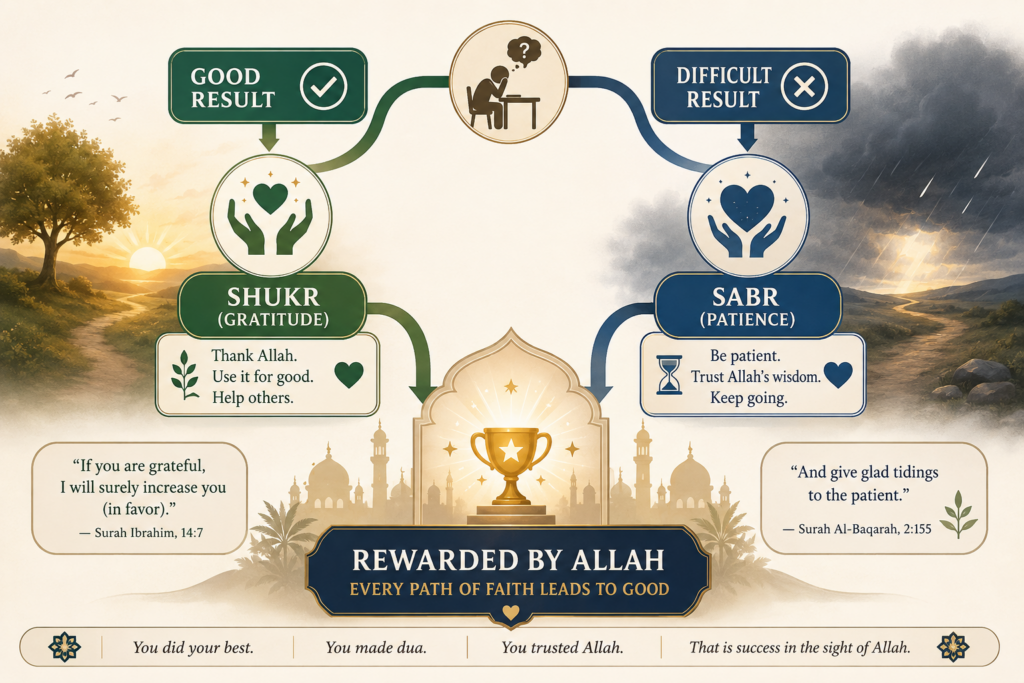
«عَجَبًا لِأَمْرِ الْمُؤْمِنِ، إِنَّ أَمْرَهُ كُلَّهُ لَهُ خَيْرٌ… إِنْ أَصَابَتْهُ سَرَّاءُ شَكَرَ فَكَانَ خَيْرًا لَهُ، وَإِنْ أَصَابَتْهُ ضَرَّاءُ صَبَرَ فَكَانَ خَيْرًا لَهُ»
“How wonderful is the affair of the believer — if something good happens to him, he is thankful, and that is good for him. If something bad happens to him, he bears it with patience, and that is good for him.” — Sahih Muslim, 2999
If you pass: the correct response is gratitude (shukr). If you don’t pass: the correct response is patience (sabr). Both are wins. Both are rewarded.
4. Make dua for your fellow students:
Ask Allah to grant success to everyone who sat the exam. The Prophet ﷺ said:
«دَعْوَةُ الْمَرْءِ الْمُسْلِمِ لِأَخِيهِ بِظَهْرِ الْغَيْبِ مُسْتَجَابَةٌ، عِنْدَ رَأْسِهِ مَلَكٌ مُوَكَّلٌ كُلَّمَا دَعَا لِأَخِيهِ بِخَيْرٍ قَالَ الْمَلَكُ: آمِينَ، وَلَكَ بِمِثْلٍ»
“The supplication of a Muslim for his brother in his absence will certainly be answered. Every time he makes a supplication for good for his brother, the angel says: Ameen! And may you also be blessed with the same.” — Sahih Muslim, 2733
When you ask Allah to help your classmates, an angel is simultaneously asking Allah to give you the same. Make it a habit to end your exam day with dua for every student who sat that paper.
How to Prepare Yourself Before Exams – Nine Steps
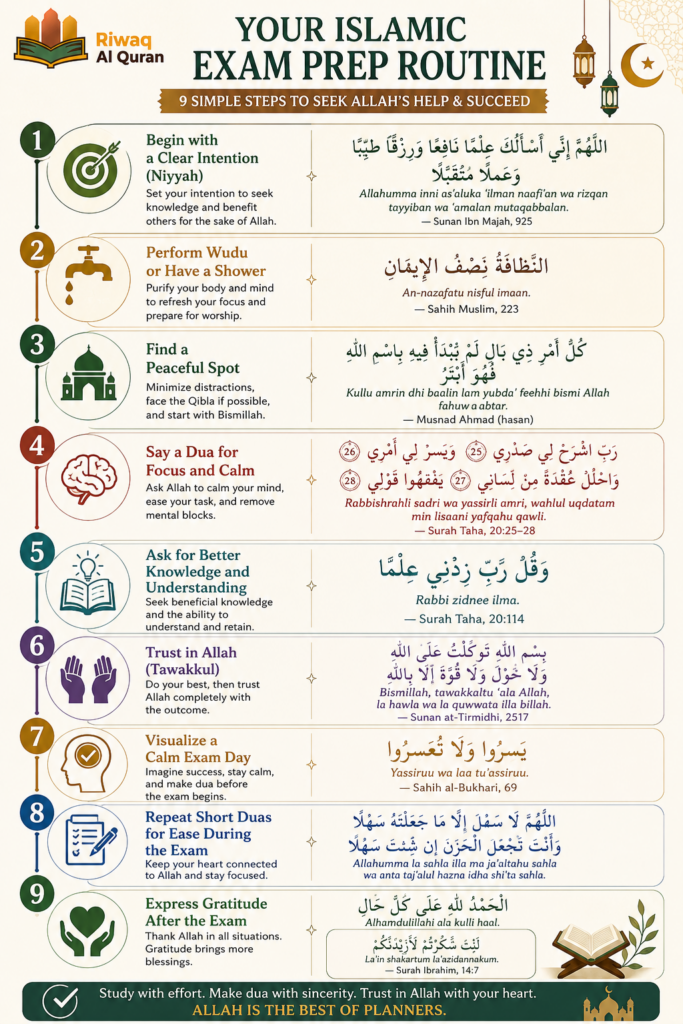
Preparing for an exam requires more than studying. Here are nine steps that combine Islamic practice with practical readiness:
1. Begin with a Clear Intention (Niyyah)
Make it clear — to yourself and to Allah — that you are taking this exam not merely for worldly achievement, but to benefit yourself and others for the sake of Allah ﷻ. The dua for pure intentions, narrated in Sunan Ibn Majah, 925, recommended as a morning supplication after Fajr:
“اللَّهُمَّ إِنِّي أَسْأَلُكَ عِلْمًا نَافِعًا وَرِزْقًا طَيِّبًا وَعَمَلًا مُتَقَبَّلًا”
“Allahumma inni as’aluka ‘ilman naafi’an wa rizqan tayyiban wa ‘amalan mutaqabbalan.””O Allah, I ask You for beneficial knowledge, goodly provision, and acceptable deeds.”
Notice the qualifier in each request: beneficial knowledge (not just any knowledge), goodly provision (not just provision), accepted deeds (not just deeds). A student who begins with this intention is not just chasing marks — they are asking Allah to ensure that whatever they achieve is truly good for them and for the world.
2. Perform Wudu Before Studying
Perform wudu (ablution) or take a brief shower before beginning your study session or reciting any dua. The Prophet ﷺ said:
«الطُّهُورُ شَطْرُ الْإِيمَانِ»
“Cleanliness is half of faith.” — Sahih Muslim, 223
A person in a state of purity is in a state of readiness for worship — and since seeking knowledge is worship, wudu is your preparation for that worship. Many students find that performing wudu before sitting down to study creates a ritual boundary that separates focused learning from distraction.
3. Find a Peaceful Space
Locate a designated area where you feel at ease and are unlikely to be interrupted. Silence your phone, organise your desk, and remove visual clutter. Face the Qibla if possible and recite Bismillah before you begin. The Prophet ﷺ said:
«كُلُّ أَمْرٍ ذِي بَالٍ لَا يُبْدَأُ فِيهِ بِـبِسْمِ اللَّهِ فَهُوَ أَبْتَرُ»
“Every matter of importance that does not begin with Bismillah is cut off from blessing.” — Sunan Ibn Majah, 1894
4. Ask Allah for Better Knowledge and Understanding
Turn every study session into an act of worship by asking Allah to bless what you learn. Recite Dua 1 from the Exam Dua List (Rabbi zidni ilma) at the start of each session. It is narrated that some of the pious predecessors (السَّلَف الصَّالِح) would recite this verse frequently throughout their studies, and that Imam Malik was famously known to recite it whenever he sat to study.
5. Trust in Allah (Tawakkul)
After doing everything you can to prepare, put your full trust in Allah. Recite Dua 4 from the Exam Dua List (Bismillah tawakkaltu) as you leave for the exam. Tawakkul is not passivity — it is active trust after full effort. The Prophet ﷺ said:
“Tie your camel, then put your trust in Allah.” — Sunan at-Tirmidhi, 2517
Studying is tying your camel. Dua is the trust. You cannot do only one. The student who studies without dua has tied the camel but forgotten Who controls the weather. Do both, and the result is in the best possible hands.
6. Visualise a Calm Exam Day
As part of your mental preparation, imagine yourself entering the exam room calmly and in control — reading each question carefully, thinking clearly, writing confidently. The Prophet ﷺ said:
«يَسِّرُوا وَلَا تُعَسِّرُوا، وَبَشِّرُوا وَلَا تُنَفِّرُوا»
“Make things easy, do not make things hard.” — Sahih al-Bukhari, 69
Islam encourages ease (يُسْر), not self-imposed hardship. Study smart, rest well, and approach the exam knowing that Allah has already made ease available to you.
7. Recite Surah Al-Baqarah 2:286 When Pressure Mounts
“لَا يُكَلِّفُ اللَّهُ نَفْسًا إِلَّا وُسْعَهَا”
“Allah does not burden a soul beyond that it can bear.” — Surah Al-Baqarah, 2:286
Every time exam pressure makes you feel like you cannot cope, return to this verse. It is a divine promise — not a consolation, but a cosmic fact. Allah, who created you and knows every limitation of your mind and body, has decreed this exam into your life. That means, by definition, you are capable of handling it.
8. Repeat Short Duas During the Exam
During the exam, use the duas from Section 5 above to stay focused and avoid panic. Keep them quiet and sincere. Even a whispered “Rabbi” is heard by Allah.
9. Express Gratitude After the Exam
“الْحَمْدُ لِلَّهِ عَلَى كُلِّ حَالٍ”
“Alhamdulillahi ala kulli haal.””Praise be to Allah in all situations.”
Allah promises:
“لَئِن شَكَرْتُمْ لَأَزِيدَنَّكُمْ”“
If you are grateful, I will surely increase you in favour.” — Surah Ibrahim, 14:7
Prophetic Sunnah Practices to Boost Your Exam Performance
Beyond the duas themselves, there are specific Sunnah practices that scholars and students of Islamic knowledge have used for centuries to sharpen the mind, strengthen memory, and invite Allah’s blessing into their learning. These are practical spiritual tools that complement your academic preparation:
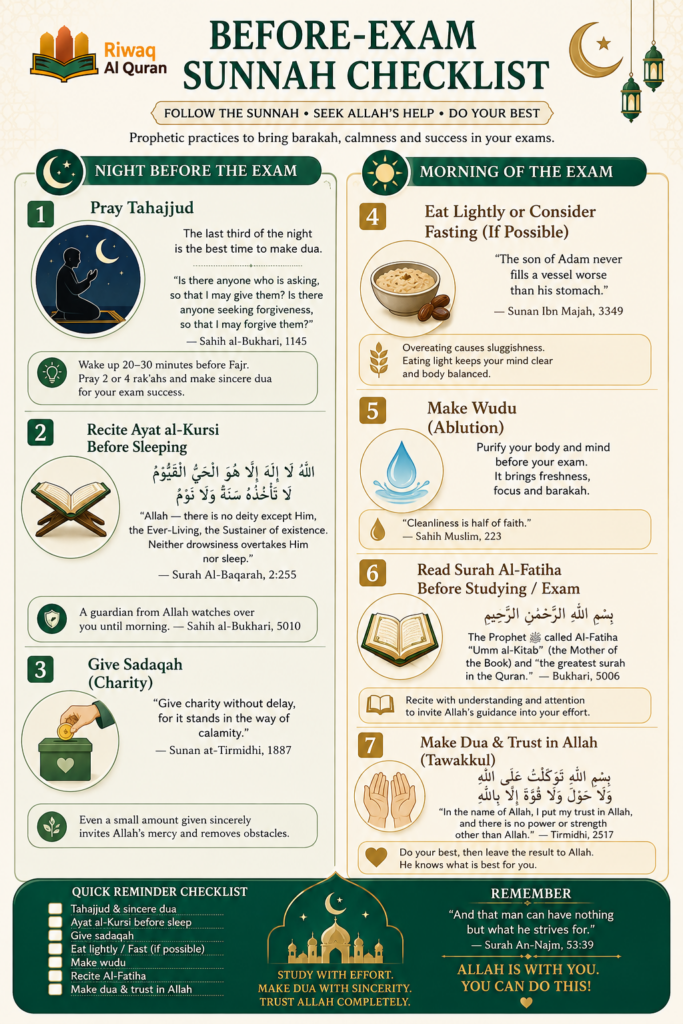
a. Pray Tahajjud the Night Before Your Exam
The last third of the night is when Allah descends (in a manner befitting His majesty) to the lowest heaven and asks:
«هَلْ مِنْ سَائِلٍ فَأُعْطِيَهُ؟ هَلْ مِنْ مُسْتَغْفِرٍ فَأَغْفِرَ لَهُ؟»“
Is there anyone who is asking, so that I may give them? Is there anyone seeking forgiveness, so that I may forgive them?”— [Sahih al-Bukhari, 1145]
There is no better time to pour your exam anxiety, your hopes, and your specific duas into a sincere conversation with Allah. Wake up 20–30 minutes before Fajr, pray two or four rak’ahs, and speak to Allah about your exam in specific terms.
Ask Him to make the questions ones you know, to give you clarity, to calm your nerves, and to write goodness in the outcome. Students who develop this habit consistently report a feeling of profound calm walking into examinations.
b. Recite Ayat al-Kursi Before Sleeping
Of all the practices a student can carry into the night before an exam, few are as layered in meaning as the recitation of Ayat al-Kursi. This single verse — the most majestic in the Quran according to the Prophet himself — is a reminder of who is truly in control.
When anxiety about tomorrow makes rest feel impossible, returning to the attributes of Allah described in this verse reorients the heart: the One who never sleeps is watching over the one who must.
“اللَّهُ لَا إِلَٰهَ إِلَّا هُوَ الْحَيُّ الْقَيُّومُ ۚ لَا تَأْخُذُهُ سِنَةٌ وَلَا نَوْمٌ”
“Allah — there is no deity except Him, the Ever-Living, the Sustainer of existence. Neither drowsiness overtakes Him nor sleep.”— Surah Al-Baqarah, 2:255
The Prophet (peace be upon him) told us that reciting Ayat al-Kursi before sleeping ensures that a guardian from Allah watches over the person until morning. [Sahih al-Bukhari, 5010] For a student who needs proper, restful sleep the night before an exam, this practice is both spiritually and practically valuable: it invites divine protection and brings the peace of mind needed for genuine rest.
c. Give Sadaqah (Charity) Before Your Exam
The Prophet (peace be upon him) said:
«بَادِرُوا بِالصَّدَقَةِ، فَإِنَّ الْبَلَاءَ لَا يَتَخَطَّى الصَّدَقَةَ»
“Give charity without delay, for it stands in the way of calamity.”— [Sunan at-Tirmidhi, 1887]
Even a small amount of sadaqah given sincerely before your exam is an act that invites Allah’s mercy and removes obstacles. Many students report giving sadaqah the morning of a major exam as a meaningful spiritual act that brings calm and a sense that Allah is with them.
d. Fast or Eat Lightly on Exam Day
The Prophet (peace be upon him) said:
“The son of Adam never fills a vessel worse than his stomach.”— [Sunan Ibn Majah, 3349]
Overeating causes sluggishness and reduces mental clarity. Eating lightly on exam day, or incorporating some voluntary fasting in the days before an important exam, is a Sunnah-inspired practice that has the dual benefit of sharpening the mind and opening the door for the extra reward of fasting.
e. Read Surah Al-Fatiha Before Studying
The Prophet (peace be upon him) called Surah Al-Fatiha “Umm al-Kitab” (the Mother of the Book) and said it is “the greatest surah in the Quran.” [Sahih al-Bukhari, 5006] Beginning every study session by reciting Al-Fatiha with full attention and meaning — not rushing through it — is an act that orients the entire session as an act of worship under Allah’s guidance.
For students who want to recite Al-Fatiha (and the entire Quran) with proper Tajweed and correct pronunciation, Online Tajweed Classes can make a significant difference in both the quality of your recitation and the barakah you receive from it.
Why Is Dua Important for Exam Success?
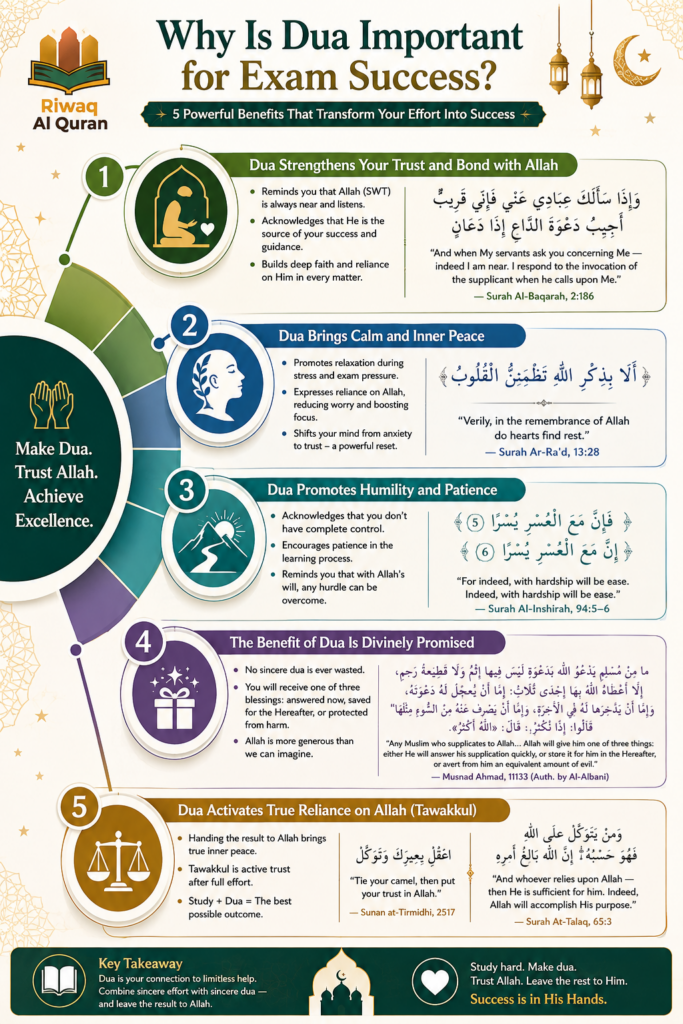
The benefits of Dua (supplication) go well beyond spiritual development — they extend into the emotional, psychological, and even practical dimensions of everyday life, particularly during exams. Here are the five core reasons why making dua regularly is one of the most powerful tools any student can use:
1. Dua Strengthens Your Trust and Bond with Allah
- Making dua reminds you that Allah (SWT) is always there and listens to you, strengthening your relationship with Him.
- Turning to Him in both good and difficult times acknowledges that He is responsible for your success and guidance.
- This instills a deep sense of faith and reliance on Allah in both small and large matters.
“وَإِذَا سَأَلَكَ عِبَادِي عَنِّي فَإِنِّي قَرِيبٌ ۖ أُجِيبُ دَعْوَةَ الدَّاعِ إِذَا دَعَانِ”
“And when My servants ask you concerning Me — indeed I am near. I respond to the invocation of the supplicant when he calls upon Me.”— Surah Al-Baqarah, 2:186
The relationship between student and Allah during exam season is an opportunity, not merely a transaction. Every moment of sincere dua deepens the bond between you and your Creator. Many students later describe their periods of intense study and dua as among the closest they felt to Allah in their lives.
2. Dua Brings Calm and Inner Peace
- Dua promotes relaxation in stressful conditions, such as exam preparation.
- When you perform a Dua, you are expressing your reliance on Allah, which helps lessen worry and keep you focused and controlled.
- The act of supplication shifts your attention from anxiety to trust — one of the most effective mental resets available.
“أَلَا بِذِكْرِ اللَّهِ تَطْمَئِنُّ الْقُلُوبُ”
“Verily, in the remembrance of Allah do hearts find rest.”— Surah Ar-Ra’d, 13:28
This is one of the most frequently cited verses in Islamic psychology, and modern research on mindfulness and prayer has only confirmed what the Quran stated 1,400 years ago: turning your attention toward something greater than yourself activates the parasympathetic nervous system and reduces cortisol levels.
Allah described this effect not as a possibility but as a certainty: hearts do find rest in His remembrance. This is not a hope — it is a divine law.
3. Dua Promotes Humility and Patience
- By asking Allah for help, you acknowledge that you do not have complete control over everything.
- This encourages patience with the process of learning and humility about the limits of your ability.
- It reminds you that with Allah’s will, any hurdle may be overcome.
“فَإِنَّ مَعَ الْعُسْرِ يُسْرًا ﴿5﴾ إِنَّ مَعَ الْعُسْرِ يُسْرًا ﴿6﴾”
“For indeed, with hardship will be ease. Indeed, with hardship will be ease.”— Surah Al-Inshirah, 94:5–6
Classical Arabic grammar scholars point out that the word “hardship” (الْعُسْر) carries the definite article (ال) both times — meaning it refers to the same hardship. The word “ease” (يُسْر), however, is indefinite in Arabic, meaning it refers to a different ease each time. The implication: one hardship comes with two eases. When exam pressure feels crushing, this verse is a reminder that Allah has already prepared your exit.
4. The Benefit of Dua Is Divinely Promised
The much-loved Prophet (peace be upon him) said:
«مَا مِنْ مُسْلِمٍ يَدْعُو اللَّهَ بِدَعْوَةٍ لَيْسَ فِيهَا إِثْمٌ وَلَا قَطِيعَةُ رَحِمٍ، إِلَّا أَعْطَاهُ اللَّهُ بِهَا إِحْدَى ثَلَاثٍ: إِمَّا أَنْ يُعَجِّلَ لَهُ دَعْوَتَهُ، وَإِمَّا أَنْ يَدَّخِرَهَا لَهُ فِي الْآخِرَةِ، وَإِمَّا أَنْ يَصْرِفَ عَنْهُ مِنَ السُّوءِ مِثْلَهَا» قَالُوا: إِذًا نُكْثِرُ، قَالَ: «اللَّهُ أَكْثَرُ».
“Any Muslim who supplicates to Allah with a supplication that contains no sin or severing of family ties, Allah will give him one of three things: either He will answer his supplication quickly, or He will store it for him in the Hereafter, or He will avert from him an equivalent amount of evil. They said, “Then we will supplicate more.” He replied, “Allah is even more generous.” Musnad Ahmad, Hadith 11133 (authenticated by Al-Albani and graded Hasan by the scholars of Musnad Ahmad)
This hadith is profoundly reassuring because it eliminates the fear of a “wasted” dua. No sincere dua is ever wasted. If your exam result does not come out as you hoped, your dua was either deflecting a harm you cannot see, or it is being stored as a reward so magnificent that you will prefer it on the Day of Judgment. The Companions heard this and immediately said: “Then we’ll ask for even more!” That is the correct attitude.
5. Dua Activates True Reliance on Allah (Tawakkul)
- One of the most spiritually empowering experiences a student can have is completing their preparation and then handing the result fully over to Allah.
- This is Tawakkul — and it produces a profound inner stillness that the student who relies only on themselves never achieves.
- Tawakkul is not passivity; it is active trust after full effort.
The Prophet (peace be upon him) said:
“وَمَن يَتَوَكَّلْ عَلَى اللَّهِ فَهُوَ حَسْبُهُ ۚ إِنَّ اللَّهَ بَالِغُ أَمْرِهِ“
“And whoever relies upon Allah — then He is sufficient for him. Indeed, Allah will accomplish His purpose.”— Surah At-Talaq, 65:3
Studying is tying your camel. Dua is the trust. You cannot do only one — you must do both. The student who studies without dua has tied the camel but forgotten Who controls the weather. The student who makes dua without studying has trusted Allah but ignored His command to take the means. Do both, and the results are in the best possible hands.
What If I Don’t Get the Grade I Wanted? The Islamic Perspective
This is a question that haunts students before results — and devastates many after them. Islam has a deeply comforting and rational answer.
First, understand that Allah’s decree (قَدَر) is perfect. He sees not just the grade but everything that grade will lead to — every door it opens, every path it prevents, every lesson it teaches. You cannot see that far. He can.
“وَعَسَىٰ أَن تَكْرَهُوا شَيْئًا وَهُوَ خَيْرٌ لَّكُمْ ۖ وَعَسَىٰ أَن تُحِبُّوا شَيْئًا وَهُوَ شَرٌّ لَّكُمْ ۗ وَاللَّهُ يَعْلَمُ وَأَنتُمْ لَا تَعْلَمُونَ”
“But perhaps you hate a thing and it is good for you; and perhaps you love a thing and it is bad for you. And Allah knows, while you know not.”— Surah Al-Baqarah, 2:216
This verse was revealed in the context of something difficult — and Allah used the word “perhaps” (عَسَىٰ) to describe both the good in what you hate and the harm in what you love. This “perhaps” from Allah is not uncertainty on His part — it is a gentle, loving way of telling you that the story is not finished yet. A grade you consider a failure may be the very thing that redirects you to your greatest success.
Second, know that making sincere dua and still not getting the result you wanted is not a sign that Allah rejected you. It may mean Allah is protecting you, elevating you in ways you cannot yet see, or storing a greater reward for the Hereafter in exchange for your sabr.
Third, use disappointment as fuel for a new beginning. The Prophet (peace be upon him) said:
«الْمُؤْمِنُ الْقَوِيُّ خَيْرٌ وَأَحَبُّ إِلَى اللَّهِ مِنَ الْمُؤْمِنِ الضَّعِيفِ، وَفِي كُلٍّ خَيْرٌ. احْرِصْ عَلَى مَا يَنْفَعُكَ، وَاسْتَعِنْ بِاللَّهِ، وَلَا تَعْجِزْ…»
“The strong believer is better and more beloved to Allah than the weak believer, while there is good in both. Be eager for what benefits you, seek help from Allah, and do not be frustrated.”— [Sahih Muslim, 2664]
Book Your Free Trial — Learn Quran, Arabic, and Islamic Studies Online
Riwaq Al Quran is a comprehensive online platform that offers personalized Quran, Arabic, and Islamic Studies Online classes for individuals of all ages and backgrounds. Their experienced instructors use a structured curriculum to cover Tajweed, Tafsir, and Memorization, providing easy and effective access to learning the Quran. The advanced online classes allow for seamless communication and interaction between students and teachers.
Take a closer look at authentic excerpts from our live classes. At Riwaq Al Quran, our instructors create a dynamic and supportive learning environment where students stay engaged, build confidence, and thrive in their studies.
Deepen Your Connection With Quranic Knowledge
If you would like to go beyond exam preparation and build a lasting relationship with the Quran and Islamic knowledge, Riwaq Al Quran offers personalised online courses for all ages and levels:
Online Arabic Courses, Ijazah Courses, and Islamic Studies Courses are also available.


- Quran Memorization Online Course — Memorise the Quran using proven hifz techniques that also strengthen general memory.
- Online Tafseer Course — Understand Allah’s words at a deeper level, beyond their literal meaning.
- Online Tajweed Classes — Recite the Quran with proper pronunciation and beauty.
- Online Quran Classes for Kids — Age-appropriate classes with patient, qualified teachers for younger learners.


Join Riwaq Al Quran for a deeper connection with the Quran — and a learning environment where knowledge and spirituality go hand in hand.
Conclusion
Preparing intellectually and spiritually with exam dua ensures that you are not only secure in your knowledge but also at peace in your heart. Success requires both hard effort and faith in Allah ﷻ. Dua invites His blessings and guidance, helping you to perform to your full potential.
The most beautiful thing about making dua for your exams is that it transforms the entire experience. Studying becomes an act of worship. The exam hall becomes a place of trust. And the result — whatever it is — becomes a gift from Allah that you face with patience, gratitude, and faith.
Allah ﷻ honours those who seek knowledge and elevates them in this life and the next. May He grant you focus in your studies, peace in your heart, clarity in your exam, and a result that opens the best doors for your life and your Hereafter. Ameen.
Frequently Asked Questions About Dua for Exams
Students and parents often have the same concerns when it comes to combining dua with academic preparation. Below are the most common questions — answered from the Quran, Sunnah, and scholarly guidance:
Can I Make Dua in My Own Language, Not Just Arabic?
Yes. Dua can be made in any language. Arabic is preferred because many duas are directly from the Quran and Sunnah, but Allah understands every language and hears every heart. What matters most is sincerity. Imam an-Nawawi and other scholars confirm that dua in one’s native language during non-obligatory prayers and in personal supplication is fully acceptable.
What Is the Best Time to Make Dua for Exams?
The most powerful times for dua include:
The last third of the night (tahajjud time) — [Sahih al-Bukhari, 1145]
Between the adhan and iqamah — [Sunan Abu Dawud, 521]
The last hour of Friday before Maghrib — [Sahih al-Bukhari, 935]
While in prostration (sujood) — [Sahih Muslim, 482]
While fasting
If your exam is approaching, try to wake for tahajjud the night before and pour your heart out to Allah then.
Is There a Specific Number of Times I Should Repeat the Exam Dua?
There is no fixed number for most exam duas, though some scholars recommend reciting specific ones three, seven, or eleven times for barakah. The most important thing is consistency and sincerity. It is better to recite one dua with full presence of heart than ten duas recited mechanically.
What If I Didn’t Study Enough — Will Dua Still Help?
Dua is never wasted. However, Islam teaches us that we must first take the means — studying is your responsibility. If you have genuinely fallen short, make sincere tawbah (repentance), ask Allah’s forgiveness for the time wasted, and then make dua with hope and sincerity. Allah’s mercy is vast. The Prophet (peace be upon him) said: “Every son of Adam commits sin, and the best of those who commit sin are those who repent.” [Sunan at-Tirmidhi, 2499]
Can I Make Dua for Someone Else’s Exam Success?
Absolutely, and it is highly recommended. The dua of a Muslim for their brother or sister in their absence is one of the most powerful forms of supplication. Ask Allah to grant your family, friends, and classmates success in their exams — and trust that the angels are saying “Ameen, and the same for you” as you do so. [Sahih Muslim, 2733]