| Key Takeaways |
| The Quran contains 114 occurrences of full Bismillah (Bismillāhi r-raḥmāni r-raḥīm, “In the name of Allah, the Most Gracious, the Most Merciful”) |
| Surah At-Tawbah (Chapter 9) is the only surah that does not begin with Bismillah. |
| Surah An-Naml (Chapter 27) contains a Bismillah within its verses (verse 30), giving the phrase an additional mid-surah appearance. |
| Scholars disagree on whether the opening Bismillah of Al-Fatihah counts as a standalone verse. |
| Understanding the Bismillah’s placement and ruling is foundational knowledge for any student pursuing Quran memorization or Tafsir study. |
Every Muslim recites it before eating, before beginning any significant act — but how many times does Bismillah appear in the Quran itself?
The Quran contains 114 Bismillahs — one for each surah — yet one surah opens without it, and one surah carries an additional Bismillah within its body. Grasping this fully sharpens your recitation precision and deepens your understanding of Quranic structure in ways that surface-level familiarity simply cannot provide.
Table of Contents
How Many Times Does Bismillah Appear in the Quran?
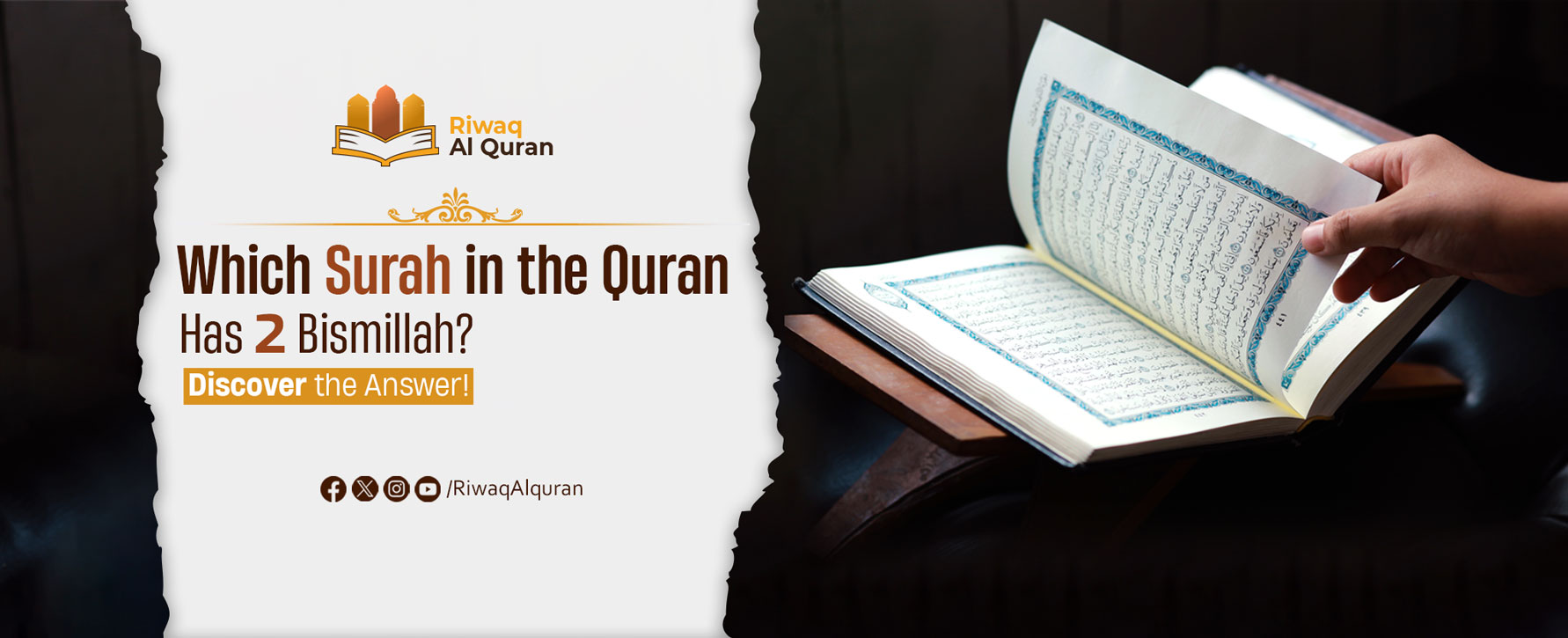
The Bismillah — بِسْمِ اللَّهِ الرَّحْمَٰنِ الرَّحِيمِ (Bismillāhi r-raḥmāni r-raḥīm, “In the name of Allah, the Most Gracious, the Most Merciful”) — appears 114 times in the Quran.
| Occurrence Type | Surah | Verse Position | Counted Separately? |
| Opening Bismillah (×113) | All surahs except At-Tawbah | Before verse 1 | Part of surah opening |
| Bismillah within body text | An-Naml (27) | Verse 30 | Yes — a distinct Quranic verse |
| Missing Bismillah | At-Tawbah (9) | N/A | No Bismillah at all |

Why Does Surah At-Tawbah Not Have a Bismillah?
Surah At-Tawbah is the only surah in the Quran that begins without the Bismillah — a fact verified by unanimous scholarly consensus.
The most widely accepted explanation, reported through companions of the Prophet ﷺ including Ibn Abbas and Ali ibn Abi Talib (may Allah be pleased with them), is that At-Tawbah was revealed as a declaration of bara’ah (disavowal) against the polytheists who had violated their treaties.
The Bismillah carries mercy and peace — qualities incompatible with a proclamation of disavowal.
A second scholarly position holds that At-Tawbah may have originally been part of Surah Al-Anfal, and the Bismillah was simply not placed between them as a separator.
For Quran students working on memorization, this distinction is practically significant — when reciting or transitioning from Surah Al-Anfal to At-Tawbah, you do not recite the Bismillah at the opening. This is a point where many non-Arabic speaking students make errors without realizing it.
At Riwaq Al Quran, our Online Quran Memorization Course ensures students learn these structural nuances before memorizing the relevant sections, preventing ingrained mistakes that are harder to correct later.
Start your Hifz journey with a Free Trial
Experience Riwaq Al Quran Classes
Watch real moments from our live sessions at Riwaq Al Quran and see how we bring learning to life. These clips highlight our interactive, student-focused approach designed to keep learners engaged, motivated, and actively involved in every step of their educational journey.
What Is the Bismillah in Surah An-Naml and Why Is It Different?
The Bismillah inside Surah An-Naml appears in verse 30 as part of the letter Prophet Sulayman (Solomon) ﷺ sent to the Queen of Sheba (Bilqis). Allah quotes that letter directly:
إِنَّهُۥ مِن سُلَيْمَٰنَ وَإِنَّهُۥ بِسْمِ ٱللَّهِ ٱلرَّحْمَٰنِ ٱلرَّحِيمِ
Innahū min Sulaymāna wa innahū bismillāhi r-raḥmāni r-raḥīm
“Indeed, it is from Solomon, and indeed, it reads: ‘In the name of Allah, the Entirely Merciful, the Especially Merciful,'” (An-Naml 27:30)
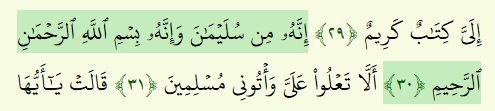
This Bismillah is unanimously counted as a Quranic verse — it is part of the numbered ayat of the surah.
Unlike the opening Bismallahs, which carry scholarly discussion about their verse status, the Bismillah of An-Naml 27:30 is unambiguously an ayah of the Quran with a verse number assigned to it.
This verse also carries a profound historical significance — it demonstrates that the practice of beginning with Bismillah predates the revelation of the Quran to Prophet Muhammad ﷺ, reaching back to the time of Prophet Sulayman ﷺ.
Read Also: How Many Words Are in the Quran?
Is the Bismillah of Al-Fatihah a Verse of the Quran?
This is one of the most widely debated questions in Islamic scholarship regarding the Bismillah — and one with direct implications for how you recite in prayer.
Scholars hold main positions:
| Scholarly Position | Ruling on Bismillah | Scholarly Support |
| It is a complete verse of Al-Fatihah | Counted as verse 1 of Al-Fatihah | Shafi’i school position. |
| It is not a verse of Al-Fatihah | A blessed phrase marking surah beginnings, not a numbered verse | Hanafi and Maliki school positions |
The Tajweed implication is direct: in the Hafs ‘an ‘Asim recitation — the standard reading for most non-Arabic speaking Muslims — the Bismillah is read before Al-Fatihah but does not interrupt the connected recitation rules of the surah itself.
Students learning Tajweed rules must understand this distinction before applying rules of waqf (stopping) and wasl (continuation) at the beginning of Al-Fatihah.
In our sessions at Riwaq Al Quran, this is consistently one of the questions that arises earliest in a student’s Tajweed study — and answering it correctly from the start saves significant confusion down the line.
Connect with our Azhari tutors to learn and memorize the Quran

Read Also: How Many Ayat (Verses) Are in the Quran?
How Does the Bismillah Affect Quran Recitation and Tajweed?
The Bismillah carries specific Tajweed rulings that every reciter must know before applying them in practice. These are not optional refinements — they affect the correctness of your recitation.
Key Tajweed rulings on the Bismillah:
- The Lam of Allah (Lafz al-Jalala): After a kasrah (Bismillāhi), the Lam in Allah is read with tarqiq (lightness/thinning), not tafkhim (heaviness). This is a rule many beginners apply incorrectly.
- Madd in Raḥmān: The alif after the Ra carries a natural madd of two counts.
- Madd in Raḥīm: The ya carries a natural madd of two counts.
The Lam of Lafz al-Jalala rule is particularly important. After a fathah or dammah, the Lam is read heavy (tafkhim). After a kasrah — as it appears in the Bismillah — it is read light (tarqiq).
Students coming from non-Arabic backgrounds frequently over-emphasize this Lam, producing a recitation that diverges from the authenticated transmission. Exploring the benefits of Tajweed in depth helps students appreciate why these precise distinctions are not pedantry — they protect the integrity of the transmitted recitation.
Why Students Love Learning with Riwaq Al Quran
Hear directly from our students about how Riwaq Al Quran Academy has transformed their connection with the Book of Allah. Their experiences reflect the dedication, care, and quality that guide every step of our teaching.
Begin Your Quran Study with Riwaq Al Quran
Understanding questions like how many Bismillah are in the Quran is a marker of serious, structured Quranic study — the kind that produces recitation precision and deep connection with the text.
At Riwaq Al Quran, our Azhari-certified instructors bring this depth to every session:
- Online Quran Memorization Course — structured Hifz with certified Hafiz tutors, one-on-one, 24/7 scheduling
- Online Quran Tafseer Course — understand the Quran structurally and linguistically with scholarly depth
- Best Islamic Studies Online Course — authentic Islamic education from Al-Azhar graduates
Two free trial classes are available. Start today — Insha’Allah, your recitation will never be the same.
Enroll now for 2 Free Trial Classes

Conclusion
The Bismillah is among the most recited phrases in a Muslim’s life — yet its precise presence within the Quran carries scholarly depth that most students have never been formally taught. There are 114 Bismillahs, including Bismillah as a numbered verse in Surah An-Naml, and a deliberate, meaningful absence at the opening of Surah At-Tawbah.
These are not minor details. They shape how you recite in prayer, how you transition between surahs, and how accurately your memorization is sealed.
Knowing the Quran’s structure at this level is what separates a reciter from a student of the Quran — and that distinction is worth pursuing with proper guidance.
Read Also: How to Study the Quran?
Frequently Asked Questions About Bismillah in the Quran
Which surah does not have Bismillah at its beginning?
Surah At-Tawbah (Chapter 9) is the only surah that does not begin with the Bismillah. Classical scholars, including reports attributed to companions Ali ibn Abi Talib and Ibn Abbas, explain this as due to the surah’s nature as a declaration of disavowal toward treaty-violating polytheists — incompatible with the Bismillah’s opening of mercy and blessing.
Is the Bismillah counted as the first verse of Surah Al-Fatihah?
Scholarly opinion is divided. The Shafi’i school considers it the first verse of Al-Fatihah. The Hanafi and Maliki schools hold it is not a numbered verse of the surah, though it is a blessed Quranic phrase. This has direct implications for prayer recitation and the number of verses attributed to Al-Fatihah across different scholarly traditions.
Do I recite Bismillah when transitioning from Surah Al-Anfal to Surah At-Tawbah?
No. When moving from Surah Al-Anfal (Chapter 8) to Surah At-Tawbah (Chapter 9), no Bismillah is recited — neither connecting nor pausing. This ruling is unanimously agreed upon by scholars of Quranic recitation across all ten Qira’at. Reciting a Bismillah in this transition would be an error in the authenticated transmission of the Quran.